Nov 112022
 

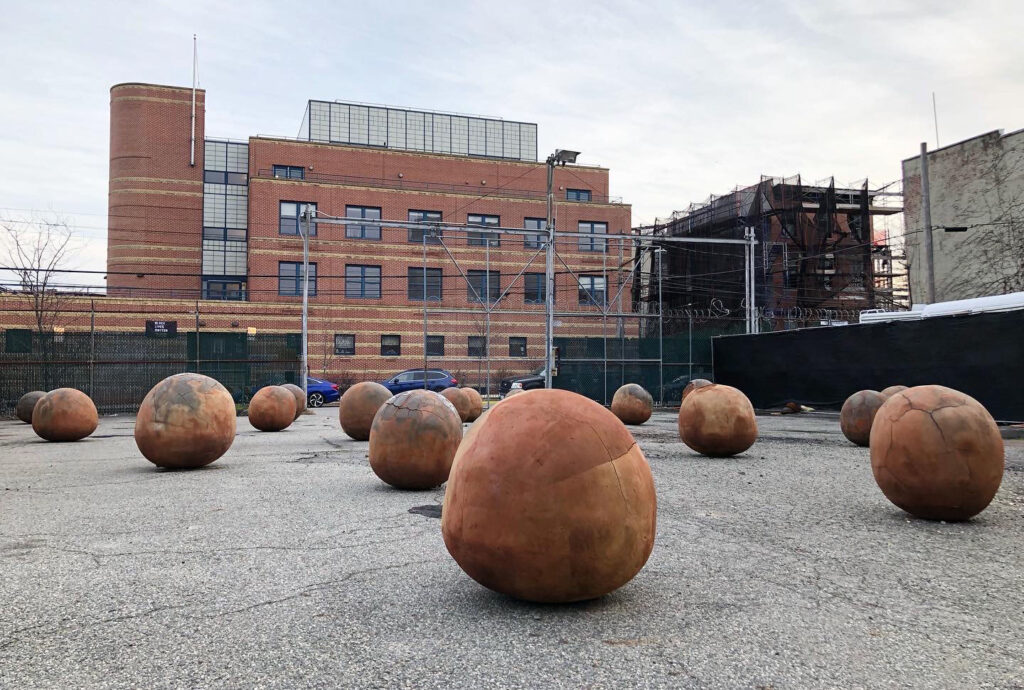
Bosco Sodi’s outdoor sculpture installation, Perfect Bodies, presented by Pioneer Works, was on view in Redhook, Brooklyn from October 2020 until December 2020.

From Pioneer Works’ press release-

Sited on a once teeming commercial concrete parking lot two blocks south of Pioneer Works, Perfect Bodies speaks to, in artist Bosco Sodi’s words, “silence, contemplation and the passing of time—the small things in life and our relationship with the earth.” The installation consists of large-scale clay spheres and cubes made from local clay fired in the artist’s studio in Oaxaca, Mexico, which made the long journey by road across the Mexico-US border to Red Hook. A longtime resident of the neighborhood—itself named after the tone of its own clay soil—Sodi is known for his use of raw and organic materials to create textured paintings and objects.

Sodi’s ongoing dialogue with nature and landscape, shaped by his interests in Japanese aesthetics and Abstract Expression, puts himself in the lineage of both Arte Povera and Land Art—two post-war movements which emphasized, respectively, radically simple materials and an integral relationship between art and earth. As Spanish author Juan Manuel Bonet remarked in the artist’s 2020 eponymous monograph, his three dimensional works reconcile an interest in minimalism with the practices of Mexican heritage. On this topic, curator Dakin Hart further writes: “At his place in Oaxaca, Sodi hand forms large geometric sculptures from clay and fires them in a makeshift kiln on the beach. Cuboids in different formats recall the scale and how-did-they-do-that-craft of cyclopean architecture across the ancient world. While spheroids, each formed by eye in a landscape of unbelievable things, might be the petrified remnants—or organic vanguard—of a Jurassic invasion. The past seeding itself into the present, a starting point for nature’s revenge.”

Currently, as part of Art Biennale 2022, Fondazione dell’Albero d’Oro is showing What Goes Around Comes Around at Palazzo Vendramin Grimani, in Venice, Italy, until November 27th, 2022.  The art installation will include his paintings as well as recent sculptures.


Oct 132022
 

This is the last weekend to see Jason Hackenwerth’s exhibition DARKMATTER at Creative Pinellas in Largo, Florida. It includes the two giant balloon sculptures shown above, as well as several of the artist’s paintings and drawings.

To hear the artist discuss his work, and see more views of the sculptures and artwork in the gallery, check out this video.

This weekend is also Third Saturday at Pinewood (Creative Pinellas, Florida Botanical Gardens, and Heritage Village). For this event Hackenworth will be leading a family arts workshop where he will be teaching visitors how to create sculptures from balloons.

DARKMATTER closes on Sunday, 10/16/22.

Sep 242022
 

Artist Kenny Scharf has painted around 260 cars for his Karbombz! project. In 2020 he even led a parade of them in Hollywood and West Hollywood.

This one was spotted on the streets of Los Angeles in 2015.

Sep 112022
 

Ofer Wolberger’s photo of Spencer Finch’s installation Trying to Remember the Color of the Sky on that September Morning, 2014, located at the 9/11 Memorial & Museum.

From the museum’s webpage about the work-

At the heart of the 9/11 Memorial & Museum’s mission is the promise to commemorate the 2,983 killed as a result of the 9/11 and February 26, 1993 attacks. The Memorial and the Museum fulfills this sacred responsibility in many ways—through memorialization, through education and, in some cases, through artistic expression.

One of the Museum’s most recognizable installations is a piece by artist Spencer Finch titled “Trying to Remember the Color of the Sky on That September Morning.” This work runs prominently through Memorial Hall, or the space that connects the two main exhibitions at bedrock in the Museum. This larger-than-life installation is part of the Memorial Museum’s permanent collection and was commissioned in 2014 before the Museum opened its doors to the public.

The piece is comprised of 2,983 individual watercolor squares—each representing a victim of the 2001 and 1993 attacks—and symbolizes the idea of memory. Many remember the beauty of the clear blue sky on the morning of 9/11. But, our own perception of the color blue might not be the same as that of another person. However, just like our perception of color, our memories share a common point of reference.

Within the larger art installation is the quote “No Day Shall Erase You From the Memory of Time” from Book IX of The Aeneid by Roman poet Virgil. Each letter was forged from recovered World Trade Center steel by New Mexico artist Tom Joyce. This quote suggests the transformative potential of remembrance and succinctly reinforces the 9/11 Memorial & Museum’s mission. Today, while the Memorial and the Museum are temporarily closed, these words remain as true as ever.

The image of the work shown above was included in Mint Museum’s 2021 exhibition, W|ALLS: Defend, Divide, and the Divine.


Sep 022022
 

John Baeder has had, and continues to have, an interesting artistic career. He is most well known for his realistic paintings of diners, but he has also photographed and painted other points of interest on his travels across America.

His oil painting, pictured above, Col. Poole’s Pig Hill of Fame, 1995, is part of  Morris Museum of Art’s permanent collection. The museum is the oldest in the country dedicated to the art and artists of the American South. The subject of the painting, Poole’s Bar-B-Q, is located in Ellijay, Georgia. When you visit Poole’s you can purchase a wooden pig that they will paint your name on to add to the hill seen in the painting.

Baeder has created several books of his work including Sign Language, which focuses on his photos of handmade signs he’s found on his travels. One of his Instagram accounts, is focused on these signs, and another on vintage postcards from his collection.

Aug 262022
 

There/Here: A Cry For Help, 2008/2011/2020

Three Carbon Catchers, 2021

The two works above are from Balance of Water, an exhibition of collaborative work by Carol Mickett and Robert Stackhouse,  at Leepa-Rattner Museum of Art in Tarpon Springs, Florida.

Information from the museum about the first image-

There/Here: A Cry For Help, 2008/2011/2020, is a map of the Gulf of Mexico with an overlay of a map of all the world’s water currents. It is meant to indicate that the world waters, as the world itself, is all connected. The Tarpon, representing all life in our waters, is encountering the effects of global warming.

For the second image-

Three Carbon Catchers, 2021- The Mangrove is a major absorber of carbon dioxide. Carbon dioxide, if left in the atmosphere or in our waters is one of the main contributors to global warming. This painting honors the mangrove.

Mangroves thrive in saltwater environments where most plants cannot. They protect our shorelines from erosion and flooding. Worldwide, mangroves absorb about 24 million metric tons of carbon in the soil each year.

From LRMA’s website about the exhibition-

Balance of Water highlights contemporary artists Carol Mickett and Robert Stackhouse whose collaborative work raises awareness of the effects of climate change on our waterways. As this delicate ecosystem nears a tipping point, they explore ways to alleviate the warming of our waters and reveal the consequences of the rapidly changing climate with a sense of mindfulness and urgency. Since relocating from St. Petersburg to Tarpon Springs in 2017, Mickett and Stackhouse unveil their work to their recently adopted community in north Pinellas County for the first time with a series of monumental paintings that tell the overarching story of the effects of global warming.

This exhibition closes on 8/28/22.


Aug 192022
 

Celo, 2015

Celo, 2015 (detail)


The World is Too Much With Us, 2021

The work above is from artist and retired UNC-Asheville Professor of Art Virginia Derryberry. It was part of the 2021 group exhibition FABRICated at Center for Craft. She curated the show with fellow artist Marcia Goldstein, whose work is included along with five emerging artists.

From the Center for Craft’s website-

FABRICated presents an intergenerational look at new boundaries in art and craft through works that merge fiber-based processes with other media, like painting, sculpture, and blacksmithing. Each of the seven artists explores ideas of the body, identity, and their unique, personal stories by using a medium with a rich history of craft. Stitching, in and of itself, is slow and methodical and invites the audience to slow down and look carefully at the physicality of the thread, the textures of the fabric, and the paint and the found objects that are introduced into the mix. The result is an exhibition that questions the nature of what constitutes women’s work, the relationship of fine art and craft, and how these elements can come together to form a new kind of community conversation.

And from Derryberry’s website about her work-

Virginia Derryberry’s current work includes large scale oil on canvas figure paintings along with fabric/costume constructions, that blend narrative elements from mythology and alchemy, the forerunner of modern science. The intent is to suggest multiple interpretations rather than straightforward illustration of a specific narrative. At first glance, it seems that a “real” space is being defined, but in fact, the painted images are constructed from multiple viewpoints and lighting systems. Passages of volumetric rendering set next to more abstract, painterly areas result in the creation of a virtual, shifting world where nothing is quite what it seems.

Aug 112022
 

cave, 2019, from Billy Childish’s 2020 exhibition remember all the / high and exalted things / remember all the low / and broken things at Lehmann Maupin’s NYC gallery.

From the press release-

For his fifth exhibition with the gallery Childish has created a body of work emblematic of his “radical traditionalist” approach. Pulling from themes found throughout art history—the bather, a lone figure in a landscape, a sunset—Childish presents intensely personal vignettes that feel archetypical, vibrating with the kinetic energy of a moment lived…

While working in a state of flow is essential to the creative process of any artist, for Childish this state represents the entirety of artistic production. Working intuitively and quickly, most of his highly gestural paintings are created in a single session without any revision. Childish is also an adept woodblock printer and he produces satirical and activist imagery with his London art cooperative, L-13 Light Industrial Workshop. His material approach to printmaking extends to Childish’s painting practice where color and line are emphasized through a flattening of each composition. His style is often compared to the expressionist painters of the early 20th century, such as Vincent Van Gogh, Kurt Schwitters, or Edvard Munch, however, for Childish, it is the embodiment of these artists’ roles within society that is most compelling. An unabashed universalist, Childish considers artistry to be the inheritance of every human being, a method to capture the expressive impulse and visualize the powerful lure of beauty.

Utterly unironic and vividly familiar, a Childish painting can be interpreted the way one might interpret a dream. In one painting, a woman swimming underwater may represent the unconscious, while in another painting, a woman wading out to a cave could represent the dark entry into the unknown. For the artist, the conceptual should never replace the humanistic—Childish states “I make a picture in the same way a child does—something ‘out there’ interests me. Making a painting of that ‘something’ then joins me with the universal creator/creation in a more intent way than just being an observer.”

Childish is currently showing new work at Lehmann Maupin’s London location until 9/3/22.