Jan 022024
 

Frank Weston Benson, “Natalie”, 1917, Oil on canvas

Childe Hassam, “Gathering Flowers in a French Garden”, 1888, Oil on canvas

Luther Emerson Van Gorder, “In the Park”, before 1894, Oil on canvas

Tampa Museum of Art’s current exhibition, Frontiers of Impressionism: Paintings from the Worcester Art Museum, features paintings by American and European impressionists and is a lovely reminder of the extraordinary works these artists created during this time period. The enduring popularity of the impressionists throughout the years makes sense when walking among these paintings. The use of color and brush work, as well as the details and beauty of the subject matter (not to mention the wealth and comfort often depicted)- make the viewer feel like they are being transported through time to the artist’s idyllic world.

From the museum-

In 2024, the term “impressionism” celebrates its 150th anniversary. Such a significant occasion inspires reflection on the profound impact that a relatively small group of artists in Paris made by positing a new mode of painting: one that favored painting outdoors over in a studio, immediacy over planning, the everyday over the grand, and the fleeting over the eternal. In doing so, the impressionists upended centuries of traditions in European art. This exhibition explores the radical impulses behind impressionism and its seemingly endless adaptability, as artists from around the world came to Paris to study and returned to their homelands, assimilating what they had absorbed and propelling the movement further.

The Worcester Art Museum pioneered new artistic horizons by embracing impressionism early in its history. The French and American impressionism collections at the Worcester Art Museum have long drawn visitors to the galleries. The first directors purchased works by Monet from his Parisian dealer, Durand-Ruel, as well as directly from American impressionists, making the Museum one of the first in the United States to collect impressionism actively as contemporary art. Over the past 125 years, this collection has grown, encapsulating the story of the movement’s roots and emergence in France and its subsequent expansion to the United States, Germany, Scandinavia, and beyond. Highlighting more than 30 artists, including Claude Monet, Pierre-Auguste Renoir, Camille Pissarro, Mary Cassatt, Childe Hassam, and Max Slevogt, this exhibition demonstrates impressionism’s international allure, captured in subjects as far-flung as Monet’s famed Giverny lily pond to the natural wonders of the Grand Canyon.

Below are a few more selections from the show.

Max Slevogt, “Selbstbildnis im Garten (A Self-Portrait in the Garden at Godgramstein), 1910, Oil on canvas

Max Slevogt, “Selbstbildnis im Garten (A Self-Portrait in the Garden at Godgramstein), 1910, Oil on canvas (detail)

Paul Signac, “Golfe Juan”, 1896, Oil on canvas

Thomas Cole, “View on the Arno, near Florence”, 1837, Oil on canvas

Lovis Corinth, “Vordem Spiegel (At the Mirror)”, 1912, Oil on canvas

John Singer Sargent, “Katherine Chase Pratt”, 1890, Oil on canvas

About the unfinished painting above (from the museum)-

A successful society portraitist, Sargent painted the elite from his international social circles. In June 1890, Sargent visited Worcester, Massachusetts, where he was inundated by requests for portraits. The sitter’s father, Frederick Pratt, a noted collector and eventual acting director of the Worcester Art Museum (1908 and 1917), became friends with the artist and invited him to return a few months later to paint his daughter, Katherine- although the idea for Katherine’s portrait originated in Sargent’s first trip to Worcester, when he had made a sketch of hydrangeas. Sargent’s vision of Katherine against a backdrop of flowers, however, proved less than satisfactory for his client and he abandoned the painting for another, more formal depiction. As an unfinished work, this painting reveals the immediacy of Sargent’s process, with careful attention to broad swaths of color and patterns in the brushwork to convey flower petals or folds of clothing.

This exhibition will be on view until 1/7/2024.

Oct 202023
 

“Ybor’s Colonel”, Acrylic on canvas

The images above are from El Arte: Echoes of Cuba a group exhibition on view at Clearwater’s Main Library this past summer that included the work of Tampa Bay artist Lynn Rattray. The work is part of her ongoing project creating portraits of the Historic Ybor City chickens. Each work she creates includes a biography of the bird.

Information on Ybor’s Colonel from the exhibition-

“In 2016, a law was broken. In the dark of night, a dingy bedraggled rooster was dropped off in the streets of Ybor City. Thrown away by his owner, he had little chance of survival in the feral community and his future seemed bleak.

Fast forward: He ascended to become the superstar of Centennial Park. Soon stunning in both appearance and character, he was dubbed, The Colonel, and a group of diverse humans became his fan club. Our Colonel was the guardian of baby chicks and new mama hens, protecting the little families from danger. Now when this artist sits in the silence of the park, she still feels the magic of our Colonel and sheds a tear for a life well lived.”

More detail on the Ybor City chicken project from her artist statement-

…A portion of her portfolio is dedicated to the free roaming chickens of Historic Ybor City. “Why chickens”, you might ask. The history of these beautiful birds dates back to 1885, when Tampa’s cigar industry was first established by Vincent Martinez Ybor. Moving his industry first from Cuba to Key West, he ultimately rebuilt in Tampa. His hopeful workers brought their families, and their chickens, from Key West, dreaming of a new and prosperous future. When the Great Depression hit that same year, the economy crashed and the cigar factories shuttered their doors.

Forced to seek new opportunities, the workers moved on, leaving their chickens behind to fend for themselves. Having adapted to life on the streets, the descendants of those original birds proudly remain in Tampa’s Historic Ybor City, linking us all to that bygone era. It’s the descendants of these original chickens that Lynn paints. Having spent much time observing the chickens, it is each bird’s personality that she seeks to capture, as much as the likeness. Working hand-in-hand with Dylan Breese, founder of Ybor Chicken’s Society, and The Ybor Misfits Micro-Sanctuary, (@theybormisfits), a recently established 503(1)(c) non-profit designed to help sick and injured chickens.

This collaboration assures that each portrait reflects not only the likeness but more importantly, the personality of the bird.

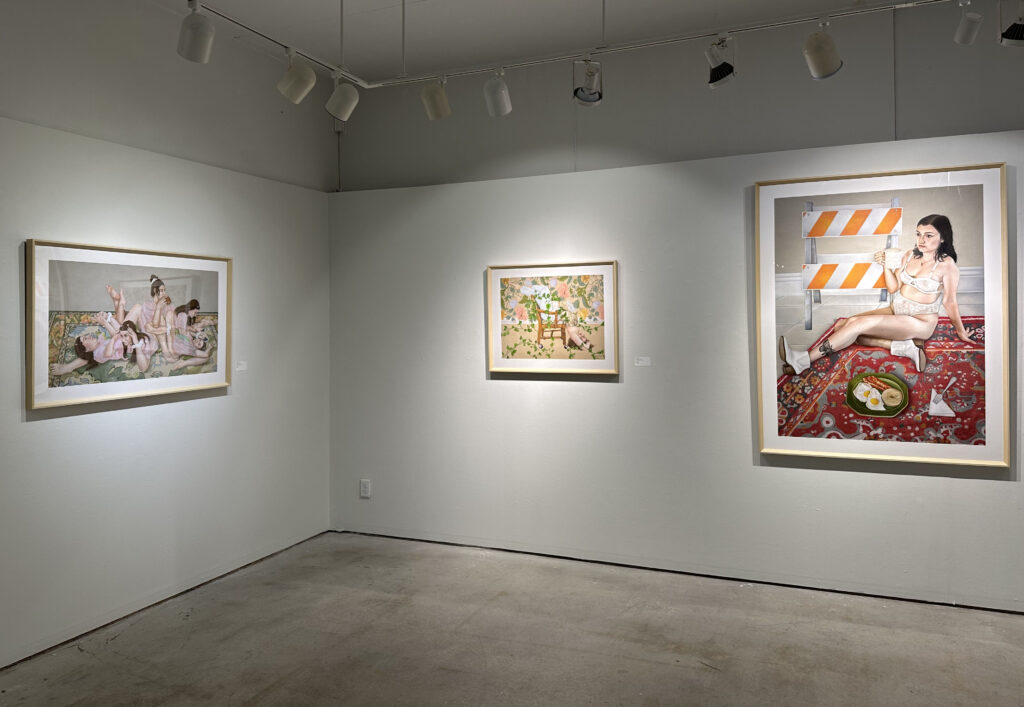
Rattray has a studio in the Kress Contemporary building in Ybor City and it is often open to the public. There you can find more of her chicken portraits as well as see the other charming paintings she is working on. The image below is of her studio at last night’s Ybor Arts Tour.


Sep 282023
 

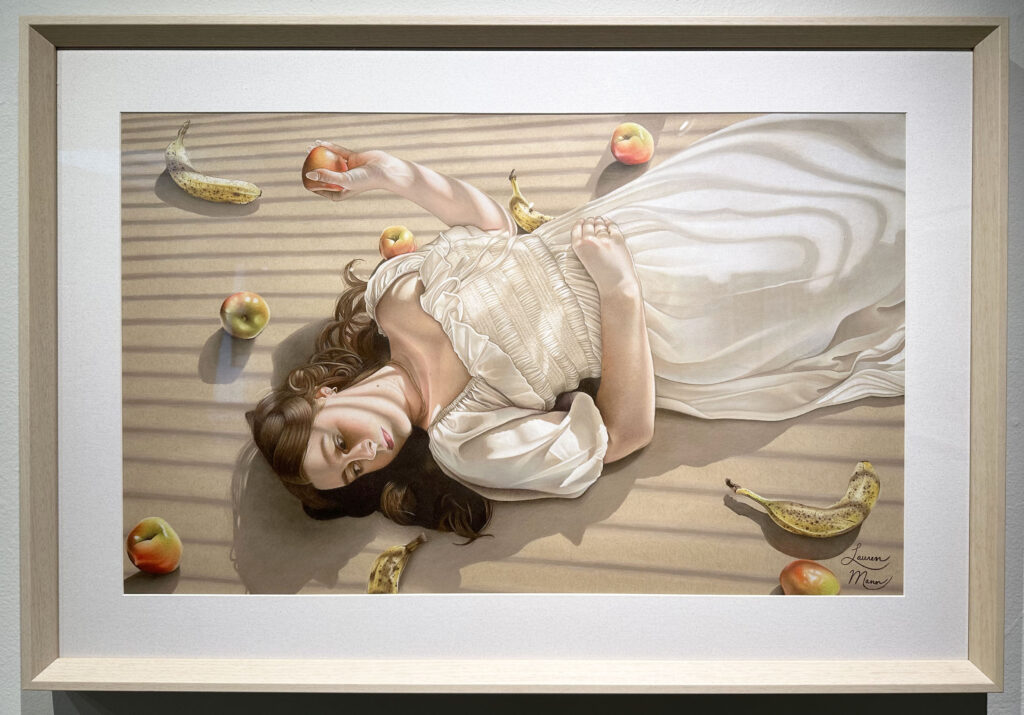
“Ripening Shadows”, 2023, Colored pencil on toned paper

It was great to see Lauren Mann’s drawings again, this time at Art Center Sarasota for her exhibition The Ephemerality of Being. Her work was previously part of 2022’s emerging artist exhibition Fresh Squeezed 6 at Morean Arts Center, in St. Petersburg, Florida.

The artist’s statement about the show-

Growing up and getting older is seeing time pass and recognizing you can’t do anything but try to take in every moment. It’s exhausting. It’s taking a deep labored breath and deciding to rest in the peaceful aftermath of the realization that your time on earth is finite.

This work combines delicate portraiture with the rich symbolism of inanimate objects to create new, contemporary still lives. Bright, sanguine memento moris. By carefully veiling these reminders of humanity’s brittle ephemerality behind the facade of beautiful and nuanced illustrations of ordinary characteristics and relationships found in everyday life, it compels the viewer to reflect on their own lived experiences and feelings towards mortality, comparatively to those conveyed in these works.

This exhibition closes 9/30/23.

Sep 132023
 

Alison Elizabeth Taylor, “Anthony Cuts under the Williamsburg Bridge, Morning”, 2020 Marquetry hybrid (wood veneers, oil paint, acrylic paint, inkjet prints, shellac, and sawdust on wood)

Currently at Orlando Museum of Art is The Outwin: American Portraiture Today, an impressive collection of work in a variety of mediums.

From the museum’s website-

Launched in 2006 to support the next wave of contemporary portraiture in the United States, the National Portrait Gallery’s celebrated triennial Outwin Boochever Portrait Competition is a major survey of the best American portraiture selected by internationally prominent jurors and curators. Now in its sixth edition, The Outwin: American Portraiture Today presents 42 works selected from over 2,700 entries, that foreground the vibrancy and relevance of portraiture today. In addition to paintings, photographs, drawings, and sculptures, The Outwin includes video, performance art, and textiles, highlighting the limitless possibilities of contemporary portraiture.

Open to both emerging and established artists, this year’s entrants were encouraged to submit work that moves beyond traditional definitions of portraiture, and to explore a portrait’s ability to engage with the social and political landscape of our time. The variety of media and subjects featured in the exhibition invite audiences of all backgrounds to find relation in the human experience.

Since its inception, finalists for the exhibition have been determined by a panel of jurors including three Portrait Gallery staff members and four external professionals (critics, art historians, artists). The competition is endowed by and named for Virginia Outwin Boochever (1920 – 2005) who, for 19 years, volunteered as a docent at the Portrait Gallery. Her commitment to advancing the art of portraiture is continued through the support of her children.

Below are a selection of works from the show and information about them from the museum.

Alison Elizabeth Taylor– Anthony Cuts under the Williamsburg Bridge, Morning, 2020 (pictured above)

On walks around her Brooklyn neighborhood during the COVID-19 lockdowns, Alison Elizabeth Taylor encountered the hair groomer Anthony Payne, who,with his workplace shuttered, had taken his scissors, mirror, and chair to the streets. Payne sought to financially support the Black Lives Matter movement, especially in the aftermath of George Floyd’s murder, and turned over proceeds from his donation-based haircuts to organizations advocating for social justice.

Taylor’s process, one she developed and named “marquetry hybrid,” incorporates vivid paints, inkjet prints, and the natural grains of over one hundred veneers. Marquetry, with its inlaid combination of woods, can “memorialize,” Taylor notes. She acknowledges the history of the craft, which was favored by Louis XIV (1654-1715) when he was acquiring furniture for Versailles. By giving Payne this “royal treatment,” Taylor aims to pay tribute to him.”I want him to see how much his example meant to me,” she explained.

Kira Nam Greene, “Kyung’s Gift in Pojagi (From the series “Women in Possession of Good Fortune”)”, 2019 Oil, gouache, colored pencil, and acrylic ink on canvas

Kira Nam Greene– Kyung’s Gift in Pojagi (From the series “Women in Possession of Good Fortune”), 2019

In this mixed-media work, by Kira Nam Greene, the artist Kyung Jeon faces us with relaxed self-assurance. She is carefully positioned on her couch as her long black hair falls over her orange and turquoise tunic. In the foreground, a wooden cylinder containing paint brushes reveals her medium of choice. A plate with persimmons, consumed during the harvest festival Chuseok to celebrate good fortune, brims with potential while the rest of the painting pulsates with action.

Greene situates her friend in a fantasy world that echoes Jeon’s artwork and their mutual interest in the traditional Korean fabric quilting technique of pojagi. Two rabbits, representing Jeon’s Chinese zodiac, appear to be concocting a potion. Flowers sprout as kaleidoscopic patterns envelop her. The reference to pojagi, the visible paint drips in the background painting, and the hands of the sitter- left unfinished- invoke the role of tradition, process, and exploration in artmaking.

Stuart Robertson, “Self Portrait of the Artist” from the “Out and Bad” series, 2020, Aluminum, earth, acrylic paint, enamel, paper,metallic bubble wrap, sequins, and gold foil on wood

Stuart Robertson–  Self Portrait of the Artist from the Out and Bad series, 2020

“In my world, skin is high-tech, amorphous, and armored,” the artist Stuart Robertson observes. “Blackness is percussive, lustrous, flexible, and indestructible.” Self-Portrait of the Artist depicts a fragment of a man- half of his face and his upper torso-shiny and monumental. A black beard delineates his jaw, and a small gold hoop adorns his ear. Although the figure is cropped beyond recognition, the work’s title provides a clue.

Through the alternation of flat and repoussé aluminum sheets, Robertson achieves a hypnotic effect, a poignant tension playing on what he reveals or hides from us viewers. His refusal to depict his entire face or figure challenges the notion of what a portrait should be and blocks the objectification of the Black male body, so often sexualized in visual culture. Simultaneously, Robertson delivers an irrepressible, resplendent image of that body, one inspired by the aesthetics of Jamaica’s dancehall culture.

Vincent Valdez, “People of the Sun (Grandma and Grandpa Santana)”, 2019, Oil on canvas

Vincent Valdez– People of the Sun (Grandma and Grandpa Santana), 2019

An elderly couple faces us with the gentle authority that old age provides. People of the Sun (Grandma and Grandpa Santana) is a portrait of Vincent Valdez’s maternal grandparents. “My grandparents spent most of their time outside,” the artist recalled. “Grandpa spent his entire life working under the blazing Texas sun as a carpenter and yard worker, cutting lawns in the wealthy communities of San Antonio right up until he passed away. Grandma was constantly working with her hands–raising kids, washing, sewing clothes, and tending the plants in her yard.”

The Santanas are depicted in a space defined by details the artist remembers: their vintage AM radio, their plants, their homemade clothes. The bedsheet, like the Virgen de Guadalupe’s aura, signals their spiritual role in the family. This portrait connects the pair to the Indigenous and mestizo cultures of the American Southwest, including the Aztec and Maya, who honored the sun.

For more work from the exhibition, please head to page 2.

Aug 252023
 

“Bryson Funmaker”, 2020, Inkjet print and beadwork

The Museum of Fine Arts St. Petersburg is currently showing an impressive collection of work from photographer Tom Jones. The photos, in multiple series, focus on Native American identity, history, cultural appropriation, and the Ho-Chunk Nation of Wisconsin, of which Jones is a member. The work engages visually while also being informative.

From the museum’s press release for Tom Jones: Here We Stand–

For over twenty years, Tom Jones has created a visual record and exploration of his Ho-Chunk community. Born in North Carolina and raised in Orlando after a short stint in Minneapolis, Jones returned to the Midwest, moving to Wisconsin at age 15. He then made his way to Chicago for graduate school at Columbia College. Jones’s father worked with Kodak and owned a photography lab, helping shape the artist’s understanding of the practical aspects of photography from an early age. During graduate school, Jones began an ongoing photographic essay on the contemporary life of his Ho-Chunk community, beginning first with the elders.

The show comprises over a dozen series, ranging from the documentary to the conceptual. Of his series on Veterans’ memorials at the annual Black River Falls Pow-Wow, Jones says, “I was interested in the way families made very conscious decisions about how they want their loved ones memorialized.” Other series include the emotionally intimate, though larger than life, beaded portraits. “Beading is a metaphor for our ancestors watching over us. I am also referencing an experience I had when I was about 8 or 9 years old. My mother took me to see a Sioux medicine man named Robert Stead. He led the call to the spirits, the women began to sing, and the ancestors appeared as orbs of light. This event inspired the series Strong Unrelenting Spirits.“

Jones’s photographs examine identity and geographic place with an emphasis on the experience of Native American communities. He is interested in how American Indian material culture is portrayed through commodification and popular culture. Much of his work counteracts and corrects decades of misinformation and misrepresentation of American Indians, particularly targeting the field of U.S. history. Jones’s critical assessment of the romanticized representation of Native peoples in photography re-examines historic pictures taken by white photographers. This reassessment questions the assumptions about identity within the American Indian culture by non-natives and natives alike. “While each of Jones’s series is distinctly different, the message remains consistent: the Ho-Chunk are not vanishing or frozen in time,” said Dr. Jane Aspinwall, Senior Curator of Photography. “Jones’s photographs emphasize a solid, generational commitment to family, tribal community, and land. His photographs reclaim appropriated images and set the historical record straight.”

Below are a some selections from a few of the series in the exhibition.

“Trenton and Roger Littlegeorge”, 2011

“Dorothy Crowfeather”, 1999

“Dear America” series

About the Dear America series pictured above-

Using each line from the first two verses of the song, America (“My Country Tis of Thee”) as the title of fourteen of the works in the Dear America series, Jones questions whose history is being propagated here. With dry wit and an unfailing commitment to truth, Jones exposes atrocities like the massive effort by the U.S. government to assimilate Native American children to non-Native culture, the merciless seizing of Native lands, and the mass hanging of thirty-eight Sioux and Ho-Chunk men under President Lincoln in 1862. He also highlights Native American identity in relation to cowboy culture, the thoughtless misappropriation of Native American customs, and the influence of the Iroquois Confederacy on the U. S. Constitution. Jones’s aim is to broaden the “traditional” historical American narrative to be more representative of all people, especially the original inhabitants of this land.

About the Ho-Chunk Veterans Memorials, pictured above-

“I wanted to do this photographic essay to honor our veterans… One in four American Indian males is a United States veteran. Ho-Chunks have fought in every war for the United States except for the War of 1812. The Ho-Chunks did this even though they were not granted the right to vote until 1924, and during the Indian Removal Act, were removed at least seven times from Wisconsin by the United States government. This is the conviction we have as a people… I honor these people who give of themselves freely to protect this land. Traditionally, Ho-Chunks are taught to live their lives for the betterment of others. The veterans have done this.’
-Tom Jones

From Jones’ “”Native” Commodity” series

About the “Native” Commodity” series-

The Wisconsin Dells, one of the most popular tourist destinations in the state, is home to spectacular natural scenery and the largest concentration of waterparks. Located on Ho-Chunk ancestral land, the area is now highly commercialized, with much of its identity resting on the appropriation of Native American stereotypical tropes. In this series, Jones documented this unabashed use of Native American symbols, images, and place names in advertising and popular culture. The sale of “Native American” crafts made in China, the liberal use of names of historically important figures like Black Hawk, and the indiscriminate mix of tribal communities into one conglomerate-tipis from the Plains next to totem poles from the Pacific Northwest next to Pueblo pottery. The Dells serve as a microcosm for how images of Native Americans are reproduced and reframed into a collective memory that is often distorted. Jones wryly noted that none of the Native American objects feature anything specifically attributable to the Ho-Chunk Nation.

This exhibition has been extended until 9/10/23.

Apr 202023
 

Closing on 4/22/23 is Amoako Boafo’s exhibition, what could possibly go wrong, if we tell it like it is, at Gagosian gallery’s Madison Avenue location.

From the press release-

When I’m making paintings, I want the characters to be strong, I want them to be free, I want them to be independent, I want them to be unapologetic.
—Amoako Boafo

Boafo’s large-scale portraits portray his friends and those he admires with candor, joy, and individuality. Focused on Black identity, his monumental paintings have already become key works in the representation of contemporary Africa and the African diaspora.

Boafo paints the faces and bodies of his subjects with his fingertips rather than a brush, the directness of his touch enhancing their expressive qualities. The works’ surfaces feature a gestural facture which the artist uses to model the figures’ anatomy. Making eye contact, Boafo’s subjects return the gaze of the viewer in an assertion of presence and identity, reflecting the artist’s interest in conveying charisma and individuality. The characters occupy domestic interiors, their casual grace reinforced by the familiarity of these settings.


Feb 262023
 

Y.Z. Kami “Woman in Dark Sweater, 2022

Y.Z. Kami “Woman in Dark Sweater, 2022 (detail)

Y.Z. Kami “Aïsha”, 2012-22

Y.Z. Kami “Messenger IV”, 2022

Y.Z. Kami “Night Painting XV”, 2022

For his exhibition Night and Day at Gagosian in NYC, Y.Z. Kami is presenting two distinct bodies of work, his portrait paintings and a newer series, Night Paintings, started in 2017.

From the press release-

Each of Kami’s large-scale painted portraits depicts a single face in muted colors on an opaque ground. Frontally composed and closely cropped, Kami’s self-absorbed subjects are removed from the specificity of context. From Aïsha (2021–22) and Lu (2022) to The Monk (2022) and Woman in Dark Sweater (2022), these paintings are titled by first names or descriptions, marking a continuum between individual identity and universality. Using layers of brushstrokes to blur his subjects’ features, Kami concentrates on the ineffability of individual presence. From longtime friends and acquaintances to strangers he has met in passing, his subjects form an ensemble of varied age, gender, and ethnicity. Kami’s introspective faces also recall the Fayum portraits of Roman-era Egypt—naturalistic likenesses of the deceased that were affixed to mummies. The works in Night and Day affirm—as do their ancient precedents—the common humanity in our observation of others.

Kami’s Night Paintings are made using a single shade of indigo—said to be the color of the night—which he blends with gradations of white to summon the sensorial dynamics of presence and absence. Each canvas is filled with apparitions that float just past the limits of materiality and concrete representation. Composed with hazy, tenebrous brushwork, these abstractions evoke a mental inner state. Their shifting outlines and hazy boundaries make manifest soft edges and shimmering biomorphic patterns, enticing the viewer to recognize elements from the human realm while ultimately confounding all attempts to do so. The Night Paintings thereby limn the boundaries between the earthly and the sublime.

Messenger IV (2022), a single painting that belongs to neither series, represents a cloaked figure seen from behind, painted in a soft-focus style. The anonymous subject appears in the foreground of a crossroads, a setting of passage and transition. Kami has positioned this figure using the classical compositional device of the Rückenfigur (back-figure), with which the viewer is encouraged to identify, thus implicating him or her in the space and narrative suggested.

Contrary to the instantaneity of a photograph, Kami composes his paintings over an extended period, his nuanced brushwork built up in many layers. Consequently, they reward sustained looking, revealing their character over time and bringing awareness both to perception as a process and to contemplation of the nature of being.


May 212021
 

Happy Birthday to Christopher Wallace aka Biggie Smalls or The Notorious B.I.G who was born today, May 21, 1972.

For more work by the creator of this piece, Vincent Ballentine, check out his website

Jan 242015
 

gillianwearingregenprojectsfearandloathingviasite

gillianwearinghandregenprojects

gillianwearingmeasnecklace

Today is the last day to see British artist Gillian Wearing’s exhibition everyone at Regen Projects.  The two new video works are especially affecting.

Fear and Loathing, the artist’s first work produced in the US, presents a split screen with two people wearing masks, one on each side, alternating monologues about either a fear or a loathing from their personal lives.  In the second, We are Here, residents of the West Midlands of England, tell stories of their lives as if they have returned from the dead. This piece was inspired by the American poet Edgar Lee Masters’ 1915 book Spoon River Anthology.

The artist also includes portraits of herself within the exhibition, including a portrait of herself in a mask of her younger self, a large necklace with a pendant that is a mask of her face, and a series of sculptures of her hand with different fortune teller readings written on them.

There’s a certain sadness to the exhibition as Wearing examines lives caught in circumstances that are often beyond their control. This ties in to the idea of the fortune teller, who is sought out for the feeling that life is predestined.  Yet the various fortune tellers here tell different stories for the same hand. Perhaps these are like the different stories we are presenting to the world throughout our lives, at times with our true faces masked.