Xenobia Bailey’s mosaic tile work Morning Stars, 2018, in downtown St. Petersburg, Florida. The work was commissioned by the St. Petersburg Arts Commission.
From the information plaque-
Bailey primarily works in fiber arts, creating crocheted mandalas which consist of colorful concentric circles and repeating patterns. For Morning Stars, Bailey crocheted several mandalas of brightly-colored fiber medium and worked with her fabricators to create the design digitally to be applied as a mosaic design.
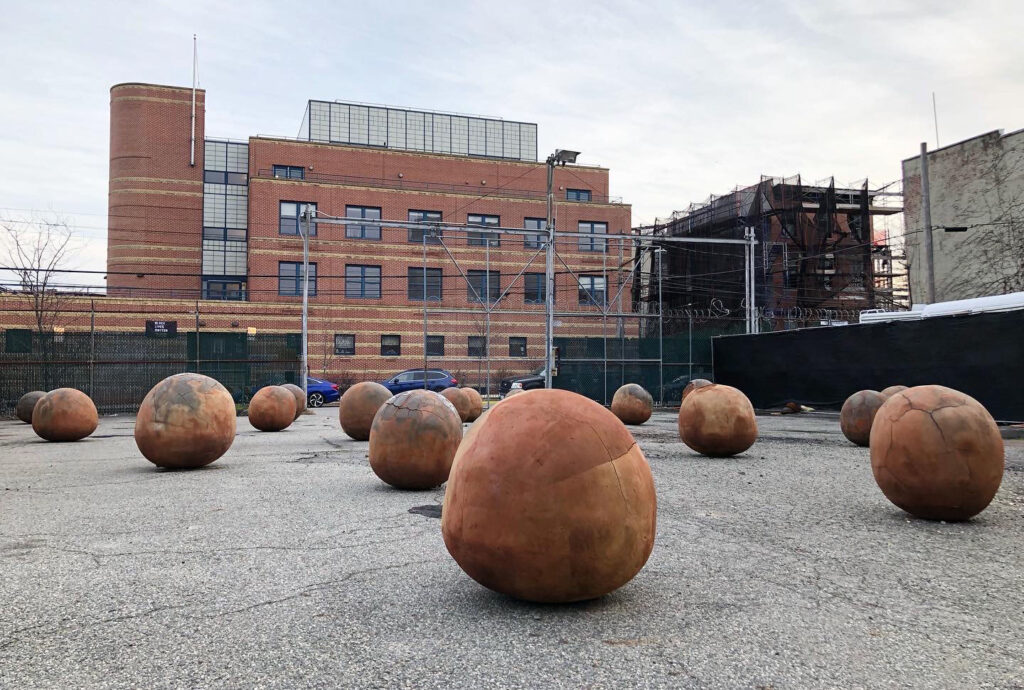
Bosco Sodi’s outdoor sculpture installation, Perfect Bodies, presented by Pioneer Works, was on view in Redhook, Brooklyn from October 2020 until December 2020.
From Pioneer Works’ press release-
Sited on a once teeming commercial concrete parking lot two blocks south of Pioneer Works, Perfect Bodies speaks to, in artist Bosco Sodi’s words, “silence, contemplation and the passing of time—the small things in life and our relationship with the earth.” The installation consists of large-scale clay spheres and cubes made from local clay fired in the artist’s studio in Oaxaca, Mexico, which made the long journey by road across the Mexico-US border to Red Hook. A longtime resident of the neighborhood—itself named after the tone of its own clay soil—Sodi is known for his use of raw and organic materials to create textured paintings and objects.
Sodi’s ongoing dialogue with nature and landscape, shaped by his interests in Japanese aesthetics and Abstract Expression, puts himself in the lineage of both Arte Povera and Land Art—two post-war movements which emphasized, respectively, radically simple materials and an integral relationship between art and earth. As Spanish author Juan Manuel Bonet remarked in the artist’s 2020 eponymous monograph, his three dimensional works reconcile an interest in minimalism with the practices of Mexican heritage. On this topic, curator Dakin Hart further writes: “At his place in Oaxaca, Sodi hand forms large geometric sculptures from clay and fires them in a makeshift kiln on the beach. Cuboids in different formats recall the scale and how-did-they-do-that-craft of cyclopean architecture across the ancient world. While spheroids, each formed by eye in a landscape of unbelievable things, might be the petrified remnants—or organic vanguard—of a Jurassic invasion. The past seeding itself into the present, a starting point for nature’s revenge.”
Currently, as part of Art Biennale 2022, Fondazione dell’Albero d’Oro is showing What Goes Around Comes Around at Palazzo Vendramin Grimani, in Venice, Italy, until November 27th, 2022. The art installation will include his paintings as well as recent sculptures.
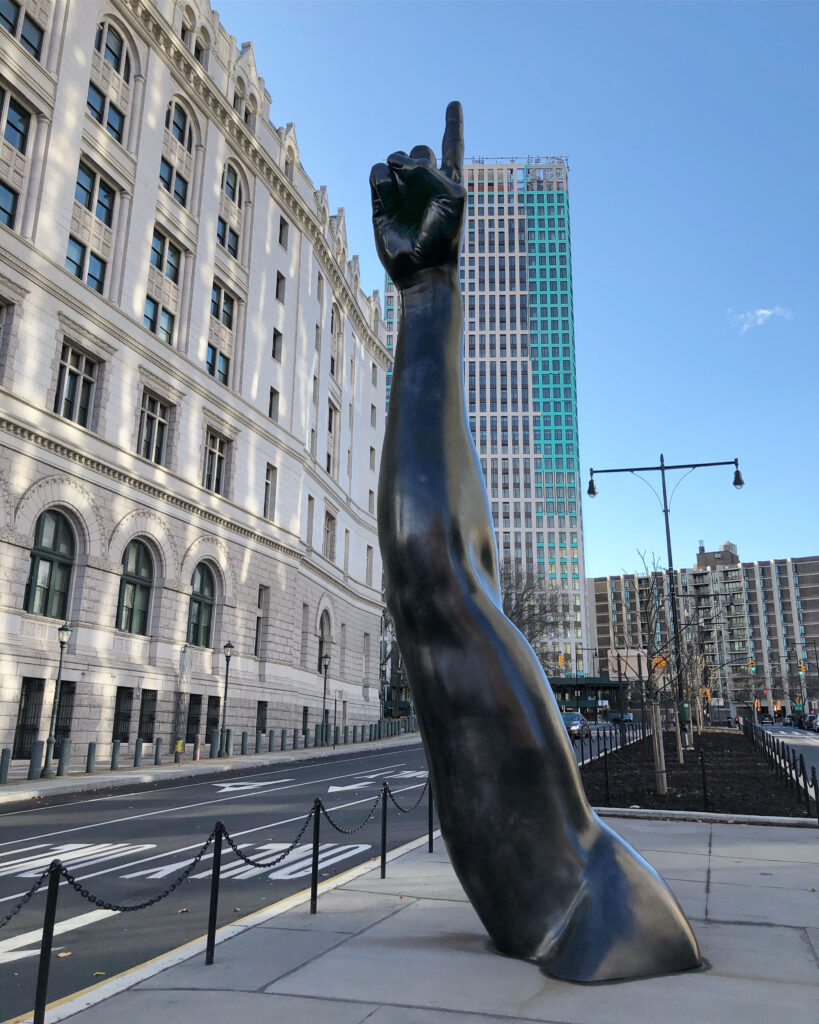
“The sculpture is an homage to and celebration of the unique and multi-faceted character of the borough of Brooklyn. The spirit of Brooklyn has always been about upward mobility and connection to roots. The large-scale sculpture of a bronze arm pointing toward the sky is intended to convey to a wide audience a myriad of ideas about individual and collective identity, ambition, and perseverance”.
Typewriter Eraser, Scale X, 1999, part of The ARIA Fine Art collection in Las Vegas
Artist Claes Oldenburg passed away this week at the age of 93. He was most famous for his large scale sculptures of everyday objects, many of which were produced with his wife Coosje van Bruggen, who passed away in 2009.
While primarily working in sculpture, early in his career in the 1960s he also created “happenings”- theatrical art related performances and collaborations with other artists in his circle. In 1985 he returned to performance and along with van Bruggen, architect Frank Gehry, and writer Germano Celant presented Il Corso del Coltello (The Course of the Knife) in Venice, Italy. In 2021, Pace Gallery in NYC, as part of the two gallery exhibition Claus & Coosje, showed work from this performance, pictured below.
From Pace’s website about the performance-
This ambitious event involved the creation and embarkation of a sea-worthy sculpture in the shape of a giant Swiss army knife. With oars protruding from its red-enameled hull as if from a Viking longship, the image of Oldenburg and van Bruggen’s Knife Ship sailing the Grand Canal has become iconic, while the massive kinetic sculpture was later shown in the rotunda of the Guggenheim Museum in New York, at the Centre Pompidou in Paris, and finally at the Museum of Contemporary Art, Los Angeles.
With so much of Oldenburg’s work, the examination of the ordinary object engages the viewer with what they might previously taken for granted and gives them a chance to look again with new eyes. There is also something lighthearted and fun, as well as investigative, about his body of work.
(image via Whitney Museum’s website)
The Whitney Museum has a video showing the process of assembling his soft sculpture Giant BLT(Bacon, Lettuce, and Tomato Sandwich) 1963, which involves putting the sandwich together piece by piece.
For more on Oldenburg, MoMA has a tribute that includes the words of people who knew him as well as his own. His 1961 artist statement is wonderful and worth reading in its entirety, here is the opening section-
I AM FOR
I am for an art that is political-erotical-mystical, that does something other than sit on its ass in a museum.
I am for an art that grows up not knowing it is art at all, an art given the chance of having a starting point of zero.
I am for an art that embroils itself with the everyday crap and still comes out on top.
I am for an art that imitates the human, that is comic, if necessary, or violent, or whatever is necessary.
I am for all art that takes its form from the lines of life itself, that twists and extends and accumulates and spits and drips, and is heavy and coarse and blunt and sweet and stupid as life itself.
I am for an artist who vanishes, turning up in a white cap painting signs or hallways.
The Guardian’s obituary is also worth a read for more information on the artist’s history.
Marcos Ramirez ERRE’sIs All That it Proves, 2015, was created for Murals of La Jolla, in San Diego. Murals of La Jolla is a project started in 2010 by The Athenaeum and the La Jolla Community Foundation. It commissions artists to create work to be displayed on buildings around La Jolla. Information on his current mural for the project can be found here and a map of all the murals can be found here.
From the Murals of La Jolla website about the work-
Marcos Ramirez ERRE’s mural, All That it Proves, is a strongly stated, critical stance on what we perceive as the truth. He employs Thomas Paine’s famous quote as both a linguistic and visual exploration of the human condition and a challenge against long standing rhetoric. Paine’s quote is about understanding that our opinion is only that, our opinion. And our opinion is not necessarily the “truth”, while at the same time it may be. The piece deviates from its most obvious reference towards eyesight and becomes about another kind of vision, the kind of vision you perceive through common sense. True to his form as humanitarian artist, Is All That It Proves, exemplifies the notion that now, more than ever, we need to embrace tolerance and learn to respect individuals who chose to think in a way different than we do.
Marcos Ramirez ERRE has come to be defined by his clever visual arguments and masterfully crafted work that maintains a poetic sensibility, even when leveling biting political commentary. He was born in 1961 in Tijuana, Mexico. ERRE received his Law Degree from La Universidad Autónoma de Baja California. In 1983, he immigrated to the United States where he worked for seventeen years in the construction industry. His multi-disciplinary background has shaped his practice. He came to prominence in the 1990s with large public installations that dealt with migrants, immigration, and border control, specifically focusing on the Mexican-American border crossing. Much of ERRE’s work grapples with these issues.
Artist Sophie Calle’sHere Lie The Secrets of the Visitors of the Green-Wood Cemetery, a 25 year long public artwork. The project debuted on April 29th and 30th, 2017.
To inaugurate the project, the public was invited to Green-Wood Cemetery, a National Historic Landmark, in Sunset Park, Brooklyn, to privately unburden and inter their most intimate confessions.
During the two-day opening, in a setting nestled among the mausoleums and monuments of Green-Wood’s verdant rolling hills, visitors transcribed their secrets onto paper, and deposited them into the earth below, through a slot on a marble obelisk of Calle’s design. The artist was on hand during the two-day event to receive some visitors’ secrets.
The two-day performance was free and open to the public. Guests were invited to spend the day exploring the sculptures and monuments throughout Green-Wood, a tradition that dates back to the early 1800s. Free maps of the cemetery, specially designed to accompany Calle’s installation, were be available. Guided walking tours emphasizing the cemetery’s symbols and iconography were offered at no cost.
Visitors to the Cemetery can now see Calle’s installation during regular cemetery hours and independently deposit secrets into the marble obelisk. Calle has also pledged to return periodically over the next 25 years, each time the grave is filled, to exhume and cremate them in a ceremonial bonfire service and moment of remembrance.
Everyone has a secret to tell, now there’s a place to put one of yours.
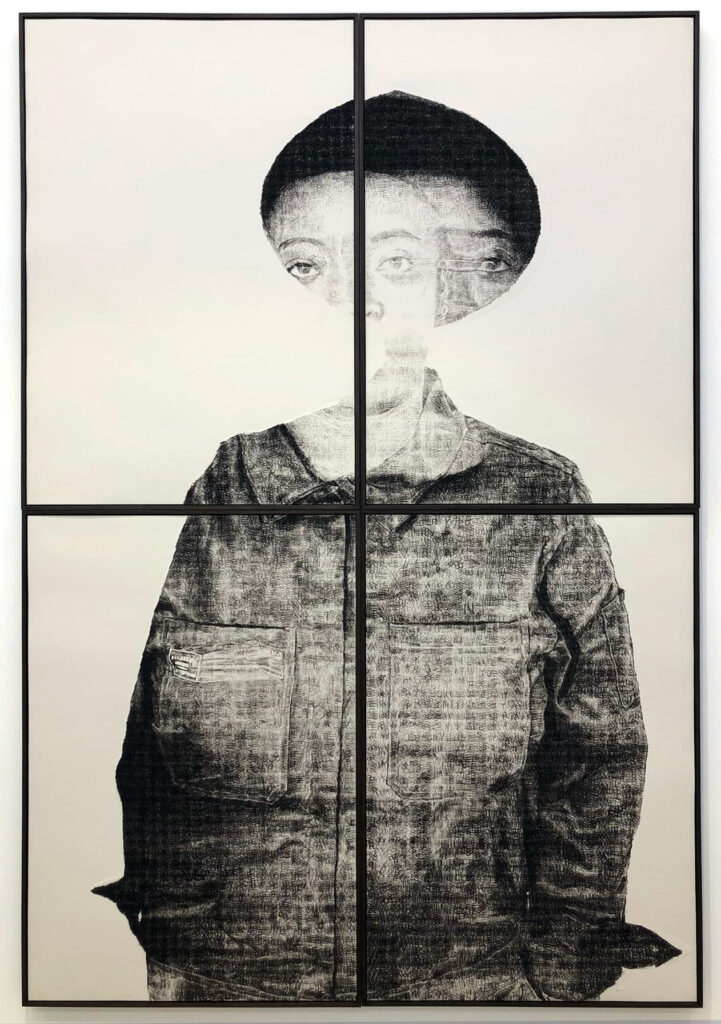
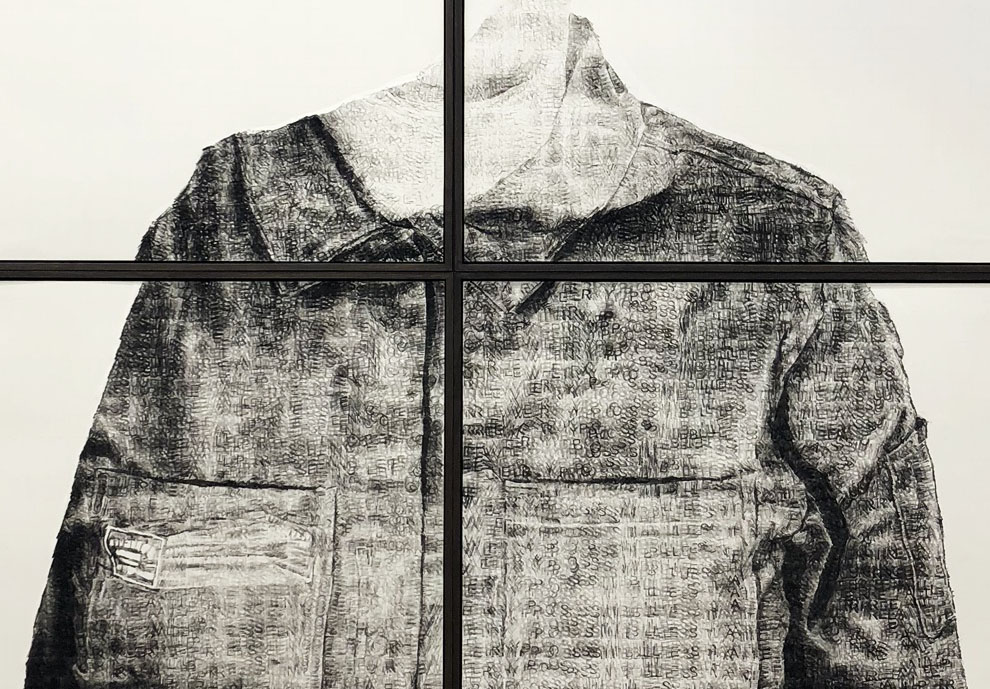
A Surreal Presence for Every Possible State, 2018 by Kenturah Davis from her 2019 exhibition, Blur in the Interest of Precision at Matthew Brown Los Angeles. The four panel work was created using oil paint applied with rubber stamp letters and graphite grid on embossed Mohachi paper.
From the press release-
Blur in the Interest of Precision is a search for parallel conditions between the poetics of our visual experience and the strangeness of our relationship to language. We often use language to carve out distinctions between one thing and another. Davis’ objective—to complicate ideas about meaning, representation and perception—have found refuge in blur and doubling. The new drawings are rendered with arrangements of text, but the words are virtually illegible. Many of the portraits pursue ideas the artist is working through via the writings of Fred Moten and Toni Morrison’s essay, Sites of Memory.
Davis’ work oscillates between various facets of portraiture and design. Using text as a point of departure, the artist explores the fundamental role that language has in shaping how we understand ourselves and the world around us. This manifests in a variety of forms including drawings, photographs and performances.
Recently Davis was commissioned by LA Metro to create work for the future Inglewood Station, slated to open in November of 2022. The work, Sonder, depicts community members photographed at gatherings at the artist’s Inglewood art studio and made into large porcelain enamel steel panels.
The photographs were hand painted with stamps incorporating letters that form the words defining the term “sonder.”
Davis was drawn to the term which alludes to the realization that every person has a unique and significant story. She hopes that the portraits inspire connections between strangers, even if only for a passing moment while waiting for the train.
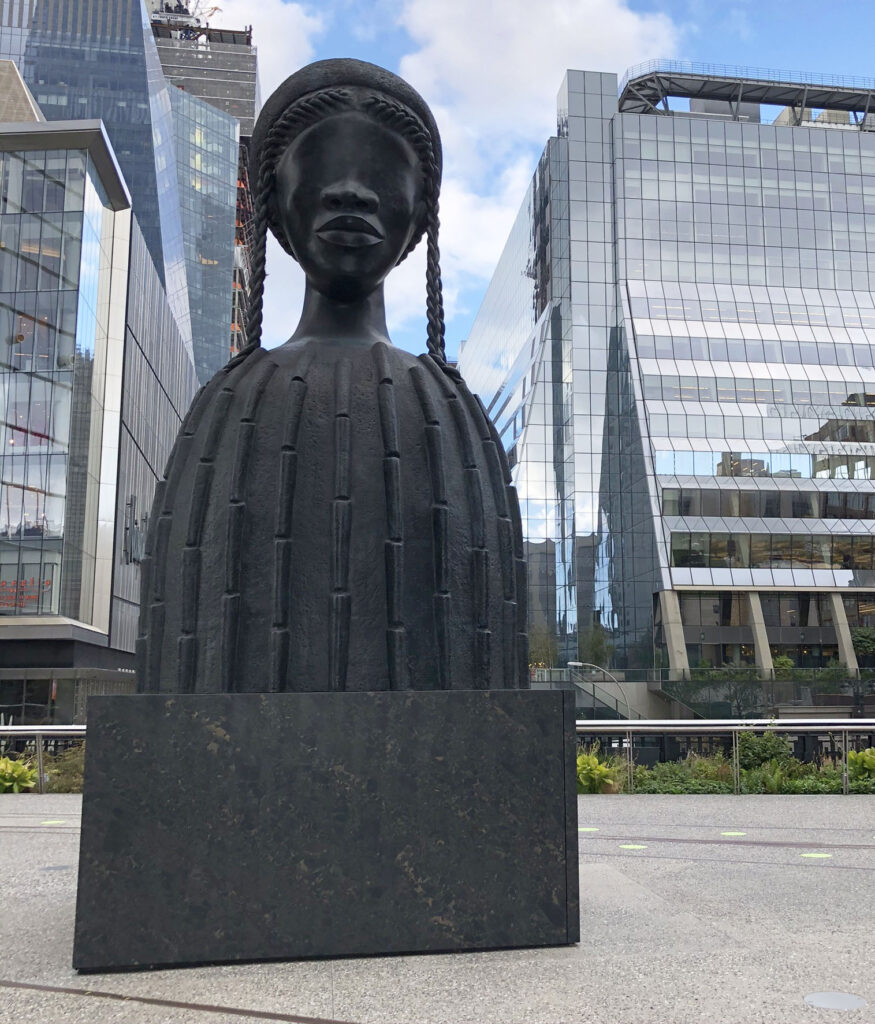
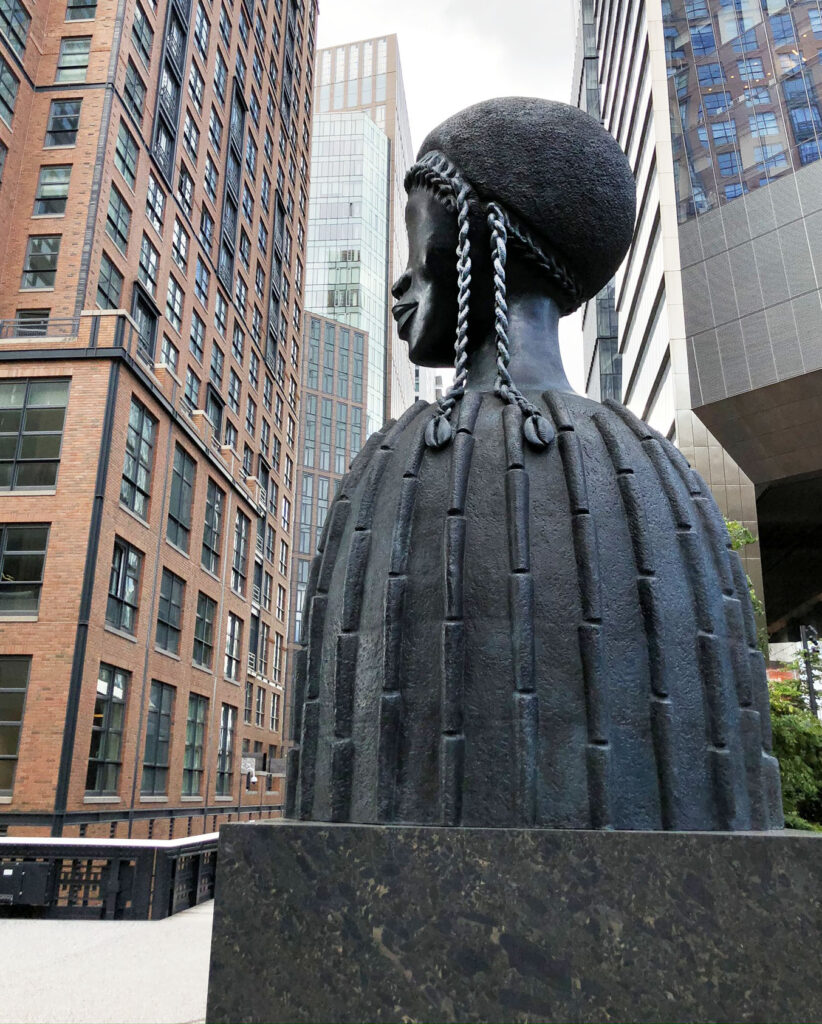
Simone Leigh presents Brick House, a 16-foot-tall bronze bust of a Black woman with a torso that combines the forms of a skirt and a clay house. The sculpture’s head is crowned with an afro framed by cornrow braids, each ending in a cowrie shell. Brick House is the inaugural commission for the High Line Plinth, a new landmark destination for major public artworks in New York City. This is the first monumental sculpture in Leigh’s Anatomy of Architecture series, an ongoing body of work in which the artist combines architectural forms from regions as varied as West Africa and the Southern United States with the human body. The title comes from the term for a strong Black woman who stands with the strength, endurance, and integrity of a house made of bricks.
Brick House references numerous architectural styles: Batammaliba architecture from Benin and Togo, the teleuk dwellings of the Mousgoum people of Cameroon and Chad, and the restaurant Mammy’s Cupboard in Natchez, Mississippi. The sculpture contrasts sharply against the landscape it inhabits, where glass-and-steel towers shoot up from among older industrial-era brick buildings, and where architectural and human scales are in constant negotiation. Resolutely facing down 10th Avenue, Leigh’s powerful Black female figure challenges us to consider the architecture around us, and how it reflects customs, values, priorities, and society as a whole.
Leigh works across sculpture, video, installation, and social practice, stitching together references from different historical periods and distant geographical locations. As a sculptor, Leigh works predominantly in ceramics—a medium that she mastered early in her career—continually pushing the boundaries of her chosen material by working in new methods and larger scales. In her intersectional practice, Leigh focuses on how the body, society, and architecture inform and reveal one another. She examines the construction of Black female subjectivity, both through specific historical figures such as Josephine Baker and Katherine Dunham, and more generally through overlapping historical lineages across Europe, Africa, the US, and the Caribbean.
The High Line’s website also has some excellent videos and additional information on the making of the sculpture well worth checking out. This work was on view until May of 2021.