Apr 282023
 

Installation by Molly A. Duff

Work by Trinity Oribio (left) and Manon VanScoder (videos on right)

Currently on view at The USF Contemporary Art Museum is SOMEDAY YOU’LL HAVE TO SAY IT OUT LOUD, an exhibition of eight students graduating with MFA degrees from the USF School of Art and Art History.

The artists included are Molly Duff, Kai Holyoke, Caitlin Nobilé, Trinity Oribio, Rachel Treide, Manon VanScoder, Alicia Watkinson, and Willow Wells.

For the artists’ statements about their work, as well as more information on the exhibition, the museum has produced this PDF.

The show will be on view until 5/6/2023.

Installation by Molly A. Duff, another view

Alicia Watkinson, “Notations in Passing II”, 2023, plywood, lightbulbs, ceramic bases, timers. Duration of light set daily according to the previous day’s activities and observations

Alicia Watkinson, “Notations in Passing II”, 2023 (detail)

Photo transfer on glass by Rachel Treide

Still from video by Rachel Treide

Caitlin Nobilé, “The gap in the door”, 2023 triptych, acrylic on wood

Willow Wells, “Whispers”, 2023, oil painting on panel

Trinidad Oribio “Untitled”, 2023 oil on canvas

Trinidad Oribio, “La Trinidad”, 2023, archival pigment print

Video installation by Manon VanScoder

Manon VanScoder, “each day is an endless scroll”, 2023

Kai Holyoke “Paradise Lakes”, 2023

Kai Holyoke “Paradise Lakes”, 2023


Apr 122023


How does one truly reckon with history?  The imagery in Yael Bartana’s three channel film Malka Germania at Petzel Gallery draws you in and presents you with this question for the entire 43 minutes. Drifting along with the film’s protagonist, scenes of beauty and destruction unfold- but seeing the eagle rise from the water as Hitler and Albert Speer’s proposed Volkshalle continues to emerge, you feel as stunned as those on the beach.

From the press release-

Malka Germania investigates the longing for collective redemption for German and Jewish histories as a response to an age of anxiety.

Malka Germania is Hebrew for “Queen Germany.” The name references a female designation for the Messiah: Malka Meshichah, or the “Anointed Queen.” In Bartana’s film, a new androgynous Messiah, Malka Germania, joins forces with the Israeli Army to liberate Berlin from its collective traumas, memories, and inherited pasts.

The 3-channel video portrays Malka as she walks through Berlin’s haunted landscape, revisiting historical events that seamlessly blend with contemporary scenes. The film weaves subconscious elements through surreal hallucinations, the biblical and mystical to leave questions of redemption, national myths and collective identities for the viewer to contemplate.

This exhibition closes 4/15/23.


Mar 092023


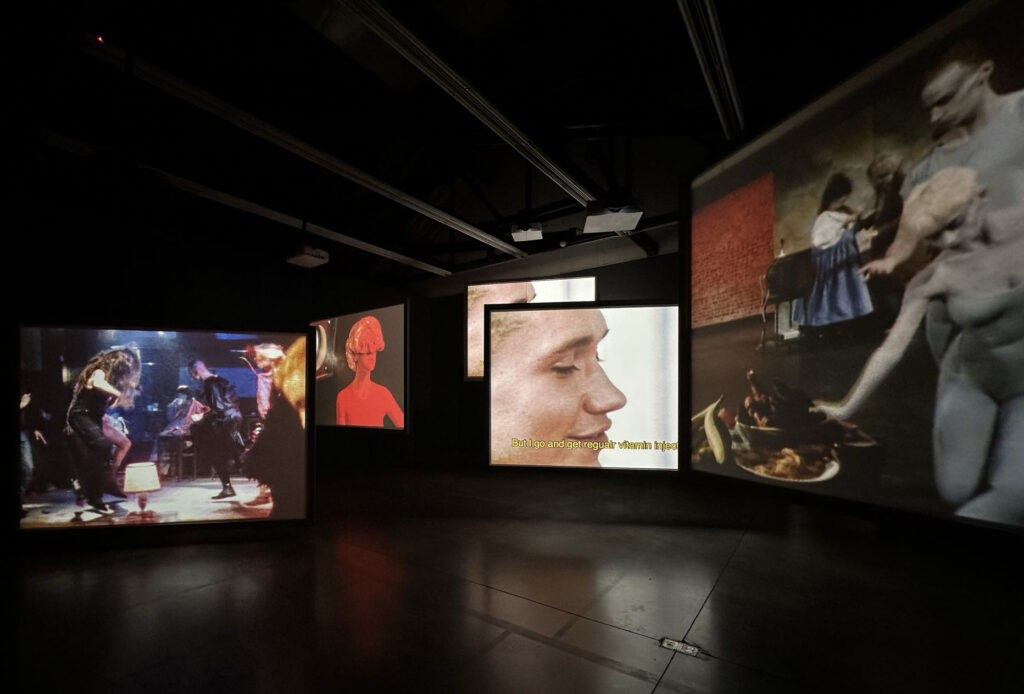
It often feels like we are oversaturated with images in today’s world, but the energy at the Charles Atlas exhibition A Prune Twin at Luhring Augustine gets the balance right.

From the gallery’s press release-

Luhring Augustine is pleased to announce A Prune Twin, the gallery’s third solo exhibition with pioneering film and video artist Charles Atlas. The presentation will mark the American debut of this major multi-channel installation with sound that was originally commissioned by the Barbican Centre, London as the centerpiece of their 2020 exhibition, Michael Clark: Cosmic Dancer; which traveled to the Victoria and Albert Museum in Dundee, Scotland in 2021.

The collaboration between the two artists began in 1984 when the young dancer, Clark, performed in two single-channel films by Atlas: Parafango and Ex-Romance. However, it was not until the groundbreaking Hail the New Puritan in 1986, that the relationship between the two artists was deeply cemented. Originally commissioned as an arts documentary by Channel 4 of the BBC, Hail the New Puritan turned the genre on its head, presenting a highly stylized and fictionalized version of a typical day in Clark’s life – an “anti-documentary”, as Atlas has called it.  The two artists also worked closely together on another Channel 4 production, Because We Must (1989), which was full of extreme theatricality in its dance, choreography, scenery, costumes, and directorial position.

In A Prune Twin, Atlas pulls material from these two major films to create an immersive eight-channel installation of sound and moving image. He extends the idea of choreography to camera and sound, flowing across and throughout screens and monitors; in this sense, Atlas choreographs his own past material into a new and compelling dance all of its own. Evident in this work, and many others by Atlas, is his strong affection and attraction to exceptionally creative collaborators, his sensitivity to movement and how to capture it on film, and his novel skills as both a storyteller and observer. Much like MC9, an immersive installation that compiles Atlas’ extensive work with Merce Cunningham, A Prune Twin surrounds the viewer in a beautifully choreographed spectacle. The work captures the spirit and passion of a 35-year collaborative relationship, one that continues to this day – currently realized through the lighting design that Atlas produces for all of Clark’s live performances, an endeavor he has undertaken since the 1980s.

Jan 252023
 

Now it Makes Sense

iFA Peddler

Conquering Pride

Internal Dialogue

Currently at the Tully-Levine Gallery at the ArtsXchange ( part of  The Warehouse Arts District Association) is The Wiz Reimagined a collaborative art exhibition by iBOMS (Jabari Reed- Diop) and Zulu Painter.

The imaginative paintings accompany sculptures and an installation which also at times includes video projections.

Tonight (1/25/23) there will be a screening of The Wiz, hosted by Hillary Van Dyke of Green Book Tampa Bay and an artist talk with both artists and Scott Terry of Mahogany Gallery.

Aug 082021
 

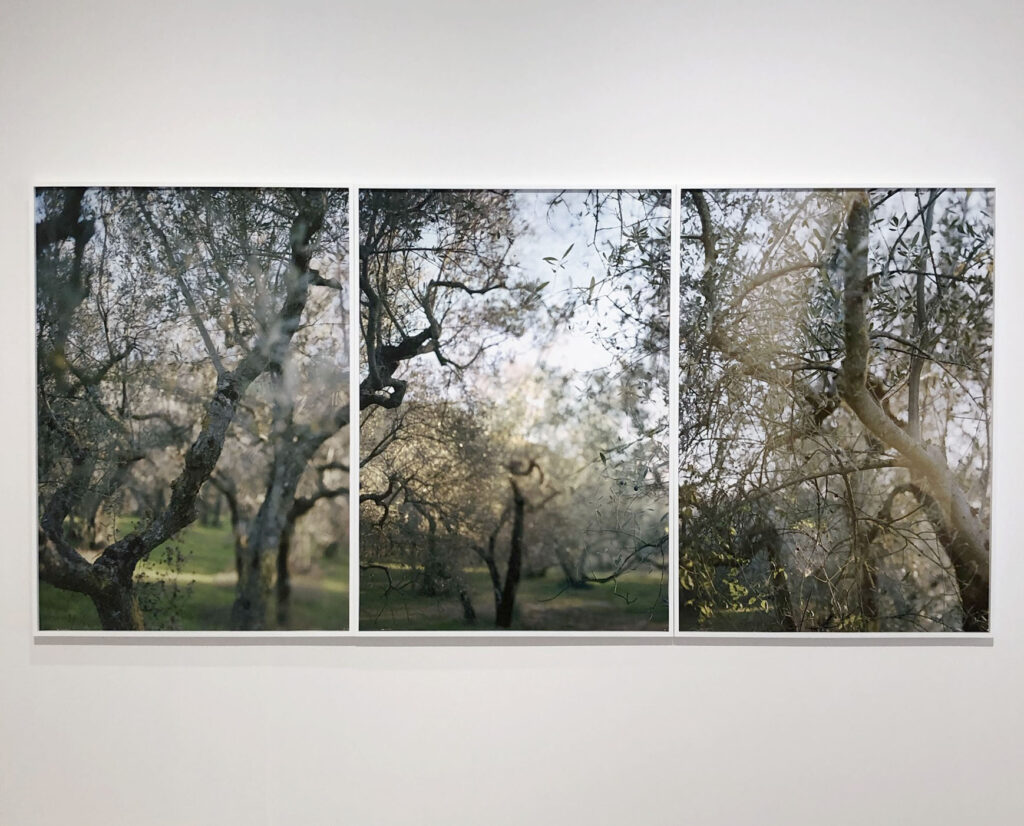
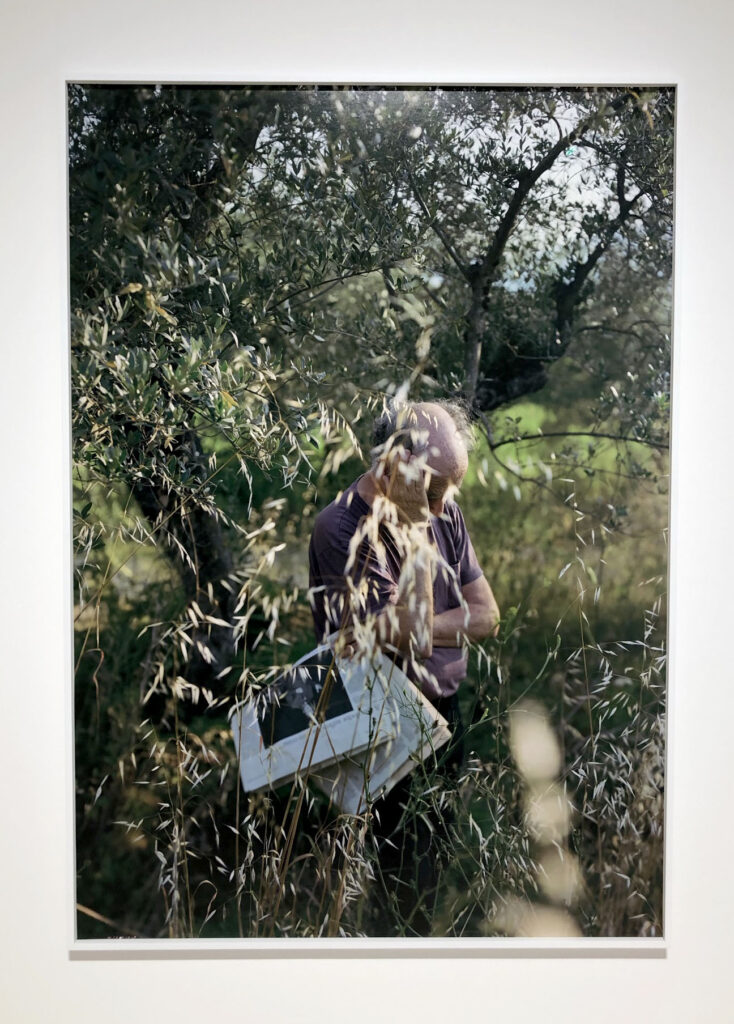
Pace Gallery is currently showing the lovely, meditative photographs of JoAnn Verburg at their NYC location.

From the press release-

JoAnn Verburg: For Now debuts recent multiple-frame photo and video works by the renowned American photographer depicting olive trees captured on three continents. Exemplifying Verburg’s multidisciplinary practice, which for over four decades has existed at the intersection of a range of art-historical traditions, including still life and portraiture, these experiential artworks offer a contemplative respite from the cacophonous urban environment outside of Pace’s gallery space in New York. In response to a period of social and political unrest and a global health crisis, Verburg’s presentation invites viewers to pause and enter a world of self-reflection while simultaneously diving into landscapes from Italy to California to Israel. Generating what the artist has called an “imagined reality,” her images become vehicles for orchestrating a performative and existential encounter between the viewer and the world.

For Now marks Verburg’s first solo exhibition with Pace since the gallery began representing her in 2020, and only the second exhibition in New York since her survey exhibition Present Tense: Photographs by JoAnn Verburg at The Museum of Modern Art in 2007.

Since her last exhibition in New York in 2010, Verburg has been experimenting with the intriguing implications of creating an installation of photos and videos within an urban environment that both acknowledge the environment and provide an escape from it. In this sense, Verburg’s desire to exhibit her images of olive trees in New York reflects her interest in the disjuncture between the contemplative space of the gallery and the busy world outside. Like the pioneering Italian still life artist Giorgio Morandi, Verburg returns repeatedly to the same subject matter—arranging and rearranging her images in three-dimensional space through use of vantage point, framing, and light, while employing techniques of classical craftsmanship, including the production of each singular print herself. In the editing process, she manipulates elements forward and back in space, creating emphases and clarifying her images by manipulating color like a painter. Having studied sociology as an undergraduate, her artwork also reflects a deep philosophical engagement with the social and formal histories of photography as well as the work of key practitioners who blended formalist concerns with sociological awareness, such as Diane Arbus and Robert Frank.

While the subject matter depicted in For Now is olive trees, the subject of the exhibition itself is the experience of the present moment—what Verburg calls “Vermeer time,” evoking the sense of suspended animation that characterizes the paintings of Dutch master Johannes Vermeer. “Her pictures describe spaces and moments suspended in the reverie that precedes action,” observed the celebrated photographer, curator, and critic John Szarkowski, “Like a Leyden jar, they are containers of potential.” Treating the olive grove as both landscape and still life, her focus on a limited range of subject matter suggests a connection between her work and the Minimalist and serial practices of the 1970s. Yet Verburg’s practice is also aligned with Old Master paintings: her works resist the acceleration and velocity of contemporary culture…

If you are unable to see the works in person, the Pace website has them on view as well as the full press release and a video of the artist in her studio.

This exhibition closes on 8/20/21.

Aug 012021
 

Act Up, 1992


Arse Injected Death Syndrome,1993

Currently at David Zwirner’s New York locations are works by British artist Derek Jarman. They are part of the gallery’s series of curated solo exhibitions More Life  which includes artists whose lives were cut short by HIV/AIDS related complications during the first twenty years of the epidemic.

From the gallery’s website-

Jarman trained as a painter from 1963 to 1967 and continued to paint throughout his life, latterly in a studio at his cottage in Dungeness, England. In his paintings, words and abstract colors, rather than overt imagery, convey the artist’s personal and physical experience with AIDS. Hovering between abstraction and language, he subverts the means through which the media and the government address and represent people living with AIDS and the virus. These works linger in the experience of a body failing, and a body being failed by larger systemic bias, inaction, and homophobia.

Drawn from Jarman’s Slogan paintings (1992–1993), the works on view feature scrawled phrases such as “Arse Injected Death Syndrome” and “AIDS Isle” across expressionist canvases. Selected works from this series were included in Jarman’s landmark solo exhibition QUEER at Manchester City Art Galleries in 1992. Commenting on the massive exhibition banners hung from the museum’s facade, Jarman called them “a world first for civic gay pride.”

Also on view is Jarman’s incredibly moving film Blue.

From the gallery website-

Premiered at the Venice Biennale in June 1993, Blue was made after an AIDS-related infection rendered Jarman temporarily blind. Afterwards, as a result of lesions discovered on his eyes, the artist suffered a condition whereby vivid flashes of blue light interrupted his vision.

The film rejects images because, according to the artist, they “hinder the imagination and beg a narrative and suffocate with arbitrary charm, the admirable austerity of the void.” Instead, an unmodified, 75-minute screen of Yves Klein’s “International Klein Blue” is accompanied by a soundtrack of music and sounds. The voices of Tilda Swinton, Nigel Terry, John Quentin, and Jarman read a haunting combination of Jarman’s own poetry and excerpts from his hospital diaries.

Blue not only recounts Jarman’s corporeal experiences with the virus, but also demands that viewers meditate viscerally on color, the void, and the somatic experience of living with AIDS. The film is Jarman’s last feature, completed months before he died.

The interview below provides some background on the artist, and includes clips from the film.

This exhibition is on view until August 3rd, 2021.


Feb 202020
 

Closing 2/22/20 at David Zwirner’s 20th Street location in New York is Stan Douglas’s fascinating video installation Doppelgänger. It is also on view at view at Victoria Miro Gallery in London.

From the press release

Since the late 1980s, Douglas has created films and photographs—and more recently theater productions and other multidisciplinary projects—that investigate the parameters of their mediums. His ongoing inquiry into technology’s role in image-making, and how those mediations infiltrate and shape collective memory, has resulted in works that are at once specific in their historical and cultural references and broadly accessible.

Doppelgänger is set in an alternative present. Displayed on two square-format, translucent screens, each of which can be viewed from both sides, the looped narrative unfolds in side-by-side vignettes that depict events on worlds that are light years apart. When one spacecraft embarks on its journey, another is launched at the same time in a parallel reality. Alice, a solitary astronaut, is teleported to a distant planet, and her double to another. Then, Alice and her ship, the Hermes II, for unknown reasons, return. Alice assumes her mission has failed and she has somehow returned home, but she has, in fact, arrived at a world where everything, from writing to the rotation of the sun, is literally the reverse of what she once knew.

The action on the two screens proceeds alternately in tandem and in parallel, seamlessly moving between two oppositional scenarios of Alice’s reception back on Earth. In one version, Alice is received compassionately and welcomed home, whereas in the other, she is treated as an outlaw or a potential threat. Douglas intentionally heightens the viewer’s feeling of displacement through a continual sense of reversal and mirroring, both in the form and content of his installation. Since the early 1990s, multi-channel video installations have been an integral part of Douglas’s practice, allowing for the simultaneous presentation of multiple, overlapping narratives or vantage points, and with Doppelgänger, he extends his ongoing exploration of both nonlinear narratives and alternate histories: the omnipresent sense of doubling that is built into the structure of the work implicitly suggests the possibility of simultaneous, diverging experiences and realities.

Intercut with quasi-abstract passages of color and light, which nod both to avant-garde cinema as well as the history of space exploration, Doppelgänger presents a nuanced and layered parable that powerfully addresses the slippery notion of objective truth, and the position of the “other” in contemporary society.


Jan 242020
 

Sadie Barnette’s recreation of her father Rodney Barnette’s bar, Eagle Creek Saloon for The New Eagle Creek Saloon at ICA LA is not only beautiful, but it also celebrates an important piece of history.

From the museum’s website-

For her first solo museum presentation in Los Angeles, Oakland-based artist Sadie Barnette (b. 1984) will reimagine the Eagle Creek Saloon, the first black-owned gay bar in San Francisco, established by the artist’s father Rodney Barnette, founder of the Compton, CA chapter of the Black Panther Party. From 1990–93 Barnette’s father operated the bar and offered a safe space for the multiracial LGBTQ community who were marginalized at other social spaces throughout the city at that time.

Barnette engages the aesthetics of Minimalism and Conceptualism through an idiosyncratic use of text, decoration, photographs, and found objects that approach the speculative and otherworldly. Barnette’s recent drawings, sculptures, and installations have incorporated the 500-page FBI surveillance file kept on her father and references to West Coast funk and hip-hop culture to consider the historical and present-day dynamics of race, gender, and politics in the United States. Using materials such as spray paint, crystals, and glitter, she transforms the bureaucratic remnants from a dark chapter in American history into vibrant celebrations of personal, familial, and cultural histories and visual acts of resistance. The New Eagle Creek Saloon is a glittering bar installation that exists somewhere between a monument and an altar, at once archiving the past and providing space for potential actions.

The museum is also showing No Wrong Holes: Thirty Years of Nayland Blake (pictured below).

From the museum’s website-

For over 30 years, artist, educator, and curator Nayland Blake (b. 1960) has been a critical figure in American art, working between sculpture, drawing, performance, and video. No Wrong Holes marks the most comprehensive survey of Blake’s work to date and their first solo institutional presentation in Los Angeles.

Heavily inspired by feminist and queer liberation movements, and subcultures ranging from punk to kink, Blake’s multidisciplinary practice considers the complexities of representation, particularly racial and gender identity; play and eroticism; and the subjective experience of desire, loss, and power. The artist’s sustained meditation on “passing” and duality as a queer, biracial (African American and white) person is grounded in post-minimalist and conceptual approaches made personal through an idiosyncratic array of materials (such as leather, medical equipment, and food) and the tropes of fairy tales and fantasy. Particular focus will be paid to work produced while Blake lived on the West Coast, first in the greater Los Angeles area as a graduate student at CalArts, followed by a decade in San Francisco—years bookended by the advancement of the HIV/AIDS epidemic in the 1980s and the “culture wars” of the 1990s.

Feeder 2, 1998

The gingerbread house, pictured above, is one of Blake’s best known works and was created using actual gingerbread. It references the fairy tale Hansel and Gretel as it recreates the house used to lure the children to their potential doom.

From the wall description-

Fairy tale and fantasy are themes to which the artist often returns as a mirror onto society and culture. Further, duality and the act of revealing are critical to Blake’s practice: as a biracial, white-passing, queer, gender non-binary person, Blake’s identity is one that is not obvious and is predicated on existing in two spaces at once. Though initially captivating through its inviting sight and scent, over time, the once-pleasant sensorial experience of Feeder 2, with its cold, empty interior, becomes overwhelming, even nauseating, as it challenges the truth of perception and association.

Both of these exhibitions close 1/26/20.

Oct 302019
 

Currently at Gladstone Gallery’s 21st Street Location in New York is Allora & Calzadilla’s exhibition Cadestre.

From the press release

The exhibition revisits the Surrealist encounter with the anti-colonial movement in the Caribbean to consider present forms of coloniality and its relation to climate justice. The artists have taken inspiration from the radical and transformative collection of poems by Martinican poet and politician Aimé Césaire under the same name. The term “cadastre” refers to the means by which the territorial limits of private property are publicly registered. Taking cue from the powerful mechanics of Césaire’s writing, Allora & Calzadilla’s exhibition Cadastre brings together three works all informed by a poetics of mark making, traces, and survival.

In April 1941, the anti-colonial Martinican poets and theoreticians Susanne and Aimé Césaire, founders of the literary journal Tropiques, met with a group of artists and intellectuals fleeing Nazi-occupied France, whose boat had temporarily docked at the West Indian port of Fort-de-France. The refugees included Helena Benitez, André Breton, Wifredo Lam, Jacqueline Lamba, Claude Lévi-Strauss, André Masson, and Victor Serge, among others. Penumbra takes as its point of departure the now mythic hikes the group took in the gouffre d’Absalom valley in Martinique, which served in part as inspiration for Lam’s masterpiece, The Jungle. Penumbra is a soundscape of “shadow tones,” a psycho-acoustic phenomenon perceived when two real tones create the semblance of a third. The original musical composition by David Lang uses nonlinear distortion of violin sounds to evoke the sensation of walking through that tropical forest.

In Graft, thousands of cast blossoms of the Tabebuia chrysantha tree, a common native species in the Caribbean, appear as though a wind had swept them across the gallery floor. Graft alludes to environmental changes set in motion through the interlocking effects of colonial exploitation and global climatic transformation. Systemic deforestation and depletion of the Caribbean’s original flora and fauna is one of the primary legacies of colonialism. Nevertheless, the Caribbean remains a biodiversity hotspot and, along with thirty-five other hotspots worldwide (which amount to just 2.4% of the earth’s land surface), supports nearly 60% of the world’s plant, bird, mammal, reptile, and amphibian species. As rising global temperatures result in more frequent and violently destructive weather, adding even more pressure to the Caribbean, the uncanny presence of tropical tree blossoms in Graft stands as a potent harbinger for the immeasurable losses that continue unabated after centuries of colonial plunder.

Measuring 6 feet in height and 70 feet in length, and covering the east and south walls, the exhibition’s eponymous work, Cadastre takes electromagnetism as its subject and medium. To make the work, Allora & Calzadilla dropped iron filings on top of a canvas and placed it above an array of copper cables connected to an electrical breaker in the artists’ studio in San Juan, which gets its power from the Puerto Rico Electric Power Authority. When the breaker is turned on, the electrical current causes the iron particles to self-organize into a composition of lines and shapes governed by the electromagnetic field. As the Latin title and full subtitle (Meter Number 18257262, Consumption Charge 36.9kWh x $0.02564, Rider FCA-Fuel Charge Adjusted 36.9 kWh x $0.053323, Rider PPCA-Purchase Power Charge Adjusted 36.9kWh x $0.016752, Rider CILTA-Municipalities Adjusted 36.9kWh x $0.002376, Rider SUBA Subsidies $1.084) suggest, the work probes the propriety politics of electricity and the power grid. Cadastre is part of a continuum of multiple sites and actors that the artists are probing through their artistic process working with electricity, from the oil futures market, to the transnational holders of PREPA bond debt, to the local consumers who are forced to pay for the recently privatized power company’s fiscal mismanagement.

This exhibition closes 11/2/19.

Recently, their film, The Great Silence, was shown at Marciano Art Foundation in Los Angeles. It is subtitled with thoughts from the perspective of an endangered Puerto Rican parrot who lives in the same area as the Arecibo Observatory, which was created to capture and transmit radio waves from and into outer space. The parrot questions why humans look to communicate and make a connection with extraterrestrial life, when there are parrots who can potentially use human language nearby.

It’s a thought provoking and moving piece, well worth a watch.

Oct 252019
 

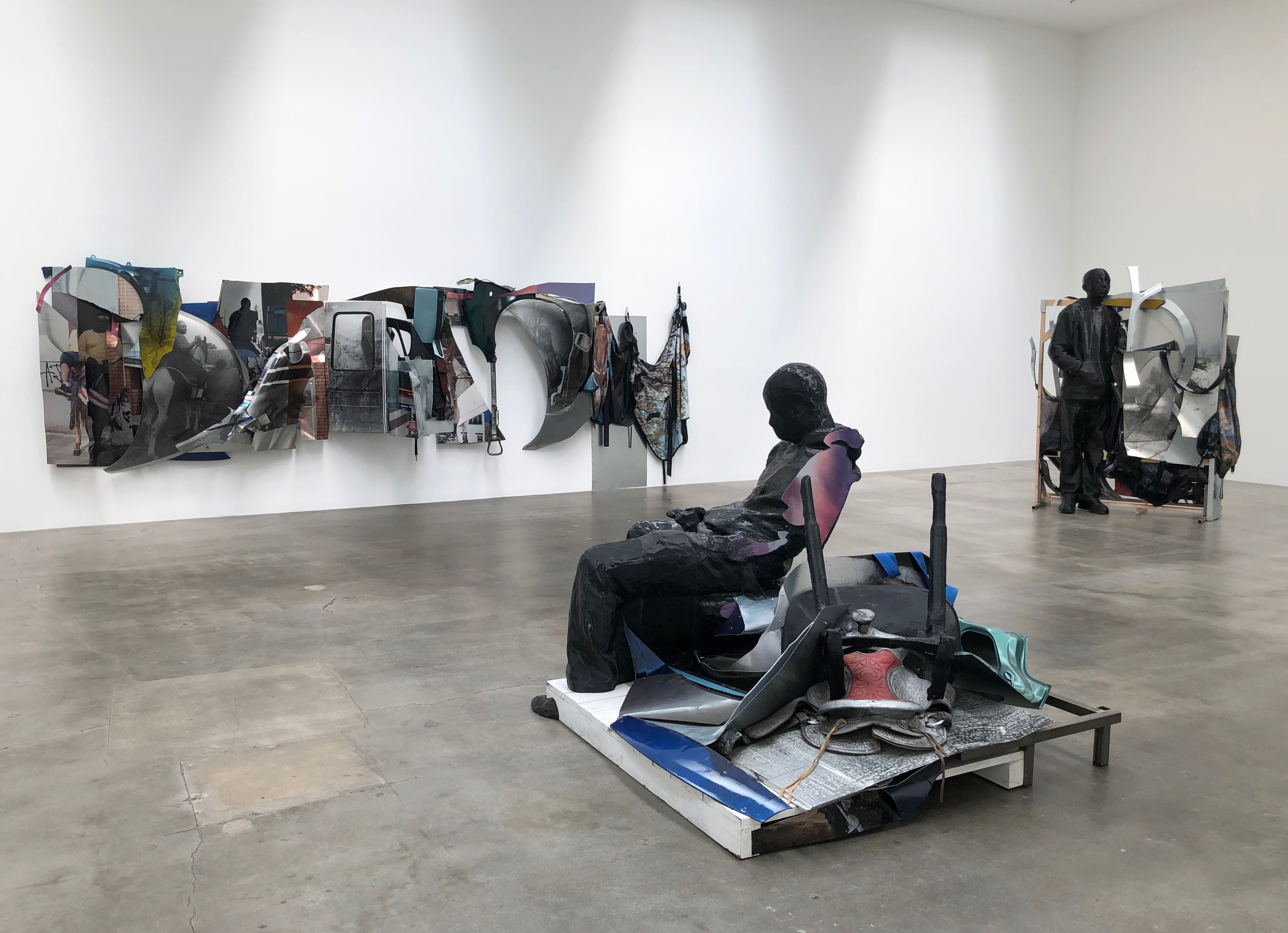
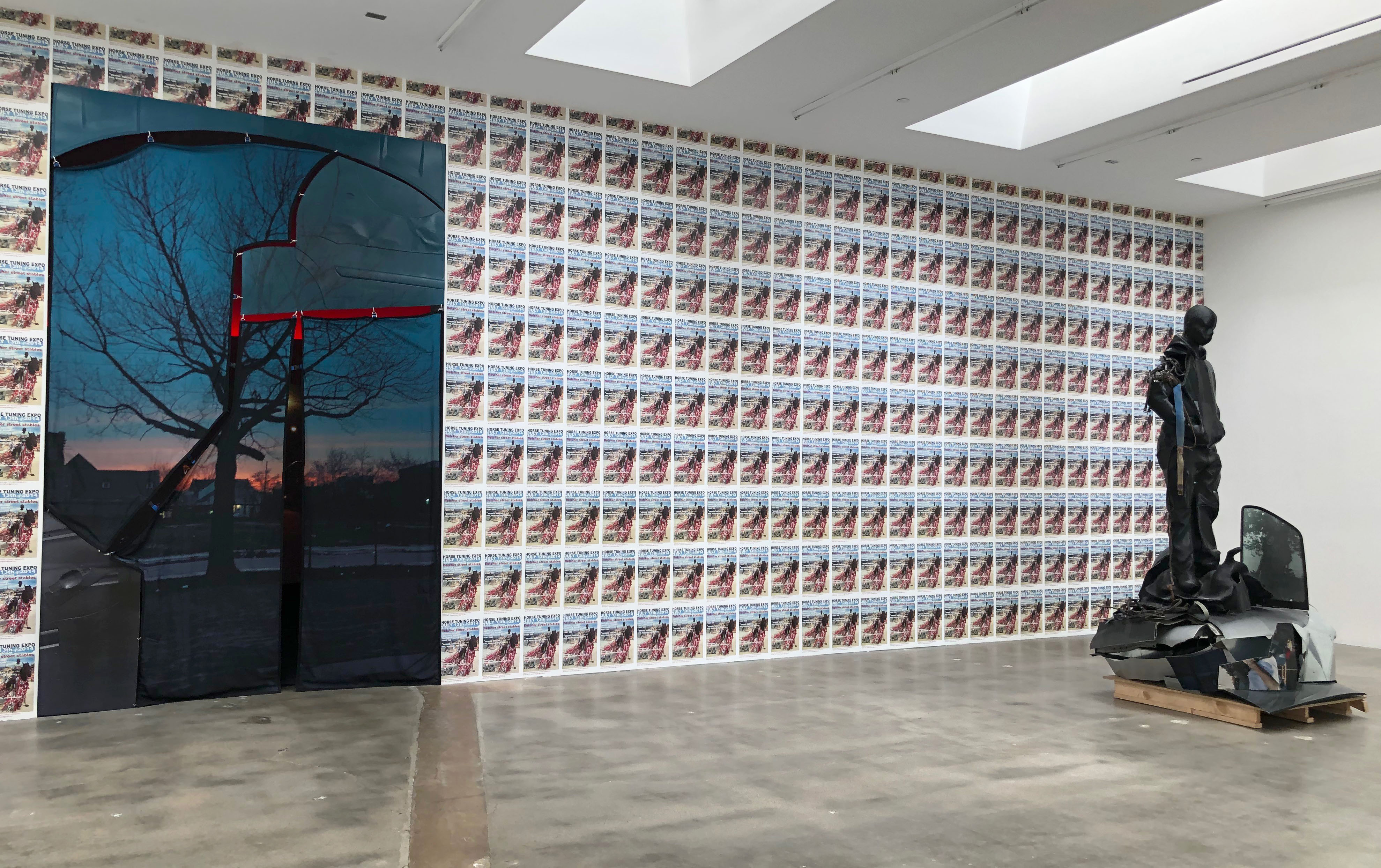
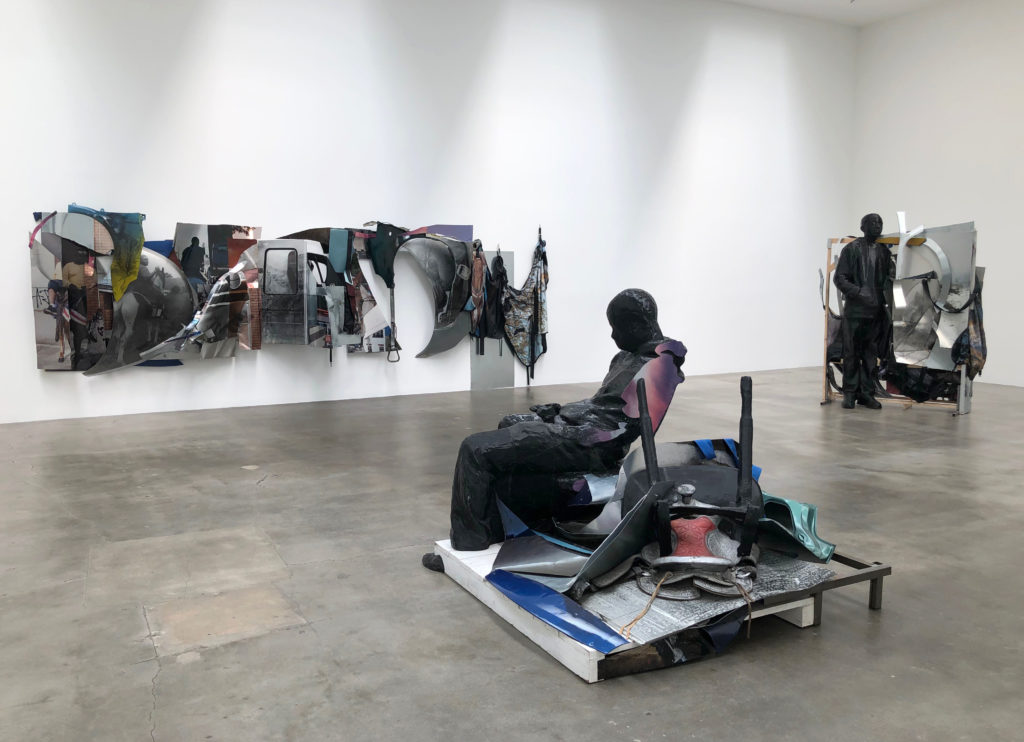
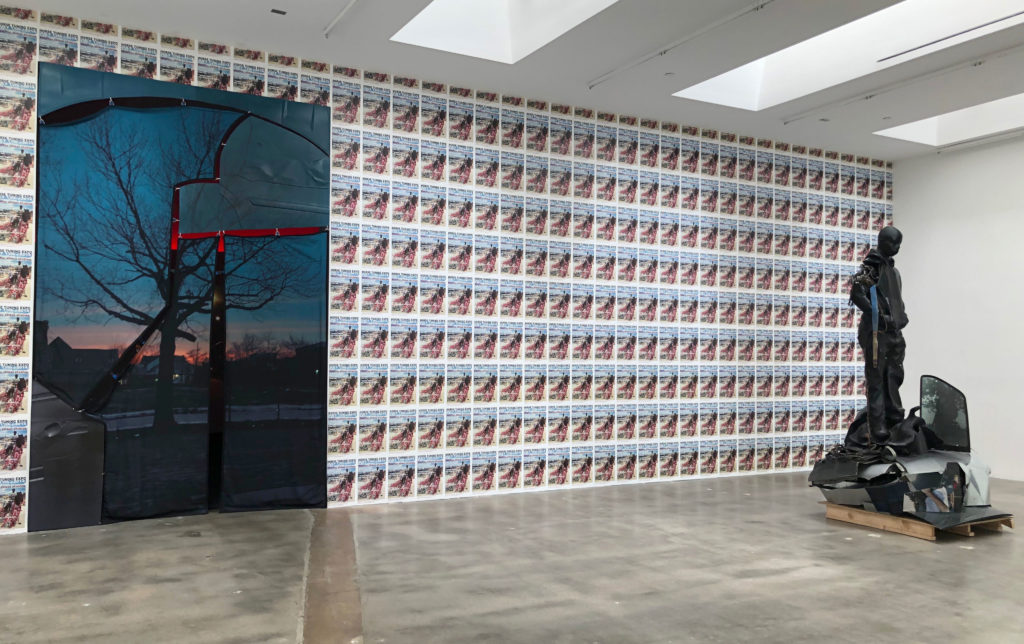
Paris-based Algerian artist Mohamed Bourouissa’s first solo exhibition in Los Angeles, Pour une poignée de Dollars (For A Fistful of Dollars), at Blum & Poe, combines film, sculpture, drawing and photography to expand on his project Horse Day, also on view at the gallery.

From the press release-

Initially driven to capture his own community and generation of immigrant youth living in the outskirts of Paris, in recent years Bourouissa’s focus has expanded to the US, the UAE, and beyond. In 2014 the artist spent nearly a year in North Philadelphia, PA living among the young men of the Fletcher Street Urban Riding Club, a non-profit established over 100 years ago by African American cowboys. This area increasingly struggles with unemployment and drug abuse, economic and social conditions from which the center attempts to provide a refuge—rescuing horses and mentoring boys who may otherwise find support hard to come by. Bourouissa instigated a collaboration with the community of riders and local artists—a riding competition and pageant called “Horse Day” in which equestrian participants arrived clad in decadent regalia, costumes including linked blank CDs, streamers, fake flowers, or fabric Pegasus wings. Using the cowboy as an emblem of a narrative of domination, the critical documents Bourouissa and the Fletcher Street community produced—sculptures, costumes, drawings, photography, and a video mixing tropes of westerns, documentaries and hip-hop—explore social injustice as it relates to geographical space, spotlight contemporary America’s culture of segregation, and intend to forge a new creative space for marginalized groups. Within a new body of sculptural work, the artist integrates images of riders and/or horses into the body parts of automobiles, as curator Okwui Enwezor once put it: “Bringing together two myths, the cowboy and the urban lowrider with his customized car, a sort of collision of the frontier and Compton.” This 3-D montage connects representations of domination and power, as well as industries and communities facing crisis.

Bourouissa’s work focuses on rituals of friendship, an exploration of alterity and the role images play in channels of distribution, investigations into the politics of representation and subjectivity. Seeking to humanize his community as social subjects, Bourouissa engages all sorts of imagery, initiating agency where is it often deprived. Bourouissa’s work is a hybrid of documentation and formal composition, collaborative choreographed representations of reality on the margins, channeling a wide range of historical precedents from Caravaggio and Delacroix to Fanon, rap music, and the Harlem Renaissance.

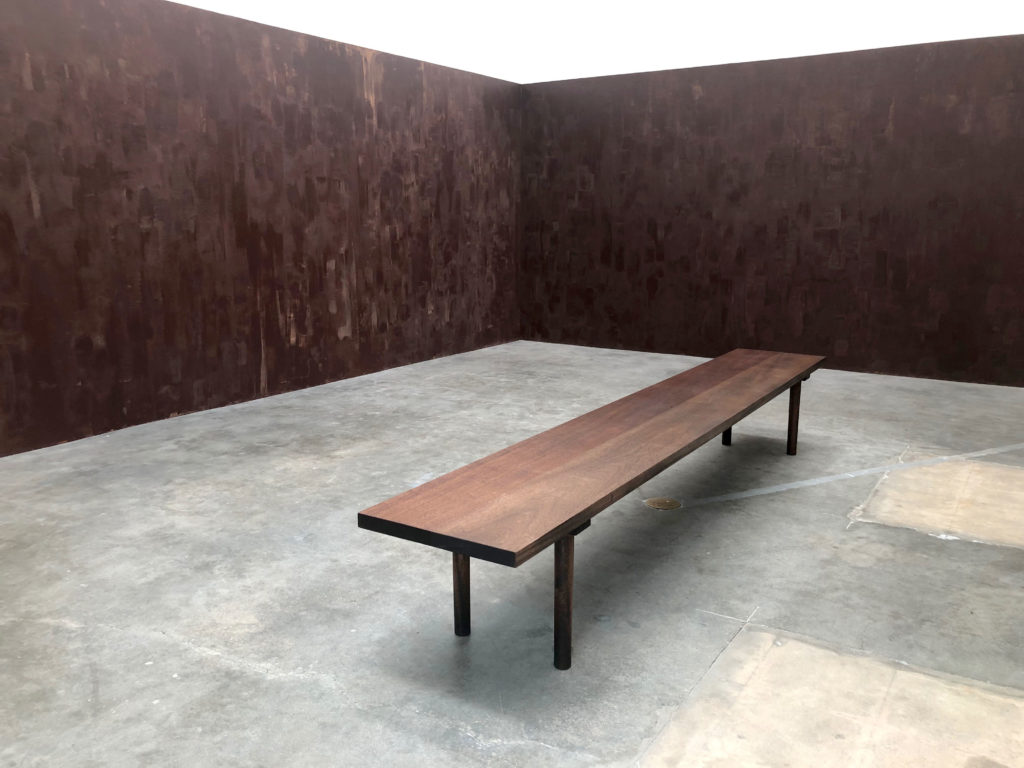
In a separate space behind the main gallery is Anya Gallaccio’s Stroke (pictured below), a room where the walls are painted with dark chocolate.  The work was originally created in September of 1994, for Blum & Poe’s inaugural exhibition at their original location in Santa Monica. Twenty-five years later, it has been recreated in an exhibition space the exact dimensions of the original gallery.

It’s worth checking out for the smell alone. It’s overpowering.

From the press release-

Stroke plays with perceptions of desire and their disconnection from reality. In this chocolate-covered room, an idea pulled from a childlike fantasy comes to life and goads the viewer’s appetite for pleasure. The whimsical notion of an edible room is contrasted with the strikingly rich, dark color of the walls and their heavy, sometimes putrid, smell. Of this disconnect, Gallaccio states, “the idea of a chocolate room is one thing, and the reality of a chocolate room is very much something else.” Created by thousands of small, repeated brush strokes for which the installation is named, prolonged looking is rewarded when one sees new colors, textures, and patterns appearing out of the darkness.

Rooted in the formal language of Minimalism, Gallaccio’s practice uses organic materials to subvert and reframe that male-dominated moment in art history. Trees, flowers, fruit, and ice are investigated for their fluidity and impermanence, and decay becomes a part of the installation to be embraced. The unpredictability of these ephemeral materials yields a freeing inability to control the final product, from which unexpected results emerge. These materials, pulled from a feminine, domestic space, challenge a masculine past and reclaim a place in history. As noted in the original press release from 1994: “Feminist in material, natural in its decay, subversively Freudian, Stroke is an enigmatic and challenging work.”
 

Both of these exhibitions close 10/26/19.