Work by Mel Rosen (sculpture) and Stass Shpanin (mural, video, and paintings)

Detail from Stass Shpanin’s “Dance of Birth” animated video

Ceramic sculptures by Mel Rosen

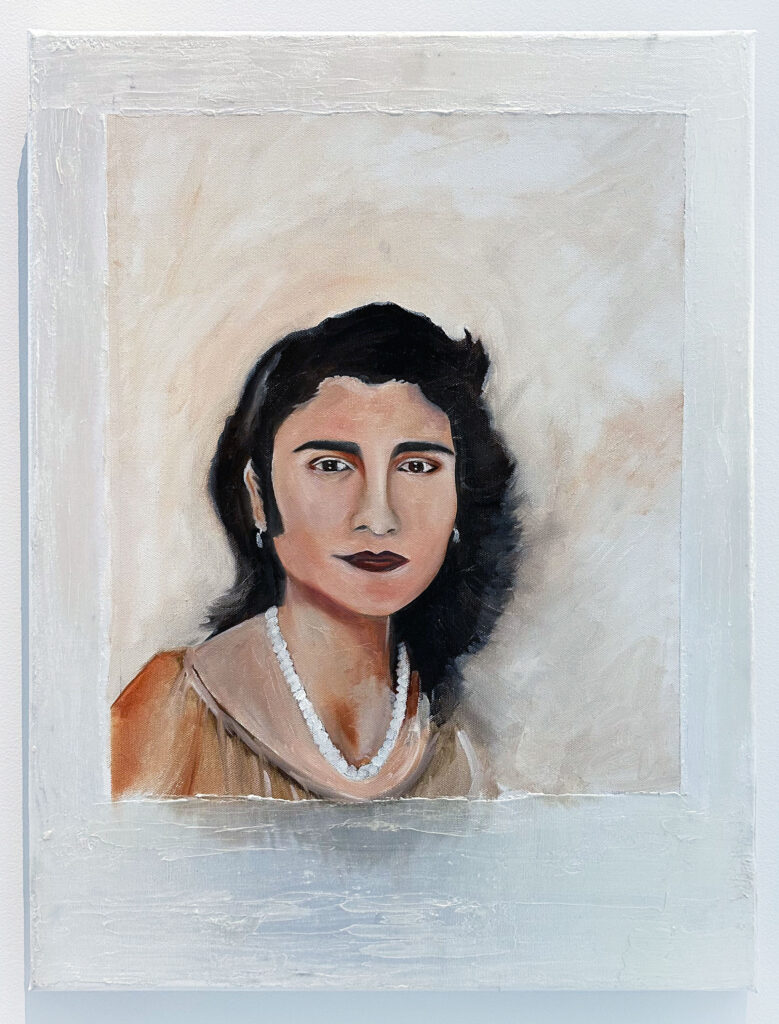
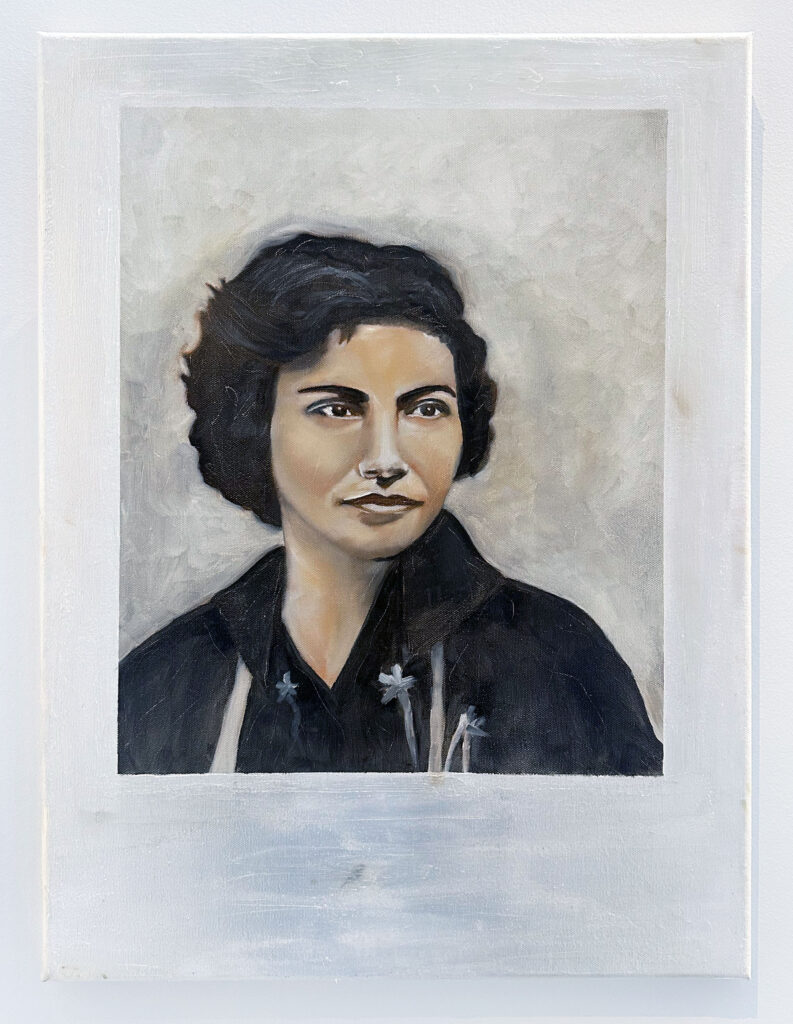
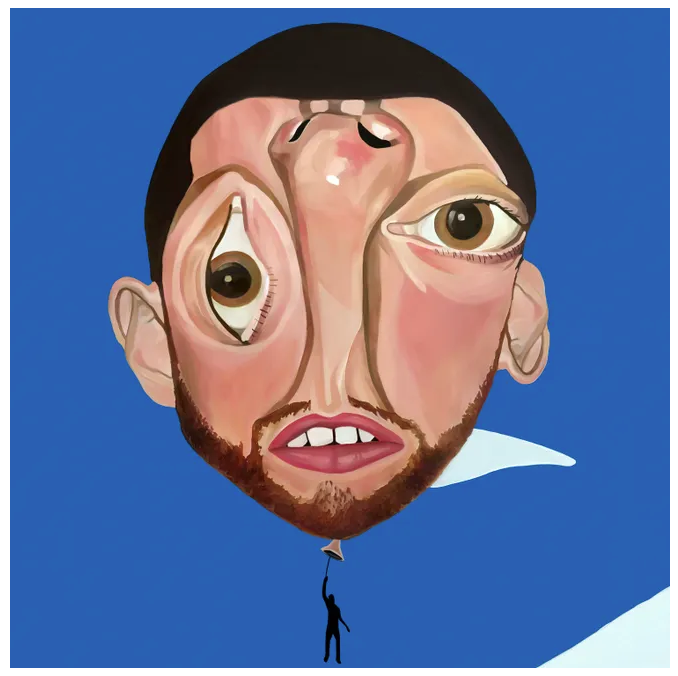
Paintings by Stass Shpanin
The Delaware Contemporary is currently showing three exhibitions as part of its 2025 Biennial Art + AI programming. This post covers two of them, the third is here.
Construct | Disrupt: Artificial Intelligence as Tool and Material features work by artists Mel Rosen, Stass Shpanin, Sol Kim, and Mark Burchick.
From the museum about the exhibition-
In an age when reality itself feels unstable—filtered through algorithms, fragmented by digital archives, and refracted through competing narratives—artists are increasingly turning to the tools of fiction and speculation not to obscure the truth, but to question how we construct it. Construct | Disrupt brings together the work of Mel Rosen, Sol Kim, Stass Shpanin, and Mark Burchick, four artists who use artificial intelligence, language, and archival material to explore the porous boundaries between perception, memory, and belief.
Across diverse practices—from ceramics, drawing, and painting to video, installation, and text—these artists engage with AI not as a replacement for the hand, but as a provocateur, a co-conspirator, and a mirror to the human imagination. Rather than seeking resolution or certainty, their works open up space for doubt, complexity, and contradiction.
Together, the artists in Construct | Disrupt invite us to consider how we construct meaning in a world where the archive is no longer fixed and where the image can be endlessly generated. The work of these artists does not offer answers, but rather asks: What do we trust? What do we remember? And how do we decide what is worth believing?
About the two artists pictured above, from the museum-
Stass Shpanin engages history as a space of imaginative reconstruction. Working with visual fragments from American folk traditions and immigrant archives, he uses AI to distort and reconfigure the past, generating speculative images that blend glitch, myth, and memory. His paintings and drawings present broken, layered timelines where visual language is both preserved and interrupted. Rather than restoring a singular truth, Shpanin’s work embraces the possibility of many coexisting histories—ones shaped as much by fantasy as by fact, as much by the digital as the ancestral.
Mel Rosen’s practice draws from archaeology, natural history, and personal memory to create objects and images that feel both ancient and otherworldly. Her use of AI image generation allows her to iterate quickly, mutating prompts based on her own drawings and a mental library of organic and cultural references—from Pompeian frescoes and fossils to barnacles and talismans. The resulting images feed back into her ceramics and drawings, where mythic forms and geometric distortions coexist in a suspended cosmology. Rosen’s work suggests that artifacts—whether material or digital—are always evolving, reshaped by time, environment, and interpretation.

Still from the video “Person Enough” by Sol Kim
Sol Kim (video still above) approaches language as a material form, using words to subtly disrupt social and technological systems. Her works often begin with a textual prompt—an instruction, label, or survey—that gives rise to absurd, humorous, or quietly unsettling performances. In The Cookiest Cookie, cookies are judged and destroyed by AI based on their perceived “cookie-ness,” while in Person Enough?, performers attempt to become more legibly “human” to computer vision systems. Through these gestures, Kim reveals the tensions between human nuance and machine classification, exposing the strange logic that governs our interactions with technology—and with one another.

Mark Burchick Installation

Images from Mark Burchick’s “Felt Presence”
Mark Burchick’s Felt Presence explores the intersection of faith, media, and artificial intelligence through the lens of Catholic mysticism. Drawing on archival photographs from the 1917 “Miracle of the Sun” in Fatima, Portugal, Burchick trains AI models to generate photorealistic images of miracles that were never captured on film. Presented alongside historical documentation and witness testimony, these fabricated scenes invite viewers to question the boundaries between belief, evidence, and visual truth—highlighting the unseen technological, institutional, and spiritual forces that shape our perception of reality.
In NOO Icons, Burchick expands this inquiry through an immersive video installation framed like a reliquary. A five-minute rear-projected loop, trained on over 100 images of stained glass Rose Windows, morphs into abstract color fields via AI animation. At its center is a 3D-printed altar piece generated using DreamFusion, a text-to-3D tool prompted to create a “solar monstrance.” The resulting object—gold-finished, internally lit, and housing Lithium batteries—evokes both the Communion host and a technological relic. As Kate Crawford notes in Atlas of AI, Lithium is a sacred yet finite resource driving modern AI. By encasing it in plastic and low-res form, Burchick critiques the planned obsolescence and ecological cost of our AI-powered age, reframing divine presence through the lens of material decay.
In another of the museum’s galleries is- Reimagine | Reveal: Challenging the Algorithmic Gaze featuring work by Danielle Glovin, Stephanie Dinkins, and Leah Modigliani.
About the show from the museum-
The works covering this exhibition theme approach AI not as a neutral instrument, but as a complex cultural system—one that reflects, amplifies, and at times distorts the values of its makers. Through the intersecting strategies of critique, reimagination, and bias exposure, Danielle Glovin, Stephanie Dinkins, and Leah Modigliani probe the systems—algorithmic, archival, social—that dictate what is preserved, who is recognized, and how knowledge circulates.
Together, these artists ask urgent questions: Who trains the algorithm? Whose histories are encoded, and whose are left out? What does it mean to build an intelligence—and who is it built for? In doing so, they model a critical engagement with AI, one that challenges default narratives, centers marginalized perspectives, and opens up space for new possibilities. Their practices call us to reconsider what it means to know, to remember, and to be recognized in a world increasingly shaped by invisible systems of intelligence.

Stephanie Dinkins’ interactive sculpture “Not The Only One (N’TOO)“

Stephanie Dinkins’ “Conversations with Bina48” (back wall) and Leah Modigliani’s AI generated letters for “Cultural Capital”

From Danielle Glovin’s series “Future Generations”
About the artists’ work pictured above-
Stephanie Dinkins’ Not The Only One (N’TOO) and Conversations with Bina48 extend this inquiry into the realm of relational AI, specifically that of minority groups in the tech sector. In N’TOO, an interactive sculpture gives voice to the oral histories of three generations of Black women, creating an AI entity intentionally designed, trained, and aligned with their values and lived experiences. It is a poignant reversal: instead of AI extracting meaning from biased data sets, Dinkins encodes her AI, reorienting the goals of intelligence design toward inclusivity and equal representation.
In Conversations with Bina48, Dinkins engages in an evolving dialogue with one of the world’s most advanced humanoid robots- probing the limits of kinship, consciousness, and identity. The recorded exchanges navigate tensions between human and machine, emotion and algorithm, intimacy and abstraction—underscoring the urgency of developing AI systems coded to reflect the full richness and diversity of human stories, cultures, and embodied experiences.
Leah Modigliani’s Cultural Capital offers a satirical yet incisive intervention into the circuits of artistic legitimacy. Through a fictional archive of AI-generated letters of recommendation and rejection—authored in the mimicked voices of historical critics and curators—Modigliani reveals how the rhetoric of value and genius in the art world is both constructed and recursively reinforced. The project uses generative tools to lay bare the biases embedded in cultural gatekeeping, drawing attention to the ways AI might amplify inherited hierarchies under the guise of neutrality.
Danielle Glovin’s Future Generations presents AI-generated reinterpretations of inherited family photographs, exposing the mechanics of machine vision and the flattening effects of automated classification. By transposing Midjourney text outputs onto her photographs, Glovin literalizes the collision between personal history and digital taxonomy. The result is a visual language at once familiar and estranged—where nostalgia meets simulation, and memory is rewritten through the aesthetics of machine learning.
These exhibitions will close on 12/28/25.