Dec 202022
 

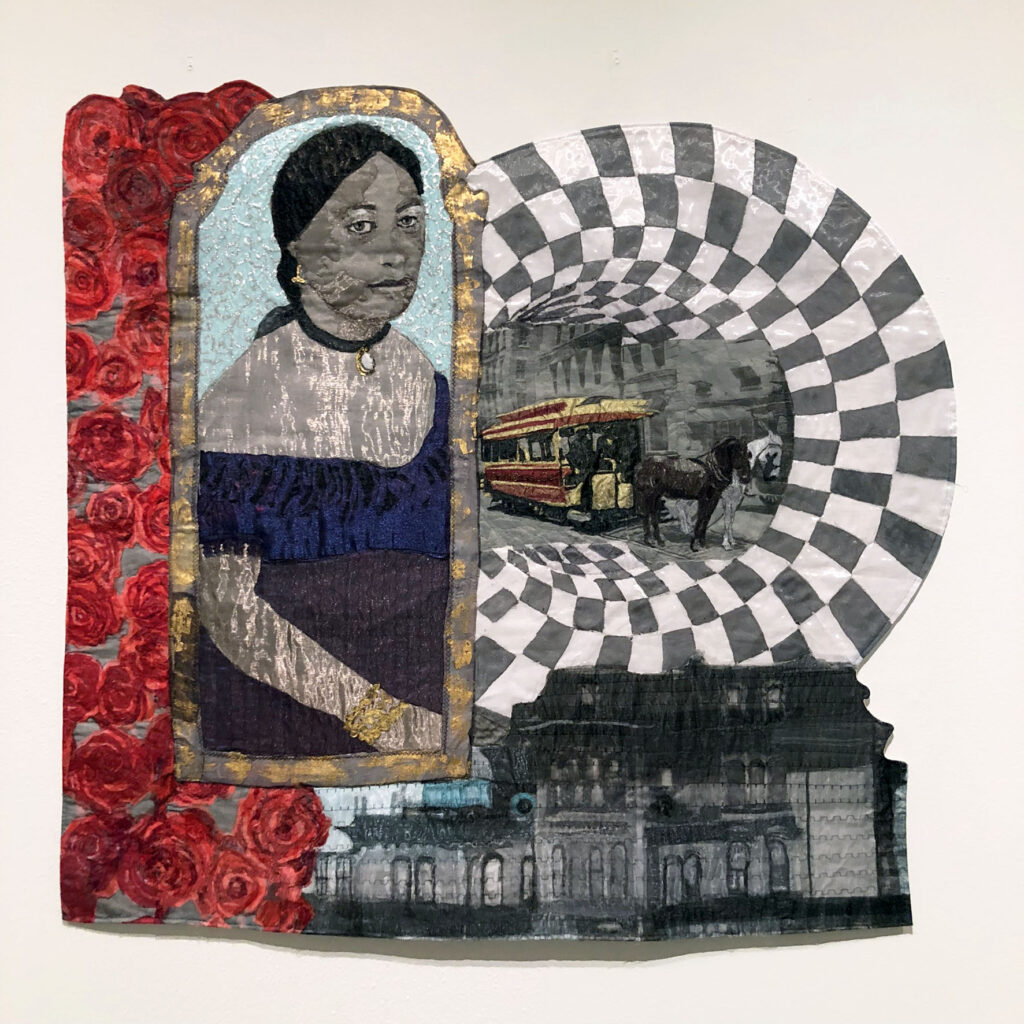
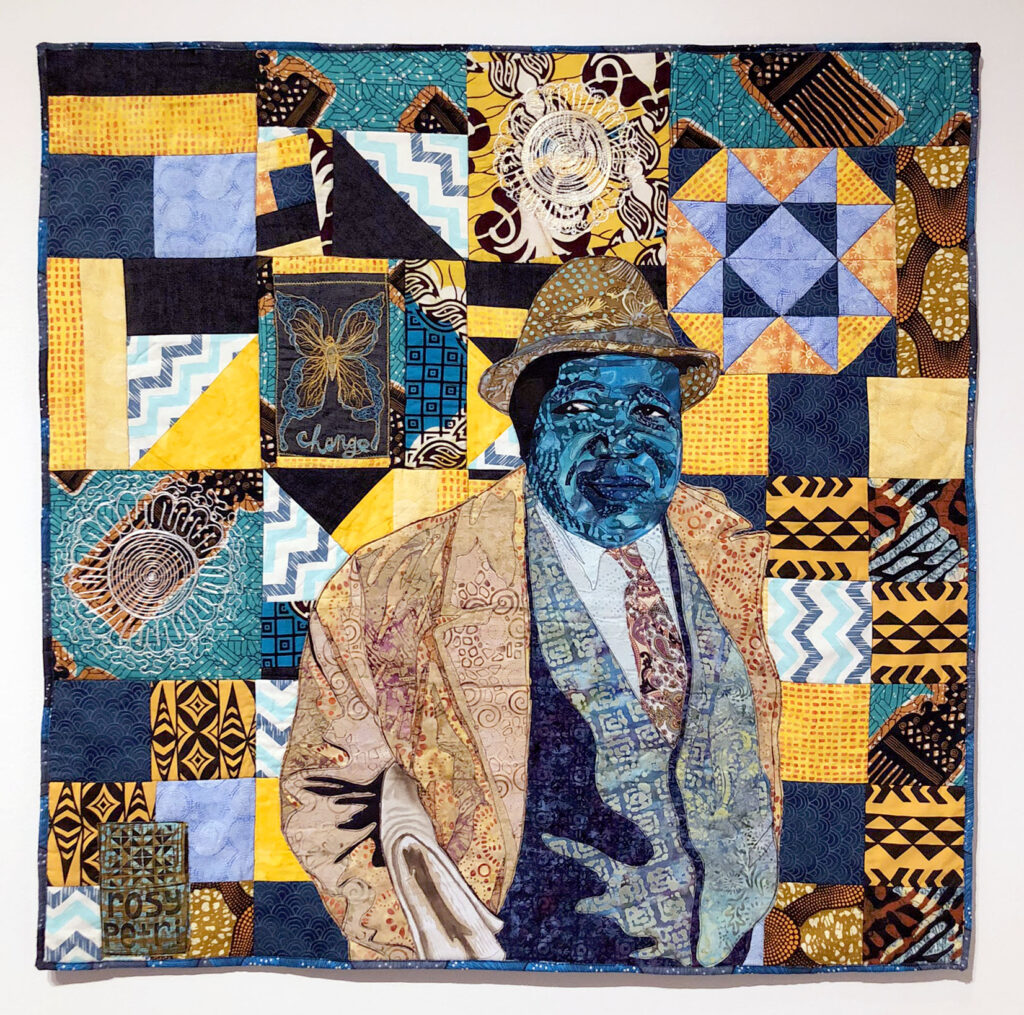
“Call Me Mrs. Mary E. Pleasant: The Midas Touch” by L’Merchie Frazier

Pictured above is a portrait of entrepreneur, civil rights activist and benefactor, Mary Ellen Pleasant who made a name and a fortune for herself in Gold Rush era San Francisco. Her timeline from 1814 to 1904 begins in racial slavery as an indentured servant girl with no formal education. She ascended to a self-made millionaire, amassing a fortune in her lifetime of over $30 million, ($900 million today).

Organized by historian, artist, and curator Dr. Carolyn Mazloomi, “Black Pioneers: Legacy in the American West” at The James Museum of Western and Wildlife Art, consists of 50 pictorial quilts created by members of Women of Color Quilters Network, a group founded by Mazloomi in 1985.

Mazloomi’s statement at the exhibition entrance-

American history is incomplete without the stories of African American men and women, from our enslaved ancestors to our societal challenges. The role of African Americans in the movement toward westward expansion has been largely overlooked. This exhibition of original pictorial quilts brings into focus the rich and diverse stories and achievements of Blacks in American western history. The timeline begins with Esteban’s 1528 arrival in the West and continues through the Civil Rights Movement.

At the end of Reconstruction in the South, discrimination and segregation caused African Americans to seek opportunities where there was less prejudice. In the 1800s, they moved by the thousands to the American West. Some went West as slaves, while free African American men joined the United States Army or became ranch hands, fur traders, cowboys, or miners.

Why quilts? Quilts and quilt making are important to American, and Black culture in particular. The art form was historically one of the few mediums accessible to marginalized groups to tell their own story, to provide warmth for their families, and to empower them with a voice through cloth. Using quilts to tell these stories accentuates the intersections of African Americans in the Western frontier while at once informing about the art form and its role in Black history. It is this often unknown and underappreciated shared reality that must be voiced if we are ever to truly value the unique contributions diverse groups make to the fabric of our nation.

Two more selections from the exhibition are below, although it was very hard to choose which quilts to highlight- there are so many great ones to choose from.

“A Good Soldier: Thomas C. Fleming, America’s Longest Serving Black Journalist” by Rosy Petri

At the time of his retirement in 1997, California journalist Thomas C. Fleming was the nation’s oldest Black journalist with the longest consecutive period of publication.

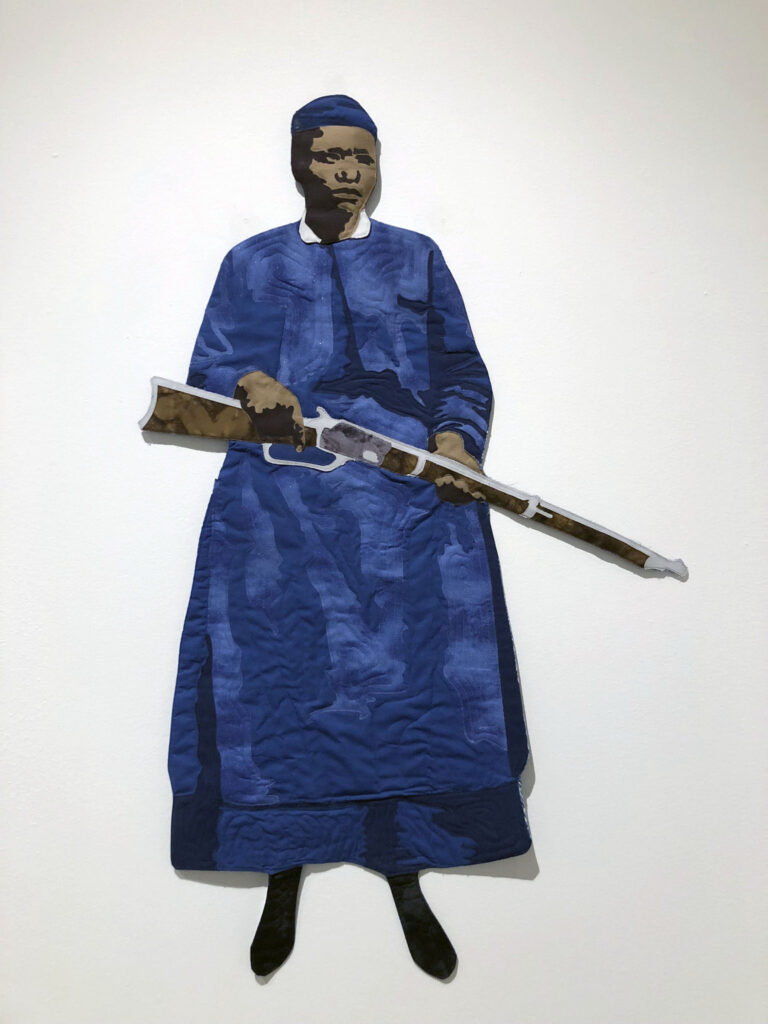
Information from the Museum’s wall plaque on Stagecoach Mary

Mary Fields- also known as Stagecoach Mary, Black Mary and White Crow-became a Wild West legend because she was the second woman and the first African American woman star route mail carrier in the United States.

Born into slavery and freed after the Civil War, she worked as a servant and laundress for families on riverboats before moving to Montana in 1885. A decade later she became a star route carrier, delivering mail using a stagecoach. She drove the 15-mile route from Cascade to Saint Peter’s Mission, Montana, from 1895 to 1903. Nicknamed Stagecoach Mary, she was known for her reliability and speed.

The six-foot-tall Fields was a quick-shooting and hard drinking mail carrier who wore men’s clothing and flaunted a revolver and a rifle. Locals praised her kindness and generosity, and schools in the town of Cascade were closed each year to celebrate her birthday.  Cascade’s mayor granted her an exemption to enter saloons after Montana passed a law forbidding women from entering these establishments.

The impressive quilts on view educate viewers with stories of individuals and events in African American history that may not have previously been familiar, and present new perspectives on those that are. It’s a wonderful way to utilize a visual medium to captivate, inform, and often inspire.

This exhibition closes on 1/8/2023.

Dec 162022
 

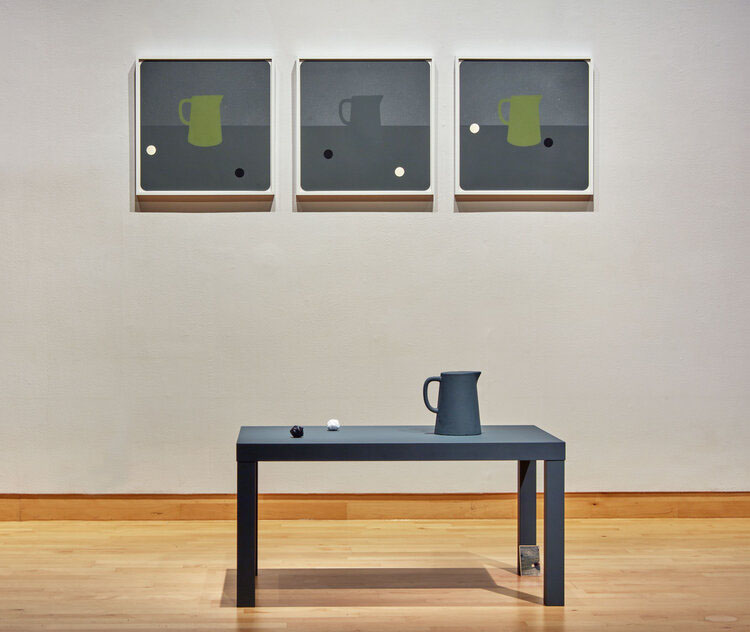
Themes for a Left-Handed Pitcher”, 2021: “Still Life with Left-Handed Pitcher (04-06)”, 2021. serigraphy, pochoir, collage, acrylic ink, gouache on paper; “Left-Handed Pitcher Still Life (II)”, 2021. particle board, acrylic ink, concrete, polymer clay; “Perfect Games (Theme for a Left-Handed Pitcher)”, 2021. projected sound from single speaker. 9:00 min. (infinite loop)

While at Dunedin Fine Art Center to hear Ry McCullough’s talk, I was reminded of seeing this work at the USF Contemporary Art Museum last year as part of Skyway 20/21: A Contemporary Collaboration. The discussion was great and touched on a lot of interesting topics, especially around his use of collage.

From the gallery’s wall plaque about Themes for a Left-Handed Pitcher

Inspired by the perfect game Los Angeles Dodgers’ pitcher Sandy Koufax threw against the Chicago Cubs in 1965, Themes for a Left Handed Pitcher engages compositional fielding of the domestic pitcher and black and white balls in a callback and comparative dialogue between sculptural objects and works on paper. Inviting playful and participatory discovery, the project includes an amplified palindromic sound score and a zine, which are both available to download. Interspersed with abstracted baseball references, the project evokes a change-up between the fabricated and found forms, the known and the unknown.

On McCullough’s website you can find the downloadable zine and the audio file mentioned in the description above and its a chance to check out more of his impressive collage pieces. For his most recent work, also check out his Instagram.

In addition to his independent practice, he is part of the collaborative project, small_bars, with artist Nick Satinover.

From the small_bars information page about the project-

Within their collaborative practice they explore the structural authority of their band name moniker, small_bars. This ambiguous name serves as an all-encompassing banner which simultaneously referencing pixels on a screen, lines of type of a letter press, halftone processes, and the physical clubs and venues their former bands played. As small_bars, McCullough and Satinover are able to generate a collection of collateral materials such as audio recordings, videos, printed ephemera, performative events, and structural arrangements, all of which support and expand the notion of what the moniker suggests. This collaborative effort seeks to use the form of a band-like entity to create a space where the acts of publishing, printing and performance co-exist.


Dec 102016


todd-murphy-nov2017-stag

todd-murphy-murmuration-12016

Marc Straus gallery on the Lower East Side has two great sculpture shows closing this weekend (12/11/16). Todd Murphy’s mixed media sculptures are gorgeous creations which glow on the walls of the upstairs space.

On the first floor of the gallery, are Chris Jones’ intricate pieces created with images from discarded magazines and books. The details within these worlds become more and more apparent the longer one looks at them, including plants growing into other spaces and laundry tumbling out into other frames.
joneschris-after-they-had-left-2015

joneschris-portrait-1-14-25-x-11-5-x-1-in

jones-chris-of-vanished-alphabets-2016-05

(images via Marc Straus)

Nov 282015
 
melindagibsonrosegalleryXVI

Melinda Gibson

GretaSterndream31rosegallery

Grete Stern

atthebeachcarollebenitahrosegallery

Carolle Benitah

Her First Meteorite, at ROSEGALLERY, is a wonderful selection of photographic collages by Carolle Benitah, James Gallagher, Melinda Gibson, Ken Graves, Stéphanie Solinas, Annegret Soltau, and Grete Stern. The work included in the exhibition ranges in time period from the late 1940′s to present day. Each of the photographers included brings a unique perspective to the different ways a photograph can be altered to create an effective image.

This exhibition closes 11/28/15.

Dec 182013
 

Len Lye’s A Colour Box (1935)

If you missed the show at Roberts & Tilton, here is one of the works from it. This piece, by New Zealand artist Len Lye, was the first direct film screened to a general audience. Set to La Belle Créole by Don Baretto and his Cuban Orchestra, it was made by painting directly on the celluloid.

Nov 082013
 

frutique

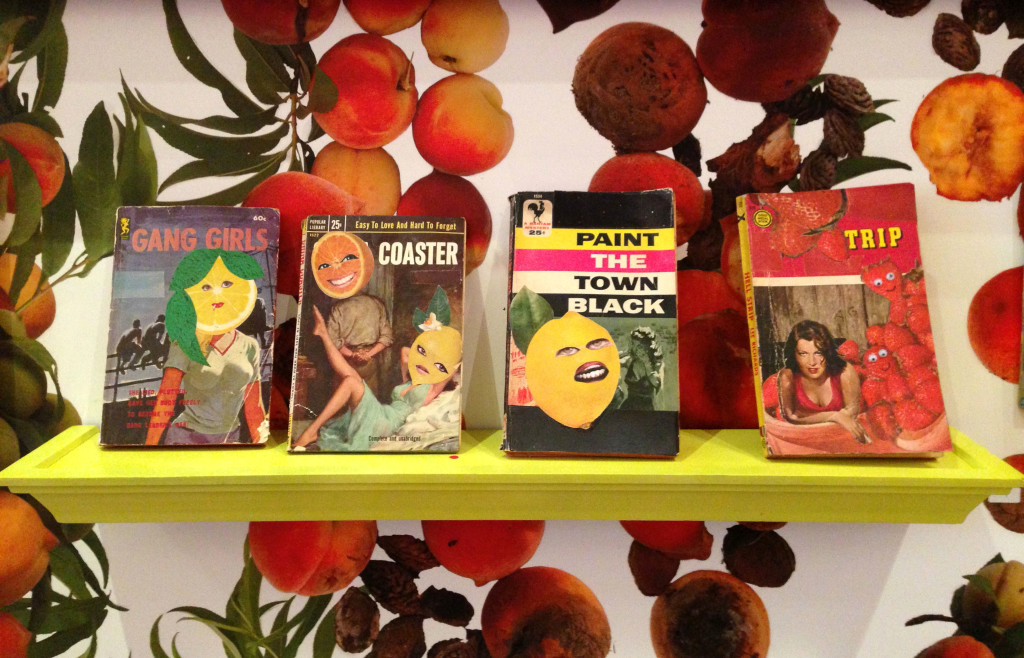
Fallen Fruit: Fruitique!

This art installation/ thrift store is part of Arts ReSTORE LA: Westwood. Everything is fruit themed within the space including the wallpaper, numerous thrift store finds and even the music playing (Cherry Bomb was on when I was there- although that may have been coincidence).  They are also planning fruit related activities throughout the event.

Fallen Fruit is an art collaboration originally conceived by David Burns, Matias Viegener, and Austin Young.

They are also part of the Ojai Art Festival this weekend.