Nov 152024
 

Sculptures by Emily Sudd

Sculptures by Kyung Boon Oh

Photography by Kate Turning

Pictured above are some selections from Plateaus: Art That Resonates, a multisensory group exhibition at Art Share L.A. exploring the dualities of life that artists bring into their work.

From the gallery-

Art Share L.A. is pleased to present Plateaus: Art that Resonates a multidisciplinary and multisensory immersive art exhibition that explores dualities: art and craft, death and life, grief and love, and activity and stillness. These contrasts exist with an interdependent bond, reminding us that bonds are intrinsic and often intertwined partners. In multiple materials, processes, and scales, monument-like creations are revealed through thoughtful burnishing of passion.  The exhibition curated by Stacie B. London features seven visual artists: Amanda Maciel Antunes, Kyong Boon Oh, Hadley Holiday, Soojung Park, Emily Sudd, Kate Turning, and Cheyann Washington, along with additional contributions of ikebana by members of Sogestu Los Angeles, music by Rocco DeLuca, perfume by Lesli Wood (La Curie Eau de Parfume), and seating by Hunter Knight. Through a shared refinement of intentional experimentation with their mediums – acrylic panels, clay, glass, ink, photography, scent, sound, stone, thread, tree stumps, and wire– these artistic achievements reveal work that is brave, meditative, resilient, and vulnerable.

Our five senses inform our experiences and knowledge and assist us in ordering the world. In Plateaus: Art that Resonates the traditional forms of visual art of painting, photography, and sculpture are broadened to include aural art — via music and sound — and olfactory art. These multisensory and immersive pieces enhance the experience of viewing visual art and introduce additional dualities: sight with smell, smell with hearing, and hearing with sight. The expanded human experiences in an art gallery switch the expected experiences and invite the possibility of a familiar experience in a new way, or a breakthrough!

Breakthroughs often occur after long periods of what often seems like stagnation, or a plateau. It’s instinctual to want growth to be a continual upward trend, but instead it’s usually a series of long, flat periods (plateaus) of work with few visible results. Seemingly out of nowhere the plateau makes space for a breakthrough of creativity or growth—an intermittent moment when everything comes together. Instead of focusing on the result, it’s good to get comfortable in the plateau.

The artists and artisans of Plateaus: Art that Resonates use a broad range of approaches and techniques towards creative creations that are examples of how to grapple dualities, navigate the plateaus of life, and share breakthroughs that transmute our awareness of mortality into loving engagements with life and it’s contradictions and opposing perspectives that inspire and infuse life with meaning, immediacy, awareness, and appreciation.

Below are two of the ikebana created by members of Sogetsu Los Angeles.

This exhibition closes this Saturday (11/16) with a closing reception from 6-9pm.

Oct 042024
 

Dennis Johnson, “Red Hot Trucking”, Acrylic on canvas

Paintings by Elaine Mathews (two left) and William Nelson (painting on the right)

Mixed media piece by Michael Stanley (left); Center sculptures by Lucia Grossberger Morales; Pair of paintings by Lisa Van Herik (right)

Photo on left by Bill Leigh Brewer; Center painting by Jan Slawson and work by Karen Elizabeth Baker (right)

Painting on left by Dennis Johnson; Center photographs by Andy Nystrom; Right painting by Mariana Maldonado-Pagán

Photograph on the left by D Wallace Colvard; Sculptures by Dean Steiner (center) and photograph by Dean Genth (right)

The Artists Council is a non-profit organization focused on local artists in the Coachella Valley. They host several exhibitions, classes, and workshops in their gallery space in Palm Desert.

Their current member exhibition Hot Times Cool Art is on view until 10/6/24. You can see many of the artworks on view on their website.

Oct 022024
 

Kathleen Strukoff, “Turquoise Bird”, Mixed Media, Kee Gallery

Backstreet Art District in Palm Springs consists of several art galleries and studios and hosts a monthly event on the first Wednesday of every month. For additional information and a list of all of the galleries and their current showings, head to their website.

Below are a few selections from this past summer.

Work by Ernesto Ramirez

Work by Erich Meager

Kee Gallery is owned and operated by artists Kathleen Strukoff, Ernesto Ramirez, and Erich Meager.

Work by Aurora Lucia-Levey at Tom Ross Gallery

Work by Rae Harrell from her gallery

Paintings by Martin Prew at Kevin Goddess’s gallery

Paintings by Kevin Goddess

The studio in the back of Stephen Baumbach Gallery

Stephen Baumbach Gallery hosts numerous photography exhibitions throughout the year and houses a fine art printing business.


Work by Gary Wexler

The studio at Gary Wexler Design


Sep 252024
 

“Le Déjeuner sur l’herbe les Trois Femmes Noires d’apés Picasso (Luncheon on the Grass, Three Black Women after Picasso)”, 2022

“Look at What You’ve Become”, 2005 and “Portrait of Mnonja with Flower in Hair”, 2008, Rhinestones, acrylic, and enamel on wood panel

Mickalene Thomas: All About Love at The Broad presents a beautifully curated collection of work from the artist’s impressive career. Below are a few selections and information from The Broad about the show and some of the individual works.

From the museum about the exhibition-

Mickalene Thomas’s paintings, photographs, video installations, and sculptures celebrate the experiences of Black women. Her work is rooted in the intimacy of relationships between mothers and daughters, between lovers, and between friends. Thomas’s work centers the joys and complexities of self-respect and love, especially at times when they are diminished or threatened.

Thomas was born in Camden, New Jersey, and grew up in Hillside and East Orange, a childhood evoked in the building facades that open this exhibition. After coming out at the age of sixteen, she moved to Portland, Oregon, where the encouragement of a small group of local artists and an inspiring encounter with the work of Carrie Mae Weems led her to attend Pratt Institute, then Yale University, to pursue visual art.

Mickalene Thomas: All About Love begins in 2003, when Thomas turned from making abstract paintings to portraiture and photography. Her first subject was her mother, Sandra Bush, affectionately known as “Mama Bush.” By focusing on their relationship, Thomas began considering identity through the mirrors of family and friends, as well as through public images manifested by Black musicians, fashion icons, actors, and performers.

From early in her career, Thomas built sets in which she would photograph her muses. She wanted her subjects to feel in a place of mutual comfort, respect, and trust. Later, Thomas would take her muses into the environments and scenes of art history, claiming space inside the narratives and imagery from which Black and queer people have been either excluded or shown anonymously. Recent work in the exhibition, such as Thomas’s Jet series and Tête de Femme (seen in Los Angeles for the first time), confronts cultural conventions of beauty, reconfiguring norms in celebration of beauty centered in individuality and acceptance.

Spanning twenty years of Thomas’s career, this exhibition takes its title from bell hooks’s essential collection of essays All About Love, in which the writer argues that in order to counter and reorient a culture of power and domination, one must act according to a set of principles where “everyone has a right to be free, to live life and well.” In the spirit of hooks, the artwork of Thomas aims to make space for Black joy, leisure, and eroticism, both for their own sake and to counteract injustice.

“A Little Taste Outside of Love”, 2007 Acrylic, enamel, and rhinestones on wood panel

“Three Graces: Les Trois Femmes Noires (Three Graces: Three Black Women)”, 2011, Rhinestones, acrylic, oil, and enamel on wood panel

“Afro Goddess Looking Forward”, 2015, Rhinestones, acrylic, and oil on wood panel

About the work above from the museum-

In this work, Thomas is the main subject, the muse of her own practice. In a 2006 photo session, the artist produced a series of self-portraits that has become the inspiration and visual material for many paintings. Early paintings based on these images include intact bodies shown inside of a shifting assortment of collaged patterns that accumulate and fracture around the subject. However, in this 2015 painting, Thomas collages a set of eyes onto the figure, drawing attention to the artist’s gaze of the viewer. This strategy- collaging onto the figure- continues today, as Thomas obscures and asserts different features of the body to investigate the construction of identity and beauty.

Her photography and video work shared a large room in the exhibition.

From the museum about the wall of photos above (image is a section of the full wall)-

Photography has long played an important role in Mickalene Thomas’s work. As a student at Yale, in a class with David Hilliard, Thomas was encouraged to experiment with the medium, to explore a subject that came “from a vulnerable place.” This led to photographing her mother, early engagements with self-portraiture, and photo sessions with women close to her. Initially, Thomas’s photography was used as material in her collages and paintings, but over time, the artist has embraced her photographs as standalone artworks.

This wall contains many facets of Thomas’s photography practice, all “proof of an experience between her and her subject,” as writer Jennifer Blessing observes. Some of the photographs—like La leon d’amour (A Lesson of Love), 2008, and Le Déjeuner sur l’herbe: Les trois femmes noires (Luncheon on the Grass: Three Black Women), 2010— became springboards for Thomas’s most well-known paintings. Other photographs speak to Thomas’s success and visibility as a dynamic studio photographer, as in her commission for Aperture in 2019, Untitled #3 (Orlando Series), and in Madame Carrie, 2018, for the New York Times.

About the video installation pictured below-

For this eight-channel video, Thomas was inspired by Eartha Kitt’s 1953 song Angelitos Negros (Black Angels), in which the singer implores artists of religious devotion to paint Black angels and add their depictions to visions of heaven. “You paint all our churches, and fill them with beautiful angels,” a translation of the song records, “but you never do remember, to paint us a Black angel.” For Thomas, the song was a revelation, speaking to the heart of her artistic practice of celebrating and advancing joyful images of Black women. This video is a collage, repurposing found footage from YouTube and enlisting Thomas’s muses to perform, all coming together in fulfillment of Kitt’s wish.

“Angelitos Negros (Black Angels)”, 2016, Eight channel digital video

There is a section of the exhibition devoted to Thomas’s Resist series, which includes The Charnel House (Resist #5), 2021, pictured below.

About the Resist paintings from the museum-

Mickalene Thomas made her first Resist painting in 2017 for the Seattle Art Museum’s Figuring History, an exhibition focused on questioning distorted narratives of history through Black experience. Making new work, Thomas brought her extensive artistic toolkit of collage, her use or rhinestones and other craft materials, and her viewpoint as a Black queer woman to create a direct encounter with the civil rights era of the 1960s. Thomas has spoken of being especially inspired by the work of Robert Colescott, whose satirical paintings offered her a sense of permission and a voice to approach social events proactively.

In the Resist series, Thomas finds echoes of the past in the present, layering archival images from the civil rights era with images from recent protests and uprisings related to Black Lives Matter and other social justice movements. Of central importance in Resist is memory, the remembrance of lives that have been taken by police brutality and injustice. In the works on view in this gallery, protests, such as those in the wake of the killing of Michael Brown in Ferguson, Missouri, are seen in the context of images of activists like James Baldwin and Shirley Chisholm, as well as of photographs of race-based attacks on Black people from many decades

From the museum about The Charnel House

In this painting, the history of civil rights in the United States meets the open conflicts and struggles of the present. The surface is an accumulation of slogans: signs for the Black Panther Party’s free breakfast for children program join the names of Freddie Gray and Alton Sterling (both killed in encounters with police), as well as posters for Black Lives Matter and others from the March for Racial Justice held in September 2017 in Washington DC, specifically “Women of Color Have Always Led Change.” The collision of eras in the work is buttressed and sharpened by deep questions about art’s ability and responsibility to be an agent for political protest and change. Thomas interlaces the panel with patterns from Pablo Picasso’s The Charnel House, 1944-45,  a work that Picasso considered a depiction of a massacre and that (along with Guernica, 1937) is seen as the artist’s most direct engagement with the politics and horrors of the Spanish Civil War and, for some commentators, World War II and the Holocaust.

In 2017 Mickalene Thomas began using Jet magazine as a source in her work, specifically it’s nude calendar which used anonymous models.

From the museum about the series-

Thomas speaks of her Jet series as rooted in desire, in her openness to unapologetically love Black women: “I think there’s something to owning Black women’s erotica-us owning our sexuality needs to be validated as we own and love our own bodies, and want to be desired.
The Black female body is beautiful.”

“February 1976”, 2021, Rhinestones, glitter, charcoal, acrylic, and oil paint on canvas mounted on wood panel and oak frame

About the above work from the museum-

The original Jet calendar image for February 1976 featured a model in an interior populated with plants, one of which served to obscure her genitals. A decorative screen acts as a backdrop and the model is posed like an odalisque, right out of art history. In Thomas’s work, she intervenes dramatically in the scene, leaving the model mostly intact and expressive, while radically abstracting the plants and screen. For the painting’s debut at Lévy Gorvy gallery in 2021, the artist evoked both the grid of the screen and the plants in the space itself, filling the floor with mirrored tiles and greenery, as seen installed here.


Jet Blue #28, 2021 Rhinestones, acrylic paint, oil pastel, mixed-media paper, and archival pigment prints on museum paper mounted on Dibond with mahogany and Jet Blue #45 (Neon), 2024, Neon

This exhibition closes 9/29/24.

Aug 072024
 

Lotus L. Kang, “In Cascades”, 2023-2024

Lotus L. Kang, “In Cascades”, 2023-2024

The Whitney Biennial ‘s 2024 edition, Even Better Than The Real Thing, presents a large group of artists, working in different mediums, with many pieces directly dealing with social and political issues. The show does have a certain heaviness to it, but with all of the issues currently happening in the world it would be impossible for that not to be reflected in the artwork.

From the museum-

The eighty-first edition of the Whitney Biennial—the longest-running survey of contemporary art in the United States—features seventy-one artists and collectives grappling with many of today’s most pressing issues. This Biennial is like being inside a “dissonant chorus,” as participating artist Ligia Lewis described it, a provocative yet intimate experience of distinct and disparate voices that collectively probe the cracks and fissures of the unfolding moment.

The exhibition’s subtitle, Even Better Than the Real Thing, acknowledges that Artificial Intelligence (AI) is complicating our understanding of what is real, and rhetoric around gender and authenticity is being used politically and legally to perpetuate transphobia and restrict bodily autonomy. These developments are part of a long history of deeming people of marginalized race, gender, and ability as subhuman—less than real. In making this exhibition, we committed to amplifying the voices of artists who are confronting these legacies, and to providing a space where difficult ideas can be engaged and considered.

This Biennial is a gathering of artists who explore the permeability of the relationships between mind and body, the fluidity of identity, and the growing precariousness of the natural and constructed worlds around us. Whether through subversive humor, expressive abstraction, or non-Western forms of cosmological thinking, to name but a few of their methods, these artists demonstrate that there are pathways to be found, strategies of coping and healing to be discovered, and ways to come together even in a fractured time.

There’s a lot of great work to see. Below are just a few selections and some documentation from the museum.

For Lotus L. Kang’s In Cascades, (pictured above), the artist has hung sheets of photographic film from steel joists suspended from the ceiling that are gradually changed by the light inside the gallery. She refers to the exposure process as “tanning” and, like our skin, the film is changing over time with its environment. On the floor are little sculptures, as well as a a suitcase, all suggesting movement and change.

Kiyan Williams eye-catching outdoor installation Ruins of Empire II or The Earth Swallows the Master’s House, has the White House is sinking into the ground with an  upside down American flag at the top.

Kiyan Williams, “Ruins of Empire II or The Earth Swallows the Master’s House”

Maja Ruznic, “The Past Awaiting the Future/Arrival of Drummers”, 2023

The description of Maja Ruznic‘s painting from the museum-

Ruznic has said that The Past Awaiting the Present/Arrival of Drummers “looks at how multiple things can be true at the same time: birth, violence, pain, suffering, joy, and music.” She has described the horizontal format of the painting as inherently linear, implying a past, present, and future. The movements suggested by the figures’ feet—some in profile and others pointed toward the viewer—collapse these temporalities into a single symbolic image.

Mary Lovelace O’Neal, “Twelve Thirty-Four “(From the “Doctor Alcocer’s Corsets for Horses” series), 2023, Acrylic and oil pastel on canvas

From the museum about Mary Lovelace O’Neal

Mary Lovelace O’Neal began the series that included Blue Whale aka #12 (from the Whales Fucking series), after two whales caught her imagination as she walked on a beach near San Francisco. “And watching them, I thought, imagine the tons and tons of water they must displace when they’re fucking!” It is this sense of excitement and desire on a grand scale, the energy of the light in their spray, that she worked to capture in paint—more than the image of the whale itself.

Such a dynamic, independent, sometimes slightly outrageous point of view has driven Lovelace O’Neal throughout her sixty-year career, which has unfolded alongside heated debates about what painting should or should not do and prescriptive views of Black artists and abstraction. While Lovelace O’Neal was deeply involved with the civil rights movement on a political level, she resisted calls to make representational paintings that would illustrate or inspire the struggle, insisting that forging her own path in abstraction—as she does in each of the paintings on view here—was equally relevant to Black life.


Isaac Julien’s immersive video installation was really absorbing. The sculptures added an extra dimension to what was on screen.

From the museum-

Unfolding across five screens, Once Again . . . (Statues Never Die) reflects on the life and thought of Alain Locke (1885–1954), philosopher, educator, and cultural critic of the Harlem Renaissance (played by André Holland) who urged members of the African diaspora to embrace African art in order to reclaim their cultural heritage. The installation includes sculptures by Richmond Barthé (1901–1989) and Matthew Angelo Harrison (b. 1985), opening up a conversation about Black artists’ legacies that extends across modern history. Julien has described the work as a form of “poetic restitution,” speaking to the ways museums have collected African art. The artist refines this critique by creating a visual and sonic meditation as a “diasporic dream-space.”

In the work, Locke contemplates the Pitt Rivers Museum at the University of Oxford—where he was the first Black Rhodes Scholar—and the Barnes Collection in Philadelphia, founded by one of Locke’s interlocutors, Albert C. Barnes (1872–1951), played by Danny Huston. Barnes also debates a skeptical Locke on his heritage, a sequence that distills many of the questions that the installation raises: Who gets to define Black modernism? Who has the authority to speak? How do men negotiate power, or queer desire?

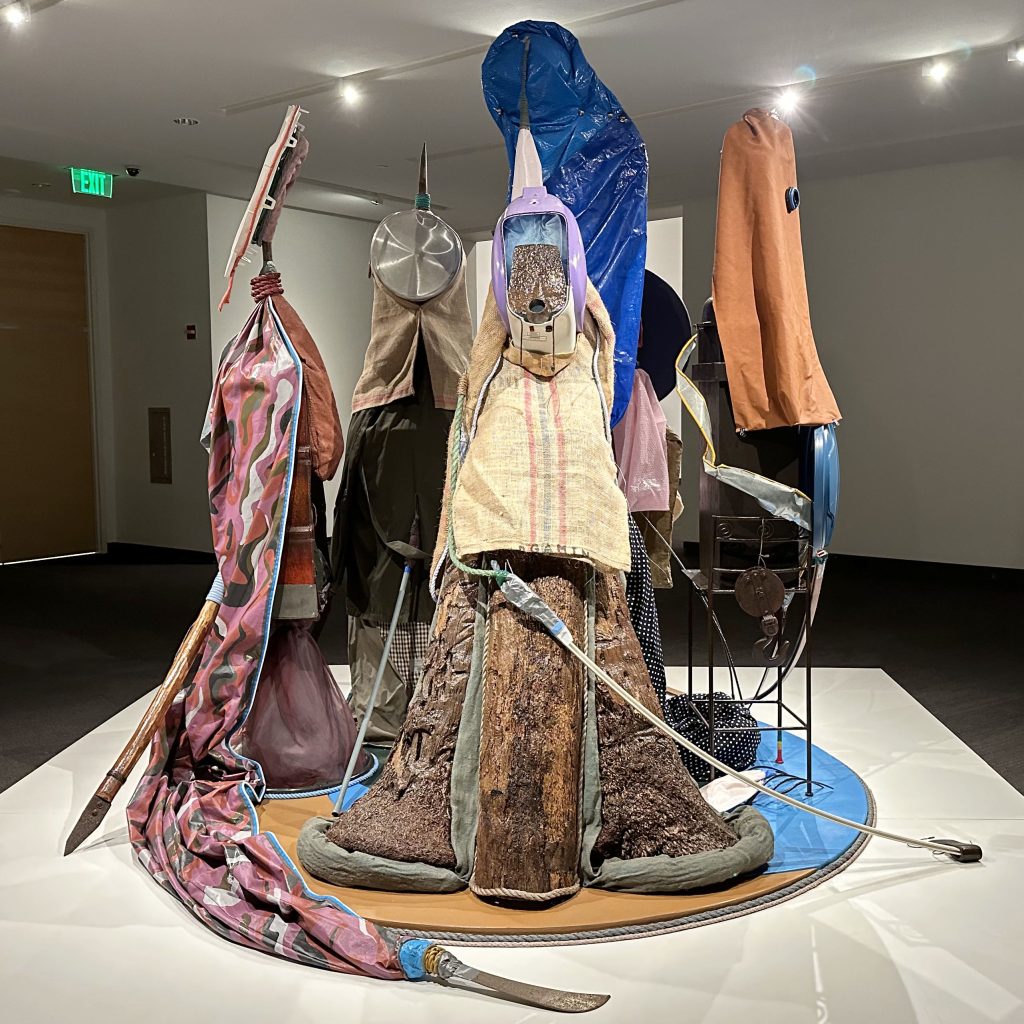
Cannupa Hanska Luger “Uŋziwoslal Wašičuta (from the series Future Ancestral Technologies)”, 2021

From the museum-

Cannupa Hanska Luger proposes: “This installation is not inverted . . . our current world is upside down.” For the artist, upending our grounding in time and space makes way for imagined futures free of colonialism and capitalism, where broader Indigenous knowledge can thrive. The work here, Uŋziwoslal Wašičuta (a Lakota phrase meaning “the fat-taker’s world is upside down”), celebrates Native technologies by using the shape of a tipi—a word that the artist has also turned into an acronym, standing for Transportable Intergenerational Protection Infrastructure (TIPI). Luger looks at the complex structure as an example of the innovations created by his ancestors of the Northern Plains tribes. Luger’s materials, such as deadstock fabric, found objects, and clay, reflect the artist’s commitment to sustainability and reuse.

One of Suzanne Jackson’s works

Work by Suzanne Jackson

From the museum about all of the unique creations by Suzanne Jackson

Suzanne Jackson made these suspended paintings without canvas, slowly building up many layers of acrylic, detritus, gel medium, and objects from the natural world, including seeds from her garden in Savannah, Georgia. Jackson has been experimenting with acrylic paint since the 1960s. “It’s painting another way,” she explains. “I don’t call it collage because it’s not another material. It’s all paint—acrylic on acrylic. And it’s suspended: paint suspended in space. . . . The paint becomes an armature for itself.” This “armature” is not fixed, however; Jackson thinks of the paintings as living things and is very open to the fact that they are malleable and will reshape. The layered paint seems to have a kind of agency and an ability to change independently. Looking at its iridescent quality up close creates an afterimage—a lasting mental image that continues even when a viewer has shifted their gaze away.

Two of Eamon Ore-Giron’s paintings from “Talking Shit”, Mineral paint and vinyl paint on canvas

From the museum-

These three paintings are part of Eamon Ore-Giron’s Talking Shit series, in which he reimagines deities from ancient Peruvian and Mexican cultures. Reflecting on a famous sculpture of the Aztec goddess Coatlicue, the poet Octavio Paz (1914–1998) traced an evolution from “goddess to demon, from demon to monster, and from monster to masterpiece.” This line of thinking resonated with Ore-Giron, who recognized that symbolic figures are continuously reimagined as cultures shift and collective and personal identities are redefined. The series title Talking Shit reflects the artist’s desire to explore this idea and a living ancestral past in ways that are open, informal, and personal.

In these works, Ore-Giron focuses on Andean folklore. He has pictured Amaru, a powerful, protean creature related to water and the underworld, as a zigzagging abstracted dragon. To depict the mythological rainbow made by the creation god Viracocha, Ore-Giron represented the celestial phenomenon as a double-headed snake moving through the sky.

Section of B. Ingrid Olson’s installation

Section of B. Ingrid Olson’s installation

From the museum about B. Ingrid Olson’s photographic and sculptural installation-

This installation intermixes two series, Dura Pictures and Indexes. Each work in the Dura Pictures series presents one photographic image physically embedded within another, what the artist describes as placing a “moment in time within a different moment in time, just like memory does of the past in the present.” The photographs were made in the artist’s studio and record B. Ingrid Olson’s own performative interactions with handmade props and assorted materials, such as mirrors or printed matter set within constrictive ad hoc spaces. The images alternate between showing a first-person vantage point with a torso or toes breaking into the picture plane, and offering a mirrored reflection of the artist, often only partially seen.

Proto Coda, Index is a single artwork with thirty constituent parts—each is a replica of one of the thirty reliefs made by the artist between 2016 to 2022. With concave interior surfaces and irregular hanging heights, the forms each suggest a container for a specific body part, like a piece of armor or a casting mold. The reliefs mark the entire length of the wall, serving as placeholders for an absent body, both fractured and multiplied.


Ser Serpas, “taken through back entrances . . . “, 2024

Ser Serpas’ large sculptural installation, assembled from found objects, grew more interesting when seen at different angles.

From the museum-

Describing sculptures like those included in this exhibition, Ser Serpas has said that “the act of making is a choreographed performance, of which the assemblage is the aftermath.” The performance begins in a city—in this case, New York, and specifically Brooklyn—with the artist collecting discarded objects that speak to her through their color, the ways they have become worn or torn, and their structural openness to being combined. Then she works with the objects’ orifices, odd junctures, and gravity to combine them into provisional sculptures. This process yields a feeling of potential energy just at the moment before an object’s collapse. The resulting sculptures become a kind of dual portrait: first of the city as seen through its cycles of consumption and decay, and then of the artist herself through the expressive choices she has made.

It’s often difficult to see many of the videos that are part of the exhibition due to time constraints. This year the museum partnered with MUBI and you can watch eight of the films for free on their site for a limited time.

On Sunday 8/11/24, the last day of the exhibition, the museum will be free all day with events that include making creature collages with Eamon Ore-Giron (whose work is pictured above).

Jul 262024
 

Helen Lundeberg, “Interior with Two Paintings”, 1982, acrylic on canvas

Room with sculpture by Chakaia Booker, “The Privilege of Eating”, 2012, rubber tires, wood, shovel

Max Neumann, “Untitled”, 1986, oil on linen

Liza Lou, “Dog”, 2002, glass beads on fiberglass and plaster

Ori Gersht, “Against the Tide, Diptych Monks”, 2010, archival pigment print on aluminum

There’s a lot of exceptional work on view for A Shadow Set Free, the group exhibition at Palm Springs Art Museum. Above are a few of the standouts, as well as one of two walls on which numerous works are grouped together.

From the museum about the exhibition and its theme-

A Shadow Set Free presents a selection of sculpture, photography, painting, drawings and prints from roughly the last 100 years. Though very different in style, subject matter and historical context, the works are united in their ability to evoke a sense of memory and convey an otherworldly aura.

The artists forgo an interest in the bright light of objective reality in favor of creating dream worlds, maintaining a rootedness in everyday reality while remaining free from specific histories. Together they demonstrate the various ways that modern and contemporary art imbues the familiar, external world with a spirit of subjectivity.

This exhibition closes 8/4/24.


Jul 252024
 

Canton Museum of Art’s Spring/Summer Exhibitions include three artists who have created engaging new worlds for visitors to explore.

Ginny Ruffner’s sculptures hide colorful surprises in her exhibition Reforestation of the Imagination. Working with animator and media artist Grant Kirkpatrick, they have created digitally animated fictional plants that burst from the certain sections of the works when using their app on your phone (the museum will also loan you a tablet if you need one). Ruffner has also provided delightful descriptions for these creations, as well as her drawings.

From the museum-

Imagine an apocalyptic landscape. It appears barren, devastated, and hopeless. It is not.

In this traveling exhibition from the Renwick Gallery of the Smithsonian American Art Museum, internationally renowned artist Ginny Ruffner creates a seemingly bleak environment that suddenly evolves into a thriving floral oasis by combining traditional sculpture with augmented reality (AR) technology. In collaboration with animator and media artist Grant Kirkpatrick, Ruffner brings to life a colorful world where glass stumps suddenly sprout mythical flora that have adapted to their surrounding conditions in unexpected, beautiful and optimistic ways. By transforming the CMA lower galleries into a multidimensional experience, Ginny Ruffner: Reforestation of the Imagination calls into question the very notions of reality and fantasy, of concrete and abstract, and of desolation and hope.

Ginny Ruffner is among a vibrant group of artists bringing AR to museum installations. By using this technology as another art media, she transforms visitor experiences. The installation consists of landmasses featuring intricate handblown glass sculptures of tree stumps, with painted tree rings that function as discrete QR codes. These islands surround a landmass that supports a large fiberglass stump sprouting beautifully grotesque bronze and glass appendages. Other than the central stump and the painted shelf mushrooms and tree rings on the surrounding stumps, the scene appears colorless and desolate; however, when viewed through AR’s technological lens an alternate landscape is revealed.

Visitors can download the free app “Reforestation” on their phones or use the iPads in the gallery to bring this second reality to life. When the tree rings of a stump are viewed through the device’s camera lens, a hologram of a fictional plant appears to sprout from the sculpture. These imagined fruits and flowers have evolved from existing flora, developing dramatic appendages and skills necessary to flourish in this radically different environment. In this reality, tulips develop stem flexibility, pears contain windows to the outside world and flowers take on the form of birds. The installation includes Ruffner’s tongue-in-cheek descriptions of her fanciful flora and their remarkable, sometimes humorous adaptations, as well as 19 original drawings by the artist that were the inspiration for the AR images.

“This is nature reimagining itself,” said Ruffner. “The imagination cannot be exterminated. It just re-creates itself. To me, ‘Reforestation’ is about hope.”

The intricate porcelain works Janice Jakielski created for her exhibition Impossible Objects are reminiscent of papercut art. Through her unique ceramic process (detailed in the Ceramics Monthly article linked below) the delicate work takes traditional objects and presents them in new and intriguing ways.

From the museum-

Janice Jakielski is a Massachusetts (soon to be Colorado) based sculptor. By inventing new ways of casting and manipulating ultra-thin porcelain sheets she can create impossible objects of curiosity, beautiful objects to provide focus, retreat and pause in an overwhelming world.  Using meticulous detail, familiar forms and uncertain function she coaxes her audience to draw near, closing the physical gap between viewer and object.  In this way the details of workmanship and the excessive fragility of the porcelain act as a whisper, flirtatiously demanding investigation. Her impossible objects were also featured in the January 2021 issue of Ceramics Monthly.

For Laine Bachman’s paintings for Beyond Worlds, she has created detailed environments filled with creatures and color.

From the museum and the artist-

Suspended in the ether of some surreal galaxy, the worlds I create give a glimpse into flora and fauna that exist in a hidden interplanetary realm.  Each is a themed bouquet where I explore and study different species that exist in our own world.  I relish the details of their structures and include many forms of life I find fascinating. I approach each piece as a puzzle with parts that can coexist, painting a picture of a precious ecosystem that becomes more complex as the work evolves.  One may find a frog nestled below a fern or a mole napping under a toadstool. There are many creatures and plants we recognize from the past and some that have yet to be discovered. Creating these planets has been a journey to capture the beauty of nature and elevate small moments that may otherwise go unseen. Though they reside in the mire of a newly formed galaxy, they are truly a celebration of our world and the life that exists within it.”- Laine Bachman

As a young child growing up in a once flourishing town in the Rust Belt of Ohio, Laine Bachman always had an affinity towards drawing and painting. Her parents encouraged her creativity from the beginning which led to her attending art school in nearby Columbus, receiving a BFA from the Columbus College of Art and Design in painting in 1997.

Often inspired by myths and folklore, Bachman infuses the worlds she creates with archetypal imagery, underlying themes, decorative motifs, and meticulous details. Working in watercolor and acrylics, her paintings are full of creatures and landscapes, real or imagined, that are all part of the larger story behind her work. Bachman’s work, recognized as Magical Realism, is greatly influenced by Henri Rosseau and his flat, lush, and detailed landscapes and also by surrealist Frida Kahlo.

Representations of life, death, beauty, innocence, and evil are depicted in Bachman’s work.  Whether it’s animals, insects, birds or favored objects, they become symbols of different expressions.  As owls are a symbol for wisdom or butterflies can represent a transformation, it’s this kind of idea behind the creatures that helps them tell a part of the whole story.

The works expose unique environments in which to explore and pay homage to the various forms of life that Bachman finds fascinating and mysterious in nature. Vast landscapes are used to showcase these life forms, showing the spaces between and the surfaces above and below. The worlds she creates are hidden and untouched by man, and give the viewer a glimpse into the secret lives of their peculiar inhabitants.

These exhibitions close 7/28/24.

The museum is free all day on Thursdays and tonight, 7/25, is the last of their Virtual Reality Nights. From 4-8pm you can create your own reality with VR headsets, guided by a CMA educator.

Jun 212024
 

“Claw Foot”, 2024, steel, glass, rubber

“Throughline”, 2024, steel, glass

“Twofold”, 2024, steel, rubber

“Tail End”, 2024, steel, glass, concrete

“Slipper”, 2024, concrete, glass, human hair

There’s something very visceral about Martha Friedman’s sculptures for Divided Subject at Broadway Gallery. The body parts, the strange juxtapositions, and the metal rods which act like skewers, combine to form works that balance humor with something darker and aggressive.

From the gallery-

The Lacanian reference of the show’s title is a tip-off that the artist will continue her ongoing psychoanalysis of Modernist sculpture traditions. Wielding humor and violence in equal measure, Friedman homes in on art historical givens with a critical eye.

A series of monumental steel skewers form the spines of these loosely figural works. Slotted with outsized hunks of meat and sliced vegetables cast in glass, and cast-rubber body parts made from molds of her muscular dancer muse Silas Reiner, Friedman marshals our collective appetites in a sendup of Minimalism. By reanimating and anthropomorphizing modes of staid Formalism, the sculptures disrupt accepted meaning and expectation via processes that are as complex and precise as they are absurdly grotesque.

Elsewhere, in some smaller works, we see cast cement limbs coated in luxuriant graphite and fitted with found footwear and exotic cast-glass foods such as geoduck clams, like a Robert Gober at the farmer’s market. These pieces are sometimes situated on artist-designed stands evoking anthropological museum display and engineered to accommodate their weight and precarious balance.

As a whole, the complex variety of materials and technique, as well as dramatic shifts in scale across the exhibition, destabilize the viewer placing them at a crossroads of technical precision and the bluntly visceral. Just as the sculpted figure in art history is a metaphorical container for meaning, Friedman’s pierced flesh reminds us that the body itself is, in fact, held fast by a delicate, porous membrane.

This exhibition closes 6/22/24.

Apr 122024
 

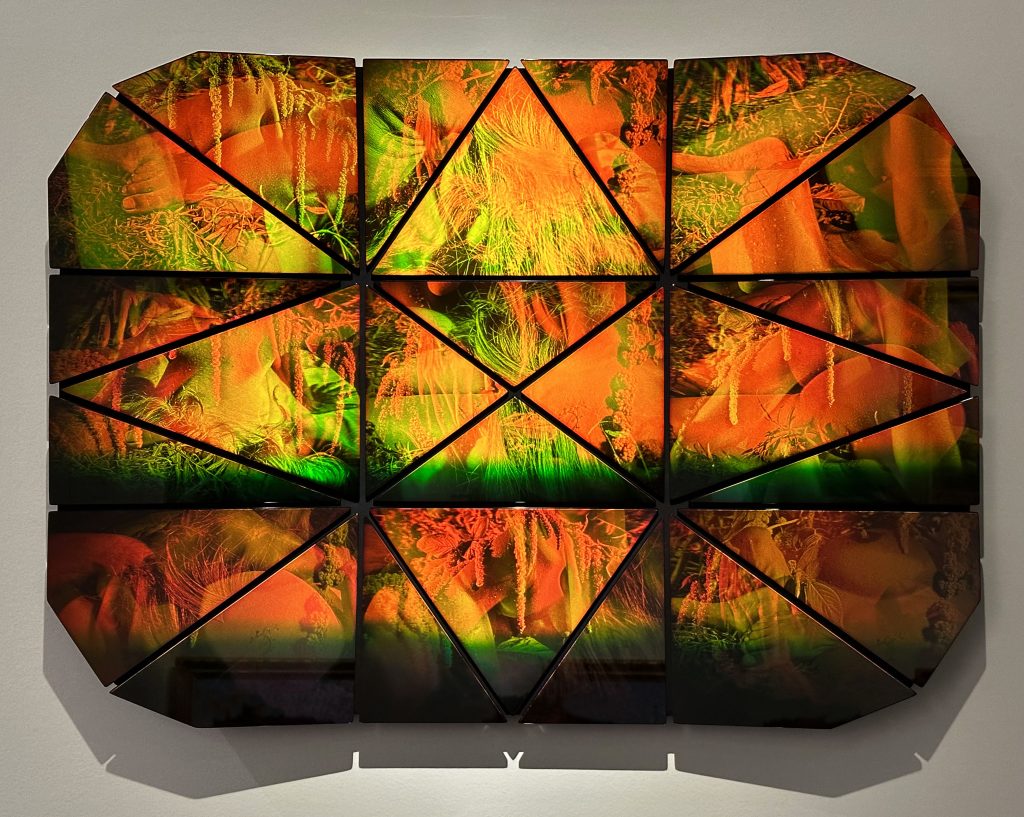
Sarah Meyohas, “Interference #19”, 2023, Holograms, mirrored black glass, aluminum

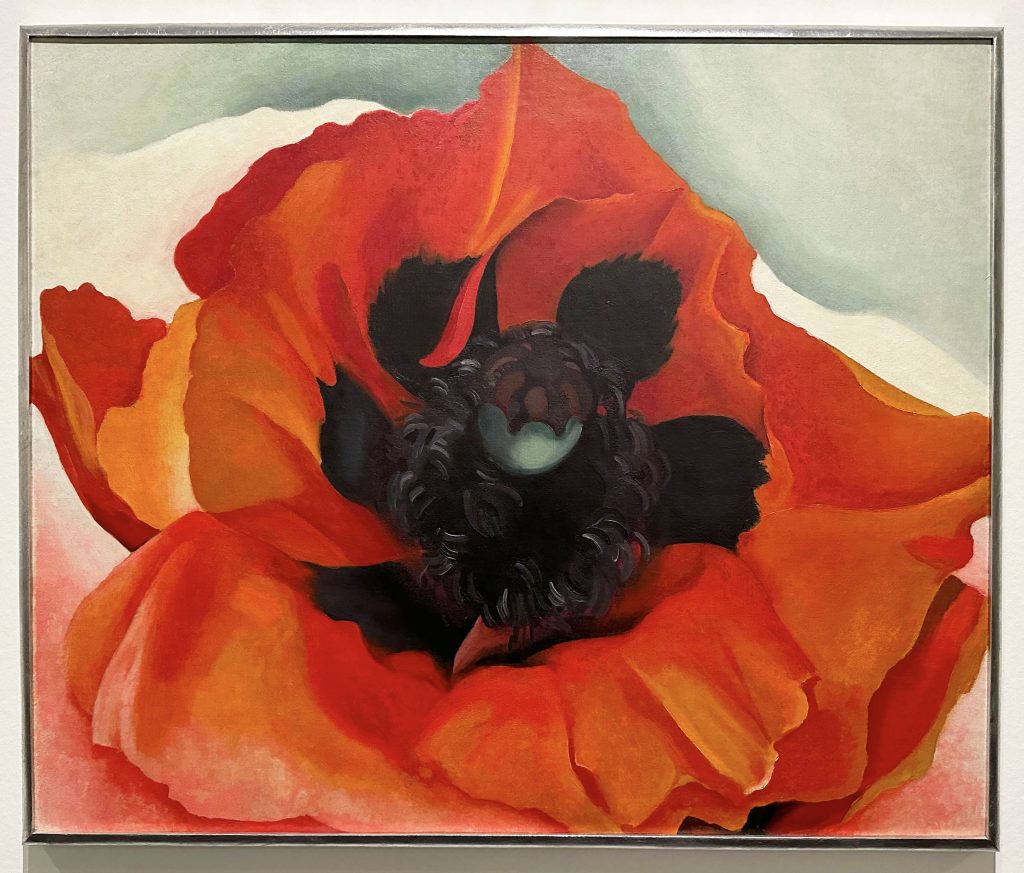
Georgia O’Keeffe, “Poppy”, 1927, Oil on canvas

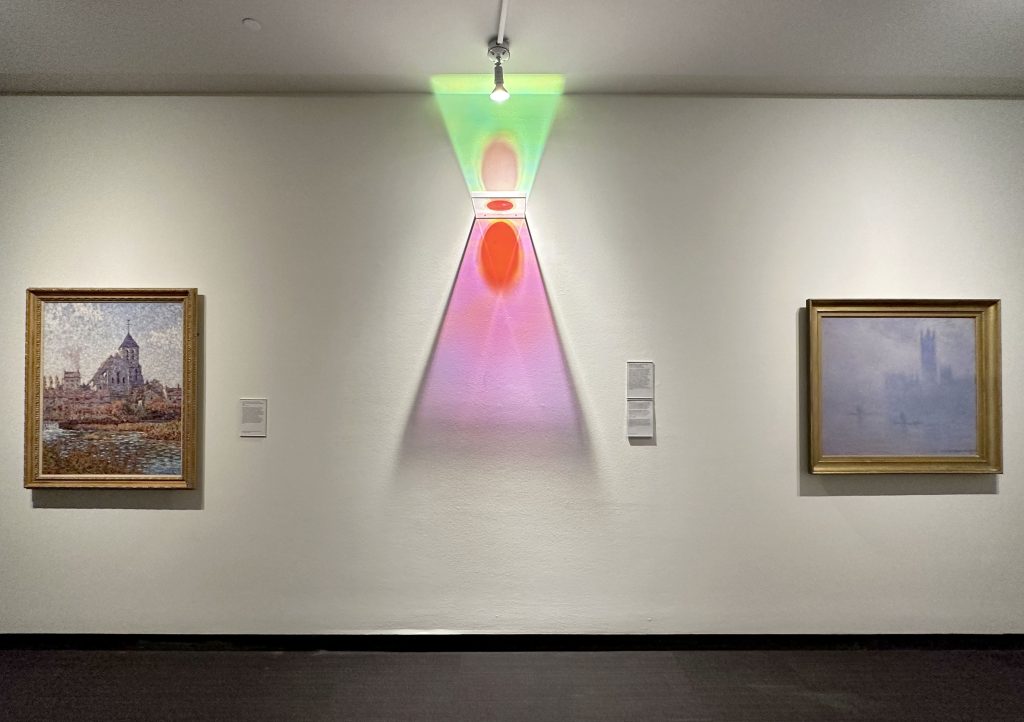
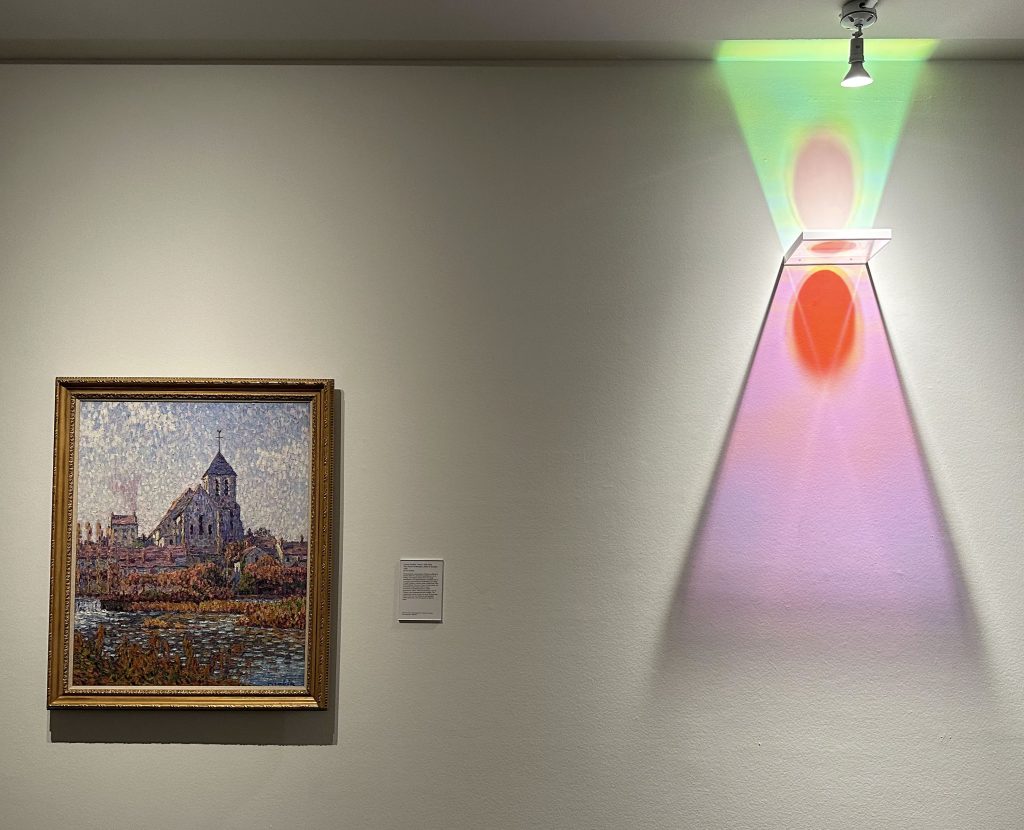
Francis Picabia “The Church of Montigny, Effect of Sunlight” 1908, Oil on canvas (left); Christian Sampson “Projection Painting”, 2023, Acrylic and films with LED light; and Claude Monet “The Houses of Parliament, Effect of Fog, London” 1904, Oil on canvas (right)

The Nature of Art exhibition at the Museum of Fine Arts St. Petersburg merges art from the museum’s collection with loaned works to explore- “art’s crucial role in our evolving quest to understand our relationship with nature and our place in the cosmos”.

One of the benefits of an encyclopedic museum is that visitors have the opportunity to experience art throughout history, and to revisit works that resonate with them. For the section titled Artist as Curator, Sarah Meyohas and Christian Sampson chose pieces from the museum’s collection to pair with their own work.

From the museum-

At first glance, perhaps, these may seem like unusual combinations, but upon deeper contemplation, their selections reveal complementary artistic intents. For instance, Meyohas and Georgia O’Keeffe share an interest in close looking, particularly in finding new ways to examine underappreciated aspects of the natural world. Sampson, influenced by the California Light and Space Movement, is interested in current scholarship that suggests the hazy fog found in Claude Monet’s work is an early depiction of air pollution, offering an entirely new perspective on the artist’s representations of light.

Sampson also created the four-part installation, Tempus volat, hora fugit, on view until 2025 at the museum.

Below are some of the works from additional sections of the exhibition.

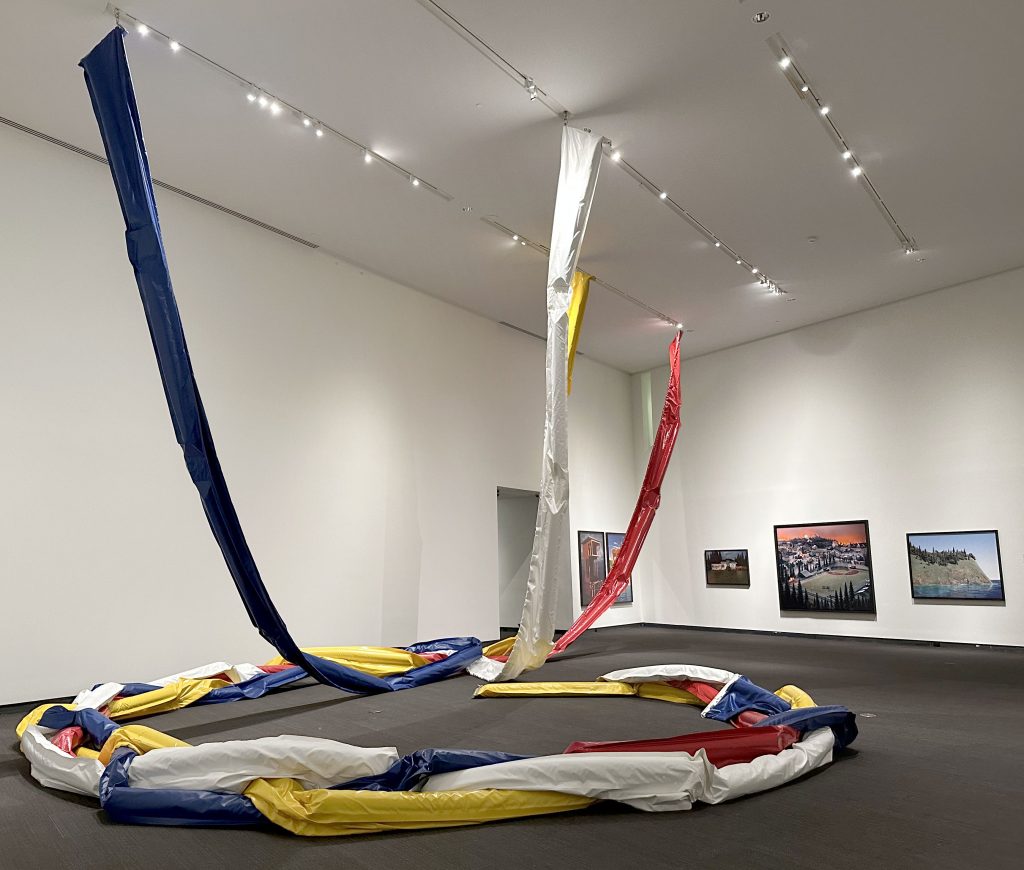
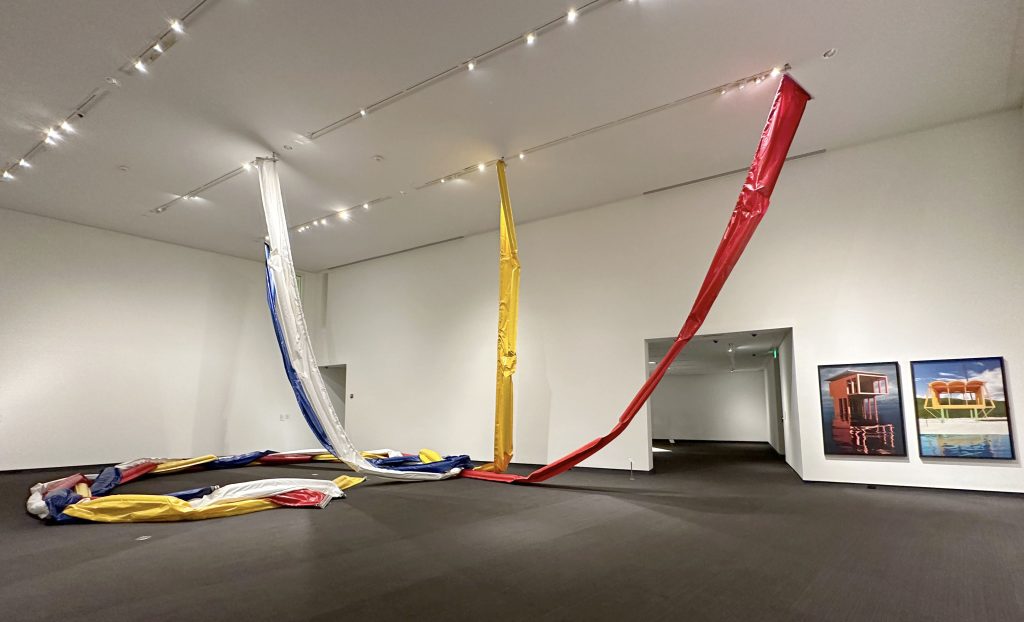
Postcommodity, “kinaypikowiyâs”, 2021, Four 30.5-metre industrial debris booms

Postcommodity, “kinaypikowiyâs”, 2021, Four 30.5-metre industrial debris booms

Postcommodity is an interdisciplinary art collective comprised of Cristóbal Martínez (Genizaro, Manito, Xicano), and Kade L. Twist (Cherokee).

About Postcommodity’s work, kinaypikowiyâs, (seen above) from the museum-

This work is composed of debris booms, used to catch and hold environmental contaminants such as garbage, oil, and chemicals. The colors of the booms correspond to different types of threats— red (flammable), yellow (radioactive), blue (dangerous), and white (poisonous)-in the labeling system for hazardous materials. To indigenous peoples, these are shared medicine colors that carry knowledge, purpose and meaning throughout the Western Hemisphere. Suspended like hung meat, the booms represent a snake that has been chopped into four parts. Each part represents an area of the colonial map of the Western Hemisphere: South America, Central America, North America, and all of the surrounding islands. The title, kinaypikowiyâs, is a Plains Cree word, meaning snake meat. Divided by borders, Postcommodity asserts that all people living in the Americas are riding on the back of this snake.

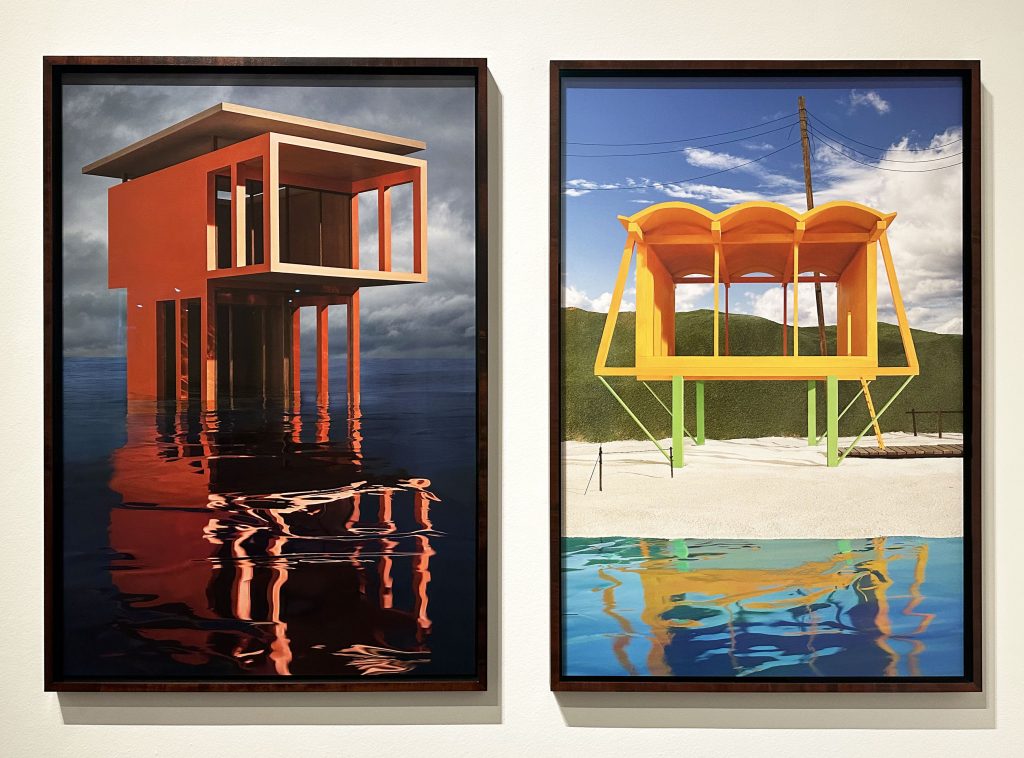
James Casebere, “Red/Orange Solo Pavilion”, and “Orange Guesthouse”, 2018, Archival pigment print mounted to Dibond

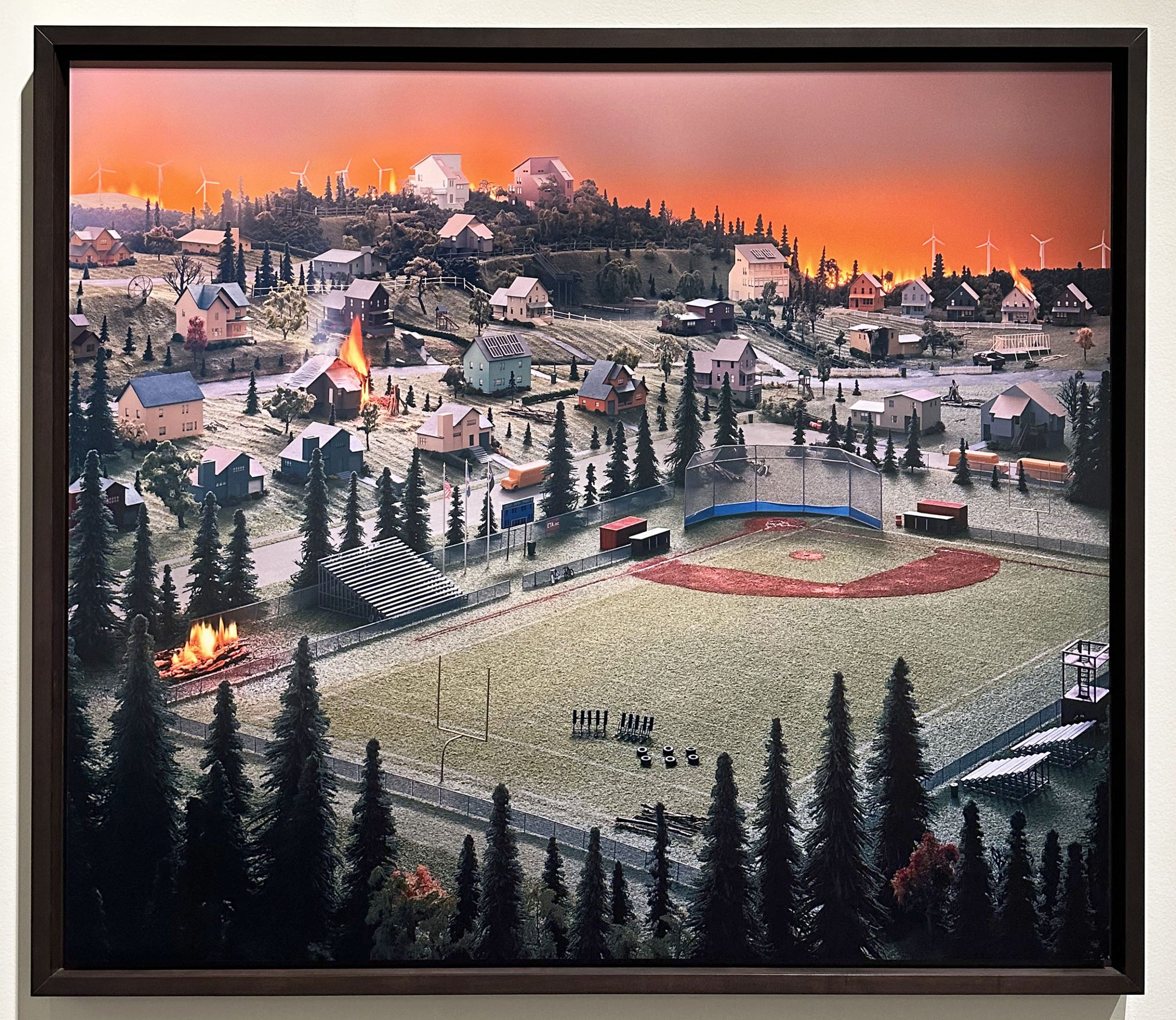
James Casebere, “Landscape with Houses (Dutchess County, NY), 2009, Archival pigment print mounted to Dibond

James Casebere creates architecturally based models for the large scale photographs seen above.

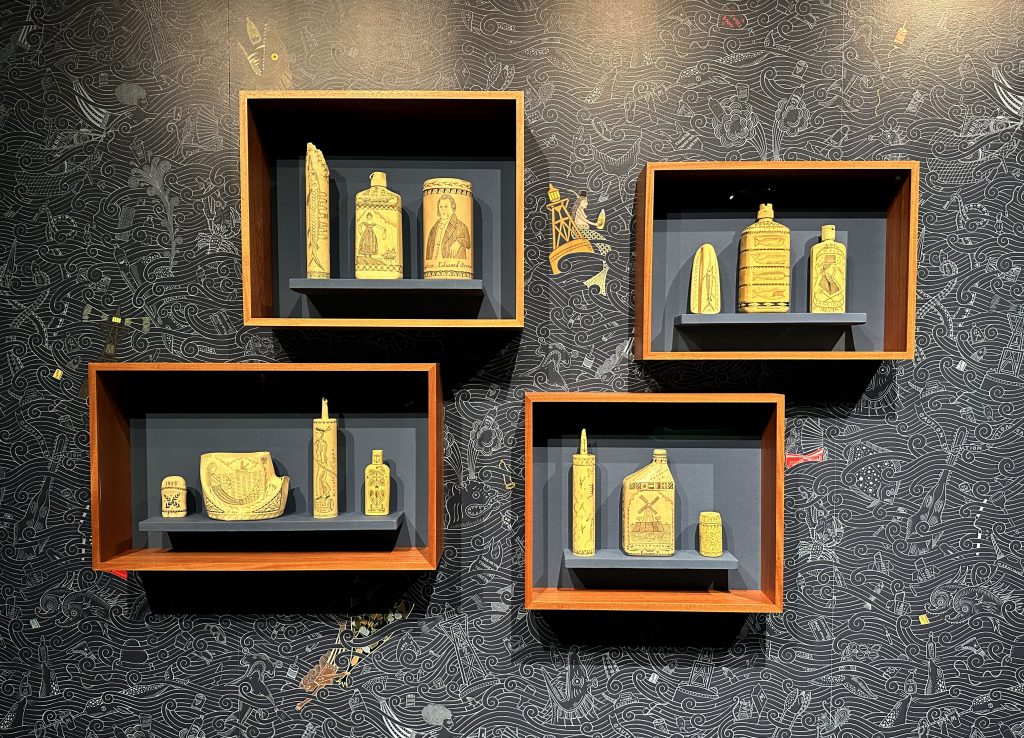
Reclaimed ocean plastic sculptures and “Tidal Fool” wallpaper by Duke Riley

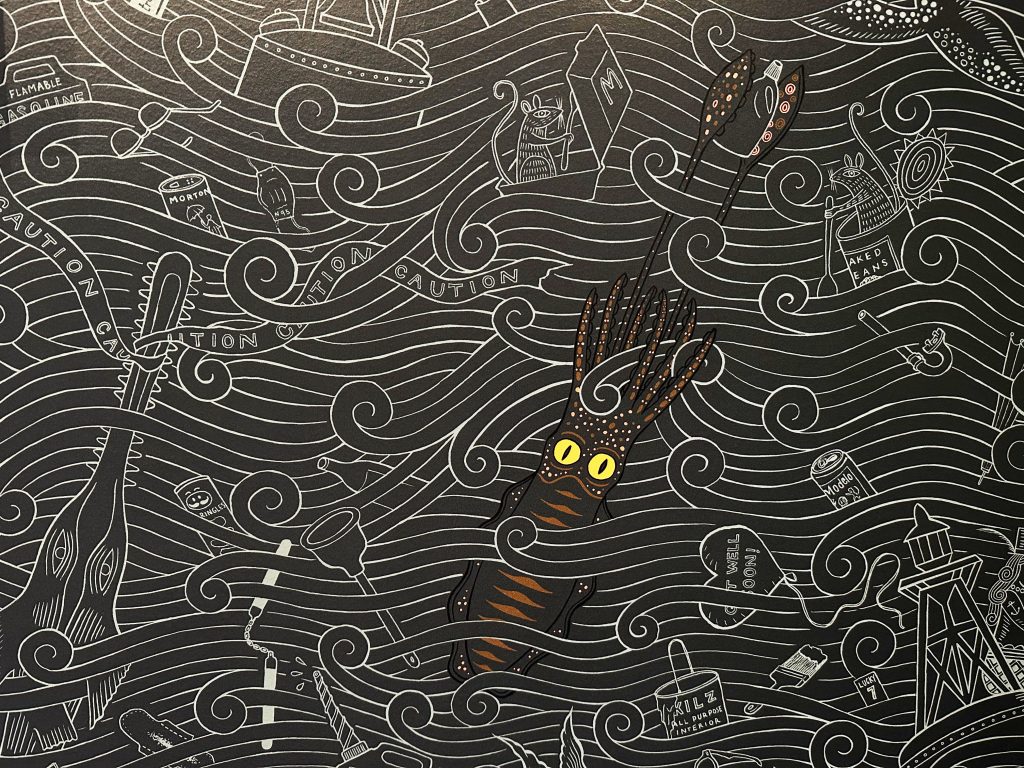
Duke Riley custom wallpaper, Tidal Fool, detail

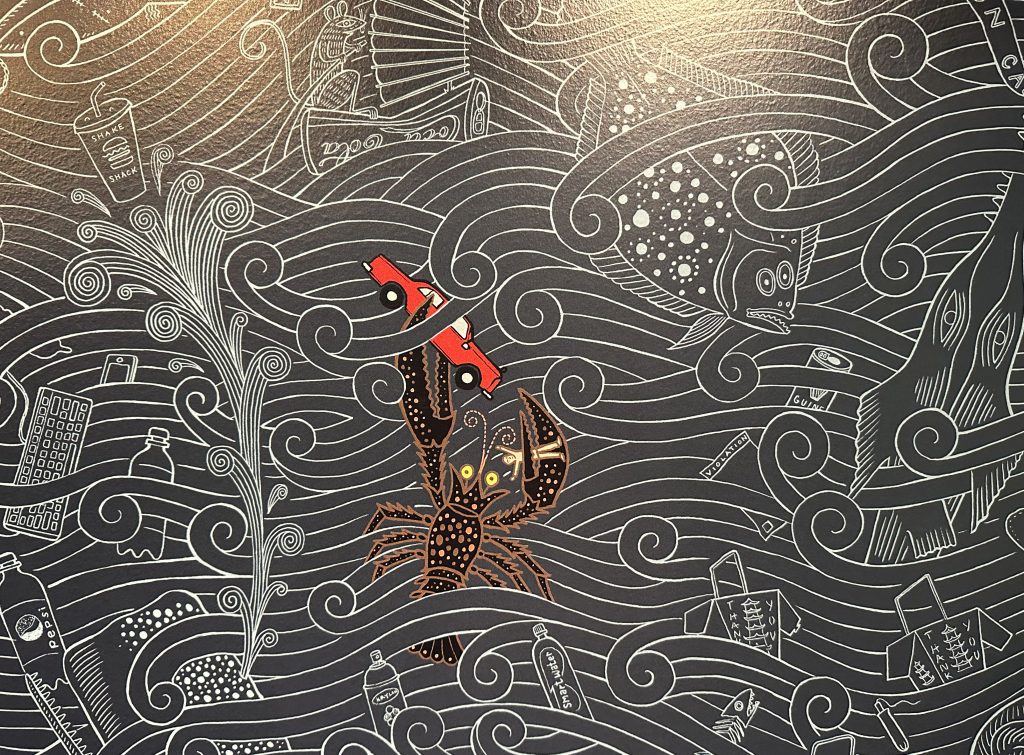
Duke Riley custom wallpaper, Tidal Fool, detail

Duke Riley’s work, which was previously shown at Brooklyn Museum, addresses issues of environmental pollution by using discarded plastics found in the ocean and other waterways to create new work inspired by the past. You can hear him discuss his work in this video.

From the museum-

Inspired by the maritime museum displays he saw while a child growing up in New England, Riley’s scrimshaw series is a cutting observation of capitalist economies-historic and today-that endanger sea life. The sculptures were created for the fictional Poly S. Tyrene Memorial Maritime Museum, and are contemporary versions of sailors’ scrimshaw, or delicately ink-etched whale teeth and bone. Riley first thought about using plastic as an ode to scrimshaw when he saw what he thought was a whale bone washed up on the beach in Rhode Island; it turned out to be the white handle of a deck brush. Riley regularly removes trash from beaches and waterways, and often uses this refuse in his work.

Riley collaborated with Brooklyn-based Flavor Paper to create these two custom wallpapers for his solo exhibition DEATH TO THE LIVING, Long Live Trash at the Brooklyn Museum. Tidal Fool exhibits Riley’s trademark humor in the face of devastating water pollution; notice the Colt 45-guzzling mermaid. Wall Bait vibrantly references Riley’s meticulous fishing lures, which he crafts from refuse found in the waters around New York City.

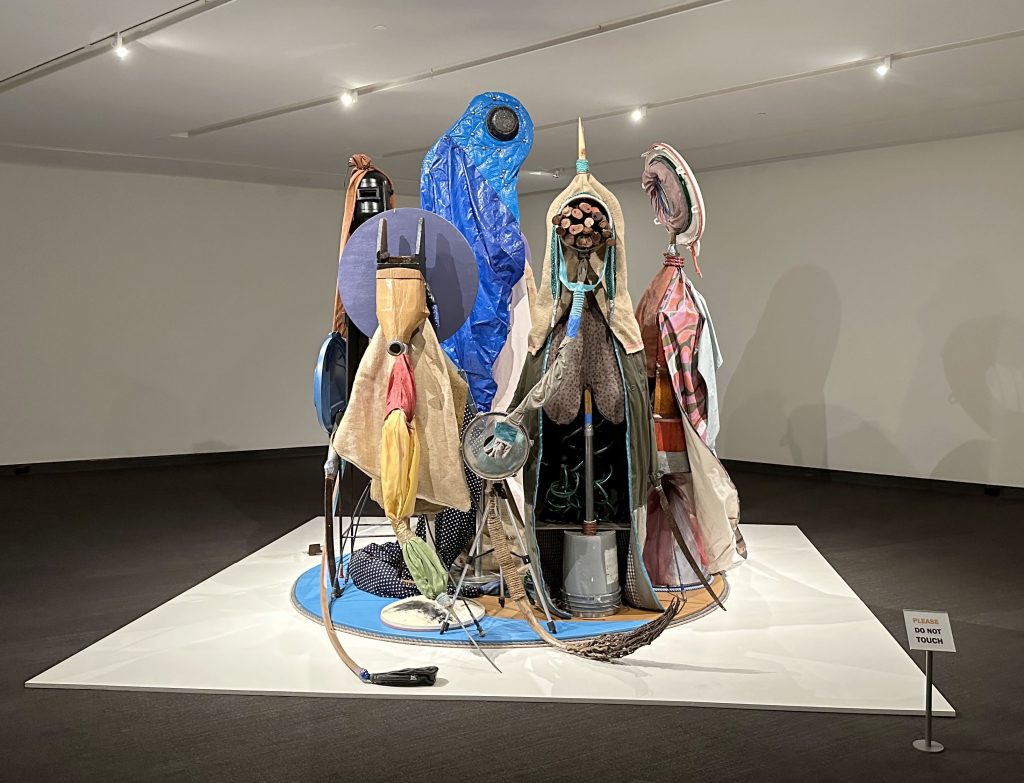
Daniel Lind-Ramos,”Centinelas de la luna nueva (Sentinels of the New Moon)”, 2022-2023, Mixed media

Daniel Lind-Ramos,”Centinelas de la luna nueva (Sentinels of the New Moon)”, 2022-2023, Mixed media

Daniel Lind-Ramos also uses a variety of recycled objects to create his sculptures.

From the museum about this work-

In Centinelas de la luna nueva, he evokes the elders of the mangroves, spiritual beings who watch over and ensure the health of this essential coastal tree. Mangroves are the basis for a complex ecosystem that shelters sea life and serves as the first line of defense in the tropical storms that batter the sub-tropics—including Florida.

Lind-Ramos’s practice reflects the vibrant culture of his native Loíza, Puerto Rico, by honoring local agriculture, fishing, cooking, and masquerade. His sculptures also evoke Hurricane Maria (2017), the COVID-19 pandemic, and ongoing environmental degradation. Lind-Ramos is committed to the survival and sustenance of Afro-Taíno traditions and people of the Puerto Rican archipelago. However, his art engages the global community through shared emotions, parallel histories, and the commonality of human experience.

The next post will discuss two other artists in the exhibition, Brookhart Jonquil and Janaina Tschäpe.

Mar 282024
 

Jazzalyn Palma, “21st st”, Oil on canvas, 2023

Rachel Augustson, “Gaze”, Ink on Paper, 2023

Ashton Burton, “…”, Oil on canvas, 2023

Cleveland Institute of Art’s 78th Student Independent Exhibition is currently on view in their Reinberger Gallery. The juried show is organized by the students and includes work from all mediums.

There are so many great pieces in this show, above and below are just a few selections.

This exhibition closes 4/7/24.

James Schaffer, “Bound”, Oil on canvas, 2023

James Schaffer, “Bound”, Oil on canvas, 2023 (detail)

Gwen Putz, “Viv!”, Monoprint, 2023

Tristen Kovacs, “897”, Spray paint and acrylic on canvas, 2023

Emily Fontana, “Untitled”, Acrylic and spackle on fabric, 2024

Emily Fontana, “Untitled”, Acrylic and spackle on fabric, 2024 (detail)