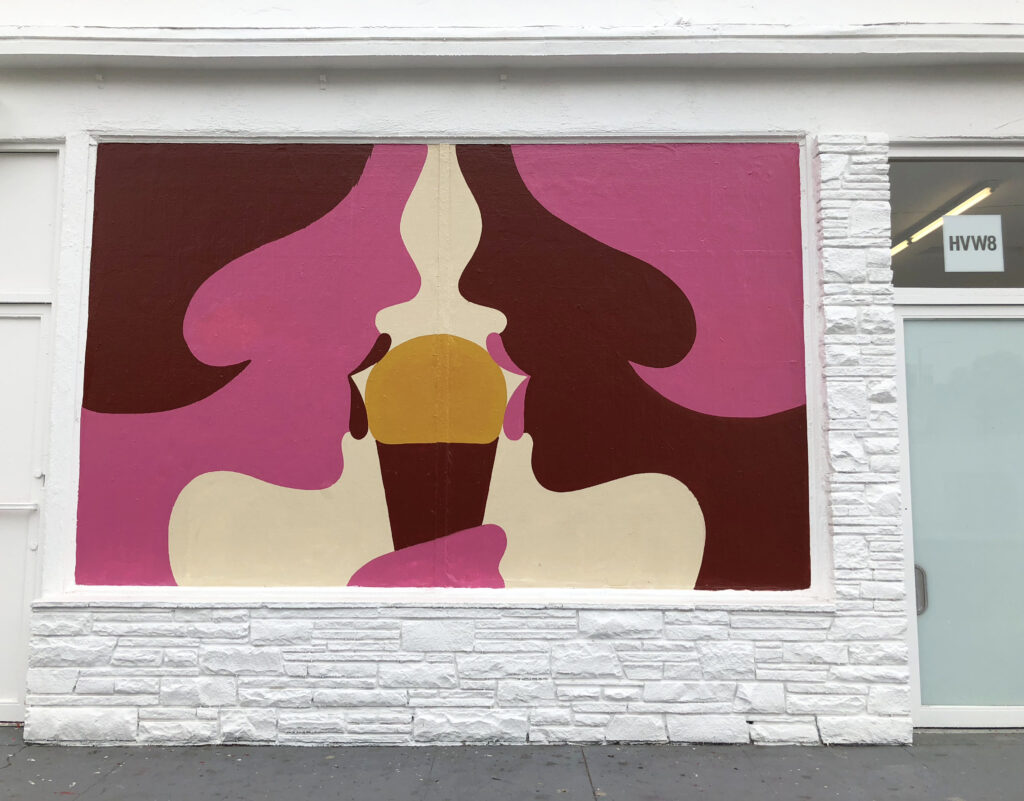
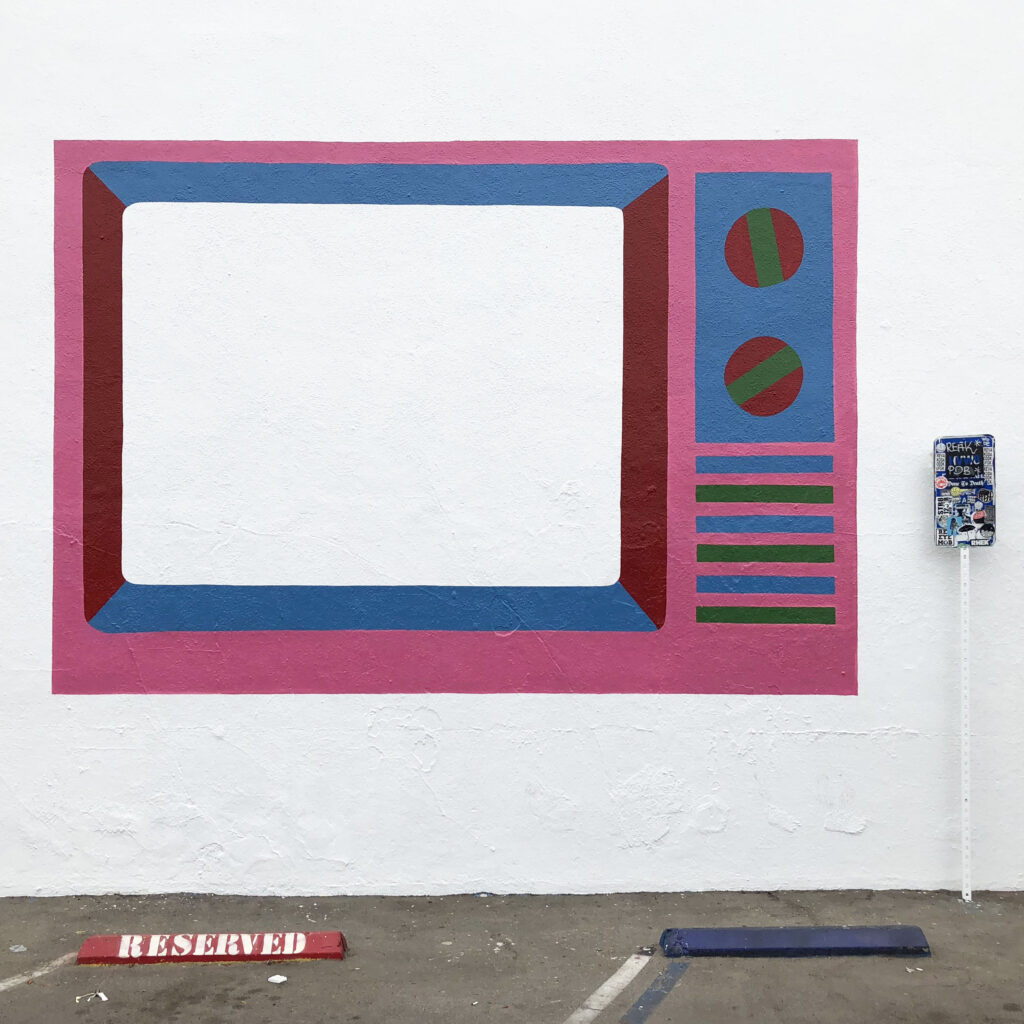
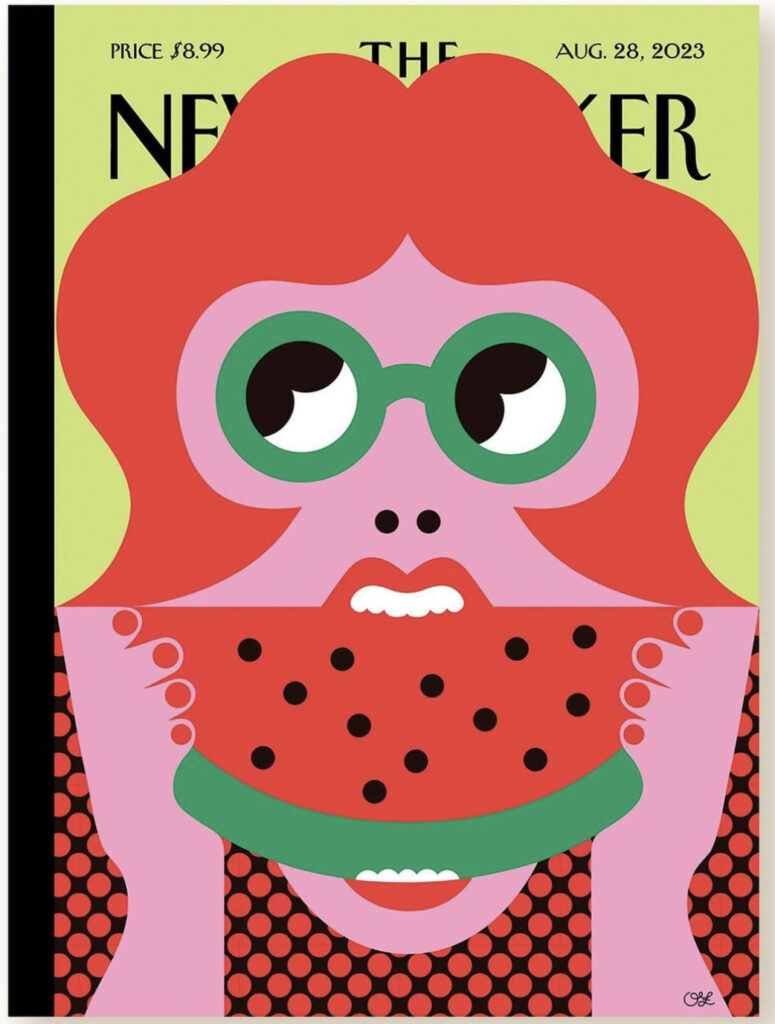
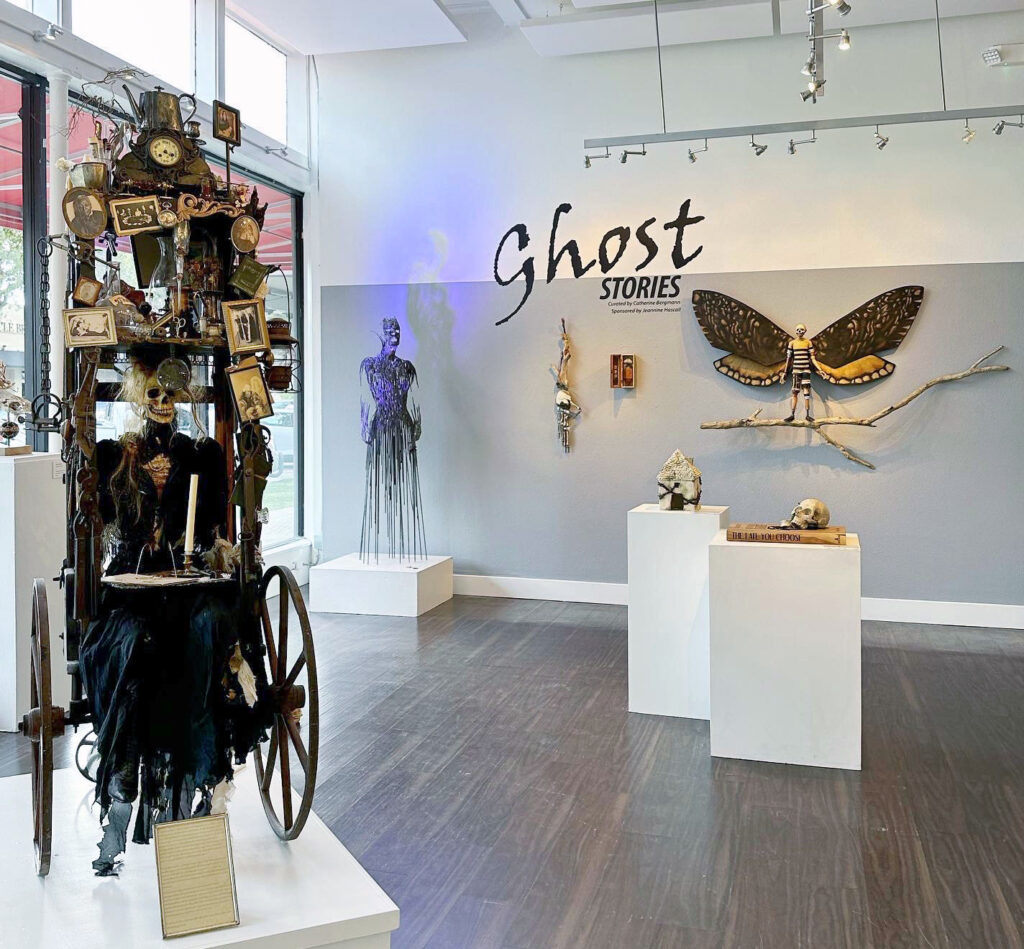
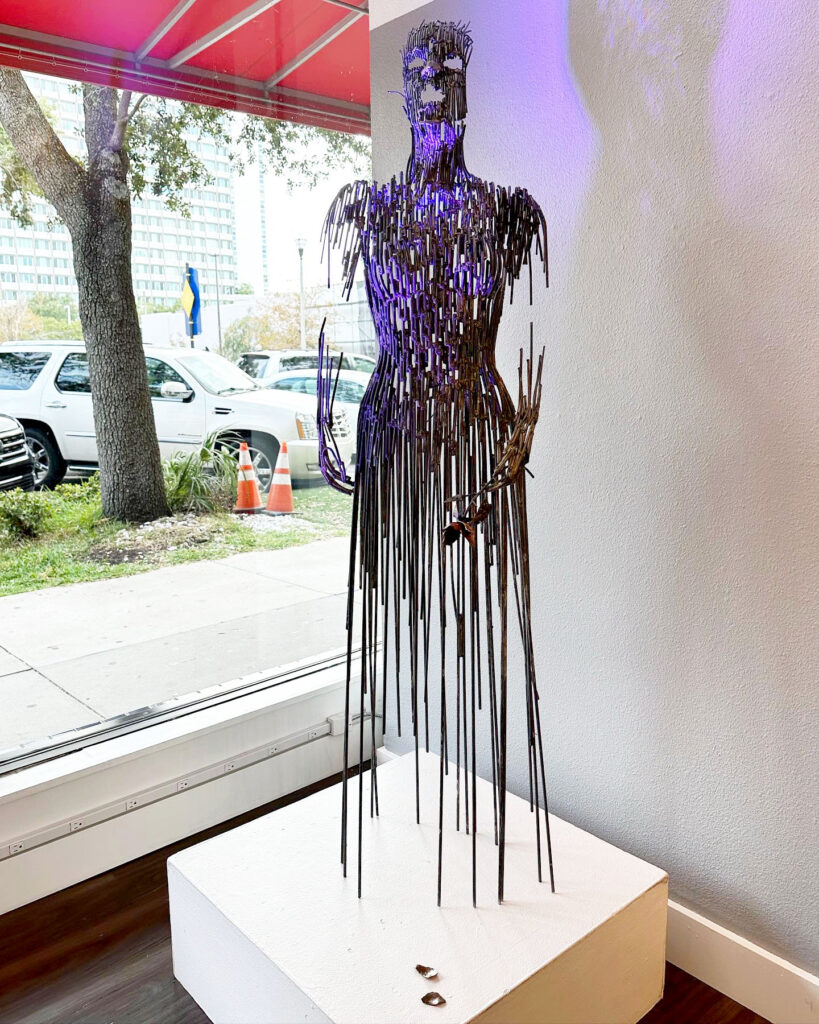
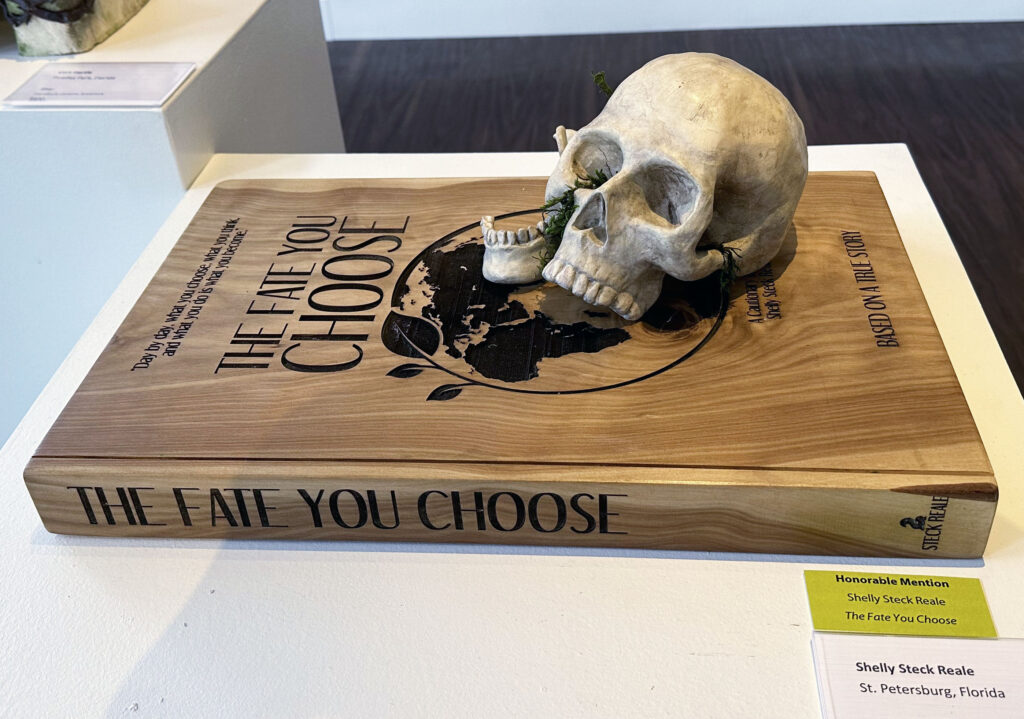
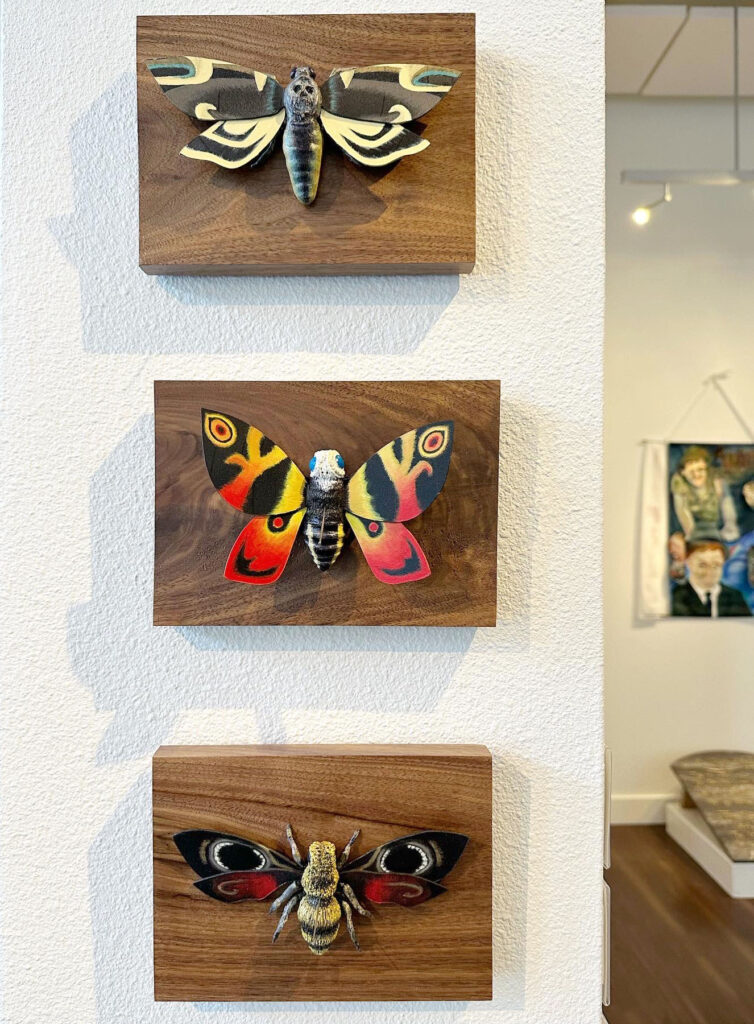
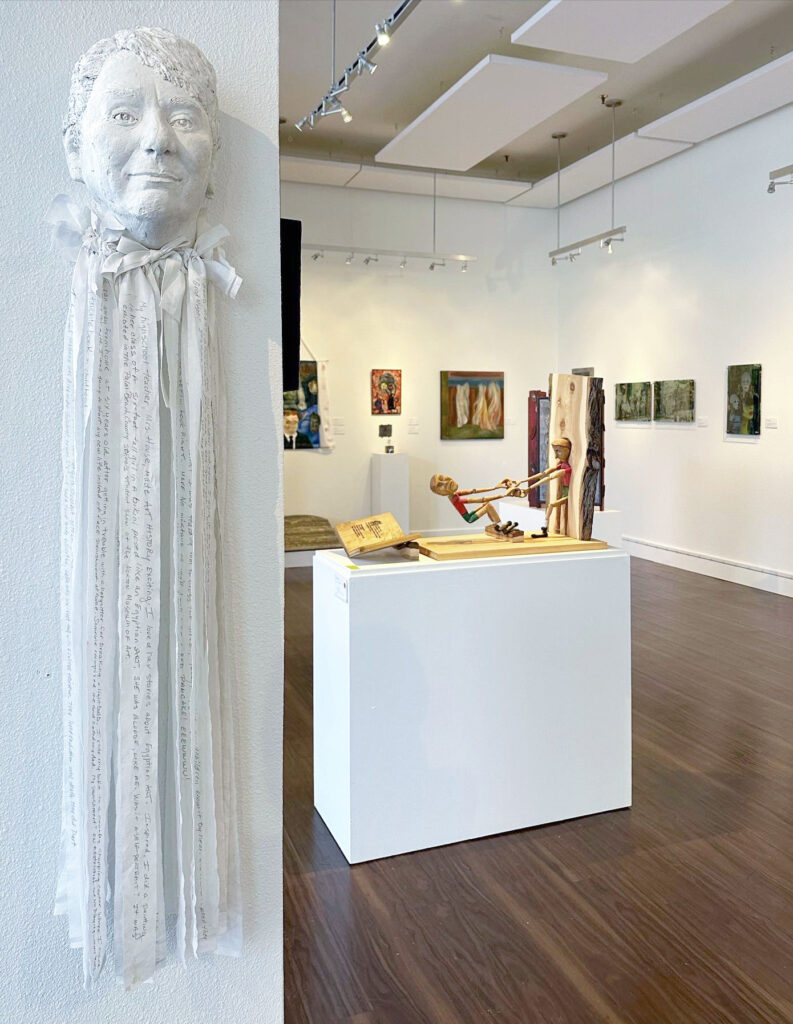
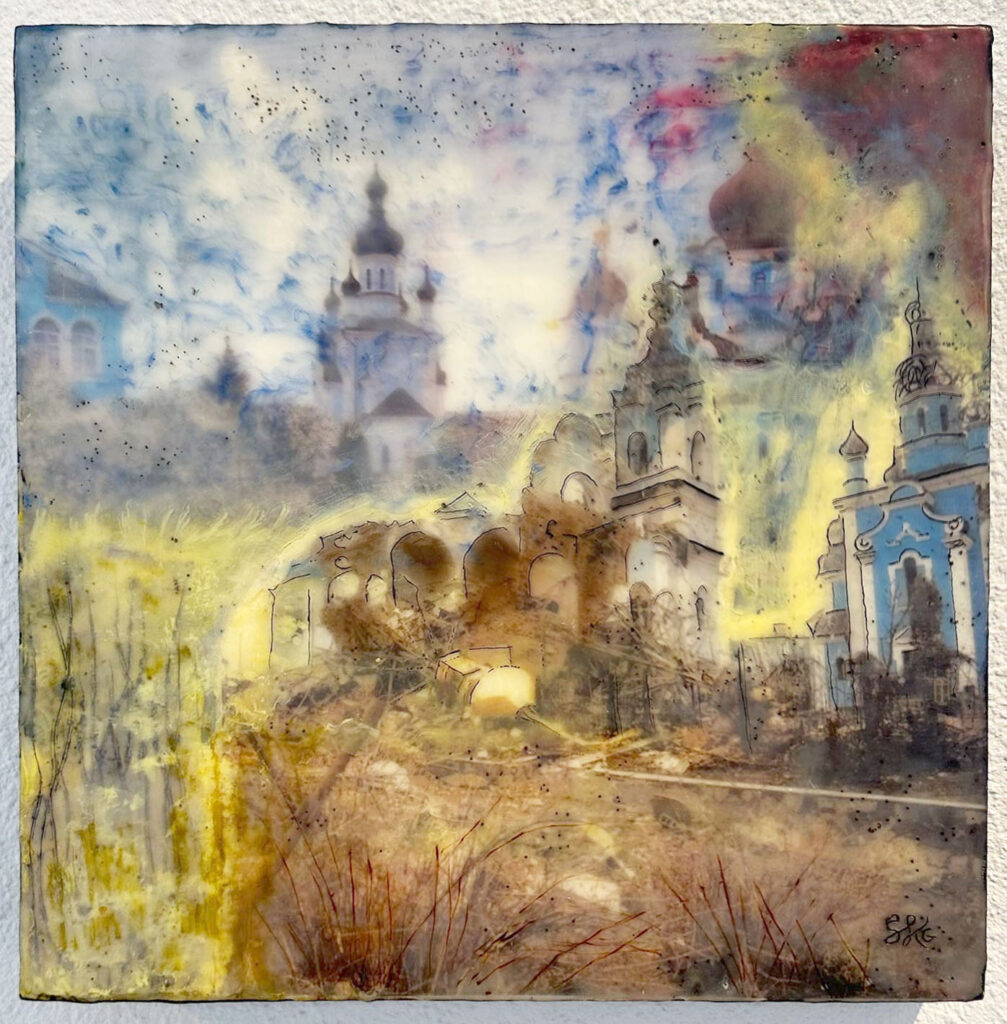
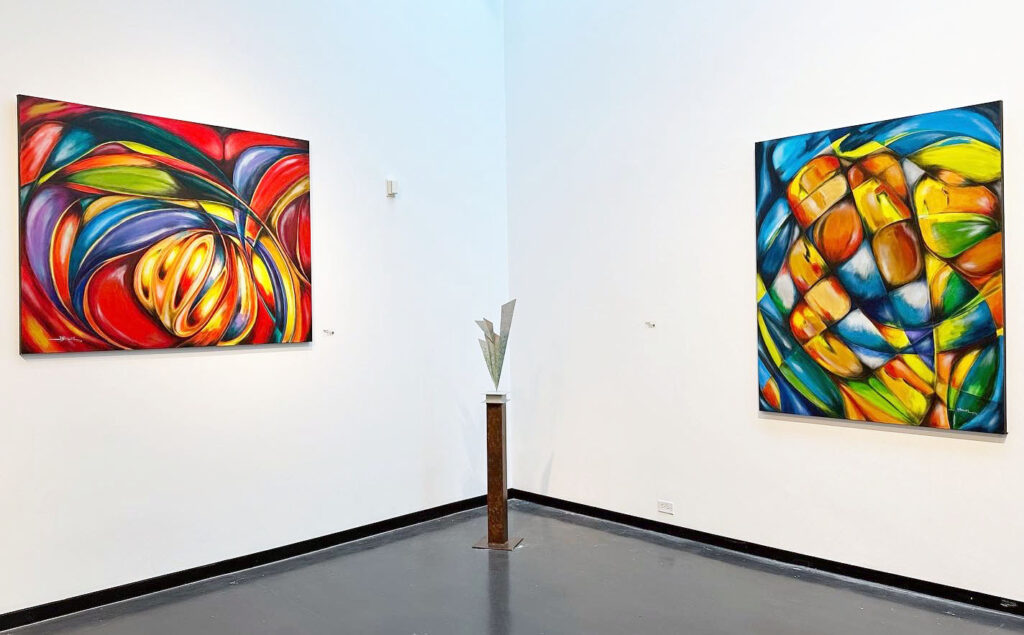
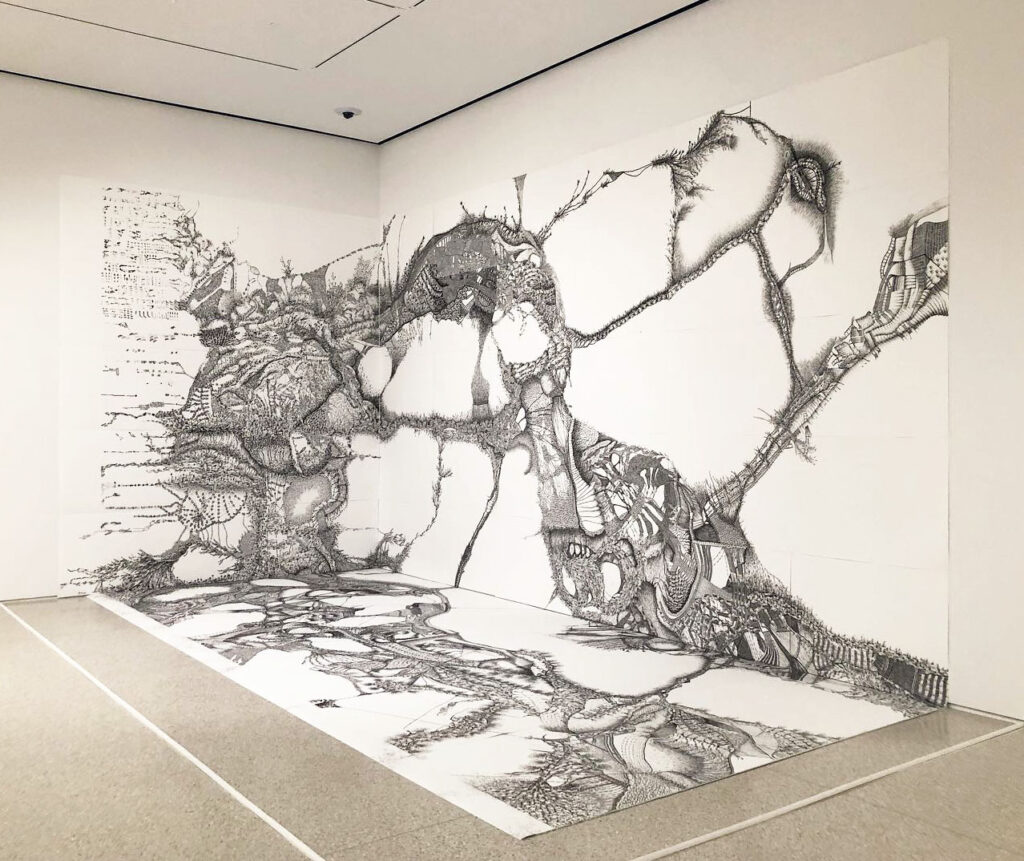
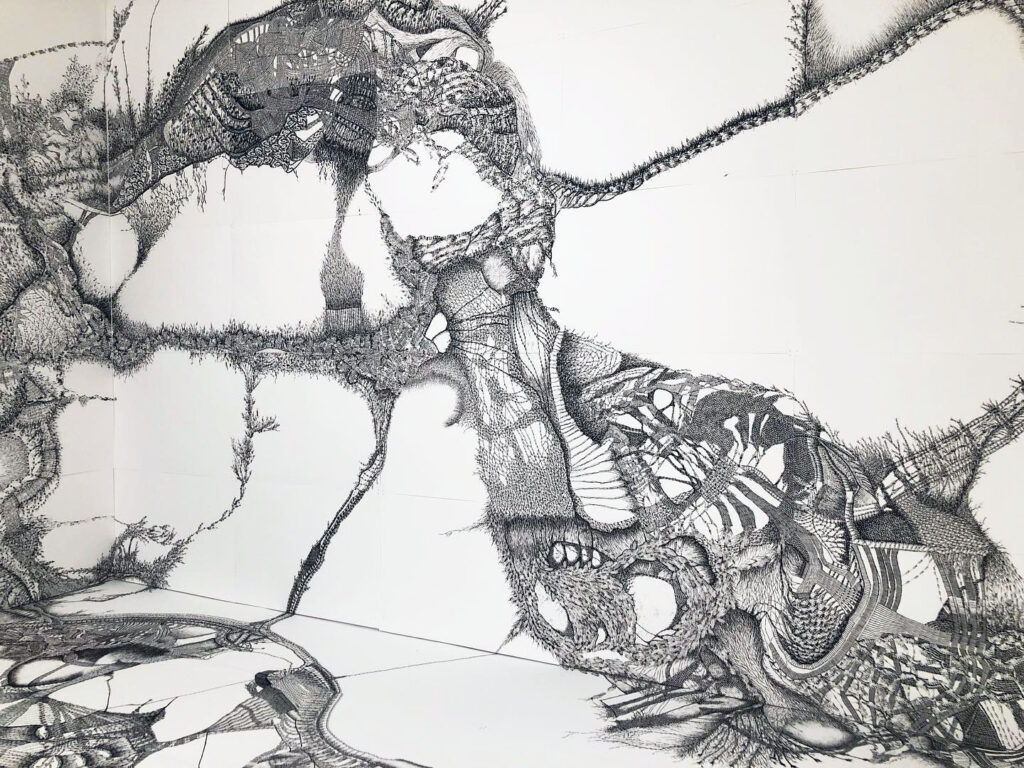
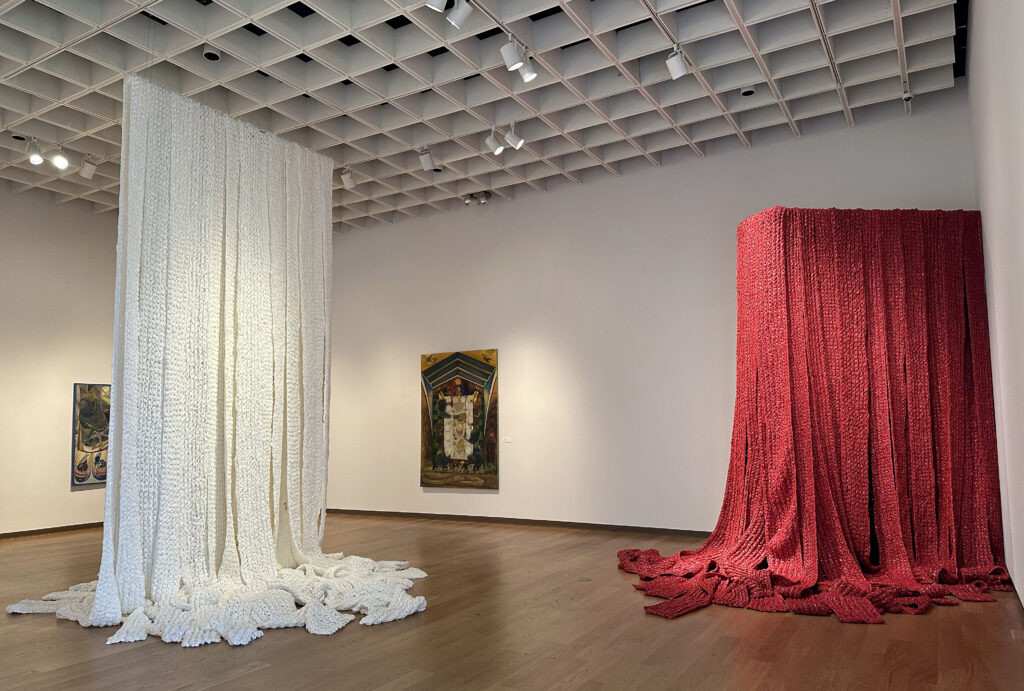
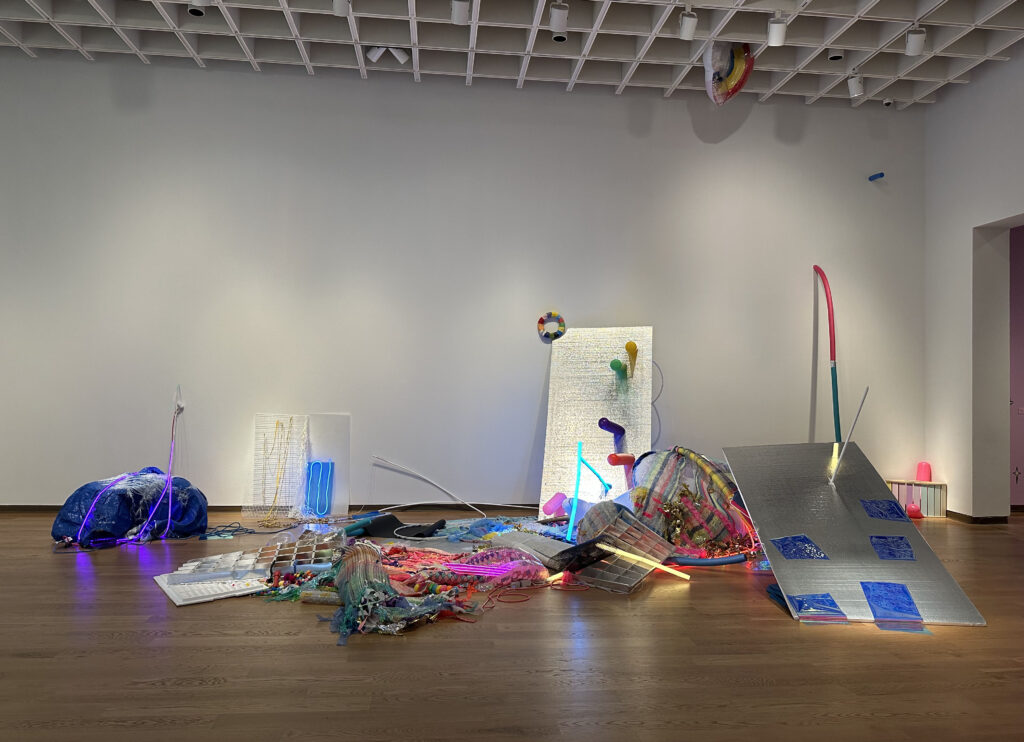
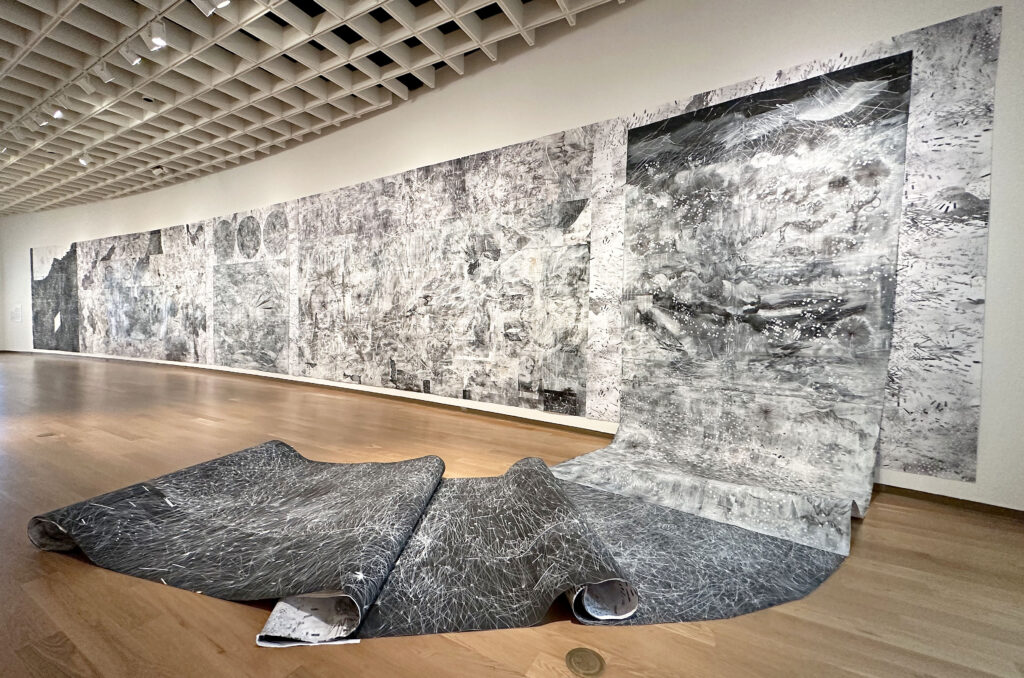
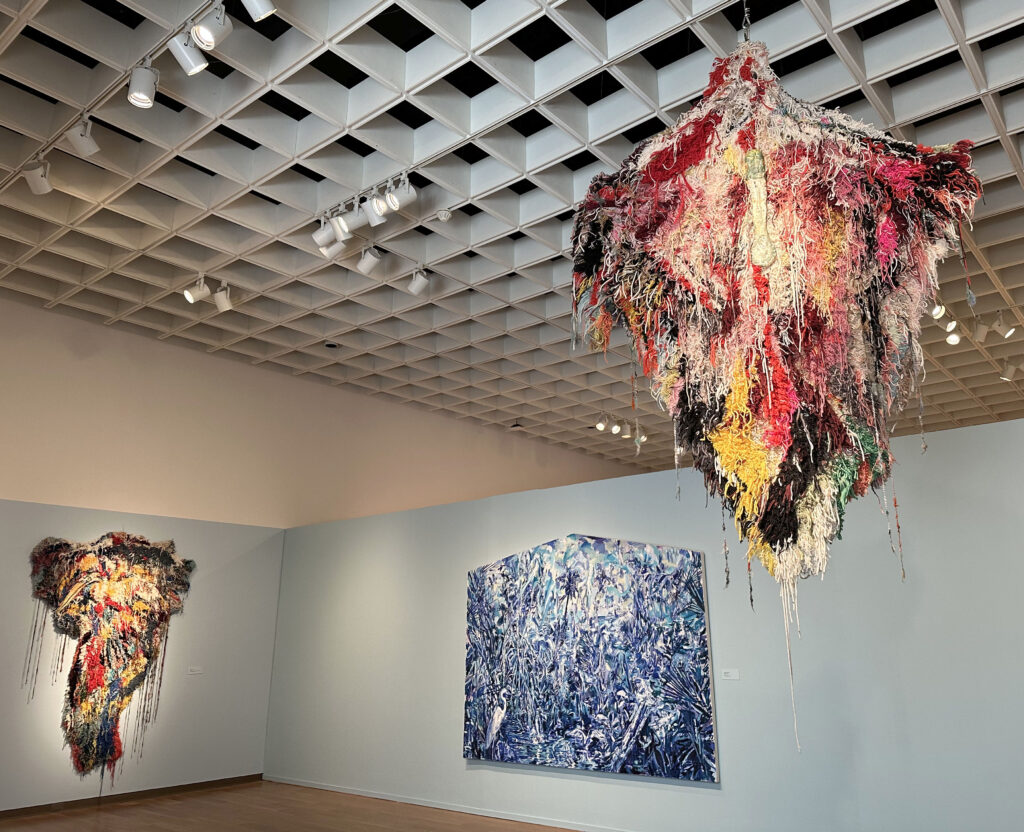
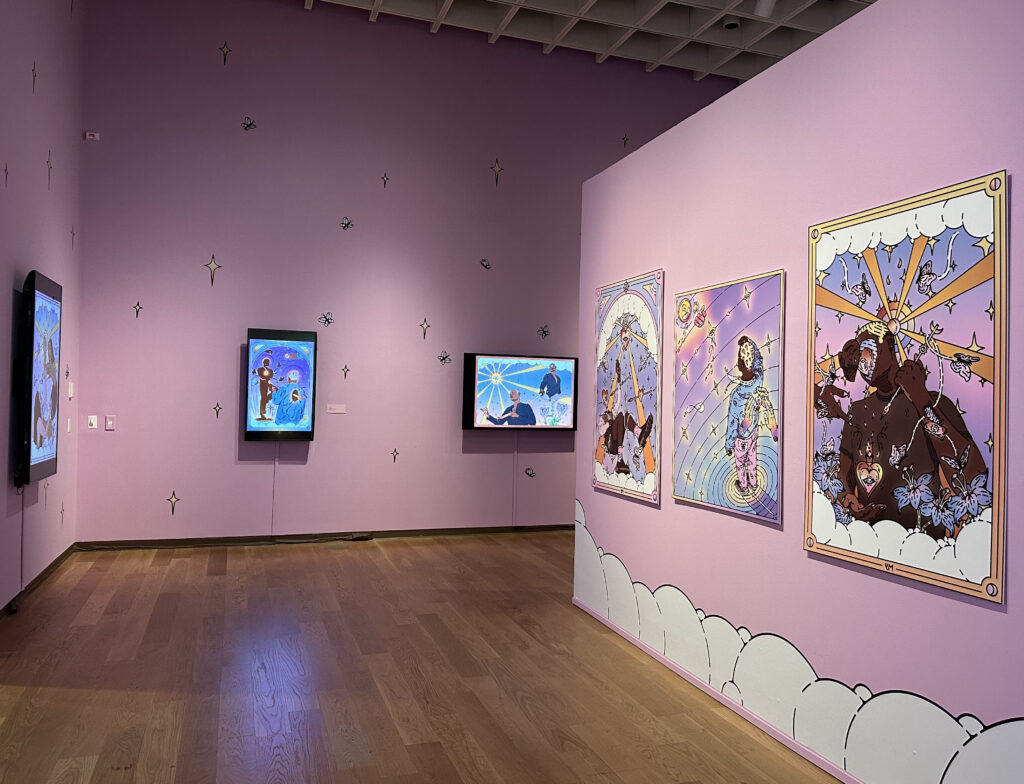
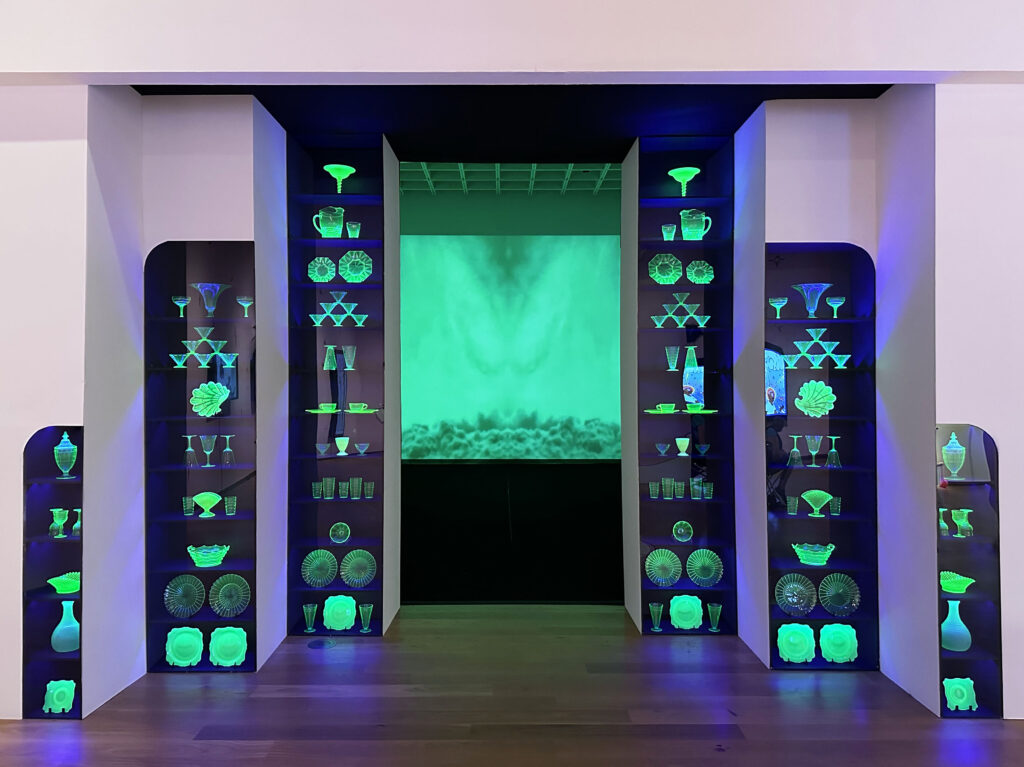
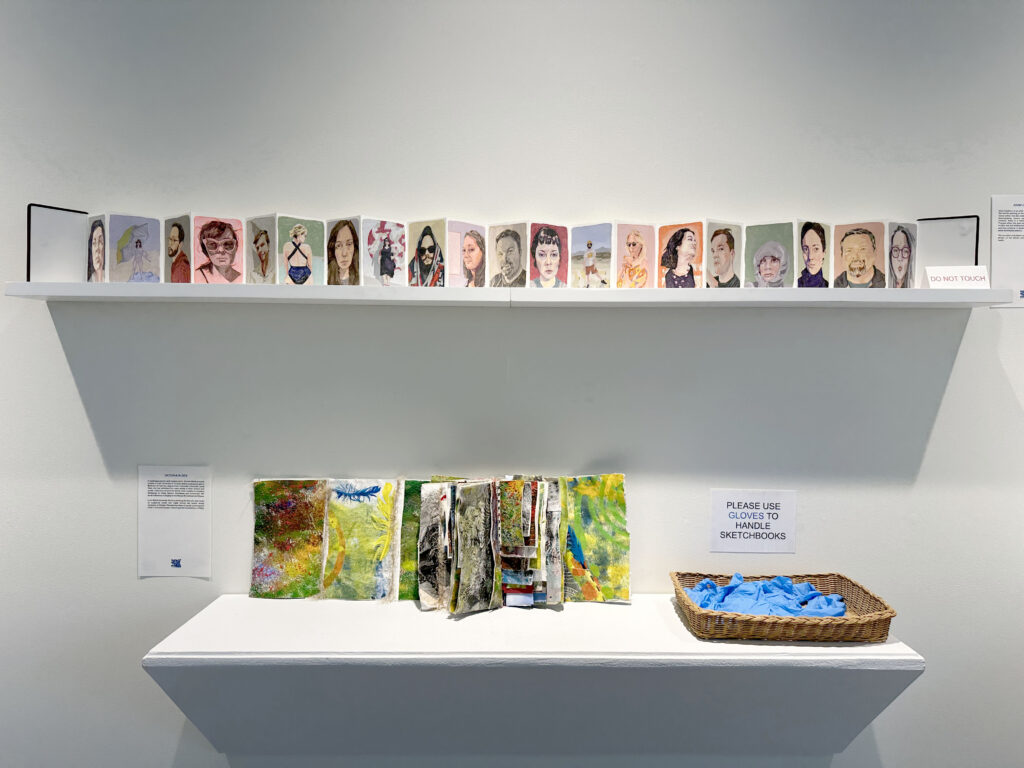
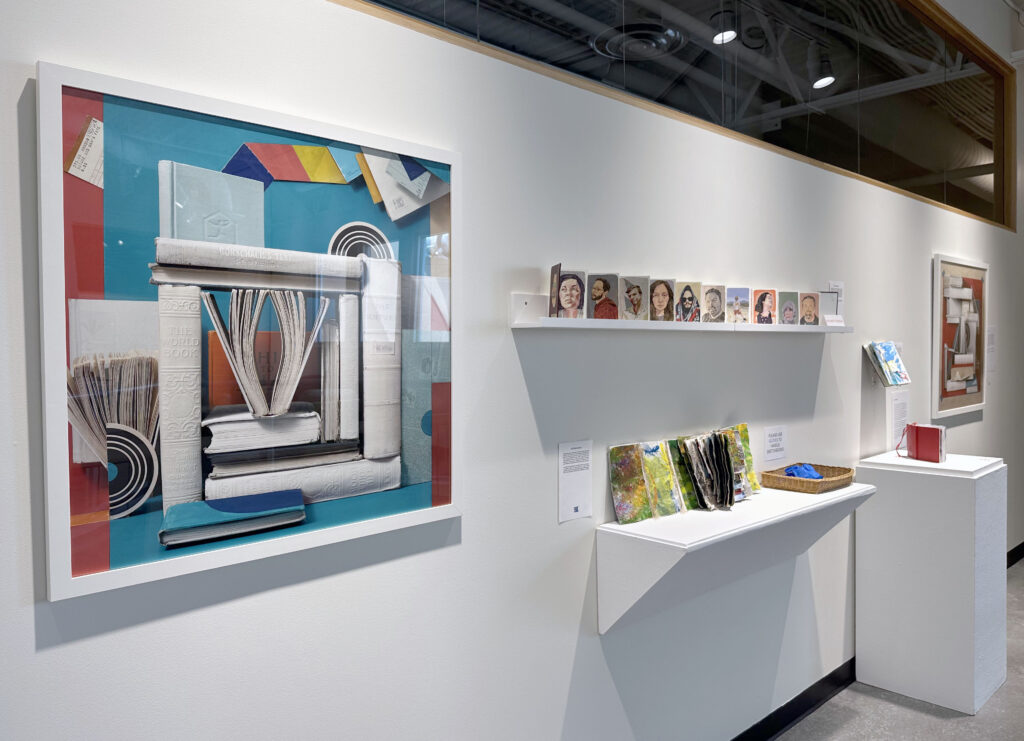
Above are images from Olimpia Zagnoli’s 2018 exhibition Cuore di Panna at HVW8 Gallery in Los Angeles. She is currently showing her work, along with her talented family at Antonio Colombo Gallery in Milan, Italy. That exhibition, ZaLiZaZa. Inventario di famiglia will be on view until 11/19/23.
The press release from the gallery-
Galleria Antonio Colombo is pleased to present the exhibition ZaLiZaZa. Inventario di famiglia, curated by Francesca Pellicciari, featuring a group of artists belonging to the same family: the photographer Miro Zagnoli (Za), the artist Emi Ligabue (Li) and their two daughters: the illustrator Olimpia Zagnoli (Za), already connected with the gallery, and the costume designer Emilia Zagnoli (Za).
The members of ZaLiZaZa are a very modern family, but also one of days gone by: were they not engaged in making their own various artifacts, we could imagine them operating in a family workshop in the Renaissance or Baroque spirit, experimenting with new painting techniques, revolutionizing styles or using them as examples to make their own; creating majestic theatrical wings, garbed in their style which is simultaneously classic and eccentric.
After all, this image is not so far from what ZaLiZaZa are doing today, in the 21st century, each in his or her own field – contiguous and often overlapping ambits – constantly coming to grips with their own research and experimentation, relying on a shared language, a true family lexicon.
The exhibition pathway is an inventory of works of all kinds – drawings and photographs, wooden books, collages, object/sculptures, fabrics, screens and magic boxes – in an intense dialogue of correspondences, where the four voices alternate and take turns, without a chronological order; a dialogue accompanied by a selection of items (sketches, notes, postcards, family photos) that document a methodology, while at the same time emphasizing the constant presence of art in the private life of ZaLiZaZa.
Thus it is no coincidence that many subjects are similar in the work of ZaLiZaZa.
While for decades design has pervaded the still analog settings and photographs of Miro (Za), it is also a recurring theme in the works of Emi (Li), from the Cicognino of Albini to the life and work of Charlotte Perriand, or anonymous design found for sale online: “I have no taboos, no type of respect or norm.” Similar use of anonymous and unconventional materials is found in the “Souvenir” clothing series by Emilia (Za), made from touristy dishtowels with the map of Italy, just as certain archetypes return in the thousands of stripes traced by Olimpia (Za), always in pursuit of the perfect synthesis between the idea and its representation.
Beyond this, beyond design, mountains, figures, bodies, portraits, chiaroscuro effects, balconies, there is the continuing echo – in the various generations of ZaLiZaZa of what Matisse said one day to Picasso, as Emi (Li) reminds us: “In the end, Picasso, we don’t have to try to be so smart. You and I are alike: what we try to rediscover in art is the atmosphere of our First Communion.” To always observe the world with the eyes of children, with the gaze of ZaLiZaZa.
If Olimpia Zagnoli’s work looks familiar, she also designed The New Yorker’s August 28th issue, seen below.
On Thursday, 10/5/23, in partnership with Keep St. Pete Lit, a group of local writers will be telling ghost stories at the gallery inspired by pieces from the exhibition. The reading will take place at 6pm.
Below are a few more selections-
Work by Alegrobot, Hand sculpted paper clay, acrylic paint
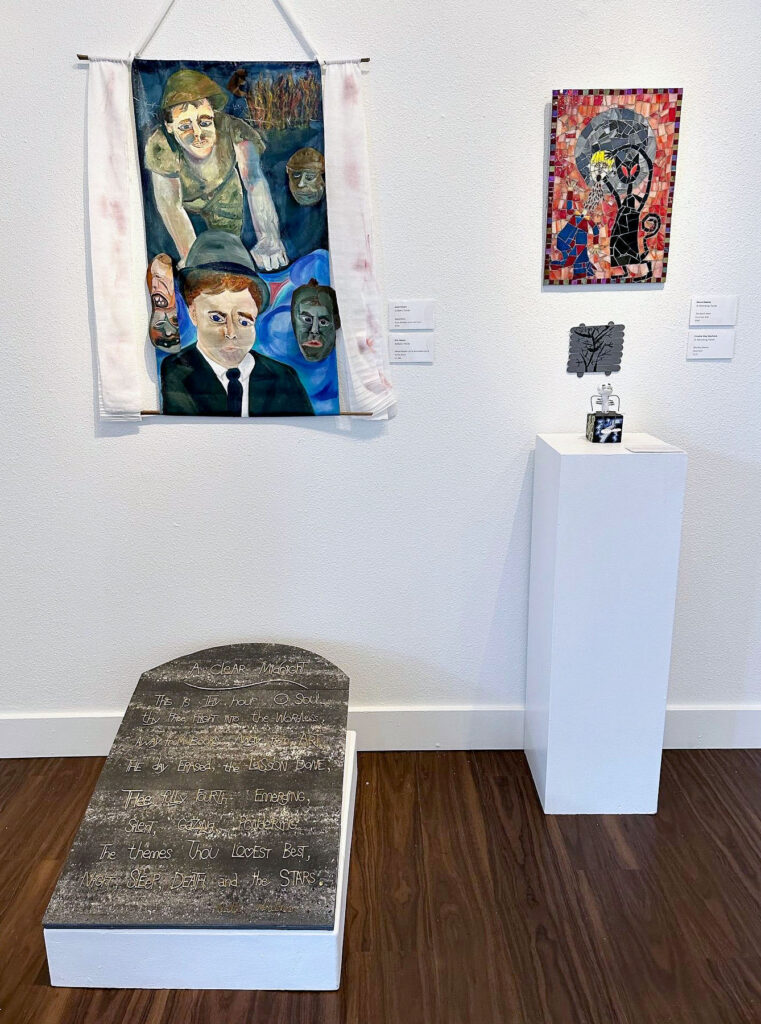
Janet Folsom, “Apparitions”, Mixed media (top left); Eric Folsom, Gravestone, bronze on marble; Donna Slawsky, (top right) “The Devil’s Work”, Stained glass, beads, and Creative Clay, Stephanie,(bottom right) “Monkey Dreams”, Mixed Media
About Creative Clay, who contributed several works to the exhibition-
“Creative Clay achieves its mission by providing ongoing studio arts workshops for individuals with disabilities five days per week. Creative Clay teaching artists provide students with education and experience in artistic techniques, as well as vocational skills related to the display, promotion, and sale or their expressive work.”
Katie Deits, “Haunted by the Past”, Ceramic, cotton, pencil, acrylic paint (left) and Nick Reale, “Out of the Wood” wood sculpture
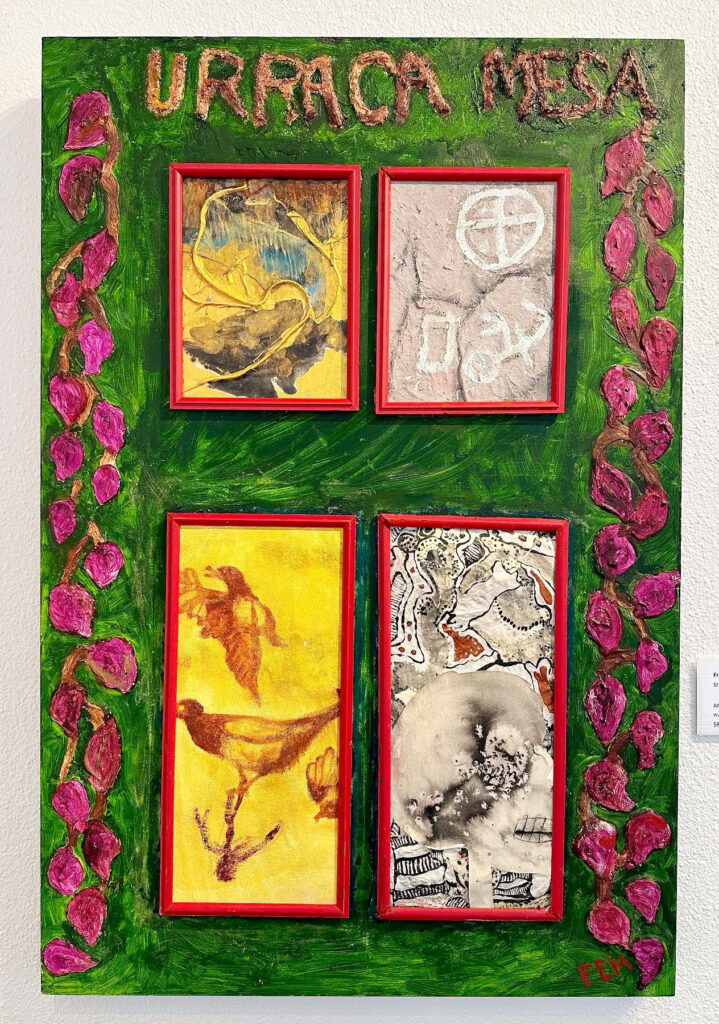
Francine Michel “Mysteries of Urraca Mesa”, Water mixable oil, collage
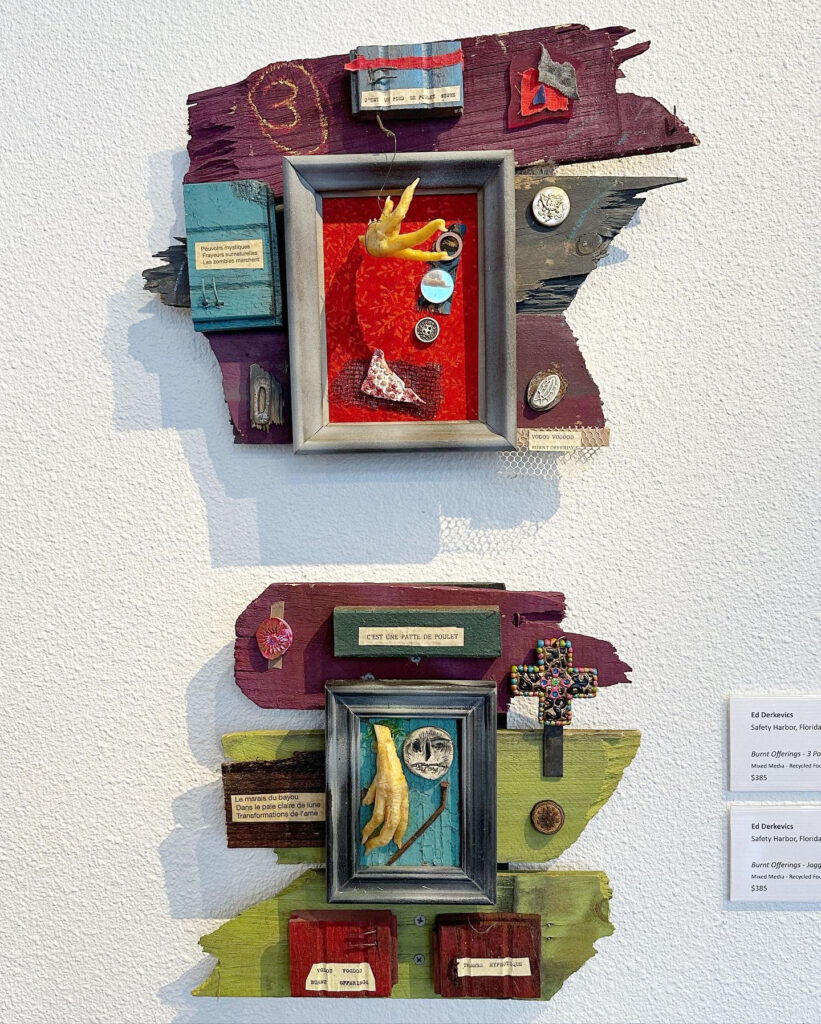
Ed Derkevics, “Burnt Offerings”- “3 Potions” and “Jagged”- Mixed Media, recycled found objects
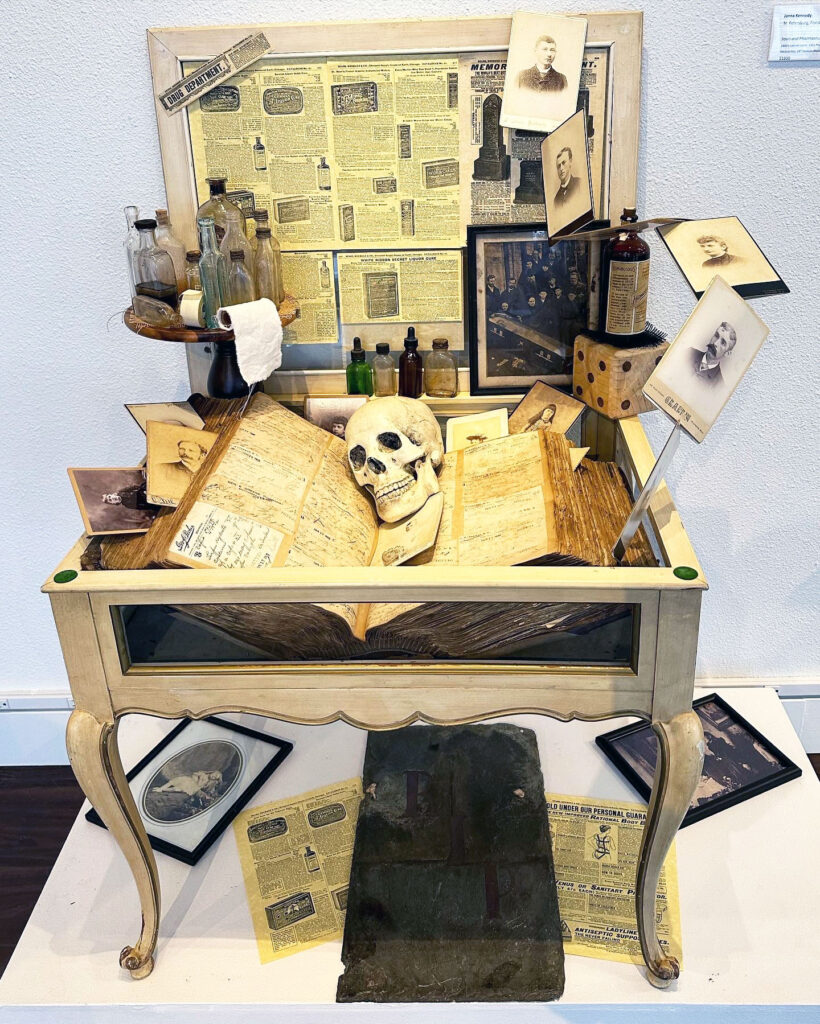
Janna Kennedy, “Souls and Pharmaseuticles”, 1800s Cabinet Cards, 1902 Pharmacy Ledger & Medical Ads, 19th Century Medicine Bottles
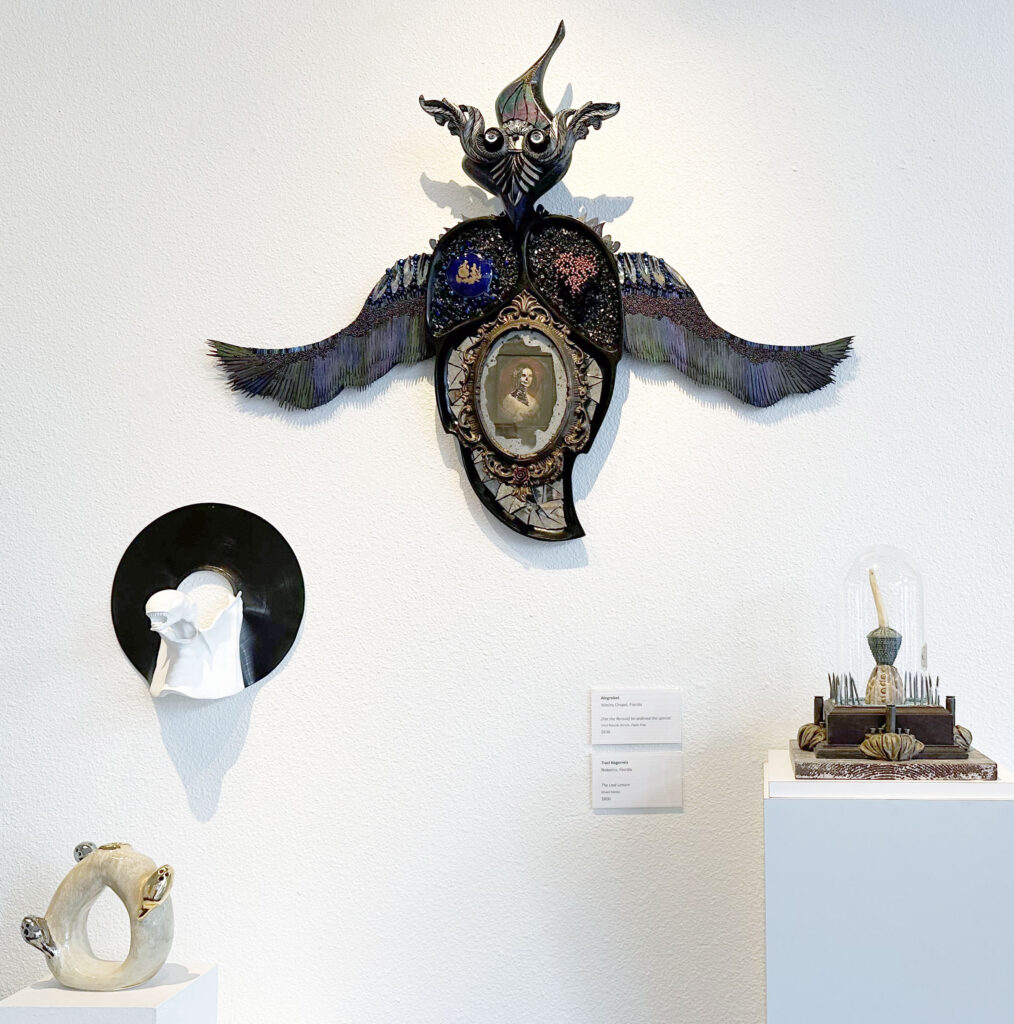
LA Finfinger, Ghost Ceramic work (bottom left); Alegrobot, “(For the Record) he ordered the special”, Vinyl record, paper clay; Traci Kegerreis, “The Lost Lenore”, Mixed media (center top); Demeree Barth, “Remembering Sedlec Ossuary”, Clay, bullet casings, wood display stand, found objects (bottom right)
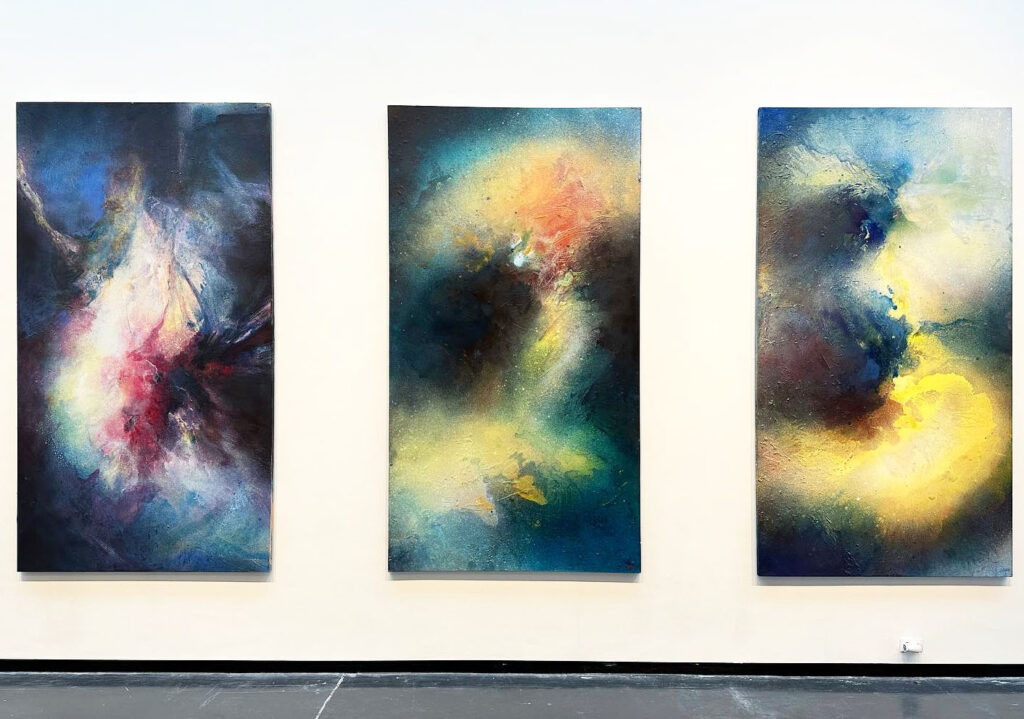
Angel Rivera Morales, “Dystopian Paradise I, II, and III”, 2023, Acrylic and oil on canvas
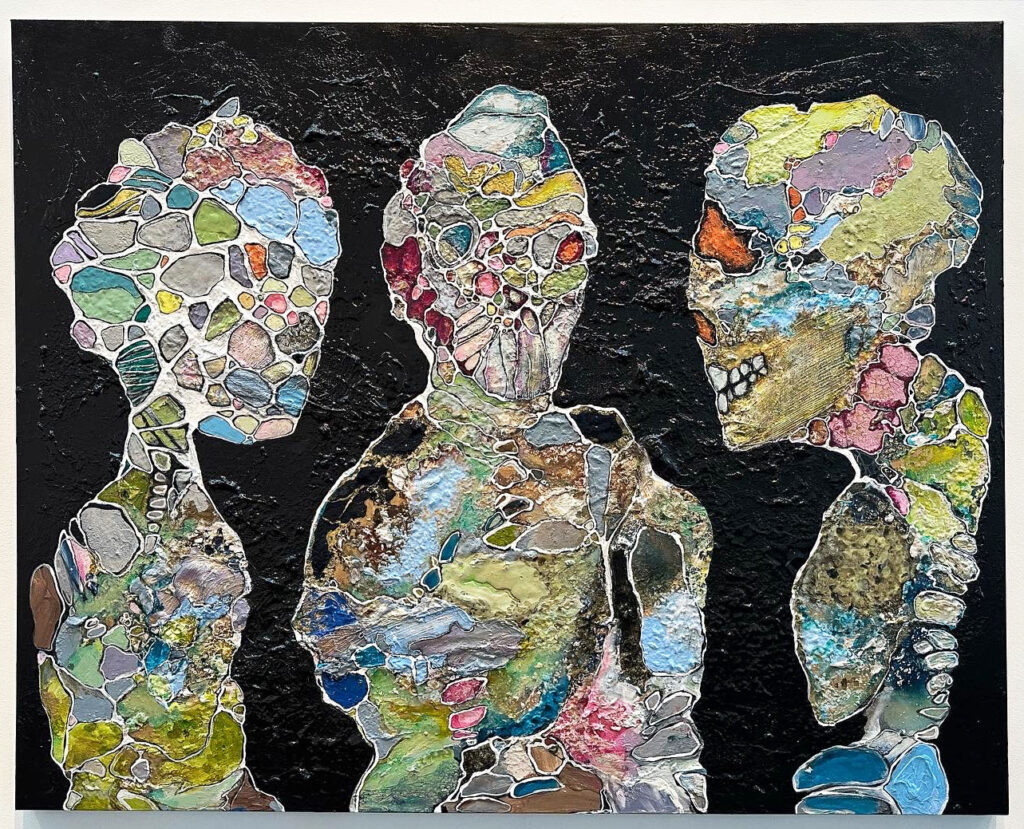
Gilbert Salinas, “As We Speak”, 2022, Mixed media on canvas
Juan Nieves Burgos, “Germinar de patria” and “Mundo sin tiranos”, 2019; Carmen Rojas Gines, “She Warrior-SW3 “Guerrera”-G3″, Steel metal
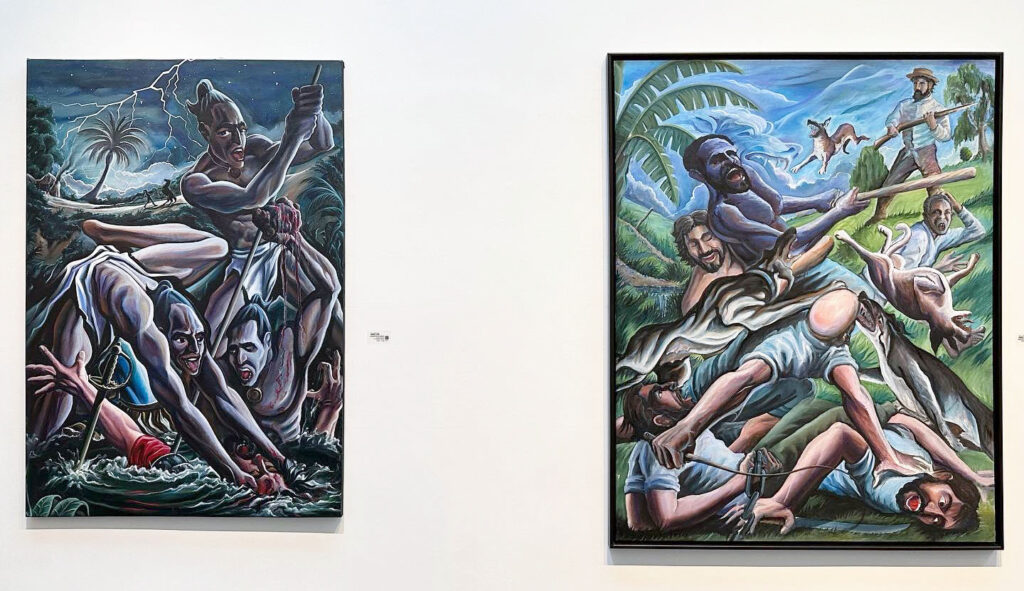
Valentin Tirado Barreto, “Salcedos Death- La Muerte de Salcedo” and “Rebellion of the slaves- Rebelión”, Acrylic on canvas
Currently at Creative Pinellas is the group exhibition Keepers of Heritage: Hidden Tales / Custodios de la Herencia: Cuentos Ocultos, on view until 10/15/23.
From the Creative Pinellas website-
Keepers of Heritage is an extended collaborative effort whose purpose is to document, present and promote the contributions of artists of Puerto Rican artists in the Caribbean archipelago and abroad.
Its roots go back to 2015 with the presentation of the “La Diaspora” exhibition at the Terrace Gallery in Orlando City Hall. Since then, the collective has expanded and traveled to institutions such as the National Museum for Puerto Rican Arts and Culture in Chicago, the Appleton Museum of Art in Ocala, and the Albin Polasek Museum in Winter Park, Florida.
Over eight years, the collective has documented and presented the work of nearly 30 artists whose artistic practices include a diversity of mediums such as painting, drawing, sculpture, engraving, multimedia, and photography.
Launched in 2006 to support the next wave of contemporary portraiture in the United States, the National Portrait Gallery’s celebrated triennial Outwin Boochever Portrait Competition is a major survey of the best American portraiture selected by internationally prominent jurors and curators. Now in its sixth edition, The Outwin: American Portraiture Today presents 42 works selected from over 2,700 entries, that foreground the vibrancy and relevance of portraiture today. In addition to paintings, photographs, drawings, and sculptures, The Outwin includes video, performance art, and textiles, highlighting the limitless possibilities of contemporary portraiture.
Open to both emerging and established artists, this year’s entrants were encouraged to submit work that moves beyond traditional definitions of portraiture, and to explore a portrait’s ability to engage with the social and political landscape of our time. The variety of media and subjects featured in the exhibition invite audiences of all backgrounds to find relation in the human experience.
Since its inception, finalists for the exhibition have been determined by a panel of jurors including three Portrait Gallery staff members and four external professionals (critics, art historians, artists). The competition is endowed by and named for Virginia Outwin Boochever (1920 – 2005) who, for 19 years, volunteered as a docent at the Portrait Gallery. Her commitment to advancing the art of portraiture is continued through the support of her children.
Below are a selection of works from the show and information about them from the museum.
Alison Elizabeth Taylor– Anthony Cuts under the Williamsburg Bridge, Morning, 2020 (pictured above)
On walks around her Brooklyn neighborhood during the COVID-19 lockdowns, Alison Elizabeth Taylor encountered the hair groomer Anthony Payne, who,with his workplace shuttered, had taken his scissors, mirror, and chair to the streets. Payne sought to financially support the Black Lives Matter movement, especially in the aftermath of George Floyd’s murder, and turned over proceeds from his donation-based haircuts to organizations advocating for social justice.
Taylor’s process, one she developed and named “marquetry hybrid,” incorporates vivid paints, inkjet prints, and the natural grains of over one hundred veneers. Marquetry, with its inlaid combination of woods, can “memorialize,” Taylor notes. She acknowledges the history of the craft, which was favored by Louis XIV (1654-1715) when he was acquiring furniture for Versailles. By giving Payne this “royal treatment,” Taylor aims to pay tribute to him.”I want him to see how much his example meant to me,” she explained.
Kira Nam Greene, “Kyung’s Gift in Pojagi (From the series “Women in Possession of Good Fortune”)”, 2019 Oil, gouache, colored pencil, and acrylic ink on canvas
Kira Nam Greene– Kyung’s Gift in Pojagi (From the series “Women in Possession of Good Fortune”), 2019
In this mixed-media work, by Kira Nam Greene, the artist Kyung Jeon faces us with relaxed self-assurance. She is carefully positioned on her couch as her long black hair falls over her orange and turquoise tunic. In the foreground, a wooden cylinder containing paint brushes reveals her medium of choice. A plate with persimmons, consumed during the harvest festival Chuseok to celebrate good fortune, brims with potential while the rest of the painting pulsates with action.
Greene situates her friend in a fantasy world that echoes Jeon’s artwork and their mutual interest in the traditional Korean fabric quilting technique of pojagi. Two rabbits, representing Jeon’s Chinese zodiac, appear to be concocting a potion. Flowers sprout as kaleidoscopic patterns envelop her. The reference to pojagi, the visible paint drips in the background painting, and the hands of the sitter- left unfinished- invoke the role of tradition, process, and exploration in artmaking.
Stuart Robertson, “Self Portrait of the Artist” from the “Out and Bad” series, 2020, Aluminum, earth, acrylic paint, enamel, paper,metallic bubble wrap, sequins, and gold foil on wood
Stuart Robertson– Self Portrait of the Artist from the Out and Bad series, 2020
“In my world, skin is high-tech, amorphous, and armored,” the artist Stuart Robertson observes. “Blackness is percussive, lustrous, flexible, and indestructible.” Self-Portrait of the Artist depicts a fragment of a man- half of his face and his upper torso-shiny and monumental. A black beard delineates his jaw, and a small gold hoop adorns his ear. Although the figure is cropped beyond recognition, the work’s title provides a clue.
Through the alternation of flat and repoussé aluminum sheets, Robertson achieves a hypnotic effect, a poignant tension playing on what he reveals or hides from us viewers. His refusal to depict his entire face or figure challenges the notion of what a portrait should be and blocks the objectification of the Black male body, so often sexualized in visual culture. Simultaneously, Robertson delivers an irrepressible, resplendent image of that body, one inspired by the aesthetics of Jamaica’s dancehall culture.
Vincent Valdez, “People of the Sun (Grandma and Grandpa Santana)”, 2019, Oil on canvas
Vincent Valdez– People of the Sun (Grandma and Grandpa Santana), 2019
An elderly couple faces us with the gentle authority that old age provides. People of the Sun (Grandma and Grandpa Santana) is a portrait of Vincent Valdez’s maternal grandparents. “My grandparents spent most of their time outside,” the artist recalled. “Grandpa spent his entire life working under the blazing Texas sun as a carpenter and yard worker, cutting lawns in the wealthy communities of San Antonio right up until he passed away. Grandma was constantly working with her hands–raising kids, washing, sewing clothes, and tending the plants in her yard.”
The Santanas are depicted in a space defined by details the artist remembers: their vintage AM radio, their plants, their homemade clothes. The bedsheet, like the Virgen de Guadalupe’s aura, signals their spiritual role in the family. This portrait connects the pair to the Indigenous and mestizo cultures of the American Southwest, including the Aztec and Maya, who honored the sun.
For more work from the exhibition, please head to page 2.
“Bryson Funmaker”, 2020, Inkjet print and beadwork
The Museum of Fine Arts St. Petersburg is currently showing an impressive collection of work from photographer Tom Jones. The photos, in multiple series, focus on Native American identity, history, cultural appropriation, and the Ho-Chunk Nation of Wisconsin, of which Jones is a member. The work engages visually while also being informative.
From the museum’s press release for Tom Jones: Here We Stand–
For over twenty years, Tom Jones has created a visual record and exploration of his Ho-Chunk community. Born in North Carolina and raised in Orlando after a short stint in Minneapolis, Jones returned to the Midwest, moving to Wisconsin at age 15. He then made his way to Chicago for graduate school at Columbia College. Jones’s father worked with Kodak and owned a photography lab, helping shape the artist’s understanding of the practical aspects of photography from an early age. During graduate school, Jones began an ongoing photographic essay on the contemporary life of his Ho-Chunk community, beginning first with the elders.
The show comprises over a dozen series, ranging from the documentary to the conceptual. Of his series on Veterans’ memorials at the annual Black River Falls Pow-Wow, Jones says, “I was interested in the way families made very conscious decisions about how they want their loved ones memorialized.” Other series include the emotionally intimate, though larger than life, beaded portraits. “Beading is a metaphor for our ancestors watching over us. I am also referencing an experience I had when I was about 8 or 9 years old. My mother took me to see a Sioux medicine man named Robert Stead. He led the call to the spirits, the women began to sing, and the ancestors appeared as orbs of light. This event inspired the series Strong Unrelenting Spirits.“
Jones’s photographs examine identity and geographic place with an emphasis on the experience of Native American communities. He is interested in how American Indian material culture is portrayed through commodification and popular culture. Much of his work counteracts and corrects decades of misinformation and misrepresentation of American Indians, particularly targeting the field of U.S. history. Jones’s critical assessment of the romanticized representation of Native peoples in photography re-examines historic pictures taken by white photographers. This reassessment questions the assumptions about identity within the American Indian culture by non-natives and natives alike. “While each of Jones’s series is distinctly different, the message remains consistent: the Ho-Chunk are not vanishing or frozen in time,” said Dr. Jane Aspinwall, Senior Curator of Photography. “Jones’s photographs emphasize a solid, generational commitment to family, tribal community, and land. His photographs reclaim appropriated images and set the historical record straight.”
Below are a some selections from a few of the series in the exhibition.
“Trenton and Roger Littlegeorge”, 2011
“Dorothy Crowfeather”, 1999
“Dear America” series
About the Dear America series pictured above-
Using each line from the first two verses of the song, America (“My Country Tis of Thee”) as the title of fourteen of the works in the Dear America series, Jones questions whose history is being propagated here. With dry wit and an unfailing commitment to truth, Jones exposes atrocities like the massive effort by the U.S. government to assimilate Native American children to non-Native culture, the merciless seizing of Native lands, and the mass hanging of thirty-eight Sioux and Ho-Chunk men under President Lincoln in 1862. He also highlights Native American identity in relation to cowboy culture, the thoughtless misappropriation of Native American customs, and the influence of the Iroquois Confederacy on the U. S. Constitution. Jones’s aim is to broaden the “traditional” historical American narrative to be more representative of all people, especially the original inhabitants of this land.
About the Ho-Chunk Veterans Memorials, pictured above-
“I wanted to do this photographic essay to honor our veterans… One in four American Indian males is a United States veteran. Ho-Chunks have fought in every war for the United States except for the War of 1812. The Ho-Chunks did this even though they were not granted the right to vote until 1924, and during the Indian Removal Act, were removed at least seven times from Wisconsin by the United States government. This is the conviction we have as a people… I honor these people who give of themselves freely to protect this land. Traditionally, Ho-Chunks are taught to live their lives for the betterment of others. The veterans have done this.’
-Tom Jones
From Jones’ “”Native” Commodity” series
About the “Native” Commodity” series-
The Wisconsin Dells, one of the most popular tourist destinations in the state, is home to spectacular natural scenery and the largest concentration of waterparks. Located on Ho-Chunk ancestral land, the area is now highly commercialized, with much of its identity resting on the appropriation of Native American stereotypical tropes. In this series, Jones documented this unabashed use of Native American symbols, images, and place names in advertising and popular culture. The sale of “Native American” crafts made in China, the liberal use of names of historically important figures like Black Hawk, and the indiscriminate mix of tribal communities into one conglomerate-tipis from the Plains next to totem poles from the Pacific Northwest next to Pueblo pottery. The Dells serve as a microcosm for how images of Native Americans are reproduced and reframed into a collective memory that is often distorted. Jones wryly noted that none of the Native American objects feature anything specifically attributable to the Ho-Chunk Nation.
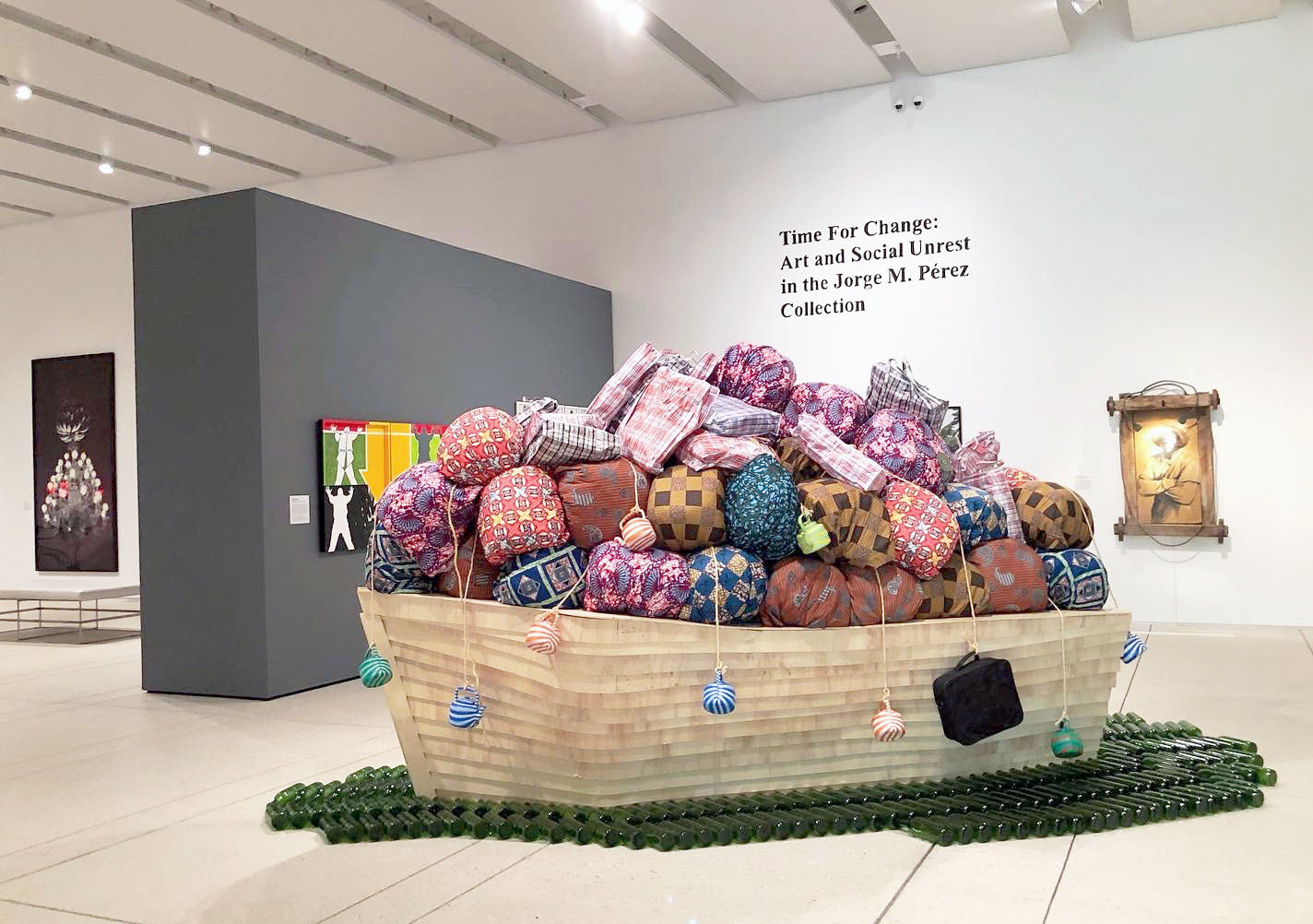
Barthélémy Toguo (Cameroonian, b. 1967), “Road to Exile”, 2018. Wooden boat, cloth bundles, glass bottles, and plastic containers
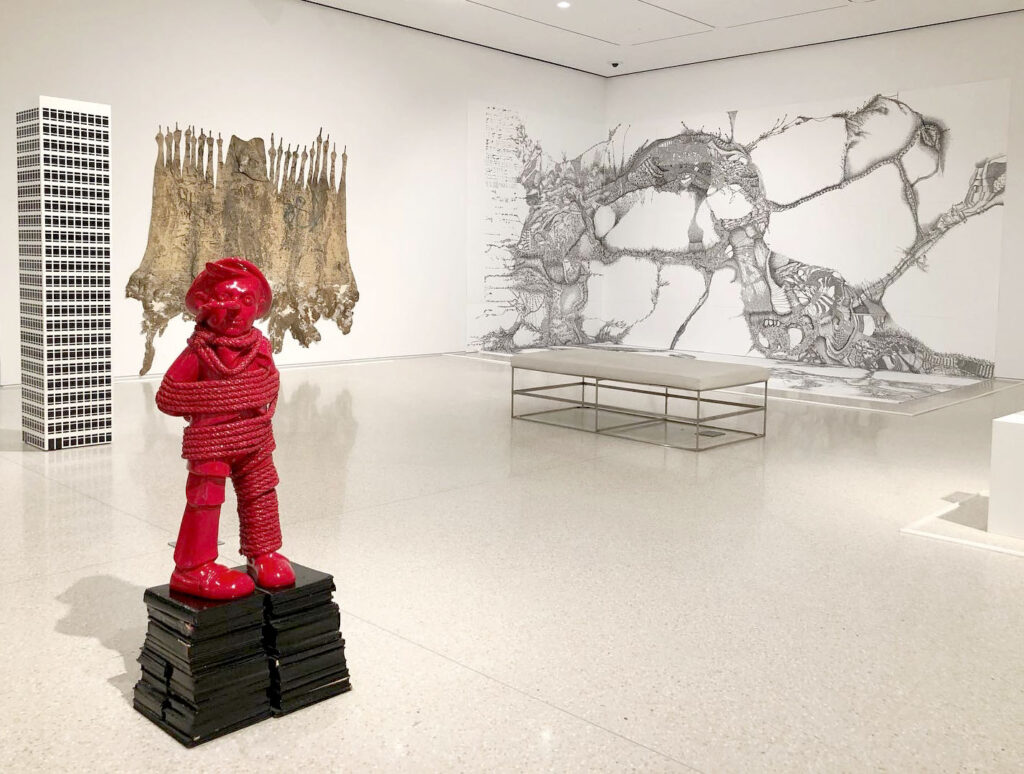
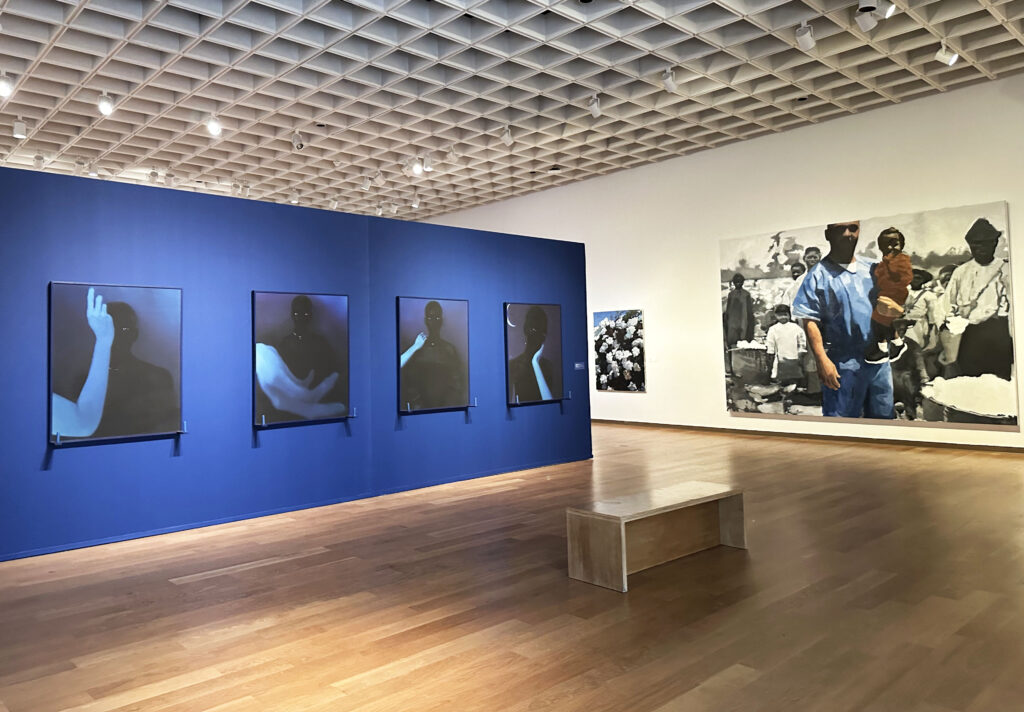
Currently on view at Tampa Museum of Art is Time for Change: Art and Social Unrest in the Jorge M. Pérez Collection. The exhibition highlights art from around the world that focuses on social issues.
From the museum-
“It is enough for the poet to be the bad conscience of his age”, stated Saint-John Perse in his 1960 Nobel Prize acceptance speech. Something similar could be said when artists address the transformations of society. We should not ask for measurable political action when their role is to point out, to render evident, to shake us from indifference. Art may not provide answers, but most of the time it interrogates and proposes uncomfortable issues, almost like rubbing salt in a wound. Artists are seldom celebratory, nor do they usually provide solutions-art’s potency lays in the symbolic efficacy of the actions it proposes more than in the practical effects they entail. Paraphrasing Brazilian poet Ferreira Gullar, “art exists because life is not enough.”
Time for Change is structured around six themes or nuclei: Entangled Histories, Extraction and Flows, Artivism, State Terror, Spatial Politics, and Emancipatory Calls. The sections are organically linked and establish dialogue and correlations among artworks that do not necessarily illustrate an argument nor are they contained by one. Entangled Histories proposes essential questions: how do we remember as a society? Who is forgotten by History, and for what reasons? Extraction and Flows examines displacement of peoples (usually forced), as well as the unequal logic on the territory. Artivism: Art in the Social Sphere focuses on political unrest and public protest on the streets. State Terror signals how protest is countered with repression and violence. The fifth section, Spatial Politics, reflects on modern architecture and its role in creating segregated communities. Lastly, Emancipatory Calls summons to reclaim difference, in the understanding that a more just society can only be built on respect for one’s right to be different.
A comprehensive look at the Jorge M. Pérez Collection reveals a tendency towards art with an interest in social change- art that examines the conflicts and contradictions of contemporary society, art that critically analyzes historical events and reframes them in the present. Many of the 60 works on view, due to their size or complexity have rarely been exhibited and are shown together for the first time in Time for Change.
About the main work pictured above, Barthélémy Toguo’sRoad to Exile, from the museum–
In 2018, the Parrish Art Museum in Water Mill, New York hosted Barthélémy Toguo’s first solo exhibition in the United States. While on site at the Parrish he made Road to Exile, a large-scale installation highlighting the plight of refugees, in particular African migrants in search of a better and safer quality of life. The installation features a life-sized wooden boat that rests on glass bottles. A metaphor of the dangerous voyage across the sea, the bottles represent the fragile line between life and death. The boat nearly overflows with bundles wrapped in brightly colored African textiles and serve as stand-ins for the body. In Road to Exile Toguo employs imagery of the boat as a means of escape rather than a vessel for exploration or adventure.
Below are images from the exhibition as well as some information on a few of the works.
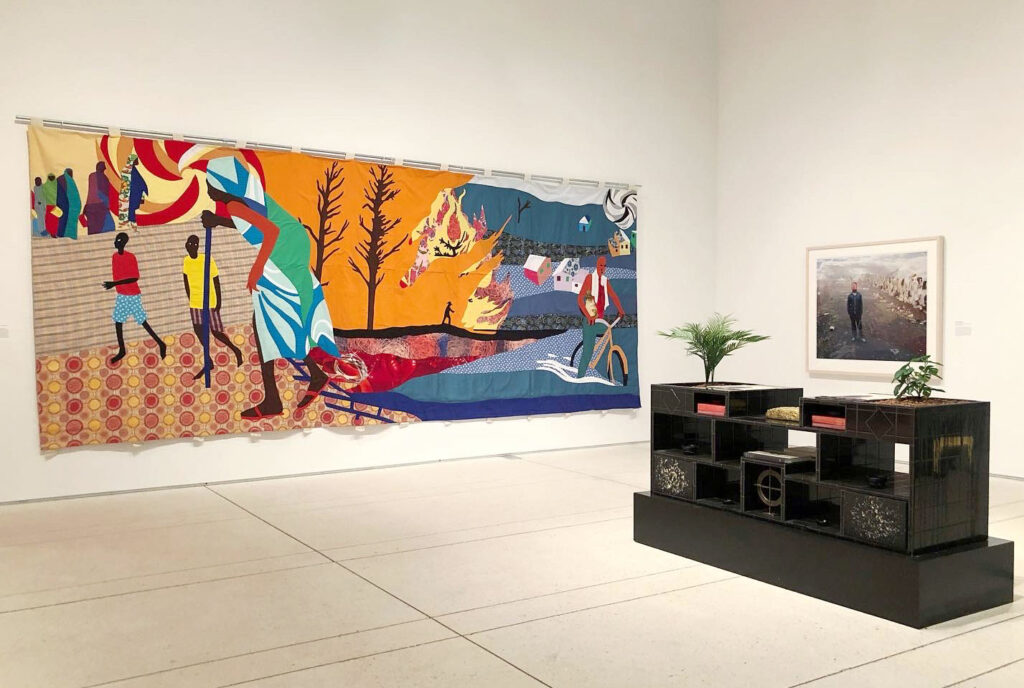
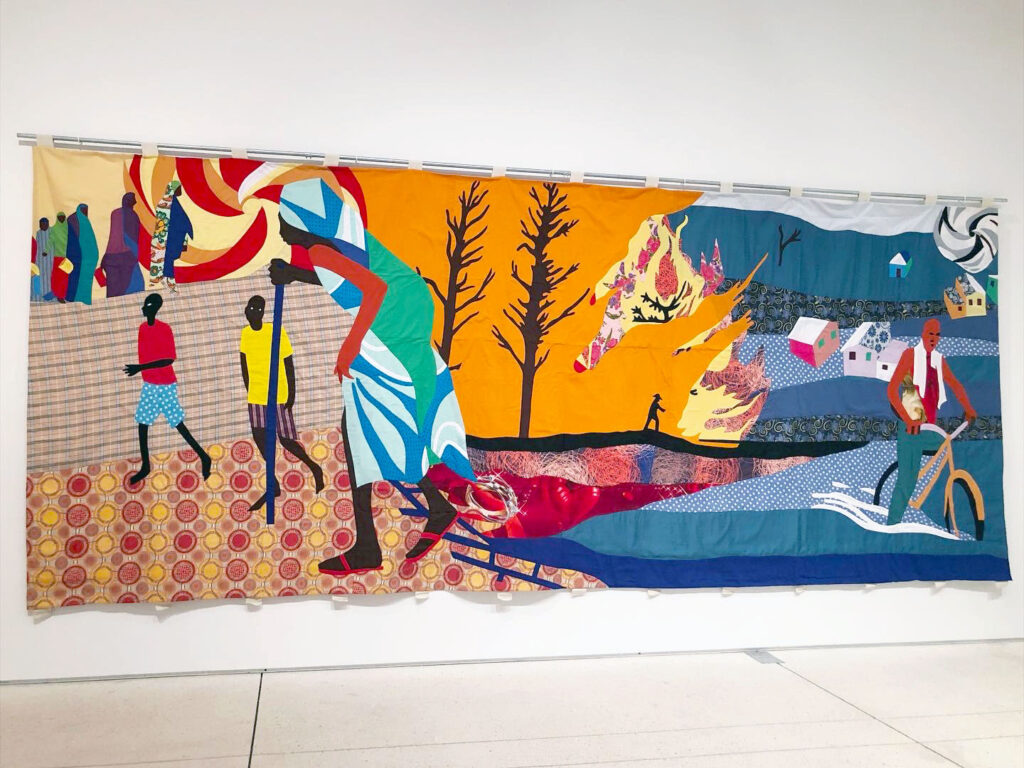
Rashid Johnson, “A Place for Black Moses, (2010), bottom right sculpture, and Christopher Myers “How to Name a Famine, a Fire, a Flood”, 2019, left wall piece
Christopher Myers “How to Name a Famine, a Fire, a Flood”, 2019, Applique fabric
From the museum about the above work-
Storytelling anchors Christopher Myers’ artistic practice. Working in a range of media, he mines history and creates art that links the past to the present. Myers’ tapestries, such as How to Name a Famine, a Fire, a Flood draws on the rich tradition of quilt making as a quiet yet radical form of resistance and protest. The stories depicted center on the effects of globalization on individuals and more specifically, communities of color. In How to Name a Famine, a Fire, a Flood, Myers portrays three different natural disasters linked to climate change. With vivid color and patterned fabric, he illustrates the impact and devastation of these catastrophic events in neighborhoods with minority populations.
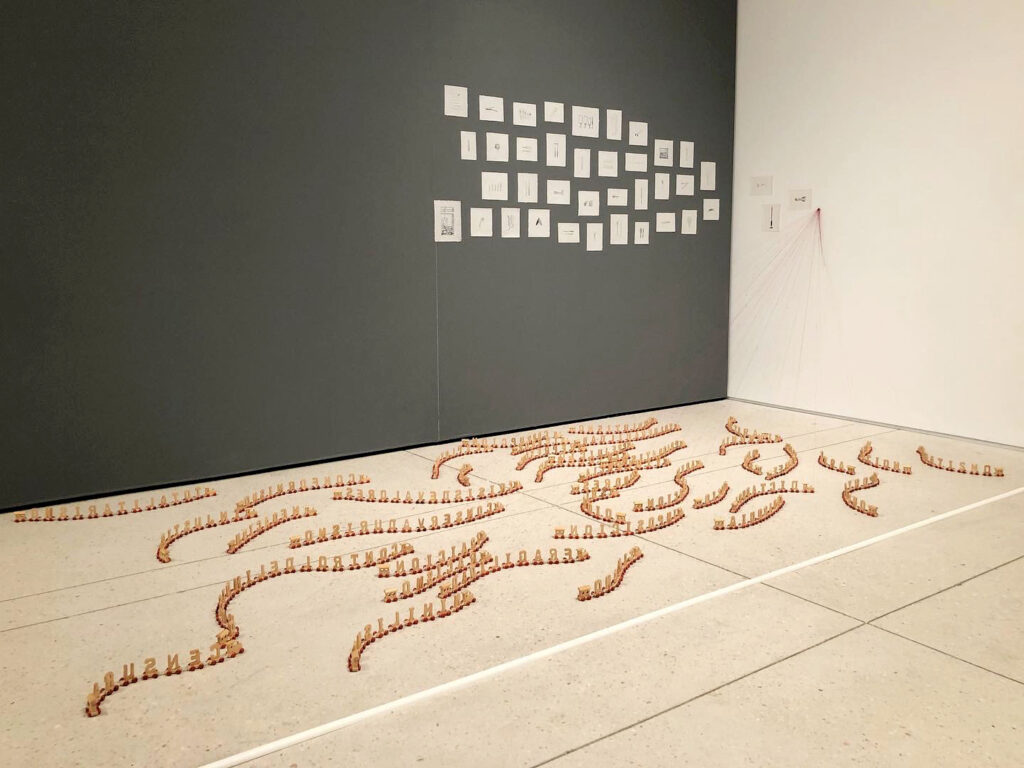
Carlos Garaicoa “La habitacion de mi negatividad (The Room of My Negativity)”, 2003, 39 ink and pencil drawings on rice paper and toy train installation
Carlos Garaicoa “La habitacion de mi negatividad (The Room of My Negativity)”, 2003 (detail)
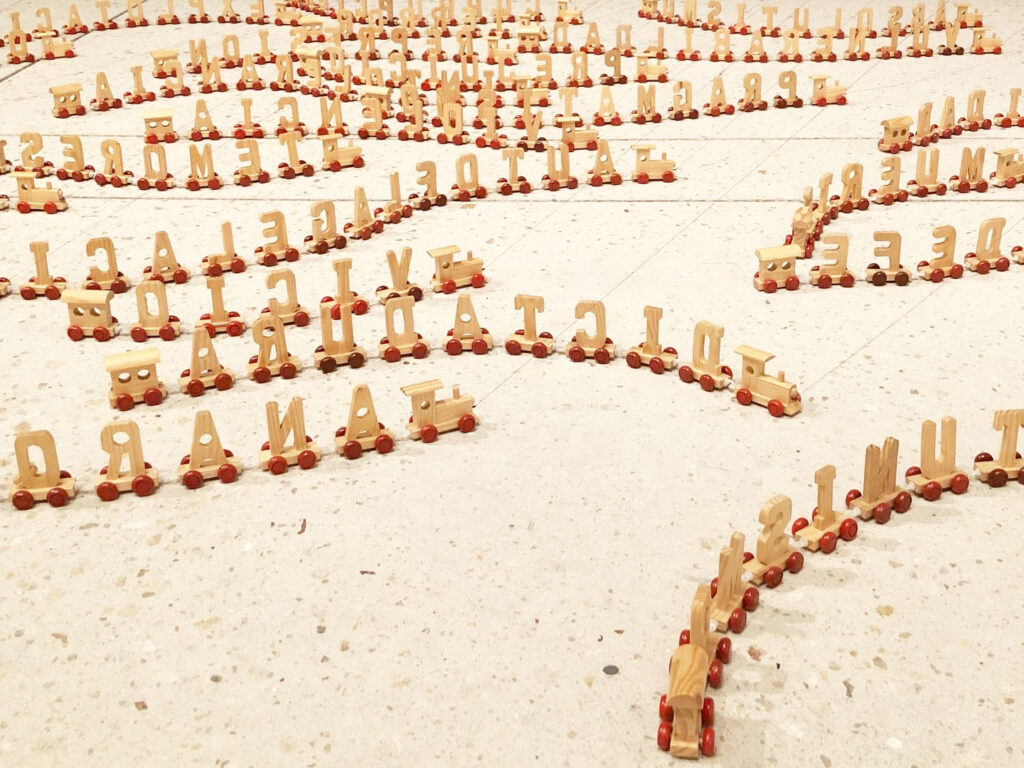
Carlos Garaicoa “La habitacion de mi negatividad (The Room of My Negativity)”, 2003 (detail)
About the above work from the museum-
Carlos Garaicoa works in a variety of media, ranging from installation, photography, and video to performance and public interventions. His early work in the 1990s focused on the urban decay of Havana as result of its political climate and economic strife. La habitacion de mi negatividad (The Room of My Negativity), turns Garaicoa’s lens inward. In this installation, comprised of toy trains and drawings of medical instruments, the artist explores his psyche and subconscious. The train’s engine pulls words that represent Garaicoa’s negative thoughts. Each train is connected to thin red thread that acts as a vein or conduit for the negative thoughts to travel. Arrange in a curved form, the train shapes mimic brain waves or the slink of a snake. Garacoia’s drawings of medical tools serve as mechanisms in which the negatively could be excavated from one’s mind.
Esterio Segura, “La historia se muerde la cola (History Bites its Tail)”, 2015, (statue bottom left); Anamaría Devis, “Infinito (Infinite)”, 2018(upper right)
Anamaría Devis, “Infinito (Infinite)”, 2018, Ink on paper
Anamaría Devis, “Infinito (Infinite)”, 2018, Ink on paper (detail)
About this work from the museum-
Anamaría Devis’ large-scale installation Infinito (Infinite) represents the artist’s study of African history in San Basilio de Palenque, Colombia. Escaped slaves founded Palenque and it was the first free town in the Americas during colonial times. While researching this history, Devis discovered that in this region of Colombia, braided hairstyles worn by Africans served as escape maps. Braid patterns reflected safe points in the area’s topography. This silent form of resistance inspired her to look at other bodily topographies like the characteristics of fingerprints, which also had names associated with cartography such as crossing, island, and fork. Devis then began to create drawings that incorporated footprints, braid patterns, and elements of nature. From the drawings she made stamps and each panel of paper that comprises Infinito (Infinite) is rendered from Devis’ various imprints. The result is an abstract representation of the body and landscape visualized through mapping and codes.
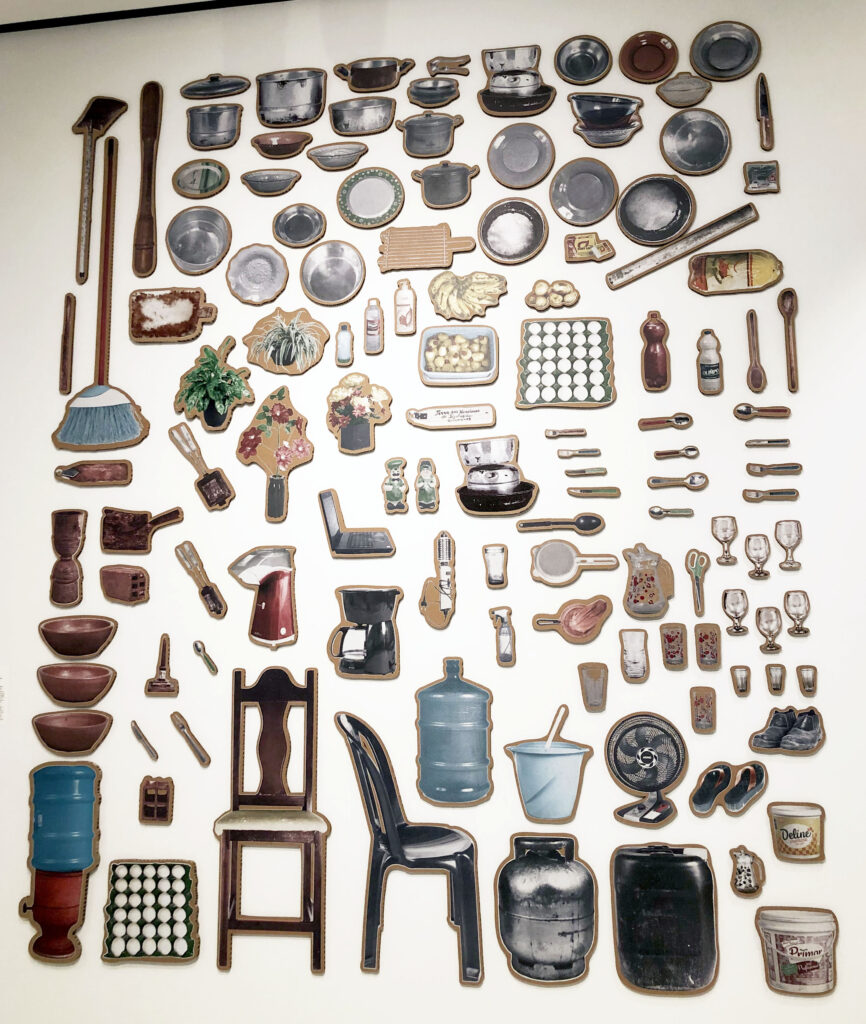
Jonathas de Andrade, “A batalha de todo dia de Dona Luzia, de Tejucupapo (The daily battle of Dona Luzia, from Tejucupapo)”, 2022 Images printed on raw falconboard
About this work from the museum-
Jonathas de Andrade collaborated with the Brazilian theater company Teatro Heroínas de Tejucupapo to create a visual reenactment of the historic 1646 Battle of Tejucupapo. For nearly 25 years, between 1630 and 1654, the Dutch occupied the northeast of Brazil including Tejucupapo, a small community in the city of Goiana. During the Battle of Tejucupapo, a brigade of black and indigenous women forced Dutch soldiers to retreat by arming themselves with household and farm objects. The Teatro Heroínas de Teiucupapo commemorates this female-led rebellion each April by restaging the battle with local actors.
Artist Jonathas de Andrade celebrates the power and courage of Tejucupapo’s women with his large-scale photographic installation A batalha do todo dia de Tejucupapo (The Battle of Tejucupapo). The work on this wall, A batalha de todo dia de Dona Luzia, de Tejucupapo (The daily battle of Dona Luzia, from Tejucupapo), presents everyday objects from the home of one of the women participating in Teatro Heroínas de Tejucupapo. This inventory explores the daily struggles, as well as strength, of Brazil’s black and indigenous women that have spanned centuries.
Clearwater Main Library is currently showing Cuba: The Natural Beauty, a selection of photographs by Clyde Butcher. Butcher is famous for his large black and white photos of nature, taken with a large-format 8×10″ or 11×14″ view camera.
About the show from the Clearwater site-
Commissioned by the United Nations to create a portfolio of the mountainous lands of Cuba, Clyde Butcher set out on three week-long expeditions into unfamiliar lands. He explored the island country’s varied geographic regions, from the Sierra Maestra Mountains in Cuba’s eastern Granma province, to the southern coast between Manzananilo and Santiago de Cuba. He ventured to places including Baracoa in the northeast, the southern waterfalls of the Serra de San Juan, and the mogotes of the west in the Piña del Rio region.
While taking photographs for the Conference for the Sustainable Habitat of the Mountains, Clyde thought about being part of an event changing history for the better, and enthusiastically saw an opportunity to make a positive difference. His photography transcends political boundaries, challenging us to work together to protect natural places across the globe.
This exhibition will continue until 10/31/23.
This past Wednesday (8/16) Butcher discussed his work at Clearwater’s Capitol Theater. It was a pleasure to hear him discuss his history, his travels in Cuba, his work, a visit with President Jimmy Carter, and life since his stroke. He will often sit for hours, under an umbrella, just to get his shot. It was a thoughtful, humorous, and often inspiring lecture.
It is definitely worth checking out his website to see more of his work and to read about his unique life. His wife Niki is an artist too, and her work is also on the website.
He has two galleries in Florida- The Venice Gallery and Studio, and Big Cypress Gallery near the Big Cypress National Preserve Oasis Visitor Center in the Florida Everglades. There are places to stay on the Big Cypress property and you can take a guided tour of the natural surroundings.
The Florida Prize in Contemporary Art is organized by the Orlando Museum of Art to bring new recognition to the most progressive artists in the State. Each year OMA’s curatorial team surveys artists working throughout the State before inviting ten to participate. One artist will receive a $20,000 award made possible with the generous support of local philanthropists Gail and Michael Winn. Artists range from emerging to mid-career, often with distinguished records of exhibitions and awards that reflect recognition at national and international levels. In all cases, they are artists who are engaged in exploring significant ideas of art and culture in original and visually exciting ways.
Work by Jenny Granberry (top) and Victoria Block (bottom)
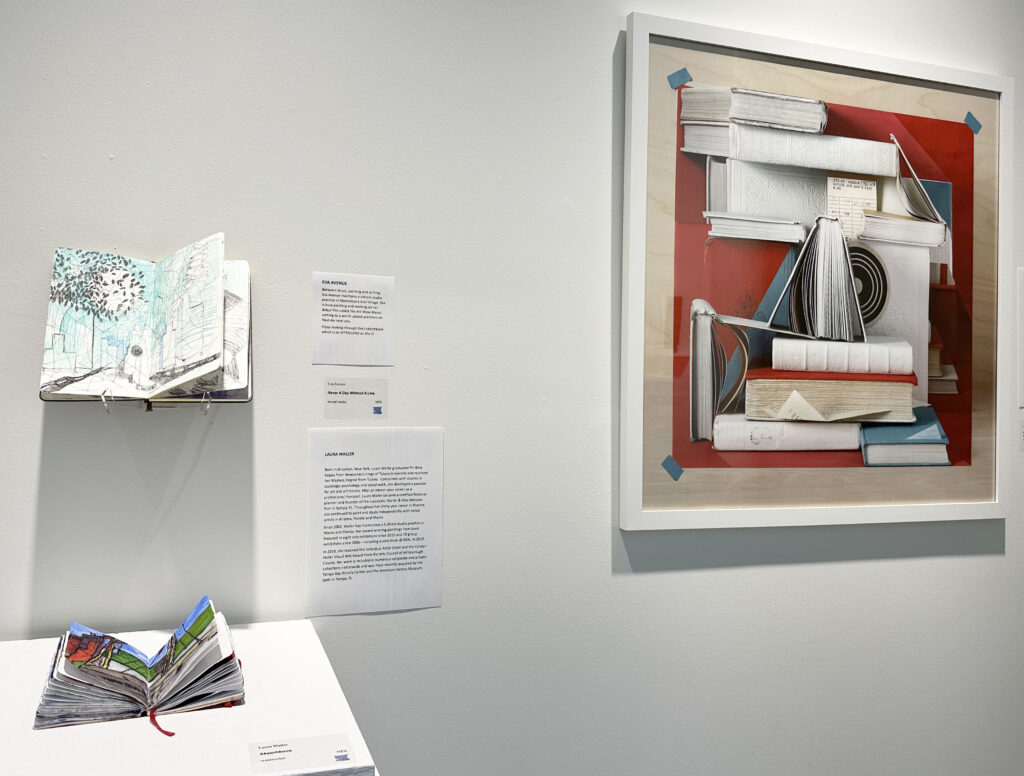
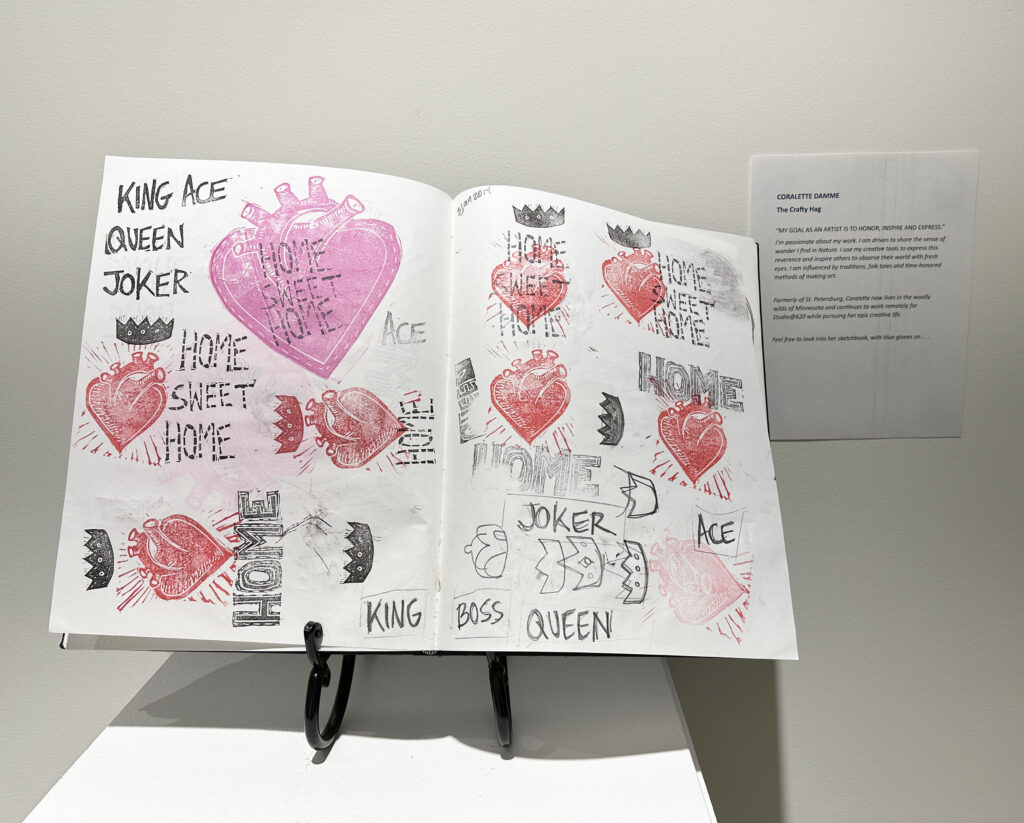
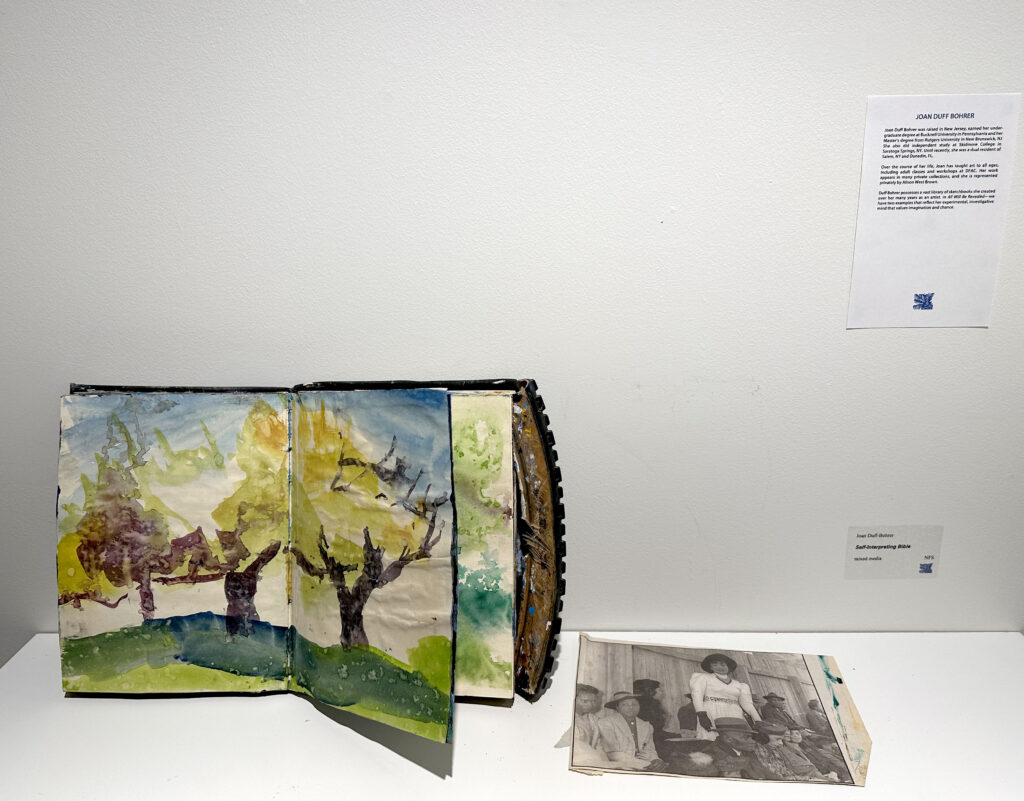
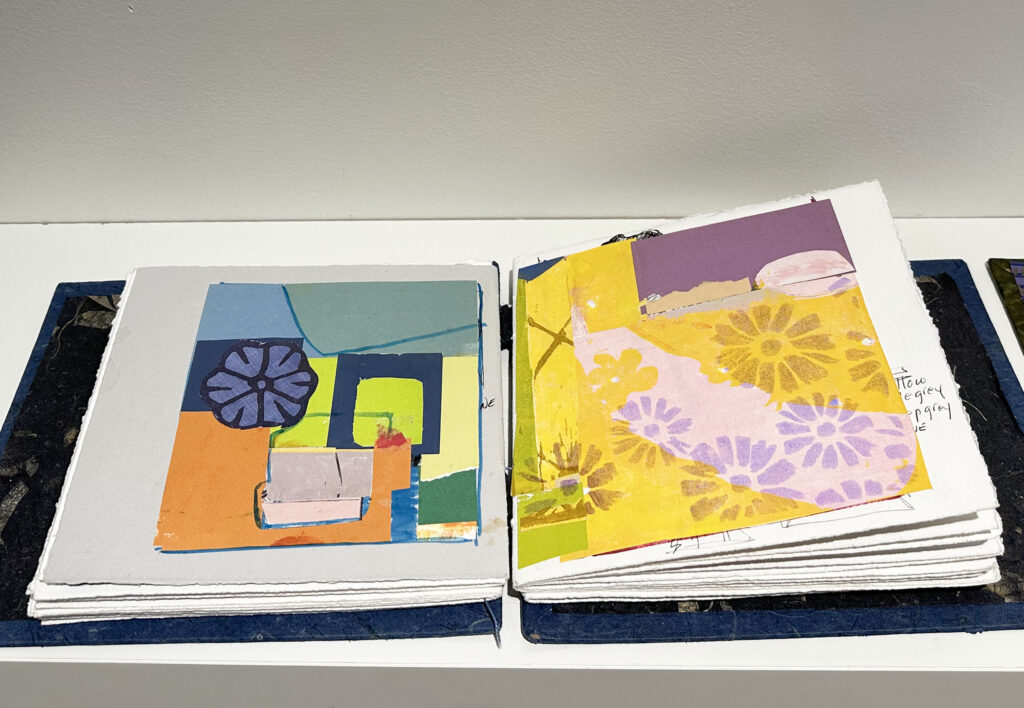
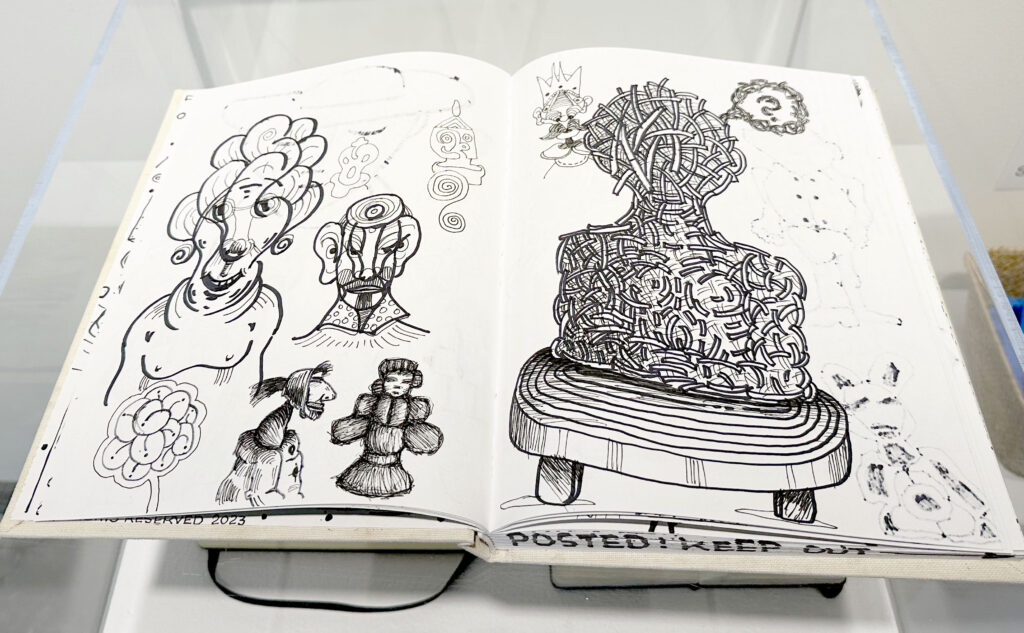
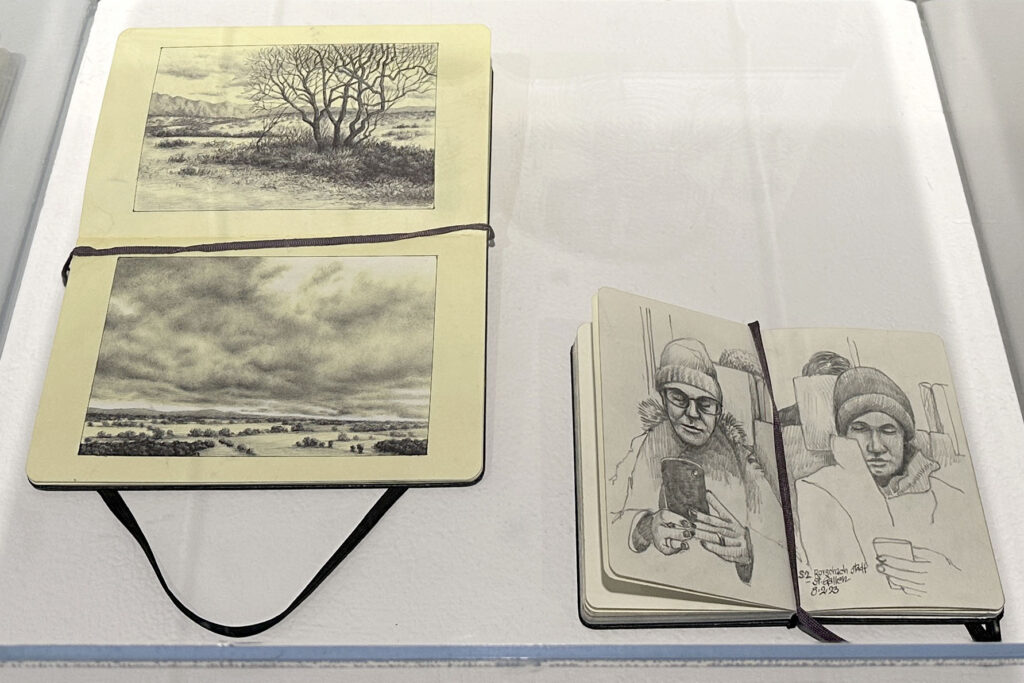
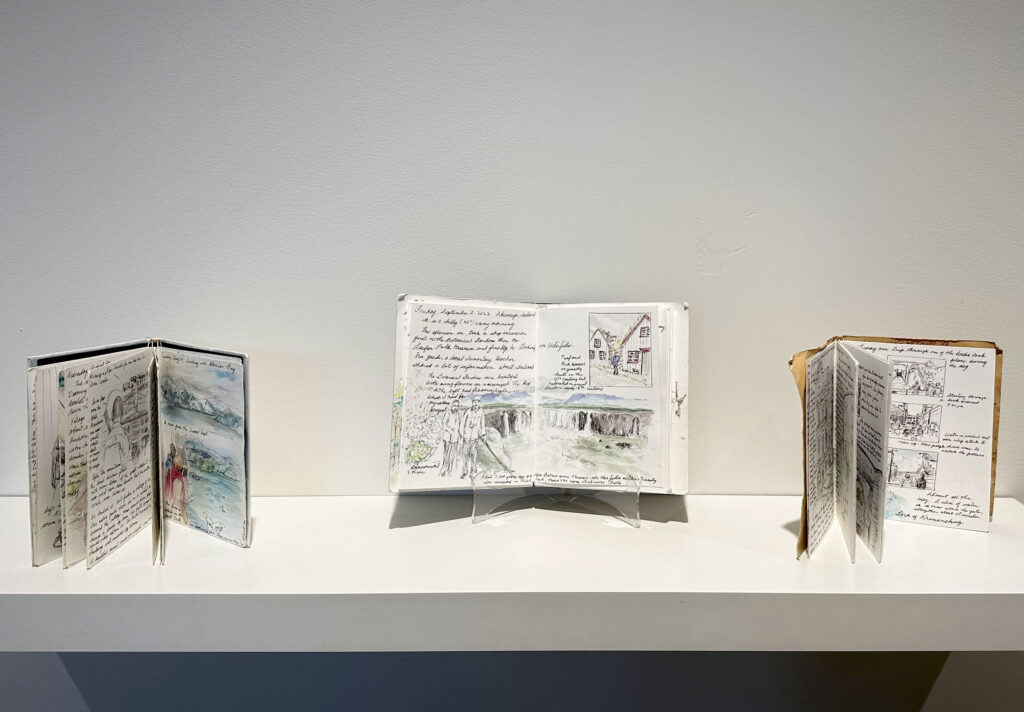
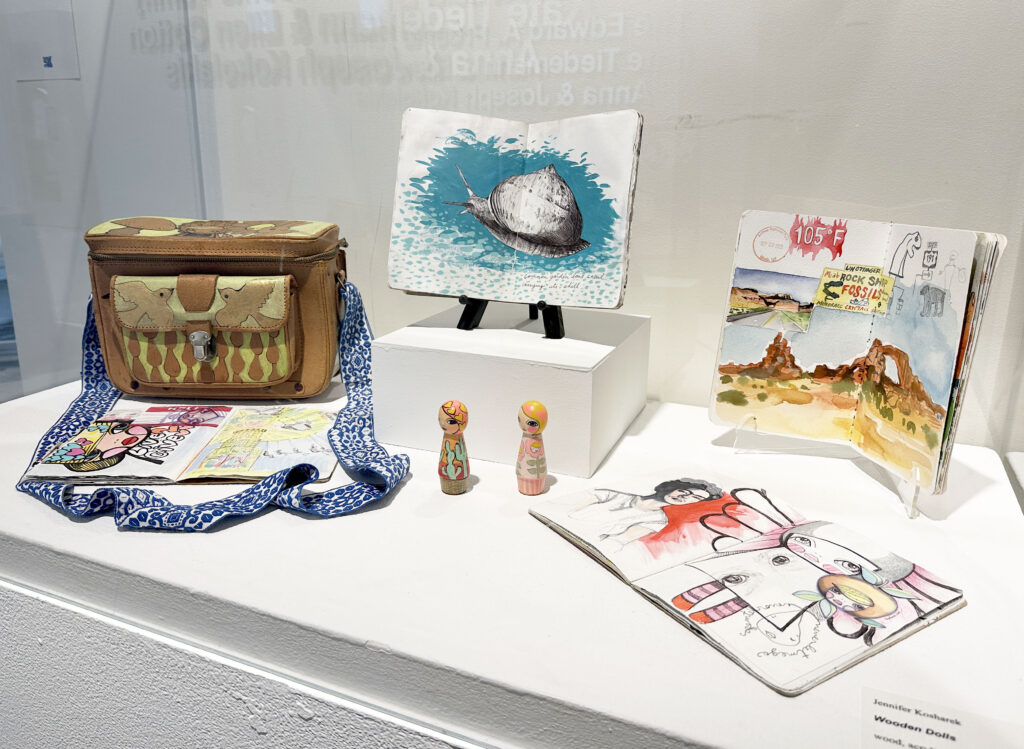
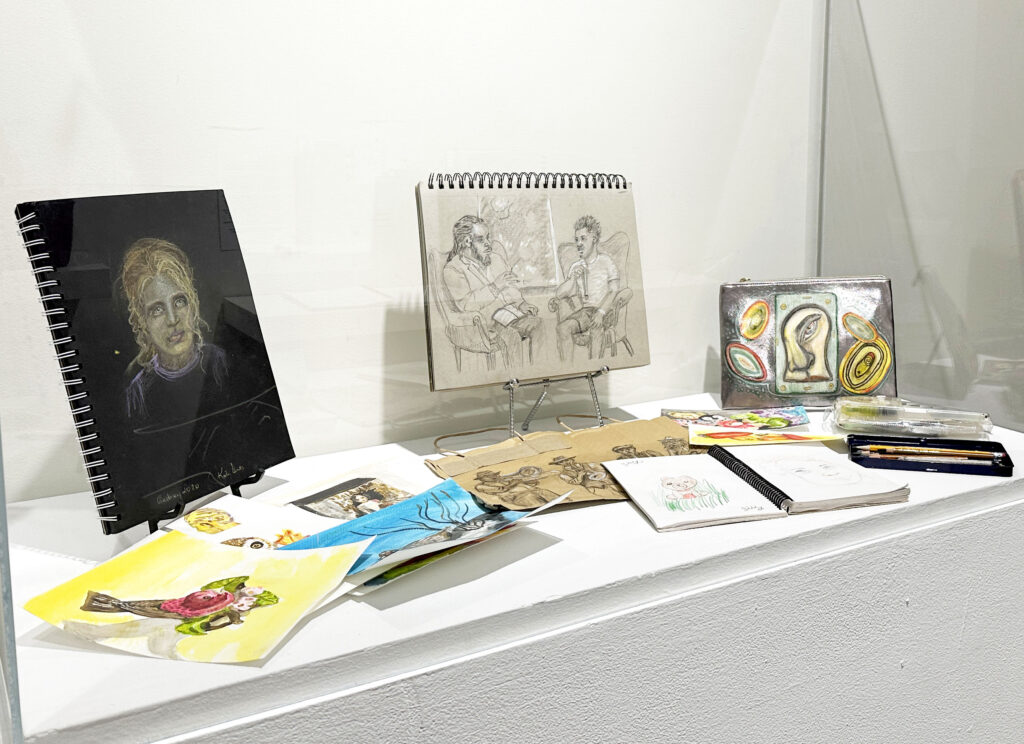
Journals by Eva Avenue (top left) and Laura Waller (bottom left) and photography by Andrew Sovjani
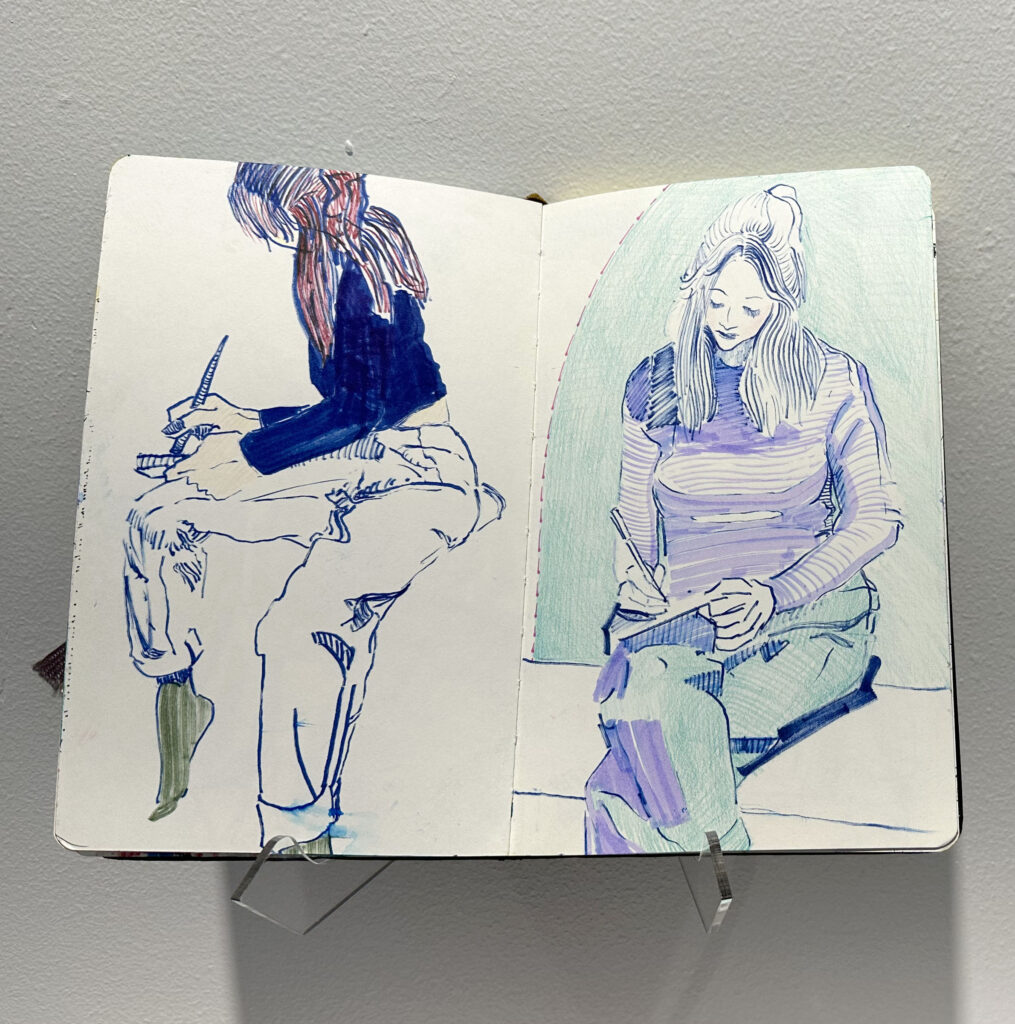
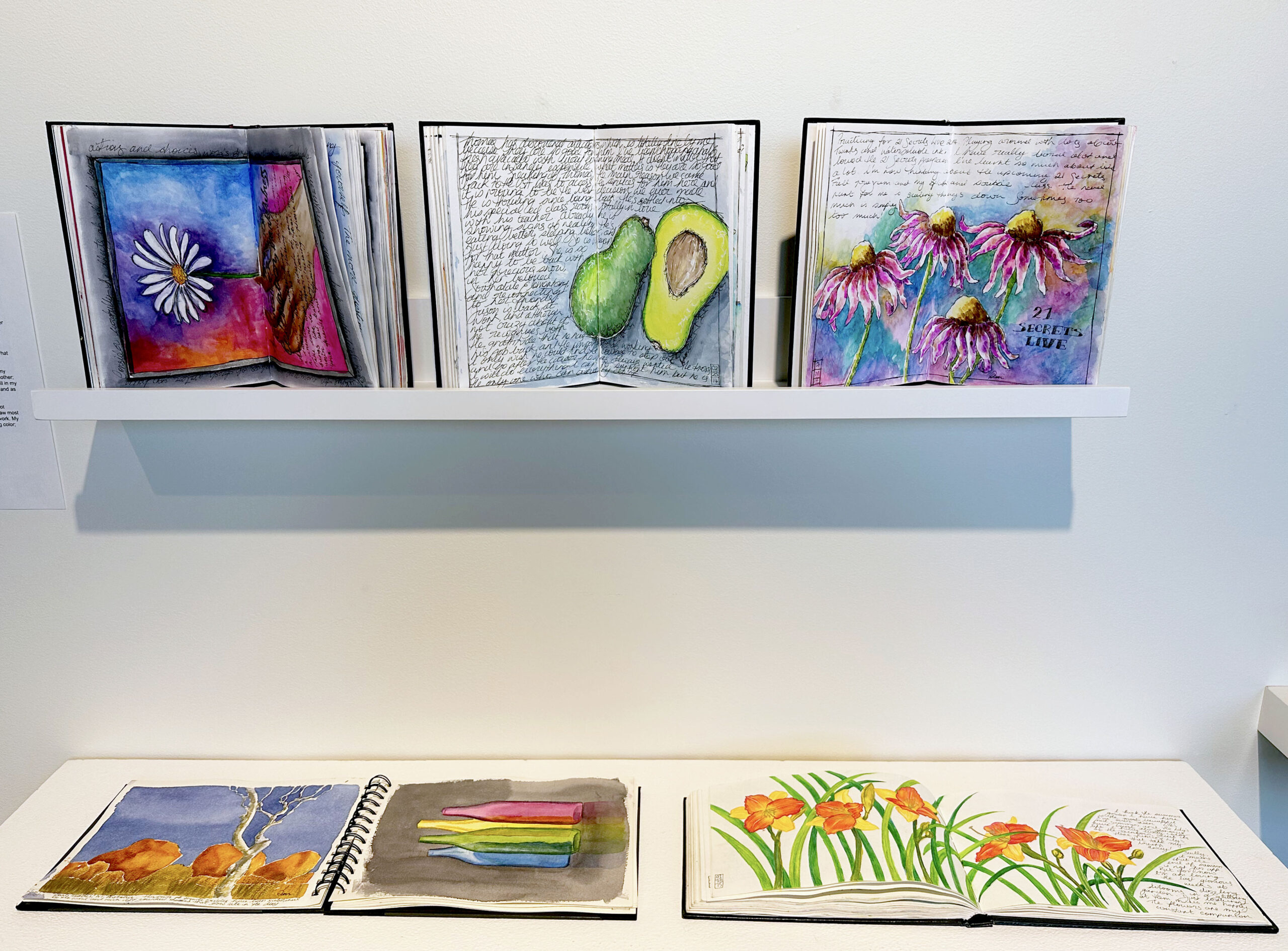
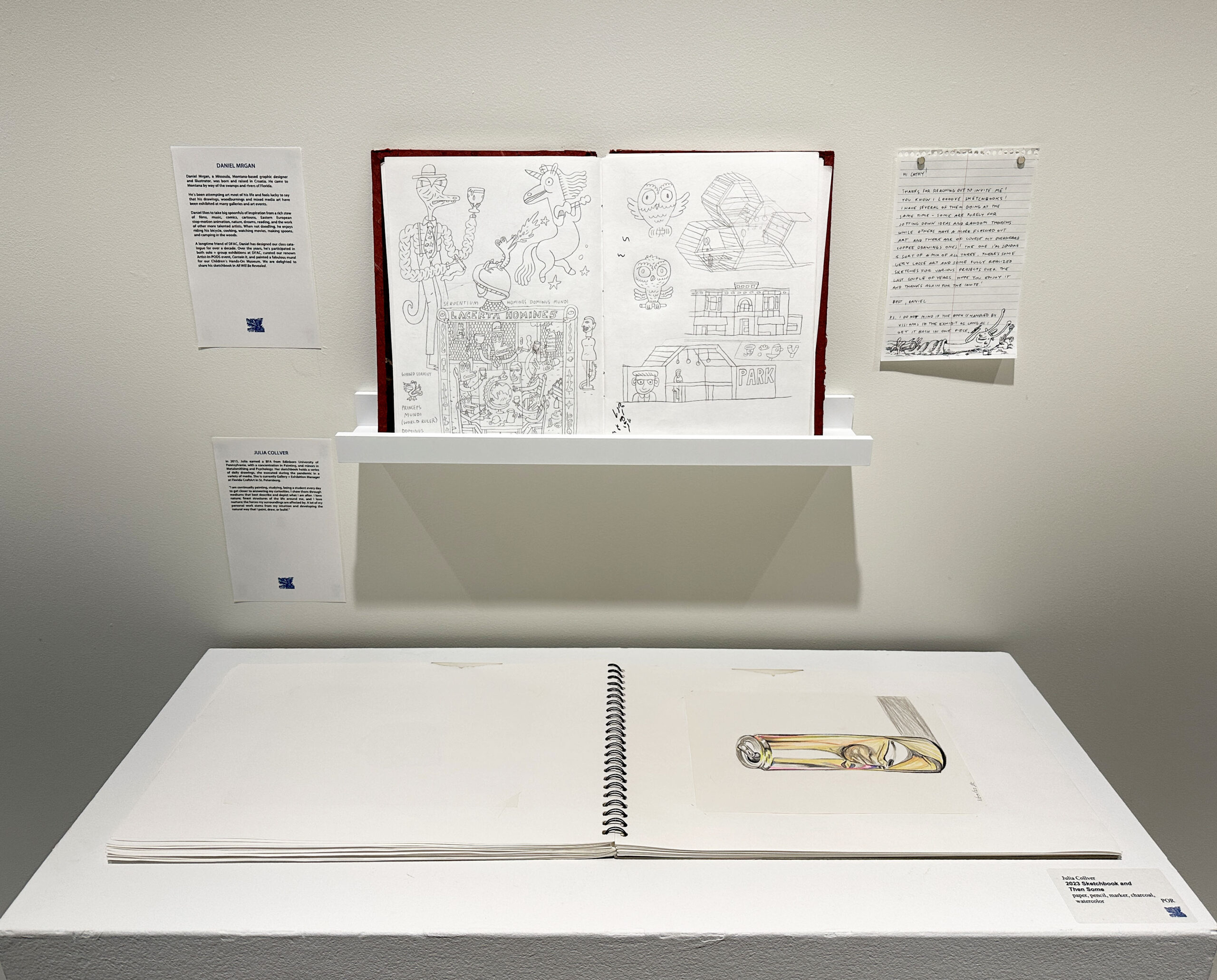
On the second floor of the Dunedin Fine Art Center are photographs by Andrew Sovjani and a collection of sketchbooks from a variety of artists, many of which you can look through- with gloves of course. It’s easy to spend lots of time with all the inspiring books these artists have created.
The exhibition closes 8/13/23.
About Andrew Sovjani, from the gallery-
Andrew Sovjani is a visual artist recognized for blurring the boundaries between photography, printmaking and painting. Raised in a family of working studio artists, art making is in his blood. Andrew has drawn from his life experiences in the scientific world and living in Asia to create transcendent bodies of work that are often extremely peaceful. His award-winning photographs have been shown in exhibitions throughout the U.S., Europe and Japan and are held in many public and private collections. He has won awards of distinction at many of the top fine arts festivals in the nation and was a finalist for the Critical Mass book awards in 2008 and 2016.
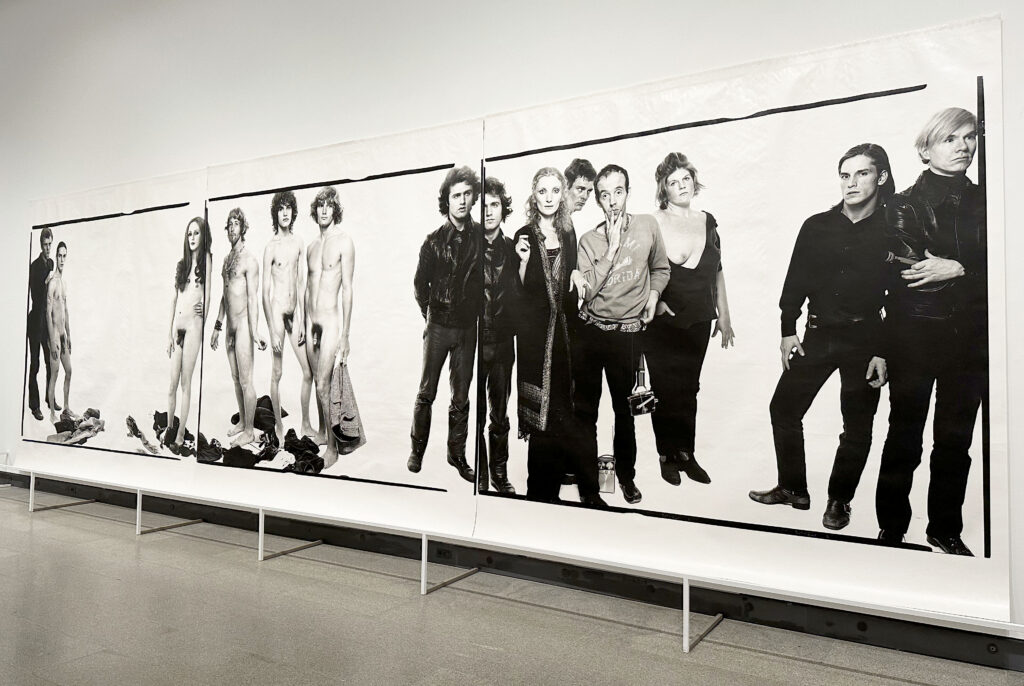
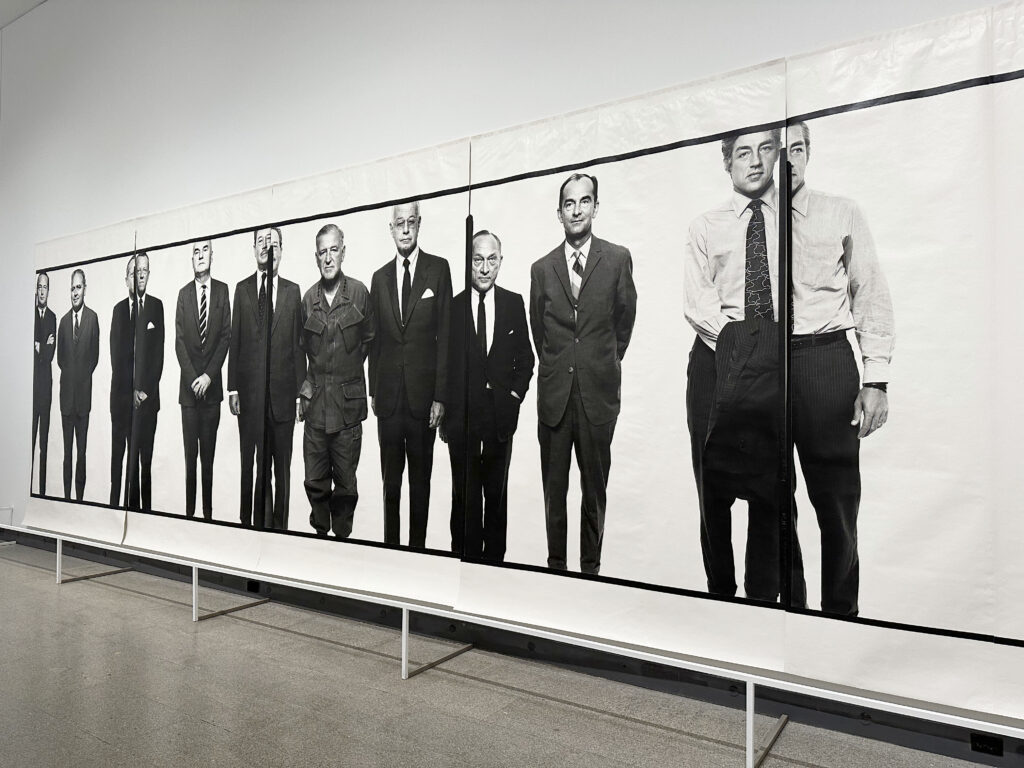
There are currently two exhibitions in New York celebrating Richard Avedon’s photography. At The Metropolitan Museum of Art is Richard Avedon: Murals. Pictured above are two of the large murals included. The first is of Andy Warhol and members of The Factory and the other is of members of the Mission Council in Saigon.
From The Met’s website about the show-
In 1969, Richard Avedon was at a crossroads. After a five-year hiatus, the photographer started making portraits again, this time with a new camera and a new sense of scale. Trading his handheld Rolleiflex for a larger, tripod-mounted device, he reinvented his studio dynamic. Instead of dancing around his subjects from behind a viewfinder, as he had in his lively fashion pictures, he could now stand beside a stationary camera and meet them head-on. Facing down groups of the era’s preeminent artists, activists, and politicians, he made huge photomural portraits, befitting their outsized cultural influence. On the centennial of the photographer’s birth, Richard Avedon: MURALS will bring together three of these monumental works, some as wide as 35 feet. For Avedon, the murals expanded the artistic possibilities of photography, radically reorienting viewers and subjects in a subsuming, larger-than-life view.
The murals are society portraits. In them, Avedon assembles giants of the late twentieth century—members of Andy Warhol’s Factory, architects of the Vietnam war, and demonstrators against that war—who together shaped an extraordinarily turbulent era of American life. Presented in one gallery, their enormous portraits will stage an unlikely conversation among historically opposed camps, as well as contemporary viewers. The formal innovations of Avedon’s high style—of starkly lit bodies in an unsparing white surround—are best realized in these works, where subjects jostle and crowd the frame, and bright voids between them crackle with tension. Uniting the murals with session outtakes and contemporaneous projects, the exhibition will track Avedon’s evolving approach to group portraiture, through which he so transformed the conventions of the genre.
About Andy Warhol and members of The Factory–
Avedon fantasized about throwing an annual fete for New York society and watching the group evolve over time. This mural is his downtown take on such a party, featuring a new “smart set” of sexual revolutionaries. They were affiliated with Andy Warhol’s Factory, the studio and gathering place for a coterie of avant-garde filmmakers, artists, and socialites. Avedon summoned them to his own studio, where they met over a series of weeks. Working in his most directorial mode, he arranged his subjects—including transgender actress Candy Darling and adult film star Joe Dallesandro—in a lateral frieze across adjoining frames, the fracture and repetition of their bodies in space suggesting the filmic passage of time.
The culmination of much trial and error, the mural’s composition took time to perfect, as evidenced by session outtakes displayed nearby. Avedon later praised the professionalism of his cast but joked, “You couldn’t keep the clothes on anybody in those years. . . . Before you could say ‘hello,’ they were nude and ready to ride.” If this unabashed undress tests gallery decorum, it is a provocation grounded in art history: in the central panel Avedon presents a male version of the “three graces,” riffing on a gendered tradition in allegorical painting with an ironic, Warholian wink.
About The Mission Council, Saigon, South Vietnam–
Avedon knew he would have mere minutes to photograph the U.S. generals, ambassadors, and policy experts who ran the war in Vietnam—not the weeks he spent refining his first mural. Planning in advance, he requested the heights of the men known collectively as the Mission Council and mapped out their positions, with careful attention to rank and influence. He rigged a makeshift studio at the embassy in Saigon, and recalled that once assembled, they “lined up like high school boys. They all wanted to be in the picture.” This is true of all but Ted Shackley, the camera-averse CIA station chief known to colleagues as the Blond Ghost, who begged out of the sitting for “a meeting,” leaving a void in the rightmost panel.
As blunt and procedural as a police lineup, the mural recalls Avedon’s first photography gig as a teenager in the Merchant Marine, where he made mugshot-style portraits of new recruits. Here, scrutinizing the faces of the war’s top brass, Avedon invokes their unseen operatives and victims. When the work was later published, one critic deemed it “a terrifying picture of business as usual.”
This exhibition closes 10/1/23.
For a more comprehensive look at Avedon’s career, Gagosian’s Chelsea location is showing Avedon 100, “a collection of Avedon photographs was selected by more than 150 people—including prominent artists, designers, musicians, writers, curators, and fashion world representatives—who elaborate on the impact of the photographer’s work today.”
The gallery’s website has a video of the installation that is well worth checking out, especially if you can’t see the exhibition in person.