Sep 202019
 

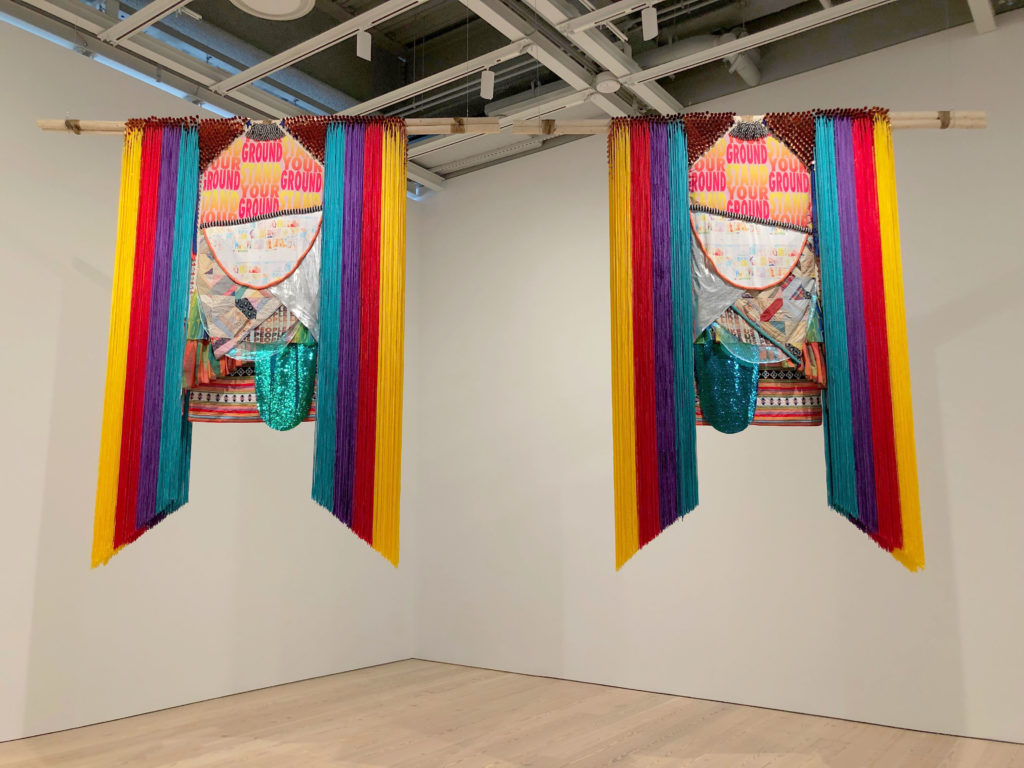
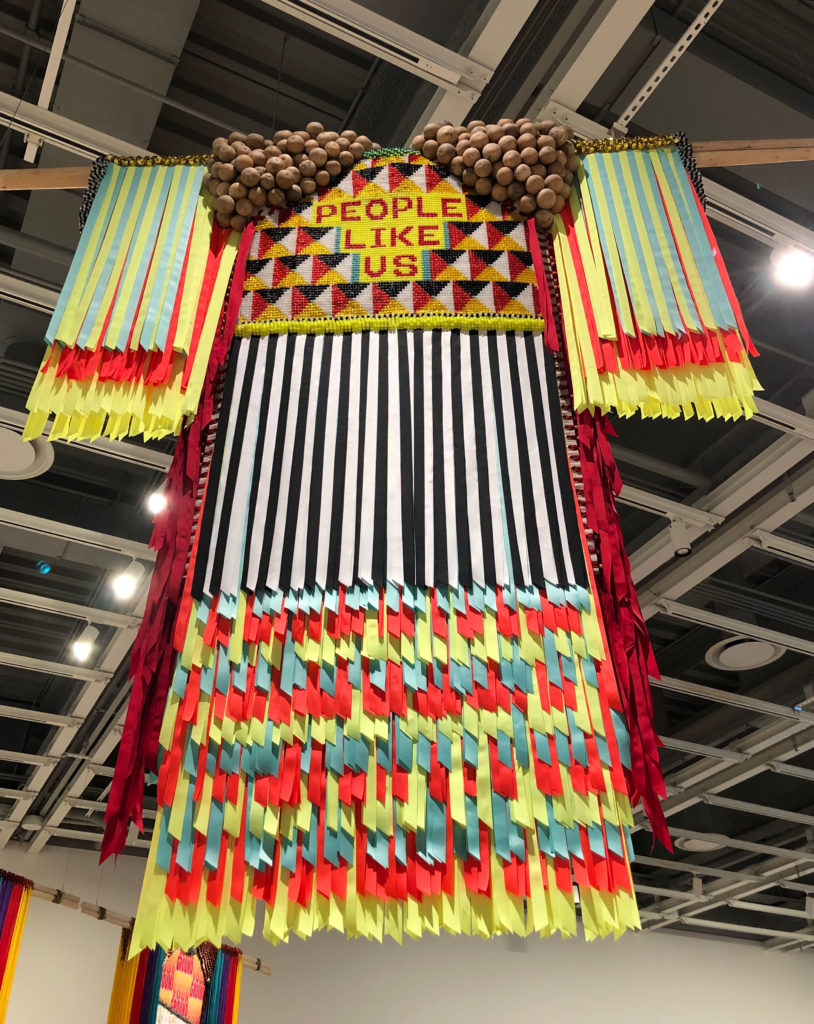
Jeffrey Gibson, “PEOPLE LIKE US”, 2019

Jeffrey Gibson

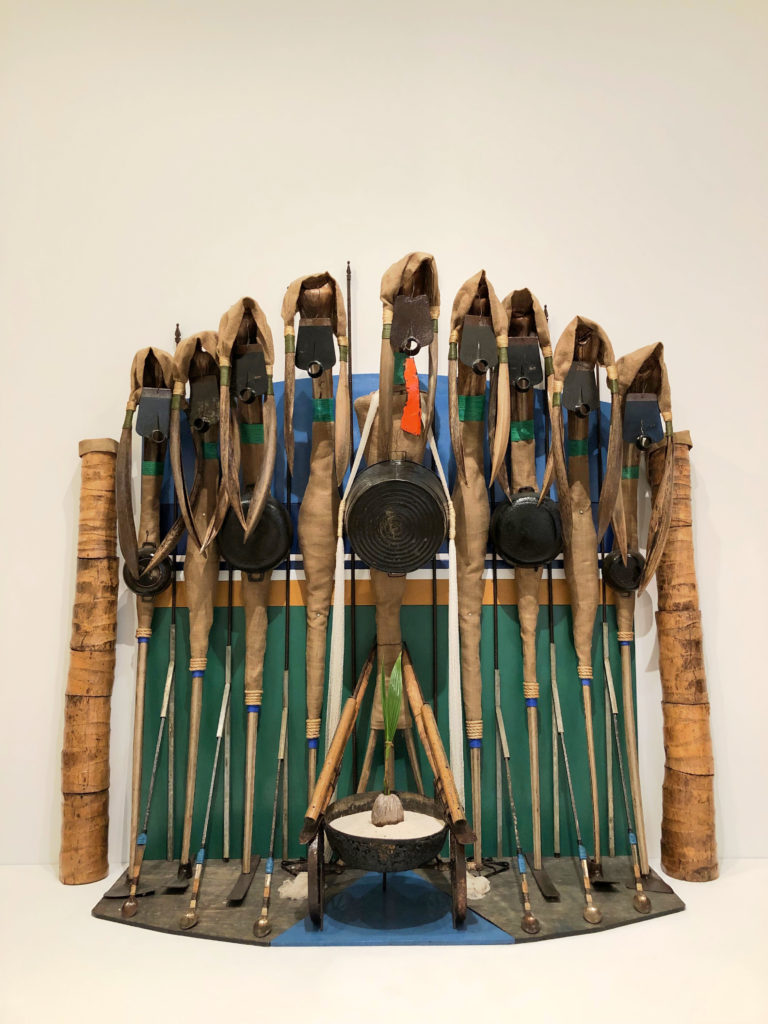
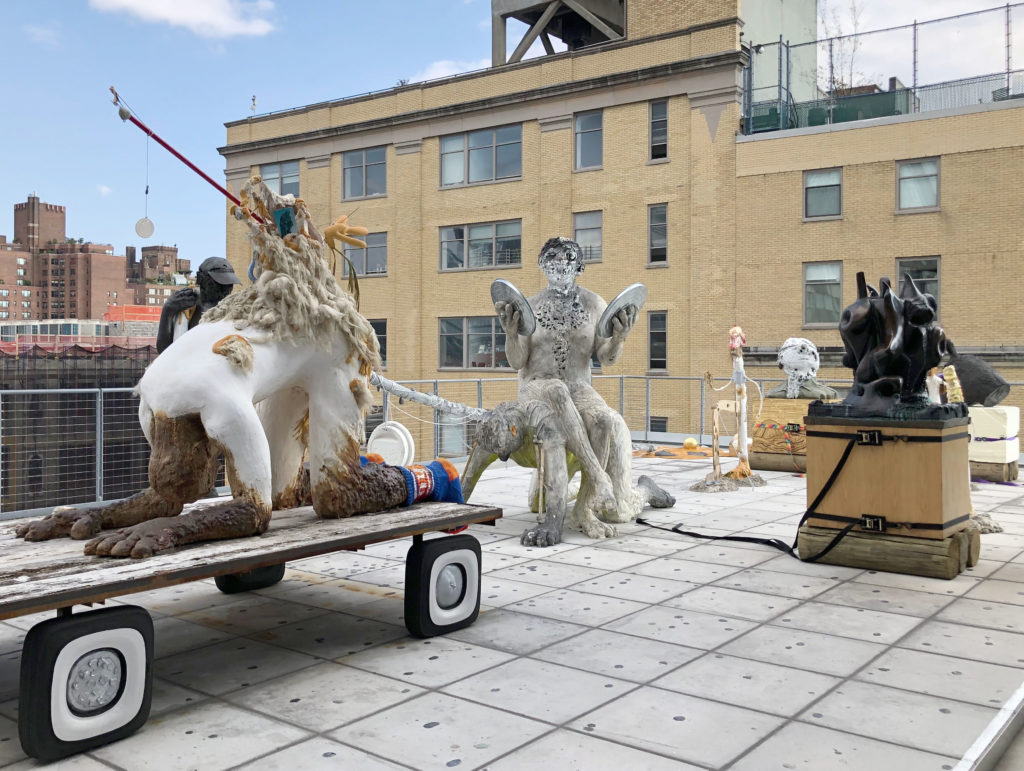
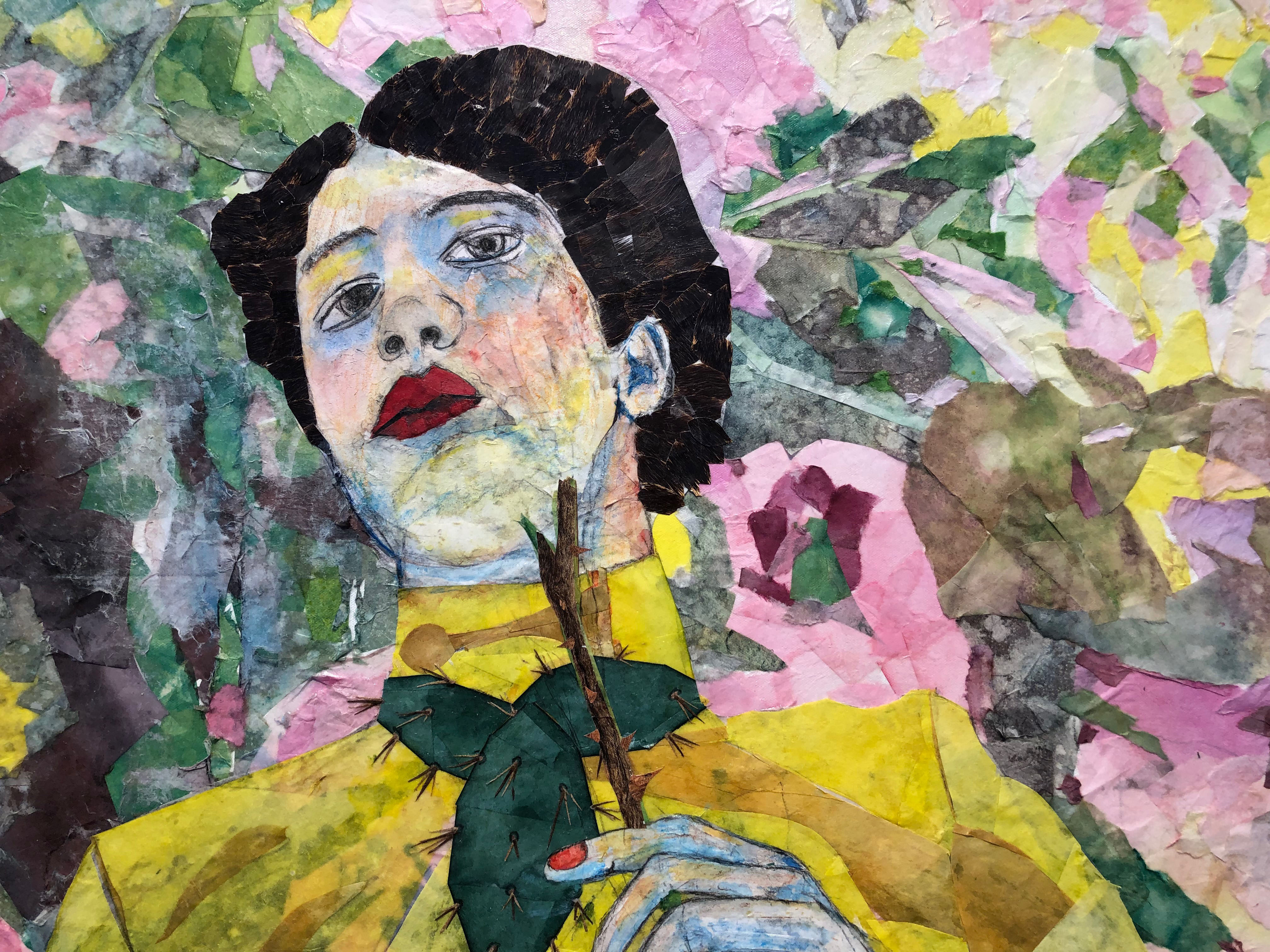
2019’s Whitney Biennial presents an interesting selection of work, by a mostly young and diverse group of artists. The works included in the show are consistently good, and often intriguing, but this time around nothing is particularly outrageous or polarizing- a contrast to many of the previous iterations.

Not that there wasn’t any drama surrounding the show. This time around, however, the controversy was not with an artwork but with former Whitney executive board member Warren B. Kanders and his ownership of Safariland, a tear-gas canister maker. He has since resigned after protests and threats of withdrawal from several of the artists included in the show. Artist collective Forensic Architecture’s film, Triple Chaser, on view in the exhibition, investigates Safariland and Kanders.

Below are a few highlights from the exhibition.

Janiva Ellis ” Uh Oh, Look Who Got Wet”, 2019

Daniel Lind-Ramos, “Centinelas (Sentinels)”, 2013

Section of Nicole Eisenman’s, “Procession”, 2019

This exhibition closes 9/22/19.


Aug 302019
 

This is the last weekend (closing 9/1) to see Black is Beautiful: The Photography of Kwame Brathwaite at Skirball Cultural Center.

From the center’s website-

See the iconic images that amplified one of the most influential cultural movements of the 1960s: “Black Is Beautiful.” Featuring over forty photographs of black women and men with natural hair and clothes that reclaimed their African roots, Black Is Beautiful: The Photography of Kwame Brathwaite, organized by Aperture Foundation, New York, is the first-ever major exhibition dedicated to this key figure of the second Harlem Renaissance.

Inspired by the writings of activist and black nationalist Marcus Garvey, Brathwaite (b. 1938) combined his political vision with the medium of photography to effect social change. Along with his brother Elombe Brath (1936–2014), Brathwaite founded two organizations that were instrumental in realizing his vision: African Jazz-Art Society and Studios, a collective of artists, playwrights, designers, and dancers, in 1956; and Grandassa Models, a modeling group for black women, in 1962. Working with AJASS and Grandassa Models, Brathwaite organized fashion shows featuring clothing designed by the models themselves, created stunning portraits of jazz luminaries, and captured behind-the-scenes photographs of the black arts community.

During an era when segregation still prevailed across the United States, Brathwaite’s work challenged mainstream beauty standards that excluded women of color. His photographs celebrated black beauty and instilled a sense of pride throughout the community. Black Is Beautiful: The Photography of Kwame Brathwaite demonstrates how the medium of photography is an essential cultural tool in the dissemination of new visual paradigms and political ideas.

Aug 232019
 

CONTACT HIGH: A Visual History of Hip-Hop, Annenberg Space for Photography‘s latest exhibition, includes an excellent selection of photos from the beginning of hip-hop until now. Over 75 original and unedited contact sheets are also being shown. These are a great addition to the exhibition and give the viewer added insight into the thought process that went into the final work.

In the center of the gallery, there is an exclusive new documentary short film featuring several of the photographers from the show at work and in conversation. There is also a pop-up record shop featuring rare hip-hop on vinyl.

This exhibition closes 8/25/19.

Aug 222019
 

A Universe of One, 2018

A Universe of One, 2018 (detail)

The Dream of Flight, 2019

The Dream of Flight, 2019 (detail)

Currently at Kohn Gallery is New York-based artist María Berrío’s first solo exhibition in Los Angeles.

From the press release-

Inspired by her youth in the countryside of Bogotá, Colombia, Berrío’s paintings explore the experience of immigrant identity, intercultural connectivity and the beauty that is found in the diversity of cultures and countries. Berrío depicts her figures with richly detailed and patterned backgrounds of exteriors and interiors. The large, detailed mixed media canvases employ lush, carefully crafted, multilayered Japanese papers and paint, resulting in scenes replete with pensive yet confident figures amid a scene of visual exuberance.

Berrío’s work often places female figures at the center of her intricately woven landscapes. Painted with watercolor details, her figures stare out of the composition determined to confront the viewer from their own surreal surroundings. Her work is evocative of predecessors such as Gustav Klimt and Egon Schiele, both known for their exceptional degree of emotional directness and figural distortion in the place of conventional beauty. Berrío’s works float seamlessly between historical and contemporary artistic styles as they employ a wide visual vernacular ranging from expressionism to graphic, abstract marks.

The variety of media and techniques found in María Berrío’s practice emphasizes the interwoven cultural breadth of the world in which we live, where globalization and injustice touch the lives of everyone. Each character Berrío paints is a symbol of this new reality and the strength that can issue from it. For the artist, a female soldier on the front lines is as brave and mighty as the mother who protects her children from the perils of war. These depictions of women are seen as guiding spirits who are strong, vulnerable, compassionate, courageous and in harmony with Nature and themselves. With these combinations of human traits and emotions, Berrío fortifies her belief that with womanhood every action is considered beautiful and strong, no matter how small or large.

For her current show, A Cloud’s Roots, Berrío focuses especially on place and migration. The individuals are seen in preparation for their travels, in moments of transition, and in various states of uncertainty. Berrío states, “the ambiguity is intentional; although I may have a specific idea in mind when making the work, the actual piece lacks cultural specificity to allow for all symbolic possibilities.” Berrío therefore gravitates towards symbols with global cultural significance, such as braids, birds, and flowers, with the hope that they allow diverse audiences to bring their own understanding to the work.

In her recent work, A Cloud’s Roots (2018), Berrío creates a fictional species of tree based on the dragon’s blood tree, found exclusively on an island off the coast of Yemen. The dragon’s blood tree has adapted perfectly to the island’s desert-like climate and rocky soil, inhospitable to most other plant life. It is a powerful symbol of survival and resilience, able to thrive even in the most unlikely conditions. The figures in the piece are compelled to leave their home but they carry with them the knowledge that they too have the power to put down roots wherever they go.

By reflecting on the beauty of our immigrant nation, Berrío’s new body of work aims to rewrite the narrative of American history to include the stories of people who have long been excluded. It makes space for those who were not born in this country, but come here full of hope and desire to make it their home. As the art canon expands its scope and redefines its boundaries, Berrío imagines a future in which people with diverse perspectives can walk into an institution and see themselves reflected back. Berrío states, “so many immigrants, myself included, are stuck in the inbetween, not quite from here, and no longer from there. I create work that bears witness to this liminal state of being and acknowledges it as an essential part of being American. I wish to convey that which can never be conveyed: the sheer joy of being, of creation, and the undiscoverable mystery of being alive.”

This exhibition closes 8/24/19.

Also, if you are in New York City, she recently created several glass and ceramic mosaics that can be seen in the Fort Hamilton Pkwy Station.

 

Aug 092019


When trying to talk about the David Hammon’s exhibition at Hauser and Wirth Los Angeles, his first in Los Angeles in 45 years, it’s hard to know where to start. There are no titles or descriptions of any of the works in the show, although there is writing on the walls in certain places. The press release, shown below, is a mass of lines and a dedication to jazz musician Ornette Coleman.

Before you enter either of the two massive galleries housing the exhibition you encounter a courtyard filled with tents, some with “this could be u and u” stenciled on them. Tents also line the corridor under Martin Creed’s neon piece, EVERYTHING IS GOING TO BE ALRIGHT, with a rack of fancy vintage coats nearby. Once predominantly in Skid Row, Los Angeles’ tent cities have been growing rapidly on street corners and under bridges and highways all over the city, but they often just blend into the background for people walking and driving past. What does a fake tent city in the courtyard of a high end gallery in a newly gentrified neighborhood mean? Is its fake version more affecting than the real one to gallery and restaurant patrons wandering by?

The work in the show feels at times random, clever, humorous, and confounding, but also impressive, thought provoking, and most importantly never dull. There are stacks of art history books sitting on scales. A water filled bowl that contains what once was a snowball Hammons had sold on the street at one point in his career, sits on a wooden shelf. A room with empty glass cubes on wood columns requires you to bend down to see the feet underneath. A book titled A History of Harlem is filled with empty black pages.

In the room pictured below is a three legged chair next to a wall of photos of women sitting in it. Nearby, one of Ornette Coleman’s suits is surrounded by glass.

Another room is filled with paint splattered and damaged fur coats, one facing an antique mirror that is covered. The symbolism feels a bit heavy handed, like the tents, but it works in that there are still several ways to interpret what Hammons might be saying.

Throughout the exhibition paintings are covered in various ways. One in paper, ripped with a bit of the painting visible. Others are partially hidden with tarps, plastic, different fabrics, even an antique rug (shown below). Once again, you can interpret the meaning of this in several ways. With the rug, for example, it’s turned so that only a bit of its design is visible in front of a painting that is not completely visible. These rugs are often associated with old money and sometimes are hung on walls themselves as artwork. Or is it just another assemblage, a visual combination to be taken at face value.

Ultimately the interpretation of all of the work is up to the viewer. There is something freeing in that, not being given answers. Sure, it’s nice to have an explanation of an artist’s intentions sometimes, but you often add your own ideas anyway. Art should make you think, question things, look at the world from a new perspective- this exhibition does all of that and more.

David Hammons at Hauser & Wirth Los Angeles closed 8/11/19.


Aug 082019
 

In addition to the murals created for POW! WOW! Antelope Valley 2018, artist Dan Witz also created a few small pieces like the one shown above. For more of his work, check out his website and Instagram.

Aug 082019
 

In addition to the murals created for POW! WOW! Antelope Valley 2018, there were also several smaller works including several of Spenser Little’s wire sculptures. For more of his work, check out his Instagram.

Jul 192019
 

Woven Stories, at the Museum of Art and History (MOAH) in Lancaster, is a collection of narrative fiber artworks as well as five solo exhibitions and five site specific installations. There are so many great pieces in the show it was hard to narrow down which artists to include, but below are a few that stood out.

Victor Wilde, Momma Bears, 2019

Vojislav Radovanovic, TWO SIDES OF A LUCID DREAM, 2018

Vojislav Radovanovic, TWO SIDES OF A LUCID DREAM, 2018

Orly Cogan, Confections

Orly Cogan, Sugar ‘n Spice ‘n Everything Nice

Upstairs, the solo exhibitions are equally impressive. Several of these artists utilize nontraditional materials to create their unique work.

Nicola Vruwink uses the film from cassette tapes instead of traditional yarn to create her pieces.

For her large sculptures, Elisabeth Higgins O’Connor, uses materials from second hand shops. The pieces of broken furniture and scraps of fabric form animal figures caught in awkward poses.

Elisabeth Higgins O’Connor, Blamethirst

Peter Hiers’ sculptures are made from found scraps of tires. Using this discarded material, he gives new life to what would ordinarily be littering the sides of highways.

Peter Hiers, Circular Logic, 2010

This exhibition closes 7/21/19.

While in Lancaster, make sure to also check out MOAH Cedar nearby, which is showing Collateral Damage, an immersive installation by Snezana Saraswati Petrovic.


Jul 122019
 

Juan Capistrán, Psychogeography of Rage (sending up searchlights in the form of flames) Western, 2019

Kim Fisher- Los Angeles Hedge, 2019

Kim Fisher, Woman Behind Rocks, 2019

Sabrina Gschwandtner, Cinema Sanctuary, 2019

Sabrina Gschwandtner, Cinema Sanctuary (close-up)

Enrique Castrejon, You, me, and all of us are in this together/Reach out to those that don’t know their status, 2019

Enrique Castrejon, You, me, and all of us are in this together/Reach out to those that don’t know their status, 2019 close-up

Every year The City of Los Angeles Department of Cultural Affairs (DCA) awards grants to the city’s best mid-career artists. The work created with these grants is then shown in the Los Angeles Municipal Art Gallery (LAMAG) in Barnsdall Park for the C.O.L.A.(City of Los Angeles) exhibitions.

COLA 2019 is made up of 11 artists working in various mediums. Two of the artists, Juan Capistrán and Kim Fisher were also shown together as part of Hammer Museum’s biennial exhibition, Made in L.A. 2014. For this show, Capistrán created large brick sculptures that he placed in sites in South Los Angeles that haven’t been rebuilt since the 1992 LA Riots. In his section of work in the gallery, he includes photos of these temporary site specific installations as well as some of the brick sculptures- two of which have balloons tied to them spelling GRATIS. The bricks can be seen as objects of destruction or building blocks, and the dual meanings work well in the context of the work.

Kim Fisher’s large collages capture another side of Los Angeles. From the hedge she used for the largest piece, to the ocean, swimming pools, and car culture, included in her others, the graphics and color come together in a way that feels very much like the traditional ideas associated with the city.  The different sections, created to look as if they were torn or cut from magazines, form collages that feel like scattered memories that have somehow arranged themselves cohesively.

Sabrina Gschwandtner took forgotten films made by female directors and stitched them together to form patterns drawn from the history of quilt-making. The use of a craft that is traditionally associated with women and tying it an artistic pursuit that women are only more recently being acknowledged for is an interesting juxtaposition. The resulting work is stunning graphically and reminiscent of Agnés Varda’s colorful house of film reels created for LACMA’s Agnés Varda in Californialand from 2014.

Enrique Castrejon created sculptures that stem from his work in an LGBTQ center in Los Angeles. His sculptures of fragmented bodies are surrounded by strips of paper with HIV infection rates. The humanity of the figures contrasts with the overwhelming strips of typed documentation that swarms all around them.

All of the work created for this exhibition is incredibly strong and these annual exhibitions are a great way to see some of the best work being created by Los Angeles artists today. If you can’t make it to the exhibition there is a video on the site that takes you on a walk through with one of the curators. Also make sure to catch Stephanie Taylor’s Municipal Art Song, which plays at the entrance to the exhibition. She created song lyrics based on text from LAMAG and DCA’s websites and catalogs, and used them to create sheet music using Schoolhouse Rock! as an inspiration. The result is really funny, especially if you read a lot of press releases.

This exhibition closes 7/14/19.


Jun 292019
 

“Graduation”, (1949) © Estate of Roy DeCarava

We look at so many images today that often the value of individual photos decreases with the abundance of them. That’s why it is such a pleasure to spend time with Roy DeCarava’s black and white photographs at The Underground Museum. His images have a meditative beauty to them. They catch your eye and hold it. There is a richness to his compositions, his use of textures and light.

While at The Underground Museum, also take a moment to look through a copy of De Carava’s book collaboration with writer Langston Hughes, The Sweet Flypaper of Life in the book store.  The images in it influenced artist Kahlil Joseph’s film Flypaper (2017), which was recently shown at MOCA.  Kahlil Joseph’s brother, artist Noah Davis, who sadly passed away in 2015, founded The Underground Museum with his wife, artist Karon Davis, in 2012.

Roy DeCarava: The Work of Art closes 6/29/19.


“Bill and son”(1962) © Estate of Roy DeCarava