

Pictured are two murals from artist Lin Fei Fei‘s Introspection series, located in Sacramento.
She is also the founder of Sacramento’s Inbetween Tattoo + Arts, which includes an arts studio and gallery space.

Pictured are two murals from artist Lin Fei Fei‘s Introspection series, located in Sacramento.
She is also the founder of Sacramento’s Inbetween Tattoo + Arts, which includes an arts studio and gallery space.


Nonstop (2107) by Arden Bendler Browning was commissioned by Philadelphia’s Percent for Art Program and is on view at Philadelphia International Airport.
From Art at PHL about the work-
Philadelphia artist Arden Bendler Browning is known for creating large-scale, highly energized, gestural paintings inspired by her urban surroundings. Browning’s paintings are mostly abstract, yet include hints of realism with the suggestion of architectural structures, roadways, telephone poles, and green spaces. Browning’s paintings envelop the viewer with their scale, intensity, and sense of movement. Her imagery is derived from photos taken while traversing the city. The photos enable her to see the city from various vantage points and, as she has described, “jump through time and space.”
Browning’s paintings visually capture that sense of timelessness as she often conveys a disorienting landscape where colors and shapes collide and overlap, where only glimpses of reality come into focus. She speaks of the urban environment as “a vast sea of fluctuating boundaries arguing claim to the demarcation of space.” This statement also describes Browning’s work as she depicts the urban landscape using an amalgam of colors, shapes, and painterly marks adrift and influx.
Browning has said, “Nonstop is multifaceted and dense, full of action, and vibrancy in unexpected places with pockets of space and clusters of commotion. It is just like Philadelphia.”
Browning is currently part of the group exhibition, The Landscape: Lost and Found at Ellen Miller Gallery in Boston, on view until 3/28/26.

Anuj Chandra Shrestha, “Sumud”

If you have a layover or arrive early to Philadelphia International Airport, make sure to take some time to check out some of the art on display. Works like the murals in this post, are part of the airport’s Exhibitions Program.
About Art at PHL:
The Airport’s Exhibitions Program is a nationally-recognized, award-winning visual arts initiative.
In 1998, Philadelphia International Airport established an Exhibitions Program – a visual arts initiative to humanize the Airport environment, provide visibility for Philadelphia’s unique cultural life, and to enrich the experience of the traveling public.
The Exhibitions Program is responsible for organizing and presenting rotating exhibitions that are located throughout the Airport. The exhibits change throughout the year to provide a variety of educational and cultural programs. This forum for presenting visual arts attests to the Airport’s commitment to supporting arts and culture.
The Exhibitions Program provides millions of visitors from around the world access to a wide variety of art forms by artists and arts institutions from the Philadelphia area.
The artists in this post- Anuj Chandra Shrestha, Lale Westvind, Steve Teare, Olivia Fredricks, and Amze Emmons are all part of the exhibition, Jawn 8. Jawn, a slang term local to Philadelphia, is defined as- “a placeholder word that may refer to a thing, place, person, or event, substituting for a specific word/name”. For even more on the word jawn, check out this article on Atlas Obscura.

Lale Westvind, “They Grew The Garden”


Steve Teare, “The Art Museum Games”


Olivia Fredricks, “The City is Our Playground”


Amze Emmons, “Philly Birdsong Onomatopoeia”


Symbiosis (2011) by artist Roxy Paine has been on display in Iroquois Park on the Benjamin Franklin Parkway in Philadelphia since June 2014.
About this work from the Association for Public Art (aPA), which organized the installation and acquisition-
Hand-fabricated from thousands of pieces of stainless steel pipe, plate, and rods, Symbiosis suggests both ecological and anatomical branching systems.
Rising 34 feet high, the more than 3.5 ton sculpture was created from standard industrial piping that was welded, formed, and polished in the artist’s studio to create two shimmering, interrelated organic forms that both buttress and weigh on one another, referencing the darker aspects of nature and the fierceness of its laws. Symbiosis represents the collision of two dendroids that result in stasis, a questionable relationship that teeters between support and detriment.
Roxy Paine’s work consistently blurs the lines between the natural and artificial. He is known for work that explores the collision of industry and nature, and his series of stainless steel “Dendroid” sculptures are exemplary manifestations of this practice. The “Dendroids,” a term combining “dendron” (Greek for “tree”) and -oid (a suffix meaning “form”), are monumental structures that convey a fusion of industrial and organic forms. They evoke arboreal structures, vascular systems, synaptic networks, and industrial pipelines, interpreting the natural world through a man-made lens. The structures represent search, growth, and the branching of systems that suggest dormant energy and potential, a theme Paine has explored in his work for the last 15 years.
Nearby you can also find Mark di Suvero‘s painted steel sculpture Iroquois (seen in the second image posted).
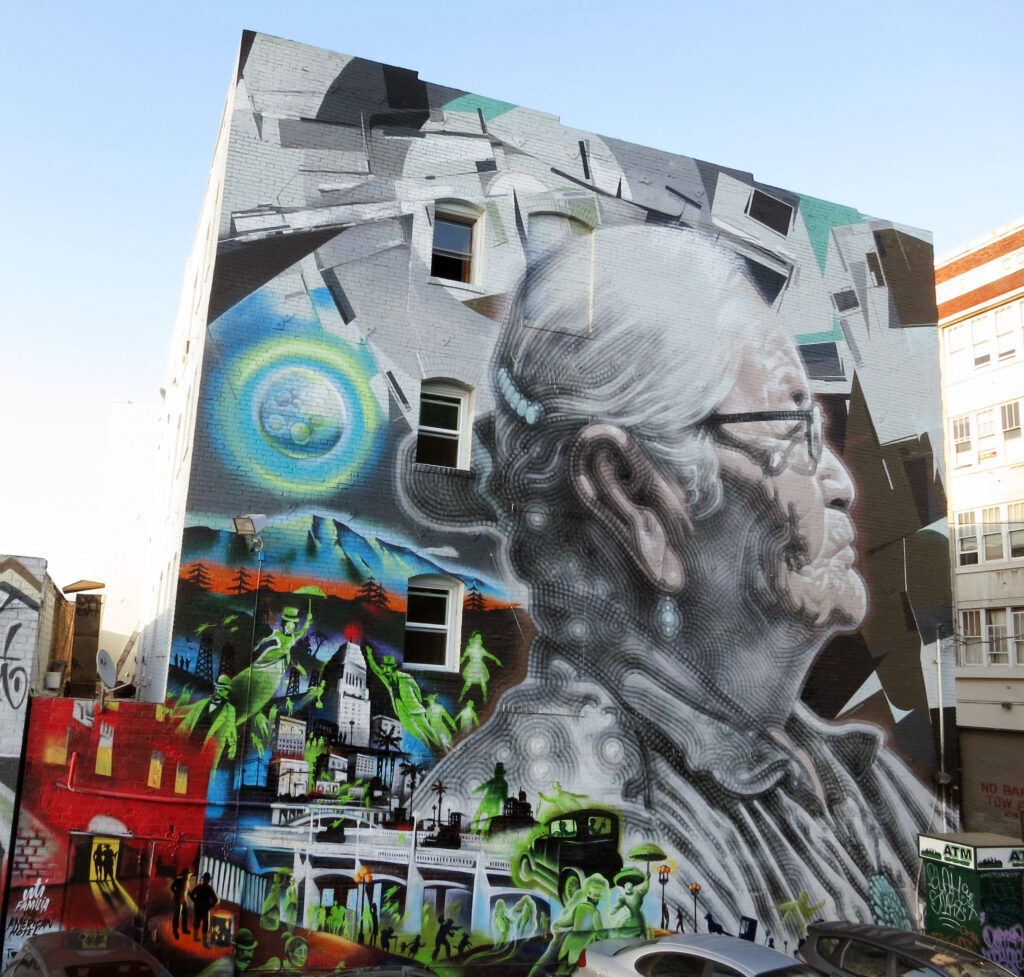
Going all the way back to 2015 today for this mural by El MAC, Augustine Kofie, and Joseph ‘Nuke’ Montalvo. La Abuelita/Má’sání, a portrait of Diné (Navajo) weaver Martha Gorman Schultz, is located on the outside of The American Hotel in Los Angeles.
From El MAC (Miles MacGregor)’s website about the mural-
“The portrait is painted entirely with aerosol and fatcaps, and is based on photos I shot a few years ago of an artist named Martha Gorman Schultz. She is a Navajo blanket weaver from northern Arizona, and part of a respected family of weavers including her granddaughter, Melissa Cody.
I felt this painting of Martha could be an empowering representation of beauty not often depicted in public art or media. Beauty that is feminine, elderly, indigenous, loving and powerful.
The building this mural was painted on was constructed in 1901, and you can imagine how much Los Angeles history it’s seen over the last hundred years or so.
This was an especially collaborative effort- Along with the work of Kofie and Nuke surrounding the figure, SKILL UTI painted the wall to the left, integrating an already existing piece by DASH 2000(Rest In Peace). SWAN provided ground support, along with CHEE, AISE, BLK, OFIER, SELEK, CALVYRUS and some other younger members of UTI crew, which has been painting these walls for the last few decades.”
Sadly, Martha Gorman Schultz passed away in February of last year at the age of 93. For more information on her life and work, check out Hyperallergic’s tribute.


Alex Da Corte‘s Soft Power was on view from the High Line until June of last year.
His latest exhibition, Parade, is currently on view at Matthew Marks in NYC, on view until 12/20/25. The Pink Panther appears in this show as well- Da Corte depicts himself as the character painting the gallery pink.
From the High Line website about the billboard-
Known for his immersive installations, sculptures, and films, Alex Da Corte’s work explores themes of identity, consumerism, and taste, challenging societal norms and reimagining the familiar in unexpected ways. The artist draws from myriad sources, including popular and consumer culture, art history, classical literature, and modern design, seamlessly weaving together disparate elements into cohesive narratives. His adept use of vibrant color and surreal imagery lends a dreamlike quality to his work that captivates viewers and blurs the lines between fantasy and reality.
Da Corte presents a new artwork for the High Line’s 18th Street Billboard, inspired by the Pink Panther, a Friz Freleng creation designed for the animated opening sequence of a 1963 Hollywood comedy that came to embody the film and has evolved, through 60 years of spin-offs and reinventions, into cultural ubiquity. Pink’s durability across many generations has allowed it to sell countless products, from fiberglass insulation foam to artificial sweetener, yet the creature’s essence remains out of reach. With neither master nor peer—and seemingly eternally unbound by the rules of others—Pink represents a certain queer freedom. Da Corte revives Pink as an icon of resistance, supine but poised, wielding a sign of universal protest, brandishing a clear pink purpose. “There is a difference between falling down and laying down,” Da Corte explains. “I call that soft power.” This billboard is an advertisement for the value of such power.


Portuguese artist Alexandre Farto, aka Vhils, created this mural of TJ Mizell (Jam Master Jay‘s son) in 2018.
It is one of many street art projects organized by LISA Project NYC.

Lily van der Stokker created Thank You Darling in 2023 for the High Line in NYC.
From the High Line website about the work-
Lily van der Stokker is one of the Netherlands’ most celebrated contemporary artists. In 1983 she moved to New York, opening a small artist-run gallery space in the East Village and has since lived alternately in both New York City and Amsterdam.
For over 30 years, van der Stokker’s drawings and monumental wall paintings have subverted artistic convention and aesthetic expectations, employing an Easter candy color palette to depict clouds, flowers, swirls, and other traditionally feminine or decorative motifs. Van der Stokker annotates these compositions with handwritten text—spelling out intimate thoughts, personal musings, notes-to-self and social niceties. Her visual language is nostalgic and comforting; her playful squiggly patterns are more likely at home in the margins of a student’s notebook as they mindlessly doodle or test out their first name with the surname of a crush than they are within the white walls of a gallery. In fact, van der Stokker’s practice is in some ways defined by this incongruity. She notes, “if I make an artwork about family problems, administrative tasks, or the common flu…I’m bringing in a whole spectrum of new subject matter that is normally absent in art.” By placing on a pedestal what has traditionally been viewed as feminine or domestic, and thus superfluous and inconsequential within the realm of “serious” visual art, van der Stokker reclaims what has long been disregarded and overlooked.
In a 1990 New York Times review of van der Stokker’s debut exhibition, critic Roberta Smith remarked, “the messages conveyed in this terminally cheerful manner usually have a double edge.” Van der Stokker’s work, which she has referred to as “feminist conceptual pop art,” is undeniably joyful and positive, however, it often simultaneously speaks to weighty themes—aging, health, and, more generally, the lived experience of being a woman within patriarchal structures. Hidden in plain sight, disguised by the veneer of her compositions’ cute and charming appearances, is reality. Occasionally mundane, sometimes cheery, and at other moments, cynical or intimate—“a baby, another baby…all my no baby friends live in N.Y.,” a past mural reads. One divulges, “whoopy doo…I am…really ugly…sorry,” in cartoonish thought bubbles. “My mother will loan me €80,000 to help me buy the house,” another reveals. Van der Stokker considers the texts to be the primary component of her work, and with each work she lays bare a vulnerable inner-world for all to see—if they’re willing to look beyond the candy-coated facade.
On the High Line, van der Stokker presents Thank You Darling, a monumental, site-specific mural. Thank You Darling is painted on the side of a building, turning the architecture and shape of the edifice into the frame for the artist’s pastel and fluorescent-hued work. The light blue background is dotted with multi-colored, simple flowers in a decorative all-over pattern that appear to float across the facade—some just coming into view from the edges of the frame. Superimposed over this, read the words “THANK YOU DARLiNG,” spelled out in a juvenile, arbitrary blend of lower and upper-case lettering. Van der Stokker’s puffy bubble-letters are a classic example of playful adolescent penmanship, seemingly lifted right out of a teenager’s diary. In this location on 22nd street, Thank You Darling actively engages with its audience, expressing gratitude to all those who pass, while reclaiming, at massive scale, intimate language that is often mocked or disparaged as being feminine and unserious.

In The Recap this month- music, art, art shows, murals, spooky season posts and more. Check it out here and subscribe!
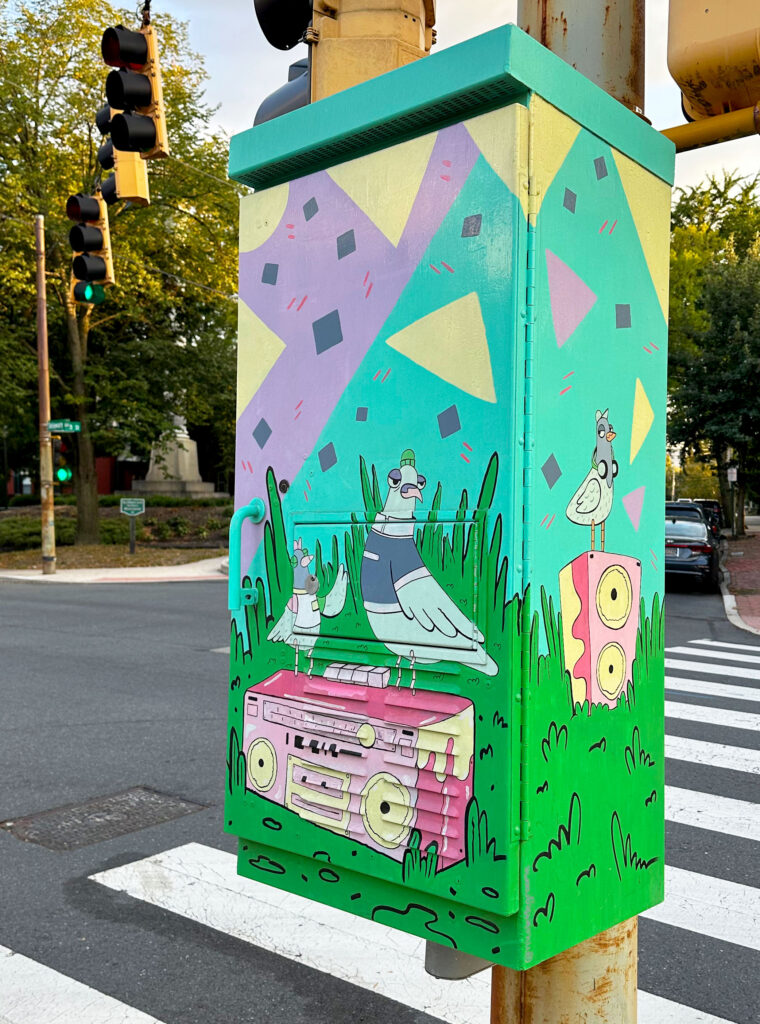


Nicolette Groome created Hip Hop Pigeons for the 2022 Trolley Square Mural Project, in Wilmington, Delaware. Organized by the Delaware Avenue Community Association, several artists created fun utility box murals to brighten up the neighborhood with art.
From more of Groome’s more recent work, also check out her Instagram.