Mar 112018
 

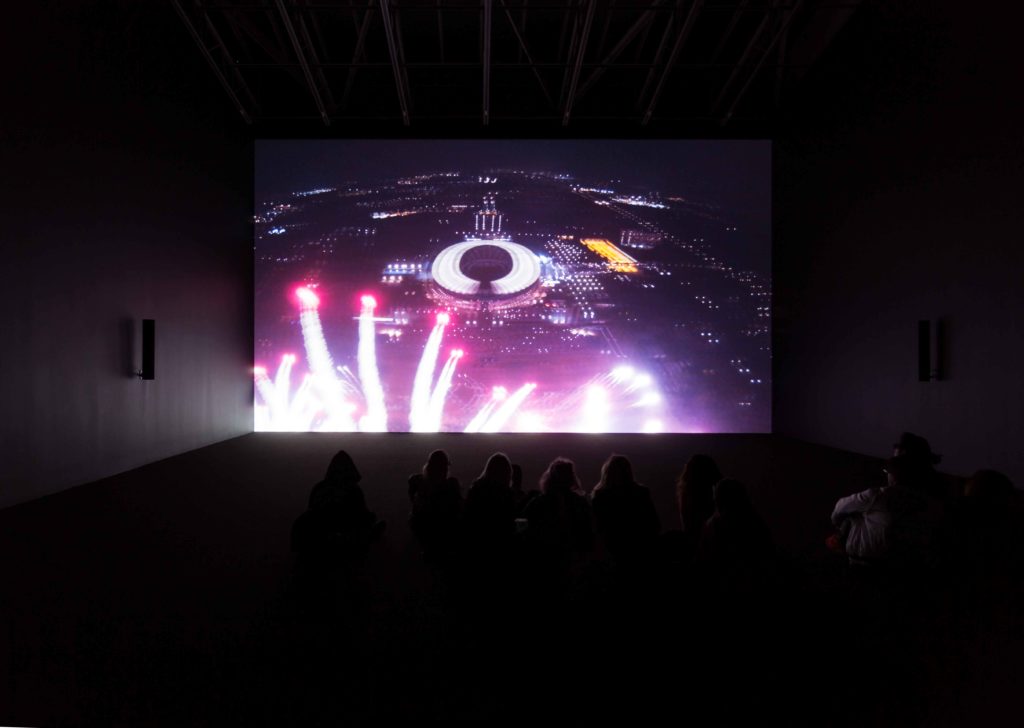
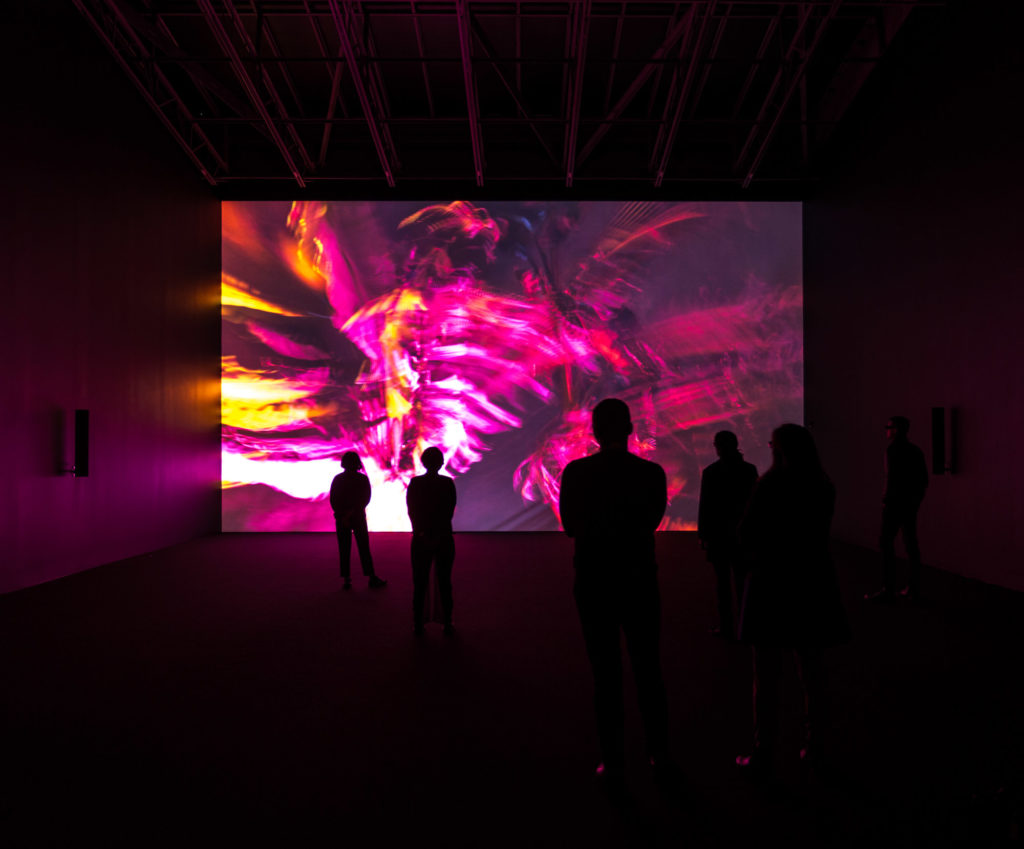
Cyprien Gaillard, Nightlife (Images above via Gladstone gallery)

At Gladstone Gallery, Cyprien Gaillard‘s 3-D film Nightlife is a wonderfully immersive experience. Starting with Rodin’s The Thinker at the Cleveland Museum of Art, the film then moves to a series of plants and trees moving in slow motion in Los Angeles, followed by the annual Pyronale fireworks at the Olympiastadion in Berlin, and finally a return to Cleveland, where a helicopter lights up the site where Jesse Owens’ Olympic oak is planted. While the film plays, a dub song reverberates throughout the room on a loop, adding to the dreamlike atmosphere.

This exhibition closes 4/14/18.
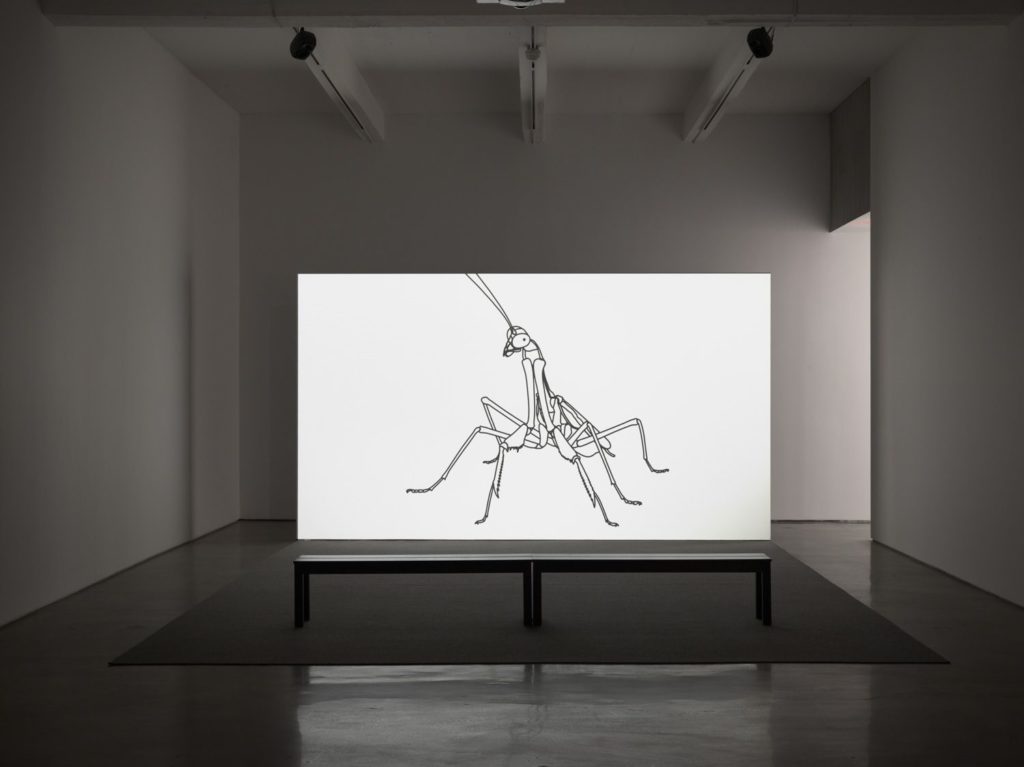
Oliver Laric, Year of the Dog (Image via Metro Pictures)

At Metro Pictures is Oliver Laric‘s two part exhibition, Year of the Dog. The video animation, the stronger part of the show, takes place in the main gallery.

From the press release

The animation continues his inquiry into concepts of metamorphosis, encompassing concerns about time and the complex dynamic between human and nonhuman lifeforms. Against a white background, linear animations of fish, fungi, and other figures move and change shape. The lines composing the animations continually extend or contract to zoom in on greater and greater detail, magnifying a sense of time as the images change. While the shapes and figures, as in his previous video works, are drawn from cartoons and Japanese anime, Laric’s subject matter has grown to also include animations based on live footage. He constructed the animation via an exacting technique in which each line moves continually between sequences—in contrast with traditional techniques in which each sequence consists of a series of redrawn frames. As the shapes perpetually transform, an atmospheric soundtrack commissioned from musician Ville Haimala establishes the sense of an unfolding narrative.

In the back gallery are three resin sculptures of a human dog hybrid holding a smaller dog in its arms, titled Hundemensch. Each sculpture is from the same mold but differs in opacity and color.

This exhibition closes 4/14/18.
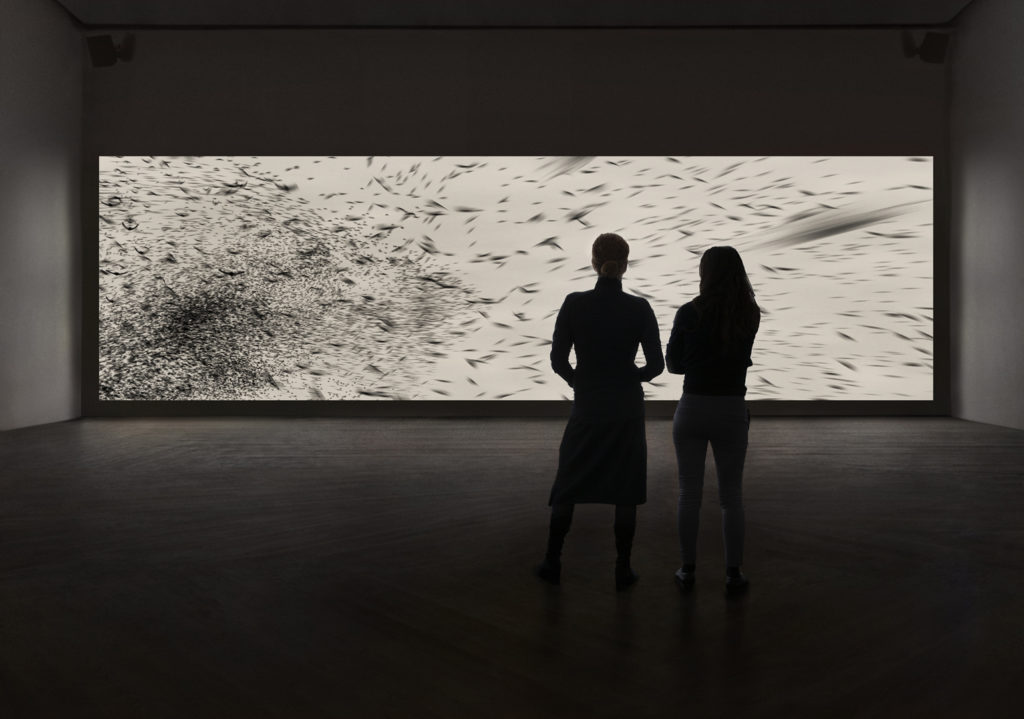
 

Desiree Dolron, Complex Systems (2017)- Image via GRIMM

Finally if you are on the Lower East Side, near the ICP Museum and the New Museum is GRIMM gallery, which is currently showing Desiree Dolron’s video, Complex Systems (2017). Her digital illustrations of the movements of starlings are made more intense by the unnatural patterns she includes, and the sounds that accompany the piece.

From the press release

Complex Systems displays a digitally drawn flock of starlings, scattering throughout the sky in a loop of ever-changing patterns. In this work themes such as the fragility of existence, impermanence and the dichotomy between the individual and the collective form the conceptual ground of her inquiry. The title of the film is adopted from the scientific field of network research, which employs the term to define the complex interactions between different components of the same group.

The shapes assumed by the birds are proven to be the result of a defense mechanism system: in order to avoid attack by predators, a singular starling keeps track of seven others simultaneously – in doing so, the starling is able to adapt to the changing flying directions of the entire flock, thus keeping the collective intact. The dichotomy between the individual and the collective is at the core of Dolron’s interest in this natural phenomenon. Complex Systems investigates the relation between singular and shared intelligence, prompting questions concerning humanity, the psyche and the possible presence of a collective unconscious.

The link to the human psyche is emphasized by the cyclical character of the film; Dolron underlines the full turn of life in which the starlings function as a metaphor. Their movements change from an initial drive to a final, slow fall, while the murmuration happens in an eternal loop that symbolizes the cycle of life and its fragility. The movements of the starlings, combined with the pivotal soundtrack of murmuring voices that intensify and fade according to the flock’s movements, allude to the human mind in a state of constant flux.

Jan 092018
 

Jim Shaw “Cloud Maintenance”, 2017

Jim Shaw “The Ties That Bind”, 2017

Currently at Metro Pictures, Jim Shaw‘s current mixed media exhibition is full of works that are interesting, engaging and fun.

From the press release

Rendered in exquisite detail, Shaw’s virtuosic work combines his analysis of the political, social and spiritual histories of the United States with contemplative reflections of his own psyche. For more than three decades he has examined art history, comic books, subcultural undergrounds and consumer products—to name only a few of his wide-ranging fields of interest—to articulate a distinct visual language that charts the country’s ever-shifting sociopolitical landscape.

The paintings in this exhibition incorporate symbols and characters of the past to comment on our fraught present. Using imagery drawn from Old Testament stories, pagan myths and satirical cartoons, Shaw relies on his encyclopedic knowledge to visualize our common vernacular. His layered symbology reads like an exaggerated mirror of our hyper-mediated, “post-truth” reality.

This show closes 1/9/18.

Work by Elizabeth Murray

At Pace Gallery’s 25th Street location is Elizabeth Murray: Painting in The ’80s, a collection of sixteen unique colorful canvases the artist created during this period.

From the press release-

Elizabeth Murray: Painting in the ‘80s presents formal and narrative content that continues to influence the techniques and subject matter of contemporary painting. Murray arrived in New York in 1967 during the heyday of Minimalism and the rise of Conceptualism, and amid prevailing assertions of painting’s demise. As she recollected, “The mood was that painting was out, that hip people, people who were avant, weren’t involved in painting. That was unnerving, but then I didn’t give a damn.” Fully committed to painting, Murray broke new ground depicting personal, poetic and at times feminist narratives on complex multidimensional shaped canvases. Murray’s compositions from the 1980s suggest large-scale breaking cups, tumbling wineglasses, tilting tables, windows, rooms, attenuated human forms, letters, symbols and abstract shapes constructed through positive and negative, real and imagined space. As Roberta Smith has written, “She has put the vocabulary of twentieth-century abstraction to new and different uses, tracing in irresistible formal terms a psychological narrative that is not explicitly feminine but that women, thanks to society’s relentless conditioning, know best and most completely.”

This show closes 1/13/18.

Jorge Pardo

For Jorge Pardo‘s first painting show at Petzel Gallery, he combines his painted self portraits with a sculptural element. Candid snapshots of the artist are “blown-up, engraved, laser-cut, hand-painted and back-lit with LEDs, to produce, in some cases, vast ornamental objects”. The beautiful large works have the added effect of changing slightly depending on where you stand in the gallery as the light shines through the wood.

This show closes 1/13/18.


Oct 202017
 

Work by Leslie Wayne

If you are heading to Chelsea this weekend, stop in to these galleries which have excellent shows closing 10/21/17-

At Jack Shainman’s 24th Street space are Leslie Wayne’s rich and colorful sculptural paintings for her exhibition Free Experience.

From the press release-

In Free Experience, I have returned to the figure-ground relationship as a way of exploring the range of possibilities for the representation of an illusion in as many different ways as possible, from trompe l’oeil to verisimilitude, while still remaining undeniably within the confines of a traditional painting. These paintings are a collision of abstraction and representation, of illusion and three-dimensional form. They are defined not so much by the shape of the objects they represent, but by the perceptual slippage between object and illusion. They are, like all my work, somewhere between sculpture and painting, and perhaps in Krauss’s view would simply be considered painting in the expanded field.

Looking at art is a free experience. It costs you nothing. But it should also be an experience that is free from encumbrances, one that inspires you to see the world as if for the very first time. But perception is a tricky thing. It is never without personal history. How do we see, what do we think we see? And what makes the experience of looking at a work of art so compelling? The answer lies outside of language, in that transformational moment between looking and seeing, between information and knowledge. In that moment before the need to translate the experience into language moves from the id to the ego. Seeing is indeed forgetting the name of the thing one sees.

Upstairs at David Zwirner’s 20th Street location, is the gallery’s first exhibition of the work of Ruth Asawa (pictured below). It includes many of her famous wire sculptures as well as works on paper, paintings, and vintage photos of her and her work taken by Imogen Cunningham.

May 202017
 

                                                                         My Madinah. In pursuit of my ermitage…, 2004

Jason Rhoades Installations, 1994-2006 at Hauser & Wirth is a lot of show. It’s a big exhibition with several rooms packed with things. Many, many things. In one room numerous neon expressions for female genitalia hang over a mosque-like environment (above), and in another over countless tourist novelties, bare mattresses, and truck nuts (pictured below).

The earlier work, like My Brother/Brancusi, which was created for the 1995 Whitney Biennial, feels a bit stronger, or at least less controversial.  Photos of Brancusi’s studio and Rhoades’ brother’s room are on the walls, while his version of his brother’s room complete with a tower of donuts (somehow still intact) that alludes to Brancusi’s Endless Column, and mechanical objects, fill the center of the installation.

This description is from the press release of The Creation Myth, 1998, another of the better pieces in the show, and gives an insight into Rhoades thought process behind the work-

The artist sought to understand why, how, and what humans create by exploring Creationist and Evolutionist theories in tandem. The irreverent representation of the human body and brain is structured into levels to suggest our categories of perception: the archetypal, the real, the unconscious and the rebellious. Each of the six nouns in the work’s subtitle (‘The Mind, the Body and the Spirit, the Shit, Prick and the Rebellious Part’) is metaphorically portrayed, while the function of the brain itself unfolds through a calculated combination of readymades and images. A series of stacked tables constitutes the ‘brain,’ in which a ‘train of thought’ – a toy train mounted by a snake’s head and tail – circles. Digestible ‘information’ enters the ‘brain’ in the form of pornography-wrapped logs of wood, representing the physicality of creation. Cut and disseminated, ‘information’ is incessantly processed and reproduced by cameras, mirrors, and computers. Smoke rings erupt from ‘the Asshole,’ a fleeting byproduct of the frenzied machine, a personification of the Spirit, alluding to the pursuit of the ephemeral moment.

If you love his work, the chaotic installations and selfie opportunities will delight you. If not, there is still plenty to think about after seeing the show.

                                                                                             Tijuanatanjierchandelier, 2006

This is a good interview discussing the exhibition with the curator (and former partner in the gallery) Paul Schimmel.

This exhibition closes 5/21/17.

May 202017
 

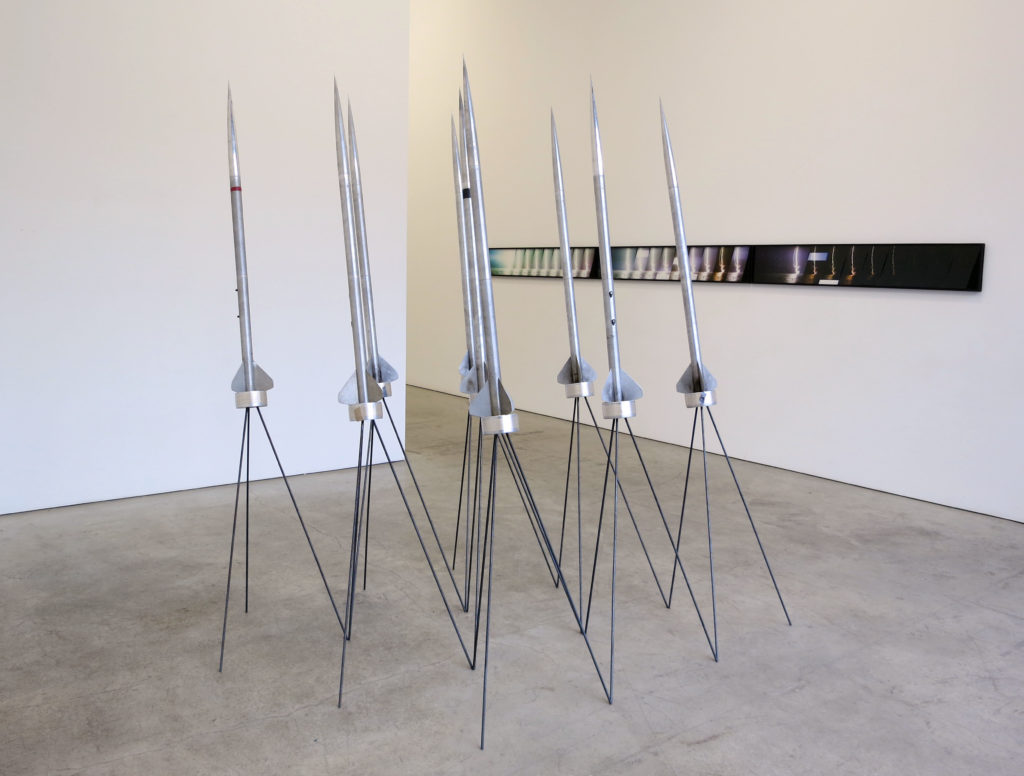
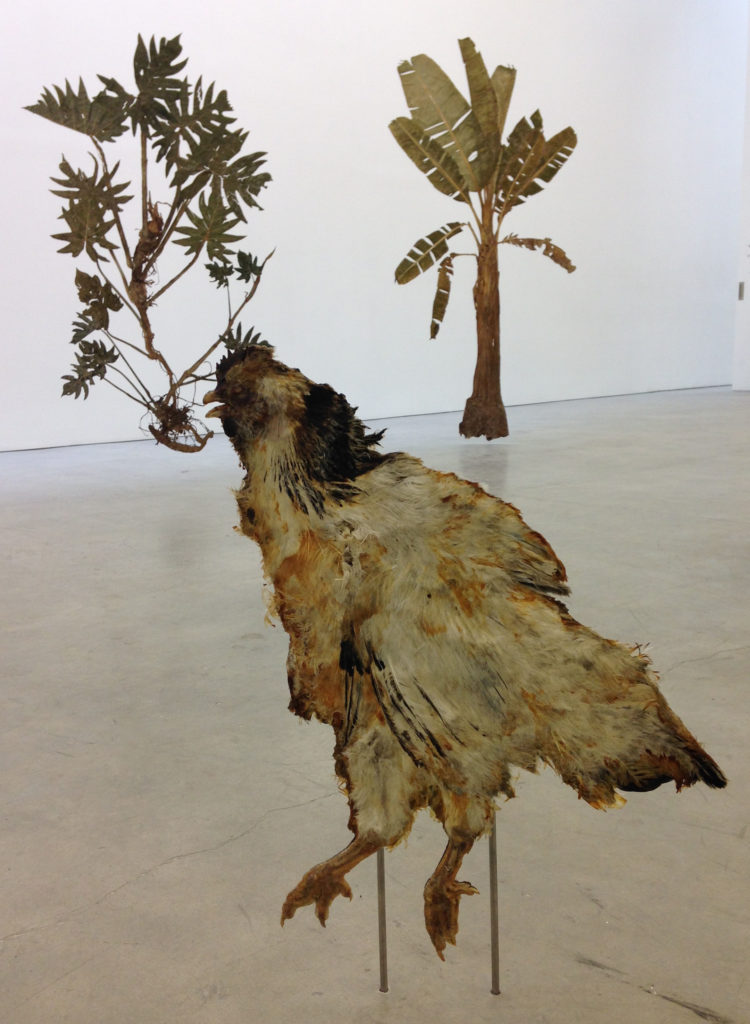
Julius von Bismarck’s Good Weather at Marlborough Contemporary is an interesting meditation on man’s desire to control nature. The first half of the exhibition focuses on Bismarck’s attempts to capture a lightning bolt with the rockets pictured above. In a side room there is a mesmerizing video of a storm rolling into a jungle and the lightning that he used for his experiment. The second half of the gallery focuses on pressed plant species and chickens.

In the press release his process for achieving these flattened works is described in detail-

Like a Colonial scientist, von Bismarck has collected plant species from jungle. Rather than pressing tiny flowers in a notebook, the artist has pressed large plants and entire palm trees into flattened specimens. Heated to a precise 250 degrees in an enormous custom-built oven and a 50-ton hydraulic press, the plants are completely dehydrated without losing their verdant coloration, and squashed astonishingly flat. They are then backed with thin stainless steel to maintain their shape for presentation.

This exhibition closes 5/20/17.

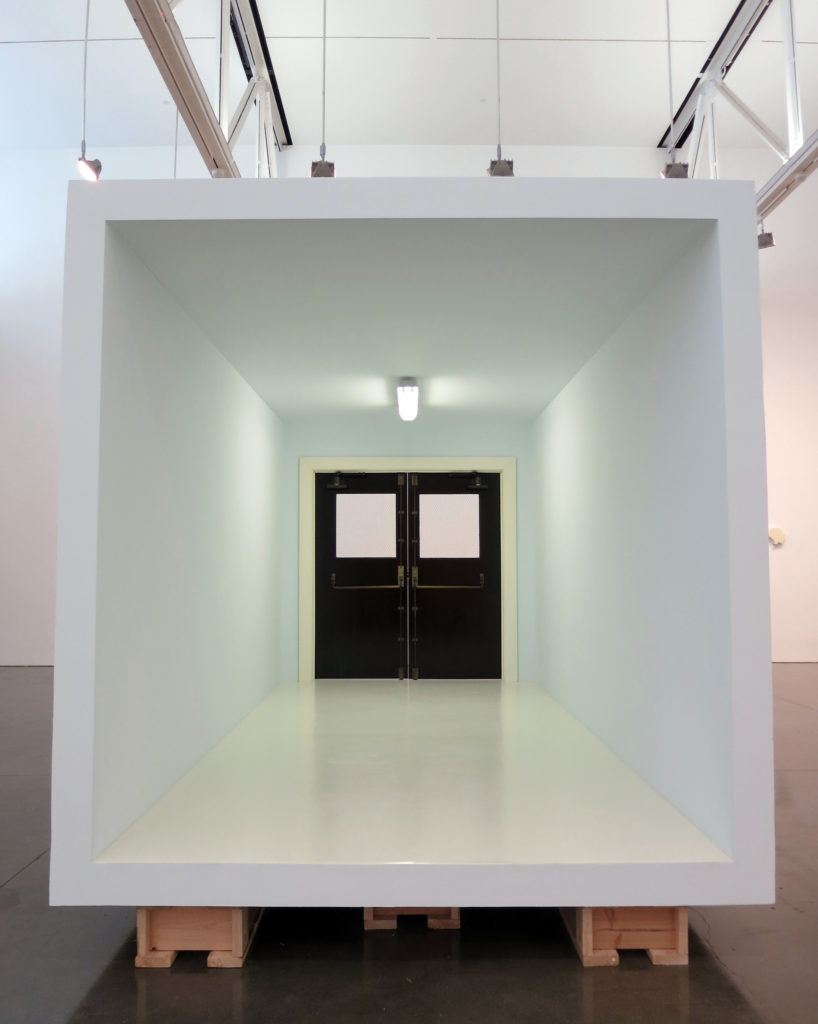
                                                                                       No title (room, panic doors), 2013-14

At Gagosian gallery is Robert Therrien‘s first show in New York in ten years. The artist, well known for his sculptures of massive tables, chairs and plates, is now creating rooms and new objects- which include drops, a bow, and a flagpole. The rooms are the works that stand out most, both in scale and in the disconcerting feeling of environments that should feel more normal than they do.

From the press release-

Despite their verisimilitude, Therrien’s rooms impede the viewer’s ability to engage with space in any comfortable way.  Meticulously assembled features of common industrial design allow one to stand in front of architectural vistas. Elevated above ground level and cut away to show interiors that, like dioramas, become impenetrable replicas of reality, each is like a mise-en-scène or readymade. No title (room, panic doors) (2013–14) presents a set of doors in a room filled with fluorescent light. In No title (paneled room) (2017), tambourines rest silent on the floor of a room luxuriously paneled in hardwood, and a ladder leads to a trapdoor in the ceiling. Each room transports the viewer out of the gallery and into a new narrative situation, prompting connections between material details and their subconscious associations. By making use of everyday things that are often overlooked, Therrien situates the viewer in familiar territory, then allows the objects to demand reassessment as instruments of subjectivity and of consciousness itself.

This exhibition closes 5/26/17.

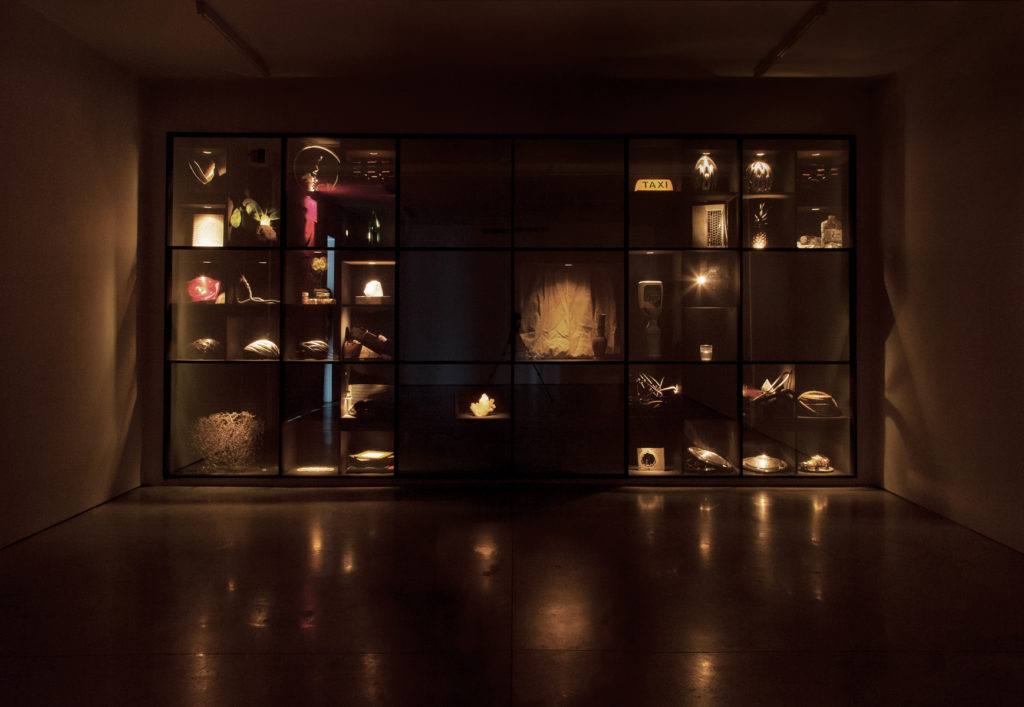
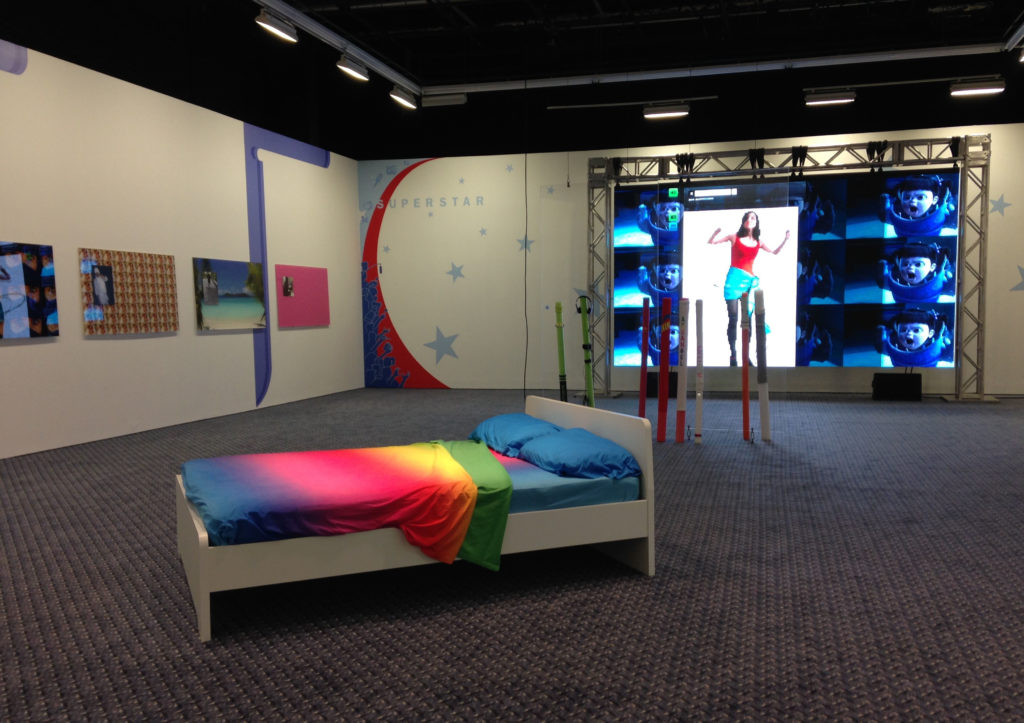
For a room of a different sort, there is Gabriel Lester’s Nevada at Ryan Lee gallery, in which various sections of a wall sized installation light up as assorted voices tell their stories.

                                                                                        Nevada, 2017 (image courtesy of Ryan Lee)
From the press release-

Questions of presence and absence resurface in Nevada, the second component of this exhibition. Nevada confronts the viewer with a floor to ceiling modular wall. Carefully selected objects that correspond with the individual stories combined in Nevada’s multilayered narrative occupy each compartment. Guided by light and sound, the viewer navigates the histories of a series of anonymous characters that find themselves locked out of the world they used to inhabit. In an effort to escape the parallel world in which they have come to dwell, each character attempts to understand the nature and cause of their own existence. Considering personal memories and local histories of migration, mining, gambling, nuclear test sites, and mysterious locations like Area 51 and the Nevada triangle (an area in the California-Nevada desert where numerous aircrafts have vanished), Lester’s Nevada probes the tensions that link the seemingly distinct characteristics of this place to a number of characters looking for a way back to a life they have lost.

The exhibition opens onto a room of low-resolution LED panels showing internet-sourced images of near extinct animals and their habitats. The two rooms feel like separate exhibitions but are brought together by their shared qualities of losing one’s place in the current world.

This show runs until 5/20/17.

Feb 182017
 

For Cory Arcangel and Olia Lialina’s exhibition at The Kitchen, Asymmetrical Response, the early days of the internet come to life in various artworks. The carpet is made of a diamond plate pattern that used to be a common background on 1990s websites and the wallpaper uses patterns from early Yahoo templates. One of the most interesting pieces is Lialina’s Give me time/This page is no more, a slide projection of former popular hosting site Geocities’ members home pages that promise a site they will create or come back to in the future. It’s hard not to look at these pages and wonder how soon what we are seeing now on the web will seem as antiquated as these images.

From the press release-

In military parlance, the terms asymmetrical and symmetrical are employed to refer to political provocations and diplomatic démarches, escalation and tension, and power dynamics of the highest order. Not specific to war, these terms also refer more generally to a set of relations that define our connections to power.

On the eve of Y2K, Russian­-born Olia Lialina—who is among the best-known participants in the 1990s net.art scene—first met American artist Cory Arcangel. Ever since, the artists have been deep in dialogue about the social and cultural impact of the Internet’s historical shift from a tool for military communication to an “information superhighway” promising open and equal exchange, and, finally, the increasingly asymmetric “content delivery system” we experience today.

This show closes 2/18/17.

Dec 222016
 

terrywintersatmatthewmarks

terrywintersyellowmatthewmarks

To keep these posts a little shorter, I have split them up into two parts. The following continues the list of Chelsea exhibitions-

Terry Winters‘ vibrant paintings at Matthew Marks Gallery are made up of layers of marks in oil, resin, and wax.

From the press release-

“These recent paintings are a series of accumulations,” Winters says. “There’s a range of paint application in terms of both material and technique. Each color is a marker, a stage of development. I’m moving across the surface, modulating the material in different ways. That inflection produces an amplification of colors, both physical and chemical. But color is basically wild and full of surprises.”

padraigtimoneyatandrewkrepsgallery

Pádraig Timoney‘s work in The Deedle Eye, at Andrew Kreps Gallery, is a diverse combination of painting, photography, and installation.

From the press release-

Despite the visually distinct results, at the work’s core is a focused inquiry into the mechanics of images. Timoney conversely works in both directions – creating new images from abstractions (the captivating results of processes achieved in the studio), or rebuilding them part-by-part from photographs or observation. In each, he acknowledges the inherent flaws of these constructions, from the faultiness of recognition, the errors of translation, and further, the subjectivity of both viewers and the artist.

These in turn become generative openings in Timoney’s work as they are distanced from their original context. The images exist within thrilling, new visual constellations, allowing for the introduction of artifice and illusion, and the question of not only what they depict, but why? Each work records an index of decisions that determine its final state, materially and cognitively, displaying a history that is intentionally left open-ended. Figuration appears to hover only a hair away from abstraction, as if the movement of a line would cause one to collapse into the other. The narrowing of this gap suggests that the works’ initial disparate appearance may lead to an alternate understanding of their connections; a net that widens only to close anew, though what’s caught within it is left for the viewer to decide.

Also make sure to go to the space next door to see Klaus Weber’s sculpture Emergency Blanket.

klausweberatandrewkreps

Ai Weiwei has four shows up in NYC right now. Two of which are in Chelsea, at Mary Boone Gallery and Lisson Gallery, one is at the Mary Boone Gallery uptown, and one is at Deitch Projects in SoHo. Mary Boone Gallery and Lisson are both showing Weiwei’s Roots and Branches work, which includes large scale sections of dead trees, sometimes like the one seen below in cast iron at Lisson, and a 25 foot sculpture made up of tree parts bolted together. The uptown gallery includes a circle made up of 40,000 spouts broken off from Chinese teapots. Deitch Projects gallery has Laundromat, in which Weiwei has arranged items of clothing left behind by Syrian refugees (after they were forced to leave camps near the border of Greece) that he collected and laundered.

aiweiweilissongallery

Dec 102016


todd-murphy-nov2017-stag

todd-murphy-murmuration-12016

Marc Straus gallery on the Lower East Side has two great sculpture shows closing this weekend (12/11/16). Todd Murphy’s mixed media sculptures are gorgeous creations which glow on the walls of the upstairs space.

On the first floor of the gallery, are Chris Jones’ intricate pieces created with images from discarded magazines and books. The details within these worlds become more and more apparent the longer one looks at them, including plants growing into other spaces and laundry tumbling out into other frames.
joneschris-after-they-had-left-2015

joneschris-portrait-1-14-25-x-11-5-x-1-in

jones-chris-of-vanished-alphabets-2016-05

(images via Marc Straus)

Dec 032016
 
aidasbareikiscanadagallery1116

Aidas Bareikis “Too Much Seaweed”, 2016

This is the final weekend of two excellent exhibitions on the Lower East Side in New York. The first is Aidas Bareikis’ Barrel of Fortune at Canada gallery.

From the press release-

In Barrel of Fortune, his first solo exhibition at CANADA, Bareikis distills his enduring vision into bundled masses. He stacks and wraps cultural objects in fabric and string, building altar-like assemblages shrouded by paint and recognizable trash. The sculptures are propped up by found furniture, wood or aluminum, and exposed to forces like time, gravity, or the elements. Rendered in deep reds, acidic oranges and vintage blues, each work operates like a junkyard relic: a curious portal into another era slowly merging with the local flora. It’s here where Bareikis navigates, somewhere between scientific method and pure psychic automatism, covering his tracks in a role equal parts wandering scientist and mad poet.

And at McKenzie Fine Art, Reed Danziger’s new paintings are dense with small details and geometric patterns which combine to form a beautiful and energetic organized chaos.

reedalexanderfromdibsDetail from A Rearrangement, 2016 (image via 1st Dibs)

Mar 182016
 
amyyaoatvsfgalleryroomview

Doppelgangers (in foreground)

amyyaovsfricedetail

Detail of Doppelgangers

amyyaovsfhomeiswhereyouarehappy

Home is Where You Are Happy, No.1

At Amy Yao’s solo exhibition, Bay of Smokes, at Various Small Fires, the fear of a polluted and harmfully modified environment plays a central role. An industrial manufactured scent fills the gallery, lead blankets are on towel racks, and a mountain of rice reveals on closer inspection that it has bits of plastic and pearls (real and fake) mixed in.

In this time of GMO’s, toxic water in Flint, and the gas leak at Porter Ranch, it’s hard not to be paranoid about what is really happening to our natural surroundings and how poisonous our daily lives really are, especially in ways we cannot discern. Yao’s exhibition is a creative and at times playful examination of these issues- but the darkness of the theme, like the scent, remains a constant presence.

This exhibition closes 3/18/16.