Aug 222023
 

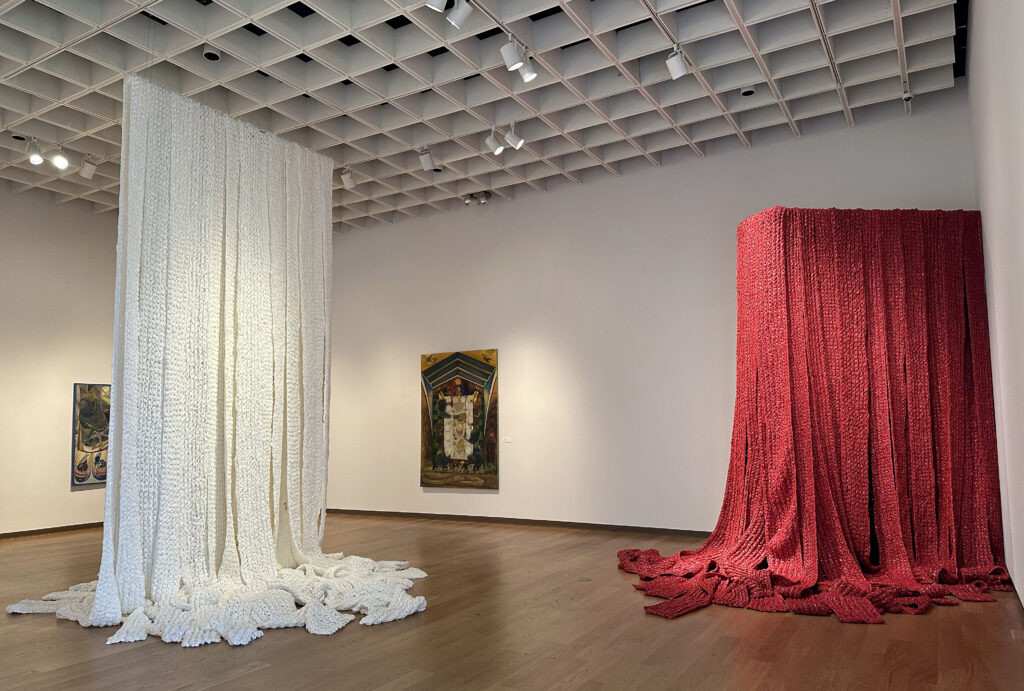
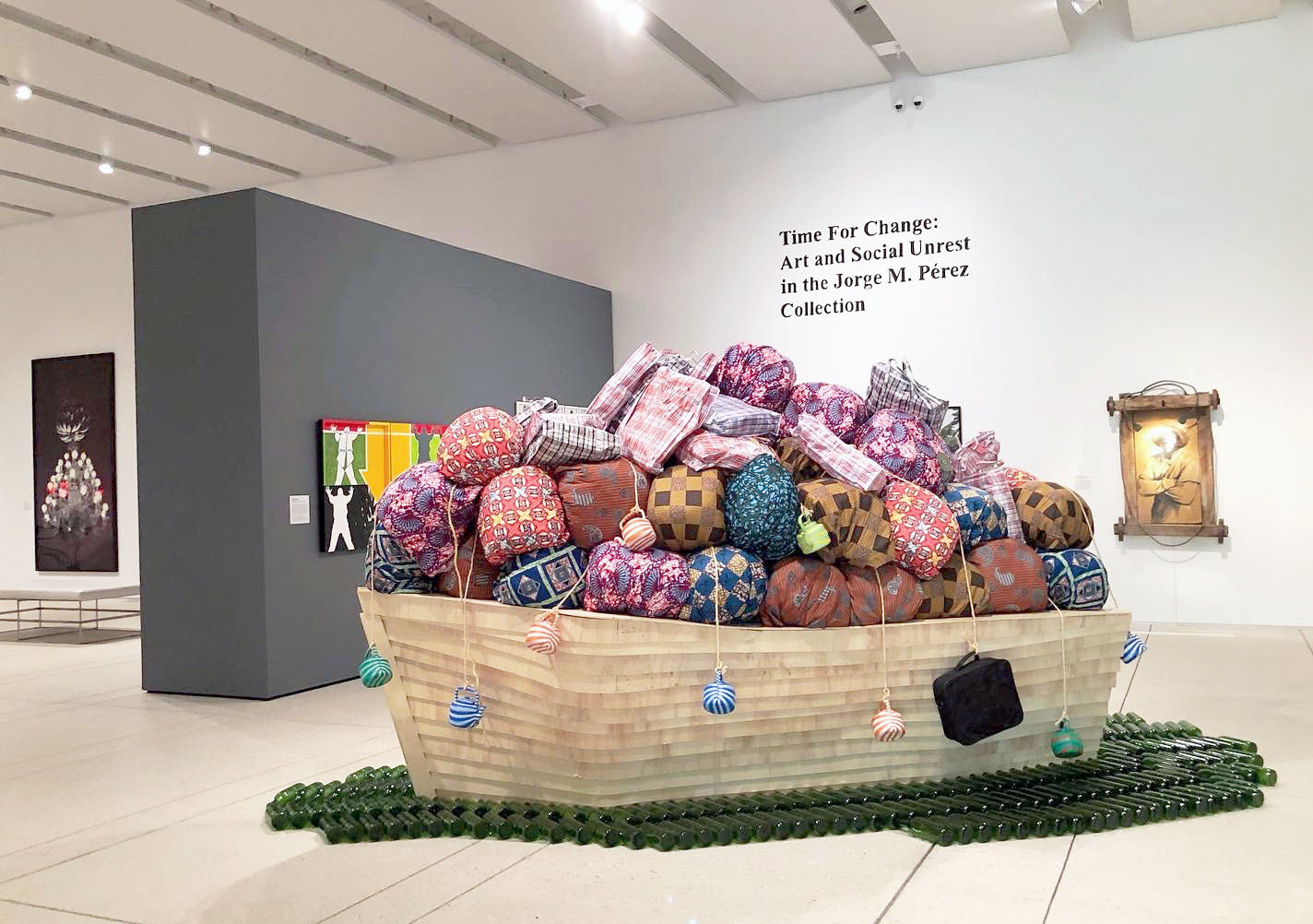
Barthélémy Toguo (Cameroonian, b. 1967), “Road to Exile”, 2018. Wooden boat, cloth bundles, glass bottles, and plastic containers

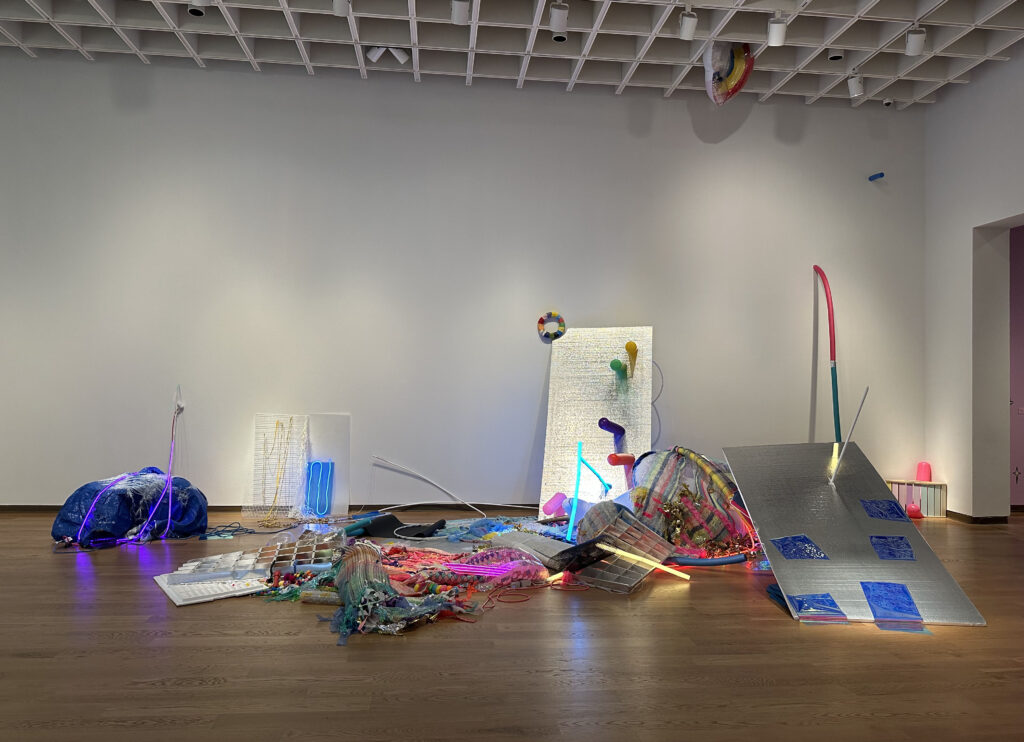
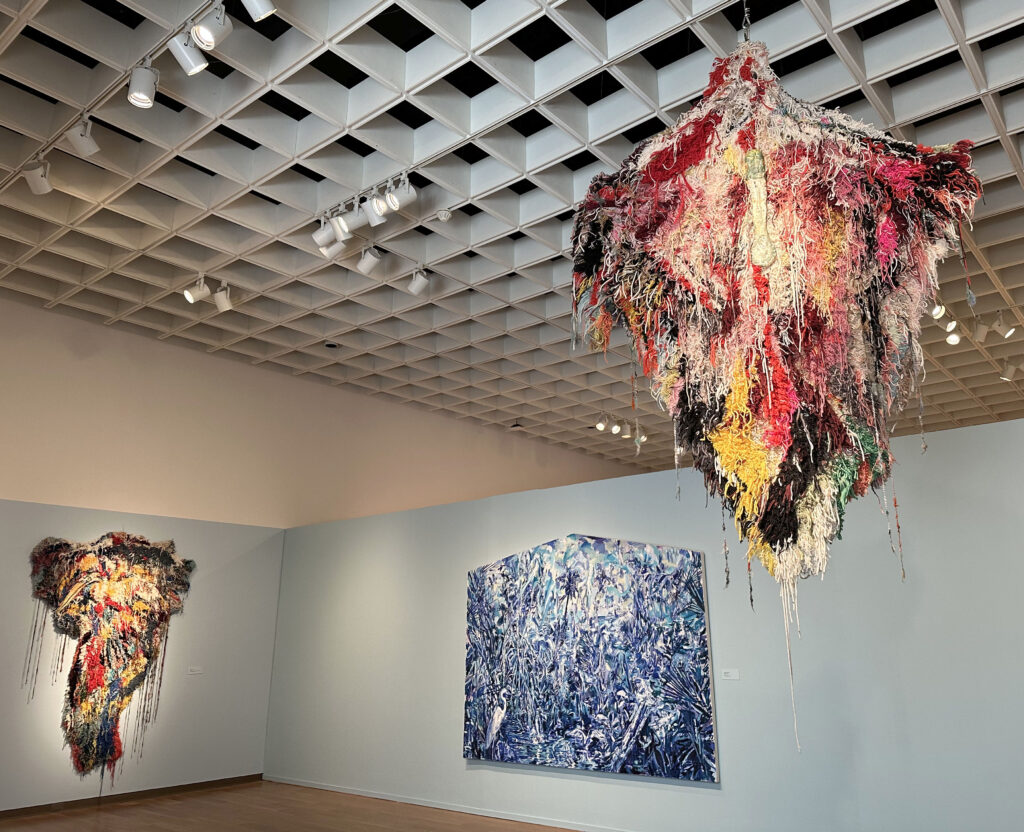
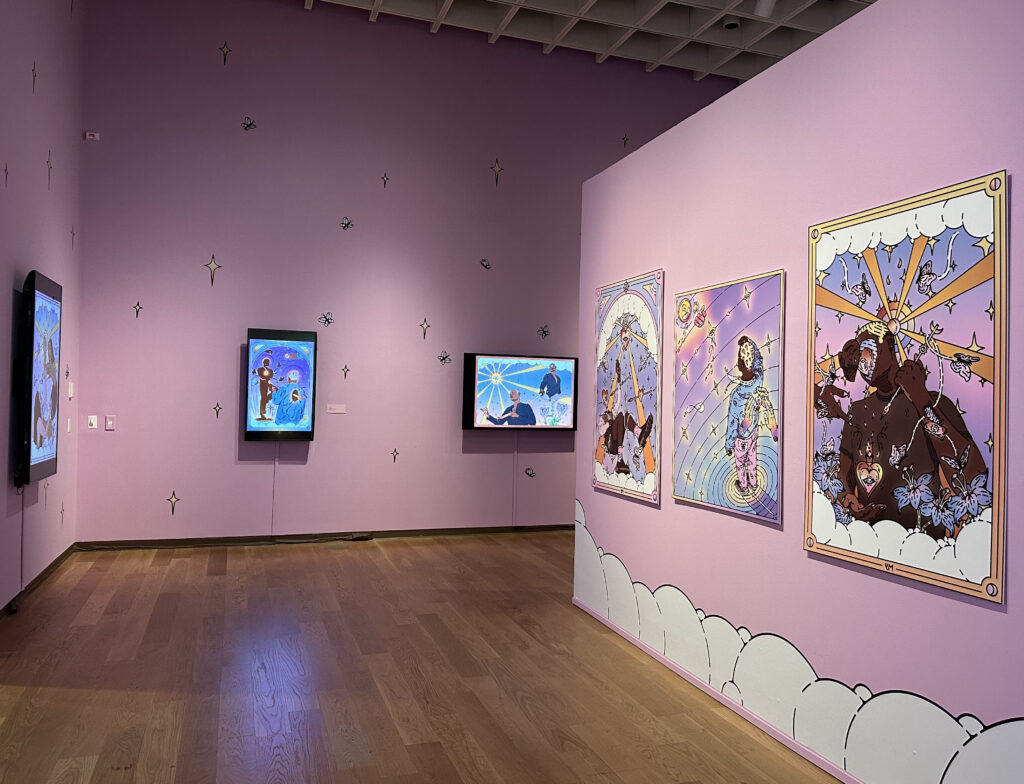
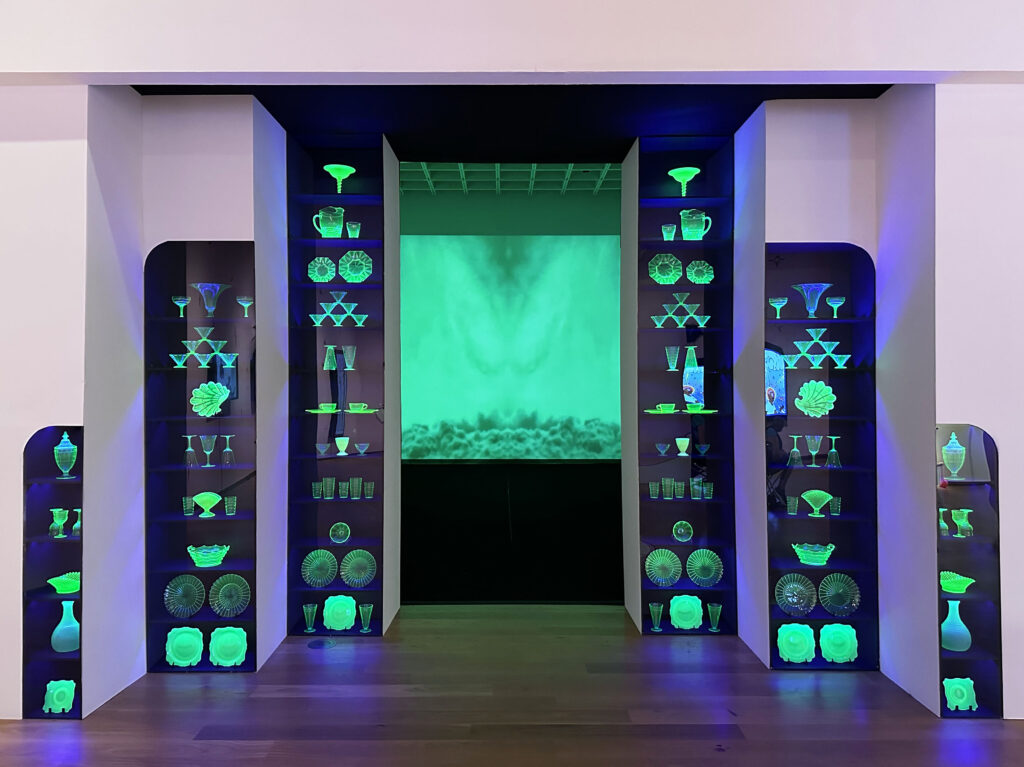
Currently on view at Tampa Museum of Art is Time for Change: Art and Social Unrest in the Jorge M. Pérez Collection. The exhibition highlights art from around the world that focuses on social issues.

From the museum-

“It is enough for the poet to be the bad conscience of his age”, stated Saint-John Perse in his 1960 Nobel Prize acceptance speech. Something similar could be said when artists address the transformations of society. We should not ask for measurable political action when their role is to point out, to render evident, to shake us from indifference. Art may not provide answers, but most of the time it interrogates and proposes uncomfortable issues, almost like rubbing salt in a wound. Artists are seldom celebratory, nor do they usually provide solutions-art’s potency lays in the symbolic efficacy of the actions it proposes more than in the practical effects they entail. Paraphrasing Brazilian poet Ferreira Gullar, “art exists because life is not enough.”

Time for Change is structured around six themes or nuclei: Entangled Histories, Extraction and Flows, Artivism, State Terror, Spatial Politics, and Emancipatory Calls. The sections are organically linked and establish dialogue and correlations among artworks that do not necessarily illustrate an argument nor are they contained by one. Entangled Histories proposes essential questions: how do we remember as a society? Who is forgotten by History, and for what reasons? Extraction and Flows examines displacement of peoples (usually forced), as well as the unequal logic on the territory. Artivism: Art in the Social Sphere focuses on political unrest and public protest on the streets. State Terror signals how protest is countered with repression and violence. The fifth section, Spatial Politics, reflects on modern architecture and its role in creating segregated communities. Lastly, Emancipatory Calls summons to reclaim difference, in the understanding that a more just society can only be built on respect for one’s right to be different.

A comprehensive look at the Jorge M. Pérez Collection reveals a tendency towards art with an interest in social change- art that examines the conflicts and contradictions of contemporary society, art that critically analyzes historical events and reframes them in the present. Many of the 60 works on view, due to their size or complexity have rarely been exhibited and are shown together for the first time in Time for Change.

About the main work pictured above, Barthélémy Toguo’s Road to Exile, from the museum

In 2018, the Parrish Art Museum in Water Mill, New York hosted Barthélémy Toguo’s first solo exhibition in the United States. While on site at the Parrish he made Road to Exile, a large-scale installation highlighting the plight of refugees, in particular African migrants in search of a better and safer quality of life. The installation features a life-sized wooden boat that rests on glass bottles. A metaphor of the dangerous voyage across the sea, the bottles represent the fragile line between life and death. The boat nearly overflows with bundles wrapped in brightly colored African textiles and serve as stand-ins for the body. In Road to Exile Toguo employs imagery of the boat as a means of escape rather than a vessel for exploration or adventure.

Below are images from the exhibition as well as some information on a few of the works.
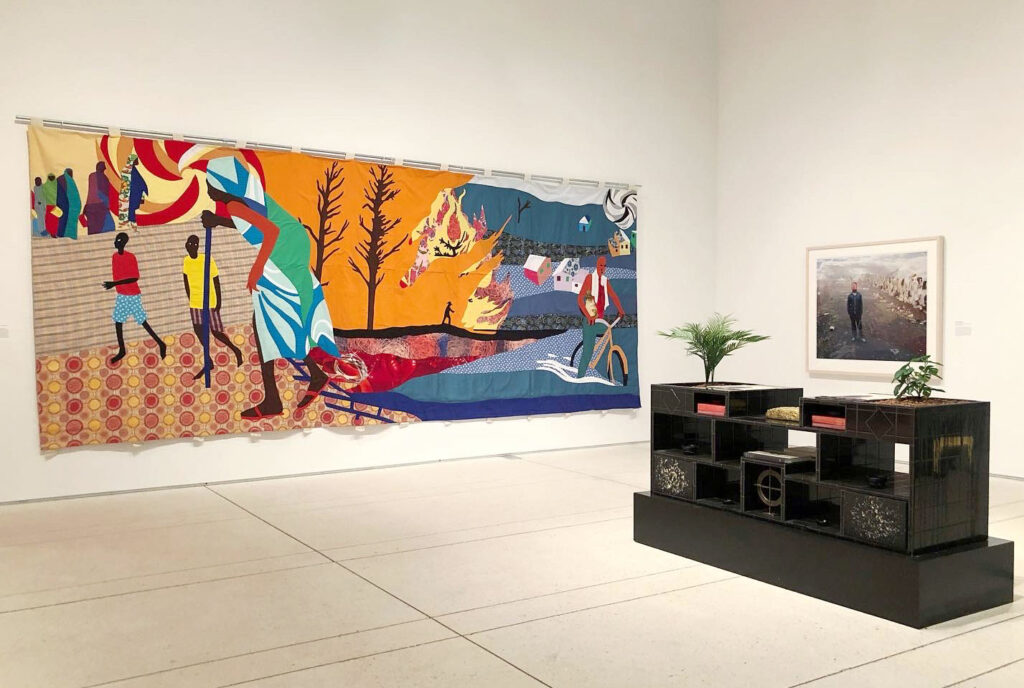
Rashid Johnson, “A Place for Black Moses, (2010), bottom right sculpture, and Christopher Myers “How to Name a Famine, a Fire, a Flood”, 2019, left wall piece
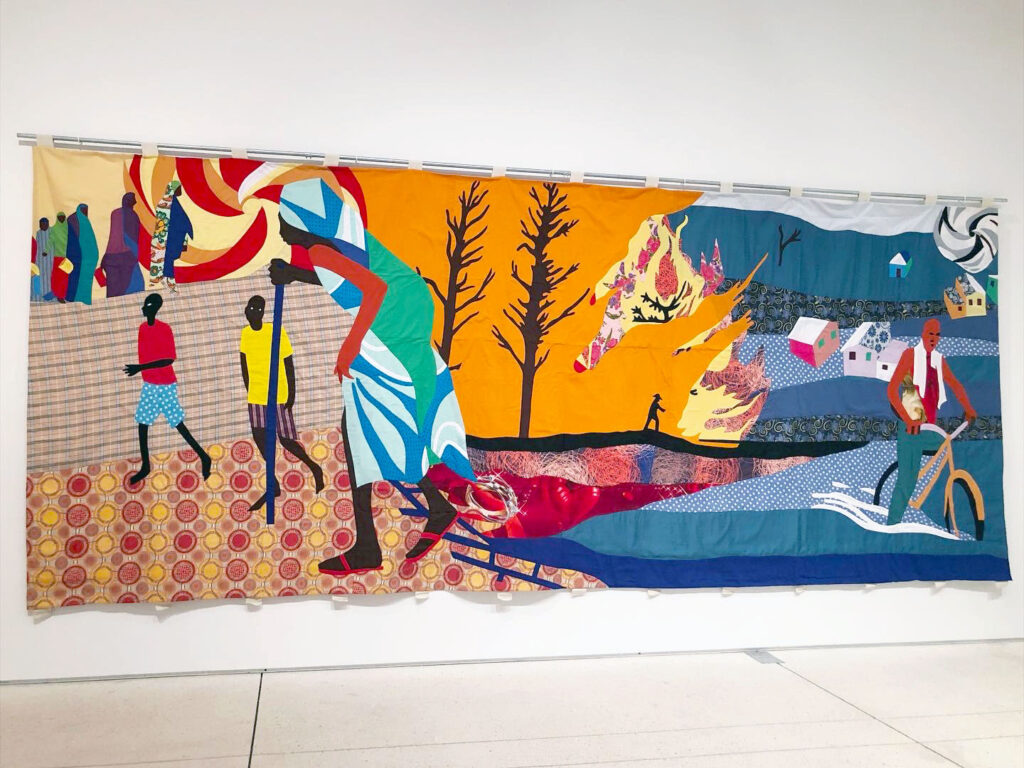
Christopher Myers “How to Name a Famine, a Fire, a Flood”, 2019, Applique fabric

From the museum about the above work-

Storytelling anchors Christopher Myers’ artistic practice. Working in a range of media, he mines history and creates art that links the past to the present. Myers’ tapestries, such as How to Name a Famine, a Fire, a Flood draws on the rich tradition of quilt making as a quiet yet radical form of resistance and protest. The stories depicted center on the effects of globalization on individuals and more specifically, communities of color. In How to Name a Famine, a Fire, a Flood, Myers portrays three different natural disasters linked to climate change. With vivid color and patterned fabric, he illustrates the impact and devastation of these catastrophic events in neighborhoods with minority populations.
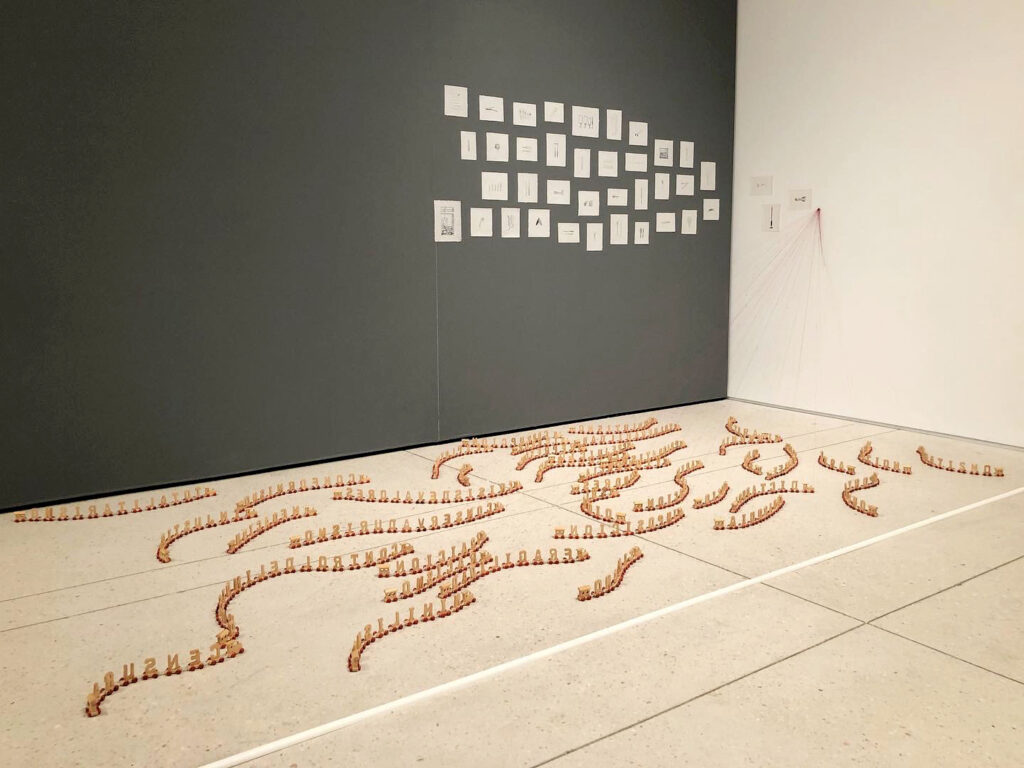
 

Carlos Garaicoa “La habitacion de mi negatividad (The Room of My Negativity)”, 2003, 39 ink and pencil drawings on rice paper and toy train installation
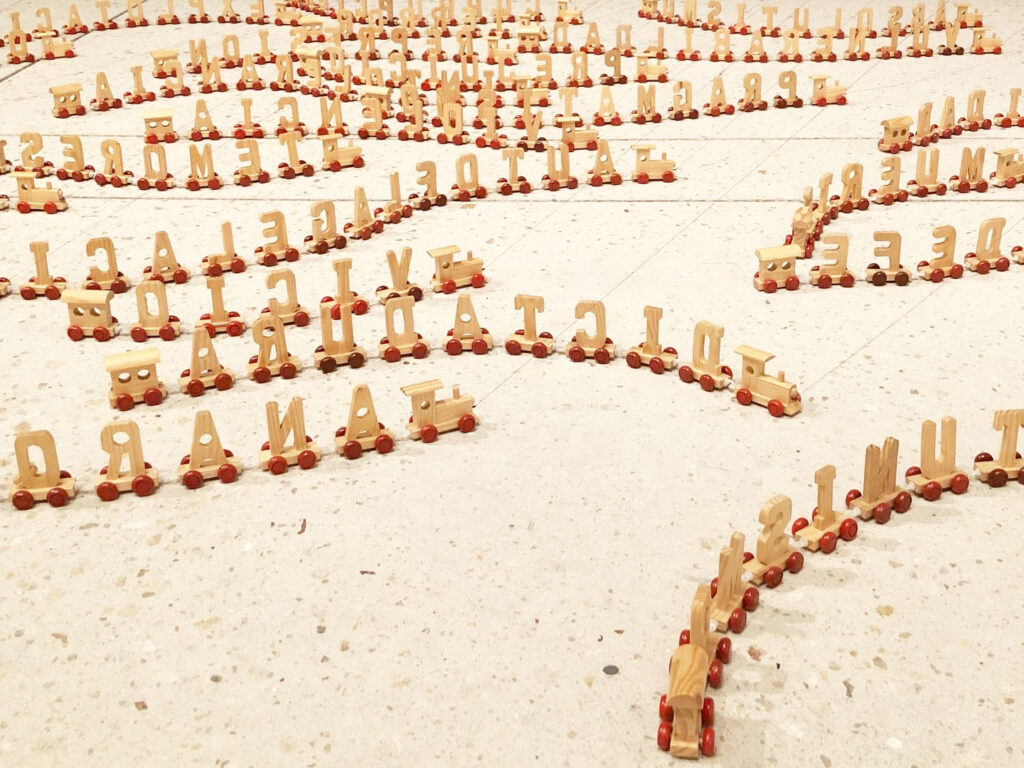
Carlos Garaicoa “La habitacion de mi negatividad (The Room of My Negativity)”, 2003 (detail)

Carlos Garaicoa “La habitacion de mi negatividad (The Room of My Negativity)”, 2003 (detail)

About the above work from the museum-

Carlos Garaicoa works in a variety of media, ranging from installation, photography, and video to performance and public interventions. His early work in the 1990s focused on the urban decay of Havana as result of its political climate and economic strife. La habitacion de mi negatividad (The Room of My Negativity), turns Garaicoa’s lens inward. In this installation, comprised of toy trains and drawings of medical instruments, the artist explores his psyche and subconscious. The train’s engine pulls words that represent Garaicoa’s negative thoughts. Each train is connected to thin red thread that acts as a vein or conduit for the negative thoughts to travel. Arrange in a curved form, the train shapes mimic brain waves or the slink of a snake. Garacoia’s drawings of medical tools serve as mechanisms in which the negatively could be excavated from one’s mind.
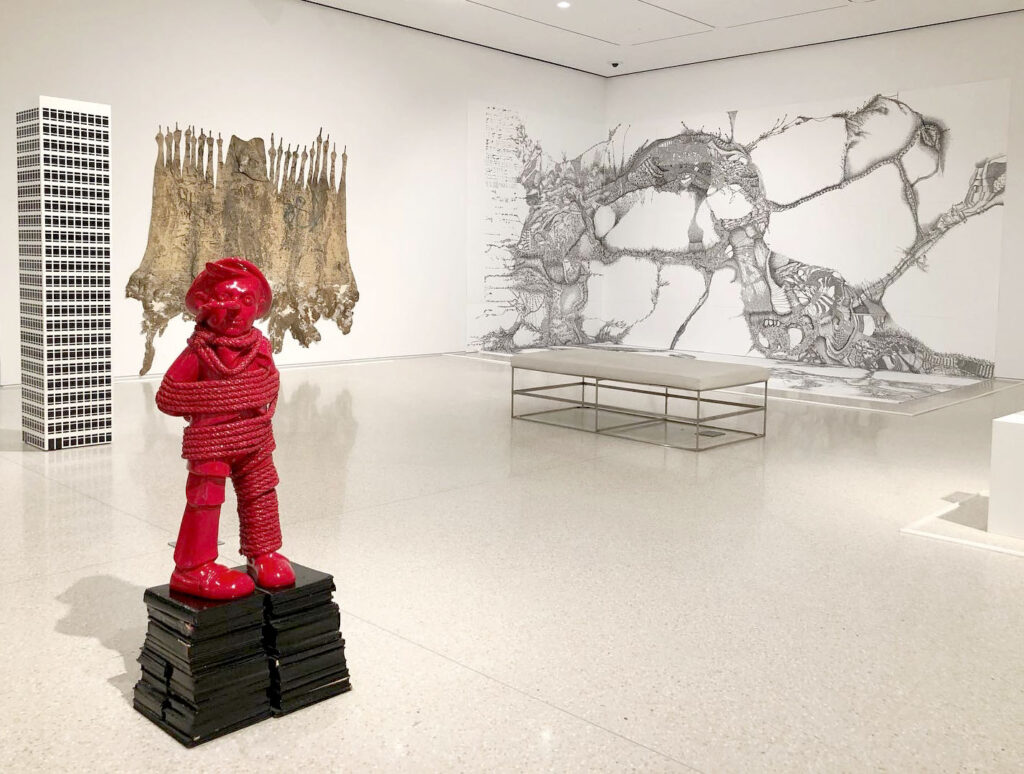
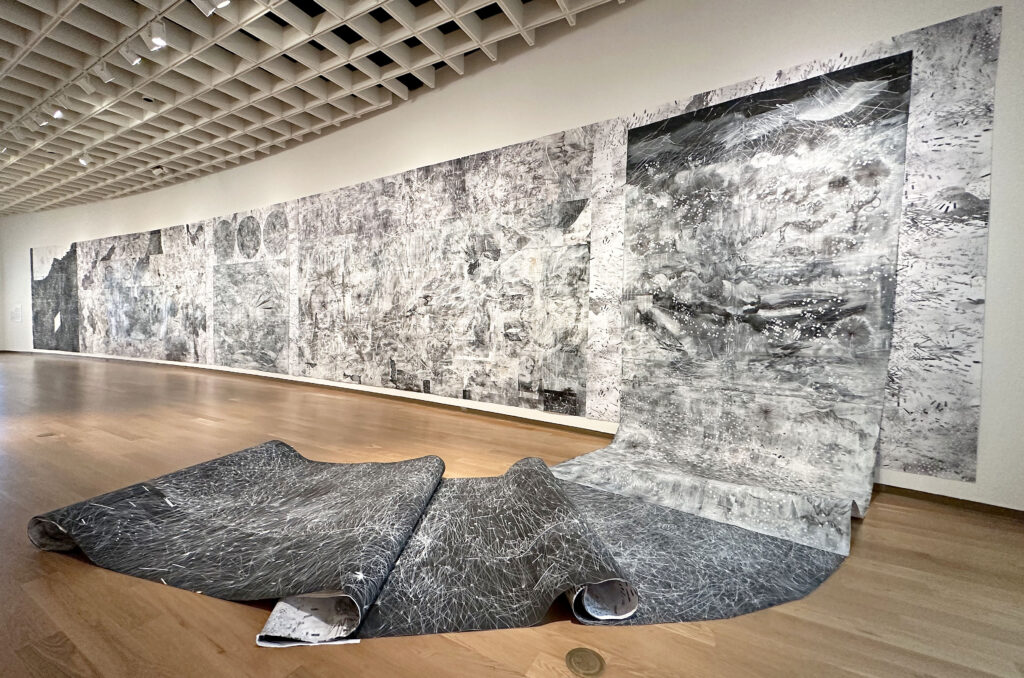
Esterio Segura, “La historia se muerde la cola (History Bites its Tail)”, 2015, (statue bottom left); Anamaría Devis, “Infinito (Infinite)”, 2018(upper right)
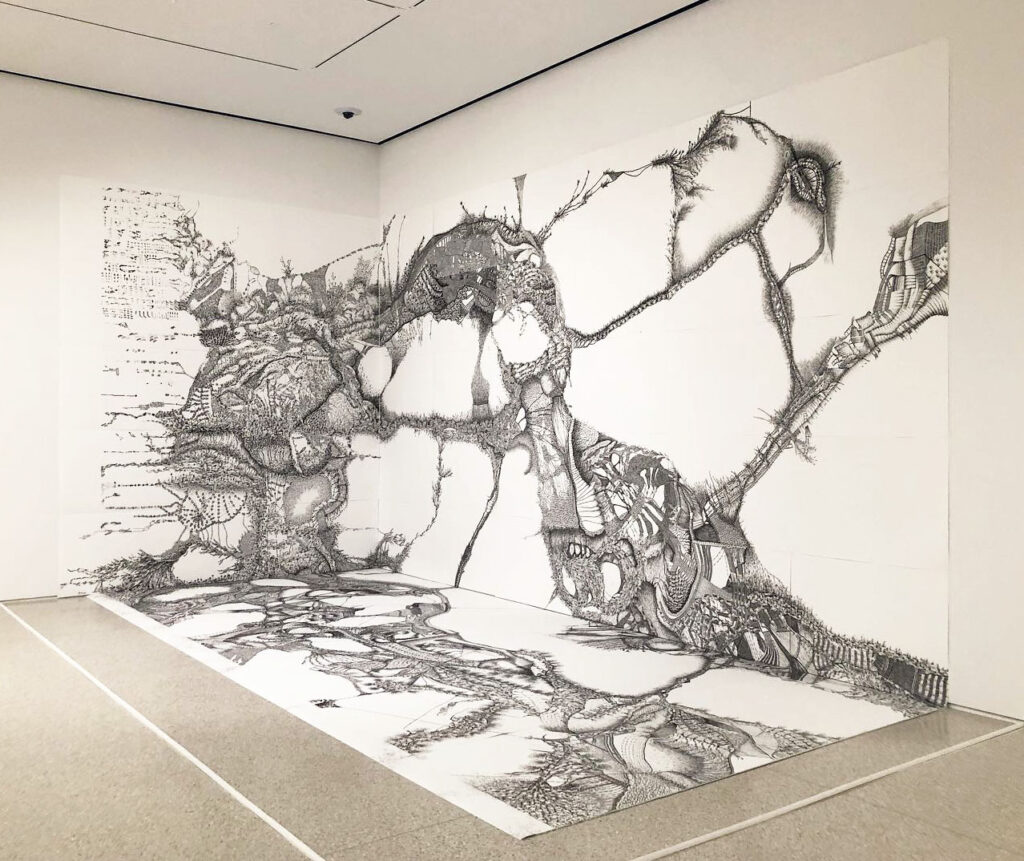
Anamaría Devis, “Infinito (Infinite)”, 2018, Ink on paper
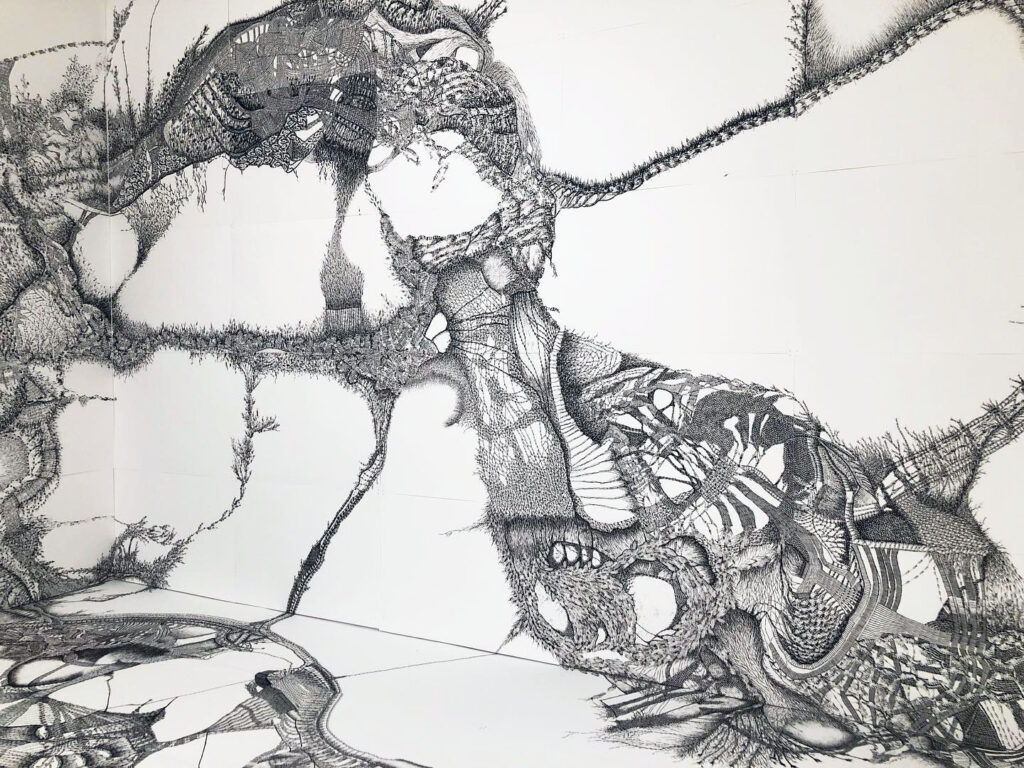
Anamaría Devis, “Infinito (Infinite)”, 2018, Ink on paper (detail)

About this work from the museum-

Anamaría Devis’ large-scale installation Infinito (Infinite) represents the artist’s study of African history in San Basilio de Palenque, Colombia. Escaped slaves founded Palenque and it was the first free town in the Americas during colonial times. While researching this history, Devis discovered that in this region of Colombia, braided hairstyles worn by Africans served as escape maps. Braid patterns reflected safe points in the area’s topography. This silent form of resistance inspired her to look at other bodily topographies like the characteristics of fingerprints, which also had names associated with cartography such as crossing, island, and fork. Devis then began to create drawings that incorporated footprints, braid patterns, and elements of nature. From the drawings she made stamps and each panel of paper that comprises Infinito (Infinite) is rendered from Devis’ various imprints. The result is an abstract representation of the body and landscape visualized through mapping and codes.
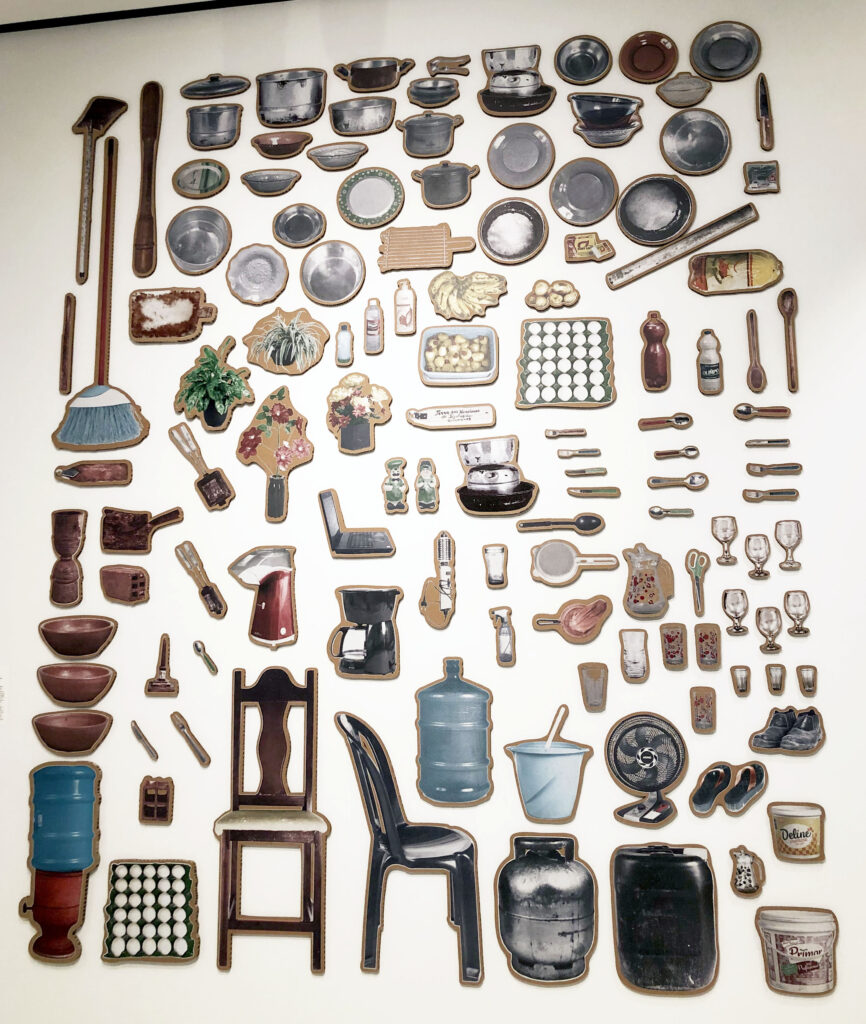
Jonathas de Andrade, “A batalha de todo dia de Dona Luzia, de Tejucupapo (The daily battle of Dona Luzia, from Tejucupapo)”, 2022 Images printed on raw falconboard

About this work from the museum-

Jonathas de Andrade collaborated with the Brazilian theater company Teatro Heroínas de Tejucupapo to create a visual reenactment of the historic 1646 Battle of Tejucupapo. For nearly 25 years, between 1630 and 1654, the Dutch occupied the northeast of Brazil including Tejucupapo, a small community in the city of Goiana. During the Battle of Tejucupapo, a brigade of black and indigenous women forced Dutch soldiers to retreat by arming themselves with household and farm objects. The Teatro Heroínas de Teiucupapo commemorates this female-led rebellion each April by restaging the battle with local actors.

Artist Jonathas de Andrade celebrates the power and courage of Tejucupapo’s women with his large-scale photographic installation A batalha do todo dia de Tejucupapo (The Battle of Tejucupapo). The work on this wall, A batalha de todo dia de Dona Luzia, de Tejucupapo (The daily battle of Dona Luzia, from Tejucupapo), presents everyday objects from the home of one of the women participating in Teatro Heroínas de Tejucupapo. This inventory explores the daily struggles, as well as strength, of Brazil’s black and indigenous women that have spanned centuries.

This exhibition will close on Sunday, 8/27/23.
 

Aug 122023
 

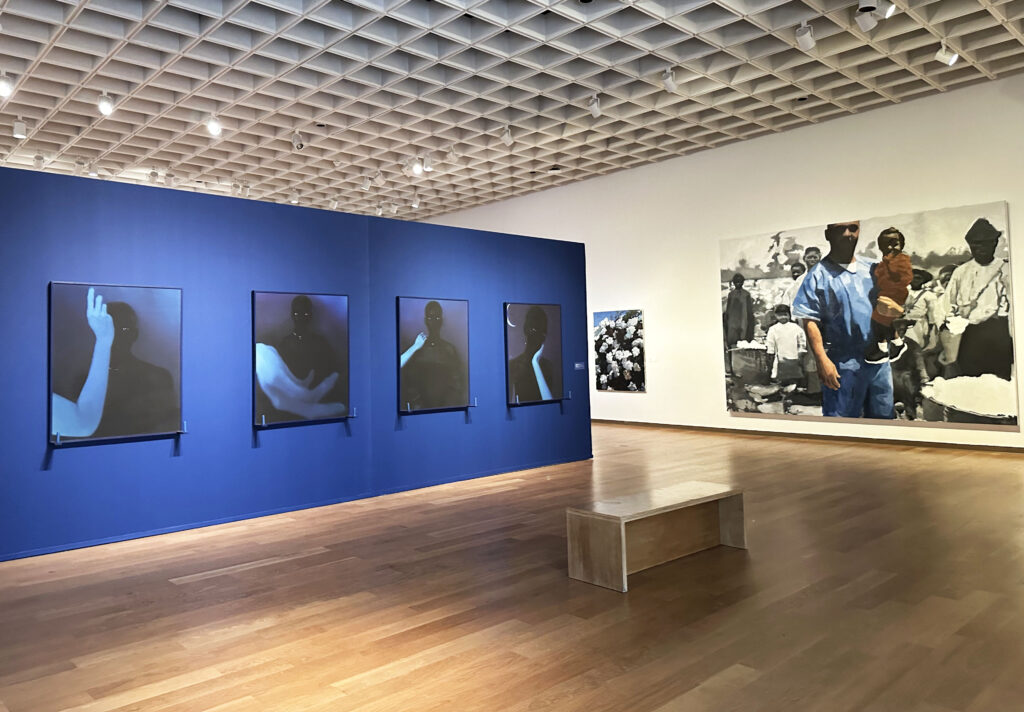
Work by Elliot and Erick Jiménez (photographs, left) and Reginald O’Neal (paintings, right)

Sculptures by Akiko Kotani, Paintings by MJ Torrecampo

Work by Denise Treizman

Work by Amy Schissel

Photography by Peggy Levison Nolan

Work by Magnus Sodamin

Work by Yosnier Miranda

Work by Cara Despain

There is some really impressive work currently on view for the 2023 Florida Prize in Contemporary Art at Orlando Museum of Art.

From the museum site about the exhibition-

The Florida Prize in Contemporary Art is organized by the Orlando Museum of Art to bring new recognition to the most progressive artists in the State. Each year OMA’s curatorial team surveys artists working throughout the State before inviting ten to participate. One artist will receive a $20,000 award made possible with the generous support of local philanthropists Gail and Michael Winn.  Artists range from emerging to mid-career, often with distinguished records of exhibitions and awards that reflect recognition at national and international levels. In all cases, they are artists who are engaged in exploring significant ideas of art and culture in original and visually exciting ways.

This year’s artists are-

Denise Treizman (@denisetreizman )

MJ Torrecampo (@mjtorrecampo )

Akiko Kotani

Peggy Levison Nolan (@peggylevisonnolan )

Amy Schissel (@amyschissel )

Reginald O’Neal (@_reginaldoneal_ )

Elliot & Erick Jimenez – (@elliotanderick )

Cara Despain (@caradespain )

Yosnier Miranda (@occurrences)

Magnus Sodamin (@magnificentmagnus )

On the following pages below are more works by the above artists and detailed information on their work in the exhibition.

Jun 222023
 

“When I Was Young”, 1995

“Here I Am/Estoy Aquí”, 2022

Two works from Joey Terrill: Cut and Paste, a solo exhibition at Ortuzar Projects in NYC this past February.

From the gallery’s press release-

Raised in Highland Park and East Los Angeles, Terrill was part of a small group of Chicano artists who in the 1970s and 80s created works that diverged from traditional Chicano-based imagery and subject matter to include visual representations reflecting his queer lived experiences. Utilizing the existing image culture that surrounded him, Terrill combines personal photographs, found pop cultural imagery, and reproductions of artworks by queer predecessors, including Diane Arbus, Robert Mapplethorpe and Wilhelm von Gloeden, to conjure utopic spaces. Spanning from his earliest explorations to substantial new works, Cut and Paste reveals collage as a foundational element to Terrill’s expanded artistic practice.

Beginning with abstract collages and silkscreens made while Terrill was an undergraduate at Immaculate Heart College—an art department still heavily influenced by the graphic artist and activist Sister Corita Kent—the exhibition draws out the interconnectivity of illustration, collage, and printmaking in Terrill’s work and their influence upon the characteristically flat style of his early paintings. Like many artists who came of age in the wake of Pop, he found refuge within the fantasies of American image culture–his earliest artworks covering his bedroom walls, which he transformed with a mix of drawings, photographs, and clippings of comic books, film starlets, and music icons. His silkscreens from the mid-1970s–a medium central to the larger Chicano art movement–find him applying a graphic sensibility to not only representations of brown bodies, but queer desire, an impulse he would continue to explore in his episodic Homeboy Beautiful proto-zines from the end of the decade.

Terrill was selected to be one of the artists in Hammer Museum’s 2023 biennial, Made in L.A., which will open this October. He also has a work in the current exhibition at the museum- Together in Time: Selections from the Hammer Contemporary Collection running until 8/20/23.

Jun 212023
 

These days it’s hard not to think sometimes about the end of the world. But have you started putting together a plan? Thought about who would be good in a crisis? Put together a pros and cons list of your friends, family and acquaintances?  Wondered if things would actually be better?

Finn Schult’s current exhibition Everything You’ve Ever Wanted at Gallery 114 at Hillsborough Community College’s Ybor City location, presents an interesting take on the current state of things for those with the end on their minds.  It includes paintings, animal traps, an ipod and walkie talkie, as well as a book containing photos, prepper information, journal entries, drawings, and some pros and cons for the people in his life, including his mom. The paintings are titled “L’appel Du Vide” a French phrase meaning “the call of the void” or the urge to jump when you are standing in a high place.

From the gallery’s website-

Everything You’ve Ever Wanted is a solo exhibition of new work by Finn Schult (b. 1993, Naples, FL) reflecting on the inevitability of the end of the world and the fantasy of apocalypse as catalyst for utopia. Schult’s multimedia series exists as fragments, sketches and interludes distilled from an otherwise deranged web of theories. At times, the artworks presented in Gallery114@HCC feel terroristic, violent and unbearably bleak–at other times, they remind us of the beauty inherent in loss, longing and love. Schult’s work yearns for a world that doesn’t yet exist and mourns for a world that isn’t yet gone, answering the cry, “How will I ever get out of this labyrinth?” with “The only way out is through.”

There is also a video in the exhibition, Where r u rn? which mixes a variety of imagery with a bit of author and mystic Terence McKenna’s 1999 final interview where he discusses “the fire in the madhouse at the end of time”- the possibility of the craziness in the world being a sign of the dying of our species.

This exhibition closes on 6/22/23.

Jun 182023
 

This work, by artist Cyla Costa, was part of the Ladies Who Paint all female mural festival in San Diego.

The subject of the mural is the Portuguese word “saudade“. It has no direct translation but she defines it as “a tangle of emotions both happy and sad about missing someone or something” (as seen in the second image).


Jun 052023
 

Currently at Jenny Carey’s Gratus Gallery in Ybor City are photographs by Johanna Keefe.

Keefe is a talented ceramicist as well as photographer. For this series she created the objects, photographed them, and than used a specific AI filter to obtain her final results.

This exhibition will be on view until 6/15/23.

May 092023
 

“Curtains”, 1972, Acrylic and fabric on canvas

“Curtains”, 1972 (detail)

“Voyage”, 1973, Acrylic and collage on canvas

“Shrine: Homage to M.L.”, 1963, Oil on canvas

“Big Ox”, 1967, acrylic on canvas

There’s only a few days left to see Miriam Schapiro: The André Emmerich Years, Paintings from 1957–76 at Eric Firestone Gallery.

From the press release-

Miriam Schapiro (1923–2015) is now well-known as a pioneer of the Women’s Art Movement, and for her contribution to the Pattern and Decoration Movement. She fused craft work, traditionally made by women, with modern painting in collages termed “femmage.” However, this exhibition will additionally shed light on her early Abstract Expressionist canvases, and her pioneering approach utilizing computer technology to create Hard Edge geometric painting in the 1960s. Spotlighting the legacy of this feminist artist, the exhibition will explore three stylistic phases, with significant examples from these two decades of Schapiro’s career.

This exhibition closes 5/13/23.

Apr 282023
 

Leo Villareal’s exhibition at PACE, Interstellar, consists of fifteen mesmerizing, colorful sculptures that are a joy to watch.

From the PACE website-

Villareal’s practice is part of a lineage of artistic engagement that explores the connections between nature, technology, and human experience. The artist’s upcoming exhibition with Pace in New York will feature wall-based sculptures, including works from his new Nebulae series. Emitting hypnotic, diffused light, the Nebulae sculptures are informed by celestial imagery and evoke the dynamism of space through interplays of color and shape. Villareal creates unique and specific sequencing for each artwork through code that is generative and visceral, like nature itself. As such, no two sculptures are the same.

This presentation at Pace in New York will also include works realized at a scale that Villareal hasn’t explored in nearly a decade: two-foot square wall-mounted sculptures. These intimately scaled artworks, paired with their glass enclosures, encourage focused readings of Villareal’s abstractions. Like his larger works, the two-foot pieces invite viewers to consider the boundary separating physical and digital worlds.

This exhibition is on view until 4/29/23.

Apr 282023
 

Installation by Molly A. Duff

Work by Trinity Oribio (left) and Manon VanScoder (videos on right)

Currently on view at The USF Contemporary Art Museum is SOMEDAY YOU’LL HAVE TO SAY IT OUT LOUD, an exhibition of eight students graduating with MFA degrees from the USF School of Art and Art History.

The artists included are Molly Duff, Kai Holyoke, Caitlin Nobilé, Trinity Oribio, Rachel Treide, Manon VanScoder, Alicia Watkinson, and Willow Wells.

For the artists’ statements about their work, as well as more information on the exhibition, the museum has produced this PDF.

The show will be on view until 5/6/2023.

Installation by Molly A. Duff, another view

Alicia Watkinson, “Notations in Passing II”, 2023, plywood, lightbulbs, ceramic bases, timers. Duration of light set daily according to the previous day’s activities and observations

Alicia Watkinson, “Notations in Passing II”, 2023 (detail)

Photo transfer on glass by Rachel Treide

Still from video by Rachel Treide

Caitlin Nobilé, “The gap in the door”, 2023 triptych, acrylic on wood

Willow Wells, “Whispers”, 2023, oil painting on panel

Trinidad Oribio “Untitled”, 2023 oil on canvas

Trinidad Oribio, “La Trinidad”, 2023, archival pigment print

Video installation by Manon VanScoder

Manon VanScoder, “each day is an endless scroll”, 2023

Kai Holyoke “Paradise Lakes”, 2023

Kai Holyoke “Paradise Lakes”, 2023


Apr 192023
 

“…from dawn to dusk, (January)”, 2022

“…from dawn to dusk, (May)”, 2022

“…from dawn to dusk, (December)”, 2022

“white blind (bright red) (02.13)”, 2002

“white blind/bright red (02.6)”, 2002

“Untitled (98.5)”, 1998

From “nowhere near” Untitled (NW 18), 1999

“… and to draw a bright white line with light (Untitled 11.10)”, 2011

Uta Barth’s two part exhibition at Tanya Bonakdar Gallery is a fascinating look at the artist’s work.  It includes the New York debut of her most recent piece, …from dawn to dusk, a nearly 360-degree installation of images commissioned by the J. Paul Getty Trust.

From the press release-

Barth’s expansive 2022 series … from dawn to dusk focuses on the intersection of Southern California light with the architecture of the Getty Center. It traces the changing light at one location of the Richard Meier built campus, for the period of one year. The location was photographed every five minutes, from dawn to dusk, on two days each month, for the entirety of the year. Made with a GigaPan, over 64,000 images were captured and a Timelapse video sequence now shows the progression of this movement of light. As the view repeats from panel to panel, there are subtle changes in light as well as more dramatic blurring and color shifts, which invoke inverted optical afterimages and other visual phenomena that occur when staring at a fixed point for a prolonged period of time. Presented as twelve consecutive single views, the video is embedded among the still images of the installation, and it comes as a surprise to discover what one first assumes to be a still photograph to actually be the moving summation of the show.

In the upstairs galleries, Elizabeth Smith’s selection of work reveals the foundations of the artist’s renowned and influential practice, as well as the trajectory that led to the explorations found in …from dawn to dusk. Elizabeth Smith shared her thoughts on Barth’s practice as she approached this exhibition:

It’s been almost thirty years since I worked with Uta Barth to present her first solo museum show at MOCA in 1995. In relation to her newest project, the gallery’s invitation to select some key examples from both her early series and subsequent ones has offered a welcome opportunity to reengage with and consider the full trajectory of her work. From her earliest to her most recent photographs, Barth’s practice has centered on a nuanced investigation of visual experience, free from narrative. Light, color, the passage of time, and the shifting nature of the process of vision through bodily experience are the ongoing subjects of her resonant images, probed in various ways over decades.

Throughout her career, Uta Barth has made visual perception the subject of her work. Regarded for her “empty” images that reference painterly abstraction, the artist carefully renders blurred backgrounds, cropped frames and the natural qualities of light to capture incidental and fleeting moments, those which exist almost exclusively within our periphery. With a deliberate disregard for both the conventional photographic subject and the point-and-shoot role of the camera, Barth’s work delicately deconstructs conventions of visual representation by calling our attention to the limits of the human eye.

As Leah Ollman writes in her recent Los Angeles Times profile of the artist,

From her earliest years as an artist, Barth’s attention has been drawn to the eye’s behavior: what attracts it, what makes it stay, what causes it to double back, what generates after-images and optical fatigue. Learning to photograph was, for her, a way of learning to see.

This exhibition closes 4/22/23.