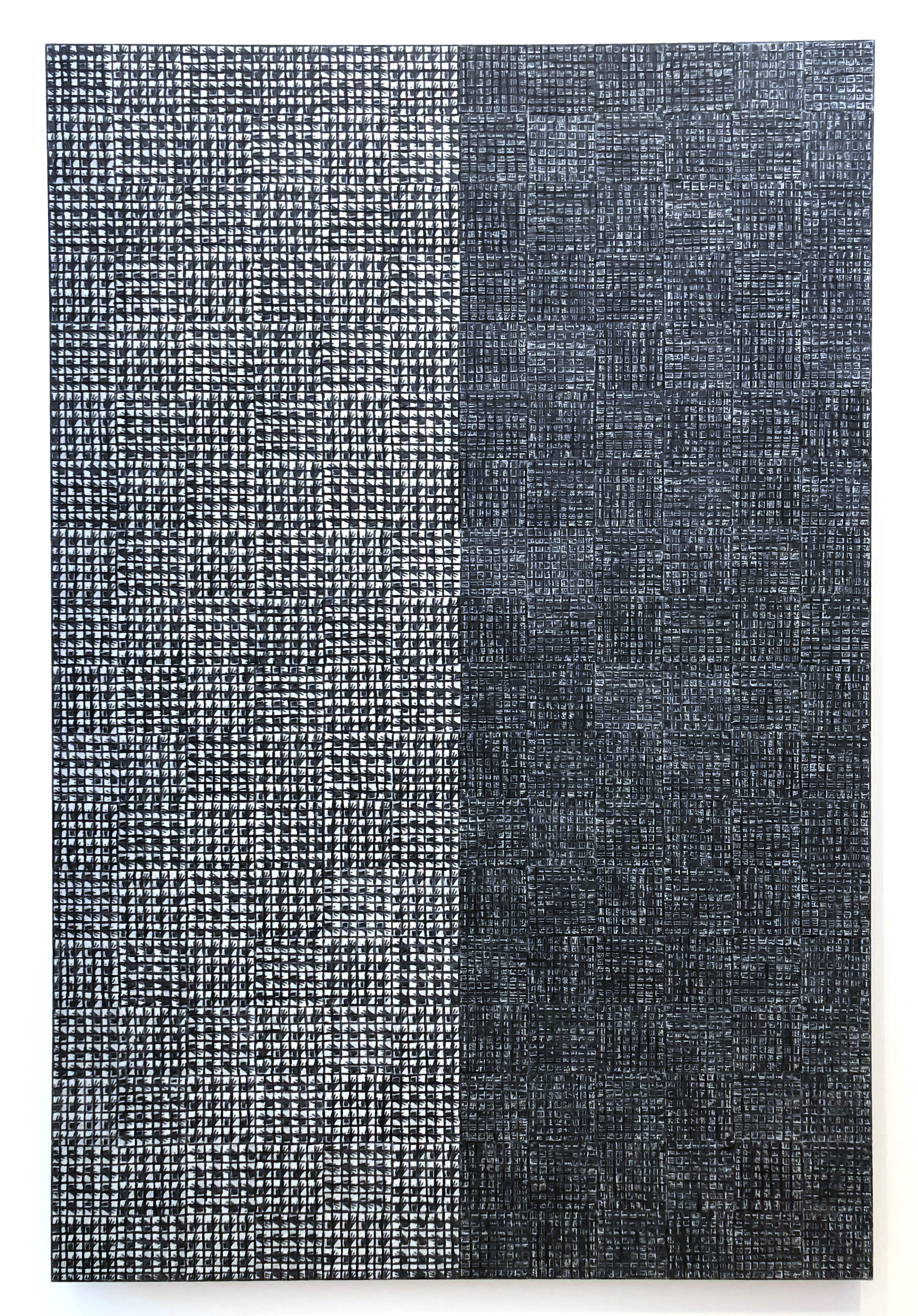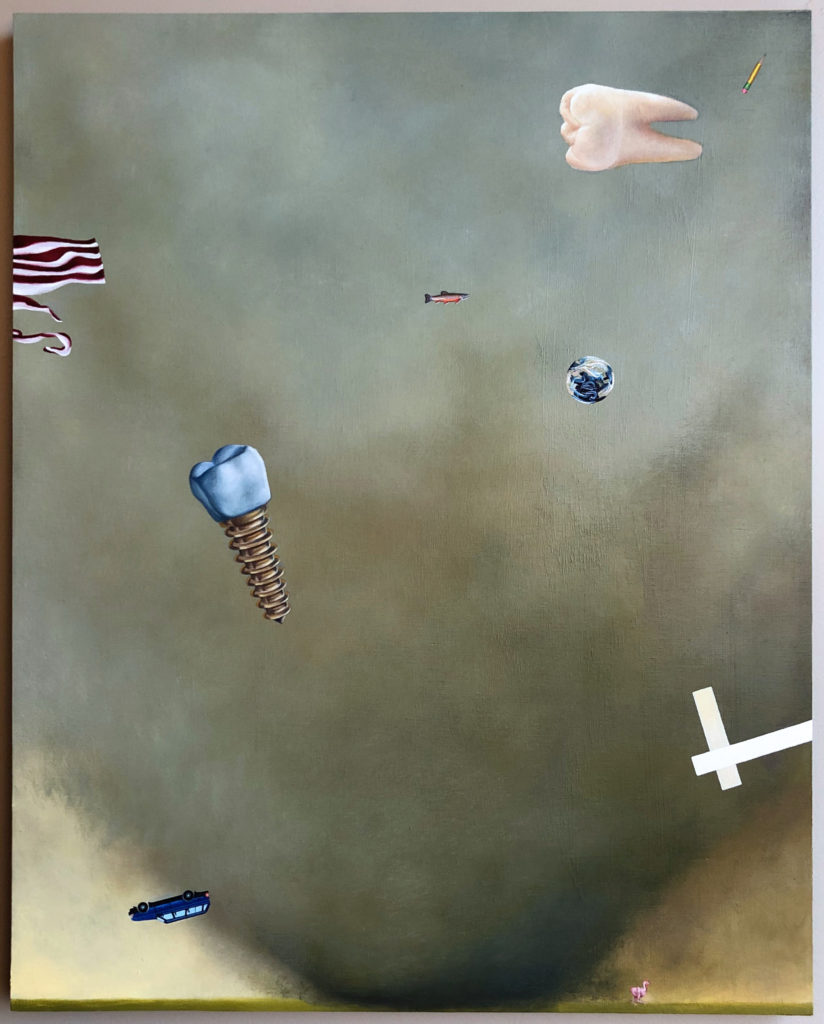
May 282018
 

William Eggleston, Tennesee (image via Metropolitan Museum of Art)

There are two great photography exhibitions happening in New York. William Eggleston‘s Los Alamos, at The Metropolitan Museum of Art is comprised of seventy-five of his dye transfer prints from color negatives made between 1965 and 1974. The color in these images is incredible as is his ability to evoke feeling from work that is deceptive in its simplicity.  Enhancing the exhibition are a series of quotes from the artist located on various walls, which offer a glimpse into his process and philosophy.

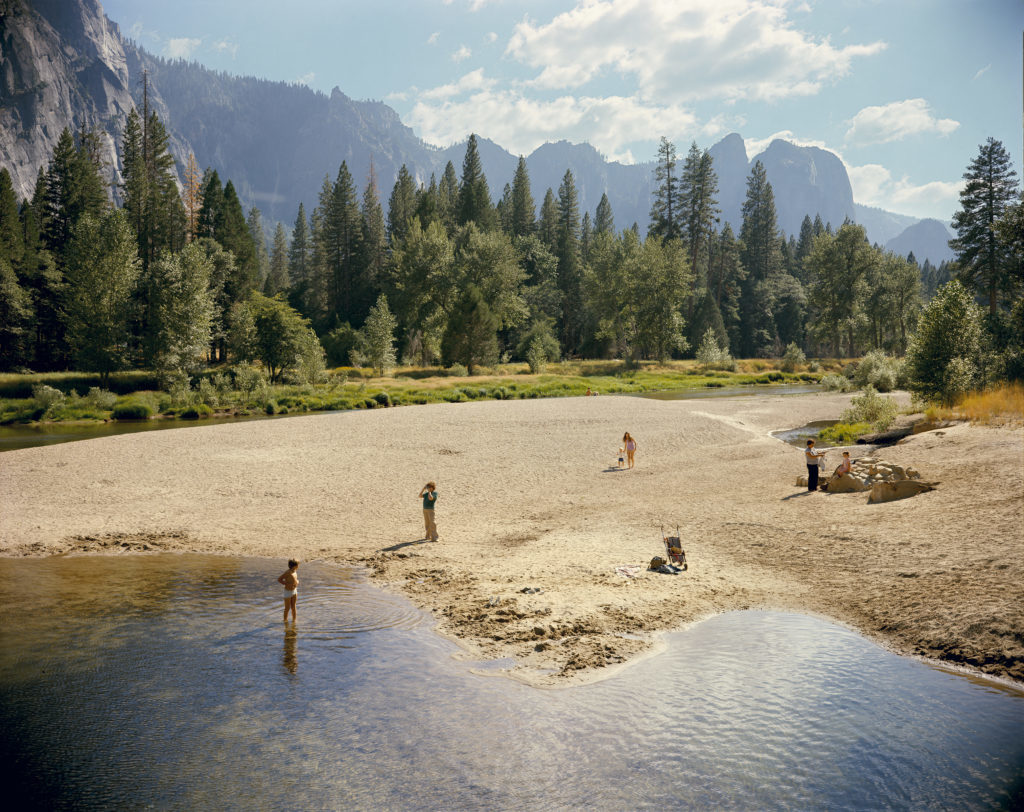
The Museum of Modern Art’s Stephen Shore exhibition includes work from his entire career- his start as a teenager meeting with Edward Steichen, time spent with Andy Warhol at The Factory, his large format images from around America, and finally his work in Israel and his current Instagram.  The body of work is impressive and where Eggleston’s work feels like it’s creating a dreamworld from the mundane, Shore’s work seems to present things as they are in true documentary form. Pictures of meals and hotel rooms force the viewer to look at things they usually take for granted in a new way. Not to say that there aren’t images like the large format work, that present an idealistic beauty.

Also included, and especially charming, are his stereographs- presented at a small table the images become three dimensional as you peer through the viewer.

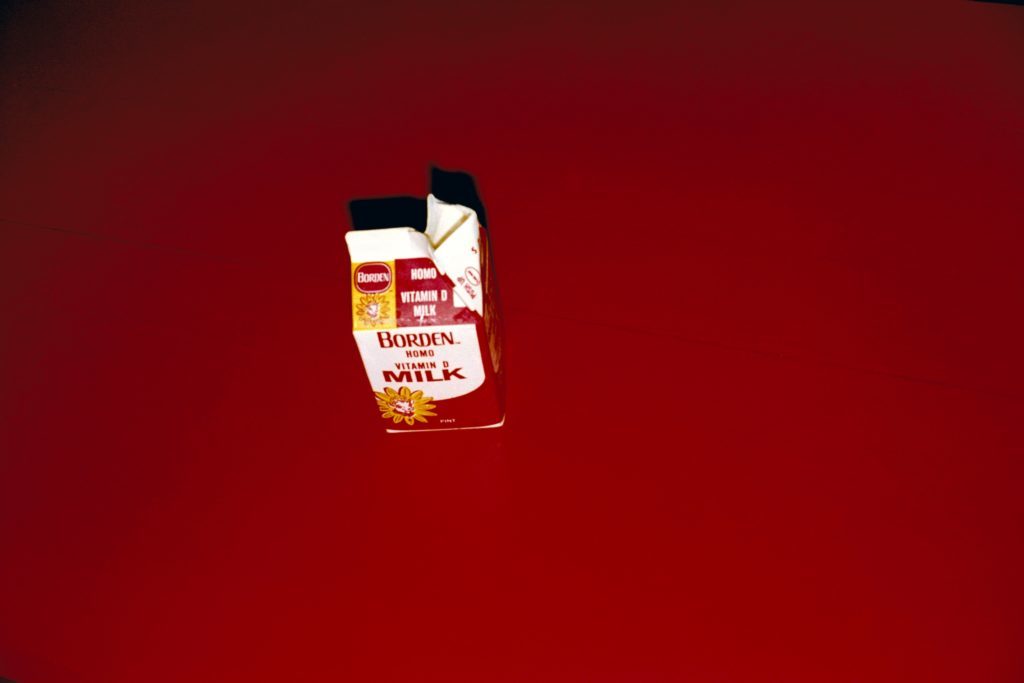
Stephen Shore, Amarillo, Texas, July 1972 (1972) Image courtesy 303 Gallery

Stephen Shore, Merced River, Yosemite National Park, California, August 13, 1979 1979. image courtesy of The Museum of Modern Art
Both of these exhibitions close 5/28/18.

Mar 242018
 

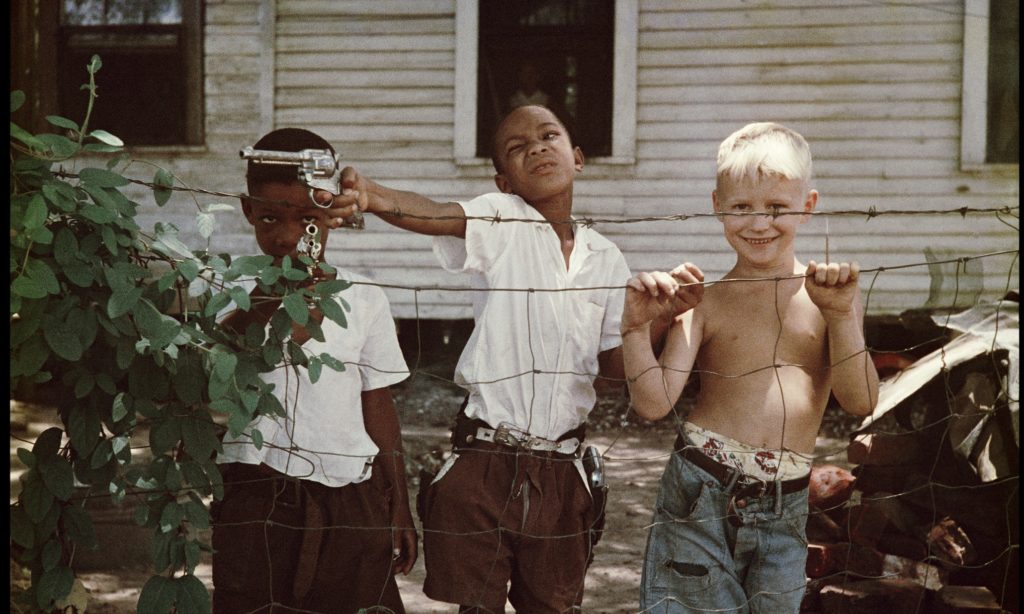
Gordon Parks, “Untitled”, Alabama (1956)

Gordon Parks was an incredible photographer whose influence continues to be felt in photography today. He had a long creative career that also expanded beyond photography to include writing several books, composing music, and directing films- the most famous being Shaft.

The Gordon Parks Foundation recently hosted the exhibition ELEMENT, which focused on several of the photographs that inspired Kendrick Lamar’s video from his album DAMN, seen below. The photo pictured above can be seen as part of the exhibition of Gordon Parks’ work I Am You Part 2 at Jack Shainman Gallery in New York. It is from his series Segregation Story for Life magazine which focused on the daily lives of three black families in Alabama in 1956.

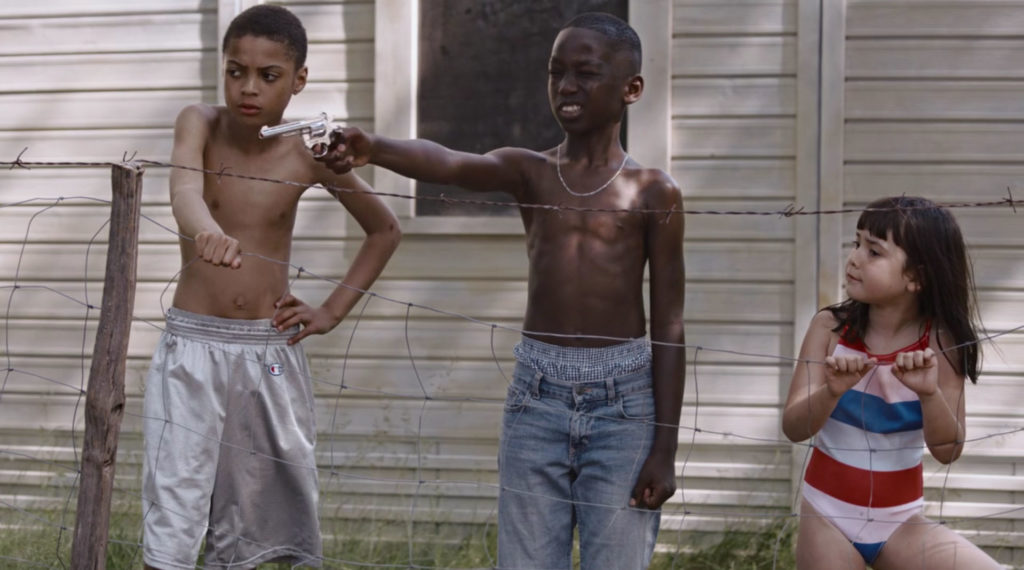
The photo below is a still from Kendrick Lamar’s Element. The video was directed by Jonas Lindstroem and The Little Homies (Kendrick Lamar and Dave Free).

To see more of Parks’ work and the work he has influenced, The Gordon Parks Foundation’s website is a good resource for upcoming exhibitions around the world.

Mar 082018
 

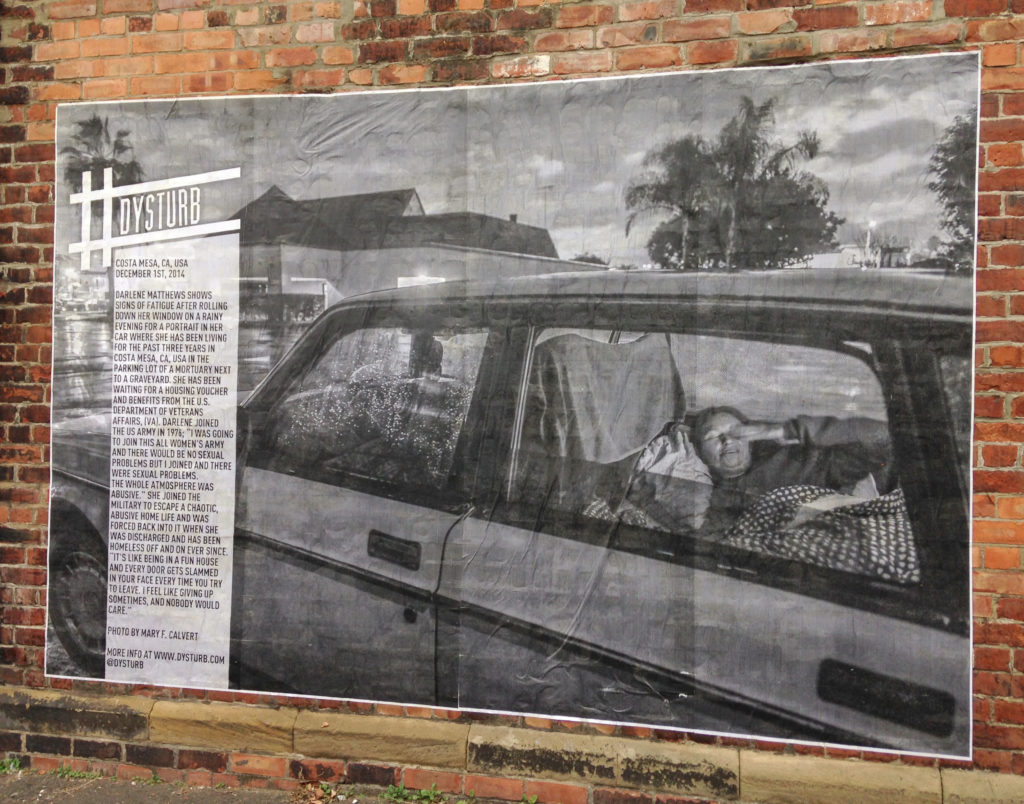
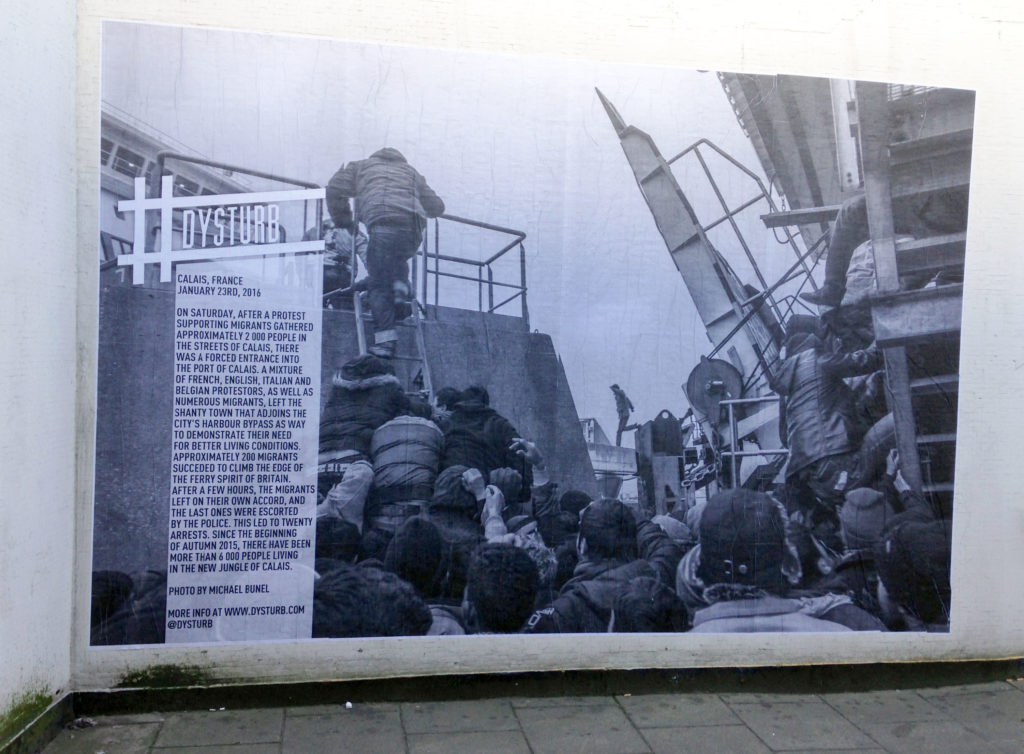
#Dysturb is a group of photojournalists who paste large-size posters in cities around the world, focusing on under-reported stories with the intention of getting this information to a wider audience. In addition to their public projects, they also have a quarterly print journal.

I first saw their work in Newcastle, UK (pictured above) as part of The Newbridge Project’s Hidden Civil War, a month of programming by various artists around the city in October of 2016.

#Dysturb’s current project is #WomenMatter, focusing on the fight against all types of violence against women. On International Women’s Day 2018, the group will be celebrating their fourth anniversary with a free discussion of this project, as well as their other work and the role of paste-up campaigns in contemporary documentary practice at ICP Museum in NYC.

Oct 202017
 

                                                            Fanon (Even the Dead Are Not Safe) 2017 (image via Metro Pictures)

Artificial intelligence is a growing field with numerous implications for the future, some more sinister than others. Trevor Paglen’s current exhibition at Metro Pictures gives some insight into this evolving technology.

From the Metro Pictures press release-

Trevor Paglen’s A Study of Invisible Images is the first exhibition of works to emerge from his ongoing research into computer vision, artificial intelligence (AI) and the changing status of images. This body of work has formed over years of collaboration with software developers and computer scientists and as an artist-in-residence at Stanford University. The resulting prints and moving images reveal a proliferating and otherwise imperceptible category of “invisible images” characteristic of computer vision.

Paglen’s exhibition focuses on three distinct kinds of invisible images: training libraries, machine-readable landscapes, and images made by computers for themselves. For Machine-Readable Hito, for example, Paglen took hundreds of images of artist Hito Steyerl and subjected them to various facial recognition algorithms. This portrait of Steyerl presents the images alongside metadata indicating the age, gender, emotional state and other signifiers that the algorithms have interpreted from the images. In another portrait in the show, Paglen trained facial recognition software to read the face of philosopher Frantz Fanon. A ghostly image of Fanon shows the facial signature–the unique qualities of a face as determined by biometric recognition software–used by computer vision to identify an individual.

To make the prints in Adversarially Evolved Hallucinations, Paglen trained an AI to recognize images associated with taxonomies such as omens and portents, monsters, and dreams. A second AI worked in tandem with the first to generate the eerie, beautiful images that speak to the exuberant promises and dark undercurrents characterizing our increasingly automated world.

The video installation Behold These Glorious Times! brings together hundreds of thousands of training images routinely used for standardized computer vision experiments and pairs them with visual representations of an AI learning to recognize the objects, faces, expressions and actions. A loose narrative begins to emerge about the collapsing distinctions between humans, machines and nature. Electronic musician Holly Herndon composed a soundtrack using libraries of voices created to teach AI networks how to recognize speech and other acoustic phenomena.

The image below is one of the prints from Adversarially Evolved Hallucinations. A series of these images, presented all in one room in the back gallery, are particularly unsettling as they have elements that seem familiar while remaining distorted. As artworks, they are captivating in their strangeness as well as their beauty.

                                                                Porn (Corpus: The Humans) 2017 (image via Metro Pictures)
The exhibition also has a printout with more detail about the creation of the work that goes beyond the press release, located at the front of the gallery. Make sure to leave time to take in this fascinating show. A Study of Invisible Images closes 10/21/17.

May 202017
 

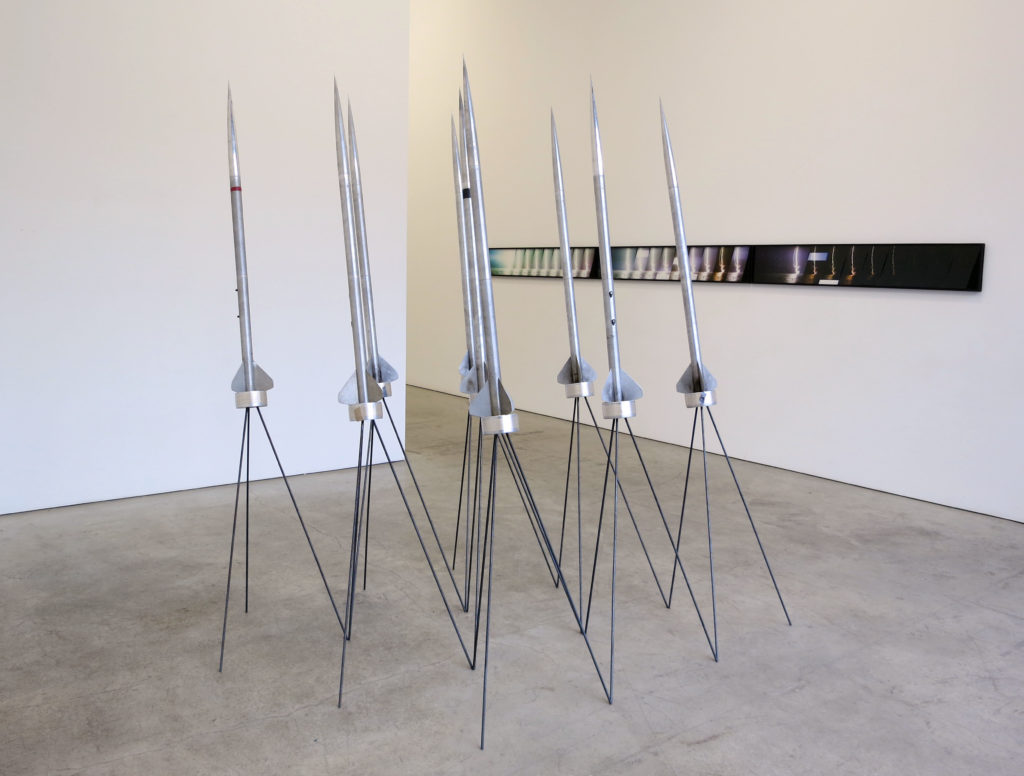
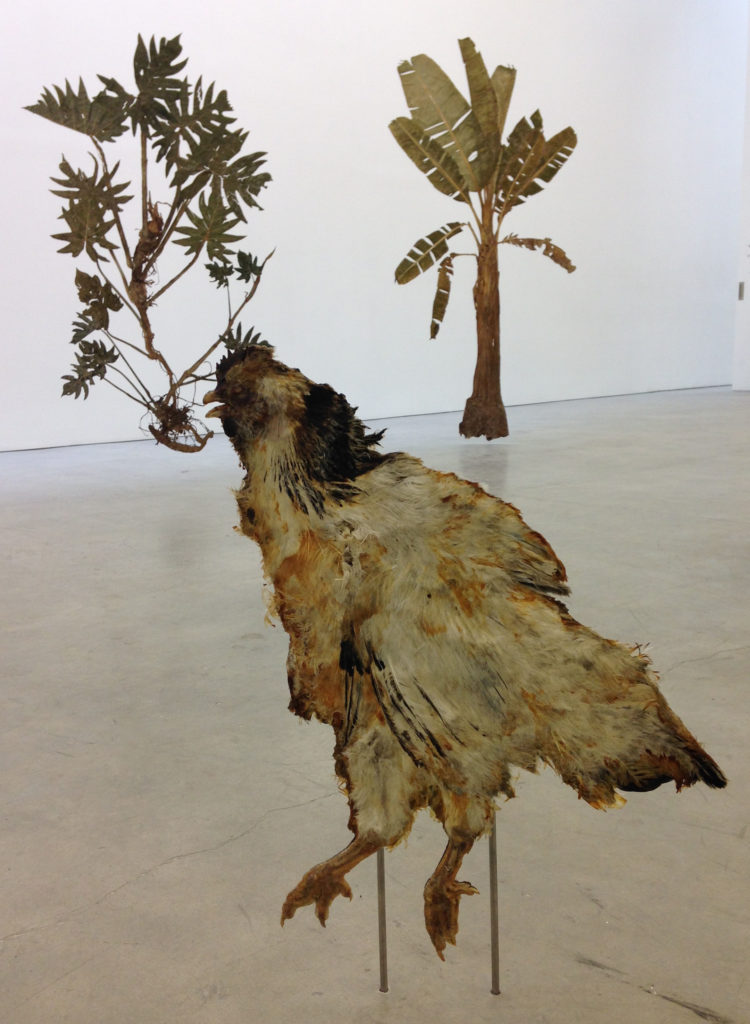
Julius von Bismarck’s Good Weather at Marlborough Contemporary is an interesting meditation on man’s desire to control nature. The first half of the exhibition focuses on Bismarck’s attempts to capture a lightning bolt with the rockets pictured above. In a side room there is a mesmerizing video of a storm rolling into a jungle and the lightning that he used for his experiment. The second half of the gallery focuses on pressed plant species and chickens.

In the press release his process for achieving these flattened works is described in detail-

Like a Colonial scientist, von Bismarck has collected plant species from jungle. Rather than pressing tiny flowers in a notebook, the artist has pressed large plants and entire palm trees into flattened specimens. Heated to a precise 250 degrees in an enormous custom-built oven and a 50-ton hydraulic press, the plants are completely dehydrated without losing their verdant coloration, and squashed astonishingly flat. They are then backed with thin stainless steel to maintain their shape for presentation.

This exhibition closes 5/20/17.

                                                                                       No title (room, panic doors), 2013-14

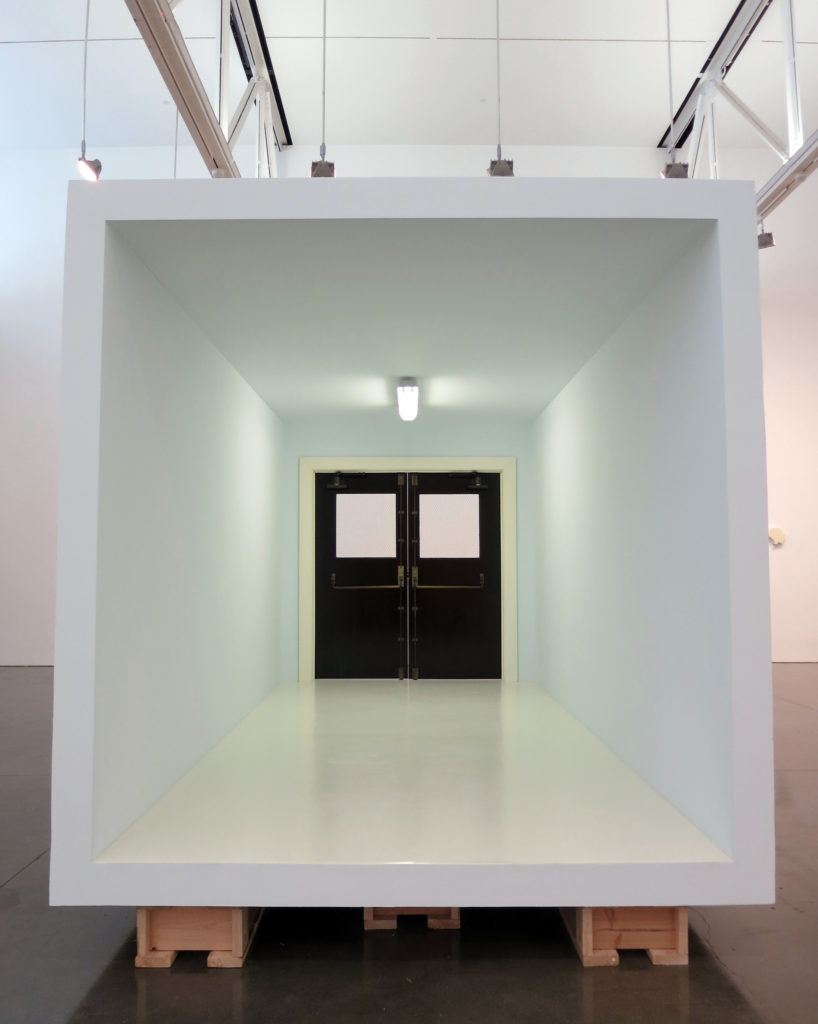
At Gagosian gallery is Robert Therrien‘s first show in New York in ten years. The artist, well known for his sculptures of massive tables, chairs and plates, is now creating rooms and new objects- which include drops, a bow, and a flagpole. The rooms are the works that stand out most, both in scale and in the disconcerting feeling of environments that should feel more normal than they do.

From the press release-

Despite their verisimilitude, Therrien’s rooms impede the viewer’s ability to engage with space in any comfortable way.  Meticulously assembled features of common industrial design allow one to stand in front of architectural vistas. Elevated above ground level and cut away to show interiors that, like dioramas, become impenetrable replicas of reality, each is like a mise-en-scène or readymade. No title (room, panic doors) (2013–14) presents a set of doors in a room filled with fluorescent light. In No title (paneled room) (2017), tambourines rest silent on the floor of a room luxuriously paneled in hardwood, and a ladder leads to a trapdoor in the ceiling. Each room transports the viewer out of the gallery and into a new narrative situation, prompting connections between material details and their subconscious associations. By making use of everyday things that are often overlooked, Therrien situates the viewer in familiar territory, then allows the objects to demand reassessment as instruments of subjectivity and of consciousness itself.

This exhibition closes 5/26/17.

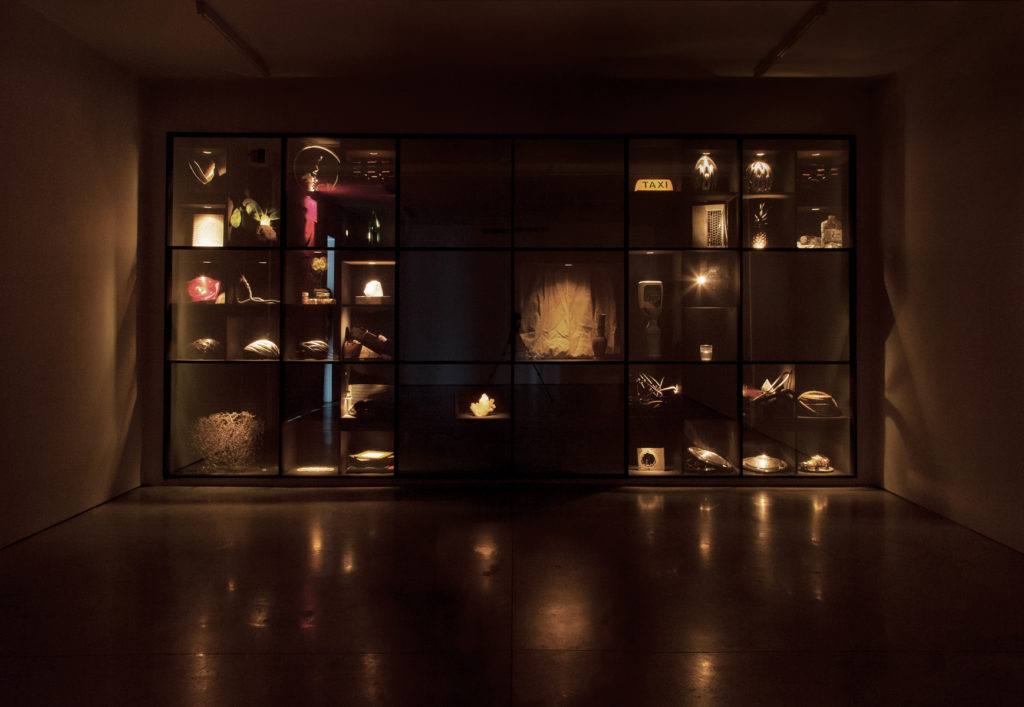
For a room of a different sort, there is Gabriel Lester’s Nevada at Ryan Lee gallery, in which various sections of a wall sized installation light up as assorted voices tell their stories.

                                                                                        Nevada, 2017 (image courtesy of Ryan Lee)

From the press release-

Questions of presence and absence resurface in Nevada, the second component of this exhibition. Nevada confronts the viewer with a floor to ceiling modular wall. Carefully selected objects that correspond with the individual stories combined in Nevada’s multilayered narrative occupy each compartment. Guided by light and sound, the viewer navigates the histories of a series of anonymous characters that find themselves locked out of the world they used to inhabit. In an effort to escape the parallel world in which they have come to dwell, each character attempts to understand the nature and cause of their own existence. Considering personal memories and local histories of migration, mining, gambling, nuclear test sites, and mysterious locations like Area 51 and the Nevada triangle (an area in the California-Nevada desert where numerous aircrafts have vanished), Lester’s Nevada probes the tensions that link the seemingly distinct characteristics of this place to a number of characters looking for a way back to a life they have lost.

The exhibition opens onto a room of low-resolution LED panels showing internet-sourced images of near extinct animals and their habitats. The two rooms feel like separate exhibitions but are brought together by their shared qualities of losing one’s place in the current world.

This show runs until 5/20/17.

Mar 042017
 

                                                                         (above work by Sandra Low, Steve Seleska, and Amy Kaps)

Currently at Walter Maciel Gallery is With Liberty and Justice for Some, for which the gallery invited artists from across the country to do 8×8 inch portraits of individuals who came to the United States as immigrants- including historic subjects, personal friends, relatives, strangers, and sometimes self portraits. The gallery is also donating a portion of each sale to various non-profit groups including ACLU, Planned Parenthood, The Trevor Project, Center for Reproductive Rights, and the LA and SF LGBT Centers. Also showing at the gallery is I.D. Please!, with works by artists Hung Liu, John Bankston, Lezley Saar, John Jurayi, Maria E. Piñeres, Nike Schröder, Dana Weiser and Monica Lundy, who have all developed studio practices based around notions of identity.

This exhibition closes 3/4/17.

Also closing this weekend in Culver City-

Egan Frantz‘s The Oat Paintings at Roberts & Tilton

(image above via Roberts & Tilton)

And at Kopeikin Gallery are Ardeshir Tabrizi‘s Observations in Linear Time (palm tree), and Jason Engelund‘s Meta-Landscapes and Visual Ambient Drones (blue).

Ardeshir Tabrizi

Jason Engelund

(images via Kopeikin)

Feb 182017
 

For Cory Arcangel and Olia Lialina’s exhibition at The Kitchen, Asymmetrical Response, the early days of the internet come to life in various artworks. The carpet is made of a diamond plate pattern that used to be a common background on 1990s websites and the wallpaper uses patterns from early Yahoo templates. One of the most interesting pieces is Lialina’s Give me time/This page is no more, a slide projection of former popular hosting site Geocities’ members home pages that promise a site they will create or come back to in the future. It’s hard not to look at these pages and wonder how soon what we are seeing now on the web will seem as antiquated as these images.

From the press release-

In military parlance, the terms asymmetrical and symmetrical are employed to refer to political provocations and diplomatic démarches, escalation and tension, and power dynamics of the highest order. Not specific to war, these terms also refer more generally to a set of relations that define our connections to power.

On the eve of Y2K, Russian­-born Olia Lialina—who is among the best-known participants in the 1990s net.art scene—first met American artist Cory Arcangel. Ever since, the artists have been deep in dialogue about the social and cultural impact of the Internet’s historical shift from a tool for military communication to an “information superhighway” promising open and equal exchange, and, finally, the increasingly asymmetric “content delivery system” we experience today.

This show closes 2/18/17.

Feb 112017
 

                                         Jonathan HorowitzDoes she have a good body? No. Does she have a fat ass? Absolutely. 2016

For their current exhibition, Petzel Gallery decided to focus on the issues raised by the recent election by having a group show related to that theme. In addition they are encouraging visitors to “write down their reactions, thoughts, anxieties, hopes for the future.”

There is a lot of great work in the show by a long list of artists that includes Barbara Kruger, Robert Longo, Glenn Ligon, Jenny Holzer, Charles Gaines and Sam Durant.  Although it can be exhausting these days to follow politics, it is encouraging to see creative expression thriving in the midst of the chaos.

Dec 222016
 

terrywintersatmatthewmarks

terrywintersyellowmatthewmarks

To keep these posts a little shorter, I have split them up into two parts. The following continues the list of Chelsea exhibitions-

Terry Winters‘ vibrant paintings at Matthew Marks Gallery are made up of layers of marks in oil, resin, and wax.

From the press release-

“These recent paintings are a series of accumulations,” Winters says. “There’s a range of paint application in terms of both material and technique. Each color is a marker, a stage of development. I’m moving across the surface, modulating the material in different ways. That inflection produces an amplification of colors, both physical and chemical. But color is basically wild and full of surprises.”

padraigtimoneyatandrewkrepsgallery

Pádraig Timoney‘s work in The Deedle Eye, at Andrew Kreps Gallery, is a diverse combination of painting, photography, and installation.

From the press release-

Despite the visually distinct results, at the work’s core is a focused inquiry into the mechanics of images. Timoney conversely works in both directions – creating new images from abstractions (the captivating results of processes achieved in the studio), or rebuilding them part-by-part from photographs or observation. In each, he acknowledges the inherent flaws of these constructions, from the faultiness of recognition, the errors of translation, and further, the subjectivity of both viewers and the artist.

These in turn become generative openings in Timoney’s work as they are distanced from their original context. The images exist within thrilling, new visual constellations, allowing for the introduction of artifice and illusion, and the question of not only what they depict, but why? Each work records an index of decisions that determine its final state, materially and cognitively, displaying a history that is intentionally left open-ended. Figuration appears to hover only a hair away from abstraction, as if the movement of a line would cause one to collapse into the other. The narrowing of this gap suggests that the works’ initial disparate appearance may lead to an alternate understanding of their connections; a net that widens only to close anew, though what’s caught within it is left for the viewer to decide.

Also make sure to go to the space next door to see Klaus Weber’s sculpture Emergency Blanket.

klausweberatandrewkreps

Ai Weiwei has four shows up in NYC right now. Two of which are in Chelsea, at Mary Boone Gallery and Lisson Gallery, one is at the Mary Boone Gallery uptown, and one is at Deitch Projects in SoHo. Mary Boone Gallery and Lisson are both showing Weiwei’s Roots and Branches work, which includes large scale sections of dead trees, sometimes like the one seen below in cast iron at Lisson, and a 25 foot sculpture made up of tree parts bolted together. The uptown gallery includes a circle made up of 40,000 spouts broken off from Chinese teapots. Deitch Projects gallery has Laundromat, in which Weiwei has arranged items of clothing left behind by Syrian refugees (after they were forced to leave camps near the border of Greece) that he collected and laundered.

aiweiweilissongallery

Dec 212016
 

42125_01_web3        Blue, 2016 (image via Matthew Marks Gallery)

42166_01_web3 The dead baby boy USA, Berlin, December 2015 / Shadow of baby, Berlin, December 2015 (image via Matthew Marks Gallery)

41994_01_web3-1Motherlove: Ayla and Tjioe in a Berlin bar, New York, June 2016 (image via Matthew Marks Gallery)

Nan Goldin currently has two exhibitions in New York City. The Museum of Modern Art is showing The Ballad of Sexual Dependency, a slide show of almost 700 images Goldin took documenting her life and the lives of those around her, starting in the 1970’s and continuing through 2004. The show has taken place in various iterations throughout the years and includes a soundtrack with music from The Velvet Underground and James Brown among others. While it plays you watch the people in these images party, fight, get married, have children, and sometimes, like Goldin’s good friend Cookie Mueller, die, all in a span of about 45 minutes. It’s hard to see these photos and not be left wanting to know more as you are drawn into this intimate world.  This exhibition runs until 2/12/17.

It’s interesting to see the work at MoMA and then to see Nan Goldin:blood on my hands, at Matthew Marks Gallery. It is the first public exhibition of her drawings as well as her new “grid” photos. The small drawings come from diaries Goldin has been keeping since childhood. They are often disturbing but the content adds insight into the personal life and thoughts of someone who has already shared so much. You can also see parallels in the drawings and her photo work, in terms of both content and style.

The photos in the exhibition are large pieces, each created around a specific color, and each taking up a wall in the gallery. The images that combine to make them are from different places and time periods and yet they flow as if they were always meant to be arranged with each other. The results are more contemplative then her other work and an interesting progression.  This show closes 12/23/16.