Feb 202020
 

Closing 2/22/20 at David Zwirner’s 20th Street location in New York is Stan Douglas’s fascinating video installation Doppelgänger. It is also on view at view at Victoria Miro Gallery in London.

From the press release

Since the late 1980s, Douglas has created films and photographs—and more recently theater productions and other multidisciplinary projects—that investigate the parameters of their mediums. His ongoing inquiry into technology’s role in image-making, and how those mediations infiltrate and shape collective memory, has resulted in works that are at once specific in their historical and cultural references and broadly accessible.

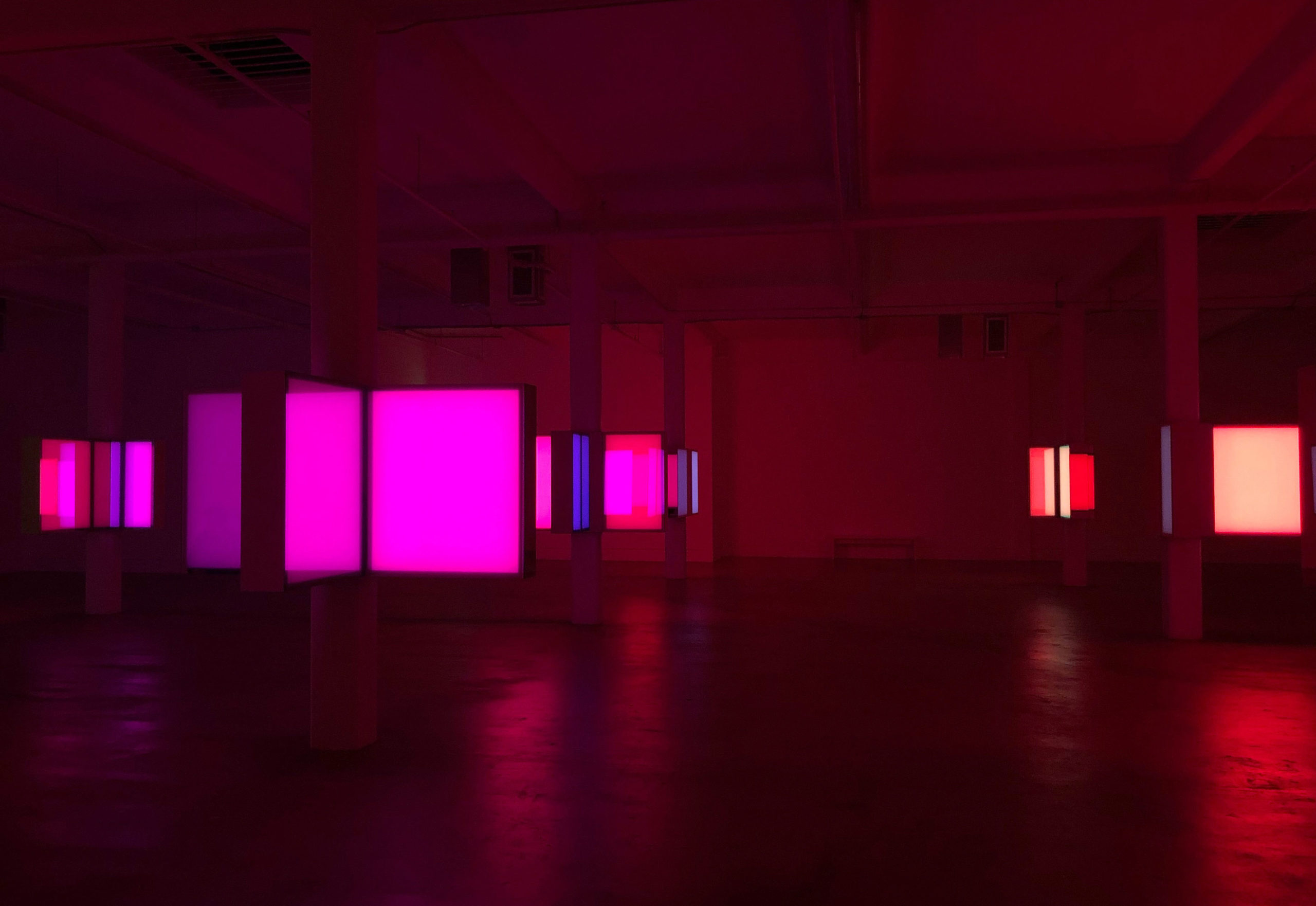
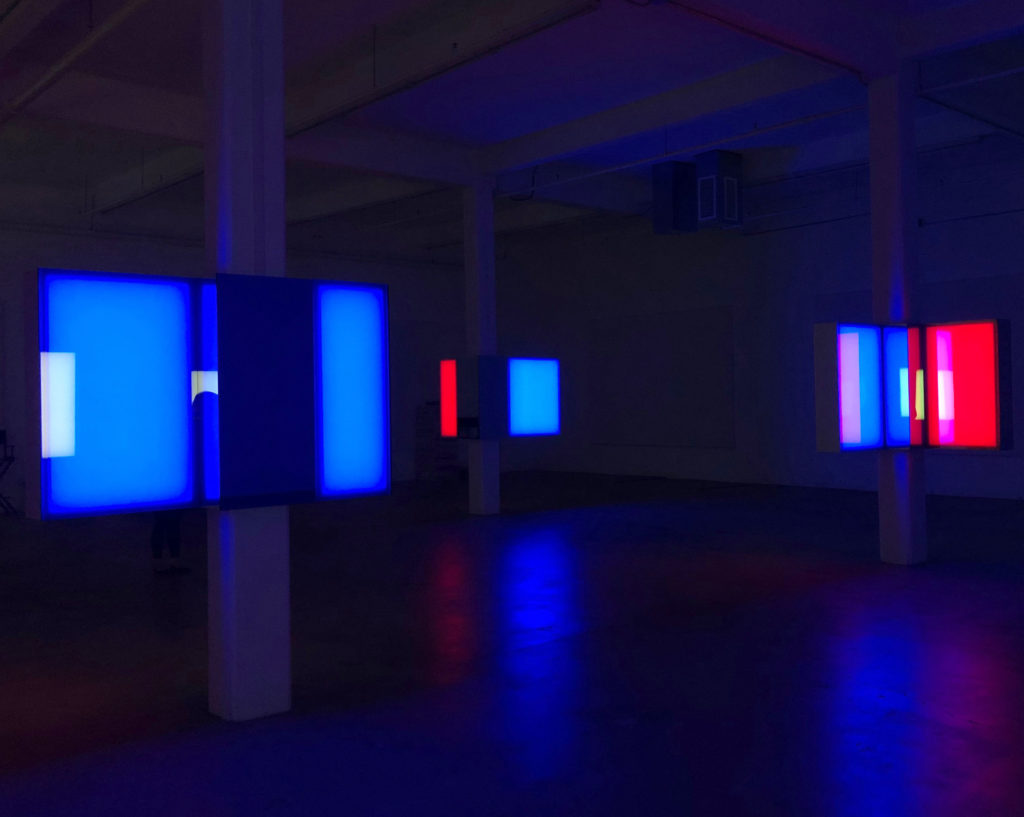
Doppelgänger is set in an alternative present. Displayed on two square-format, translucent screens, each of which can be viewed from both sides, the looped narrative unfolds in side-by-side vignettes that depict events on worlds that are light years apart. When one spacecraft embarks on its journey, another is launched at the same time in a parallel reality. Alice, a solitary astronaut, is teleported to a distant planet, and her double to another. Then, Alice and her ship, the Hermes II, for unknown reasons, return. Alice assumes her mission has failed and she has somehow returned home, but she has, in fact, arrived at a world where everything, from writing to the rotation of the sun, is literally the reverse of what she once knew.

The action on the two screens proceeds alternately in tandem and in parallel, seamlessly moving between two oppositional scenarios of Alice’s reception back on Earth. In one version, Alice is received compassionately and welcomed home, whereas in the other, she is treated as an outlaw or a potential threat. Douglas intentionally heightens the viewer’s feeling of displacement through a continual sense of reversal and mirroring, both in the form and content of his installation. Since the early 1990s, multi-channel video installations have been an integral part of Douglas’s practice, allowing for the simultaneous presentation of multiple, overlapping narratives or vantage points, and with Doppelgänger, he extends his ongoing exploration of both nonlinear narratives and alternate histories: the omnipresent sense of doubling that is built into the structure of the work implicitly suggests the possibility of simultaneous, diverging experiences and realities.

Intercut with quasi-abstract passages of color and light, which nod both to avant-garde cinema as well as the history of space exploration, Doppelgänger presents a nuanced and layered parable that powerfully addresses the slippery notion of objective truth, and the position of the “other” in contemporary society.


Feb 142020


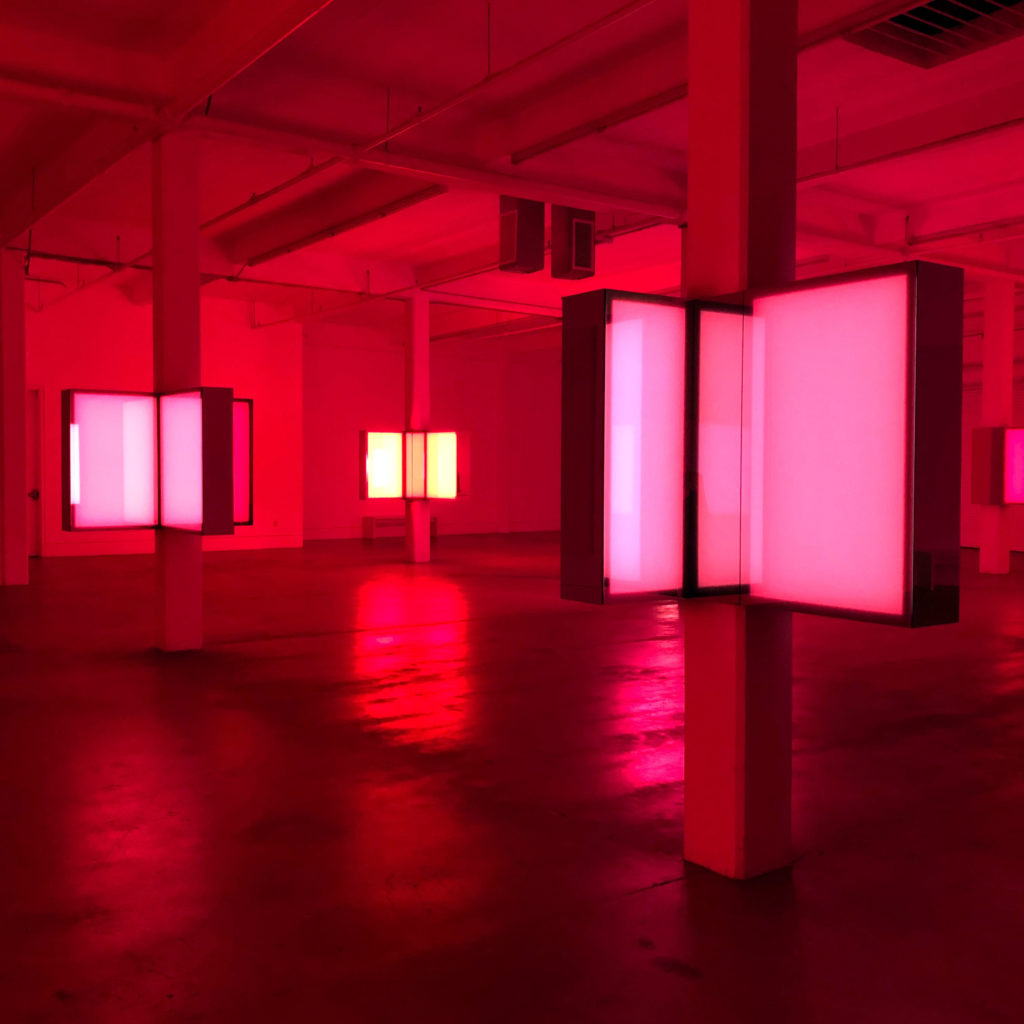
For Bridge Projects inaugural exhibition at their location in Hollywood they are showing Phillip K. Smith III’s 10 Columns, an immersive light installation created specifically for the space. Watching the colors fade in and out as you stand, sit, or walk around the sculptures is a wonderfully meditative experience.

From the press release-

The faceted surface of the San Bernardino mountains and surrounding desert both frame Smith’s studio and inform his practice; perpetually shifting light and color refracting across the landscape inspires the artist’s exploration into phenomenology, optical theories, and color. As a result, change has become fundamental to the experience of his work. Through the use of reflective, geometric forms just larger than human scale, Smith has distilled something as monumental as a sunset to an intimate encounter.

Commissioned for the inaugural exhibition of Bridge Projects, 10 Columns features Smith’s signature mirrored surfaces and dynamic light program. Expanding on past site-specific installations, the artist adjoined mirrored rectilinear forms to the colonnades of Bridge Projects’ site at Santa Monica Blvd and Highland creating an architecture inside the existing one. The modular structure consists of thirty forms of equal heights and three distinct widths, adhering to the ten concrete columns in unique combinations of 90 and 180 degree angles that shift between aligning with and disrupting the grid of columns. The forms are animated by Smith’s patented light program. As the surfaces emit gradations of light and color, the dimensions and experience of the room shift and blur, evoking the changes of light in the Los Angeles atmosphere throughout the day. Recalling both LA’s Light and Space movement and ancient cosmologies, light is a resonant image for the beginning of Bridge Projects.

This exhibition closes this weekend (2/16) and the gallery is having programming on Saturday and Sunday that includes a soundscape featuring “Watermusic II” by William Basinski, a relaxation workshop, and a tea tasting.


Jan 242020
 

Sadie Barnette’s recreation of her father Rodney Barnette’s bar, Eagle Creek Saloon for The New Eagle Creek Saloon at ICA LA is not only beautiful, but it also celebrates an important piece of history.

From the museum’s website-

For her first solo museum presentation in Los Angeles, Oakland-based artist Sadie Barnette (b. 1984) will reimagine the Eagle Creek Saloon, the first black-owned gay bar in San Francisco, established by the artist’s father Rodney Barnette, founder of the Compton, CA chapter of the Black Panther Party. From 1990–93 Barnette’s father operated the bar and offered a safe space for the multiracial LGBTQ community who were marginalized at other social spaces throughout the city at that time.

Barnette engages the aesthetics of Minimalism and Conceptualism through an idiosyncratic use of text, decoration, photographs, and found objects that approach the speculative and otherworldly. Barnette’s recent drawings, sculptures, and installations have incorporated the 500-page FBI surveillance file kept on her father and references to West Coast funk and hip-hop culture to consider the historical and present-day dynamics of race, gender, and politics in the United States. Using materials such as spray paint, crystals, and glitter, she transforms the bureaucratic remnants from a dark chapter in American history into vibrant celebrations of personal, familial, and cultural histories and visual acts of resistance. The New Eagle Creek Saloon is a glittering bar installation that exists somewhere between a monument and an altar, at once archiving the past and providing space for potential actions.

The museum is also showing No Wrong Holes: Thirty Years of Nayland Blake (pictured below).

From the museum’s website-

For over 30 years, artist, educator, and curator Nayland Blake (b. 1960) has been a critical figure in American art, working between sculpture, drawing, performance, and video. No Wrong Holes marks the most comprehensive survey of Blake’s work to date and their first solo institutional presentation in Los Angeles.

Heavily inspired by feminist and queer liberation movements, and subcultures ranging from punk to kink, Blake’s multidisciplinary practice considers the complexities of representation, particularly racial and gender identity; play and eroticism; and the subjective experience of desire, loss, and power. The artist’s sustained meditation on “passing” and duality as a queer, biracial (African American and white) person is grounded in post-minimalist and conceptual approaches made personal through an idiosyncratic array of materials (such as leather, medical equipment, and food) and the tropes of fairy tales and fantasy. Particular focus will be paid to work produced while Blake lived on the West Coast, first in the greater Los Angeles area as a graduate student at CalArts, followed by a decade in San Francisco—years bookended by the advancement of the HIV/AIDS epidemic in the 1980s and the “culture wars” of the 1990s.

Feeder 2, 1998

The gingerbread house, pictured above, is one of Blake’s best known works and was created using actual gingerbread. It references the fairy tale Hansel and Gretel as it recreates the house used to lure the children to their potential doom.

From the wall description-

Fairy tale and fantasy are themes to which the artist often returns as a mirror onto society and culture. Further, duality and the act of revealing are critical to Blake’s practice: as a biracial, white-passing, queer, gender non-binary person, Blake’s identity is one that is not obvious and is predicated on existing in two spaces at once. Though initially captivating through its inviting sight and scent, over time, the once-pleasant sensorial experience of Feeder 2, with its cold, empty interior, becomes overwhelming, even nauseating, as it challenges the truth of perception and association.

Both of these exhibitions close 1/26/20.

Nov 202019
 

Murals of La Jolla is a project started in 2010 by The Athenaeum and the La Jolla Community Foundation. It commissions artists to create work to be displayed on buildings around La Jolla. The works are on view for a minimum of two years (a map of current work here)

The above work, Tear Stains Be Gone, was created by Jean Lowe in 2015 and is still on view as of this writing in 2019 at 7661 Girard Avenue.


Nov 012019
 

Closing 11/2 at Tanya Bonakdar’s Los Angeles location is Ernesto Neto’s interactive exhibition Children of the Earth.

From the press release-

In Children of the Earth, Neto creates an alluring environment of color, materials, fragrances and sound, transforming the gallery into a living organism, where visitors are encouraged to wander, touch, feel, interact and connect.

Upon entering the gallery, a curtain in green and brown patterns invites the viewer to walk through a tunnel-like path which leads to the main gallery space. Entitled Children of the Earth, a large-scale installation of crochet, spices and leaves hangs from the ceiling to the floor. The large biomorphic shape—hand knitted in vibrant colors of yellows, greens, purples and reds—is flanged by drop-shaped crochet vines that serve as counterbalance and establish the delicate equilibrium of the piece. Here, references to nature interconnect with formal questions of tension, gravity and weight. On the floor, tracing the outline of the structure above, a soft surface of handmade textile is installed. Ceramic vases sprout from the ground, representing the diversity of peoples inhabiting the planet, and that ultimately, we are all the children of the earth. Musical instruments, spices, and crystals comprise an integral part of this malleable, highly tactile sculpture, which engages the five senses, and invites viewers to connect with one another in new and meaningful ways. In expanding the boundaries of physical space and calling for a new type of interaction, Neto creates an experience that is physical, sensorial, intellectual and social all at once.

Surrounding the piece, as another layer of skin, hand-sewn fabric hangs. The organic pattern and color pallet further recall the natural world, as they invoke the forest, wood grain, or the circulatory system of a plant. The path the visitor follows throughout the space, and from within the piece—like an organic line in nature—is analogues to Neto’s conception of life where there is “no separation between humans and nature, nor between art making and art experience”, highlighting that in the exhibition, as in life, everything is connected.

In the back gallery a hanging platform with a crochet canopy and crochet tendrils is installed. Designed for direct interaction, this is a healing bed that offers a moment of rest and respite, where people can connect to themselves, as to one another.  The tendrils function as ‘connectors’, as they amplify the pulse of life while connecting us to the environment and to our own physicality. Embracing the participant in its serenity, the healing bed investigates the meeting point of art, sensation, personal connection and the human body.

The exhibition as a whole connects mind, body and nature through a sensory experience that is unmediated. It is an invitation to connect to ourselves and to our planet at a time when connectivity is most needed. For Neto, sculpture is an extension of the body, and the body is ultimately an extension of earth.

Jul 252019
 

Lala Lala- Water Over Sex

Thing to do in Los Angeles this weekend (7/25-7/28/19)-

Thursday

Megan Thee Stallion, Rico Nasty, Blueface, Comethazine, Tierra Whack, DaBaby and more will be performing for the XXL Freshman 2019 Concert at The Novo

Justus Proffit and Outer Spaces are opening for Radiator Hospital at The Hi Hat

Hammer Museum’s free Summer Concert Series continues this week with a performance by The Tracks as well as KCRW DJs, food trucks and a cash bar

Skirball Cultural Center is free on Thursdays and this week there is a free sunset concert with marimba super-group Río Mira performing

Hollywood Night Market at Yamashiro is a lovely way to have some food and drinks while enjoying beautiful views of the city- free shuttles leave from the Mosaic parking lot


Friday

The Underground Museum’s Purple Garden Cinema is hosting FWD: Short Films. The free program, curated by MEMORY, will feature a range of work from emerging and established filmmakers.

Metro Art has a new program featuring LA based DJ collectives- Movements at Union Station. The first night in the series will feature The Soul Children, an LA based crew of artist, promoters and DJs. The event will also include a drop-in silkscreen stencil workshop led by Self Help Graphics & Art, a photo booth and food trucks.

B Boys are playing a free show at Hotel Figueroa with Bodega and Shark Toys

Golden Vessel is performing at El Cid with Instupendo and The Nicholas

The Music Center’s Dance DTLA, a night of free dance lessons and music ,continues this week with a disco theme

UCLA Film & Television Archive is screening an action film double feature of Sister Street Fighter and Lady Terminator, at Hammer Museum’s Billy Wilder Theater ($9)

Florist are playing at Pico Union Project with Hand Habits (solo)


Saturday

The Getty’s free concert series Off the 405 continues this week with Lala Lala

Bergamot Station is having a Summer Open House all day with live music, art openings, a book sale, art talk, food, drink, and more

The Box is screening Leigh Ledare’s The Task at 2pm with a conversation with the artist and Catherine Taft, director and curator at LAXART, to follow from 4:30-6:30pm

Morgan Delt is playing at the Lodge Room with Pearl Charles, Vinyl Williams, The Sunsettes, and Mad Alchemy Light Show

The Drums are playing at the Hollywood Palladium with CHAI

Smokescreens, Holy Tunics, and Susan are playing at The Monty Bar

UCLA Film & Television Archive is screening a double feature of the Paris-set films Funny Face and Paris Blues, at Hammer Museum’s Billy Wilder Theater ($9)

Latin American folk-rock group Aterciopelados are playing a free show at Pershing Square with Elefante opening


Sunday

To celebrate the opening weekend of The Invisible Man and the Masque of Blackness, Zak Ové’s sculptural installation, LACMA is hosting an afternoon of art, music, which will include a discussion with Ové. A performance by Trinidad Steel Drum Band begins at 4 pm, followed by a conversation with Ové at 5 pm. (free)

Independent Shakespeare Co. is having a free performance of the play Pericles in Griffith Park tonight (also Saturday)

Shutups, Weird Night, Launcher, Slaughterhouse, and Shitgiver are all performing at The Rec Center

Cam’ron is playing a $5 show at The Novo

Johanna Samuels and Dylan Rodrigue are opening for Lou Roy at the Bootleg Theater


All Weekend

OUTFEST Los Angeles LGBTQ Film Festival continues in various locations with screenings that include shorts and television episodes. This weekend some of the screenings will be at the outdoor Ford Theatre including- the Kathy Griffin documentary, with Griffin in conversation with Louis Virtel pre-screening on Thursday, and the documentary Gay Chorus Deep South on Friday which includes a performance by the San Francisco Gay Men’s Chorus.

May 242019
 

Wendy White’s exhibition Racetrack Playa, at Shulamit Nazarian, is a very American show. Her collages of old car ads ,and their often blatant sexism, combined with the use of denim as a sculptural medium, play with the iconography of America’s past to force us to think about America today. How do you reconcile a love of the open road and exploring natural landscapes with the environmental destruction caused by using cars fueled with oil to get there? How much of the past perception of women as objects still informs thinking today? Will America get out of its wood paneled basement to move into a better place- or will its longing for the past continue to slow its progress?

From the press release-

Shulamit Nazarian is pleased to announce representation of New York-based artist Wendy White. The artist’s first solo exhibition in Los Angeles, Racetrack Playa, will feature new paintings, sculptures, pigment prints, and a site-specific installation.

The exhibition takes its name from a three-mile dry lakebed in Death Valley National Park where sliding rocks or “sailing stones” have inscribed mysterious linear imprints on the landscape. Using this scarred landscape as a metaphor for our current times, the works in Racetrack Playa explore power, entitlement, and imperialism via the aesthetics and evolution of American car culture.

In pieces that function as both homage and critique, White collapses signs of racing and car culture with references to 20th-century American painting. Multiple-canvas works such as Posi Track and Burnout (both 2019) take cues from James Rosenquist’s famous Vietnam War-era painting F-111 (1964–65). In White’s versions, images of mangled engines, worn tire treads, and damaged landscapes suggest a trampling of both philosophical ideals and the natural environment. In addition, the works make reference to Andy Warhol’s Death and Disasters series and Jackson Pollock’s drip paintings.

The exhibition also includes new works from the artist’s ongoing Jeans series. These pieces make use of worn denim, a quintessentially American fabric associated with labor and a sense of rugged individualism. Co-opting the material and its cultural connotations as a substrate for painting, White makes marks with dripped and splattered bleach before garnishing each piece with flat cut-out rainbows, beer bottles, and energy drinks.

A site-specific installation complete with wood paneled walls, carpet, and one of White’s signature denim sofas creates a quasi-automotive shop backdrop for a new suite of unique pigment prints. Carving directly into the paneling, White references the DIY aesthetic of the 70s muscle car era by way of hand-drawn symbols, slogans and logos.

Taken together, the works in Racetrack Playa riff on the visual cues of car culture, the resilient materiality of denim, and the sexiness of commercial graphics to examine a society long drawn to speed and dominance. Reexamining this typically male-dominated arena, White pushes back on advertising’s false promise that perhaps all of your desires are for the taking, if you just smoke the right cigarettes and drive the right car.

This exhibition closes 5/25/19.

Feb 252019


Currently outside of LACMA’s Ahmanson Building is one of artist Sam Durant’s “electric signs”. It takes its text from a photo taken at the 1963 March on Washington for Jobs and Freedom where Martin Luther King, Jr. delivered his “I Have A Dream” speech.

May 202017
 

                                                                         My Madinah. In pursuit of my ermitage…, 2004

Jason Rhoades Installations, 1994-2006 at Hauser & Wirth is a lot of show. It’s a big exhibition with several rooms packed with things. Many, many things. In one room numerous neon expressions for female genitalia hang over a mosque-like environment (above), and in another over countless tourist novelties, bare mattresses, and truck nuts (pictured below).

The earlier work, like My Brother/Brancusi, which was created for the 1995 Whitney Biennial, feels a bit stronger, or at least less controversial.  Photos of Brancusi’s studio and Rhoades’ brother’s room are on the walls, while his version of his brother’s room complete with a tower of donuts (somehow still intact) that alludes to Brancusi’s Endless Column, and mechanical objects, fill the center of the installation.

This description is from the press release of The Creation Myth, 1998, another of the better pieces in the show, and gives an insight into Rhoades thought process behind the work-

The artist sought to understand why, how, and what humans create by exploring Creationist and Evolutionist theories in tandem. The irreverent representation of the human body and brain is structured into levels to suggest our categories of perception: the archetypal, the real, the unconscious and the rebellious. Each of the six nouns in the work’s subtitle (‘The Mind, the Body and the Spirit, the Shit, Prick and the Rebellious Part’) is metaphorically portrayed, while the function of the brain itself unfolds through a calculated combination of readymades and images. A series of stacked tables constitutes the ‘brain,’ in which a ‘train of thought’ – a toy train mounted by a snake’s head and tail – circles. Digestible ‘information’ enters the ‘brain’ in the form of pornography-wrapped logs of wood, representing the physicality of creation. Cut and disseminated, ‘information’ is incessantly processed and reproduced by cameras, mirrors, and computers. Smoke rings erupt from ‘the Asshole,’ a fleeting byproduct of the frenzied machine, a personification of the Spirit, alluding to the pursuit of the ephemeral moment.

If you love his work, the chaotic installations and selfie opportunities will delight you. If not, there is still plenty to think about after seeing the show.

                                                                                             Tijuanatanjierchandelier, 2006

This is a good interview discussing the exhibition with the curator (and former partner in the gallery) Paul Schimmel.

This exhibition closes 5/21/17.

Mar 102017
 

Katharina Grosse‘s current exhibition at Gagosian, consists of dynamic brightly colored canvases and one cast metal sculpture. Unlike traditional painting, these works are created using a spray gun which creates the unique effects.

Her process is described in the press release-

Embracing the events and incidents that arise as she paints, Grosse opens up surfaces and spaces to the countless perceptual possibilities of the medium. While she is widely known for her temporary and permanent in situ work, which she paints directly onto architecture, interiors, and landscapes, her approach begins in the studio. With calculated focus, she allows new patterns and procedures in her paintings to emerge from action, further multiplying this potential with stencils cut from cardboard and thick foam rubber—tools with which to develop further cuts, layers, and perspectival depths. Grosse’s gestures unfold all at the same time in unmixed acrylic colors, engulfing the viewer in a toxic sublime.

In this exhibition, selected works from several interconnected suites of untitled paintings produced during the last twelve months demonstrate this constant interaction of process and material. Base shapes migrate from one painting to another, appearing in new layers or fusing into clusters that advance and retreat. The paintings record Grosse’s ongoing choices about color, density, and velocity. In one group, monadic forms proclaim their specific hues within larger zones of color. A red shape takes its place amidst expressive jewel-toned streaks. A plane of cerulean blue opens, or perhaps closes, to a black and yellow void. In other more complex orchestrations, these coloristic moments become so compelling that the canvas, which supports it all, is easily forgotten.

Grosse also made news this past summer with her installation for MOMA P.S. 1, titled Rockaway!. Located at Fort Tilden, she used a similar technique to paint an abandoned and soon to be demolished building (due to being structurally unsound after Hurricane Sandy).

 Grosse’s gallery exhibition closes this weekend, 3/11/17.