May 262021
 

Mel Chin’s animatronic sculpture Wake, formerly on display in NYC’s Times Square, is now on view in Asheville, North Carolina until December 1.

From The Community Foundation of Western North Carolina website-

Wake was commissioned as part of Mel Chin: All Over the Place, a multi-site survey of his works from across many decades that took place in several New York City locations. A collaborative group, led by UNC Asheville’s Steam Studio and CFWNC, formed to plan and raise funds for the sculpture to be seen locally.

Wake – 60 feet long, 34 feet wide and 24 feet high, conceived and designed by the artist – was engineered, sculpted and fabricated by an interdisciplinary team of UNC Asheville students, faculty, staff and community artists led by Chin. Wake is interactive and features decks and places to sit and contemplate.

Wake evokes the hull of a shipwreck crossed with the skeletal remains of a marine mammal. The structure is linked with a carved, 21-foot-tall animatronic sculpture, accurately derived from a figurehead of the opera star Jenny Lind that was once mounted on the 19th century clipper ship, USS Nightingale. Jenny Lind moves subtly as she breathes and scans the sky.

“She may be looking at what cannot be seen as she moves away from the wreckage of her past,” explained Chin. “It’s about relationships we have to history. It’s almost an obligation to understand our relationships with our environment now and an opportunity to project what things could be like far into the future if we’re not engaged.”

The artwork is not only a comment on climate change, it calls forth a history that includes ships, like the USS Nightingale and many other vessels, used to move tea, guns and slaves that augmented the nation’s burgeoning economy. “These expanding past economies serve as prologue and perhaps a warning to our current environmental dilemma,” said Chin.

“Wake is a powerful comment on how the tides of history have shaped many communities, including Asheville,” said Steph Dahl, who manages the City of Asheville’s Public Art Program. “The piece asks us to acknowledge and discuss a long and complicated past, one that has left us operating in a sea of racial inequities and environmental crises. Wake’s temporary presence in an empty lot where the history and future of the Southside and South Slope meet is part of its power, and its impermanent nature underscores some of the tough questions we need to address together.

“Jenny Lind was the Beyoncé or Adele of her time,” said Chin. “She was brought by P.T. Barnum to tour America as the Swedish Nightingale. Barnum initiated American mass marketing and the world still lives in the real wake of this marketing enterprise. American commercialism provided profound advancement and wealth, but it came with real costs including colonialism, enslavement and rapid expansion. Jenny Lind, an abolitionist herself, had nothing to do with the USS Nightingale, but as its figurehead, she is an integral part. You can’t escape the web you’re in whether you are in New York City or Western North Carolina.”

Since the late 90’s Chin has lived and worked in Egypt Township, outside of Burnsville in Yancey County, North Carolina. His work has been exhibited by major art centers nationally and globally. He is described in his MacArthur entry as “a category-defying artist whose practice calls attention to complex social and environmental issues. In an expansive body of work ranging from collages, sculptural objects, animated films and video games to large-scale, collaboratively produced public installations, Chin demonstrates a unique ability to engage people from diverse backgrounds and to utilize unexpected materials and places.”

Dec 042020
 

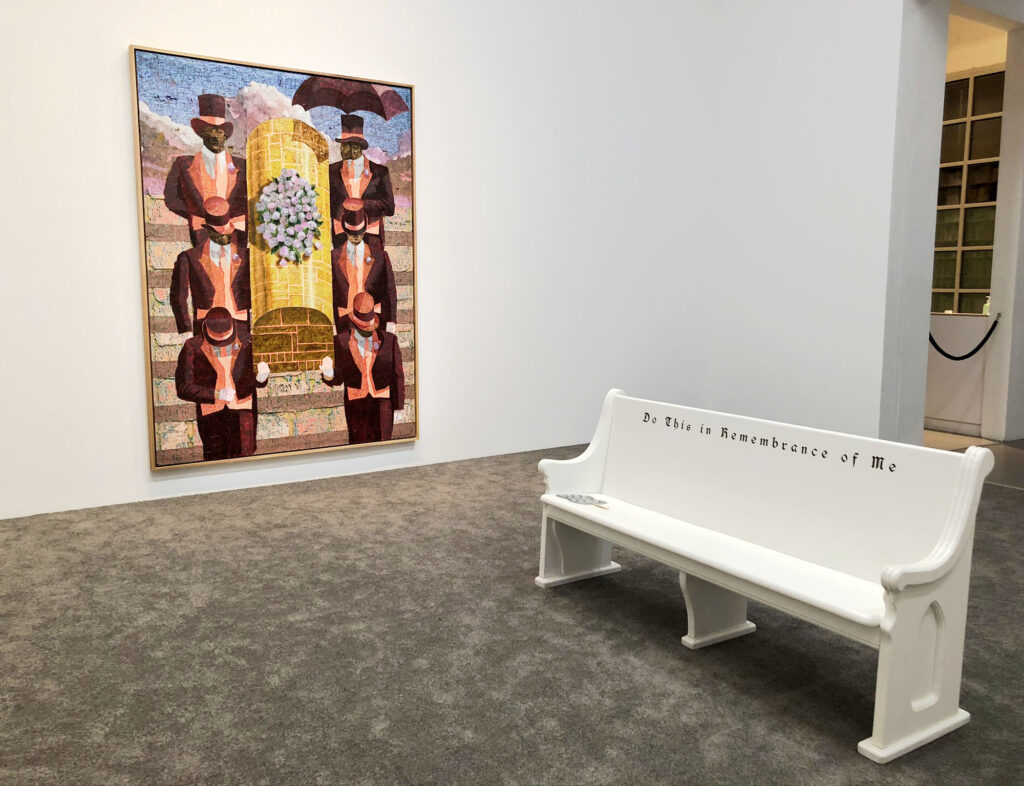
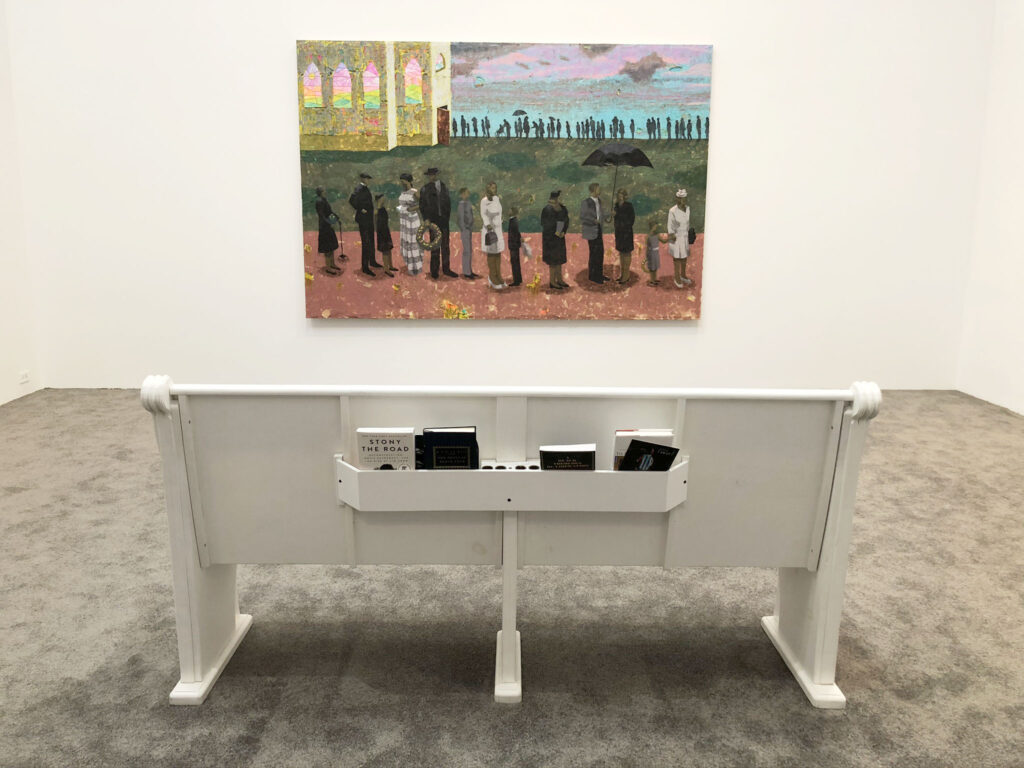
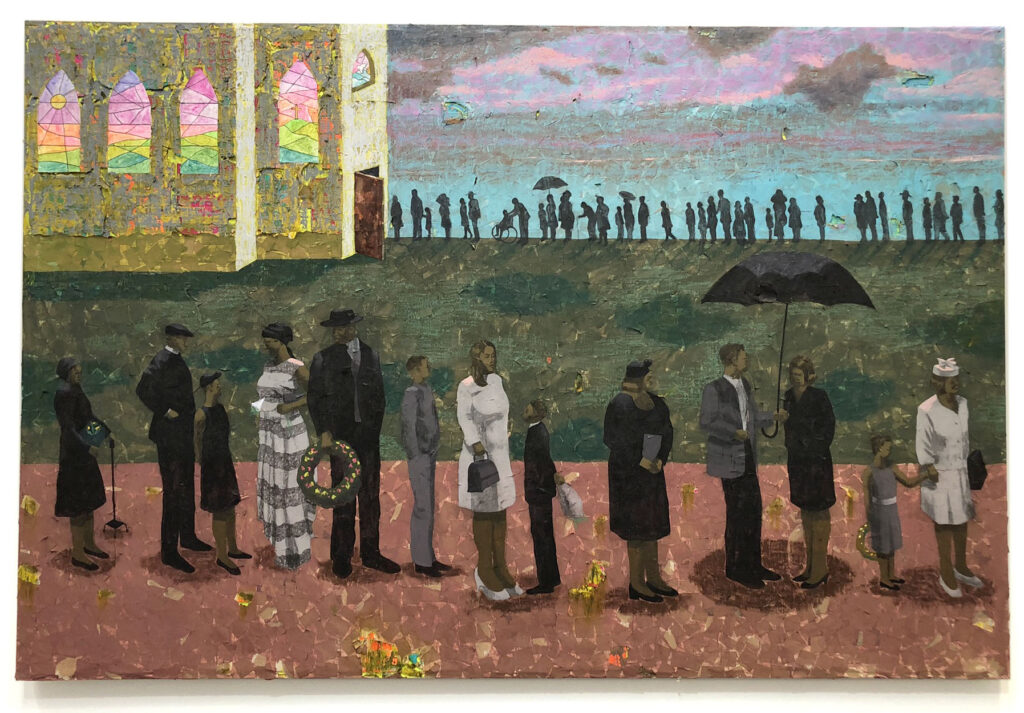
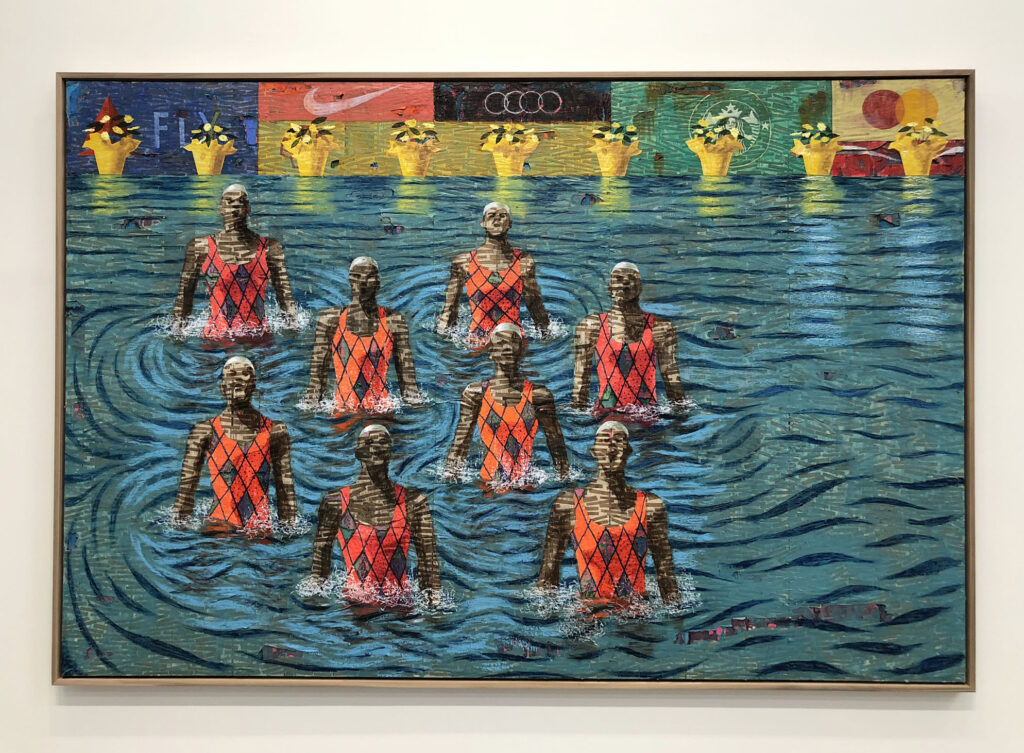
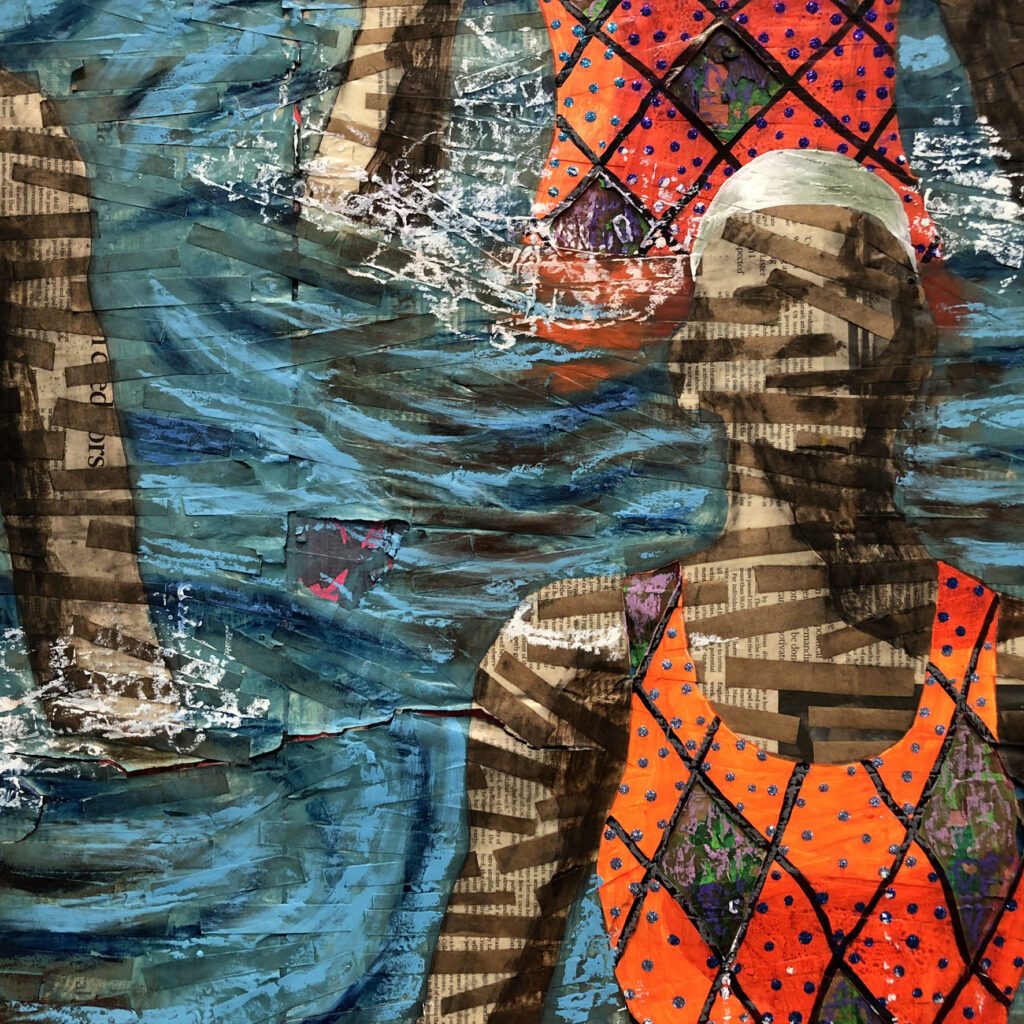
Currently at Petzel in NYC is Derek Fordjour’s solo exhibition, SELF MUST DIE, which incorporates painting, sculpture and Fly Away, a performance collaboration between Fordjour and award-winning puppeteer Nick Lehane.

From the press release-

The show, Fordjour’s first with the gallery, is an offering of creative labor in response to our current moment, a deeply personal and collective state of anxiety around death and hyper-visible racial violence. It examines the nature of martyrdom, vulnerabilities inherent to living in a Black body, performance of competency, and the liminal space existing between autonomy and control.

In SELF MUST DIE, Fordjour interrogates the inevitability of actual death, made more urgent by the realities of a global pandemic, and points to the aspirational death of the artist’s ego brought into focus by a burgeoning career. It is both cultural manifesto and personal declaration. The show is comprised of three parts: VESTIBULE, a site-specific sculptural installation; Fly Away, a live puppetry art performance; and a suite of new paintings.

VESTIBULE offers a collection of sculptural objects imbued with biblical allegory and the spirit of James Cone’s Black Theology of Liberation. It refashions the gallery as a secular yet sacred space of memorial. Among its features, the small entry compels visitors to undergo a destabilizing bodily shift that elicits an intimate and reorienting experience. A directional light from above slowly combs the entire room, invoking both searchlight and spotlight, ideas central to the recent death of Breonna Taylor. Constructed of bituminous coal and wrought iron, Taylor Memorial hangs from above.

Fly Away, a collaboration between Fordjour and award-winning puppeteer Nick Lehane, is performed by a stellar cast, with an original score composed by John Aylward and performed live by oboist Hassan Anderson. The puppet is a Fordjour-designed, hand-sculpted figure crafted by Robert Maldonado. The protagonist’s narrative arc rises and falls along a journey of personal discovery. Larger themes that course through Fordjour’s body of work become resonant.

Spanning two galleries are several new paintings, executed in Fordjour’s signature collage technique, representing the latest developments in his studio practice. The first is a suite of paintings based on Black funerary tradition. The second gallery presents a broad range of subjects including several at monumental scale.

This exhibition closes 12/19/20.

Nov 012020
 

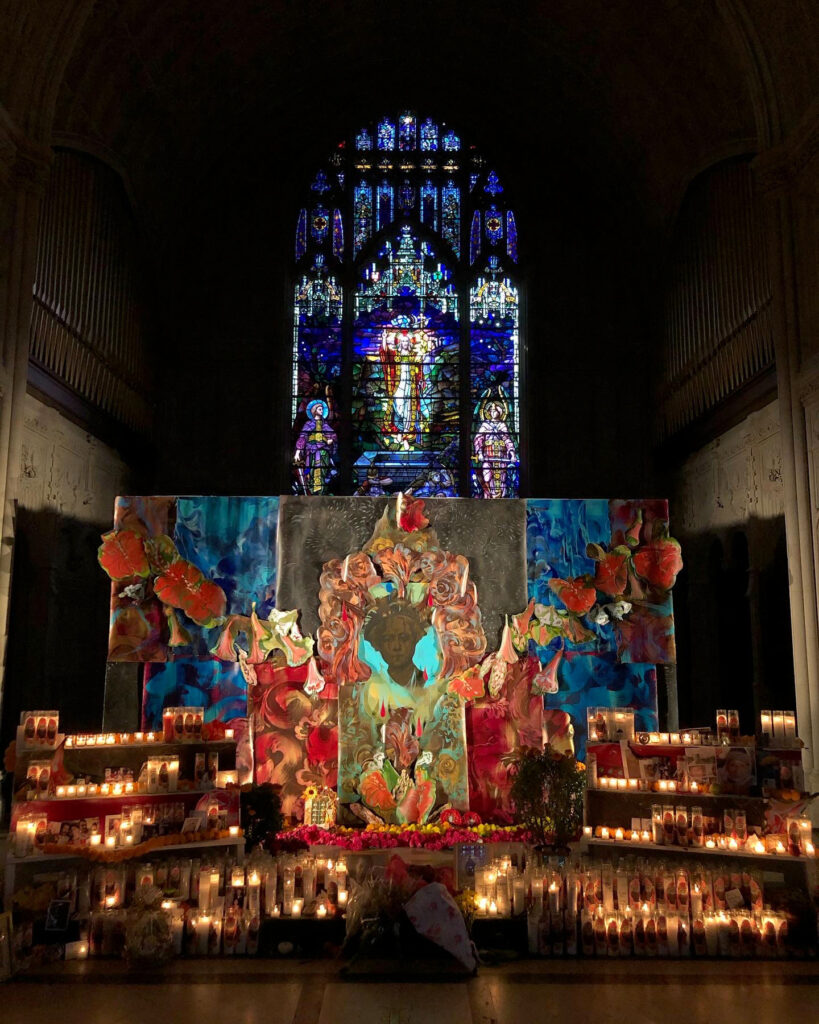
Artist Scherezade García’s large-scale community altar at Green-Wood Cemetery’s Historic Chapel for Día de los Muertos. Visitors were encouraged to bring personal offerings to a community altar, including flowers, photographs, and notes, among other objects.

Info from the artist’s Instagram

Inspired by altars found throughout Mexico and the Mexican diaspora, Garcia’s altar combines her own unique style with this centuries-old celebration of the departed.

The centerpiece of the altar is a weeping, cinnamon-colored Statue of Liberty. By mixing all the colors in her palette, Garcia achieves a brown hue that embodies the ideals of diversity and inclusiveness. Her rendition of the Statue of Liberty, an iconic symbol of New York City, evokes the multitudes of immigrants that have found home here, including large Latin and Caribbean American communities. Garcia has dedicated the altar to all the New Yorkers who fell victim to the coronavirus.

Sep 292020
 

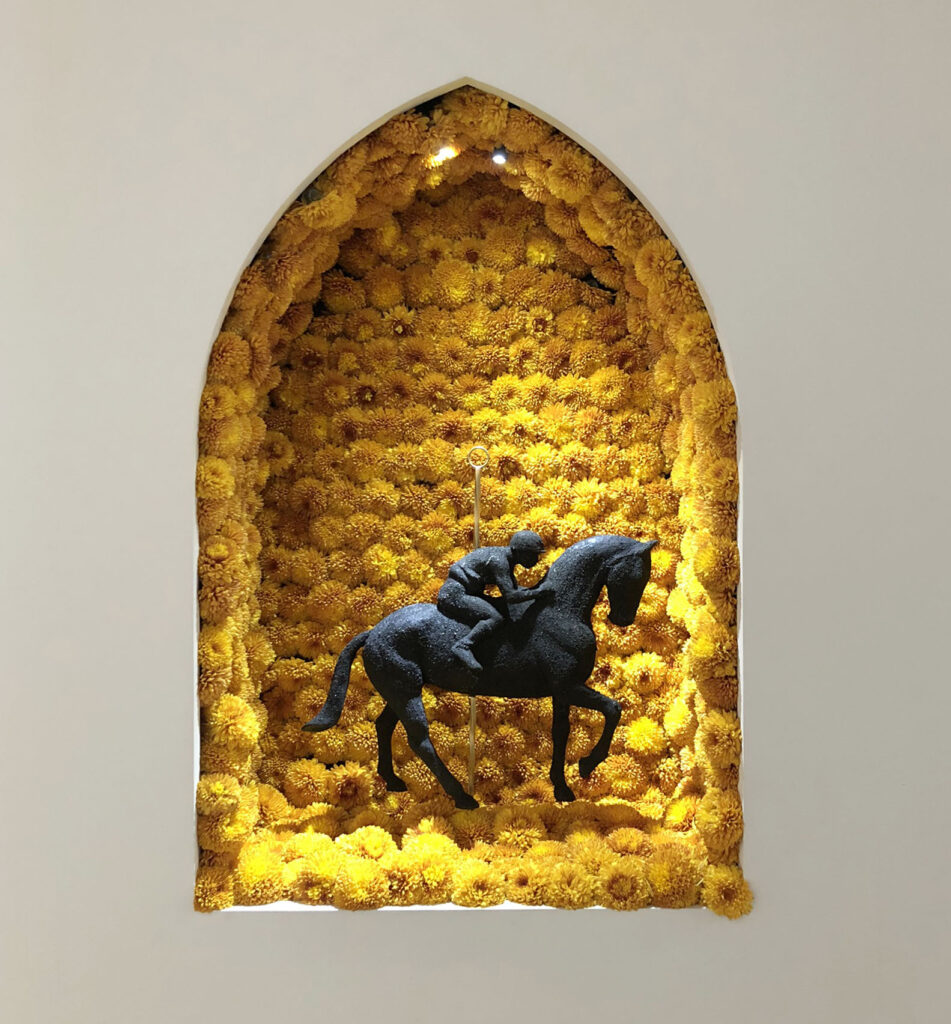
One of the many art works in East Jesus, an art museum near the Salton Sea in California. This sculpture by Flip Cassidy is made entirely from found and collected TV sets and computer monitors, with more added as time goes on. The version pictured is from 2018.

May 212020
 

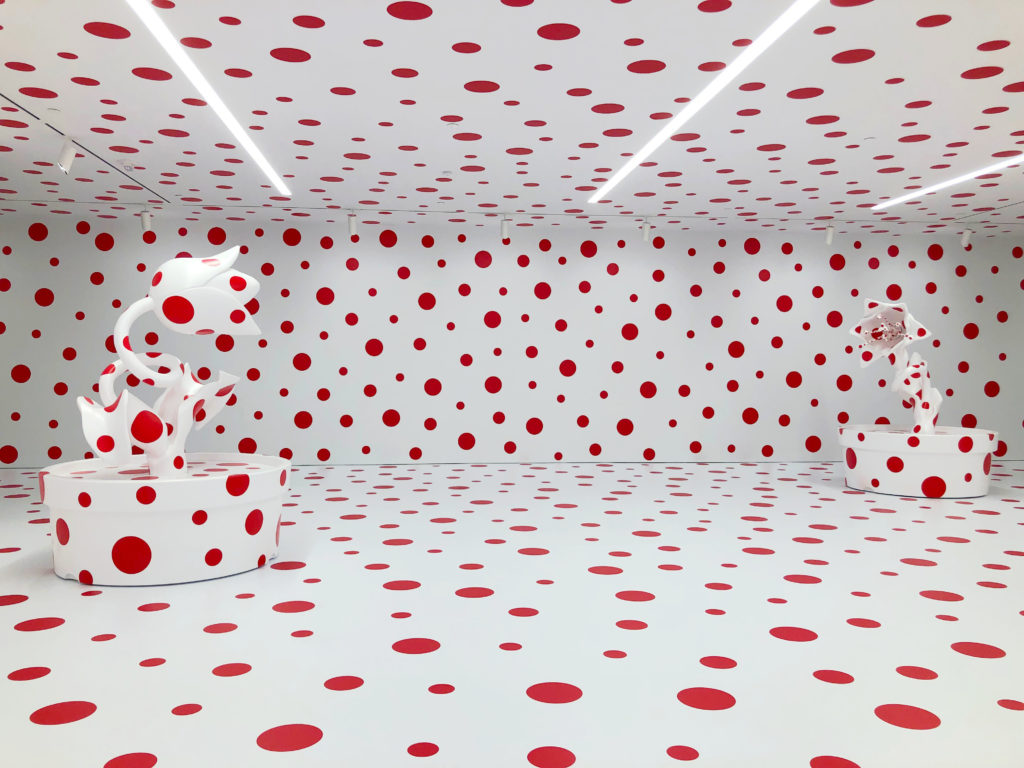
Yayoi Kusama’s installation, With All My Love For The Tulips, I Pray Forever (2011), was on view at Marciano Art Foundation in Los Angeles in 2019.

From the foundation about the work:

Kusama’s exuberant sculptural installation “With All My Love For The Tulips, I Pray Forever”(2011) exemplifies the dualism found throughout her work between the organic and the artificial. Shown here for the first time in Los Angeles, the oversized flower-potted tulips made from fiberglass-reinforced plastic are painted with the same red polka dots as the floor, ceiling, and walls, creating an immersive viewing experience while at the same time diminishing the appearance of depth. This work exemplifies Kusama’s singular vision and her distinctive gift for drawing viewers into the work on a deeply visceral level. Kusama currently lives and works in Tokyo.

Apr 062020
 

For Doug Wheeler’s fourth solo exhibition at David Zwirner’s NYC location, he created the immersive light installation 49 Nord 6 Est 68 Ven 12 FL (2011–2012), shown above.

This exhibition opened on 1/24/20 but was closed due to the Coronavirus (COVID 19) pandemic.

Apr 042020
 

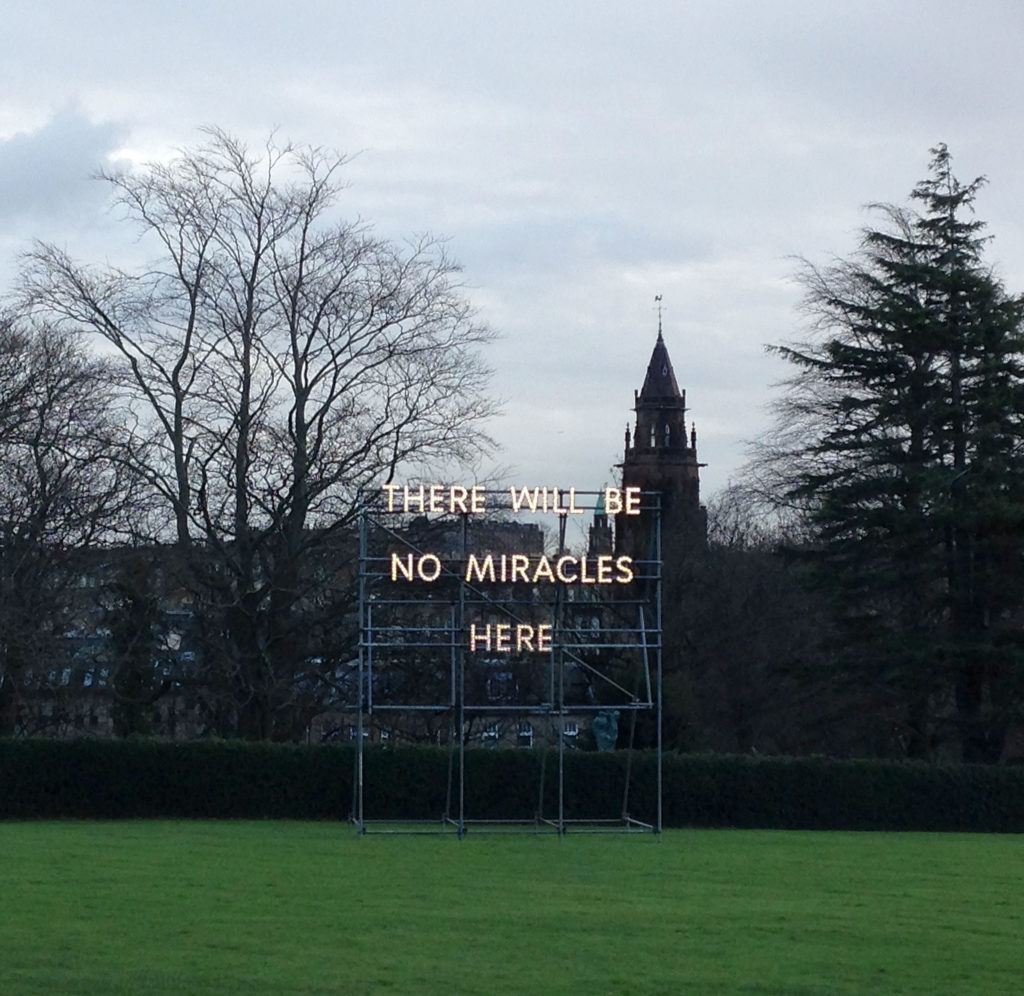
This work by Scottish artist Nathan Coley is located outside the Scottish National Gallery of Modern Art in Edinburgh.

From the museum’s website

This outdoor work by Nathan Coley proposes, on a scaffolding support six metres high in illuminated text, ‘There Will Be No Miracles Here’. This originates from a project in which Coley posted a series of public announcements around the town of Stirling. One included these words, taken from a seventeenth-century royal proclamation made in a French town believed to have been the frequent site of miracles. Coley’s practice is based in an interest in public space, and how systems of personal, social, religious and political belief structure our towns and cities, and thereby ourselves.


Mar 062020
 

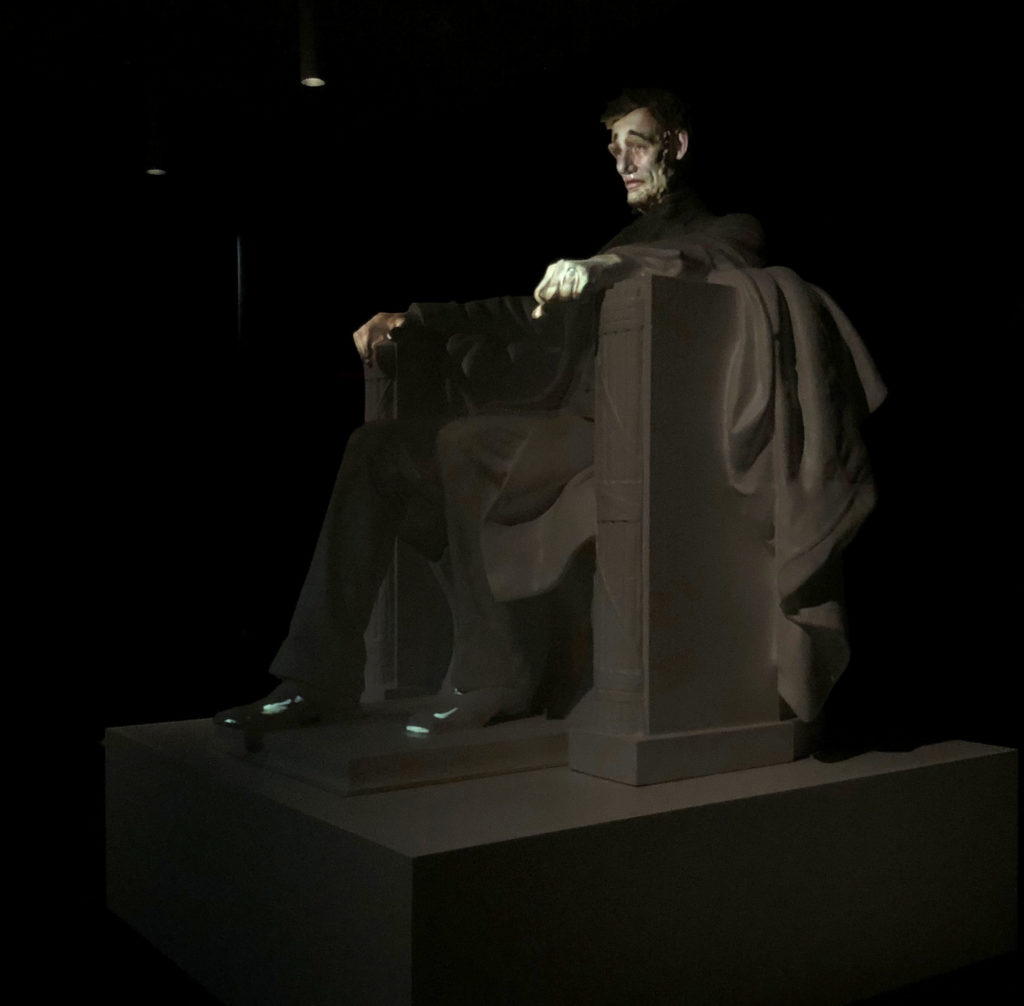
Currently at Galerie Lelong & Co. is Krzysztof Wodiczko: A House Divided…, a projection installation work that explores the diverse political issues in the United States. For this project Wodiczko projects videos of various people from New York’s Staten Island discussing their political views. Their bodies appear superimposed on two large statues of Abraham Lincoln, which face each other in the room.

From the press release-

The exhibition’s title refers to the phrase “A house divided against itself cannot stand” from Abraham Lincoln’s 1858 speech during an unsuccessful run for U.S. Senate, which quoted a passage from the Bible, Matthew (12:22-28). Lincoln borrowed a familiar phrase in order to garner support for the contentious proposition of unifying a rapidly expanding nation teetering on the brink of war. Wodiczko repurposes the statement in a contemporary setting to highlight the partisan contention. In 2019, Wodiczko conducted research of suburban social landscapes in the Tri-State area before choosing Staten Island, a New York City borough that is racially and ethnically diverse yet a simultaneously politically divided geography: north as liberal-leaning and south as conservative-leaning. “Speaking to each other, they explain and exchange their positions and disagreements while expressing their mutual wish for careful and respectful listening to the opposite side,” says Wodiczko.

This exhibition closes 3/7/20 but the artist’s most recent site-specific projection, Monument, is showing in Madison Square Park (starting at dusk) through May 10th.

For Monument, Wodiczko projects “the likenesses and spoken narratives of resettled refugees—who have originated from different parts of the world—onto the Park’s 1881 monument to Admiral David Glasgow Farragut. A looping video projection will bring the monument to life with stories of displacement that illuminate how war, conflict, and political fallout impact individuals globally, encouraging visitors to consider how the history of conflict is memorialized.”


Mar 062020
 

Spoons, 1979.

For Sandy Skoglund’s exhibition Winter, at Ryan Lee gallery in New York, she has partially recreated the environment she used to created the title piece. Many of her photographs are created by building new worlds-this is a chance to immerse yourself in one of them.

The exhibition also includes a collection of her work from the late ’70s to 2005, including Radioactive Cats from 1980 (pictured below).

From the press release-

Skoglund describes Winter as “a study in perseverance and persistence, an artificial landscape celebrating the beautiful and frightening qualities of the coldest season.” In the photographic image, a man, woman, and child punctuate an icy blue scene. They are inside of an iceberg, perhaps, surrounded by its craggy walls. Standing pensive with hands in the pockets of their winter coats, only the child, a red-headed girl, looks out toward the viewer. The trio is joined in this fantastical setting by a cluster of three snowflake-emblazoned owls and a female figure that seems to have frozen mid-slumber. The imagery evolved from Skoglund’s interest in similarity and difference among snowflakes. Her fascination with the appearance of correspondence versus the reality of difference extends from earlier investigations of the liminal territory between the natural and the artificial, or order and chaos. Through her constructed imagery, Skoglund explores the space between what the human eye and the camera can see.

Since the late 1970s, Skoglund has been celebrated for her panoramic installations—entire environments that she meticulously designs, constructs, and then re-visualizes photographically. Skoglund likens Winter to “a very slow shutter speed on a camera. Time stands still but also inches forward.” Relentlessly inventive, Skoglund challenges herself to experiment with new creative technologies, always in search of the medium best suited for her message. For Winter, which was part of a larger project on the four seasons, years of experimenting with various forms of clay modeling and 3D-printing led to the ultimate inclusion of digitally-cut metal snowflakes bearing ultraviolet cured ink, and the computer-sculpted figure and owls.

Radioactive Cats, 1980. (image courtesy of Ryan Lee )

This exhibition closes 3/7/20.


Feb 272020
 

Currently at Sikkema Jenkins & Co. gallery in New York is on the lower frequencies I speak 4U (alquimia sagrada), a solo exhibition of work by william cordova.

From the press release-

For the artist’s fourth solo exhibition at the gallery, cordova has developed a multi-media installation seeking to explore “the juxtaposition of past structures to more contemporary structures that illuminate the ephemeral nature of our existence, as beings who create material culture as a means of documentation and memory.”

The exhibition incorporates large-scale drawing collages, photography, and sculpture into an environment that reflects on abstract forms rooted in sacred geometries, while also drawing from historical moments and monuments of resistance. Two large scale sculptures, untitled (RMLZ), and untitled (palenque), reference both Brutalist and pre-Columbian architecture, specifically the temple-Citadel sites at Sacsayhuaman and Ollantaytambo. Incorporating the architectural motifs found at these sites, such as zigzags and grids, cordova’s sculptures thread an ephemeral repository, meditating on the concepts of image encoding from biological, natural, galactic, and cultural sources. The sculptures disrupt the formal structure of the gallery, creating alternative perceptions of space and time.

In his series rumi maki, william cordova takes on an ethnographic approach in addressing shared symbolism found in textile data encoding and architectural design. Named after the ancient Andean martial arts, rumi maki consists of multi-colored collages on paper, constructed from vivid layers of recycled paint chips. The arrangement of colors and patterns carry latent meanings, dependent on geography, culture, and the readings of celestial bodies. As cosmological maps, the collages synthesize the sacred geometries of architecture with the visual narratives of historical civilizations. Its form also recalls pioneering early video installation artist Beryl Korot, and her contributions to the 1970s video journal Radical Software.

ogun (el siglo de silencio) sees the artist return to large-scale collage on paper after several years focused on site-specific installations and smaller-scaled work. This work introduces viewers to a new series titled el quinto suyo (the fifth suyo), collages culled from reclaimed paint chip samples and recycled cardboard pigmented with old discarded oil stick paint. Literary references permeate cordova’s collages; texts such as El Siglo de Las Luces by Alejo Carpentier, El Monte by Lydia Cabrera and Decimas by Nicomedes Santa Cruz point to his ongoing interest in the distribution of power, spirituality, and labyrinths of perception.

In the back gallery is an exhibition of paintings (pictured below) by Josephine Halvorson, titled On The Ground.

From the press release-

On The Ground, also the title of her essay in Art In America (June/July 2018), continues Halvorson’s exploration of the ground—as a motif, material, and metaphor. Each painting registers an area of ground through Halvorson’s close observation and pictorial description, while its accompanying surround incorporates crushed rocks and debris from the site of the painting’s making. Together, they realize a faithful translation of place and time. The work in this exhibition was made in the Berkshire mountains, the Mojave Desert, and Matanzas, Cuba.

These hybrid paintings are made with gouache, site material, dry pigment, and printmaking. They expand Halvorson’s on-site practice of transcribing direct experience by hand. While her previous work in oil allowed her encounter with an object to congeal over the course of a day, Halvorson has turned to gouache, a fast drying and graphic medium, which, like handwriting, records her observations in real time. Her paint application is indelible and fresco-like, transferring color from the brush into the absorbent ground of the panel.

Touching down at various points of interest—a piece of plastic, a blade of grass—Halvorson’s notational marks establish a correspondence between environment, painting, and viewer. Like a map, they depict the literal scape of the ground while offering an escape from mimesis. The reality of proximity breaks down as one gets lost in the archeology of a single stride. Gravel becomes galactic. The surround acts as a legend or key, a space for evidence and tools of calibration. A ruler, coins, or color chart orient the onlooker in terms of scale and perception, and the site material indexes the painting to its original locale. These are paintings of verification and memorialization. They ask how we make sense of what we see, how we express that witnessing, and how an account of experience is made concrete.

Both of these exhibitions close 2/29/20.