Oct 232024
 

Aliza Nisenbaum’s paintings for Altanera, Preciosa y Orgullosa, her current exhibition at Regen Projects, fill the gallery with colorful portraits depicting dancers from dance troupes and studios local to Southern California- including Teresita de Jesús of Studio 10, Folklorico Revolución, Mariachi Tierra Mia, and Amelia Muñoz Dancers.

From the press release-

An early, leading figure in the centrality of representation and portraiture in the preceding decade, Nisenbaum develops vibrant, figurative paintings through a form of participatory observation. She forges relationships with her subjects and connects meaningfully to the complex communities they create together. Informed by a diverse array of artistic and political traditions, Nisenbaum’s pictures (and the process through which they are made) recall forebears such as Alice Neel, Sylvia Sleigh, and Diego Rivera.

From mariachi to salsa, the works give painterly shape to the fleeting festivity of these traditions. Exploring connections between sight and sound, they evoke music and movement in an otherwise static, silent medium by way of color, contour, and pattern. As such, they recall modernist experiments and visionaries such as Sonia Delaunay and Florine Stettheimer. Mindful of the ever-intensifying specter of technology that shapes our daily lives and recalling sociologist Émile Durkheim’s theory of “collective effervescence,” Nisenbaum’s paintings celebrate these spaces and occasions for dancing as consecrated moments apart from our screens and devices, reminding us of the pleasure of being more fully of and with our bodies and each other.

The exhibition’s title, Altanera, Preciosa y Orgullosa, draws from “La Bikina,” an iconic Mexican ballad, and describes the song’s namesake subject, a “haughty, gorgeous and proud” woman. As such, it alludes to the sounds and sentiments that might accompany the dancers and musicians pictured throughout Nisenbaum’s paintings, as well as her overarching interest in depictions of female power, independence, and self-assuredness. These themes recur in La Bruja, a painting of dancers learning to carry lit candles safely atop their heads as they dance to lyrics that describe a witch, or “bruja,” at work in the middle of the night. For Nisenbaum, La Bruja, like “La Bikina,” evokes a powerful mythology of strong women, informed by their own agency and control as they move through the world.

Poised and focused, Shine Arm Styling, on 1, introduces us to a duo especially attentive to the most decisive details. Likewise, Nisenbaum’s paintings orchestrate a carefully calibrated concert of humming patterns and colors, from the rhyming latticework of tights to the gauzy curtains that drape and cocoon the rooms, the lacey fretwork of leotards and costumes, and the pronounced grain of the wooden floors. Animating and unbridled patterning recurs across the canvases, a painterly translation of the energy of the dancers and the spirit of their music. Just as the women tap more and more frenetically in La Bruja—building and accelerating—the pattern that frames them expands through and beyond the figures, likening the sonic experience to this visual effect, as well as the pace of paint handling that produces it.

Similarly, as dancers slide and screech to a halt, the undulating motion of the wooden floors mirrors the movement of the figures via painterly gesture. Rehearsal mirrors and elevated bars occasion playful angles, geometries, and juxtapositions, expanding and suturing spaces and passages. They punctuate, frame, divide, and at times provocatively double or even triple figures and forms, creating and implying pictures within pictures. Such reflections liken Nisenbaum’s activity as a painter to that of the whirling dancers. Her complex tableaux reveal her deep awareness and clear delight in the possibilities of painting to narrate human experience and the relationships that sustain us.

This exhibition closes 10/26/24.

Oct 232024
 

magnetic instinct, Liz Larner’s current exhibition at Regen Projects, balances the textures and colors of her unique ceramic sculptures with the simplicity of her 1989 work Rubber Divider. The show is also part of the Getty’s PST ART: Art and Science Collide programming.

From the press release-

“…for wander is a verb that needs no object…My aim is to limit myself to the ingenuity of innate action, to be awed by it, and not to try and clear up its mysteries.”
—Fernand Deligny, The Arachnean and Other Texts, 2015, pp. 37/46

The exhibition presents new ceramic works surrounding Larner’s “Rubber Divider, 1989—two sheets of pure gum rubber connected to steel rods attached to two flame-cut, solid steel blocks that hold the tension of the opposing pull of weight and elasticity of the rubber sheets. Their opposition and mutual dependence underscores Larner’s longstanding interest in the relationship between structural support and the attitude of the object.

Engaged with the many possibilities of sculpture and abstract form, Larner uses material to encourage discoveries led by an intrinsic link between impulse and perception. Polished to a mirror finish, the brass and aluminum of these sculptures allows them to be positioned on the wall, as the side of the glazed ceramic facing the wall is reflected in the cool light of aluminum and the warm glow of brass. Each surface has its own quality, from the extremely reflective to a textured matte, and these differences create a varying vibrancy of reflected light. Larner’s ceramics highlight a symbiotic continuity that troubles definitions of art and environment, object and subject.

Larner’s morphological research thinks likewise with ecological networks, as described in the writings of Fernand Deligny, or by the botanist Anne Pringle, in “Establishing New Worlds: The Lichens of Petersham.” The dialogue between these new works and Larner’s more historic sculpture, Rubber Divider—which debuted in the 1989 Whitney Biennial—underscores the interplay between support, form, surface effect, and infrastructure, that has often animated her practice, exploring how our observed experience of the world is innately personal but based on connection. Mindful of the specter of the Anthropocene, it also occasions a meditation on how we distinguish past and present, wondering what forms, what artifacts of human action and intelligence will last, and outlast us.

Distinguished by the unique physical rules that govern its transition, from soft to fragile to almost indestructible, Larner engages clay in part because of its apparent self-determination and pliancy, a kind of material agency and chemical intelligence distinct from our own. The ceramic forms in this exhibition are molded by impressions with ubiquitous forms made with a precision that often goes unnoticed. These forms are softened by the contact of the clay being shaped by them. The consequence of this method of forming is ghostly and transpositional. Among many other potential interpretations and resonances, the exhibition’s title points to these principles, and likens them to the same encodings that inform human perception and the activity of many other life-forms, as we are learning to be of and with.

Larner’s work is also currently on view as part of Transformative Currents: Art and Action in the Pacific Ocean at the Orange County Museum of Art and For Dear Life: Art, Medicine, and Disability at the Museum of Contemporary Art San Diego . Both shows are also part of PST ART: Art and Science Collide.

For more on her creative process, and earlier work, check out the video below from Art21 in 2016.


Oct 162024
 

Lita Albuquerque’s exhibition of new work for Earth Skin, on view at Michael Kohn Gallery, includes several dramatic blue paintings and a huge installation piece on the floor of the gallery that grabs your attention the moment you enter the gallery.

From the gallery-

Beginning her career in the 1970s with works that intimately connected her to the earth, Albuquerque’s artistic evolution envelops the cosmos and the space between it and us. Her work emanates from years of practicing the exact science of Kundalini breath technique as well as automatic writing; both drive a deep investigation and scientific inquiry of who we are as individual beings on this planet. Albuquerque further connects to the exactness of physics by a meditation she, and astronomers, call the cosmic address. These daily practices are at the root of her art, precisely positioning self to cosmos. It is those discoveries she embeds in works of art that permit us, the viewer, to experience the connections she has made between these internal and external worlds.

Thinking about the exhibition, Albuquerque writes:
Feet dancing above the earth, dancing with fervor, drumming, the increasing drumming of the feet not fragile on the fragile earth.

The wisps of bodies, like skins falling off their frames leaving the planet, the planet strong and our forms ethereal, the strength of us, our feet, on the fragile earth, the wispy lightness of us, detached from the earth, transforming into space.

The earth strong behind us, propelling us upward, giving us her strength, throwing us in the air, while we fly, never falling, the fierce intensity of our rhythm while alive, and the freedom of release from the earth.

Experiments of intensities of emotions and colors, whirling dervishes’ cyclones, Earth Skin is whispered, “Earth Skin” she whispered.

For PST’s Art and Science Collide, Albuquerque transforms the gallery with a titular installation, Earth Skin. A membrane of decomposed granite fills the space creating the illusory sensation of the earth being revealed below the gallery, as if the concrete floor has been meticulously removed. Accompanying this installation is a new series of paintings revolving around the gestures of the body and ancient marks, like a hieroglyphic code only the artist has a key for. With each gesture, Albuquerque embraces the tactile intimacy of painting, reminding us of the power of capturing and transforming the elusive into the material. This installation invites viewers to explore the shared fragility of humanity and earth.

Two of the paintings, picutred below, include poems referencing fellow artist Ana Mendieta, who was known in part for her “earth-body” work and who passed away tragically in 1985.

“Propelling Us Upwards, She, The Earth, Throwing Us In The Air While We Fly, Never Falling, A Poem for A.M.”, 2024, Pigment on Canvas

“Desire and Memory, A Poem for A.M.”, 2024, Pigment on canvas

This exhibition is part of The Getty’s Pacific Standard Time: Art and Science Collide an arts event taking place in various venues around Southern California.

For more information on Lita Albuquerque and her work Red Canary Magazine recently published an excellent article that is worth a read as well.

Aug 022024
 

The above image is of Jessie Homer French’s  Mapestry California 2012, 2012 (fabric, thread, fabric paint, and pen), which was on view in 2018 at Palm Springs Art Museum.

From the museum about the work-

This work is from a series of “mapestries” that the artist made between 2012-2017. These textile works graphically map out natural elements and forces in California, from prominent flora and fauna, natural monuments and mountain ranges, as well as hidden fault lines that spur the earthquakes that constantly threaten the region and its inhabitants. The work reflects the artist’s hyperawareness of the environment around her. Their flat, graphic qualities are similar in form to the artist’s paintings. The mapestries were made specifically for Californians, as artworks that could do no harm hanging over one’s bed in case of an earthquake.

One of her paintings is currently part of the benefit exhibition Art for a Safe and Healthy California at Gagosian Beverly Hills. The exhibition, presented by Jane Fonda, along with the gallery, is raising money to protect communities from toxic oil drilling.

Jul 122024
 

The painting above is 3 Oracles, 2022, by Sayre Gomez, on view at Columbus Museum of Art. It is part of the exhibition New Encounters: Reframing the Contemporary Collection of the Columbus Museum of Art .

From the museum about the work-

Based in Los Angeles, Sayre Gomez often employs techniques borrowed from Hollywood set painting and commercial advertising to heighten the sense of lifelikeness in his paintings. In 3 Oracles, Gomez’s depiction of a vacant big-box store renders the shifting forces of the consumer economy in exacting, photo-realistic detail. The three appliance brands represented on the store’s façade, DieHard, Craftsman, and Kenmore, were all formerly owned by Sears Corporation, a retail giant that filed for bankruptcy in 2018.

Gomez recently co-curated the Feed the Streets Benefit Show at Sebastian Gladstone in Los Angeles. The opening is tomorrow evening (7/13) from 6-9pm and the exhibition will be on view until 8/3/24.

The group exhibition includes work by- Alfonso Gonzalez Jr. , Andrew Park, Bennet Schlesinger, Bryan Ruiz, Calvin Marcus, Chad Murray, Eddie Martinez, Emma McMillan, Evan Holloway, Greg Ito, G.V. Rodriguez, Jaime Muñoz, Jake Longstreth, Jonas Wood, Josh Smith, JPW3, Julia Yerger, Juliana Halpert, Justin Caguiat, Kalan Strauss, Mario Ayala, Max Hooper Schneider, Mungo Thomson, Nick Angelo, Nick Clark, Nihura Montiel, Richard Tinkler, Ryan Preciado, Sam Moyer, Sayre Gomez, Sterling Ruby, timo fahler, and Tristan Unrau.

All proceeds benefit Feed the Streets and their ongoing mission of colecting donated food, hygiene products, clothing, and educational items for hand to hand distribution in Los Angeles and New York. Feed the Streets also provides athletic and creative resources for underserved youth.

Apr 032024
 

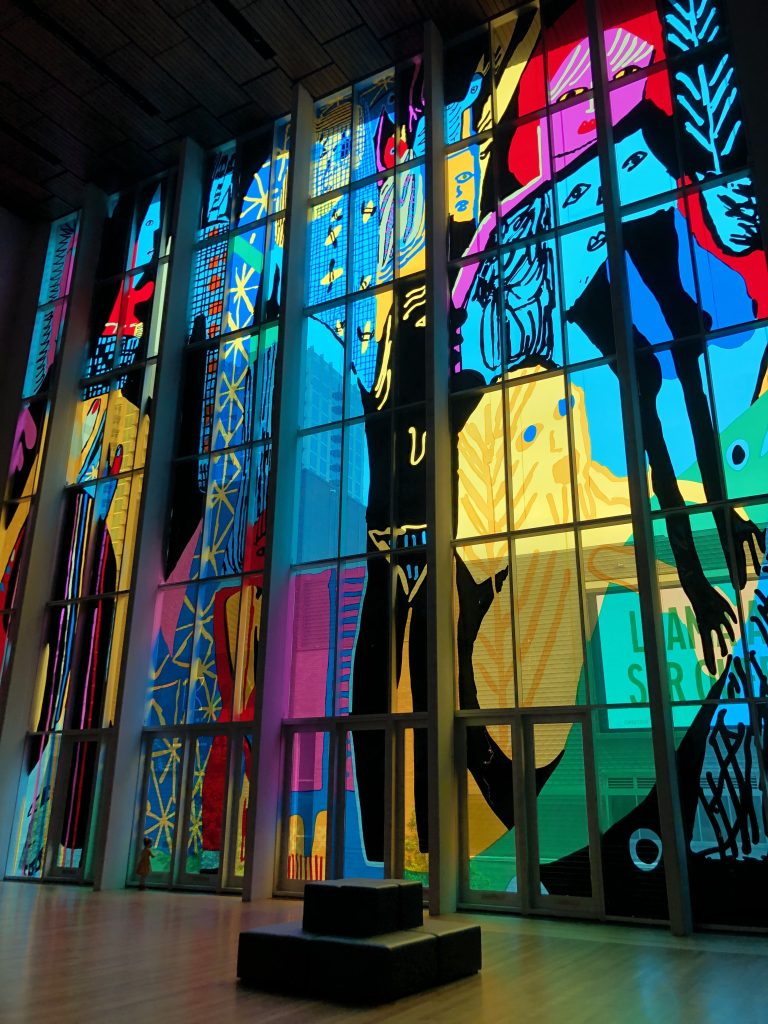
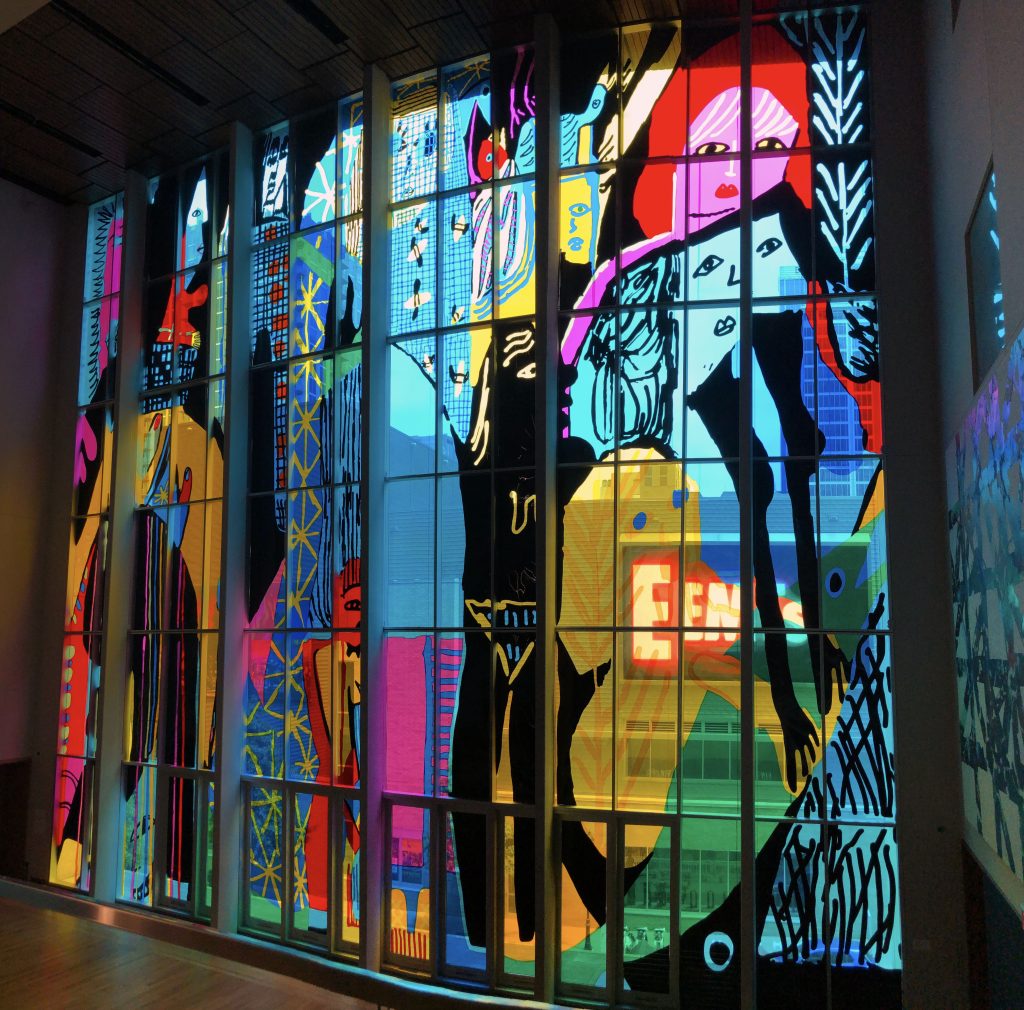
Summer Wheat created this mural, Foragers, in 2020 for the Mint Museum in Charlotte, North Carolina, where it remains on view today.

From the museum about the work-

This monumental “stained glass” installation celebrates the resilience of North Carolina’s community of makers and providers and creates a space where our present-day Charlotte community can gather for contemplation and inspiration. Collaging sheets of colored vinyl, Wheat has created a towering, prismatic composition that fills all 96 windows of the Mint atrium with female figures of varied sizes, ages, shapes, and races performing acts of labor: fisherwomen, beekeepers, hunters, mothers, caretakers, farmers, bankers.

Following the tradition of stained-glass windows found in places of worship, Wheat offers a narrative of hope and resilience that can be enjoyed in a few minutes or studied over hours. Wheat says that “Foragers presents a tradition in which women were the original hunters, technologists, and artists. This array of women connected by geometric patterns echoes the psychological space of women supporting each other. They are marching together, connecting to creatures from land and water, demonstrating their inherent link to natural elements and to the intricate depths of the unconscious.”

The women in Foragers also call attention to the underrecognized populations who have cultivated the land that we now call North Carolina, from the indigenous tribes to the colonial settlers to the enslaved Africans and all those who have followed. The region is home to myriad traditions-ceramics, basket weaving, quilting, furniture construction, textile production-and The Mint Museum specifically celebrates that legacy through its collection and exhibitions. Foragers salutes North Carolina’s history of creativity and industry, both by those whose names we know and those who remain anonymous.

Her latest exhibition, Fertile Ground, is currently on view at Nazarian/Curcio in Los Angeles, closing on 4/6/24. It includes new paintings and three stone mosaic sculptures.

Jan 192024
 

Pictured above is Drossos P. Skyllas‘ painting, Wisconsin Ice Cave, 1950, part of LACMA’s 2018 exhibition, Outliers and American Vanguard Art.

About the artist from the National Gallery of Art in Washington D.C. where the exhibition was also on view-

Drossos Skyllas achieved the exquisitely detailed, jewel-like surfaces of his paintings with tiny brushes he fashioned himself. He applied miniscule dabs of luminous oil paint in a pointillist manner, which gave his subjects a petrified yet shimmering quality. His refined technique and adherence to the academic genres of still life, landscape, portraiture, and mythological scenes demonstrate his knowledge of art history. And inspired by the old masters, he perfected the difficult depiction of reflective surfaces, including gems, mirrors, water, and ice. At the same time, his uniform clarity of detail, imposed symmetry, and sense of frozen time create a dreamlike mysteriousness reminiscent of magic realism. In addition to high art sources, Skyllas likely drew upon commercial illustration and photography. Untitled (Roses) resembles both traditional floral still lifes and midcentury advertisements for jewelry and flowers. Wisconsin Ice Cave relates as much to northern Renaissance landscape painting as to mass-produced picture postcards.

Born in Greece, Skyllas worked in his father’s tobacco business before emigrating to the US shortly after World War II. He settled in Chicago and devoted himself to becoming a professional artist, though he had no formal artistic training. Supported financially by his wife, Skyllas produced thirty-eight paintings from the late 1940s until his death in 1973. Some of these he submitted to the annual juried exhibition at the Art Institute of Chicago, Chicago and Vicinity, which featured his work in 1955, 1967, 1969, and 1973. He also sought commissions to paint portraits, but with asking prices as high as $30,000, he never found any patrons.

Skyllas’s work was discovered after his death by Chicago gallerist Phyllis Kind, who added him to her roster of self-taught artists in 1974. He was likely known to artists Jim Nutt and Gladys Nilsson before this, as they had exhibited alongside him in the 1967 Chicago and Vicinity exhibition and are enthusiastic collectors of self-taught artists (Wisconsin Ice Cave is in their collection). The meticulous finish of Skyllas’s paintings, which simultaneously evokes advertising art and Renaissance illusionism, appealed to Nutt, Nilsson, and fellow Chicago imagist Roger Brown, whose art collection also included the self-taught Greek master.


Dec 142023
 

Mirror House, 2016 by artist Paige Jiyoung Moon was one of the paintings in her 2019 exhibition, Days of Our Lives at Steve Turner in Los Angeles. Her works are all of scenes from her life, painted from memory.

She is currently part of Hammer Museum’s most recent biennial, Made in L.A. 2023: Acts of Living, its sixth iteration, on view until 12/31/23.

The house in the painting, Mirage, was created by Doug Aitken for Desert X in 2017. On the fictional television series, The Curse, created by Nathan Fielder and Benny Safdie, the main characters are building houses with similar look.

Nov 272023
 

Tonight is the penultimate full moon of the year, so it seemed like a good moment to post this painting, The Real Realities 2, 2013, by Friedrich Kunath. It was on view in 2019 at the Marciano Art Foundation in Los Angeles which after abruptly closing due to a labor dispute, appears to have reopened.

The Art of Surviving November, Kunath’s inaugural solo exhibition at Galerie Max Hetzler’s London location, and consisting of a new body of paintings, is on view until 1/6/24.


May 212023
 

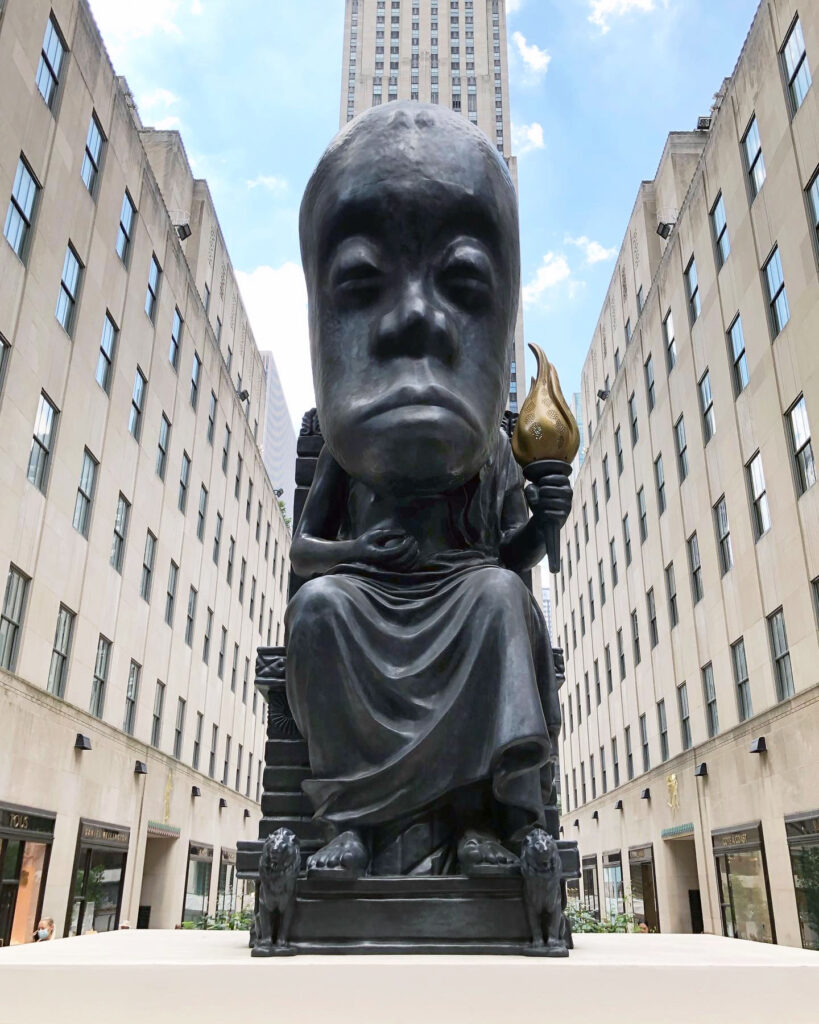
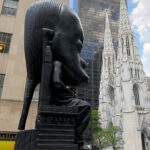
The above photos are of Sanford Biggers’ sculpture The Oracle when it was located at Rockefeller Center in NYC in 2021, where it was part of a multimedia installation.

It now resides outside the Hammer Museum in Los Angeles, on the new outdoor sculpture pedestal on Wilshire Boulevard and Glendon Avenue. It will be there until March of 2024.

From the Hammer website about the work-

Anchoring this corner is Oracle (2021), a cast bronze figure weighing 7.64 US tons (15,280 pounds) and standing at 25 feet tall. This monumental commission from Biggers continues his “Chimera” series that hybridizes the canonical figures and gestures of Greco-Roman sculpture with an assortment of iconic African objects from the 14th–20th centuries. Unlike Biggers’s other “Chimera” sculptures that are made in marble, Oracle is cast in bronze. The seated figure in Oracle is a depiction of the statue of Zeus at Olympia, while the head is a composite of several masks and busts from different African cultures, including the Luba Kingdom and the Maasai.

Biggers sculpturally patchworks historical depictions of the body and their subsequent myths, narratives, perceptions, and power. Biggers is intrigued by the recent scholarship about the academic and historical “white-washing” of classical Greco-Roman sculpture simultaneously intersecting with the early twentieth-century “black-washing” of various African sculptural objects. Oracle challenges the associated cultural and aesthetic assumptions about their source material while acknowledging the often dubious origins of the original objects themselves.