Apr 212026
 

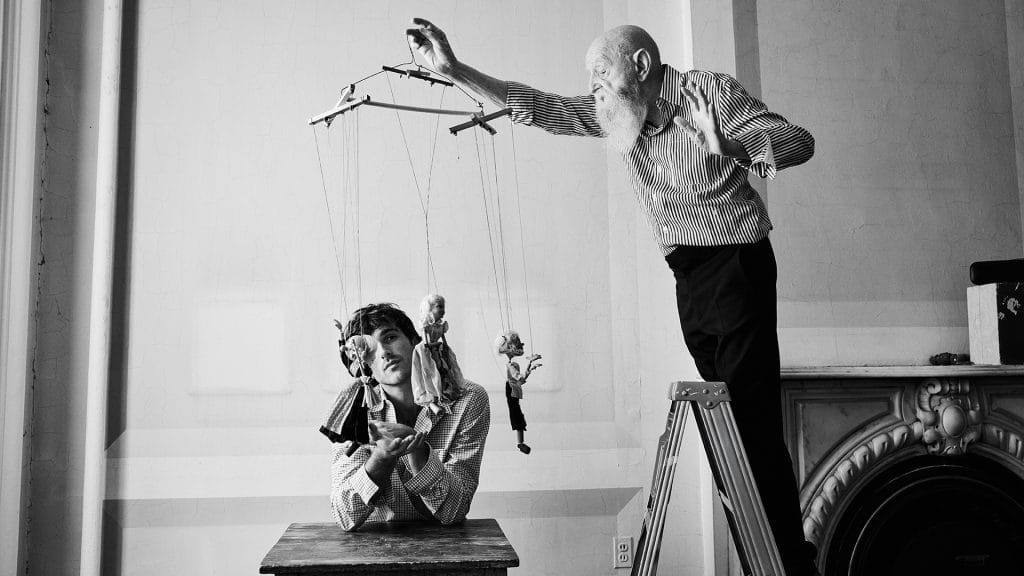
Todd Gray, “The Song Remains (assumptions about the nature of time)”, 2024, Two UV pigment prints on Dibond, artist’s frames

In LA-based artist Todd Gray’s The Song Remains (assumptions about the nature of time), two images, one of Iggy Pop and the other of a statue in Italy, merge both visually and conceptually. It was on view as part of While Angels Gaze, his exhibition at Lehmann Maupin in NYC in 2025.

About the work from the gallery-

In The Song Remains (assumptions about the nature of time) (2024)—one of the exhibition’s smallest works, composed of just two panels—Gray depicts Iggy Pop in black and white, his image overlaid against a statue from Villa Torlonia of a figure holding a pan flute. The gesture of the statue’s outstretched arm on the left is mirrored in Iggy’s raised hand on the right, connecting the two figures across time as if by an invisible thread. The image suggests an enduring human archetype, different and yet unchanged over the course of many centuries, and invites wider questions about the essence of human nature.

Gray’s latest solo exhibition, Portals, is currently on view in Perrotin‘s new Los Angeles gallery through until 5/30/26. His commissioned piece, Octavia’s Gaze, was installed last year at LACMA in the new David Geffen Galleries, which are opening to the general public in May (they are currently open to members only).

Apr 092026
 

Thea Abu El-Haj, “Architecture of Exile”, 2023, oil on board

Rayan Elnayal, “The courtyard lit up-Al Hoash Nawar”, 2023, digital print

Shira Walinsky’s installation

For This Place Meant at The Delaware Contemporary, artists Thea Abu El-Haj, Rayan Elnayal, and Shira Walinsky each present work that reflects aspects of what home means to them.

From the museum about the exhibition-

This Place Meant explores how three artists think about and imagine home when they are far from it. Each artist explores their lived or past relationship with the place they call home and where they are now. Thea Abu El-Haj remembers the home she once knew, Rayan Elnayal imagines a home she hopes to know, and Shira Walinsky shares the home she knows with new neighbors. If you were forced to leave your home, whether to be closer to family, to find a better life, to escape natural disasters or political trouble, how would you share memories from where you once lived? What parts of that place would you describe: the colors, the smells, the sounds?

We hope you tell them what that place meant to you.

Below are some additional works and the artist bios from The Delaware Contemporary’s website.

Paintings by Thea Abu El-Haj

As a Palestinian American artist, Thea’s work excavates personal and collective narratives of loss, exile, and resistance, even as it celebrates the beauty and joy around us. She is drawn to the imprint of human history on the natural landscape. Growing up in the Middle East, the colors, quality of light, and traces of millennia of human presence continue to resonate through her work, even as the landscapes of the Northeastern U.S. where she has lived her adult life influence what she paints. Buildings and stone walls in the process of decay; light coming through dark and dark through light; the quality of color at different times of day are all sources for her work.

Digital prints by Rayan Elnayal

Rayan Elnayal is a Sudanese artist, designer, and educator based in London, with a background in architecture. In 2020, she transitioned from traditional practice to an alternative one that fosters a more equitable and creative approach to design but also nurtures her artistic pursuits. She is also the co-founder and director of Space Black, a collective of Black professionals in the built environment, dedicated to imagining alternative spatial futures for marginalised communities.

Her pieces invite viewers to step into these imagined spaces and explore them. Her work challenges us to reflect on our personal attitudes toward futurism and futuristic aesthetics, while reminding us that our envisioned future built environments can honour our heritages, communities, and shared joy.

Shira Walinsky is an interdisciplinary artist and teacher. Her work centers on people and places in the City of Philadelphia. She has worked in Philadelphia for 20 years on murals, paintings, photography, films and other public participatory work. The map can be a portrait of places and the face a map of our experiences. She is interested in how the vibrant and the sensory can amplify the stories of people and place. This manifests in bus wraps, films, photography, painting and murals. In 2012 she co-founded Southeast by Southeast with Mural Arts Philadelphia. Southeast by Southeast is a community space co-created with social workers and artists and community leaders for and with refugee and immigrant communities. Shira strives to create innovative projects which elevate the resilience of immigrant and refugee stories.

This exhibition, part of the museum’s Winter/Spring exhibitions, closes on 4/26/26.

Mar 262026
 

Ava Blitz created this glass mosaic, Pink, in 2012 for Philadelphia International Airport. It is part of Philadelphia’s Percent for Art Program.

From Art at PHL-

Philadelphia artist Ava Blitz works in various artistic disciplines including sculpture and photography. In either medium, Blitz is inspired by nature and natural forms. In her sculptural work, she is known to mass similar objects together to suggest continual growth and to emulate the abundance of repetitive forms found in nature. Her sculpture is often large-scale and abstract with minimal detail to capture nature’s basic essence and to encourage the viewer’s imagination. Blitz also photographs nature, usually imagery that she has taken while on walks near her home. The photographs, typically of trees, feature variations of dense, lush foliage. Using digital photography, Blitz is able to heighten the color and alter the imagery to emphasize the beauty and mystery that inspires her artwork.

In Pink, Blitz has incorporated her photography and her interest in nature, abstraction, and repetition to create a glass tile mosaic. She describes the artwork as “playing with the edge between realism and abstraction to create a magical forest or garden – a virtual reality that viewers can enter, explore, and experience on multiple levels.” Seen from a distance, the branches and pink blossoms are recognizable. Yet up close, the tree dissolves into an abstraction of tactile, colorful, iridescent glass tiles.

Mar 262026
 

Sarah Zwerling‘s digital collage Hamilton Street, Philadelphia, is on view at the Philadelphia International Airport as part of their exhibition programming.

From Art at PHL’s website

Philadelphia artist Sarah Zwerling was invited to create a site-specific artwork installed directly on two interior glass enclosures located in Terminal A-East. Zwerling, whose work often features nature and architectural structures, has combined these influences as she has re-imagined her neighborhood street — an area in West Philadelphia characterized by its abundance of twin homes. Using digital photography, Zwerling focused on the rooflines of the Hamilton Street homes in combination with various trees found throughout nearby Fairmount Park. The imagery lines both sides of the concourse similar to the experience of walking along a narrow residential street like Hamilton. Zwerling has emphasized and altered aspects of the homes and the trees, even adding stylized blossoms and birds to animate the landscape and enhance the overall beauty and sense of wonderment.

Feb 062026
 

Giorgio de Chirico, “Portrait of Guillaume Apollinaire”,1914, Oil and charcoal on canvas

René Magritte, “The Secret Double”, 1927, Oil on Canvas

Dreamworld: Surrealism at 100 at the Philadelphia Museum of Art presents a large collection of works, in a variety of mediums, from the artistic movement. The show takes you through Surrealism’s history and is filled with many inventive and imaginative pieces- including several from lesser-known artists.

From the museum about the exhibition-

Surrealism burst onto the scene in Paris in 1924. French writer André Breton announced the aims of this revolutionary literary and artistic movement in his Manifesto of Surrealism. It started with a question: How, ideally, should we live? Breton observed that, at about twenty years of age, we make the error of trading our childlike imaginations for adult good sense and logic. Yet it’s the imagination that allows access to the innate state of freedom that we all possess. And maintaining freedom, Breton proposed, should always be the highest human aspiration.

Surrealism’s ambitions were broad and bold: its adherents wanted nothing less than a revolution in consciousness. To that end, they explored a method of experimental poetry called automatic writing, comparable to spoken free association, done spontaneously and, as far as possible, without conscious intent. Sigmund Freud’s theories about the role of the unconscious and the interpretation of dreams were an important inspiration. The Surrealists looked to access the unconscious mind to break free from the constraining rationality of the modern world.

Visual artists were part of the Surrealist movement from the start. They took up surprising and often challenging subject matter, imagery, and techniques across many mediums: painting, sculpture, drawing, printmaking, photography, book illustration and design, and film. In Dreamworld: Surrealism at 100, we explore how, from the movement’s 1920s beginnings through the 1950s, these trailblazing artists made good on Surrealism’s revolution in consciousness.

The exhibition is split into six categories- Waking Dream which features Surrealism’s beginnings in the 1920s, Natural History, focused on the influence of nature, Desire, Premonition of War, Exiles, and Magic Art, which focuses on the new type of esotericism that emerged within Surrealism in the aftermath of World War II.

Lee Miller’s photographs of natural rock formations

Salvador Dalí, “Aphrodisiac Telephone” 1938, Plastic, metal

From the museum about Aphrodisiac Telephone, one of the artworks in the Desire section

Salvador Dalí likened the Surrealist object, which uses found items, as a symbolic creation with improbable juxtapositions, comparable to poetry and sexual perversion. He applied this idea in Aphrodisiac Telephone. Its basis is the substitution of a lobster— a real lobster in the sculpture’s first iteration for display in 1938, a factitious lobster in white plastic for the editioned version —for a similarly shaped telephone handset. The title alludes to the lobster’s reputation as an aphrodisiac when eaten.

Max Ernst, “The Fireside Angel (The Triumph of Surrealism)”, 1937, Oil on canvas

From the museum about the Max Ernst painting above, from the Premonition of War section-

Ernst painted The Fireside Angel (The Triumph of Surrealism) to protest the atrocities of the Spanish Civil War as well as the defeat of the Republican side. But this depiction of a rampaging bird-headed beast also served as an allegorical reflection on the nature of evil. Ernst exhibited this painting as The Triumph of Surrealism — a despairingly ironic title given the situation in Europe — at the 1938 International Surrealist Exhibition in Paris.

During World War II many European artists escaped to New York City and Mexico. The Exiles section features works by these artists, as well as Mexican (like Roberto Montenegro pictured below) and American artists whose work could also be seen as part of the Surrealist movement.

Roberto Montenegro, “The Double”, 1938, Oil on panel

The last section of the exhibition Magic Art, focuses on the increase in post-war interest in supernatural themes. There was also a room devoted to the work of artist friends Leonora Carrington and Remedios Varo, who had moved to Mexico during the war.

Leonora Carrington, “And Then We Saw the Daughter of the Minotaur”, 1953, Oil on canvas

Remedios Varo, “Creation of the Birds”, 1957, Oil on Masonite

This exhibition is on view until 2/16/25.

Dec 192025
 

While reading through the recently released list of artists selected for next year’s Whitney Biennial, I was very happy to see Kimowan Metchewais on the list. I discovered his work when it was part of USF Contemporary Art Museum‘s 2023 exhibition, Native America: In Translation.

The exhibition included a slide show of Metchewais’s polaroids that was particularly captivating. The images in this post are just a few favorites. For more on the artist, this Aperture article from 2023 is very informative.

Below are a few more selections-

Dec 182025
 

Work by Mel Rosen (sculpture) and Stass Shpanin (mural, video, and paintings)

Detail from Stass Shpanin’s “Dance of Birth” animated video

Ceramic sculptures by Mel Rosen

Paintings by Stass Shpanin

The Delaware Contemporary is currently showing three exhibitions as part of its 2025 Biennial  Art + AI programming. This post covers two of them, the third is here.

Construct | Disrupt: Artificial Intelligence as Tool and Material features work by artists Mel Rosen, Stass Shpanin, Sol Kim, and Mark Burchick.

From the museum about the exhibition-

In an age when reality itself feels unstable—filtered through algorithms, fragmented by digital archives, and refracted through competing narratives—artists are increasingly turning to the tools of fiction and speculation not to obscure the truth, but to question how we construct it. Construct | Disrupt brings together the work of Mel Rosen, Sol Kim, Stass Shpanin, and Mark Burchick, four artists who use artificial intelligence, language, and archival material to explore the porous boundaries between perception, memory, and belief.

Across diverse practices—from ceramics, drawing, and painting to video, installation, and text—these artists engage with AI not as a replacement for the hand, but as a provocateur, a co-conspirator, and a mirror to the human imagination. Rather than seeking resolution or certainty, their works open up space for doubt, complexity, and contradiction.

Together, the artists in Construct | Disrupt invite us to consider how we construct meaning in a world where the archive is no longer fixed and where the image can be endlessly generated. The work of these artists does not offer answers, but rather asks: What do we trust? What do we remember? And how do we decide what is worth believing?

About the two artists pictured above, from the museum-

Stass Shpanin engages history as a space of imaginative reconstruction. Working with visual fragments from American folk traditions and immigrant archives, he uses AI to distort and reconfigure the past, generating speculative images that blend glitch, myth, and memory. His paintings and drawings present broken, layered timelines where visual language is both preserved and interrupted. Rather than restoring a singular truth, Shpanin’s work embraces the possibility of many coexisting histories—ones shaped as much by fantasy as by fact, as much by the digital as the ancestral.

Mel Rosen’s practice draws from archaeology, natural history, and personal memory to create objects and images that feel both ancient and otherworldly. Her use of AI image generation allows her to iterate quickly, mutating prompts based on her own drawings and a mental library of organic and cultural references—from Pompeian frescoes and fossils to barnacles and talismans. The resulting images feed back into her ceramics and drawings, where mythic forms and geometric distortions coexist in a suspended cosmology. Rosen’s work suggests that artifacts—whether material or digital—are always evolving, reshaped by time, environment, and interpretation.

Still from the video “Person Enough” by Sol Kim

Sol Kim (video still above) approaches language as a material form, using words to subtly disrupt social and technological systems. Her works often begin with a textual prompt—an instruction, label, or survey—that gives rise to absurd, humorous, or quietly unsettling performances. In The Cookiest Cookie, cookies are judged and destroyed by AI based on their perceived “cookie-ness,” while in Person Enough?, performers attempt to become more legibly “human” to computer vision systems. Through these gestures, Kim reveals the tensions between human nuance and machine classification, exposing the strange logic that governs our interactions with technology—and with one another.

Mark Burchick Installation

Images from Mark Burchick’s “Felt Presence”

Mark Burchick’s Felt Presence explores the intersection of faith, media, and artificial intelligence through the lens of Catholic mysticism. Drawing on archival photographs from the 1917 “Miracle of the Sun” in Fatima, Portugal, Burchick trains AI models to generate photorealistic images of miracles that were never captured on film. Presented alongside historical documentation and witness testimony, these fabricated scenes invite viewers to question the boundaries between belief, evidence, and visual truth—highlighting the unseen technological, institutional, and spiritual forces that shape our perception of reality.

In NOO Icons, Burchick expands this inquiry through an immersive video installation framed like a reliquary. A five-minute rear-projected loop, trained on over 100 images of stained glass Rose Windows, morphs into abstract color fields via AI animation. At its center is a 3D-printed altar piece generated using DreamFusion, a text-to-3D tool prompted to create a “solar monstrance.” The resulting object—gold-finished, internally lit, and housing Lithium batteries—evokes both the Communion host and a technological relic. As Kate Crawford notes in Atlas of AI, Lithium is a sacred yet finite resource driving modern AI. By encasing it in plastic and low-res form, Burchick critiques the planned obsolescence and ecological cost of our AI-powered age, reframing divine presence through the lens of material decay.

In another of the museum’s galleries is- Reimagine | Reveal: Challenging the Algorithmic Gaze featuring work by Danielle Glovin, Stephanie Dinkins, and Leah Modigliani.

About the show from the museum-

The works covering this exhibition theme approach AI not as a neutral instrument, but as a complex cultural system—one that reflects, amplifies, and at times distorts the values of its makers. Through the intersecting strategies of critique, reimagination, and bias exposure, Danielle Glovin, Stephanie Dinkins, and Leah Modigliani probe the systems—algorithmic, archival, social—that dictate what is preserved, who is recognized, and how knowledge circulates.

Together, these artists ask urgent questions: Who trains the algorithm? Whose histories are encoded, and whose are left out? What does it mean to build an intelligence—and who is it built for? In doing so, they model a critical engagement with AI, one that challenges default narratives, centers marginalized perspectives, and opens up space for new possibilities. Their practices call us to reconsider what it means to know, to remember, and to be recognized in a world increasingly shaped by invisible systems of intelligence.

Stephanie Dinkins’ interactive sculpture Not The Only One (N’TOO)

Stephanie Dinkins’ “Conversations with Bina48” (back wall) and Leah Modigliani’s AI generated letters for “Cultural Capital”

From Danielle Glovin’s series “Future Generations”

About the artists’ work pictured above-

Stephanie DinkinsNot The Only One (N’TOO) and Conversations with Bina48 extend this inquiry into the realm of relational AI, specifically that of minority groups in the tech sector. In N’TOO, an interactive sculpture gives voice to the oral histories of three generations of Black women, creating an AI entity intentionally designed, trained, and aligned with their values and lived experiences. It is a poignant reversal: instead of AI extracting meaning from biased data sets, Dinkins encodes her AI, reorienting the goals of intelligence design toward inclusivity and equal representation.

In Conversations with Bina48, Dinkins engages in an evolving dialogue with one of the world’s most advanced humanoid robots- probing the limits of kinship, consciousness, and identity. The recorded exchanges navigate tensions between human and machine, emotion and algorithm, intimacy and abstraction—underscoring the urgency of developing AI systems coded to reflect the full richness and diversity of human stories, cultures, and embodied experiences.

Leah Modigliani’s Cultural Capital offers a satirical yet incisive intervention into the circuits of artistic legitimacy. Through a fictional archive of AI-generated letters of recommendation and rejection—authored in the mimicked voices of historical critics and curators—Modigliani reveals how the rhetoric of value and genius in the art world is both constructed and recursively reinforced. The project uses generative tools to lay bare the biases embedded in cultural gatekeeping, drawing attention to the ways AI might amplify inherited hierarchies under the guise of neutrality.

Danielle Glovin’s Future Generations presents AI-generated reinterpretations of inherited family photographs, exposing the mechanics of machine vision and the flattening effects of automated classification. By transposing Midjourney text outputs onto her photographs, Glovin literalizes the collision between personal history and digital taxonomy. The result is a visual language at once familiar and estranged—where nostalgia meets simulation, and memory is rewritten through the aesthetics of machine learning.

These exhibitions will close on 12/28/25.

Nov 202025
 

In Welcome to Li’l Wolf, 2022-3 Fellow Amy Ritter‘s solo exhibition at A.I.R. Gallery, she explores the mobile home park where she grew up and her parents continue to live. Throughout her career she has documented several mobile home parks around the U.S. and considers how they reflect on the American Dream. For this exhibition the work is more personal and includes depictions of her father, his life, and his feelings of nostalgia.

From the press release-

In 2015, Ritter created the MH Archive to document the forgotten and marginalized mobile home communities across the United States. Through meticulous documentation consisting of interviews, photography, recordings, and video, Ritter has gained a deeper understanding of the diverse world of manufactured housing. This ongoing process of visiting mobile home parks now brings her back to where her interests originated, Li’l Wolf, her parents’ mobile home community in eastern Pennsylvania. Using her father’s camcorder from the ’90s, she turns her focus inside her childhood home for the first time. She offers the audience a glimpse into her father’s life by investigating the spaces he inhabits.

When the visitor first steps into the gallery, they are confronted by Li’l Wolf 6, part of the artist’s ongoing MH Window Series. In this life-sized photograph, taken of a window at her parents’ home, Ritter captures the exterior of a world often guarded and hidden from society. Installed opposite the photograph is the video “Happy Birthday Dean.” Here, Ritter gives the viewer an intimate tour of the inside of her father’s home, culminating with footage from a recent birthday party. The celebration evokes feelings of nostalgia in her father and a yearning for his childhood—a time when things were easier for him. As his age has increased, so too have his fears and resistance to change, encapsulated by the fifteen-minute video Fear | Comfort, projected on the central wall.

The insecurities that haunt Ritter’s father flicker across the projector and TV screen. But, unlike the details of his home’s exterior, they remain partly hidden from view. The viewer is asked to project onto Ritter’s father their own baggage about the American Dream. Seen through his daughter’s lens, he becomes a window into the psyche of an entire generation, leaving us with the question: “How do we restore the dignity of those who get left behind?”

Ritter more recently created work in a similar vein for the 2025 installation What Does it Feel Like To Be You at Ortega y Gasset Projects.

Oct 082025
 

Theo Platt, “Chrome”, Oil on canvas

Theo Platt, “Sunstream”, Oil on canvas

Theo Platt, “Sunstream”, Oil on canvas (detail)

Theo Platt, “Deep Calm”, Oil on canvas

Somerville Manning Gallery is currently showing two painting exhibitions: Theo Platt‘s textured oil paintings from his Oceans series of works (pictured above) and Steven Nederveen‘s Stillness in the Shade of Green.

Below Nederveen describes his process for the work (pictured below)-

Using a mixed media approach to image making, I combine acrylic paint and C-print photographs. By layering these elements I can etch down into the emulsion of the photograph to reveal golden hues and also build up the surface with impasto and washes of colour. The result is an image with photo sharp detail in focal areas and painterly brush marks that obscure and create space for the imagination.

Both of these exhibitions close 10/11/25.

Steven Nederveen, “Gold Hidden Within”, Mixed Media

Steven Nederveen, “Gold Hidden Within”, Mixed Media (detail)

Steven Nederveen, “Breathe In the Forest Air”, Mixed Media


Oct 072025
 

William Wegman‘s portraits of his Weimaraner dogs were recreated in glass mosaic form by Mayer of Munich in 2018 for “Stationary Figures”, lcated in the 23rd Street subway station. The eleven murals brighten up the walls and are one of the many projects created by MTA Arts & Design.

From MTA Arts & Design about the work-

Photographed with the artist’s deadpan sense of humor, the dogs take on human attributes, from wearing street clothes like a shiny raincoat or flannel shirt, to being grouped like passengers as they gaze into space or peer down the platform as if waiting for the train.

Situated in bold blocks of color, the larger-than-life mosaic dogs are bursting into space and interacting with commuters. The mosaic fabricator, Mayer of Munich, interpreted the photographs taken for this project by meticulously transforming the facial expressions, skin textures and patterns of the dogs’ vibrant attire into glass mosaic. Wegman has lived and worked in the neighborhood for decades, and together with his dogs Flo and her brother Topper, they have created images that enliven this busy station.

Speaking about the project, Wegman said, “I wanted to create portraits of individual characters, people who you might see next to you on the platform. For these I dressed the dogs in more or less ordinary clothes, nothing too fashionable. I was very interested in the way in which photographs, even the out of focus dogs in the background of some images, could be translated into mosaic by Mayer of Munich, who skillfully turned gray stones into gray dogs.”

Below are the two series consisting of three panels each-