Apr 122024
 

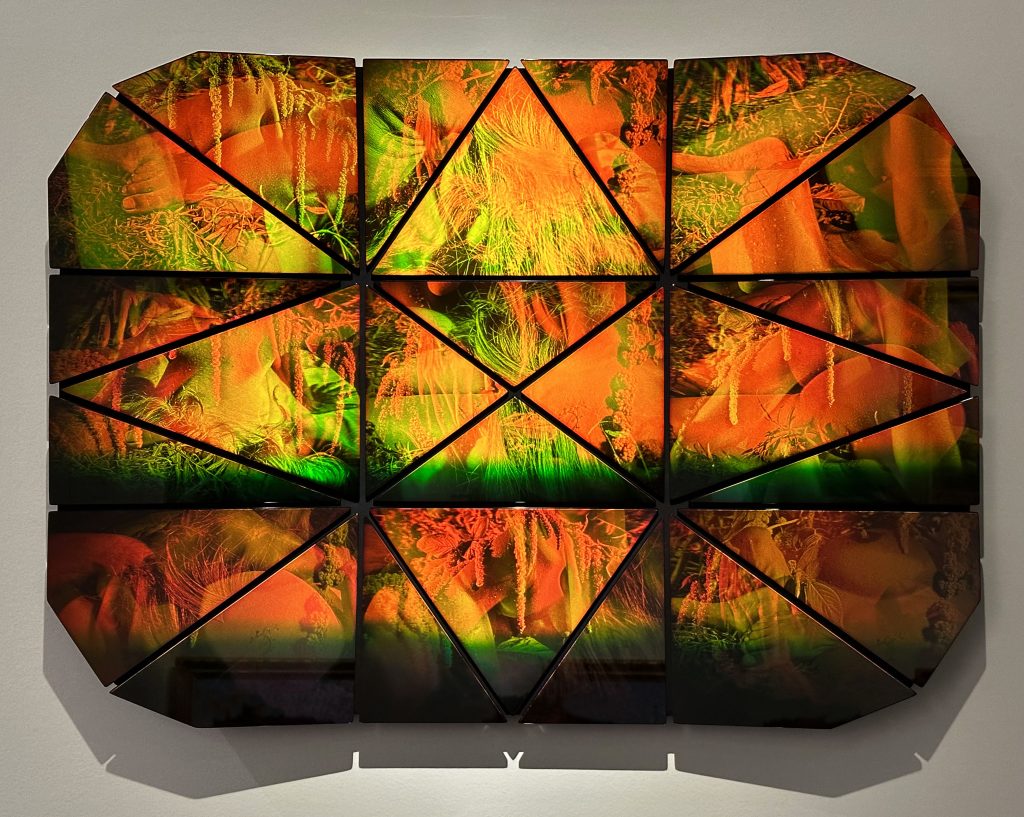
Sarah Meyohas, “Interference #19”, 2023, Holograms, mirrored black glass, aluminum

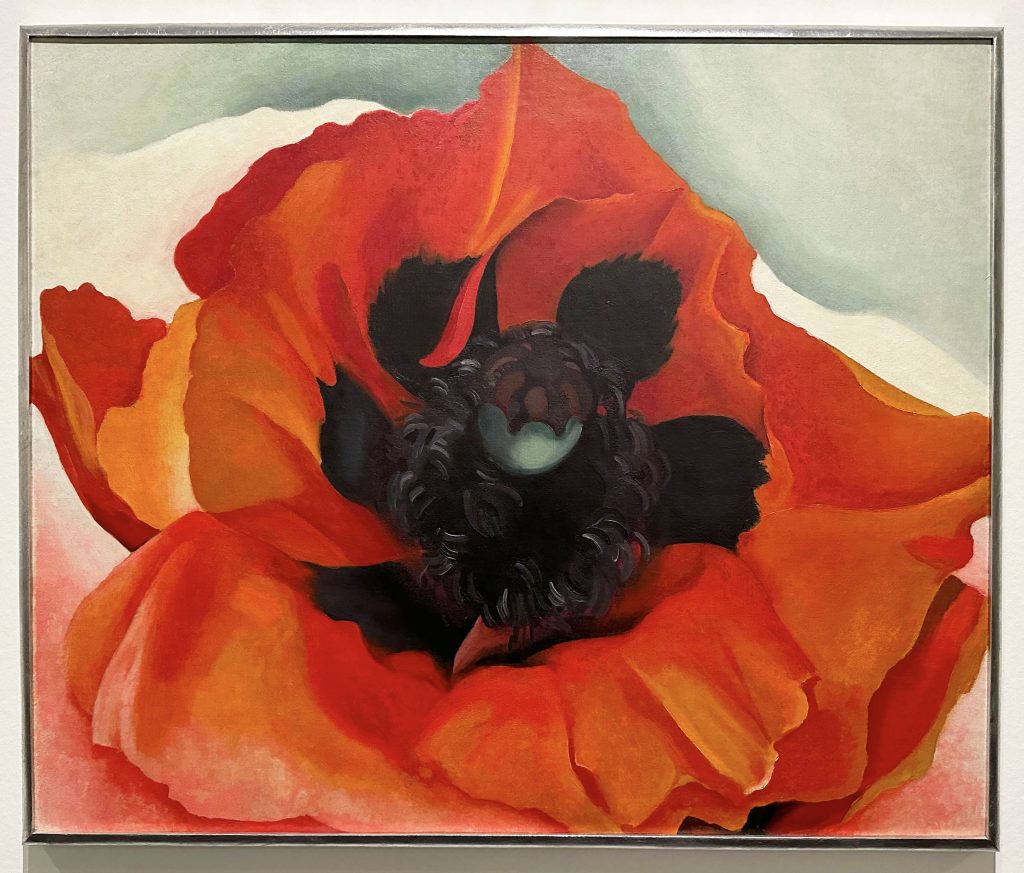
Georgia O’Keeffe, “Poppy”, 1927, Oil on canvas

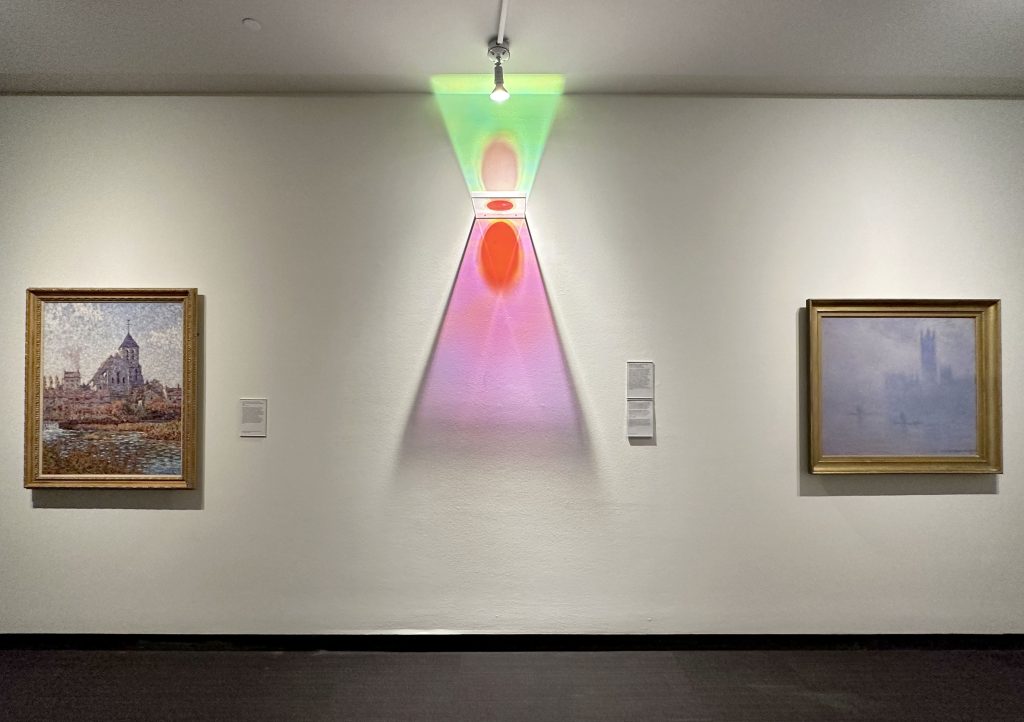
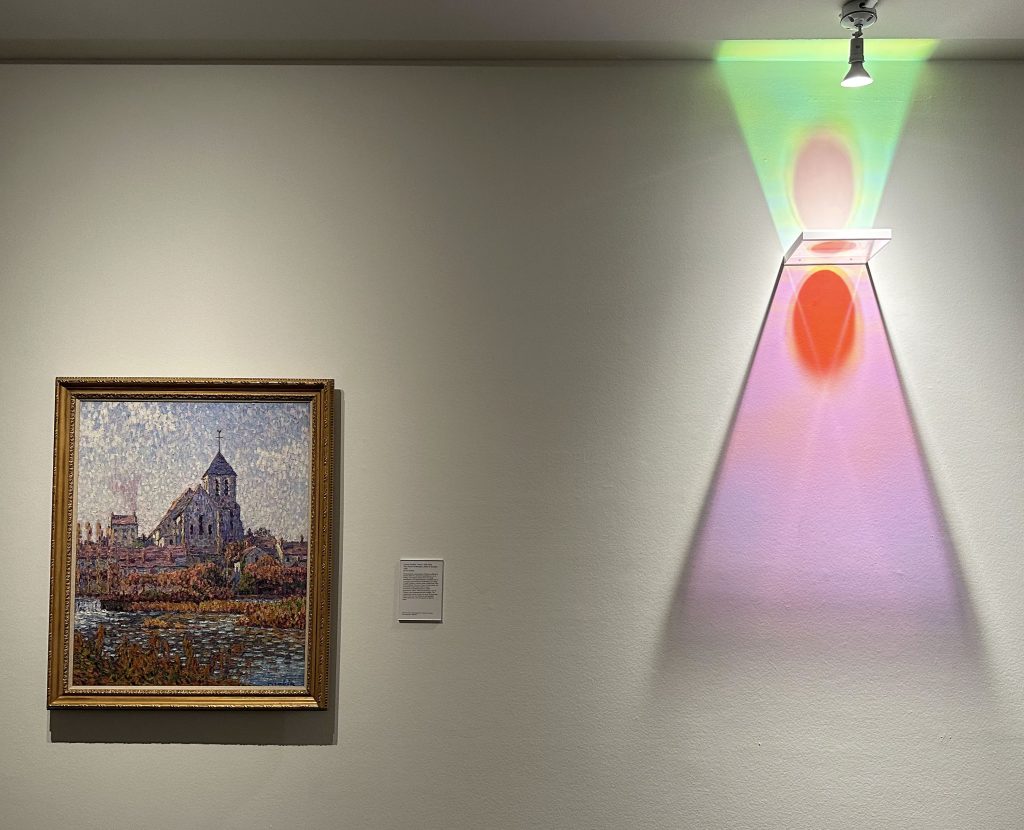
Francis Picabia “The Church of Montigny, Effect of Sunlight” 1908, Oil on canvas (left); Christian Sampson “Projection Painting”, 2023, Acrylic and films with LED light; and Claude Monet “The Houses of Parliament, Effect of Fog, London” 1904, Oil on canvas (right)

The Nature of Art exhibition at the Museum of Fine Arts St. Petersburg merges art from the museum’s collection with loaned works to explore- “art’s crucial role in our evolving quest to understand our relationship with nature and our place in the cosmos”.

One of the benefits of an encyclopedic museum is that visitors have the opportunity to experience art throughout history, and to revisit works that resonate with them. For the section titled Artist as Curator, Sarah Meyohas and Christian Sampson chose pieces from the museum’s collection to pair with their own work.

From the museum-

At first glance, perhaps, these may seem like unusual combinations, but upon deeper contemplation, their selections reveal complementary artistic intents. For instance, Meyohas and Georgia O’Keeffe share an interest in close looking, particularly in finding new ways to examine underappreciated aspects of the natural world. Sampson, influenced by the California Light and Space Movement, is interested in current scholarship that suggests the hazy fog found in Claude Monet’s work is an early depiction of air pollution, offering an entirely new perspective on the artist’s representations of light.

Sampson also created the four-part installation, Tempus volat, hora fugit, on view until 2025 at the museum.

Below are some of the works from additional sections of the exhibition.

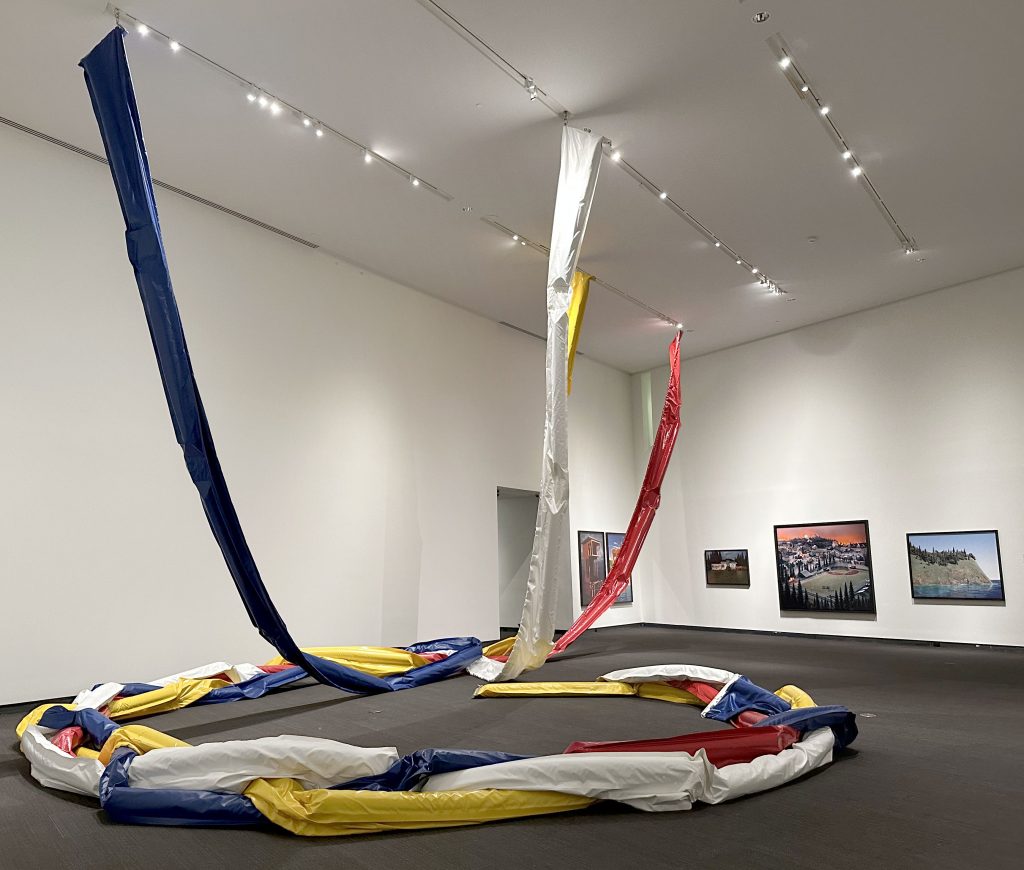
Postcommodity, “kinaypikowiyâs”, 2021, Four 30.5-metre industrial debris booms

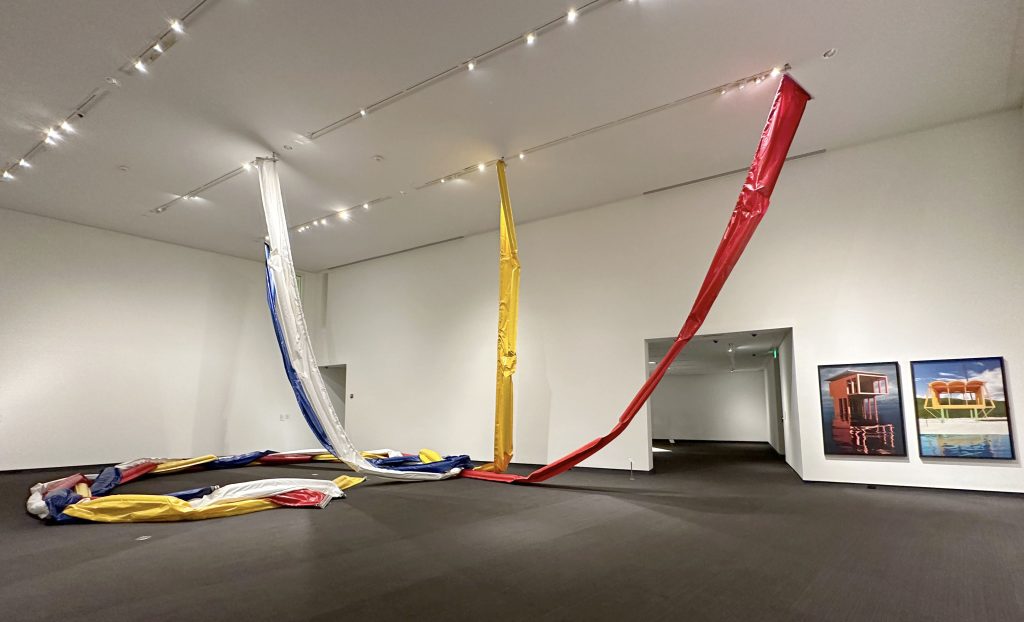
Postcommodity, “kinaypikowiyâs”, 2021, Four 30.5-metre industrial debris booms

Postcommodity is an interdisciplinary art collective comprised of Cristóbal Martínez (Genizaro, Manito, Xicano), and Kade L. Twist (Cherokee).

About Postcommodity’s work, kinaypikowiyâs, (seen above) from the museum-

This work is composed of debris booms, used to catch and hold environmental contaminants such as garbage, oil, and chemicals. The colors of the booms correspond to different types of threats— red (flammable), yellow (radioactive), blue (dangerous), and white (poisonous)-in the labeling system for hazardous materials. To indigenous peoples, these are shared medicine colors that carry knowledge, purpose and meaning throughout the Western Hemisphere. Suspended like hung meat, the booms represent a snake that has been chopped into four parts. Each part represents an area of the colonial map of the Western Hemisphere: South America, Central America, North America, and all of the surrounding islands. The title, kinaypikowiyâs, is a Plains Cree word, meaning snake meat. Divided by borders, Postcommodity asserts that all people living in the Americas are riding on the back of this snake.

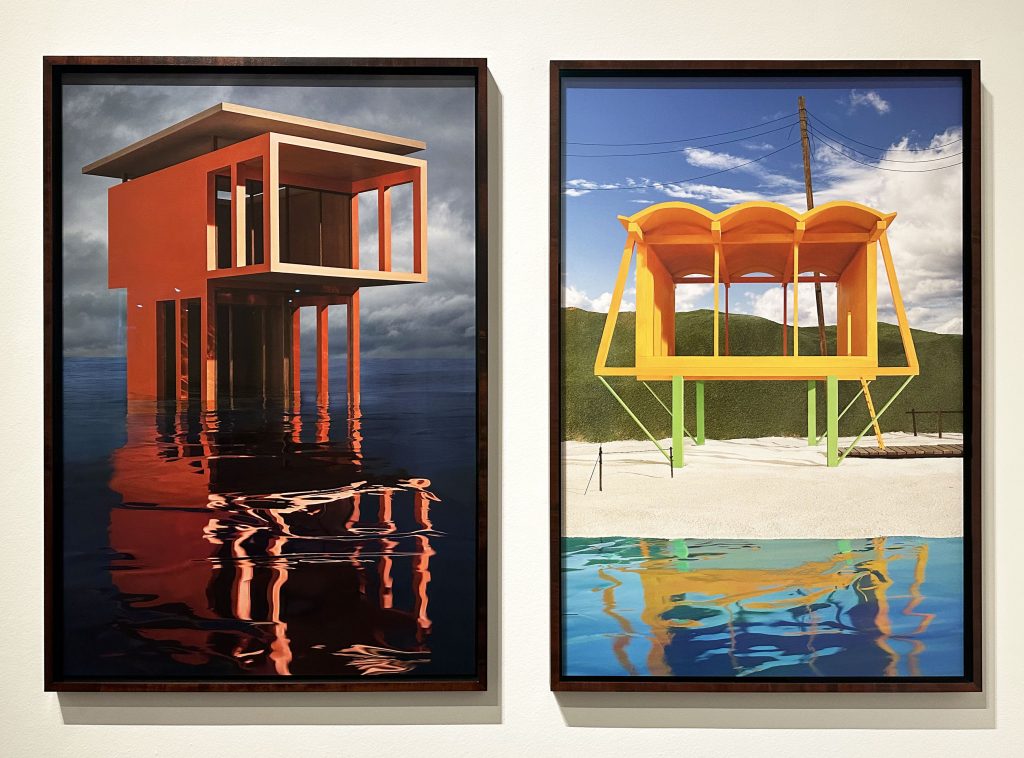
James Casebere, “Red/Orange Solo Pavilion”, and “Orange Guesthouse”, 2018, Archival pigment print mounted to Dibond

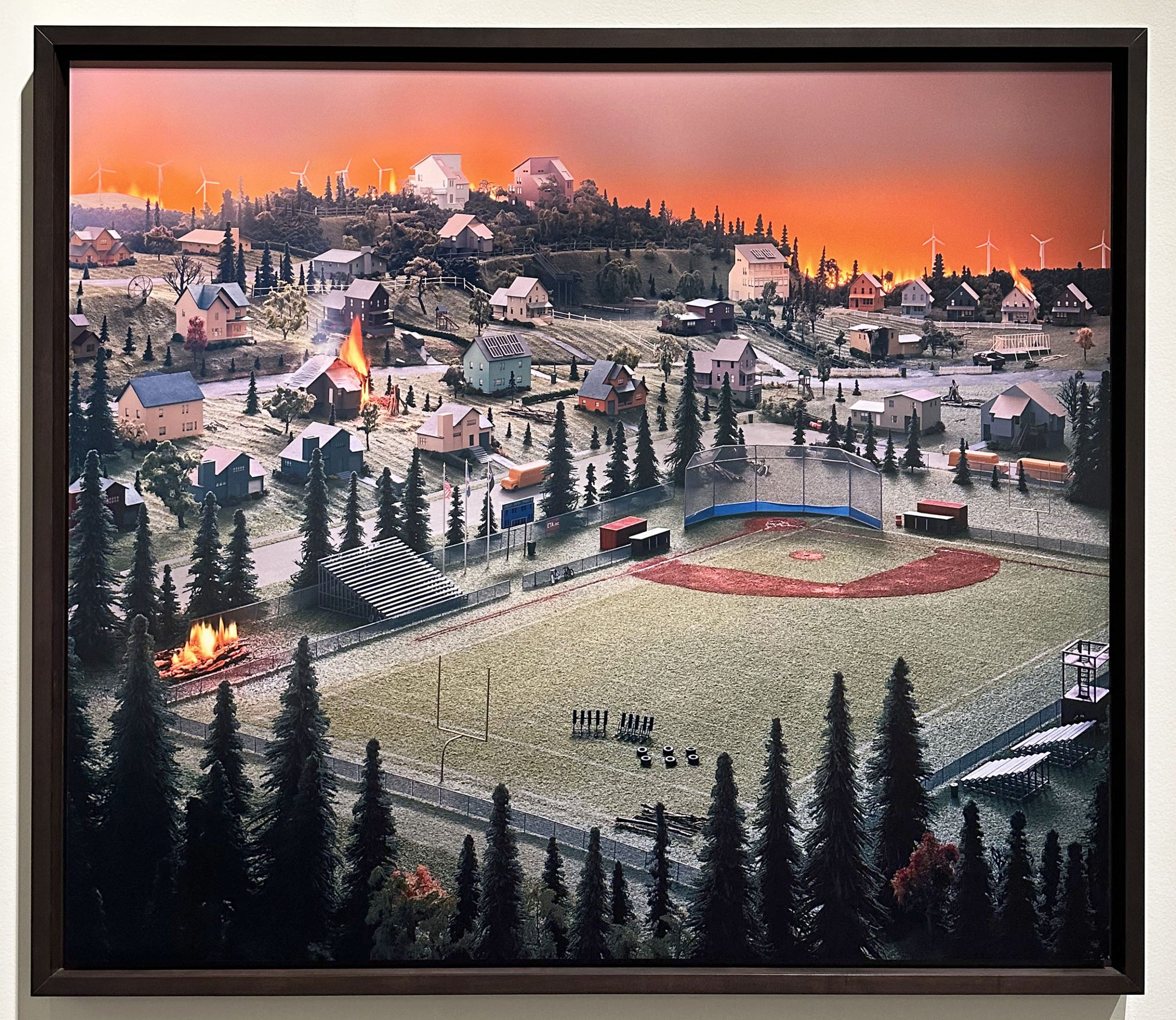
James Casebere, “Landscape with Houses (Dutchess County, NY), 2009, Archival pigment print mounted to Dibond

James Casebere creates architecturally based models for the large scale photographs seen above.

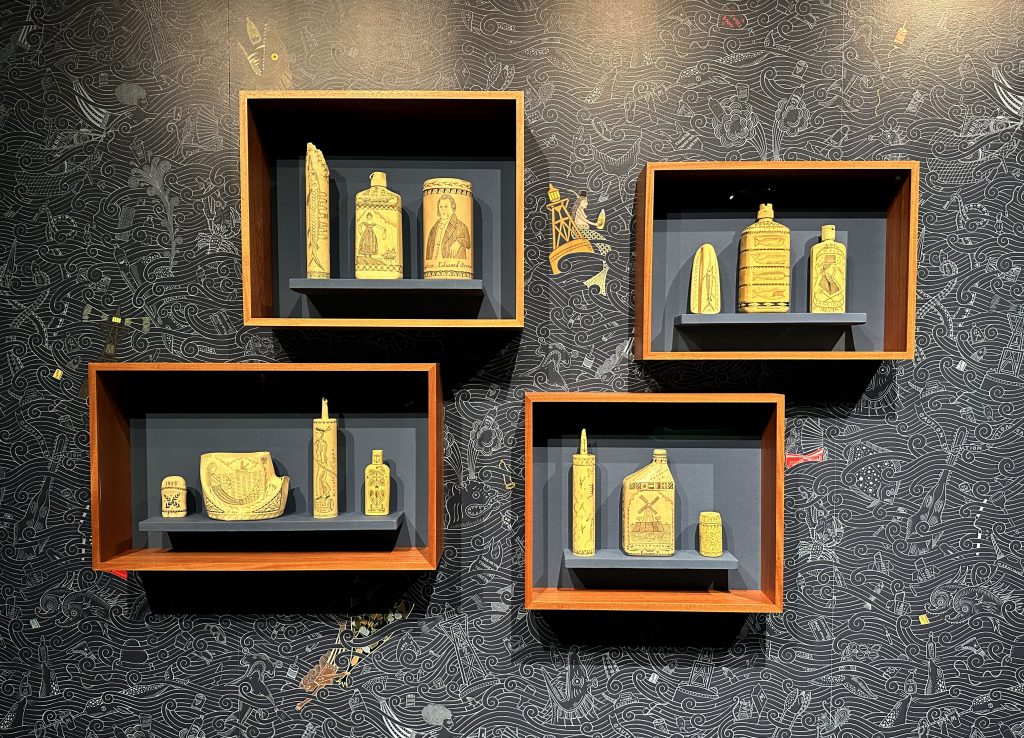
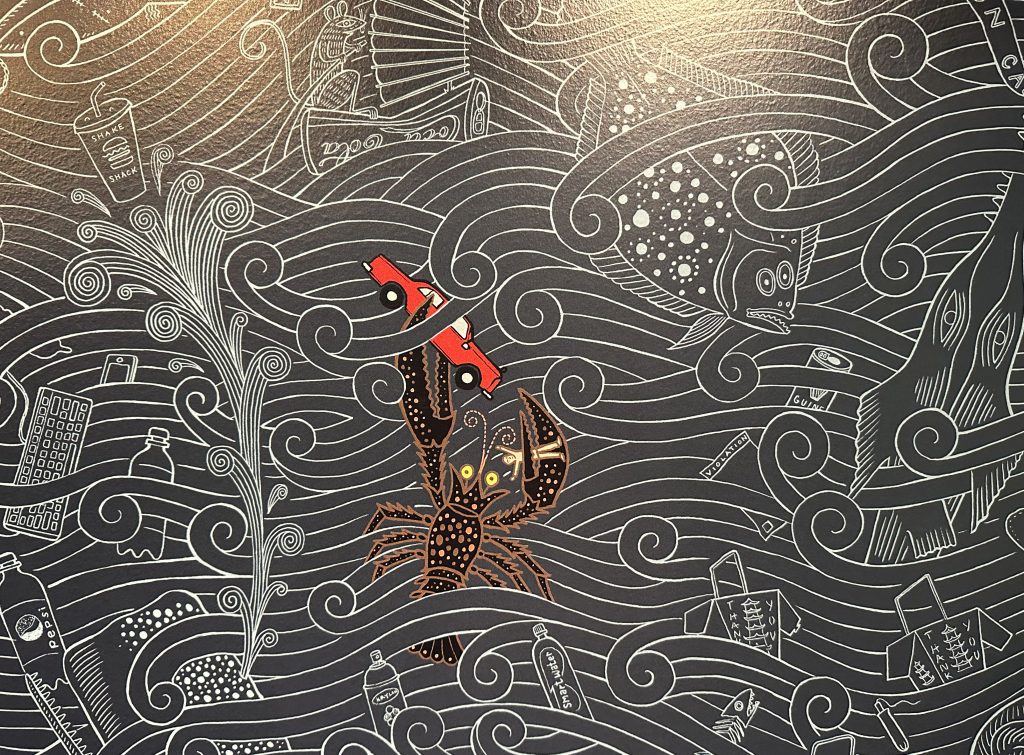
Reclaimed ocean plastic sculptures and “Tidal Fool” wallpaper by Duke Riley

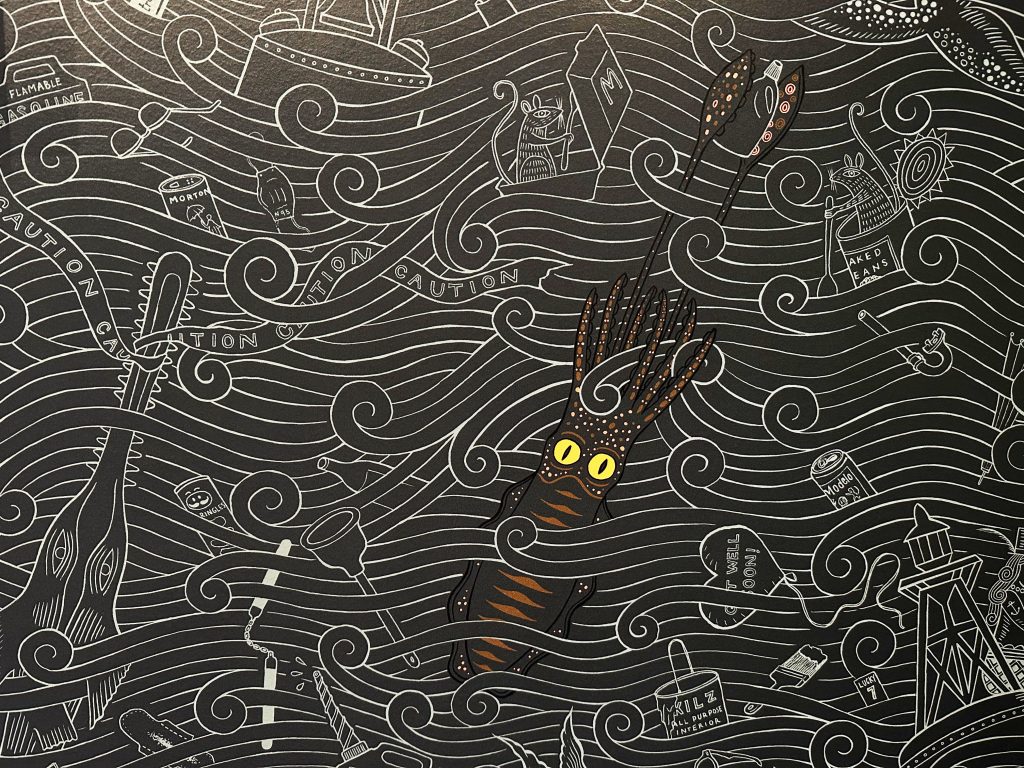
Duke Riley custom wallpaper, Tidal Fool, detail

Duke Riley custom wallpaper, Tidal Fool, detail

Duke Riley’s work, which was previously shown at Brooklyn Museum, addresses issues of environmental pollution by using discarded plastics found in the ocean and other waterways to create new work inspired by the past. You can hear him discuss his work in this video.

From the museum-

Inspired by the maritime museum displays he saw while a child growing up in New England, Riley’s scrimshaw series is a cutting observation of capitalist economies-historic and today-that endanger sea life. The sculptures were created for the fictional Poly S. Tyrene Memorial Maritime Museum, and are contemporary versions of sailors’ scrimshaw, or delicately ink-etched whale teeth and bone. Riley first thought about using plastic as an ode to scrimshaw when he saw what he thought was a whale bone washed up on the beach in Rhode Island; it turned out to be the white handle of a deck brush. Riley regularly removes trash from beaches and waterways, and often uses this refuse in his work.

Riley collaborated with Brooklyn-based Flavor Paper to create these two custom wallpapers for his solo exhibition DEATH TO THE LIVING, Long Live Trash at the Brooklyn Museum. Tidal Fool exhibits Riley’s trademark humor in the face of devastating water pollution; notice the Colt 45-guzzling mermaid. Wall Bait vibrantly references Riley’s meticulous fishing lures, which he crafts from refuse found in the waters around New York City.

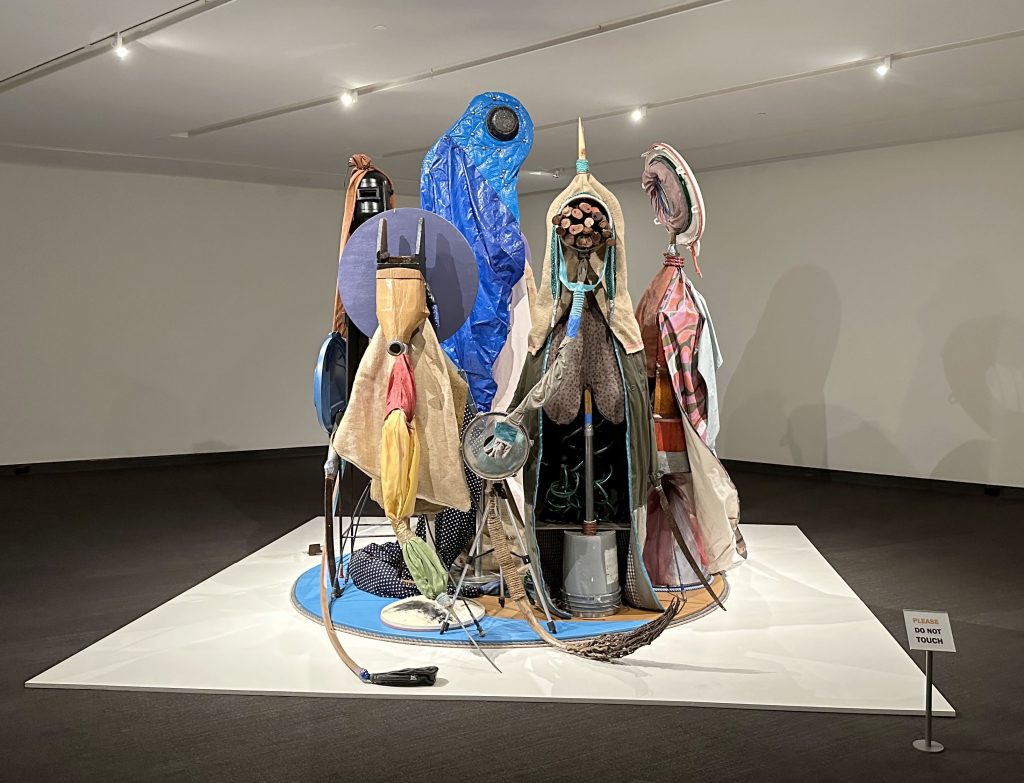
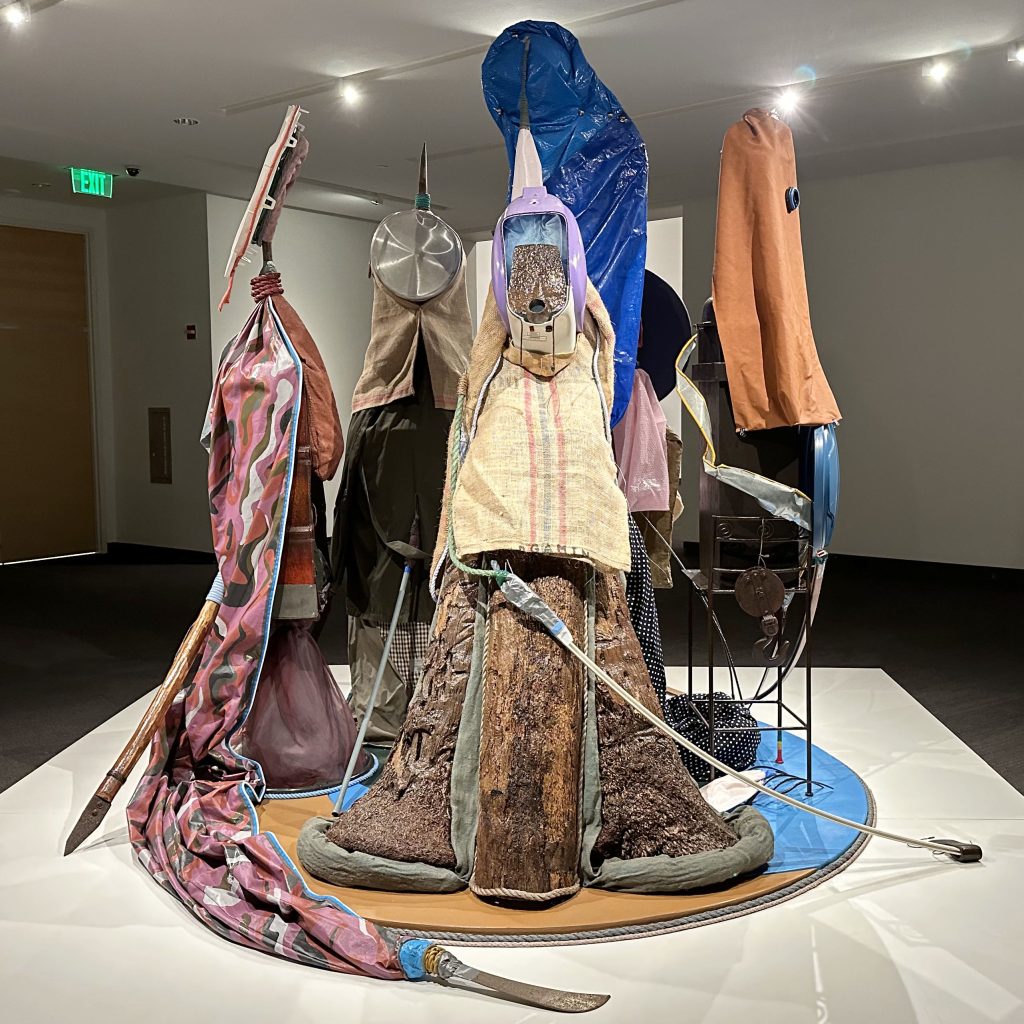
Daniel Lind-Ramos,”Centinelas de la luna nueva (Sentinels of the New Moon)”, 2022-2023, Mixed media

Daniel Lind-Ramos,”Centinelas de la luna nueva (Sentinels of the New Moon)”, 2022-2023, Mixed media

Daniel Lind-Ramos also uses a variety of recycled objects to create his sculptures.

From the museum about this work-

In Centinelas de la luna nueva, he evokes the elders of the mangroves, spiritual beings who watch over and ensure the health of this essential coastal tree. Mangroves are the basis for a complex ecosystem that shelters sea life and serves as the first line of defense in the tropical storms that batter the sub-tropics—including Florida.

Lind-Ramos’s practice reflects the vibrant culture of his native Loíza, Puerto Rico, by honoring local agriculture, fishing, cooking, and masquerade. His sculptures also evoke Hurricane Maria (2017), the COVID-19 pandemic, and ongoing environmental degradation. Lind-Ramos is committed to the survival and sustenance of Afro-Taíno traditions and people of the Puerto Rican archipelago. However, his art engages the global community through shared emotions, parallel histories, and the commonality of human experience.

The next post will discuss two other artists in the exhibition, Brookhart Jonquil and Janaina Tschäpe.

Apr 072024
 

“Moon Setting into Fog Bank over Cape Cod Bay, Morning of the Total Lunar Eclipse”, 2007, printed 2023

“1:30-4:30a.m., Moon Rising, Antelope Lake”, 2011, printed 2023

“Sun Ball, Imnamatnoon Creek, Lochsa River Valley”, 1995, printed 2023

“Fireflies”, 2005

One of the smaller prints from the “Fireflies” series

There is something so peaceful about the photographs in Barbara Bosworth: Sun Light Moon Shadow, currently on view at Cleveland Museum of Art. These beautiful moments she has captured allow the viewer to share her sense of wonder.

From the museum about the exhibition-

“My childhood home is where all my photographs come from,” says American photographer Barbara Bosworth (born 1953). Growing up in Novelty, Ohio, Bosworth adored walking with her father and looking up at the night sky, a practice that became a lifelong passion. This exhibition -timed to coincide with the total solar eclipse visible in Cleveland on April 8— features the artist’s photographs of light, from eclipses, sunrises, and sunsets to the luminescent glow of fireflies and a flashlight. Her images both explore how we endow these phenomena with personal meaning and elucidate bonds between humans and the natural world that often go unnoticed.

Photography is an art form with its roots in science, even though the two disciplines are sometimes considered opposites. The term photography was coined in 1839 by British scientist and astronomer Sir John Herschel from Greek words meaning “drawing with light.” Bosworth notes that light is an essential ingredient in both astronomy and photography. The camera and telescope, used together as Bosworth has in a number of the photographs on view, each collect light.

Time is another integral component of photography: a photograph records the light that strikes a sensitized surface-such as film or, in the case of digital photography, a sensor-during a certain length of time. In making her photographs of the heavenly bodies, Bosworth says she wants “to be reminded of the mystery closer to home: the sheer strangeness that light — millions of years old, unfathomably old – can still land on my film and be seen.”

This exhibition is on view until 6/30/24.


Apr 032024
 

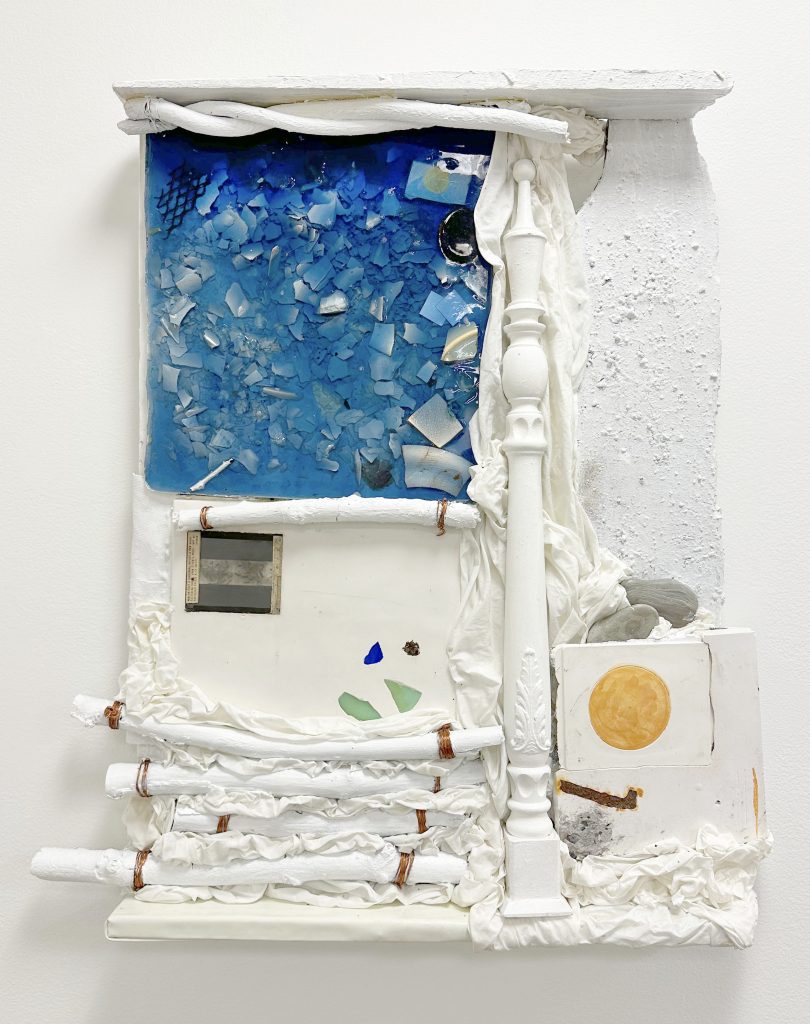
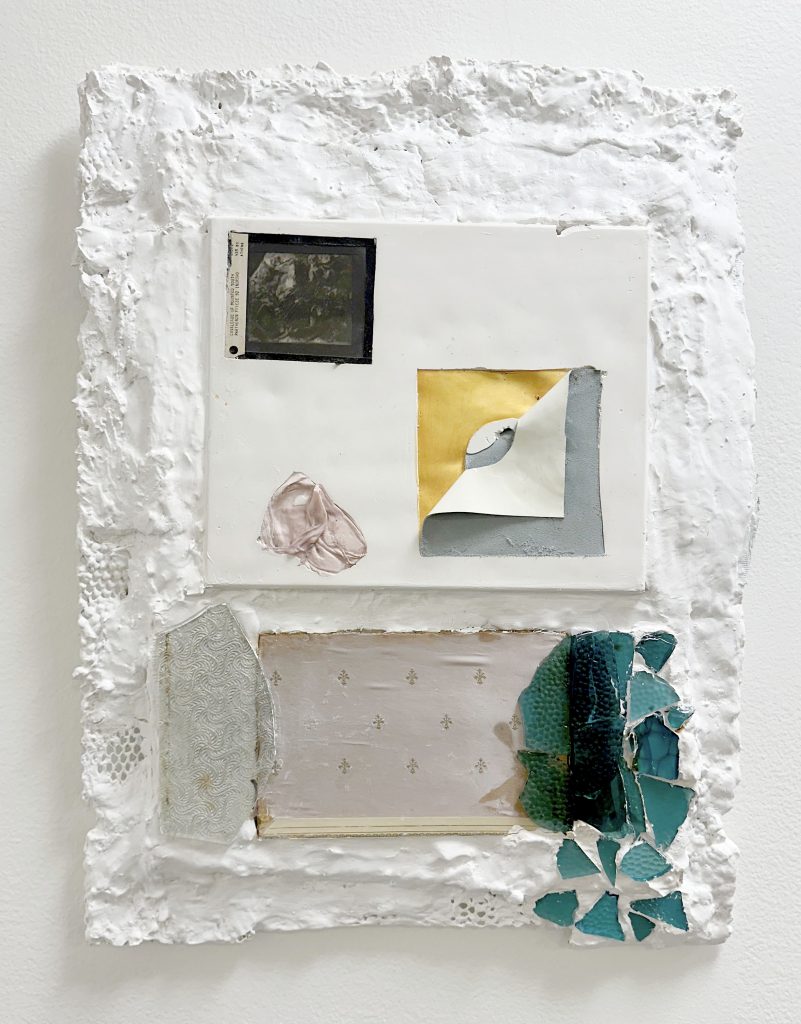
Julia Schenkelberg, “Blue Ocean”, 2020, Blue dye, resin, rusted metal from Detroit factory floors, plaster chips, vintage china, glass from Brooklyn beaches

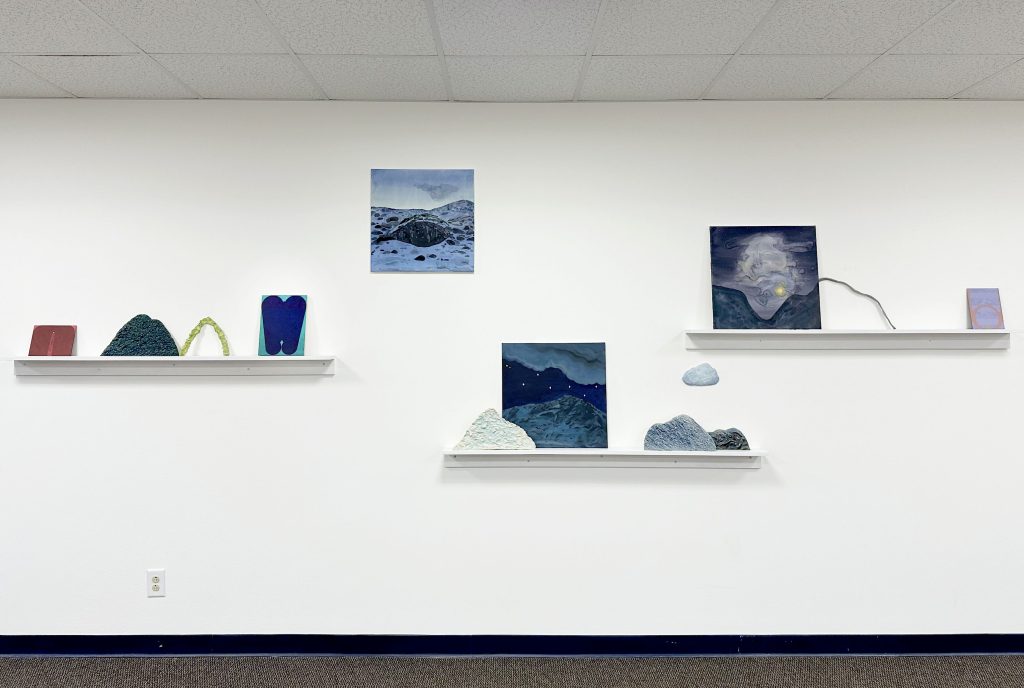
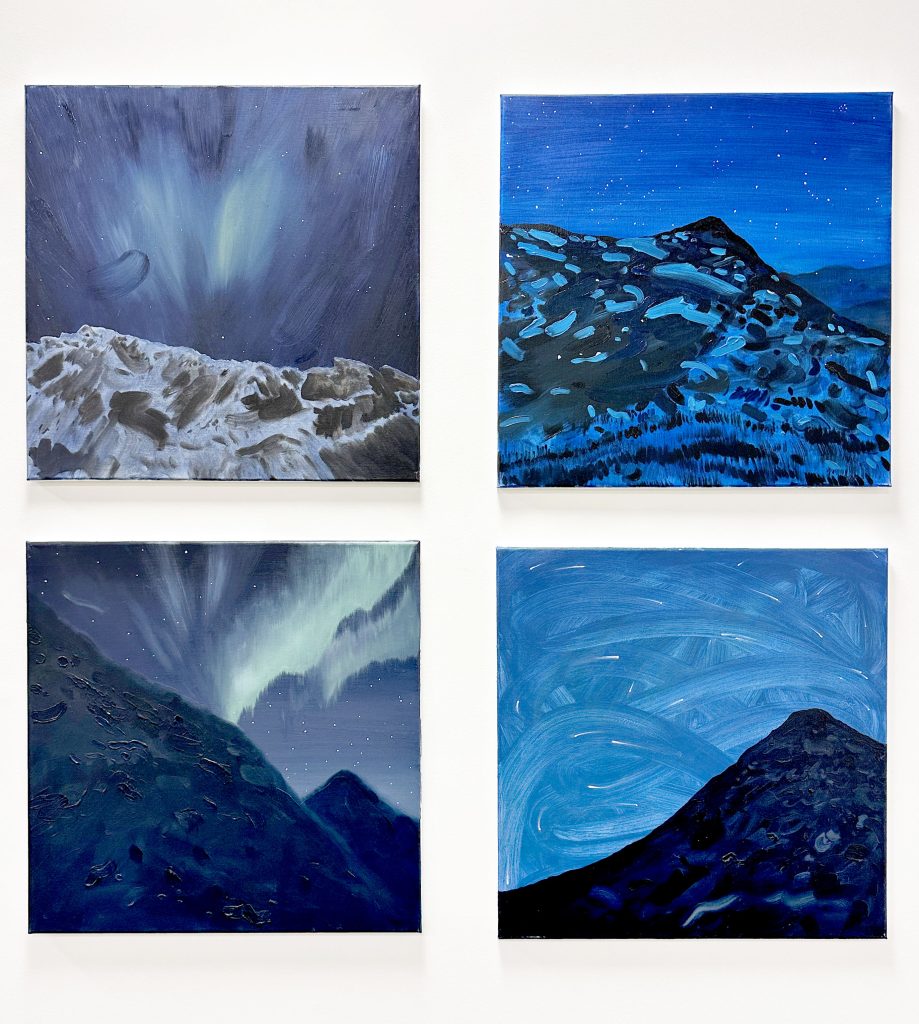
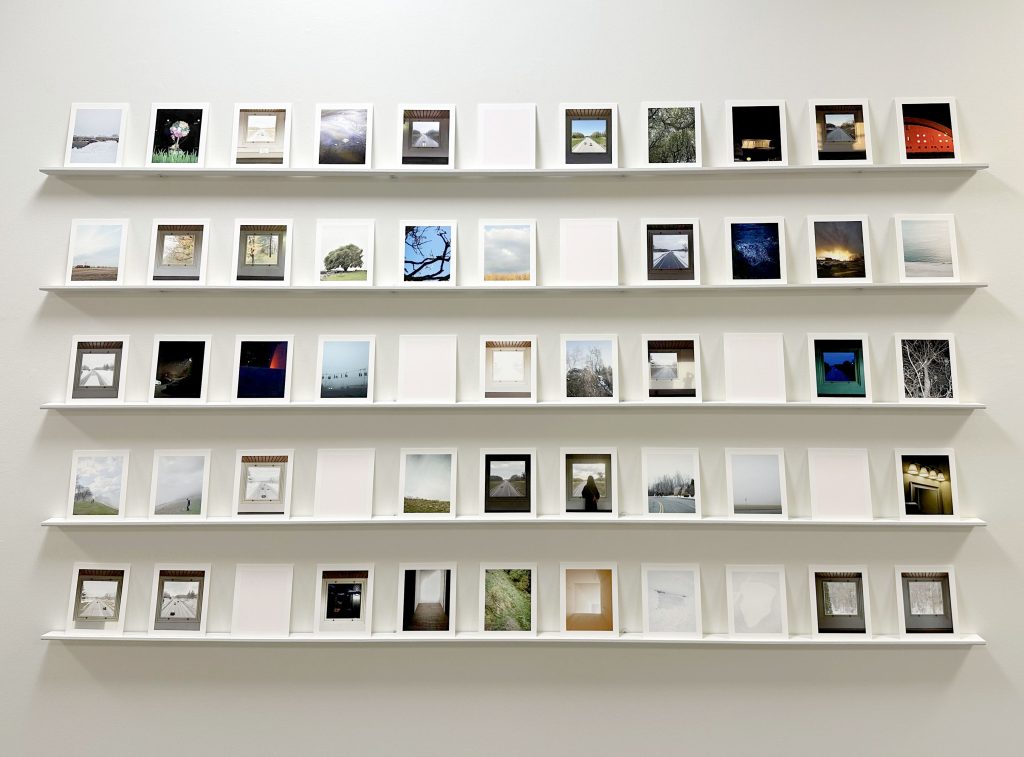
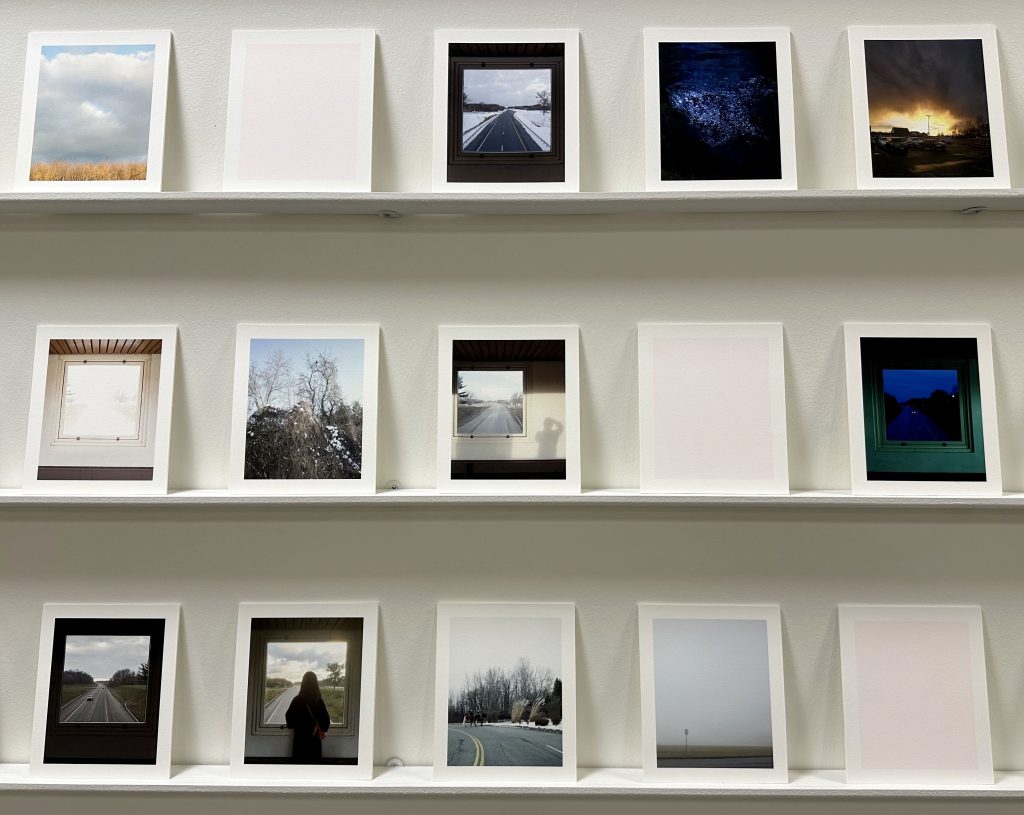
Malone University Art Gallery’s exhibition Healing Spaces features work by Northeastern Ohio artists Julie Schenkelberg, Chen Peng, Yiyun Chen, and Emily Bartolone. Although the mediums differ, the work flows together in the room. Below are some selections and more about each artist from the gallery’s documentation.

Julie Schenkelberg, “Modern Memorial”, 2020, Found screen, plaster, acrylic paint, vintage leather and fabric, jewelry box interior, glass gathered from Cleveland and Detroit auto and steel factory abandoned floors, vintage glass slide of the Parthenon Frieze

Julie Schenkelberg grew up in the post-industrial landscape of Cleveland, Ohio. Her mixed-media installations start with furniture, dishware, textiles, and marble, combined with concrete, resin, and construction materials, to transform notions of domesticity, and engage with the American Rust Belt’s legacy of abandonment and decay. Using the home as a playground for formal and conceptual subversions, the work aggressively disrupts cohesion within the physical sphere. Familiar furnishings rekindle memories or premonitions of collapse, suggesting both the utter destruction of war, calamities, or urban decay, but also the uncanny juxtapositions of fragile substances such as cloth and china, with industrial materials such as rusty metal, heavy concrete, and tool-made marks such as drilled holes and chain-sawed indentations.

Chen Peng, Paintings from the “Mountains at Night” series, 2023, gouache, acrylic, and oil on canvas

Deriving from a desire to find stillness and grounding as an immigrant, Chen Peng explores the connection between landscape and the complexities of identity and belonging. She creates foreign landscapes from a combination of past experiences, memories, and imagination, delving into the disorienting sense of not knowing where home is. The moon, particularly in its fullness, becomes a symbol encapsulating emotions and metaphors associated with loneliness, reverence, and even terror. Her ceramic pieces extend this exploration of landscapes, featuring textures and marks that convey the essence of mountains, clouds, and the moon.

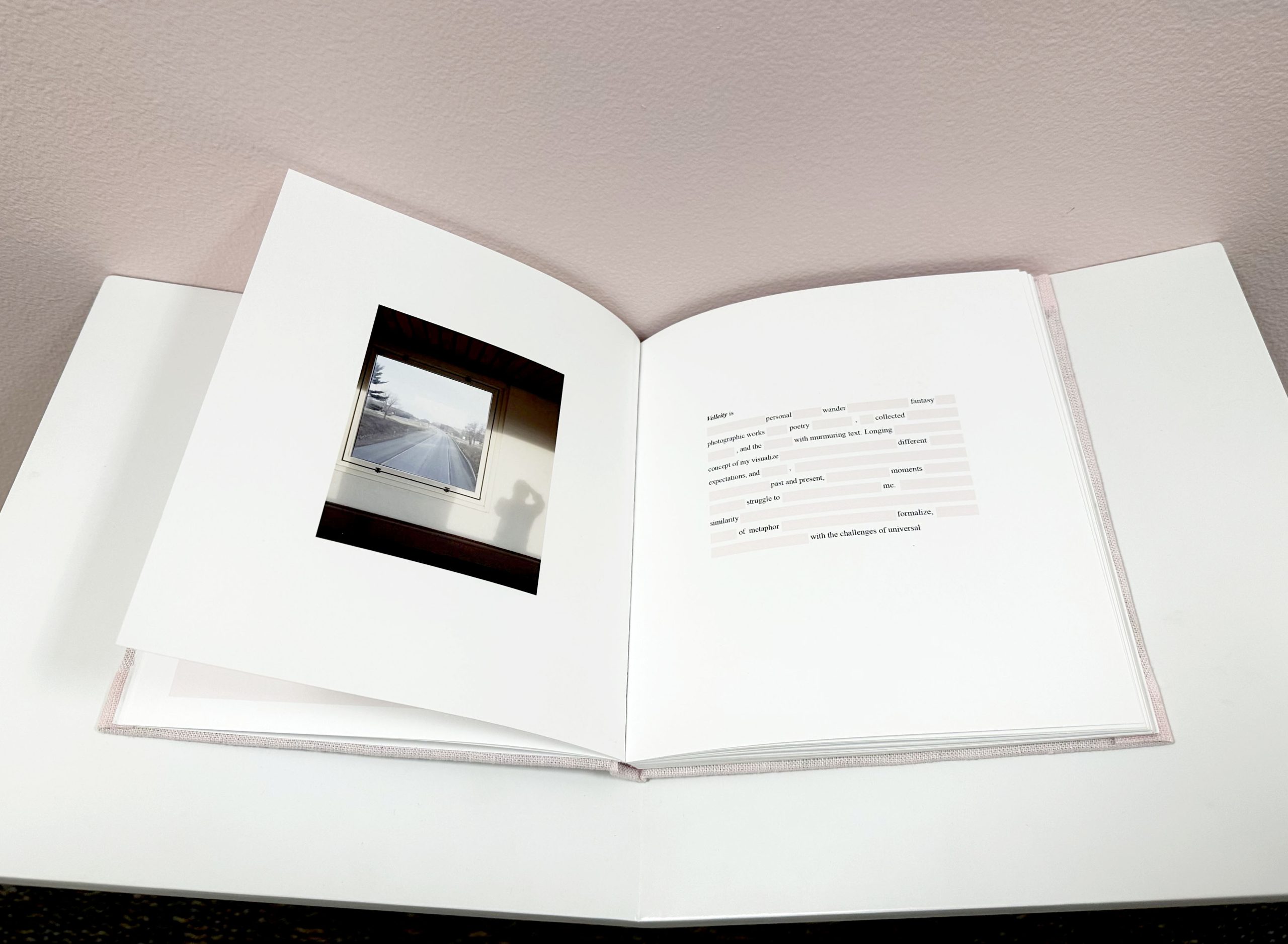
Photographs from from Yiyun Chen’s series “Velleity”, 2016-2018

Yiyun Chen, “Velleity”, detail

Yiyun Chen, Handmade photobook, 2018

The photography of Yiyun Chen is about the process of self-reflection and self-discovery as an Asian immigrant, exploring the relationship between people, environment and society, turning its personal experience and empathy into gentle conversations between humans and nature, capturing the poetic and distance of the environment around us. Through photography, we can take the essence of life seriously again and treat the people and things around us tenderly. Through his lens, they often have similar structure, people look tiny in nature scenes, creating an intimate visual experience. Most of his photographs are captured outdoors, with soft light and harmonious colors often used.

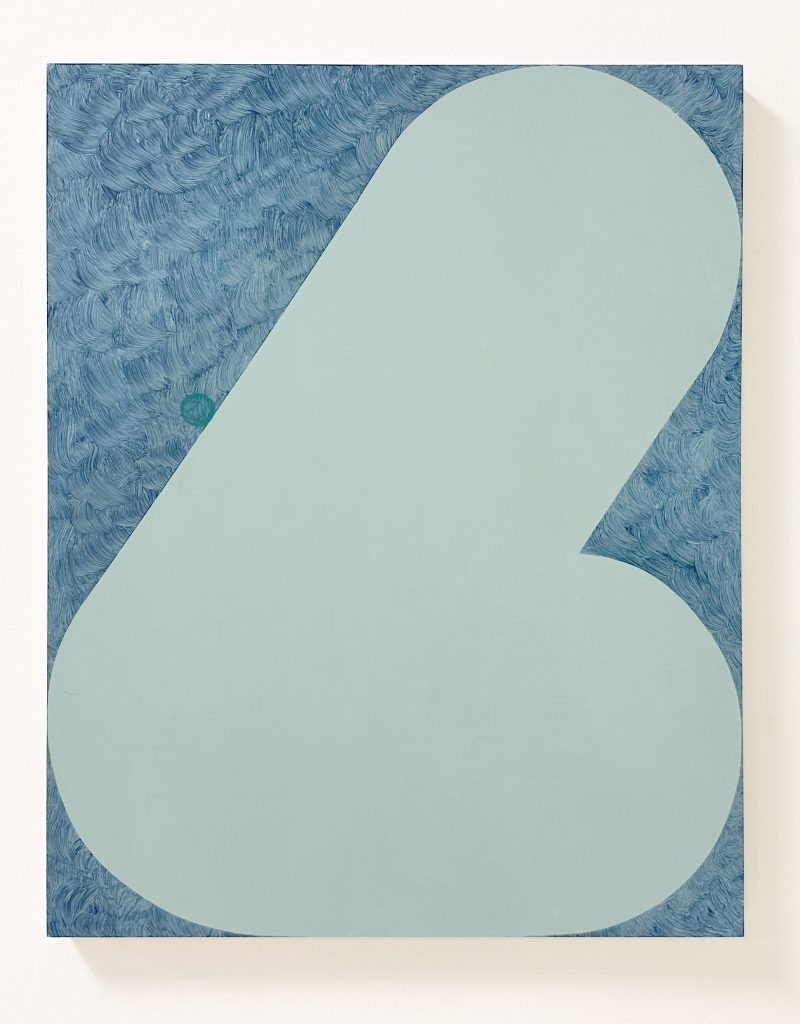
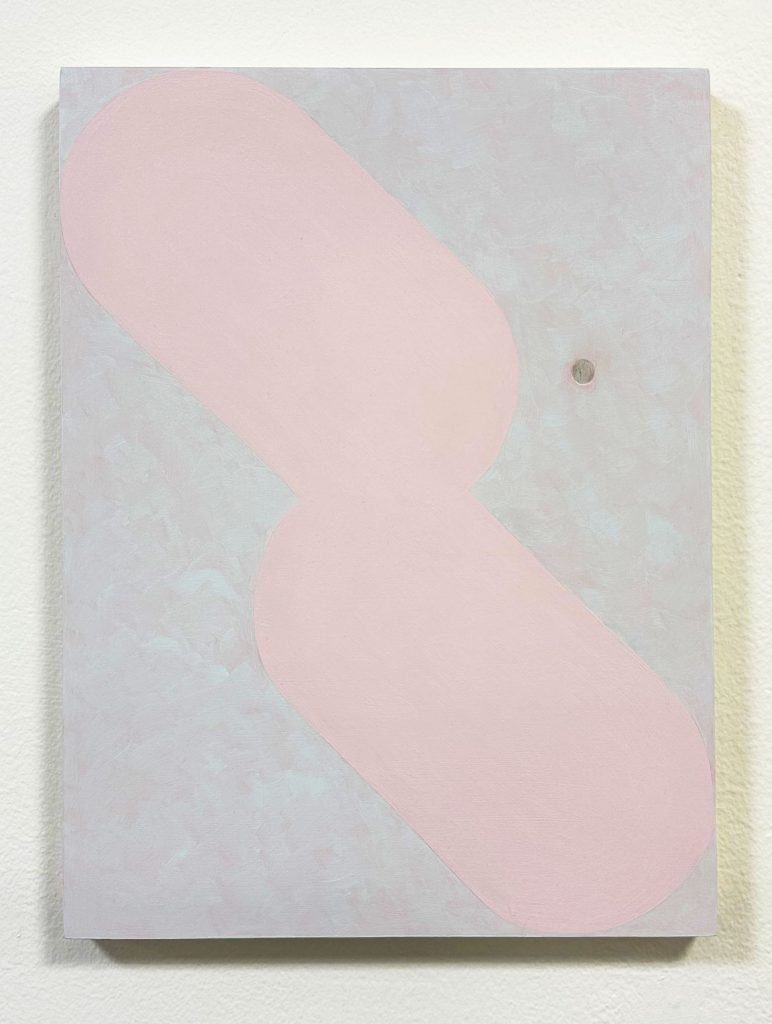
Painting by Emily Bartolone

Painting by Emily Bartolone

Stemming from her infatuation with the formal elements of painting, the work of Emily Bartolone pairs down simple, anthropomorphized shapes in an effort to explore paint and color theory while simultaneously creating tension and humor through color, edges, and texture. The playful, human qualities of painting are incorporated into the work through the use of amorphous shapes animated within the picture plane. Further informed by ideas of the mundane, the awkward, and the jovial that surround everyday life, the complexity of human relationships are mimicked by the shapes interacting on each painting’s surface. In acknowledging that life is not always cordial, moments of tension are placed within the satisfying surfaces in the form of an abrupt mark, a disparate color, or a shift in scale. These ideas are used to take viewers outside of themselves for a short period of time, hoping to offer a break from the bombardment of distractions, notifications, and news we encounter so often on a daily basis.

This exhibition closes 4/9/24.
 

Mar 202024
 

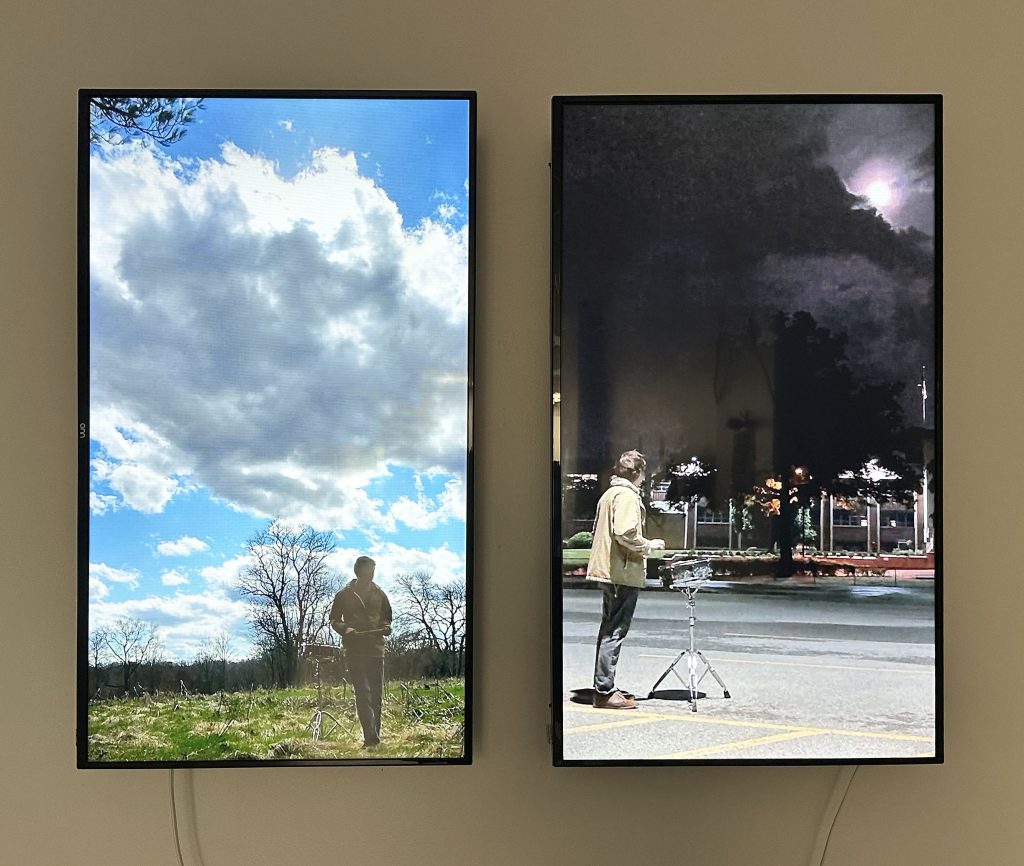
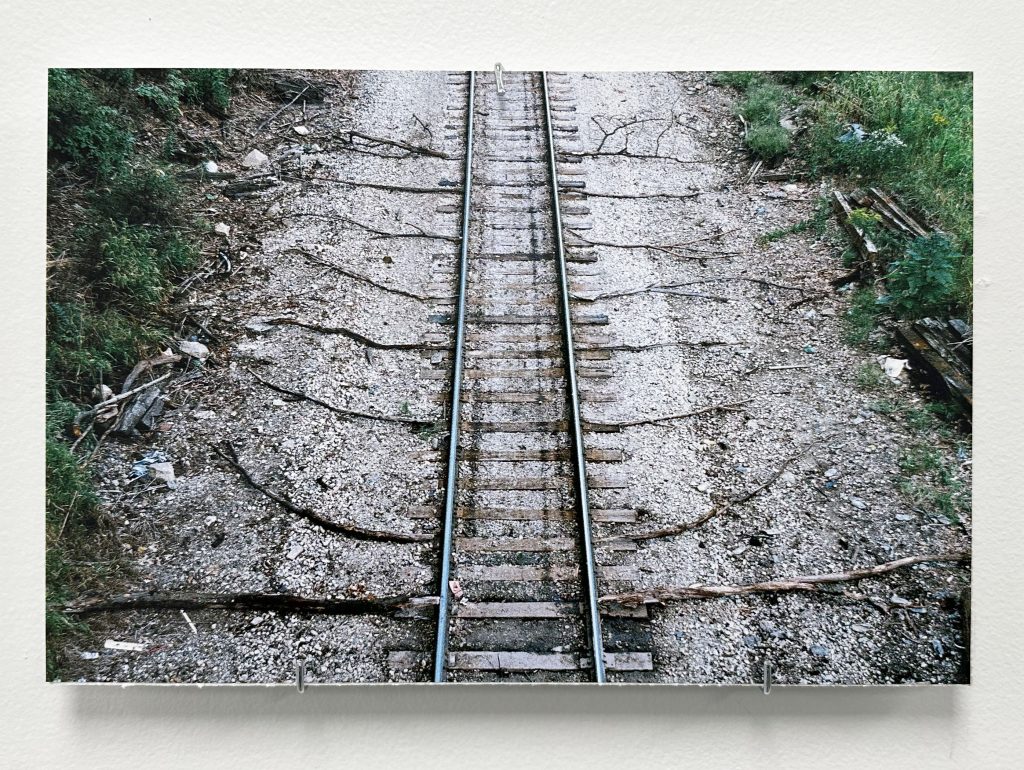
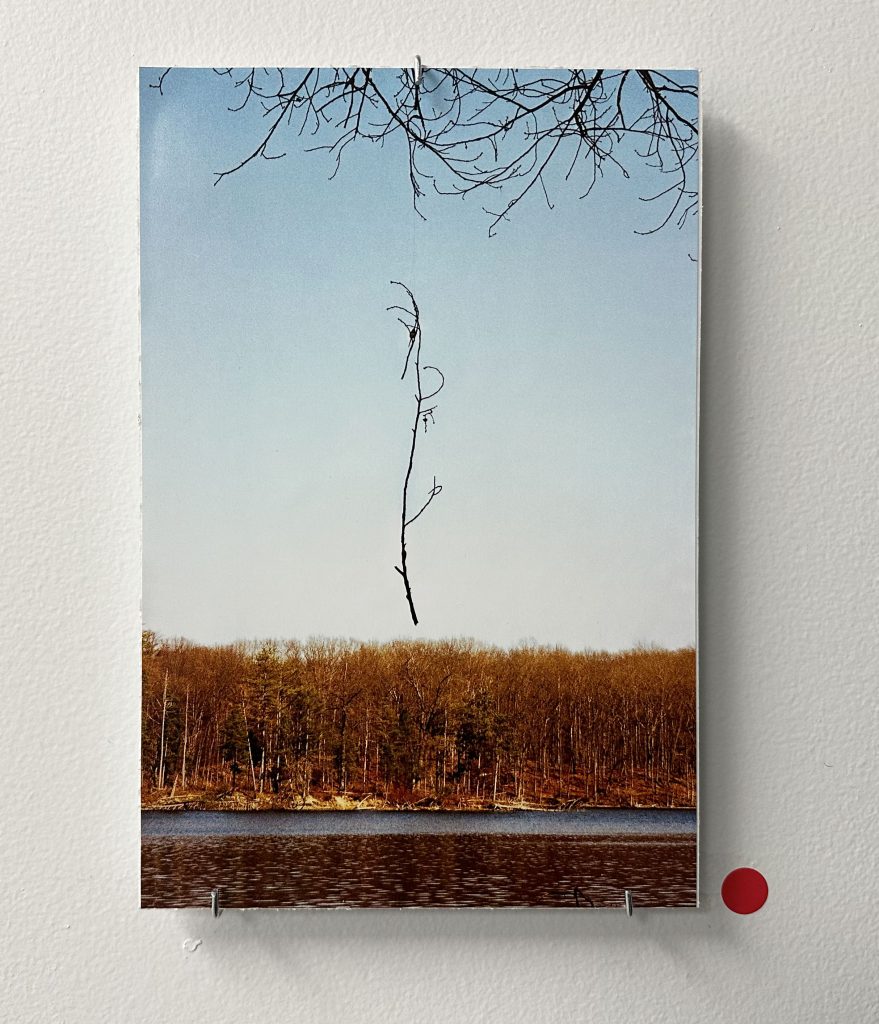
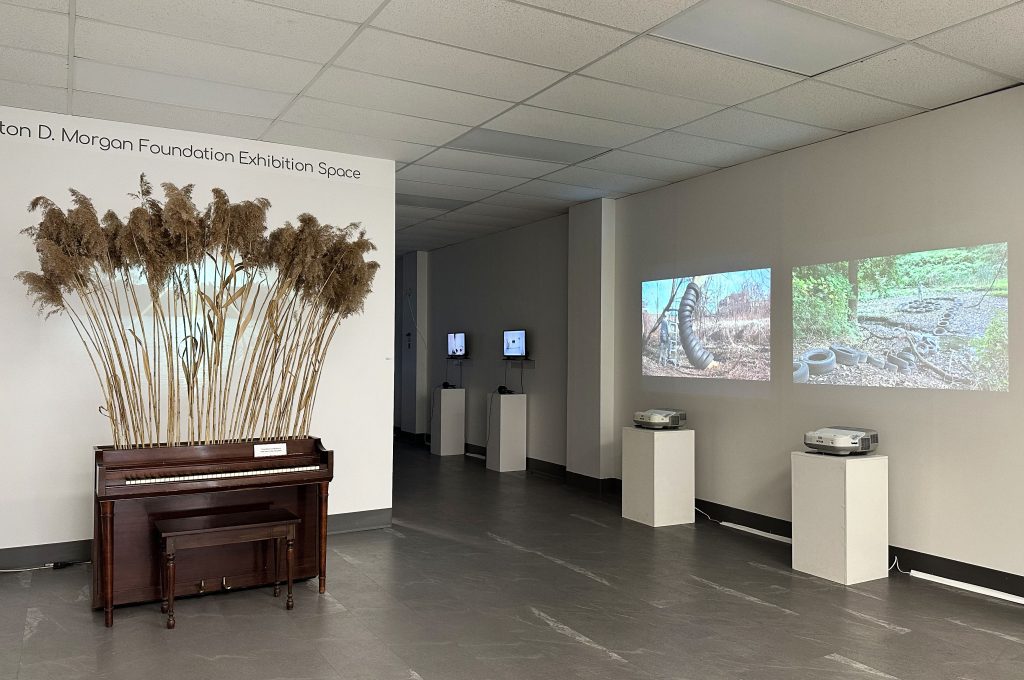
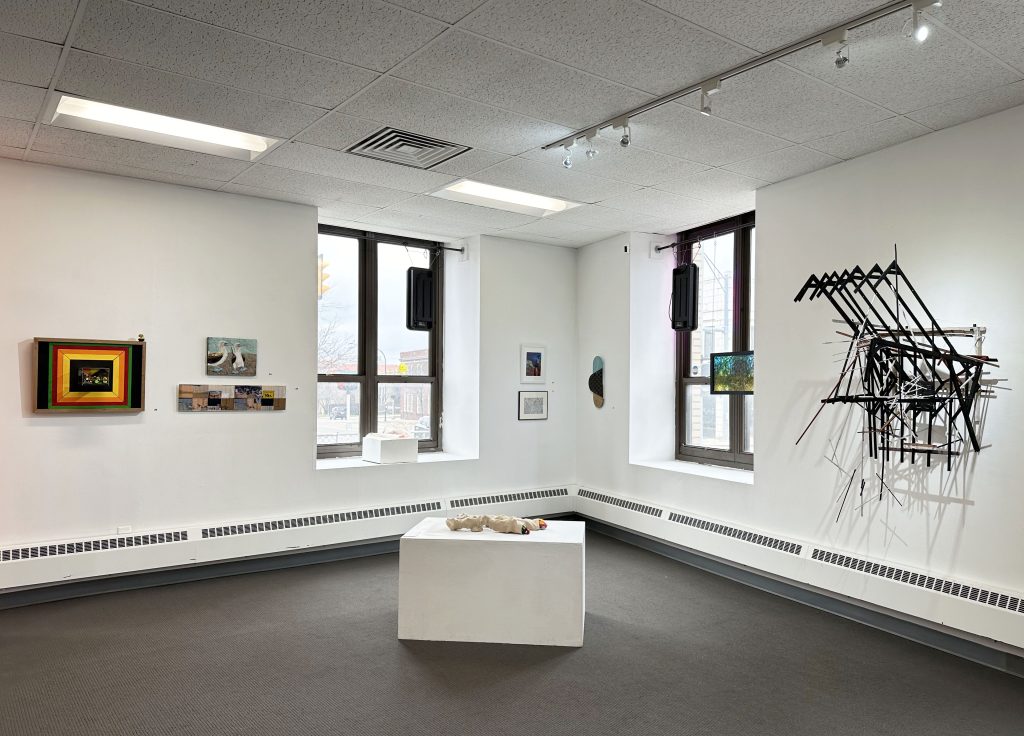
Akron Soul Train supports local artists through a residency program, exhibitions, and a shop in the front of the gallery which sells their work. Currently the gallery is showing work by Matthew Kurtz (work seen above) and Thomas Smith (work pictured below). Both artists are approaching the environment in different and interesting ways. Several of Kurz’s video pieces are focused on his upcoming performance for the solar eclipse. His photographs, for which he’s created additions to scenes he finds, are charming- as is his sculpture- a piano that moves his natural additions when played.

From the gallery-

Performance artist Matthew B. Kurtz presents Drumroll for a Total Eclipse: A Preliminary Exhibition, a prelude to his upcoming live performance with this year’s solar eclipse. Kurtz’s work fuses place, nature, sound, rhythm, and movement to question the mystery of existence. With humor, curiosity, and in tandem with his surroundings, Drumroll explores the process of trying to understand wonder.

For his upcoming performance on April 8, 2024, Kurtz will invite an audience to celebrate the total eclipse. Collaborating with the cosmos, he will perform a drumroll before “totality” passes over Northeast Ohio and creates the natural phenomenon known as “the blackout.”

“When I engage with a site for an art piece, I consider its history, recontextualize its objects, and insert my identity through intuitive gestures. I was raised to believe that humans are supposed to connect the lines between their innate feelings and the unknown. Making art is [my] attempt to reclaim this existential directive. These experiences are documented so outside viewers can participate in my examination of ambiguities, systems, and the sublime.” — Matthew B. Kurtz

Kurtz is also a musician. Check out his Instagram and Bandcamp to listen to his 2021 album 107.

For Thomas Smith’s sculptures he creates natural environments within man-made structures and uses the results as a commentary on the growth and sustainability of suburban development.

From the gallery-

In SUBARIUM II reprise, Thomas Smith combines materials from big box stores with contained terrariums to generate a sense of security and quality. However, upon second look, the viewer may see past the façade of what may look safe to what is substandard. Perhaps it is even denying growth and positive change. Smith’s sculptures dare to ask questions about survival, public image, and the landscape of today.

“Akin to an ecosystem enclosed in a terrarium, my sculptures depict a vibrant but, ultimately, unsustainable artificial environment. As plants within the terrarium grow, competition for space intensifies, turning the once-comfortable space into a struggle for survival. The metaphor extends to suburban America, where curated living conditions prioritize aesthetics over functionality, reflecting an impermanent American Dream.”

— Thomas Smith


Both of these exhibitions close 3/23/24.​

Mar 162024
 

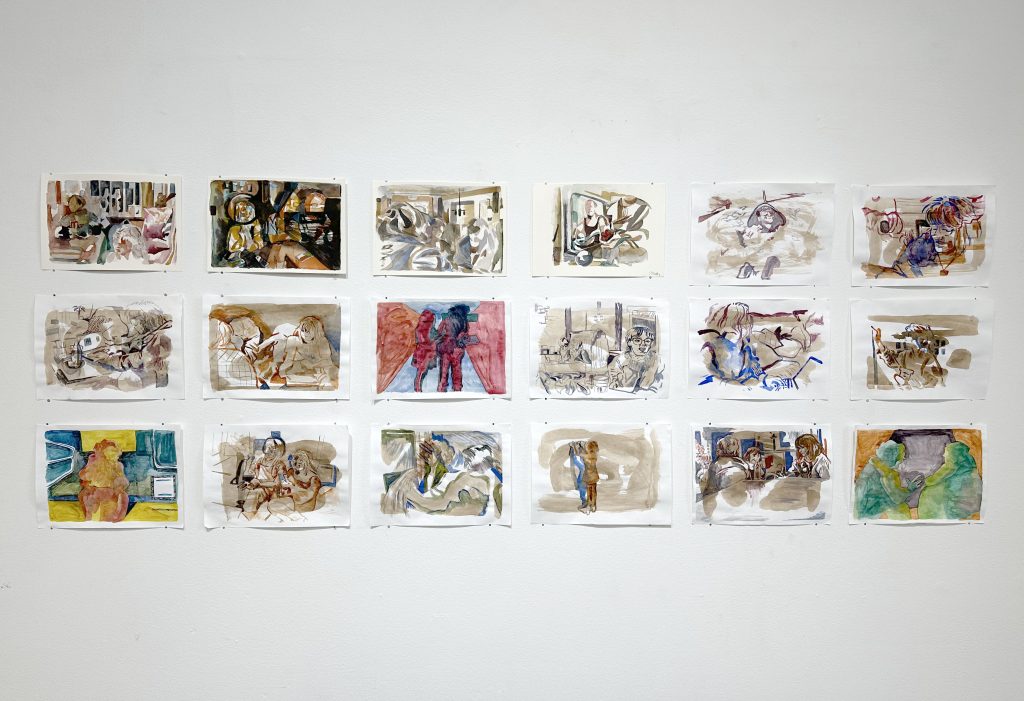
Watercolor paintings by Katherine Strobel

There is A LOT of work currently on view at Summit Artspace for their Winter Exhibitions (see the previous two posts) and it is worth mentioning these shows as well.

In the Welcome Gallery are watercolor paintings (seen above) by Katherine Strobel, for her exhibition, Bad Nostalgia.

Her statement about the work-

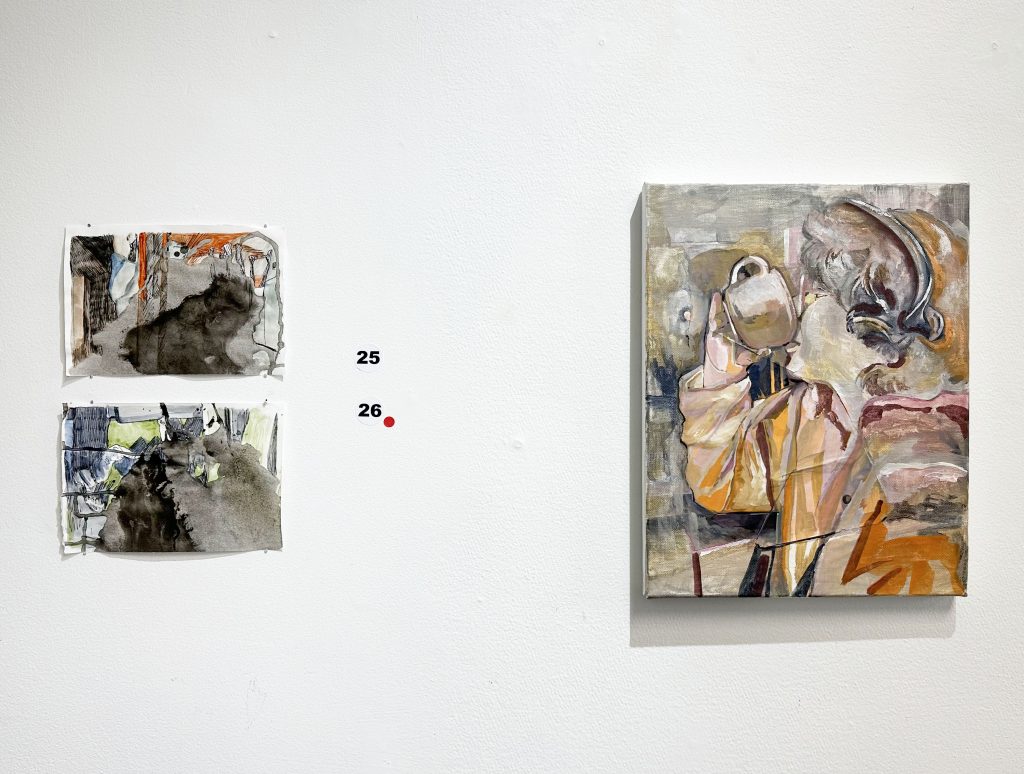
People forget to take pictures of things that don’t matter because it’s impossible to photograph qualities such as the feeling of an inside joke, the sound of an exhale through the nose, or dirty silverware that must be returned to the kitchen and replaced. These things act as set, pieces for what make up the rest of our lives. This series is a catalog of work that focuses on memory and candidness of a scene or subject. The people pictured are painted from life or candid photographs which are then emphasized from a naive image to something more. When an image is exaggerated with new colors and shapes it serves to make the mundane more desirable. The paintings are watercolors with a textured surface; the texture creates a sense of play with paper elements. In my work watercolor is often indicative of memory because of its ephemeral quality and transparent layers. This is because of how impossible it is to clarify every element that makes up a color when the layers are all compressed and viewed as a complete state.

Below are works from FRESH, an annual exhibition of local artists juried by Pita Brooks, Executive Director of Akron Soul Train. The website has all of the artists included and their statements and bios- definitely worth taking a look at what is being created in the area.

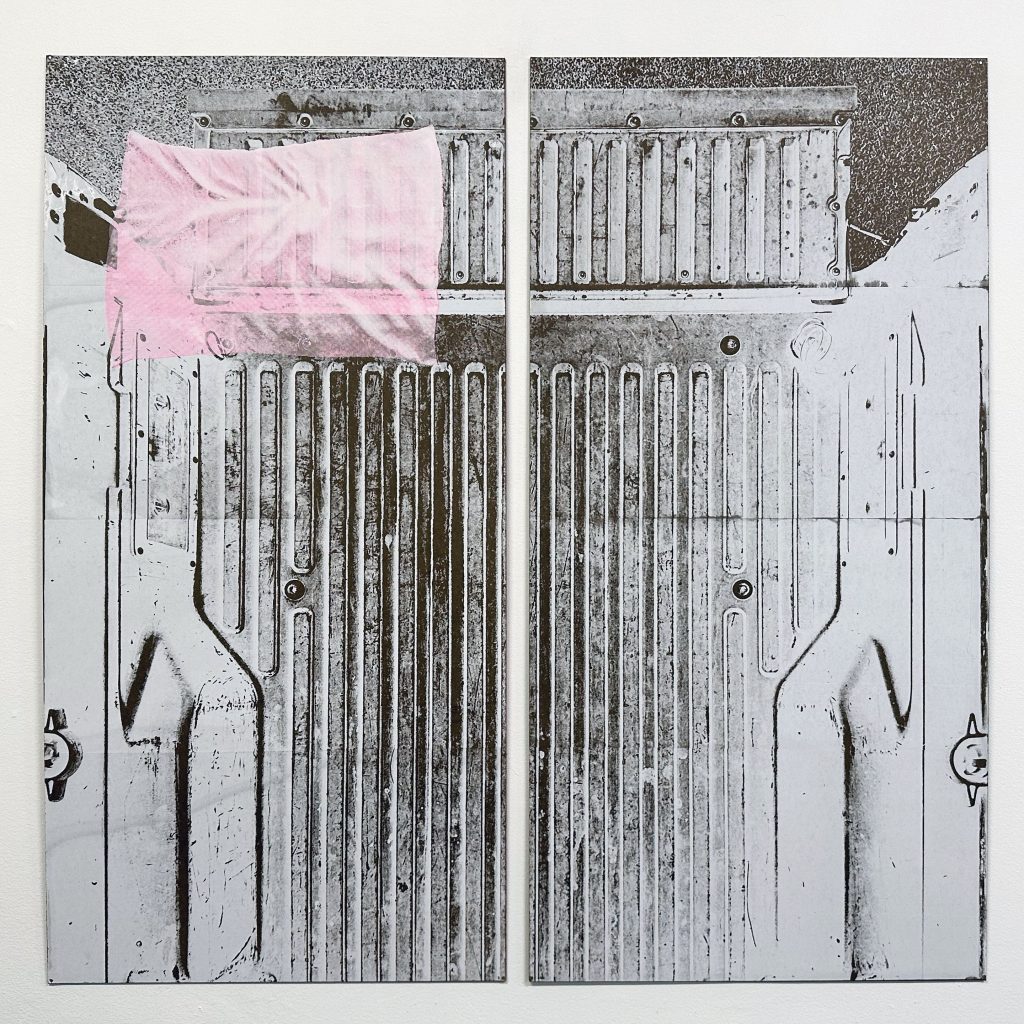
Michelle Eisen, “I’ve Made My Bed”, Silkscreen on hardboard

Steven Mastroianni “Fathomable Series #24”, Unique cameraless photogram, silver gelatin print

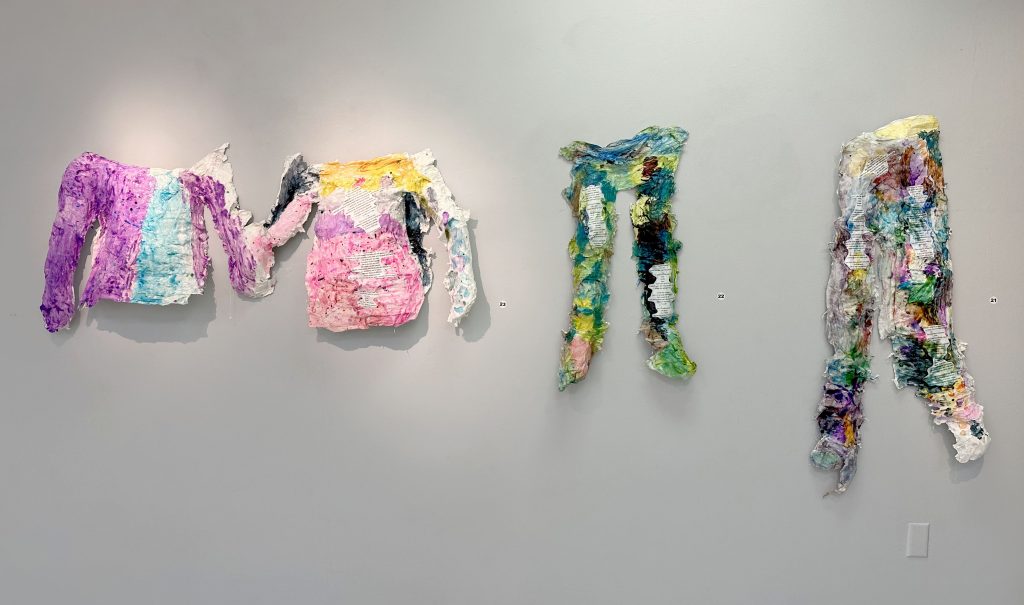
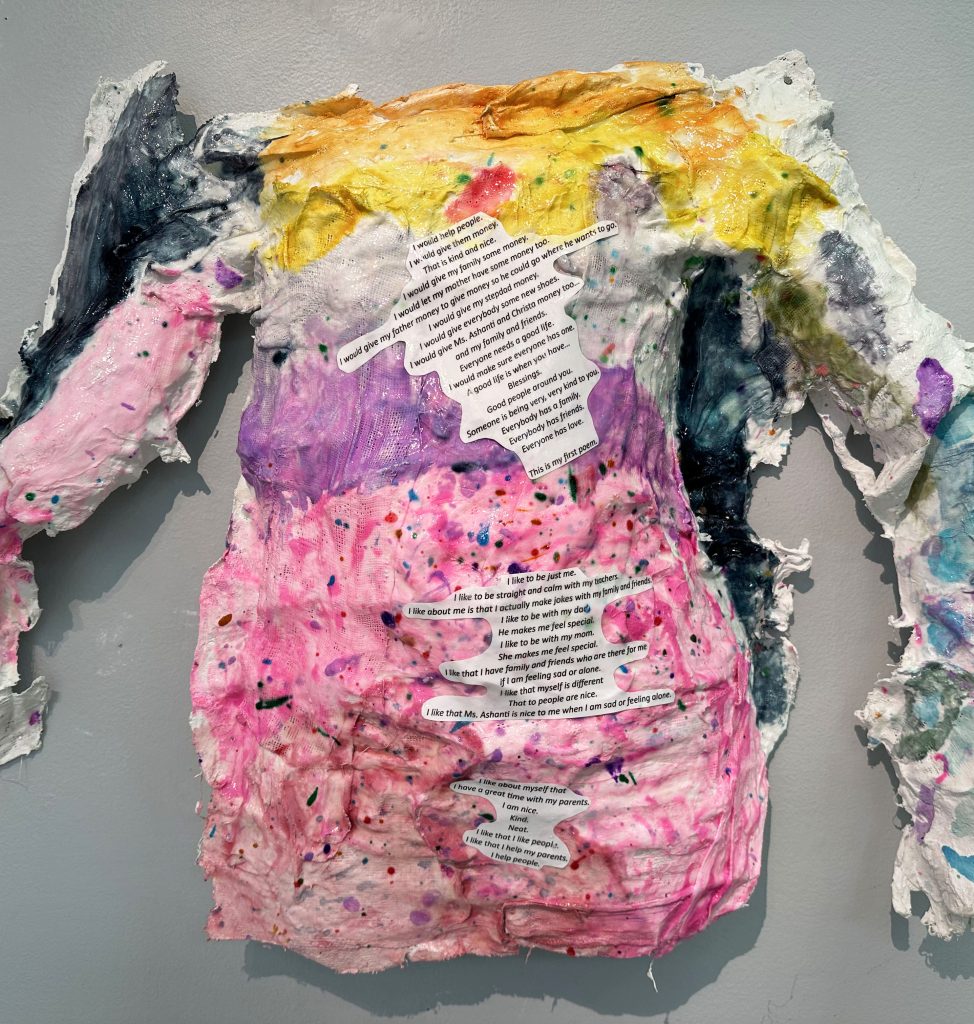
Finally, on view throughout the building are works by local students, teachers, and school leaders for Taking Care of Our House: Communities Coming Together and Making a Difference. The exhibition is made with the organization Art Resistance Through Change (ART-C). The works pictured below are a few of the sculptures created that included the personal narratives of the artists.

It’s worth mentioning that along with these exhibitions there are artists studios and galleries also in the building and worth checking out. Summit Artspace is open Fridays 12-7pm and Saturdays 11am-5pm.

Mar 152024


The mural above is a reproduction of Masumi Hayashi’s Edgewater Park no.2, Cleveland, OH. The mural is located in Cleveland and is one of the many public art projects organized by LAND Studio.

From the information plaque next to the mural about the artist-

Masumi Hayashi (1945- 2006) was a visionary fine art photographer who taught at Cleveland State University for 25 years. During her time in Cleveland, she lived in the Gordon Square neighborhood in the first residential development project of the Detroit Shoreway Community Development Organization. Dr. Hayashi was a beloved neighbor, friend, and local artist. She achieved global success with her signature format, the panoramic photo collage.

Hayashi was born in the Gila River War Relocation Camp in Rivers, Arizona, which was one of the U.S. government’s Internment camps for Japanese-Americans during World War II. Hayashi created her striking panoramic photo collages by assembling individually shot color photographs into a composition, like tiles in a mosaic. She shot photographs in a meticulously ordered sequence using a completely manual, non-digital film camera on a tripod. A single piece could take four to eight hours to shoot, and she might not see the results for days or weeks. When working at a site, she had to imagine the composition she desired from a location, and then create the individual photographs, while considering factors like time of day, weather, and location of the sun, through the entire shoot. Many of her large panoramic compositions involve more than one hundred individual photographic prints.

Much of Hayashi’s work explores socially difficult subjects, like the Japanese-American Internment camps, abandoned prisons, and EPA Superfund cleanup sites. She was able to create artwork that makes difficult subjects approachable. Her earlier work includes many significant sites in Cleveland, including the Cultural Gardens, RTA stops, Lake Erie and Edgewater Park (as seen in the artwork shown to the left). Later in her career, her artwork reflected a deep interest in culturally significant spiritual sites in India, Nepal, Japan, and Thailand.

Mar 072024
 

Francesca Woodman, “Untitled (Rome), 1977-8, Gelatin silver print (image via Columbus Museum of Art)

Two of Cindy Sherman’s “Film Stills”, Gelatin silver prints from the 1970s

Four Gelatin silver prints by Diane Arbus

Francesca Woodman’s “Italy”, 1977-1978 (printed later) Gelatin silver print

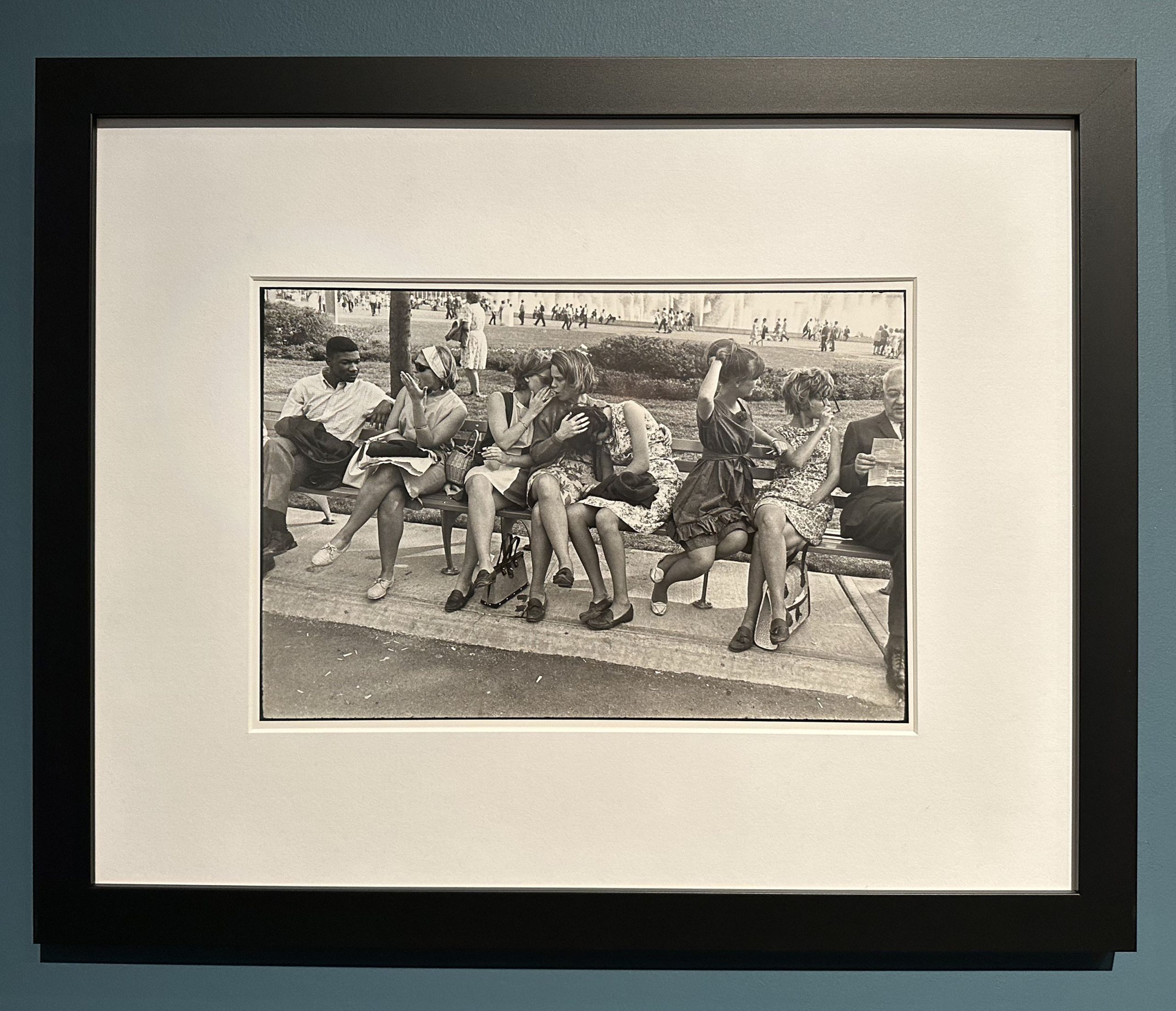
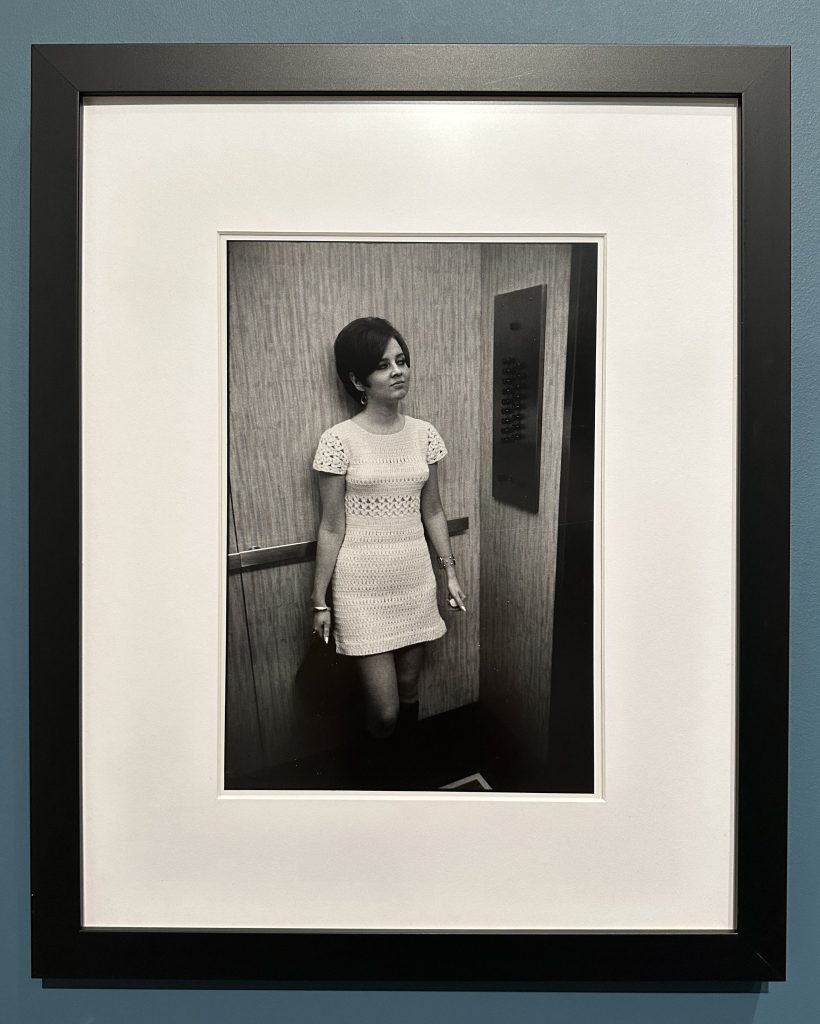
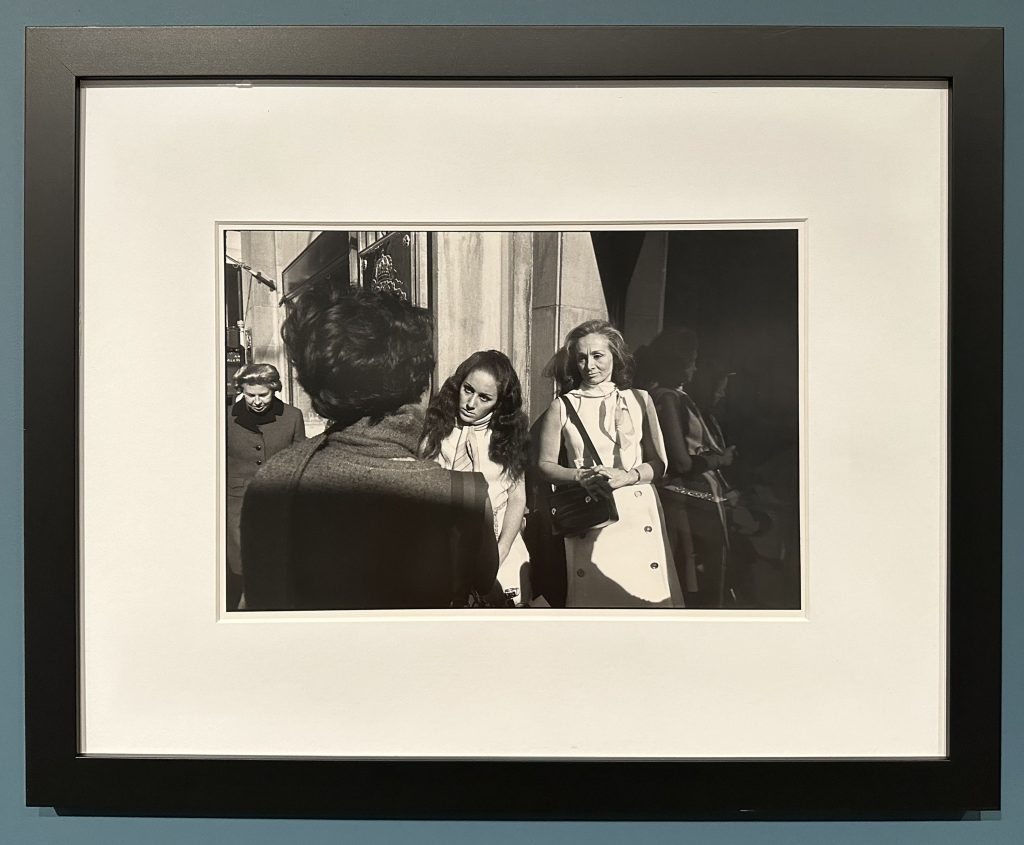
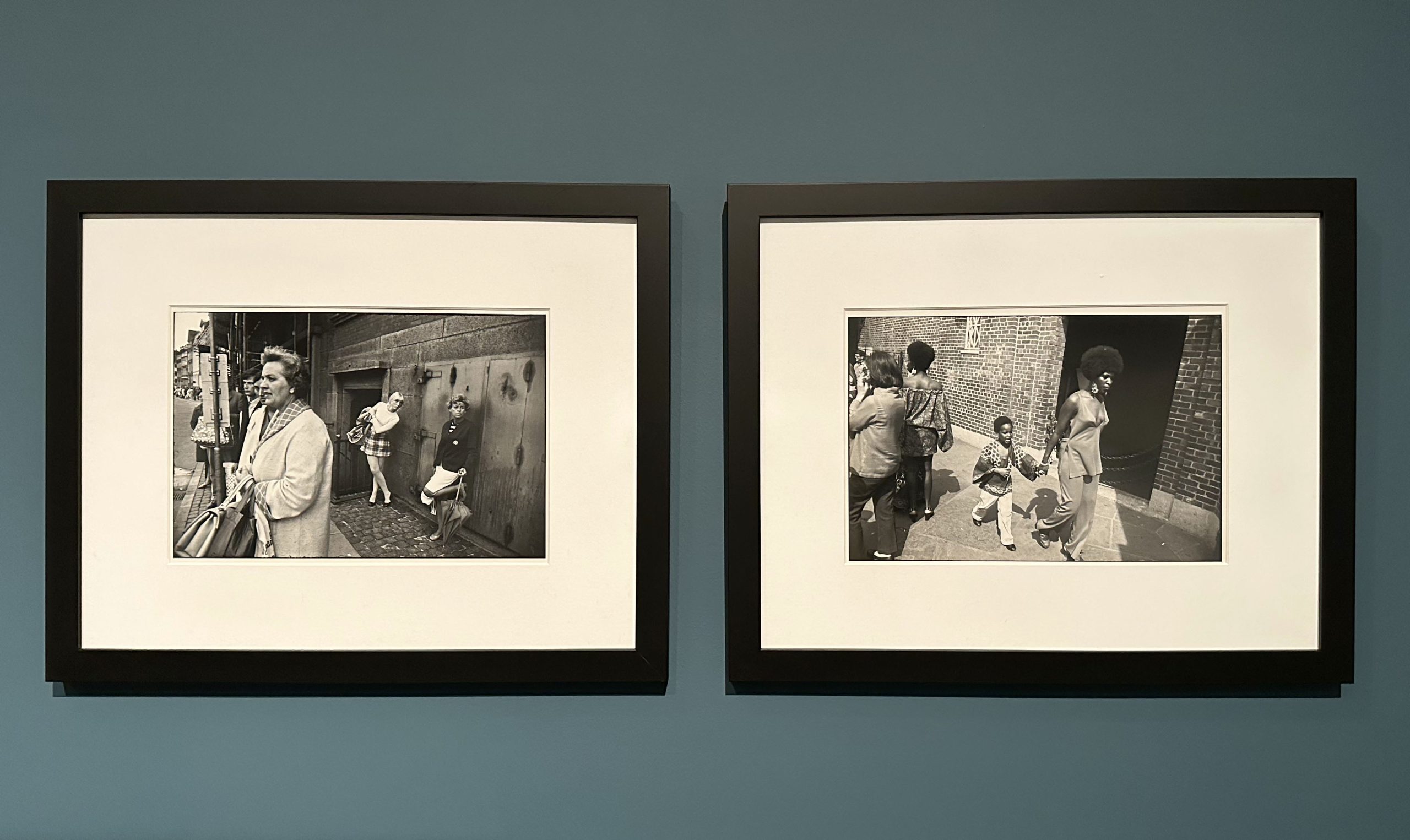
Currently on view at Columbus Museum of Art is Arbus • Sherman • Woodman: American Photography from the 1960s and 1970s. Although many of these photographs by Diane Arbus, Cindy Sherman and Francesca Woodman are well known, it’s great to see the work of these three exceptional artists in person. The black and white images still captivate, even in our current image saturated world.

About the show from the museum-

This selection of monochromatic prints reflects a shared interest in capturing the world outside oneself as well as the world within. Perspective is an elemental link between each work: the images speak to how we see ourselves as individuals, how we are perceived, and how we observe others.

While Arbus was known for photographing families, children, pedestrians, performers, and celebrities, both Sherman and Woodman turned the camera on themselves. Dressing as anonymous female film characters from the 1950s and 1960s, Sherman poses in the series “Untitled Film Stills”. However, these works are not considered self-portraits, but rather carefully constructed performances of various female identities. Conversely, Woodman’s surrealist images might be called non-traditional self-portraits. By obscuring, blurring, or cropping parts of herself out of the final image, the photographs become intimate, personal snapshots that reflect a wider human fragility.

Arbus, Sherman, and Woodman are considered among the most prominent twentieth-century photographers and remain influential to contemporary artists today. By including aspects of feminism in their work and pushing the limits of the medium, these women challenged societal norms of their time while contributing to the elevation of photography as an art form.

It’s always interesting to hear artists discuss each other’s work. Included in the exhibition is this quote by Cindy Sherman about Francesca Woodman-

“She had few boundaries and made art out of nothing: empty rooms with peeling wallpaper and just her figure. No elaborate stage set-up or lights… Her process struck me more the way a painter works, making do with what’s right in front of her, rather than photographers like myself who need time to plan out what they’re going to do.”

For more on Francesca Woodman, her short life, and her artistic family, The Woodmans is an excellent documentary.

Feb 282024
 

The images above are from Brianna Lynn Hernandez’s exhibition Anticipatory|Después, one of three currently on view at Spaces gallery in Cleveland. Her moving video and sculptural installations focus on themes of end-of-life-care, grief, and mourning.

From the gallery about the work-

Anticipatory|Después visualizes the anticipatory grief of caregiving and the process of dying through performative videos and photography. Each piece shares the physical and emotional state of the dying, the caregiver, and at times the two concurrently. Ranging from fast and aggressive dance-like movement to slow and meditative contemplation, the enacted scenes capture a range of emotions and thought processes of understanding and untangling the intertwined traumas of caregiving and acute grief.

As her mother’s caregiver in the final year of her life, Hernández translated her personal experience of grief into her studio practice in order to combat the isolation and shame many grievers face in our death-avoidant culture. Through several series including Anticipatory | Después, the works aim to normalize honest conversations of grief and act as an entry point into education on end-of-life planning. Hernandez states that while we will all eventually experience the pains of loss, preparing for the logistics of death and nurturing supportive communities for grievers can provide comfort and lessen the unnecessary stressors attached to loss.

A Botanical Conversation, Mehdi-Georges Lahlou’s exhibition, explores environmental, identity, and cultural issues using the natural world as a backdrop. The two large murals are of an enlarged palm tree cell as seen through a microscope.

The exhibition statement by curator Conor Moynihan-

The palm tree is a central component of Mehdi-Georges Lahlou’s practice, a motif he has explored to highlight themes of exoticism, migration, and cultural heritage. Recently, Mehdi- Georges Lahlou has used the palm tree to explore themes of colonization, climate change, and history. While members of the Arecaceae family- palm trees- can be found in many parts of the world, they are not found here in Ohio. Unless, of course, you go to the Cleveland Botanical Garden as Mehdi-Georges Lahlou did for his residency at Spaces.

For A Botanical Conversation, Mehdi-Georges Lahlou has created four new video works using the Cleveland Botanical Garden as the setting and backdrop. While many of the plants visible in these works come from elsewhere across the world, his collaborators Diwe Augustin-Glave, CHIMI x Nature, and Dr Lady J are based in Cleveland. In many ways, this body of work imagines the conversations that might happen if the flora in the Cleveland Botanical Garden could speak, sing, chant, and educate, and then transports this dialogue in the gallery space.

Microscopy, the mural that extends over two walls in the gallery, serves a double function. Based on the cell of a dead palm tree, it enlarges from an unusual perspective a motif central to the exhibition. And it also serves as a container and a frame for the four videos. This conversation emerges within the boundaries of the palm tree cell, transporting this exhibition into the botanical garden.

Characteristic of his practice, Mehdi-Georges Lahlou draws our attention to how plants and botanical gardens become ways to highlight histories of colonization, compulsory heterosexuality, and climate disaster all contained under canopies of glass. Yet, especially through the performances of Diwe Augustin-Glave, CHIMI x Nature, and Dr Lady J, they also celebrate new queer ecologies and configurations, melding African and African American musical traditions, queer theory and scholarship, ecological history, and environmental justice towards new ends.

A Botanical Conversation is a cacophony. It asks us to listen carefully to hear all the voices that make up this chorus.

Aaron D. Williams has created a video installation, ESCAPING AAWFUL LAND, that continues the work created for his previous Aawful Friends exhibition. This new creation addresses the issue of anxiety and the power of collaboration as a way to combat it.

From the gallery-

ESCAPING AAWFUL LAND is an immersive exhibition that builds upon the success of Aaron D. William’s previous Aawful Friends showcase at Zygote Press. This new showcase explores the creative journey between Williams and collaborating artists. By delving into anxiety through art, we seek to acknowledge its profound impact on our collective well-being. We must address anxiety as a shared concern and foster a future community that supports and uplifts one another. Through individual and collective artistic expression, we can overcome the gravity of the situation and find healing and unity. In our fast-paced society, anxiety affects people from all walks of life, taking various forms and manifesting in relentless thoughts, paralyzing fear, and an overwhelming sense of unease. Despite its grip, we encourage you to embrace your inner courage and take the leap. The installation will be held at The Vault in SPACES gallery, where you will be transported to AAWFUL LAND – a hidden realm within our city accessible only to those who know it exists. Guided by the mysterious GUARDIAN, you will journey through its enigmatic mysteries. As you step into AAWFUL LAND, you will be captivated by a mesmerizing video presentation. Witness AAWFUL AARON engaged in a gripping game against a formidable opponent, reminding us that we have the inner strength to persevere and pursue our dreams even amidst anxiety. In Aawful Land, anxiety takes on tangible forms and bursts forth in vibrant colors. CREATURE is at the heart of our narrative, an overbearing shadowy figure personifying anxiety and serving as the central antagonist. Aawful Aaron is locked in a fierce battle against CREATURE, desperately seeking escape from this hidden world. However, a subtle hint suggests that Aaron may need assistance to overcome his challenges. Within Aawful Land, a group of trapped artists may hold the key to their collective liberation. Together, they offer a glimmer of hope, representing collaboration’s power in overcoming Aawful Land’s perils. This work serves as a proof-of-concept or work-in-progress, paving the way for Aawful Friends II. In the forthcoming installation, we will feature this newfound group of artists, showcasing their collective efforts and unveiling the transformative power of collaboration. Their shared experience demonstrates that collective creativity and expression can lead to freedom and transcendence. ANXIETY IS HARD – TAKE YOUR SHOT ANYWAY.

All three of these exhibitions close 3/1/24.

Feb 262024
 

Willie Cole, “American Domestic”, 2016, Digital Print

Tom Laidman, “Broadway”, 1993 and “Bois Ma Petite”, 1999, Lithograph on paper

Currently on view at Akron Museum of Art is RETOLD: African American Art and Folklore, a collection of art from the Wesley and Missy Cochran collection, organized into themes exploring aspects of African American history and culture. The show features many well known and lesser known artists including Amiri Baraka, Beverly Buchanan, Willie Cole, Trenton Doyle Hancock, William Pope.L., Tom Laidman, Jacob Lawrence, Alison Saar and more.

From the museum about the exhibition-

African folklore has been around as long as humankind, and the African diaspora in America has added new dimensions to its rich history. African American folk stories teach about culture, the mysteries of life, and the survival of a race of people bought and sold who continue to thrive in an unjust society.

“RETOLD: African American Art and Folklore” focuses on four themes: Remembering, Religion, Racialization, and Resistance. These themes provide a comprehensive retelling of the works featured in the exhibition. In many of the pieces, the artist’s muse connects closely with stories that have been told generation after generation. Folklore texts are featured throughout the space as a means to retell a richer, deeper story of African American culture.

There are more than forty artists represented in this exhibition, all holding one similar truth: their story of joy and struggle in the African American experience.

In addition to the artwork, there is also an educational video produced by Josh Toussaint-Strauss of The Guardian that explores the misconceptions about Haitian Voudou that is worth a watch.

How ‘voodoo’ became a metaphor for evil

Feb 152024
 

“The Flameless Green Dragon”, 2018, Elm and acrylic

“In Rhythm”, 2018, Elm and acrylic; and “Water Music”, 2002, Inkjet photocollage on paper

“Introvert”, 2019, Elm; “Engendering Life”, 2020, Green soapstone

Two left sculptures made of Italian translucent alabaster and “Harboring Emptiness”, 2021, Maple and acrylic

Above are several works from Barbara Stanczak Spirit and Matter, the artist’s recent exhibition at Akron Art Museum.  Stanczak’s sculptures are energetic shapes created in partnership with the natural materials used.

From the museum’s web page-

Barbara Stanczak’s sculptures are born from an essential combination: the artist’s creative vision and the natural qualities of her materials. This two-sided collaboration remains in effect throughout Stanczak’s entire process of conceiving and creating an artwork. A piece of wood or stone presents initial possibilities that help to set a direction, but invariably the course will change—the substance may be so hard as to resist carving, or it may contain internal structures that must be accommodated. But the artist does not surrender her own interests, as she has found that a successful work must become the physical embodiment of a rich and valuable idea. In her own words, “I can only hold onto my idea of the whole by letting go of ‘mine’ and focusing on ‘our.’ The material becomes a partner who needs my patience, respect, thoughtfulness, cooperation, skill, and persistence.”

Stanczak committed to working with wood and stone only after a long process of discovery. Born in Germany in 1941, she moved to the United States in 1960 to assist her grandfather in painting church frescoes, and later worked in handmade paper, metal, and a variety of other media. She also worked alongside her husband, Julian Stanczak, whose paintings and prints were celebrated at the Akron Art Museum with a one-artist show in 2013. As her own career evolved throughout her thirty-seven-year tenure as a professor at the Cleveland Institute of Art, Barbara carved her first wooden sculpture in 1992. “I was tired of searching,” she recalls. “It was time to arrive!”

Stanczak continues to find wood and stone compelling because, as she puts it, they are constantly “teasing, tempting, and provoking me to see more, to see beyond, to see the micro and the macro of the universe.” She finds these universal qualities not in immediately recognizable forms like leaves and flowers, but rather in dense rings and layers, subtle features formed over decades or even thousands of years. As Stanczak exercises her own intuition, she aligns it with these natural processes. As the artist and the materials harmonize, it is as if two forms of intelligence are working together—as if spirit and matter are not so separate as one might expect.