Aug 152024
 

The images above are of Terence Gower’s El Muro Rojo (Barragán), 2005, from the group exhibition Color Effects at Galerie Lelong in NYC last year.

From the artist’s website about the work-

A large black and white photograph of the roof patio of the Casa Barragán is mounted on an enormous red wall. The photograph is a copy of Armando Salas Portugal’s famous 1953 photograph (this time commissioned from architectural photographer Jorge del Olmo), and shows a corner of Luis Barragán’s roof patio with its famous coloured walls reduced to grey tones. The work separates a tonal and planar understanding of the architecture from the “emotional” encounter with colour that Barragán aspired to.

From his statement about his practice-

I work on a number of bodies of work at once, each developed over several years. In the past decade my work has focused on a critical re-reading of the modern movement and its utopian bent. A desire to reexamine the notion of progress—a term corrupted by the excesses of technological modernism—has fueled my research on the post-war period and has led to a search for models from the past that might still be relevant today.

Below is the Armando Salas Portugal color photograph referenced by Gower’s work.

Armando Salas Portugal, “Barragán House”, Mexico City, 1948. View of the roof terrace in the late 1960s. Image via Barragan Foundation

Armando Salas Portugal is known for his photographs of the Mexican countryside and the architecture of the city. He captured the work of several famous architects, in addition to Luis Barragán’s projects.

From Wikipedia about the influence of modernism on Barragán and his concept of “emotional architecture“-

Barragán visited Le Corbusier and became influenced by European modernism. The buildings he produced in the years after his return to Mexico show the typical clean lines of the Modernist movement. Nonetheless, according to Andrés Casillas (who worked with Barragán), he eventually became entirely convinced that the house should not be “a machine for living.” Opposed to functionalism, Barragán strove for an “emotional architecture” claiming that “any work of architecture which does not express serenity is a mistake.” Barragán used raw materials such as stone or wood. He combined them with an original and dramatic use of light, both natural and artificial; his preference for hidden light sources gives his interiors a particularly subtle and lyrical atmosphere.

Aug 082024
 

Gift, by Lili Yuan was created for the 2020 edition of SHINE Mural Festival in St. Pete, Florida.

This is her statement about the work from the SHINE website

“With millions of gallons of wastewater spilled around Tampa Bay in recent years, I chose to depict an obscured female surrounded by water to convey an implicit narrative that the water and humanity are more tightly coupled than ever. After going through many ideas, I went for a simplified design because the value of water itself is precious enough to resonate. Holding water in hand symbolizes a precious gift from nature as water sustains all life no matter big or small; and the round shape represents nature’s best gift – our mother earth.

Meanwhile, I chose the Chinese idiom “上善若水“, which means “Be like water, as water stays humble while benefiting all”. It shows the importance of water and strikes a chord with humans whom should all be loving nature and preserving our precious water resources.”- Lili Yuan

Aug 012024
 

Sandra Cinto created the mural above in 2018 for Murals of La Jolla, in San Diego. The Murals of La Jolla project commissions various artists to create murals around La Jolla with 16 currently on view and 48 created in total.  A map of current work can be found here.

From the Murals of La Jolla website about this work

In Sandra Cinto’s mural, Untitled, we get lost in a vortex of lines that push and pull in every direction. Inspired by the immersive relationship of the ocean as a part of La Jolla’s Landscape, Cinto “decided to create another kind of landscape and make it by drawing without colors”. The artist intends for each viewer to have a different experience with the work as it is meant to be an open landscape. For Cinto, her work reinforces a kind of philosophy that each little mark is important, since “little details, little actions can change everything.” The viewer can be absorbed in the lines and details found in her work or step back and behold an undulating and pulsating landscape.


Jul 252024
 

Move, by Thomas Evans, aka Detour, was created for PINCFest in Sarasota’s Rosemary District. The mural depicts Congolese dancer Enock Kadima (left) and singer/dancer Canela Vasquez (right), who performs with the Westcoast Black Theatre Troupe, which is based in Sarasota.

Evans recently completed a mural for Long Beach Walls in Los Angeles. In addition to posting recent work, he also gives useful art advice every Tuesday on his Instagram page.

May 032024
 

In March, Strauss Studios hosted Diane Belfiglio: An Artist’s Legacy, an exhibition celebrating the late artist. The Ohio artist and educator’s exploration of light and shadow give her subjects a unique graphic quality.

Here Belfiglio discusses her acrylic paintings-

My paintings prominently feature closely-cropped, sunlit architectural forms. Although realistic in their presentation, I rely heavily on their underlying abstract qualities to give to the already imposing images an even greater sense of power. Shadows, ethereal by nature, take on a rigid structural aspect in these compositions. Colors range from brilliant to subtle in an effort to reproduce the strong sense of sunlight streaming through each piece. Although these images are visually powerful, the delicate details in the architecture—and often in the surrounding vegetation–are also prominently featured in my work. The resultant blend produces a heightened, stylized reality. I work to transform the mundane into the extraordinary, so that we see beauty in images that generally go unnoticed by most of us on a daily basis.

And here she talks about her decision to work with watercolor, like in the pair above-

Never say never. For the majority of my life, I have not taken to watercolor as a medium I ever wanted to use professionally. But in 2015-16, the Canton Museum of Art had a spectacular show of Joseph Raffael’s watercolor paintings. The colors and luminosity in his work were so amazing that I just couldn’t get the images out of my head. A couple of years later, I was called upon to teach Watercolors at Walsh University, a class I normally don’t teach. So there was another toe in the water (pun intended). Fast forward to 2020, when I finally had the urge to vanquish my demons and give it a try. I started slowly, making plenty of mistakes, but soon realized that I could create the luminosity that I crave in my work in this medium.

Tomorrow (5/3/24), Strauss Studios will be open late for Canton First Friday and showing the new exhibition Exploring Light and Darkness featuring artists Emily Orsich, Heather Bullach, Jo Westfall, Joe Ostrowske, Mary Crane Nutter, Patricia Zinsmeister Parker, and Susan Wilkof.


Apr 182024
 

Orbital- The Box

This song is from Orbital’s 1996 album, In Sides. They are currently on tour and playing Coachella on Saturday, 4/20/24.

The stop-motion video above, starring Tilda Swinton, was directed by Jes Benstock and Luke Losey. Benstock did an interview with 909originals for the 25th anniversary of its release in 2021.


Feb 292024
 

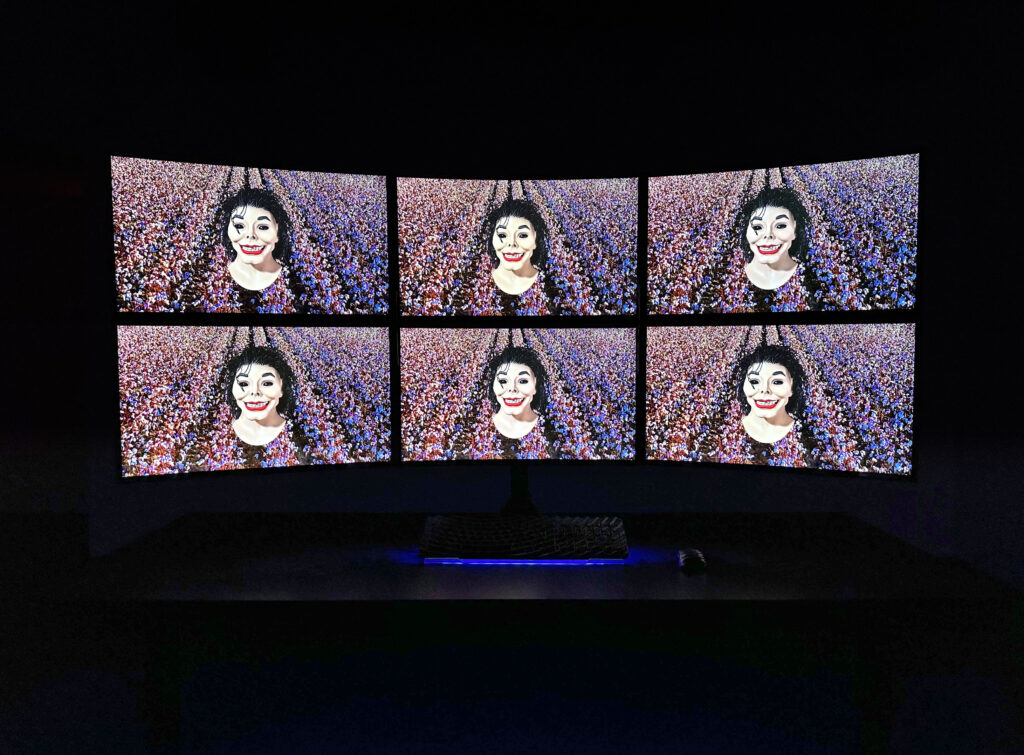
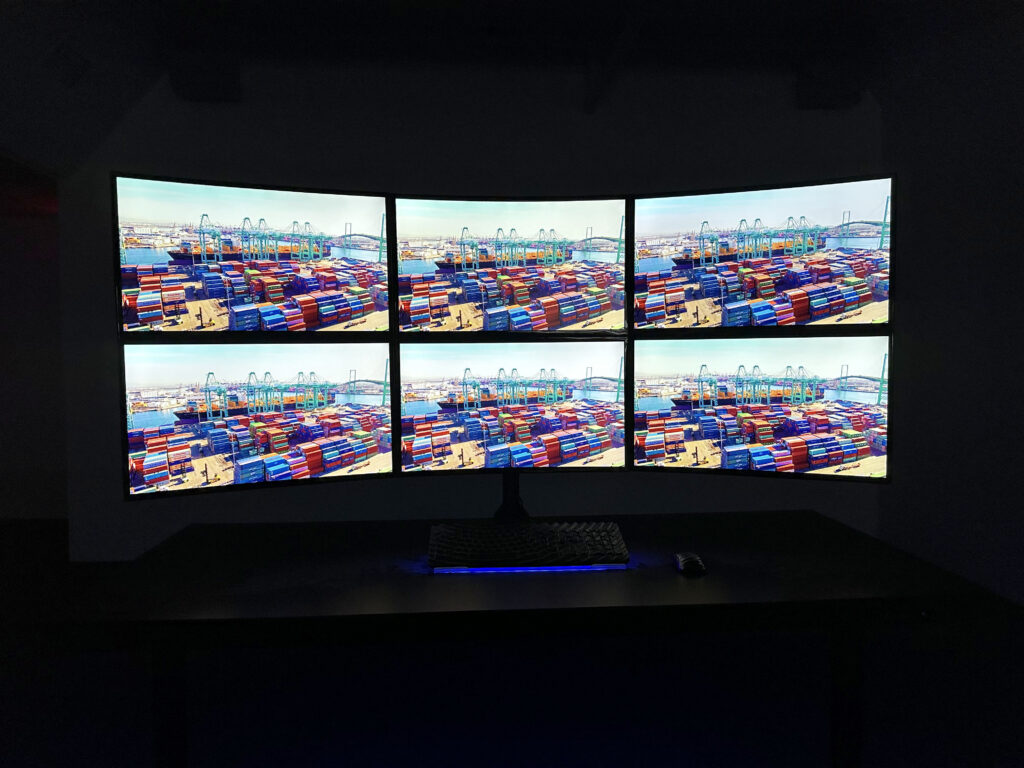
Today’s throwback is to Jenson Leonard’s solo exhibition Workflow, at Wood Street Galleries in Pittsburgh, from the beginning of February.

From the gallery about the work-

Workflow, the first institutional solo exhibition of artist Jenson Leonard, centers on a titular film that explores the velocity and momentum of Blackness as it relates to the philosophical concept of acceleration—the notion that the only way out of capitalism is through its intensification.

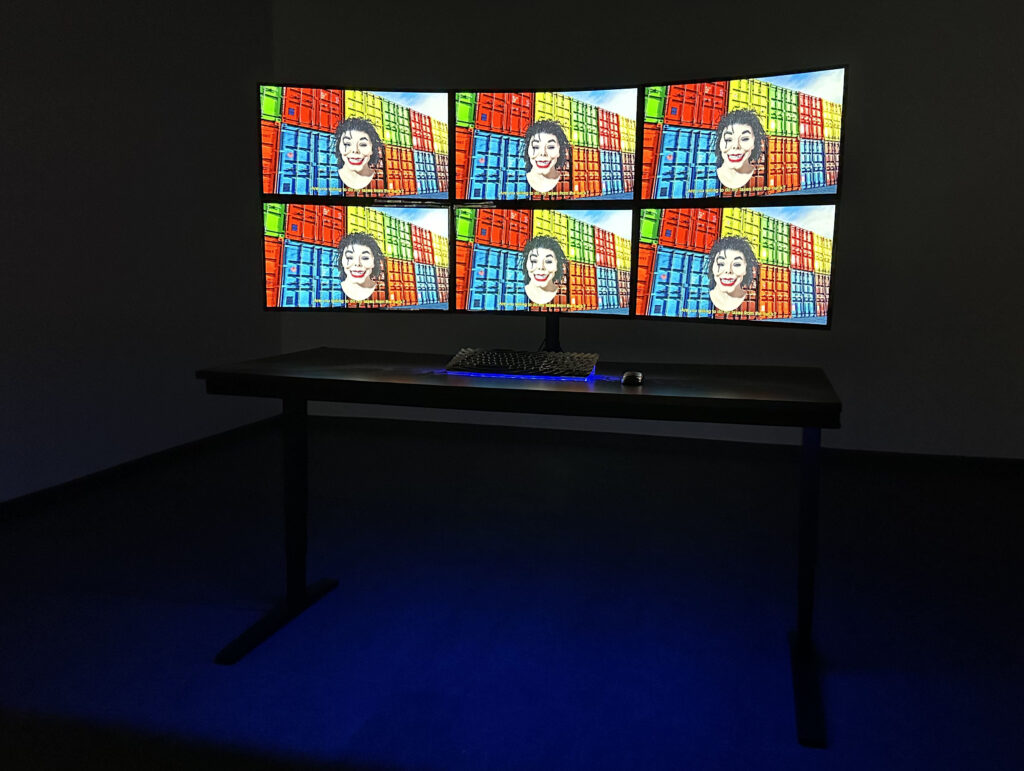
In Workflow, a spectral Michael Jackson Halloween mask recites a surrealistic quarterly earnings reports. Building on a 2017 essay by artist Aria Dean titled “Notes on Blacceleration,” the short film centers on the ways in which the Black subject grapples with its commodified status within the labor market despite—or, resultant of—its own history as a commodity, stemming back to the Trans-Atlantic slave trade. Completed during Leonard’s residency at Pioneer Works in 2021, the video utilizes uncanny humor as a mechanism to expose the shared grammars inherent in Afro-pessimism and speculative finance.

Within the exhibition, the film repeats simultaneously across two grids of computer monitors situated on ergonomic desks that flank the gallery, mimicking the workstations that can be found ubiquitously across stock trading floors and financial institutions. Sculptures modeled after computer keyboards and mouses are displayed on the desks, each rendered inoperable by concentric riffs that symbolize the erratic transformations caused by the flows of capital. The appearance of Jackson represents a transmogrification of its own; whereas many have aligned the controversial pop icon’s bleached skin and surgical procedures with Black self-hatred, Leonard positions his bodily modifications as a radical rupture from racial paradigms of being.

In Leonard’s own words, “Workflow is defined as the sequence of industrial, administrative, or other processes through which a piece of work passes from initiation to completion. My film seeks to disabuse notions of completion, whether it be completion of the human, the nation state, or civil society. As Dean notes, Blackness is ‘always already accelerationist’ via its incongruence with Western humanism, a wrench thrown into the locomotive gears of ‘capital and subjecthood.’ Her essay prompts us to look toward the way that the Black has been historically constructed outside of the human, as coterminous with the slave. Slavery therefore represents a kind of proto-automation, a mass forced coercion of labor, and the Blacks’ transition from object to subject calls for a reappraisal of accelerationist ideas about the (non)human entity and its revolutionary potential.”

The artist continues, “There is something about going to work—the repetition of it—that gets inscribed at an epigenetic level, as an everyday, embodied violence. From there, I thought about the panoptic workplace (open air plan, transparent yet closely surveilled, management that does not have to be in the room to be monitoring you), the fetish of efficiency (ergonomic mouse and keyboards so you can work longer), biometric data of a labor force (fingerprint and facial scans to help reduce repeat processing tasks). All of these methods to maximize profits and production can be traced back to methods worked out and perfected in the cotton and sugar cane fields hundreds of years prior.”

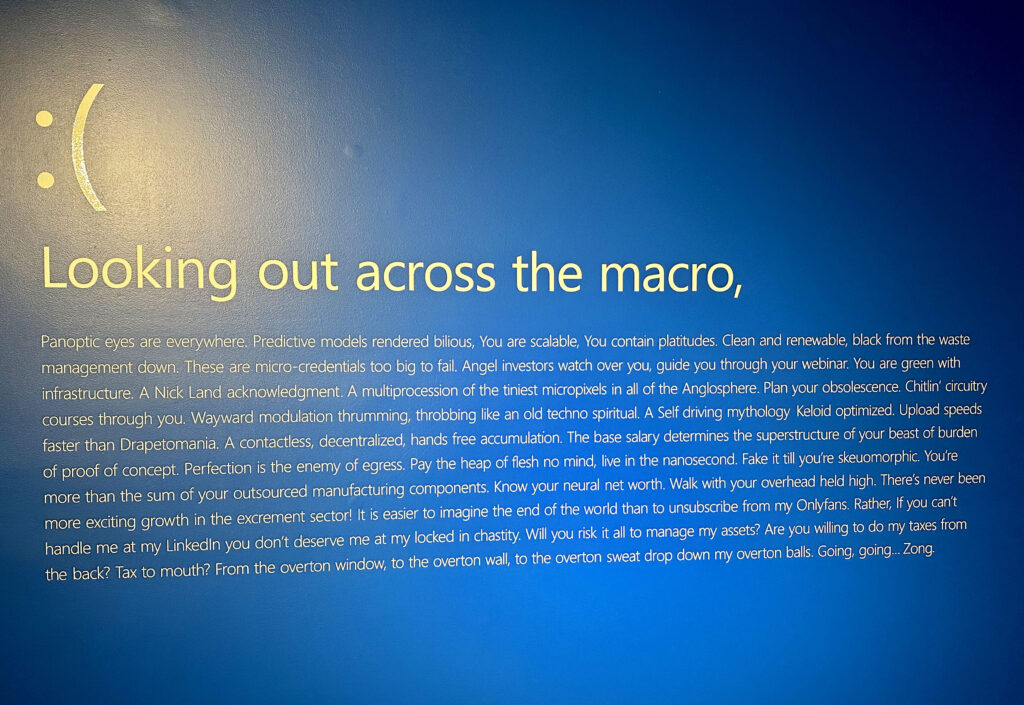
The text from the video was included on one of the gallery walls (image above) but I’ve included it below as well as it is definitely worth reading.

“Looking out across the macro- Panoptic eyes are everywhere. Predictive models rendered bilious, You are scalable, You contain platitudes. Clean and renewable, black from the waste management down. These are micro-credentials too big to fail. Angel investors watch over you, guide you through your webinar. You are green with infrastructure. A Nick Land acknowledgment. A multiprocession of the tiniest micropixels in all of the Anglosphere. Plan your obsolescence. Chitin’ circuitry courses through you. Wayward modulation thrumming, throbbing like an old techno spiritual. A Self driving mythology Keloid optimized. Upload speeds faster than Drapetomania. A contactless, decentralized, hands free accumulation. The base salary determines the superstructure of your beast of burden of proof of concept. Perfection is the enemy of egress. Pay the heap of flesh no mind, live in the nanosecond. Fake it till you’re skeuomorphic. You’re more than the sum of your outsourced manufacturing components. Know your neural net worth. Walk with your overhead held high. There’s never been more exciting growth in the excrement sector! It is easier to imagine the end of the world than to unsubscribe from my Onlyfans. Rather, If you can’t handle me at my Linkedin you don’t deserve me at my locked in chastity. Will you risk it all to manage my assets? Are you willing to do my taxes from the back? Tax to mouth? From the overton window, to the overton wall, to the overton sweat drop down my overton balls. Going, going… Zong.”

Feb 012024
 

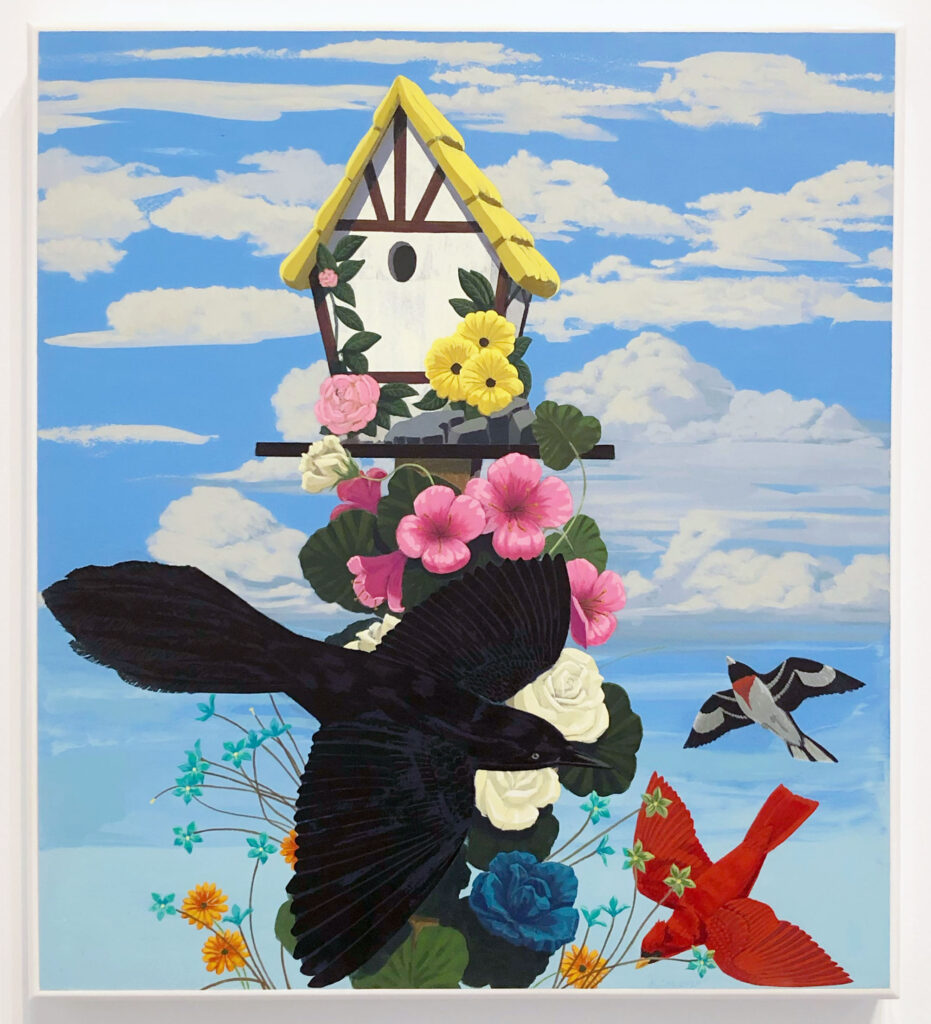
Black and part Black Birds in America: (Grackle, Cardinal & Rose-breasted Grosbeak), 2020, by Kerry James Marshall, was part of the group exhibition 20/20 at David Zwirner gallery in NYC in December of 2020. The painting is part of a series that explores black identity, his love of birding, and by the history and work of John James Audubon.

Below is an excerpt from a New York Times article about the work and its Audubon connection-

“There’s a disconnect between the house that’s built and the birds,” Mr. Marshall said of the crow and grackle. “It’s not designed for them, you know?” The scene considers, he said, “the pecking order.”

The series itself has been brewing in Mr. Marshall’s mind for eight or nine years, he said, and he began painting the works just before transmissions of the coronavirus accelerated in the United States in March.

A casual bird enthusiast who has been fascinated by Audubon’s draughtsmanship since he was a child, Mr. Marshall has long put Black protagonists at the center of his complex, richly layered compositions. “Many Mansions” (1994), one of his large-scale depictions of housing projects, features three Black men gardening — and, not incidentally, there are two bluebirds holding up a banner, too. The pointed inclusion of Black figures is part of what he has called a “counter-archive” to the familiar, white-centered story of Western art.

For the new series, the images hinge on Audubon’s own racial heritage: Many people believe he was, as Mr. Marshall’s title suggests, “part Black” — born in what is now Haiti, as Jean Rabin, to a white, plantation-owning father and a Creole chambermaid who may have been of racially-mixed descent. But, the theory goes, he was able to pass as white.

Jan 252024
 

The image above is of Squeak Carnwath’s painting, Best Borrowed, 2005, Oil and alkyd on canvas, taken at Palm Springs Art Museum in 2018.

A solo exhibition of her work is currently at Pt.2 Gallery in Oakland, California, on view until 2/16/24.