The image above is of Squeak Carnwath’s painting, Best Borrowed, 2005, Oil and alkyd on canvas, taken at Palm Springs Art Museum in 2018.
A solo exhibition of her work is currently at Pt.2 Gallery in Oakland, California, on view until 2/16/24.

The image above is of Squeak Carnwath’s painting, Best Borrowed, 2005, Oil and alkyd on canvas, taken at Palm Springs Art Museum in 2018.
A solo exhibition of her work is currently at Pt.2 Gallery in Oakland, California, on view until 2/16/24.

Pictured above is Drossos P. Skyllas‘ painting, Wisconsin Ice Cave, 1950, part of LACMA’s 2018 exhibition, Outliers and American Vanguard Art.
About the artist from the National Gallery of Art in Washington D.C. where the exhibition was also on view-
Drossos Skyllas achieved the exquisitely detailed, jewel-like surfaces of his paintings with tiny brushes he fashioned himself. He applied miniscule dabs of luminous oil paint in a pointillist manner, which gave his subjects a petrified yet shimmering quality. His refined technique and adherence to the academic genres of still life, landscape, portraiture, and mythological scenes demonstrate his knowledge of art history. And inspired by the old masters, he perfected the difficult depiction of reflective surfaces, including gems, mirrors, water, and ice. At the same time, his uniform clarity of detail, imposed symmetry, and sense of frozen time create a dreamlike mysteriousness reminiscent of magic realism. In addition to high art sources, Skyllas likely drew upon commercial illustration and photography. Untitled (Roses) resembles both traditional floral still lifes and midcentury advertisements for jewelry and flowers. Wisconsin Ice Cave relates as much to northern Renaissance landscape painting as to mass-produced picture postcards.
Born in Greece, Skyllas worked in his father’s tobacco business before emigrating to the US shortly after World War II. He settled in Chicago and devoted himself to becoming a professional artist, though he had no formal artistic training. Supported financially by his wife, Skyllas produced thirty-eight paintings from the late 1940s until his death in 1973. Some of these he submitted to the annual juried exhibition at the Art Institute of Chicago, Chicago and Vicinity, which featured his work in 1955, 1967, 1969, and 1973. He also sought commissions to paint portraits, but with asking prices as high as $30,000, he never found any patrons.
Skyllas’s work was discovered after his death by Chicago gallerist Phyllis Kind, who added him to her roster of self-taught artists in 1974. He was likely known to artists Jim Nutt and Gladys Nilsson before this, as they had exhibited alongside him in the 1967 Chicago and Vicinity exhibition and are enthusiastic collectors of self-taught artists (Wisconsin Ice Cave is in their collection). The meticulous finish of Skyllas’s paintings, which simultaneously evokes advertising art and Renaissance illusionism, appealed to Nutt, Nilsson, and fellow Chicago imagist Roger Brown, whose art collection also included the self-taught Greek master.

Mirror House, 2016 by artist Paige Jiyoung Moon was one of the paintings in her 2019 exhibition, Days of Our Lives at Steve Turner in Los Angeles. Her works are all of scenes from her life, painted from memory.
She is currently part of Hammer Museum’s most recent biennial, Made in L.A. 2023: Acts of Living, its sixth iteration, on view until 12/31/23.
The house in the painting, Mirage, was created by Doug Aitken for Desert X in 2017. On the fictional television series, The Curse, created by Nathan Fielder and Benny Safdie, the main characters are building houses with similar look.

Eagle Opens Up by Haisla, Heiltsuk artist Paul Windsor, located in Vancouver, Canada.
You can also find his work on Instagram.


ALIVE! by artist Jeffrey Gibson was created for the first edition of the biennial Desert X in 2017, and is on view in the sculpture garden of the Palm Springs Art Museum.
It was recently announced that Gibson was selected by the U.S. State Department to represent the country at the 2024 Venice Biennale. He is a member of the Mississippi Band of Choctaw Indians and of Cherokee descent, and will be the first Indigenous artist to have a solo exhibition in the U.S. Pavilion at the event.
The artist’s statement about the work from the Desert X site-
ALIVE! is a found object ready made sculpture altered with paint and text that reads: I am alive! You are alive! They are alive! We are living!
I chose to work with a wind turbine blade because of how it alters one’s perceptions when they look out across the desert landscape. They are enormous and when viewing one up close you get a sense of the expansiveness of the desert landscape that they occupy. They are also really beautiful in form and their shape reminds me of something like a wing, a fin, or a bone from a massive whale. The text references the people who live in Palm Springs and the original indigenous people who occupied this land and their belief that the landscape is living.

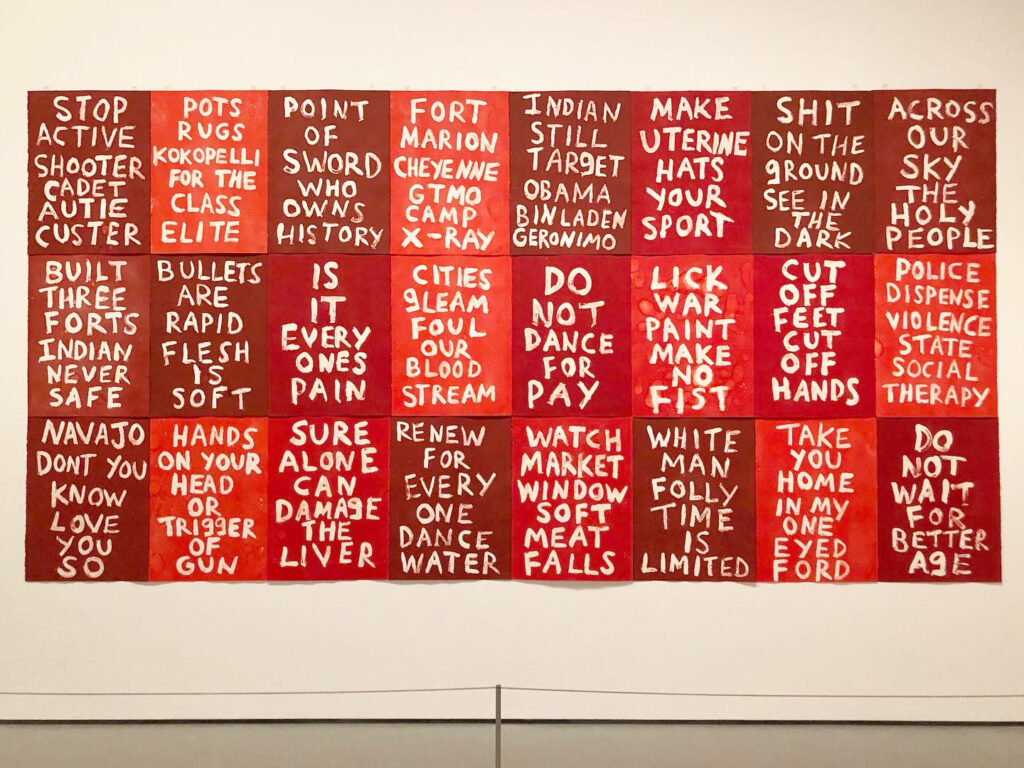
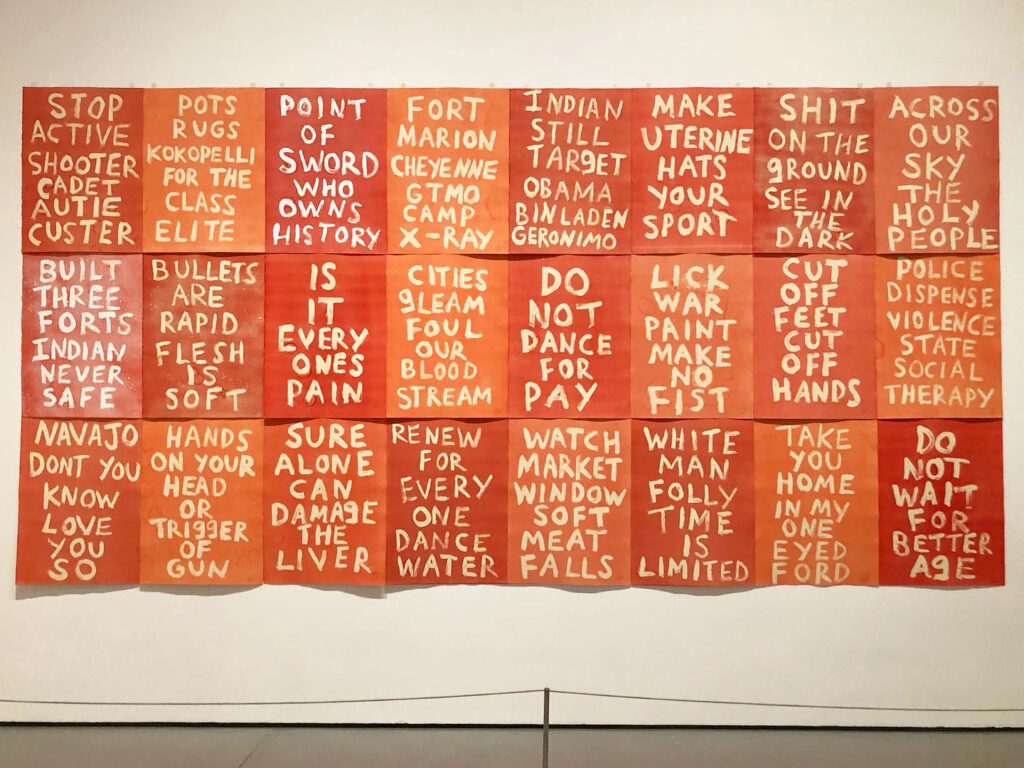
Above is Hock E Aye Vi Edgar Heap of Birds’s work Surviving Active Shooter Custer, 48 monoprints, 2018, from the Museum of Modern Art in New York City, on view in 2021.
From the museum about the work-
The term “active shooter” is one we hear too often in today’s news. Here, Heap of Birds uses this contemporary phrase to characterize massacres committed by United States troops against Native Americans in the 1800s. Each of this work’s panels contains six lines of text evoking the violence of not only this country’s history but ongoing acts of oppression against Indigenous communities. The prints on the right are “ghost prints” of those on the left, made by using the residual ink remaining on the printing plate after the first print was produced. For the artist, these prints recall the “ghosts of a whole culture.”
In the video below from the museum, the artist discusses the work with two of MoMa’s curators.

For more work by DOER3, check out their Instagram.
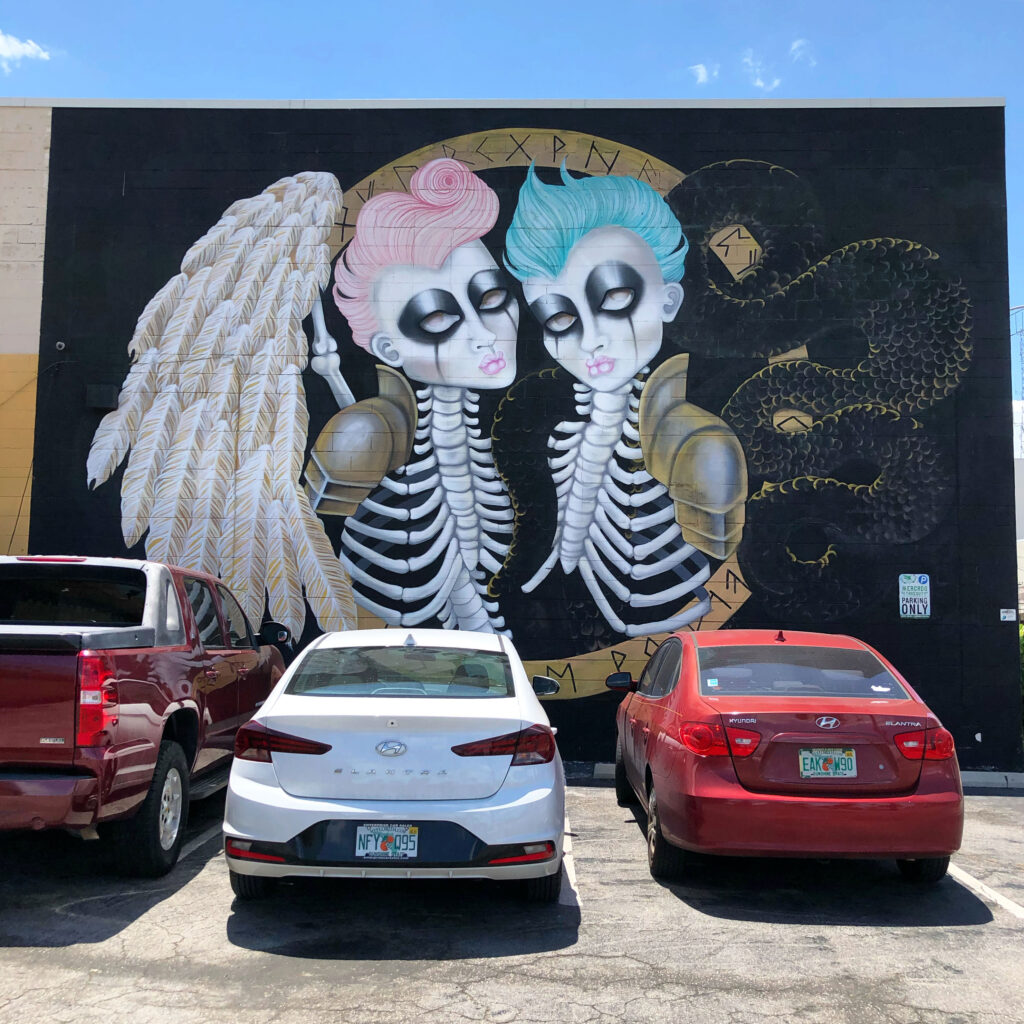
Diarchy by Bekky Beukes was part of the 2018 edition of SHINE Mural Festival in St. Pete, Florida.

Above is “A very anxious feeling”, 2007, by assume vivid astro focus, part of Tampa Museum of Art’s 2022/3 exhibition All in Favor: New Works in the Permanent Collection.
From the museum about the artist collective and the work-
A very anxious feeling by the collective assume vivid astro focus (avaf) conjures both sense of worry and whimsy. In this vibrant neon artwork each letter is rendered in a different color-ranging from pastel pinks and blues to bright primary colors. The final letter, a yellow capital “G,” appears to fall away from the text.
Eli Sudbrack founded the collective assume vivid astro focus in 2001 and works collaboratively with fellow artist Christophe Hamaide-Pierson. A very anxious feeling represents a prime example of their art, as they are known for their colorful, kaleidoscopic paintings, drawings, sculptures, and light installations. assume astro vivid focus explores notions of free speech, gender identity, and civil rights in their artworks and projects. The collective often partners with other creative types, including musicians, dancers, and designers.
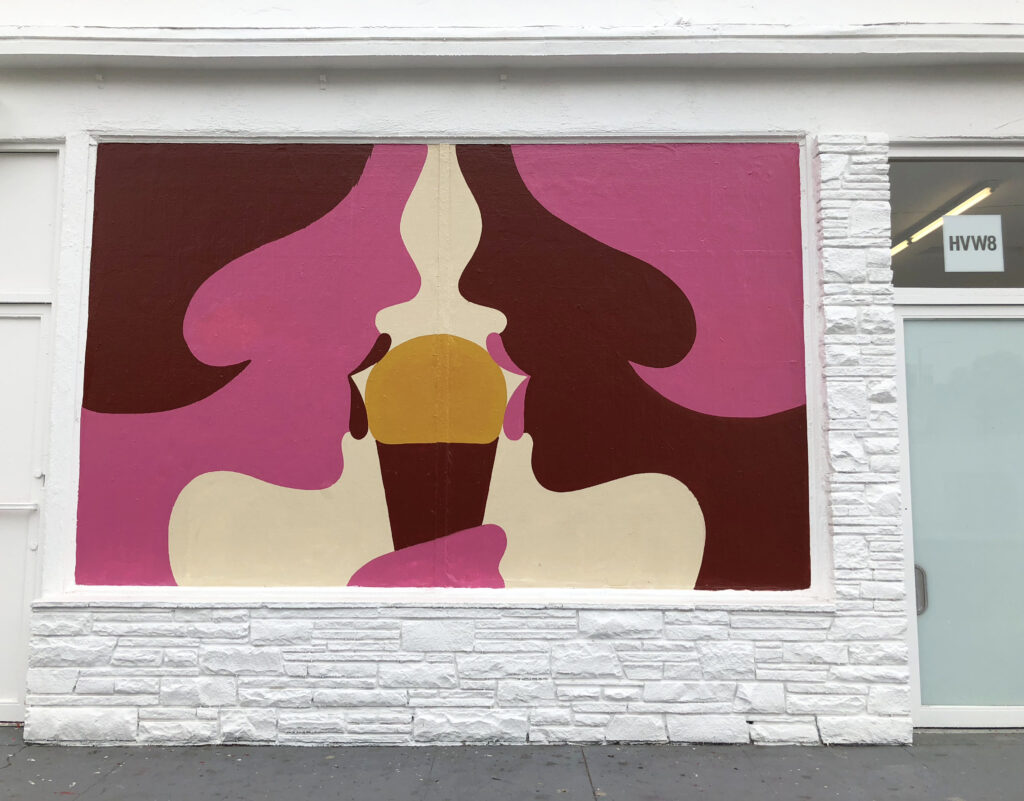
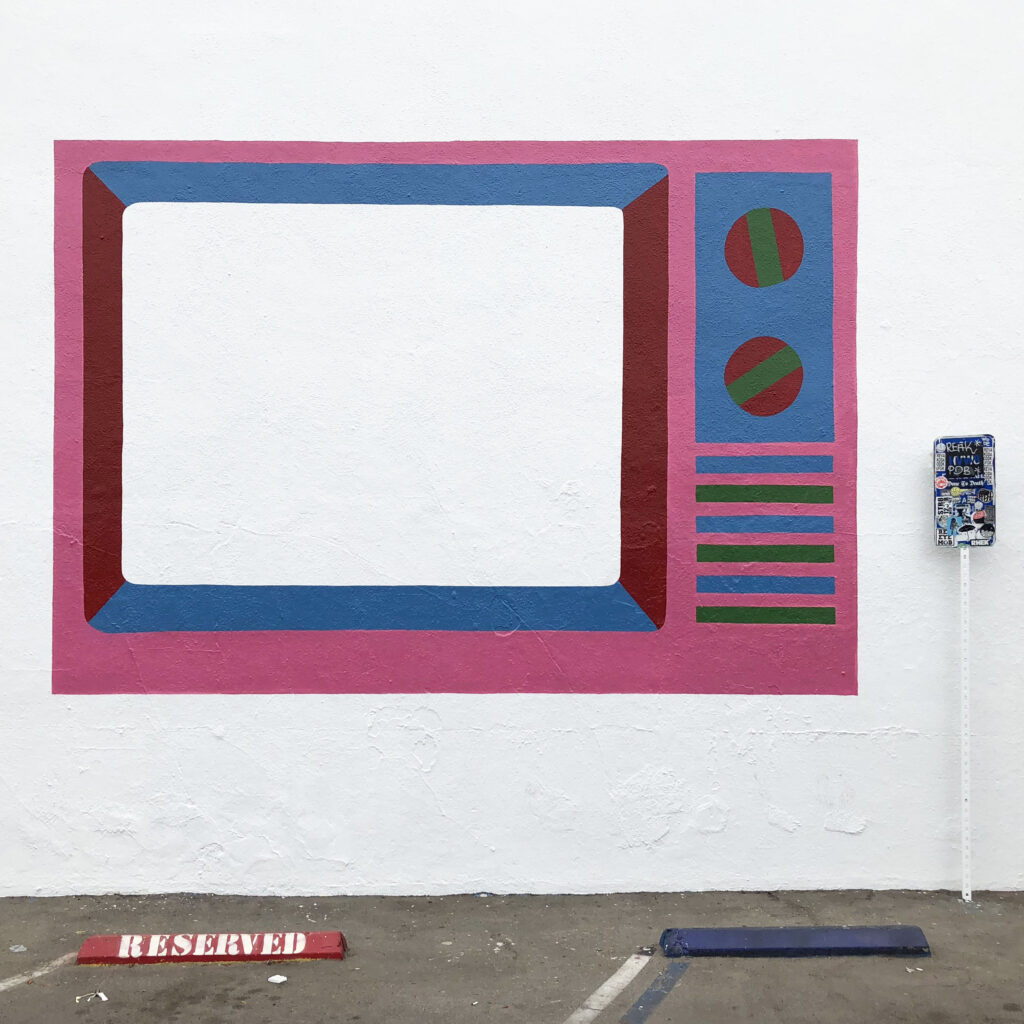
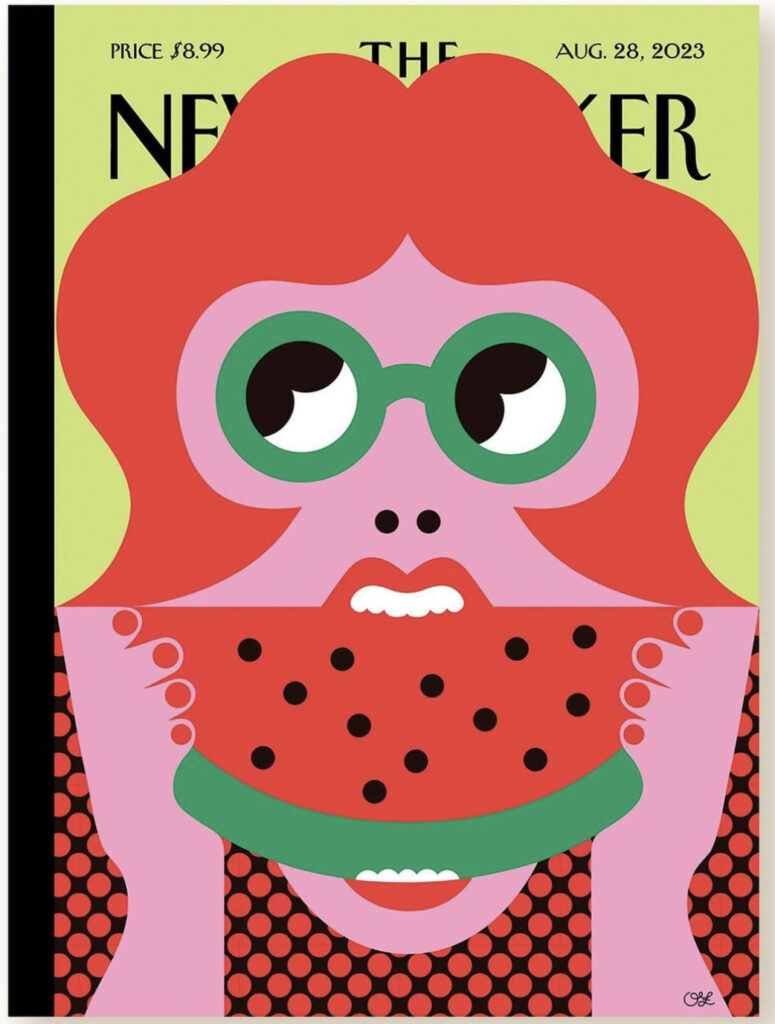
Above are images from Olimpia Zagnoli’s 2018 exhibition Cuore di Panna at HVW8 Gallery in Los Angeles. She is currently showing her work, along with her talented family at Antonio Colombo Gallery in Milan, Italy. That exhibition, ZaLiZaZa. Inventario di famiglia will be on view until 11/19/23.
The press release from the gallery-
Galleria Antonio Colombo is pleased to present the exhibition ZaLiZaZa. Inventario di famiglia, curated by Francesca Pellicciari, featuring a group of artists belonging to the same family: the photographer Miro Zagnoli (Za), the artist Emi Ligabue (Li) and their two daughters: the illustrator Olimpia Zagnoli (Za), already connected with the gallery, and the costume designer Emilia Zagnoli (Za).
The members of ZaLiZaZa are a very modern family, but also one of days gone by: were they not engaged in making their own various artifacts, we could imagine them operating in a family workshop in the Renaissance or Baroque spirit, experimenting with new painting techniques, revolutionizing styles or using them as examples to make their own; creating majestic theatrical wings, garbed in their style which is simultaneously classic and eccentric.
After all, this image is not so far from what ZaLiZaZa are doing today, in the 21st century, each in his or her own field – contiguous and often overlapping ambits – constantly coming to grips with their own research and experimentation, relying on a shared language, a true family lexicon.
The exhibition pathway is an inventory of works of all kinds – drawings and photographs, wooden books, collages, object/sculptures, fabrics, screens and magic boxes – in an intense dialogue of correspondences, where the four voices alternate and take turns, without a chronological order; a dialogue accompanied by a selection of items (sketches, notes, postcards, family photos) that document a methodology, while at the same time emphasizing the constant presence of art in the private life of ZaLiZaZa.
Thus it is no coincidence that many subjects are similar in the work of ZaLiZaZa.
While for decades design has pervaded the still analog settings and photographs of Miro (Za), it is also a recurring theme in the works of Emi (Li), from the Cicognino of Albini to the life and work of Charlotte Perriand, or anonymous design found for sale online: “I have no taboos, no type of respect or norm.” Similar use of anonymous and unconventional materials is found in the “Souvenir” clothing series by Emilia (Za), made from touristy dishtowels with the map of Italy, just as certain archetypes return in the thousands of stripes traced by Olimpia (Za), always in pursuit of the perfect synthesis between the idea and its representation.
Beyond this, beyond design, mountains, figures, bodies, portraits, chiaroscuro effects, balconies, there is the continuing echo – in the various generations of ZaLiZaZa of what Matisse said one day to Picasso, as Emi (Li) reminds us: “In the end, Picasso, we don’t have to try to be so smart. You and I are alike: what we try to rediscover in art is the atmosphere of our First Communion.” To always observe the world with the eyes of children, with the gaze of ZaLiZaZa.
If Olimpia Zagnoli’s work looks familiar, she also designed The New Yorker’s August 28th issue, seen below.