Nov 282025
 

Los Angeles based artist Llyn Foulkes sadly passed away last week. An innovative artist and musician, it was always fun to see his work around California.

The painting above, Post Card from Chatsworth, 1984, was on view at Palm Springs Art Museum in 2018.

About the work from the museum-

Foulkes is known for his acerbic perspective, dry humor, and distinctive style that draws from American popular culture. In the 1980s the artist returned to making Post Card paintings, which he originally created in the 1960s. This image of a seemingly desolate landscape features a large rock, an inscription, a post-office cancellation, and small self portrait. In celebrating the grand nature of the American landscape, the oversize format of the postcard also documents the absurdity of our own touristic impulses. Chatsworth is a neighborhood in northwest Los Angeles, but the area had previously been home to Native Americans, and its caves bear markings of rock art formations.

Nov 272025
 

Lily van der Stokker created Thank You Darling in 2023 for the High Line in NYC.

From the High Line website about the work-

Lily van der Stokker is one of the Netherlands’ most celebrated contemporary artists. In 1983 she moved to New York, opening a small artist-run gallery space in the East Village and has since lived alternately in both New York City and Amsterdam.

For over 30 years, van der Stokker’s drawings and monumental wall paintings have subverted artistic convention and aesthetic expectations, employing an Easter candy color palette to depict clouds, flowers, swirls, and other traditionally feminine or decorative motifs. Van der Stokker annotates these compositions with handwritten text—spelling out intimate thoughts, personal musings, notes-to-self and social niceties. Her visual language is nostalgic and comforting; her playful squiggly patterns are more likely at home in the margins of a student’s notebook as they mindlessly doodle or test out their first name with the surname of a crush than they are within the white walls of a gallery. In fact, van der Stokker’s practice is in some ways defined by this incongruity. She notes, “if I make an artwork about family problems, administrative tasks, or the common flu…I’m bringing in a whole spectrum of new subject matter that is normally absent in art.” By placing on a pedestal what has traditionally been viewed as feminine or domestic, and thus superfluous and inconsequential within the realm of “serious” visual art, van der Stokker reclaims what has long been disregarded and overlooked.

In a 1990 New York Times review of van der Stokker’s debut exhibition, critic Roberta Smith remarked, “the messages conveyed in this terminally cheerful manner usually have a double edge.” Van der Stokker’s work, which she has referred to as “feminist conceptual pop art,” is undeniably joyful and positive, however, it often simultaneously speaks to weighty themes—aging, health, and, more generally, the lived experience of being a woman within patriarchal structures. Hidden in plain sight, disguised by the veneer of her compositions’ cute and charming appearances, is reality. Occasionally mundane, sometimes cheery, and at other moments, cynical or intimate—“a baby, another baby…all my no baby friends live in N.Y.,” a past mural reads. One divulges, “whoopy doo…I am…really ugly…sorry,” in cartoonish thought bubbles. “My mother will loan me €80,000 to help me buy the house,” another reveals. Van der Stokker considers the texts to be the primary component of her work, and with each work she lays bare a vulnerable inner-world for all to see—if they’re willing to look beyond the candy-coated facade.

On the High Line, van der Stokker presents Thank You Darling, a monumental, site-specific mural. Thank You Darling is painted on the side of a building, turning the architecture and shape of the edifice into the frame for the artist’s pastel and fluorescent-hued work. The light blue background is dotted with multi-colored, simple flowers in a decorative all-over pattern that appear to float across the facade—some just coming into view from the edges of the frame. Superimposed over this, read the words “THANK YOU DARLiNG,” spelled out in a juvenile, arbitrary blend of lower and upper-case lettering. Van der Stokker’s puffy bubble-letters are a classic example of playful adolescent penmanship, seemingly lifted right out of a teenager’s diary. In this location on 22nd street, Thank You Darling actively engages with its audience, expressing gratitude to all those who pass, while reclaiming, at massive scale, intimate language that is often mocked or disparaged as being feminine and unserious.

Nov 252025
 

Artist, writer and professional wrestler Rosalyn Drexler, born on November 25, 1926, sadly passed away in September of this year. In addition to her famous artworks, she also wrote several novels and won Obie awards for her plays.

The painting above, Marilyn Pursued by Death, 1963, is currently on view at the Whitney Museum of American Art in New York.

From the museum about the work-

Rosalyn Drexler’s work often explores the dark backstories of postwar media culture and gender roles. She frequently clipped subjects from printed materials-here, a news photograph of Marilyn Monroe fleeing the paparazzi with her bodyguard in tow-enlarged and collaged them onto canvas, and then painted over the image. In the artist’s words, her source images were “hidden but present, like a disturbing memory.” On the day this source photograph was taken in 1956, Marilyn Monroe and Arthur Miller were to announce their upcoming marriage; in the frenzy to cover the event, a car carrying reporters crashed, killing at least one member of the press.

Nov 212025
 

In The Recap this month- music, art, art shows, murals, spooky season posts and more. Check it out here and subscribe!

Nov 182025
 

Jasper Frances Cropsey, “Autumn in the Ramapo Valley, Erie Railway”,1873, Oil on canvas

Jasper Francis Cropsey, “Autumn in the Ramapo Valley, Erie Railway”,1873 (closer)

Andrew Wyeth “Fall at Archies”, 1937, Egg tempera on panel

Andrew Wyeth “Fall at Archies”, 1937,(detail)

Jasper Francis Cropsey, “Autumn on the Brandywine”, 1887, Oil on canvas

Autumn is a perfect time to see the latest exhibition Cropsey, Wyeth, and the American Landscape Tradition at the Brandywine Museum of Art. The exhibition offers the first opportunity to view the large painting Autumn in the Ramapo Valley, Erie Railway by Jasper Francis Cropsey in a museum, as well as to see several additional works by artists including the always wonderful Andrew Wyeth.

From the museum about the exhibition-

A stunning example of Gilded Age patronage, Autumn in the Ramapo Valley, Erie Railway of 1873, has been in private British collections since it was commissioned the same year by Irish-American railroad magnate James McHenry. This major canvas changes our understanding of Jasper Francis Cropsey, one of the iconic talents of American art. Almost seven feet in length, Autumn in the Ramapo Valley, Erie Railway is both a celebration of the American landscape and American industry. The train passing through the valley is a reference to the Erie Railroad, in which McHenry had recently acquired a majority stake. Just after it was completed, McHenry had the painting shipped to England where it remained until purchased in 2025 by the The J. Jeffrey and Ann Marie Fox Foundation for American Art. Seen by the public for the first time since 1873, the painting will be at the heart of a special exhibition, Cropsey, Wyeth, and the American Landscape Tradition, which draws on the rich and varied holdings of the Brandywine Museum of Art and the Wyeth Foundation for American Art to provide a focused appraisal of the complex art of American landscape painting.

Alongside this exceptional large-format Cropsey, additional works by Cropsey, Alfred Thompson Bricher, Albert Bierstadt, William Trost Richards, John Frederick Kensett, Mary Blood Mellen, Martin Johnson Heade, and more survey the nineteenth-century boom in landscape painting in the United States and the relationship to industry that was a key context at the heart of this movement. The exhibition continues the story with Cropsey’s afterlives. Through key works in the Brandywine and Wyeth Foundation collections, a clear line of descent traces the further development of American landscape art, via Homer, Bellows, and N.C. Wyeth to an especially rich flowering in the works of Andrew Wyeth (1917–2009). Documentation in the Wyeth family library and archives shows a depth of engagement with artists of the Hudson River School not previously recognized, including specific lessons in composition, allegory, and the aesthetic potential of industry that Andrew Wyeth learned from paintings like Autumn in the Ramapo Valley. With a variety of works in watercolor and tempera, some of which have never been exhibited before, the story of the rich American landscape tradition continues and intriguing commonalities between the artists of the Hudson River School and Wyeth emerge.

Some additional information about Cropsey from the museum-

Cropsey was one of the leading lights of American art in the third quarter of the nineteenth century: a period in which new fortunes from natural resources and transportation were being spent on ambitious landscape paintings depicting the very regions that were the sources of their wealth. Cropsey’s rivals included the likes of Frederic Edwin Church and Albert Bierstadt. All three worked regularly for railroad barons, and all three achieved notable success, while the so-called “landscape boom” lasted, that allowed them to build statement mansions in New York’s countryside.

It was at Cropsey’s country home, “Aladdin,” in Warwick, New York that he made this painting for the transatlantic businessman James McHenry. Irish-born, Philadelphia-raised, Liverpool-launched, and London-based by this time, McHenry was a European supplier for, and investor in, American railroads. By this date, he had taken control of the Erie Railway and, in celebration, commissioned a depiction from Cropsey of its passage through the scenery of the Ramapo Valley near the northeastern border of New Jersey with New York. Cropsey had already gained a national reputation for paintings that blend industrial and natural subjects in this way, most famously in his 1865 painting Starrucca Viaduct, Pennsylvania (Toledo Museum of Art) depicting a major engineering feat of the same railroad McHenry now controlled, so he was a fitting choice for this commission.

While many American landscape artists were traveling and painting internationally in the period, interest in their work generally came from American audiences. Cropsey was an exception: he worked in London for seven years and exhibited thirteen paintings at the Royal Academy of Art’s competitive annual exhibitions, was presented to Queen Victoria, and sold numerous works to British buyers. The return of Autumn in the Ramapo Valley, Erie Railway to the United States is a landmark moment for scholars and art lovers alike that helps in telling a fuller story of the global networks that surround historical American art.

This exhibition closes 5/31/26.

Nov 072025
 

“Drexler Pigeon (Columba blued)”, 2022, Oil on wood panel

Clive Smith‘s incredibly detailed trompe-l’œil paintings of birds were part of the 2024 exhibition From Cellar to Garret at Marc Straus gallery in NYC.

The first image is of the painting Drexler Pigeon (Columba blued) which uses elements from fellow artist Lynne Drexler’s 1961 painting Blued.


Nov 052025
 

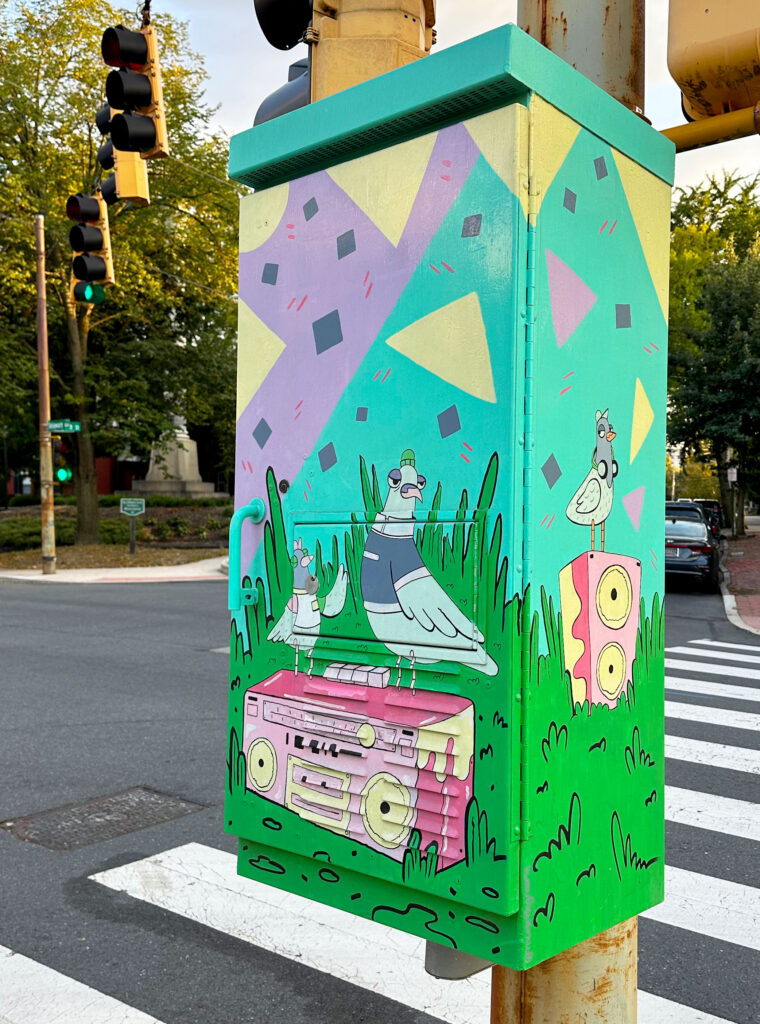
Nicolette Groome created Hip Hop Pigeons for the 2022 Trolley Square Mural Project, in Wilmington, Delaware. Organized by the Delaware Avenue Community Association, several artists created fun utility box murals to brighten up the neighborhood with art.

From more of Groome’s more recent work, also check out her Instagram.

Oct 312025
 

Kashink was one of the many artists who created murals for Jeffrey Deitch’s Coney Art Walls in Coney Island, Brooklyn. You can find their most recent work on Instagram.

Below is Jeffrey Deitch‘s statement about the project from his website-

“Coney Art Walls was an outdoor museum of street art in the center of the Coney Island amusement park. Sixty-eight murals by leading and emerging artists from around the world were presented during the three year curatorial project from 2015 – 2017. Coney Art Walls was possibly the most visited contemporary art installation in the world during its run, experienced by many of the five million people who visit Coney Island each summer. Since the 1970s, when I would visit Coney Island with my punk rocker friends, I had a dream of creating a populist art installation there. Reading about a large vacant lot in the center of the amusement park, I approached the owner, Thor Equities, with my proposal for an outdoor museum of street art. They were enthusiastic about the concept and funded a remarkable three-year project. The mural project was enhanced by a Brooklyn food court with outdoor seating and a music program. It was thrilling to see hundreds of young people dancing in front of the murals on summer nights.”

Oct 312025
 

Today’s flashback is to a few of the intricate works from Sofia Love‘s 2023 exhibition Vaquera at Shelter in NYC.

From the gallery about the exhibition-

Vaquera – not determined by an article, the word becomes both a noun and an adjective, an iconic figure and a way of being in the world. For Brooklyn-based painter Sofia Love’s debut solo exhibition in New York, vaquera is both a manifesto of queer self-fashioning and a patron saint.

Born and raised in Boston, but with deep family ties to the Mexican community of Laredo, TX, Love’s acrylic paintings serve as a negotiation between ancestral memory and contemporary identity. The titular cowgirl recurs throughout the exhibition – gun-slinging, brown, and frequently nude – framed by expanses of desert. She’s a real, historical cowgirl. She’s the artist traversing her own imagination. She’s a badass dyke. For Love, vaquera is an object of desire and an extension of herself.

While there are traditional canvases, the majority of works on view take the form of nichos, intimate yet elaborately decorated altars that can be found in homes across Mexico. Dedicated to deceased ancestors or particular saints, nichos blend folk spirituality with Catholicism, smuggling pre-Colombian vernacular traditions into contemporary, Westernized culture. Love’s nichos draw on this history to produce art objects that exist at the border of painting and sculpture, with frames that extend the content and imagery of the paintings they enshrine.

The resulting works each have interiors and exteriors, the painting and the frame, in which ambivalent scenes are surrounded by totems and animals that seem to hint at the psychological subtext of the central image. Figures reappear across the framed nichos like characters in a narrative, each with its own personal connotation for the artist. Skulls, moths, storks tell stories that are only partially legible from an external perspective. Like the vaquera herself, Love’s layered compositions refuse any easy interpretation.


Oct 302025
 

Mural by Reid Jenkins and Scott Hillis, located in Pinellas Park, Florida.

It is one of several murals outside a group of buildings that includes Studios at 5663 and Saint Paint Arts.