Jul 092024
 

“Jeff Way In His Tribeca Loft”, 2023; “Turtle Owl Death Mask”,2018 and  “Egyptian Violet Gorilla Mask”, 2017

Kimiko Fujimura “Party-3 (Party at Peter’s), 1990, and “Kimiko Fujimura in her Chinatown Loft”, 2023

For his current exhibition, Loft Law, on view at Westwood Gallery, documentary photographer and filmmaker Joshua Charow photographed artists living and working in the remaining spaces still protected by Loft Law in NYC. The well-crafted portraits offer a chance to see how the artists have made these spaces home over the years.

The gallery has also included artwork by eleven of the artists featured in the photos- Carmen Cicero, Loretta Dunkelman, Betsy Kaufman, Kimiko Fujimura, Joseph Marioni, Carolyn Oberst, Marsha Pels, Gilda Pervin, Steve Silver, Mike Sullivan, and Jeff Way.

From the gallery-

In 1982, Article 7-C of the Multiple Dwelling Law, also known as the Loft Law, was passed in New York City. The law gave protection and rent stabilization to people living illegally in manufacturing and commercially zoned lofts. Hidden behind this legislation were thousands of artists who needed a live/work environment at an affordable rent. These artists protected by the Loft Law changed the trajectory of New York’s cultural landscape.

Three years ago, Charow found a map of the remaining buildings with Loft Law protection. He rang hundreds of doorbells to find and photograph over 75 Loft Law tenants across the city to document the last of these incredible spaces and the creative individuals who made them home. Charow’s interest in the Loft Law and the vanishing history of New York stemmed from his early teenage years when he became immersed in a subculture called ‘Urban Exploring,’ the practice of illegally climbing skyscrapers, bridges, and abandoned subway stations. One of the rooftops he visited was an old factory building in South Williamsburg, where a tenant explained to Charow about the building’s remaining tenants under Loft Law protection.

The photos are a living visual document of the expansive spaces: old flophouses on the Bowery, garment factories in Tribeca and SoHo, glass factories in Greenpoint, and even a former ice cream factory in DUMBO. From the 19th to the 20th century, many buildings in NYC, including SoHo, were manufacturing centers for items from sewing machines to textiles to printing houses. The massive light-filled loft spaces with high ceilings were left empty when these businesses vacated in the mid-1900s and moved to other areas outside of New York City. The industrial-zoned lofts were not legal to live in, as they did not meet the building requirements for residential use, and oftentimes were completely raw spaces without a kitchen, shower, plumbing, or even heat. However, artists were attracted to these large spaces where they could work and create at any hour of the day. At the end of the 1970s, loft living started gaining attention in the media and the wealthy started to become attracted to this lifestyle. Soon landlords began to evict the artist tenants in favor of a wealthier clientele. A group of artists formed the Lower Manhattan Loft Tenants and spent years lobbying in Albany to gain legal protections and rent stabilization. At the time the Loft Law was first passed, there were tens of thousands of artists living in lofts across the city. Today, only a few hundred artists protected under the original 1982 Loft Law remain. This exhibition marks one of the first documentary insights into this vanishing history.

The majority of Charow’s images depict painters, sculptors, photographers, musicians, and filmmakers captured amidst their industrial loft spaces. Notable portraits include experimental music and film artists Phillip (Phill) Niblock (1933-2024) and Katherine Liberovskaya (b. 1961); Phill was instrumental in the avant-garde music and film scene from the 1960s to the present. Visuals artists include 97-year-old abstract and figurative expressionist Carmen Cicero (b. 1926), who has works in the collections of the Guggenheim Museum, Museum of Modern Art, and Whitney Museum; Kimiko Fujimura (b. 1932), who in 1965 was selected as “Japan’s Top 5 Female Painters in Contemporary Art” by Geijutsu-Shincho, a Japanese monthly art magazine; minimalist painter Loretta Dunkelman (b. 1937), a co-founder of the all-female artists cooperative A.I.R. Gallery; and Gilda Pervin (b. 1933), whose studio occupies the top floor of a 1790s Quaker building linked to the Underground Railroad and happens to be the old studio space of famed sculptor Eva Hesse, who worked there from 1965-70. Also included is Chuck DeLaney, co-founder of the Lower Manhattan Loft Tenants, an early activist group that was responsible for the lobbying and passing of the Loft Law.

This exhibition closes on 7/13/24.

Jul 052024
 

Joan Jonas: Good Night Good Morning, at the Museum of Modern Art, showcases the artist’s long and varied career. The exhibition includes her videos as well as props, sculptures, paintings and drawings. It’s a celebration of her collaborations (including Volcano Saga with actress Tilda Swinton), performances, installations, and her use of play to create all of these inventive works.

From the museum-

“I didn’t see a major difference between a poem, a sculpture, a film, or a dance,” Joan Jonas has said. For more than five decades, Jonas’s multidisciplinary work has bridged and redefined boundaries between performance, video, drawing, sculpture, and installation. The most comprehensive retrospective of the artist’s work in the United States, Joan Jonas: Good Night Good Morning traces the full breadth of her career, from works that explore the encounter between performance and technology to recent installations about ecology and the landscape.

Jonas began her decades-long career in New York’s vibrant Downtown art scene of the 1960s and ’70s, where she was one of the first artists to work in performance and video. Drawing influence from literature, Noh and Kabuki theater, and art history, her early experimental works probed how a given element—be it distance, mirrors, the camera, or even wind—could transform one’s perception.

Joan Jonas: Good Night Good Morning presents drawings, photographs, notebooks, oral histories, film screenings, performances, and a selection of the artist’s installations. Jonas continues to produce her most urgent work through immersive multimedia installations that address climate change and kinship between species. “Despite my interest in history,” she has said, “my work always takes place in the present.”

The museum’s website has several videos of her work online, as well as an interview with the Jonas in her NYC loft (seen below).

Art21 also has some great videos worth checking out to learn more.

The exhibition at MoMa closes 7/6/24.
Jun 012024
 

It’s easy to become a bit overwhelmed at Arthur Jafa’s exhibition BLACK POWER TOOL AND DIE TRYNIG at 52 Walker. His latest show includes a large installation, photography, sculpture, painting and a new film. Passing the reflective black surface and walking through his sculptural installation, Picture Unit II,  you’ll find portraits of bikers, a photo from the Manson murders, a subway car, and a stripper at a club next to a photo from a Rwandan genocide memorial. Next to where a video plays a collage of clips, an installation of cut out figures includes himself, Miles Davis, The Sex Pistols, and artists Cady Noland and Adrian Piper.

Death plays a large part in the show, as does personal and collective history. His best friend of forty years, cultural critic Greg Tate, recently passed away, also contributing to the heaviness of this recent work.

From the press release-

Lauded for his achievements as a filmmaker and cinematographer as well as a visual artist, Jafa has developed an incisive, chameleonic practice, through which he seeks to unravel the cultural significance and strictures ascribed in tandem upon Black existence in the Western world. In BLACK POWER TOOL AND DIE TRYNIG, Jafa invokes the body’s personal, political, and industrial guises in one fell swoop, deftly interweaving images and objects to create a forceful and maximal space that beckons toward engulfment and revelation alike.

Jafa’s exhibition at 52 Walker brings to the surface questions of form, force, and resistance— in addition to tensions that result from common slips and errors. The title of the show, BLACK POWER TOOL AND DIE TRYNIG, applies strategies of sequencing and juxtaposition, channeling various meanings in its wordplay—including political ideologies, industrial terminologies, and the specter of death—while also nodding to the complexities of the word “black” and its many inflections. Favoring intuitive arrangement over uniformity, the artist eschews traditionally monolithic modes of presentation and instead coheres multiple simultaneous events, applying a decidedly Black and non-Western viewpoint that confronts twentieth-century art historiography and museology’s indebtedness to African aesthetics.

In the video below, also on the 52 Walker website, Jafa discusses the show with screenwriter Judnick Mayard and is worth watching for additional insights.

This exhibition closes 6/1/24.

May 192024
 

Ann Schaumburger, “Silver Moon in Darkened Sky House”, 2023, Flashe on wood

Ann Schaumburger

Ann Schaumburger

The three exhibitions currently on view at A.I.R. Gallery in Brooklyn all focus on homes in unique ways. In the first gallery, Ann Schaumburger’s paintings of houses for New Work continue her exploration of color.
From the gallery-

For over fifty years, Schaumburger has used the house as a basic structure—a scaffold—for exploring how colors interact with one another. Schaumburger builds her houses with blocks of four pigments, using stencil brushes and tape to fill each house with modular forms. Influenced by the theories of Josef Albers, Schaumburger’s approach to color is meticulous yet playful. Different colors dazzle and dance when placed in proximity, creating a sense of surprise.

The paintings in this new body of work depart from Schaumburger’s earlier explorations in one key detail: the houses are now mounted on wheels. This choice was inspired by Schaumburger’s reading of the biography of Henry David Thoreau, whose family had attached wheels to their domicile, allowing them to transport the house across different sites in Concord, Massachusetts. “The idea of taking a solid house, attached to the ground, and letting it roll away,” Schaumburger says, “seems both comical and deeply suggestive of our times.”

Schaumburger has described her color choices as an attempt to “solve an aesthetic problem.” Yet the work is not entirely abstract. Titles like Forest House Under Summer Sky and Moonscape Moving House gesture toward the fact that certain color relationships become evocative of different seasons, places, and times of day. All of the paintings in the exhibition feature a crescent or small globe in the upper left or right quadrant. Sometimes, this globe is rendered in metallic gold or bronze, recalling the sun. Other times, it is a lunar silver. The round shape of the globe mirrors the house’s circular wheels. Just as the earth rotates around the sun, the wheels rotate around their own axles, allowing the house to move.

The wheeled house becomes a spirited metaphor for Schaumburger’s practice. Dynamic rather than stationary, it embodies the liveliness and energy of Schaumburger’s color choices, as well as the open-ended nature of her process.

Roberta Dorsett’s photos for Sleepwalking explore isolation and uneasiness in her family’s suburban home.

Roberta Dorsett, “Sleepwalking”

Roberta Dorsett, “Sleepwalking”

Roberta Dorsett, “Sleepwalking”

From the gallery-

Dorsett’s Sleepwalking is a series of photographs examining isolation in the suburbs and how a sense of danger often accompanies seemingly idyllic environments. The work depicts three women, Dorsett’s aunt, her cousin, and Dorsett herself, occupying the shared space of a suburban home in Connecticut. Tension arises from the camera’s interaction with the women. The camera acts as an intrusive person, an interloper, and a voyeur as it captures the women in moments of discomfort and vulnerability.

In Dorsett’s previous work, she took on the role of family historian, photographing moments of in-betweenness that result in candid and uncontrived images. Her obsession with taking photographs of her family is driven by their lack of extant family albums or other visual documentation. Because of the family’s socioeconomic status, photography was considered a luxury and only done for special occasions. Moreover, Dorsett’s mother had to leave behind her family’s photographic history when she immigrated from Jamaica to the United States.

Dorsett initially intended Sleepwalking to be a straightforward documentation of her aunt and cousin’s experience as first-time Black homeowners. But she found herself drawn into the project’s narrative and began photographing her family in a more constructed and story-driven way, drawing inspiration from slasher and horror films. Dorsett captures the visceral thrills of these types of films by continuing to utilize her family to explore the concepts of voyeurism and anxiety. The single-family home, once a symbol of milestone achievement, now becomes a surreal site of both safety and terror. As she stood behind and in front of the camera, registering the uneasiness and distress of these three women inside their home, Dorsett dreamed up a distorted reality and asked herself, “Am I awake or sleepwalking?”

Finally, Denisse Griselda Reyes multimedia installation for Did you have a hard time finding me?  explores home and identity using a combination of original artwork and family archives.

Denisse Griselda Reyes, “Did you have a hard time finding me?

Denisse Griselda Reyes

From the gallery-

Featuring short films and familial ephemera alongside a new body of paintings, this exhibition humorously meditates on questions of self-formation, reparative representation, and archival preservation, inviting us to dwell in the absurdity these ambitions unintentionally generate. This is Reyes’s first solo exhibition in New York City.

Presenting what Reyes has called a “maximalist constellation of memory,” the exhibition juxtaposes materials from their family archives with paintings and multimedia projections within an installation space that recalls, yet does not perfectly reproduce, the domestic interiors of Reyes’s family. Anchoring this exhibition is a short film that ties together two threads. First, the border crossings of Reyes’s grandmother Anita that were necessitated by the peril of the Salvadoran Civil War, and this history’s impact on Reyes’s mother. Second, the queer dating life of Reyes’s indignant and savvy alter-ego, Griselda. Part-narrator, part-drag-persona, part-survival-strategy, Griselda offers Reyes a means to dictate the terms of their own representation against the expectations that constrict queer Latinx artists in the United States. Still, Griselda is also beholden to identitarian demands. Reyes allows their avatar to straddle the line of spectacle, flirting with failure, acknowledging that self-formation might be an impossible endeavor. By juxtaposing Griselda’s exploits with the narrative of their grandmother, Reyes interrogates whether familial, social, and historical processes have the final word on what generates a self.

Reyes has produced Griselda as a mediating figure—one who negotiates their own identity between femininity and non-binary gender, and who personifies the absurdity of any singular narrative of origin. In its plenitude and play, the exhibition exceeds the ostensible facticity of the familial and historical archive. Featuring new paintings that hazily recreate family photographs, a vitrine full of childhood teeth that parodies genres of museal presentation, screens that toggle between home videos and the simulation of archival footage, and striking blue-green walls that recall the past domestic spaces of Reyes’s family in El Salvador, the exhibition transforms processes of preservation into acts of mythmaking. The exhibition is less a recreation of the artist’s family’s domiciles than a space of critical reflection and ambiguity. Guests are invited to join in this meditation—and may find their own notions of selfhood implicated as a result.

These exhibitions close 5/19/24.

May 142024
 

Kwakwaka’wakw artist and activist Chief Beau Dick’s (1955-2017) carved masks for the exhibition Walas Gwa’yam / Big, Great Whale at Andrew Kreps Gallery draw you in with their intriguing visages.

From the press release-

Our whole culture has been shattered. It’s up to the artists now to pick up the pieces and try and put them together, back where they belong. Yeah, it does become political. It becomes beyond political; it becomes very deep and emotional.” – Beau Dick speaking in the 2017 film ‘Maker of Monsters: The Extraordinary Life of Beau Dick.

Beau Dick’s works are deeply informed by the tradition of potlatch, a gift-giving ceremony practiced by Indigenous people of the coast of Pacific Northwest Canada, which focused on the redistribution of wealth as a tool for building solidarity. Outlawed by the Canadian Government for nearly seventy years as part of an ongoing history of forced assimilation, the seclusion of Dick’s birthplace on Kingcome Inlet (Gwa’yi) allowed his community to continue practicing customs relatively free from the gaze of colonial authorities. Trained in wood-carving by his father, grandfather, and other master carvers, and completing his education in Vancouver, Dick was acutely aware of inherent tensions between contemporary consumer culture and Kwakwaka’wakw teachings. Refuting his masks as static objects, his carvings reference supernatural figures, like Dzunuk’wa, the “wild woman of the woods,” and her counterpart, Bakwas, “wild man of the woods,” which are reanimated to combat what Dick saw as capitalism’s “ravenous” oppression. Frequently employing his works in dances and performances, in 2012 he took forty Atlakim (Forest) masks to his community in Alert Bay, where after one final ceremony, they were ritually burned, referencing the ongoing responsibility for rebirth, and recreation in the face of erased tradition.

Apr 262024
 

This tribute to artist Margaret Kilgallen was spotted in Los Angeles in 2014. The quote is paraphrasing what she said during an interview for the PBS program Art21. The full quote reads- “I do spend a lot of time trying to perfect my line work… when you get close up, you can always see the line waver. And I think that’s where the beauty is.” Kilgallen died of cancer in 2001, at only 33, but left behind a remarkable body of work.

You can currently see one of these works at Cantor Arts Center’s as part of the group exhibition, Day Jobs, on view until 7/21/24. The exhibition examines the impact of day jobs in the lives and work of several famous artists.

Image courtesy of Cantor Arts Center: Margaret Kilgallen, “Money to Loan (Paintings for the San Francisco Bus Shelter Posters)” [detail], 2000. Mixed media on paper and fabric, sheet 68 × 48½ inches Courtesy of the Margaret Kilgallen Estate, photo by Tony Prikryl

You can learn more about Kilgallen, her husband and fellow artist Barry McGee, and several other artists including Shepard Fairey, Mike Mills, Ed Templeton and Harmony Korine in Aaron Rose’s film Beautiful Losers.


Apr 122024
 

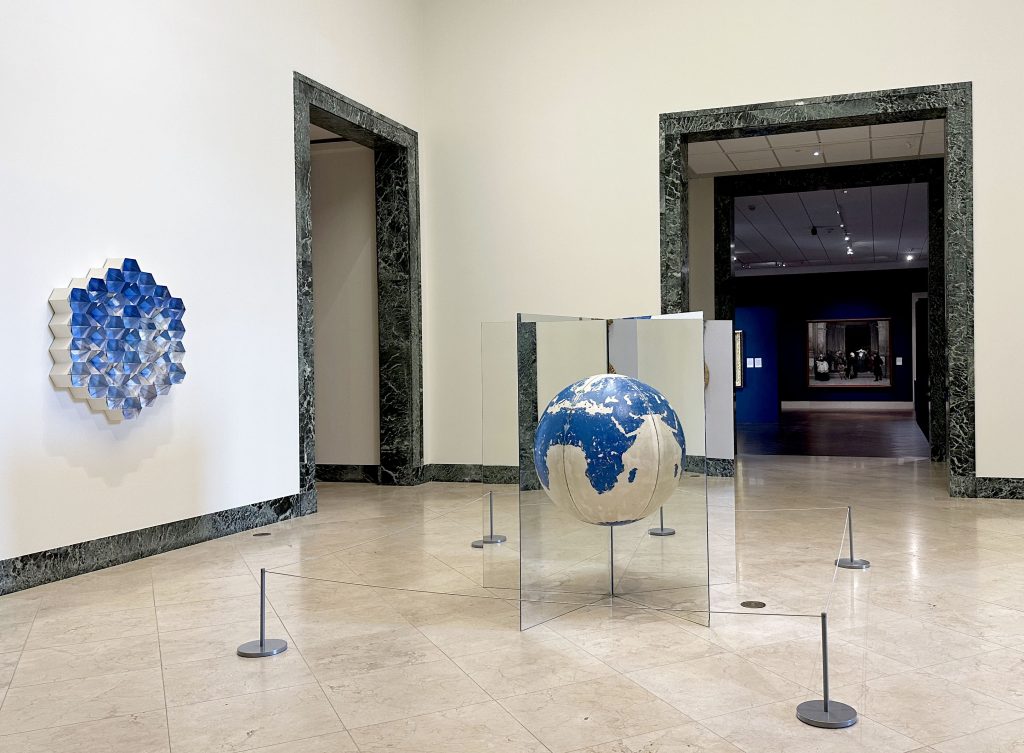
Brookhart Jonquil, “Groundless”, 2023, Mirrors, steel, acrylic paint, enamel paint

Brookhart Jonquil, “Groundless”, 2023, Mirrors, steel, acrylic paint, enamel paint (detail)

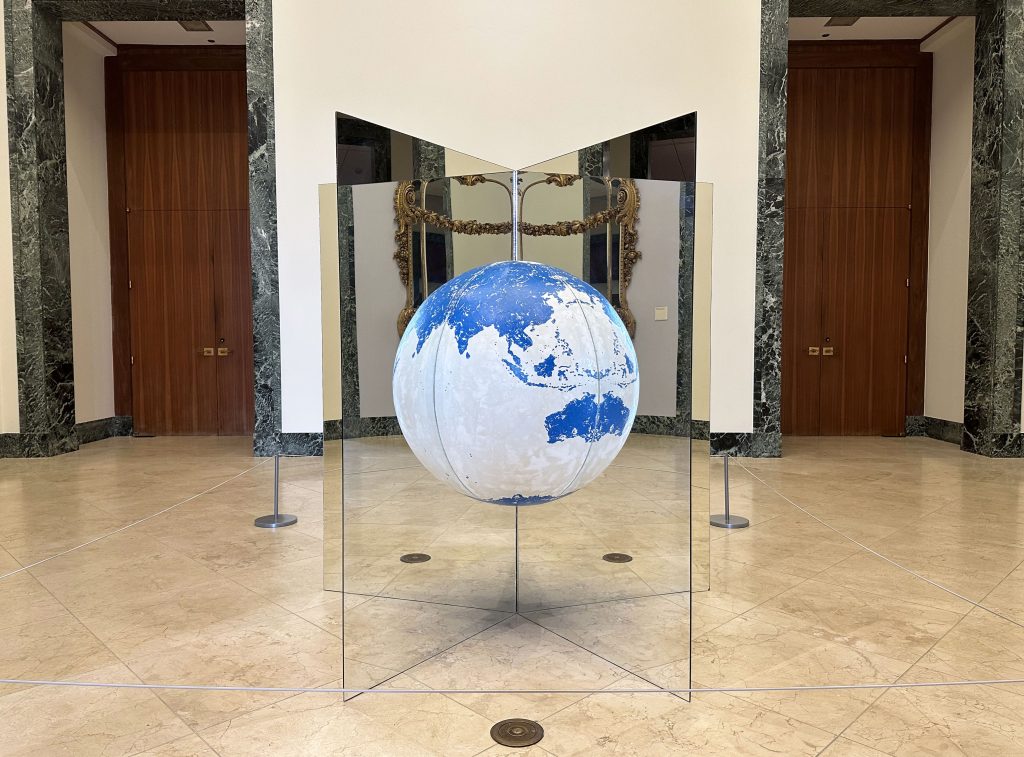
Brookhart Jonquil, “E)A)R)T)H)”, 2012, Mirrors, EPS, MDF, plaster, paint

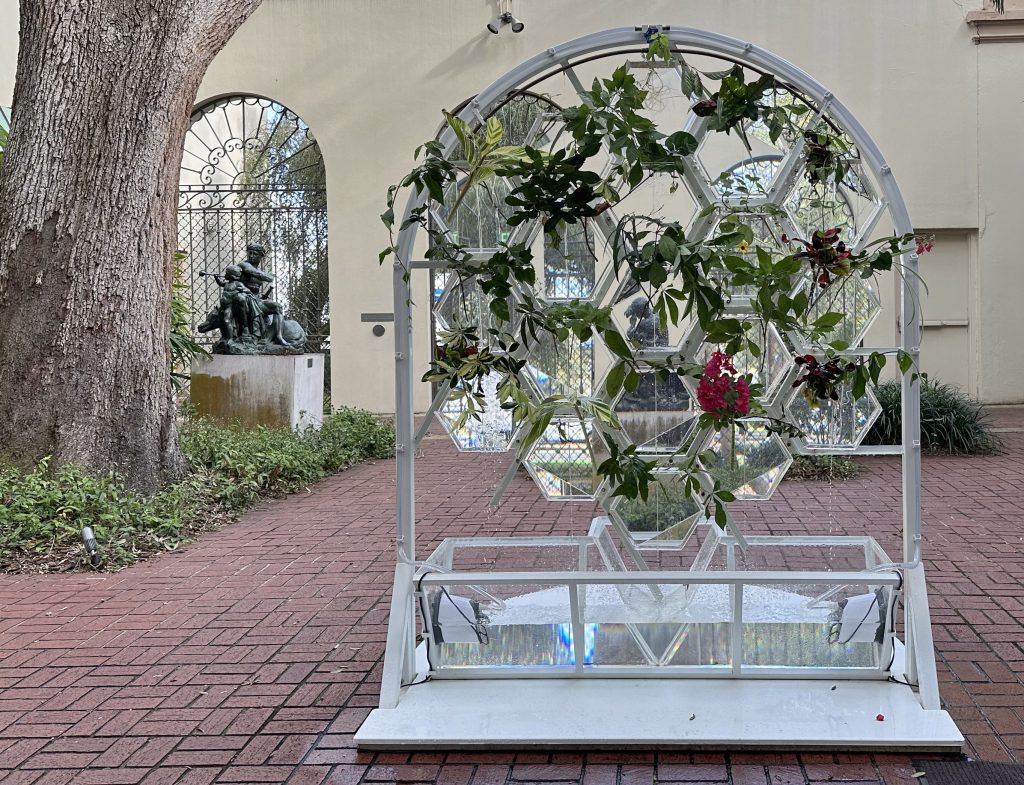
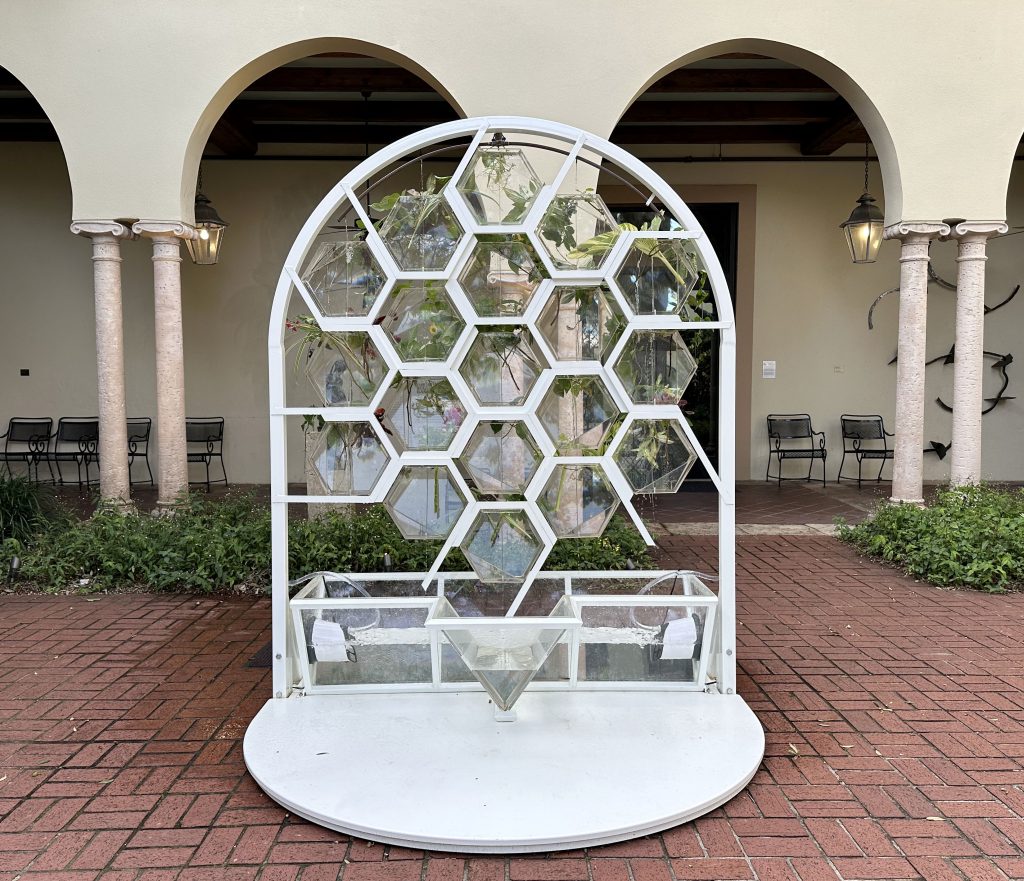
Brookhart Jonquil, “Multiplication Portal”, 2022, Plexiglass, water, powdercoated steel, plant cuttings, marine polymer sheet, pump system

Brookhart Jonquil, “Multiplication Portal”, 2022, Plexiglass, water, powdercoated steel, plant cuttings, marine polymer sheet, pump system

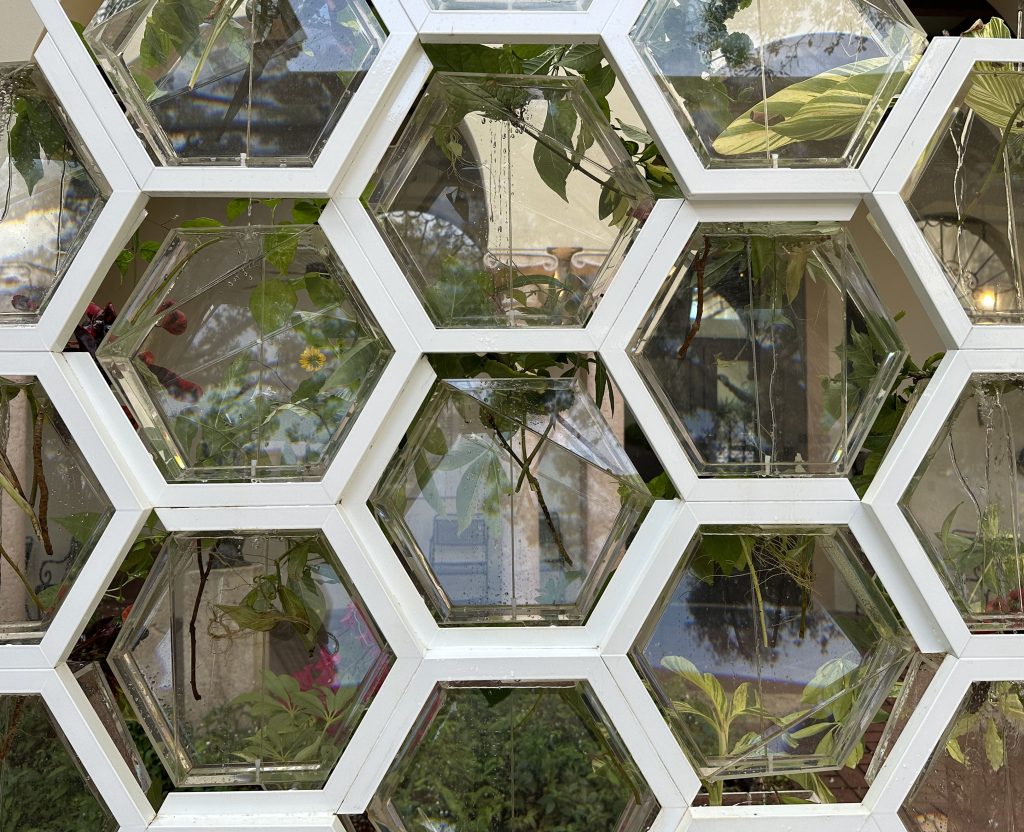
Brookhart Jonquil, “Multiplication Portal”, 2022, Plexiglass, water, powdercoated steel, plant cuttings, marine polymer sheet, pump system

Brookhart Jonquil, “Multiplication Portal”, 2022 (detail)

For The Nature of Art at the Museum of Fine Arts St. Petersburg, work from the exhibition is spread throughout different sections of the museum. In the Great Hall and Sculpture Garden are installations by Brookhart Jonquil.

From the museum about these works-

In this group of installations, Brookhart Jonquil creates art that engages physics, architecture, and ecology to explore the immaterial, shifting aspects of the natural world. His work reflects influences ranging from Minimalism to theories of utopia and perfection; it offers viewers new ways of seeing and a nuanced understanding of our place in the world. The works exhibited here and in the Sculpture Garden encompass over a decade of his career, illustrating how nature has always influenced his artistic practice.

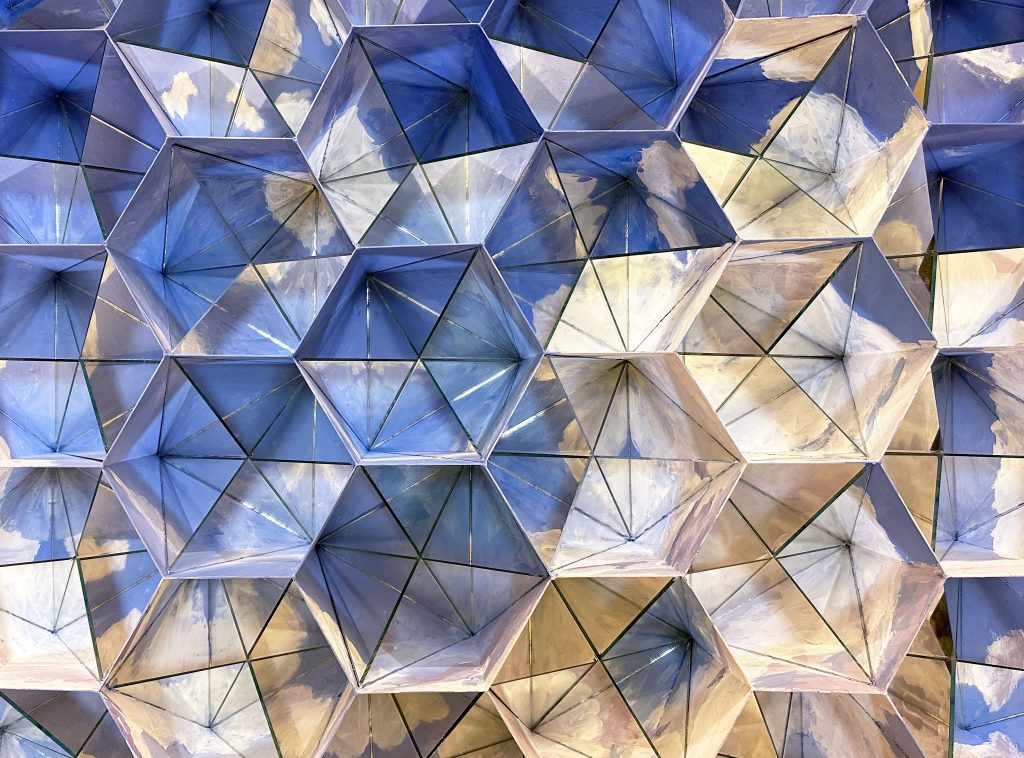
Groundless is Jonquil’s most recent work, inspired by painting en plein air, the Impressionist practice of working outdoors. However, the artist has complicated this by incorporating mirrored surfaces that deny full control of his compositions. Jonquil notes, “Each stroke of paint multiplies unpredictably as I place it, while shifting colors and cloud-forms evade fixity.”

The floor-based sculpture E)A)R)T)H) uses five pieces of mirror glass to dissect an earthly sphere. Unlike Groundless, these mirrors reflect the Great Hall, foyer, and surrounding galleries, suggesting a macro-and micro-viewing of our planet. To further a sense of dislocation, Jonquil has inverted the colors typically associated with land and water: bodies of water are depicted in white, while land is blue.

Multiplication Portal-on view in the Sculpture Garden- is a participatory sculpture highlighting the care and responsibility involved in cultivating plants. Reminiscent of both a kaleidoscope and a beehive, it was inspired by chaos theory-also known as the butterfly effect, which is the idea that one tiny gesture can have colossal consequences within dynamic systems. Brookhart created Multiplication to fight environmental disillusionment. Can one individual impact the impending climate disaster? What is the point of separating paper and plastic? Does turning off the lights make a difference? Multiplication Portal serves as a reminder that our seemingly small actions have the potential for significant consequences.

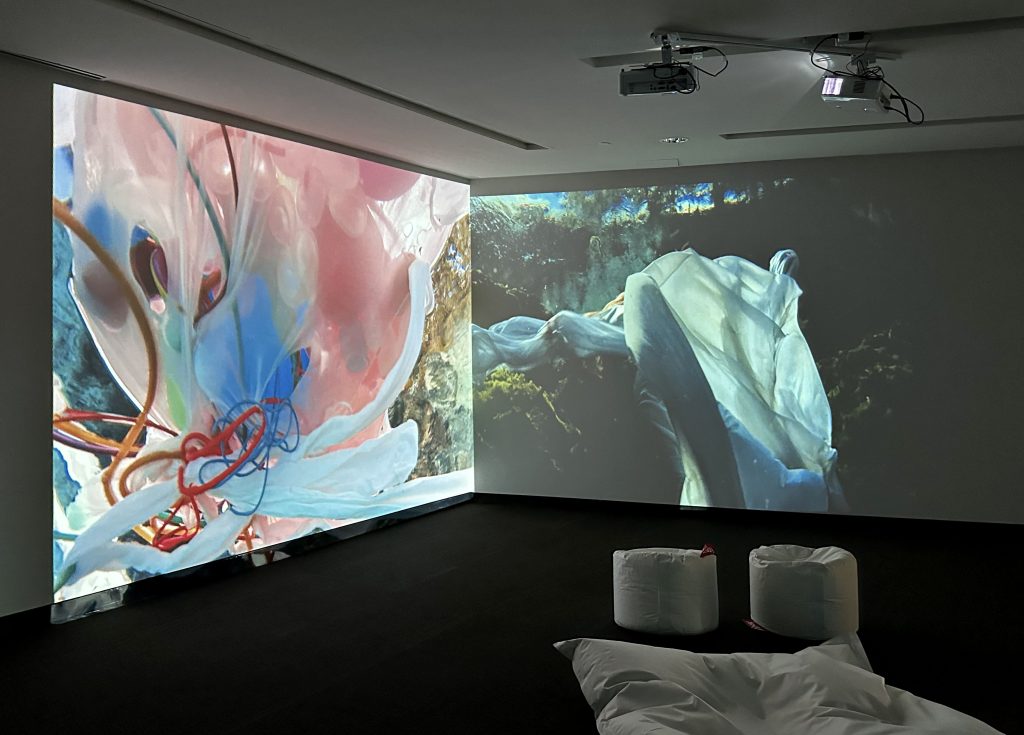
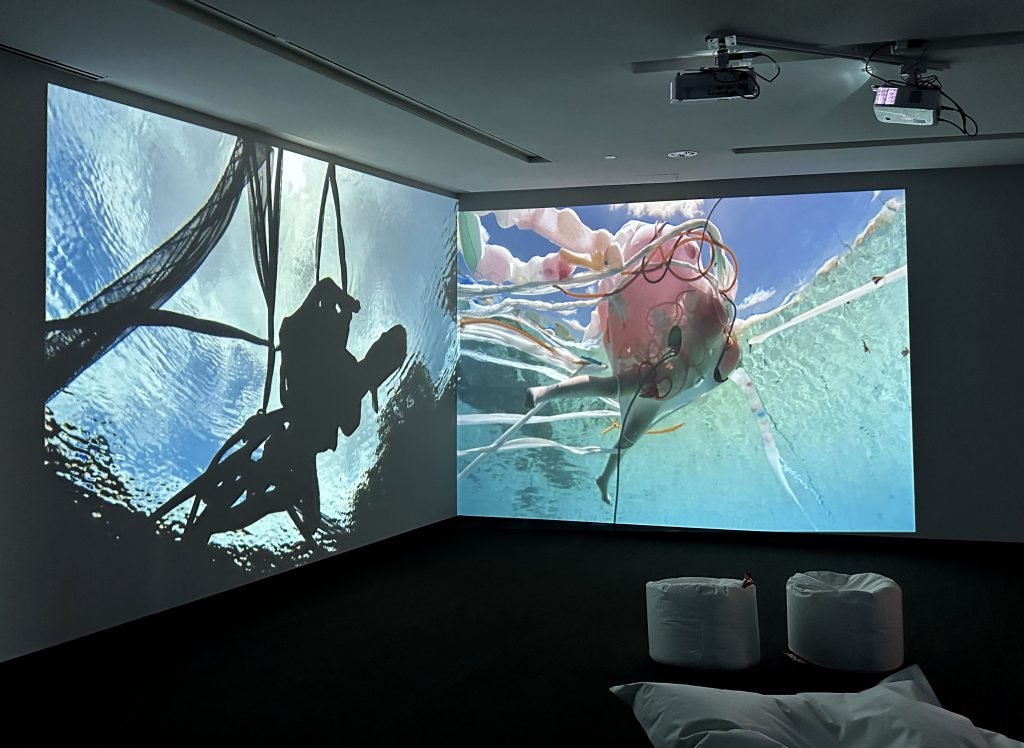
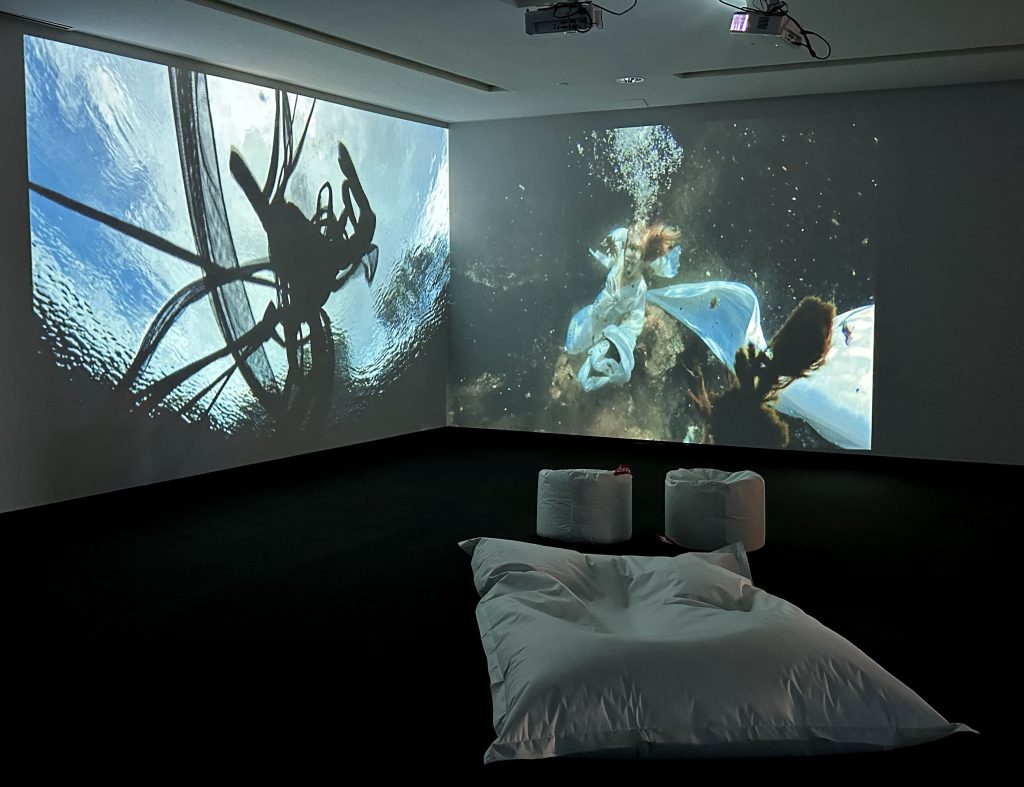
In an upstairs gallery is the video installation, Blood, Sea by Janaina Tschäpe (seen below). The dreamy video takes you underwater to explore transformation through sea maiden myths.

Information on the installation from the museum-

Reminiscent of Voltaire’s Micromégas, Janaina Tschäpe’s fantastical scenes dissolve boundaries, seamlessly intertwining in an ever-flowing continuum of evolution and transformation in a grand opera that delves into themes of change, gender, and the construction of myth and history. The universe created by Tschäpe beckons one into a parallel world of ambiguous scale-indeterminate in both time and space. The spring-fed grotto provides the scenographic impetus for this grand production, a captivating fusion of a theme park nestled within a state park and bearing the distinction as one of Florida’s oldest roadside attractions. The sea maiden mythologies that inform Blood, Sea link endless stories from across time and space, as many cultures have some version of a water goddess. Millennia of previously unknown deep-sea creatures caught in fishermen’s nets spawned the mythic narratives that gave rise to these goddess/creature tales. From the Mami Wata spirits of West Africa to the water sprites of Irish lore, the trope of the sea maiden appears around the world and across time. Tschäpe’s primary connection is her namesake, the Orixa lemanja of Candomblé. This powerful water spirit is the Brazilian version of the many syncretic gestures born of the Yoruban Afro-Atlantic diaspora. But lemanja is merely one character in the global pantheon of the water goddess.

The split-tail mermaid motifs that adorn the exterior walls of centuries-old homes in the landlocked Swiss Alps are a testament to the enduring allure of the fish woman’s imagery. The split-tail represents the hybrid presence of both home and away, the perpetual dual identity of the émigré, and a curious cipher of Tschäpe’s experience living between the culturally antipodean points of Germany and Brazil. This existence places her between logic and magic, between Protestant rationalism and the mystical worldview of Candomblé, between the grey angst of northern Romanticism and the sensual elegance of the southern hemisphere. This ever-changing identity is evidenced clearly in Blood, Sea, where the video’s perspective perpetually shifts. At certain moments, the viewer finds themselves aboard a ship, assuming the role of a scientist discovering a previously unknown life form. In other instances, we have the privilege of swirling amidst the creatures, becoming one with them.

This exhibition closes on 4/14/24.

Apr 102024
 

Nalani Stolz “Bread Bodies”, bread, ceramic, muslin

Nalani Stolz, “”like floating in thick waters”, fermented membrane, stainless steel

Nalani Stolz, “a small ocean swallowed” baking soda, ceramic, cheesecloth, vinegar, pump, latex

“a small ocean swallowed”, closer

Nalani Stolz, “a wild wetland in our gut” ceramic, plum vinegar, muslin, stuffing, salt

Nalani Stolz, “a wild wetland in our gut” ceramic, plum vinegar, muslin, stuffing, salt

The Sculpture Center in Cleveland is currently showing Nalani Stolz’s Bodies Still Becoming and Zachary Smoker’s Inured.

With the sound of water dripping, the bread stretching fabric, and growth covered vessels leaking into mattresses- Stolz’s sculptures engage the viewers senses, at times viscerally.

She has also included her film Traces in the exhibition. For this work she and her mother slowly sew their hair together through a sheet of gauze.

From the gallery about the exhibition

The bodies Nalani Stolz crafts bulge, grow, and break down. Materials such as rising dough expand and constrict, cloth sculptures leak and ooze, fermented membranes and porous clay forms seep vinegar, growing warts across their surfaces. These bodily processes draw on the often-gendered experiences of how our physical forms take in and expel matter; the feelings of expansion and fullness and those of emptying out, of breaking down when weeping, menstruating, and experiencing miscarriage, abortion, and pregnancy. These moments shift our seemingly solid edges and reveal our porous boundaries; reminding us that we are dying, changing, decaying vessels, loosely contained by skin, muscle, and bone.

Zachary Smoker’s sculptures for Inured address issues related to U.S. currency, power, capitalism, and material culture. In two of the works, familiar items ask questions about purpose. The whiffle ball bat /police baton combination mixes violence and play. Shopping carts now have associations with living on the street, as well as for buying goods in a store- which one will this be used for when assembled?

Zachary Smoker, “Crony Tikes”, Plastic Whiffle ball bats, pegboard, double hooks, 2024

Zachary Smoker, “Anyone can make Art, not everyone can buy it”, Demonetized U.S. currency, BFK Rives, Elmer’s glue stick, safety wire glass, poplar, enamel paint, paint marker, 2023

Zachary Smoker, “A place for everyone, and everyone in their place”, Steel shopping cart, polyurethane wheels, enamel paint, 2024

Both of these exhibitions close on 4/13/24.

Mar 202024
 

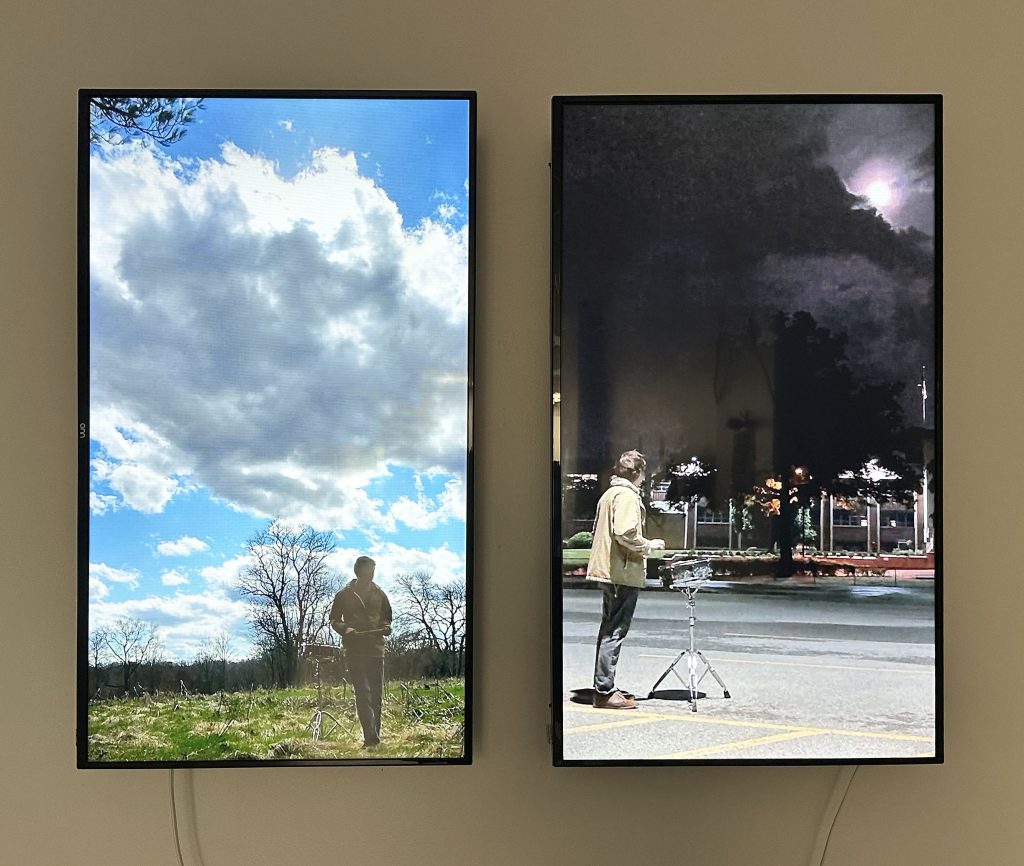
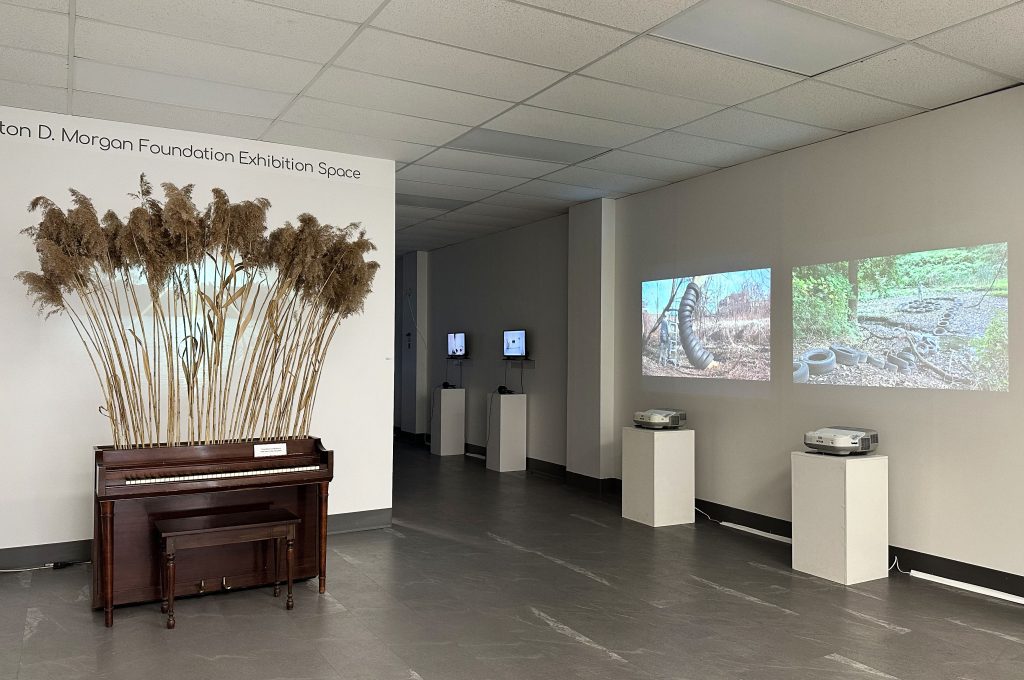
Akron Soul Train supports local artists through a residency program, exhibitions, and a shop in the front of the gallery which sells their work. Currently the gallery is showing work by Matthew Kurtz (work seen above) and Thomas Smith (work pictured below). Both artists are approaching the environment in different and interesting ways. Several of Kurz’s video pieces are focused on his upcoming performance for the solar eclipse. His photographs, for which he’s created additions to scenes he finds, are charming- as is his sculpture- a piano that moves his natural additions when played.

From the gallery-

Performance artist Matthew B. Kurtz presents Drumroll for a Total Eclipse: A Preliminary Exhibition, a prelude to his upcoming live performance with this year’s solar eclipse. Kurtz’s work fuses place, nature, sound, rhythm, and movement to question the mystery of existence. With humor, curiosity, and in tandem with his surroundings, Drumroll explores the process of trying to understand wonder.

For his upcoming performance on April 8, 2024, Kurtz will invite an audience to celebrate the total eclipse. Collaborating with the cosmos, he will perform a drumroll before “totality” passes over Northeast Ohio and creates the natural phenomenon known as “the blackout.”

“When I engage with a site for an art piece, I consider its history, recontextualize its objects, and insert my identity through intuitive gestures. I was raised to believe that humans are supposed to connect the lines between their innate feelings and the unknown. Making art is [my] attempt to reclaim this existential directive. These experiences are documented so outside viewers can participate in my examination of ambiguities, systems, and the sublime.” — Matthew B. Kurtz

Kurtz is also a musician. Check out his Instagram and Bandcamp to listen to his 2021 album 107.

For Thomas Smith’s sculptures he creates natural environments within man-made structures and uses the results as a commentary on the growth and sustainability of suburban development.

From the gallery-

In SUBARIUM II reprise, Thomas Smith combines materials from big box stores with contained terrariums to generate a sense of security and quality. However, upon second look, the viewer may see past the façade of what may look safe to what is substandard. Perhaps it is even denying growth and positive change. Smith’s sculptures dare to ask questions about survival, public image, and the landscape of today.

“Akin to an ecosystem enclosed in a terrarium, my sculptures depict a vibrant but, ultimately, unsustainable artificial environment. As plants within the terrarium grow, competition for space intensifies, turning the once-comfortable space into a struggle for survival. The metaphor extends to suburban America, where curated living conditions prioritize aesthetics over functionality, reflecting an impermanent American Dream.”

— Thomas Smith


Both of these exhibitions close 3/23/24.​

Mar 162024
 

David Kruk’s solo exhibition Nobody Here at Summit Artspace in Akron, asks questions about the state of culture (or lack of culture) we are currently experiencing. Is the difference between the Venus of Willendorf and a Funko Pop just time period and material? Using the Vaporwave aesthetic, a remix of past pop culture in itself, he explores consumerism and nostalgia. Walking around the empty spaces in his video game creation, one is left wondering- what comes next?

The artist’s statement about the work-

This exhibition will consider Mark Fisher’s concept of “lost futures” through the aesthetics of Vaporwave and Funko Pops. I am interested in how these anachronistic objects utilize nostalgia through the remixing of cultural references to engage with consumer capitalism. According to Fisher, this continual referencing of the past exemplifies contemporary society’s cultural stagnation and the erosion of collective imagination towards a radically transformative future.

The sculptures in the exhibition are intended to push these anachronisms a bit further; to undergo a life cycle of adaptation and re-contextualization. I enjoy thinking about the ways in which something like Vaporwave can function as a critique of consumer culture, questioning capitalism’s impulse to commodify everything in sight, including our identities and memories. Vaporwave was born from the internet, and its aesthetic continues to be quite popular within online communities. These communities may often be collectors of pop culture paraphernalia: such as Funko Pops, which I’ve become interested in for their cultural symbolic value. Collecting Funko Pops can provide a source of aesthetic stability for some, while simultaneously operating as totems for coping with the realities of adulthood.

Conceptually within this exhibition, I wonder about the ideological trajectory from ritualistic idol to mass-produced fandom figurine, how capitalism influences our engagement with nostalgia, how the concept of a collectible operates within the spheres of the household to the museum, and how an art object may change over time through being digested through the body of consumerism.

For the video below, available on the gallery’s website, Kruk discusses his work – from tracing images using an oven light as a child, to a growing interest in sculpture, to creating the interactive video game from the show.

This exhibition closes 3/16/24.