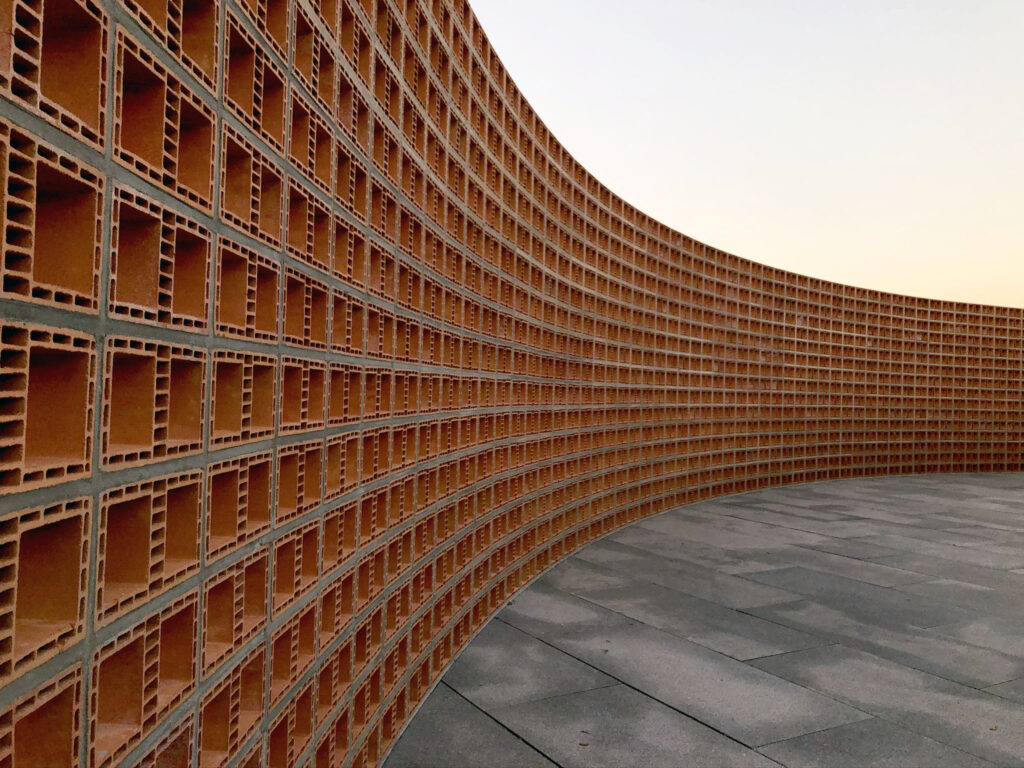
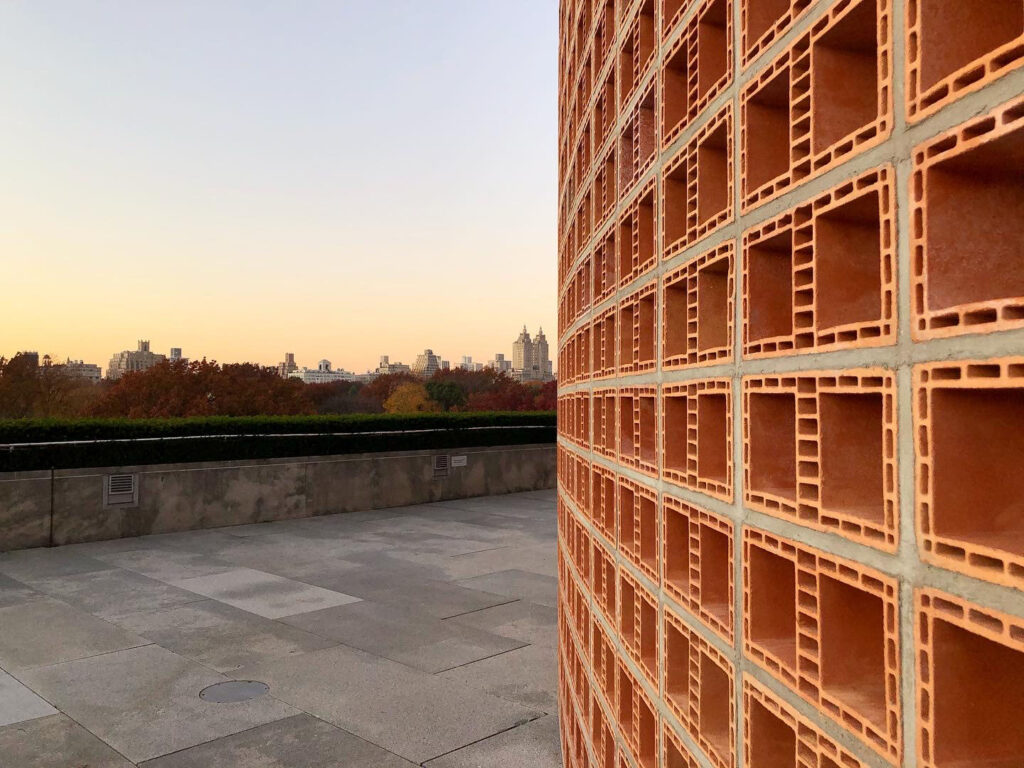
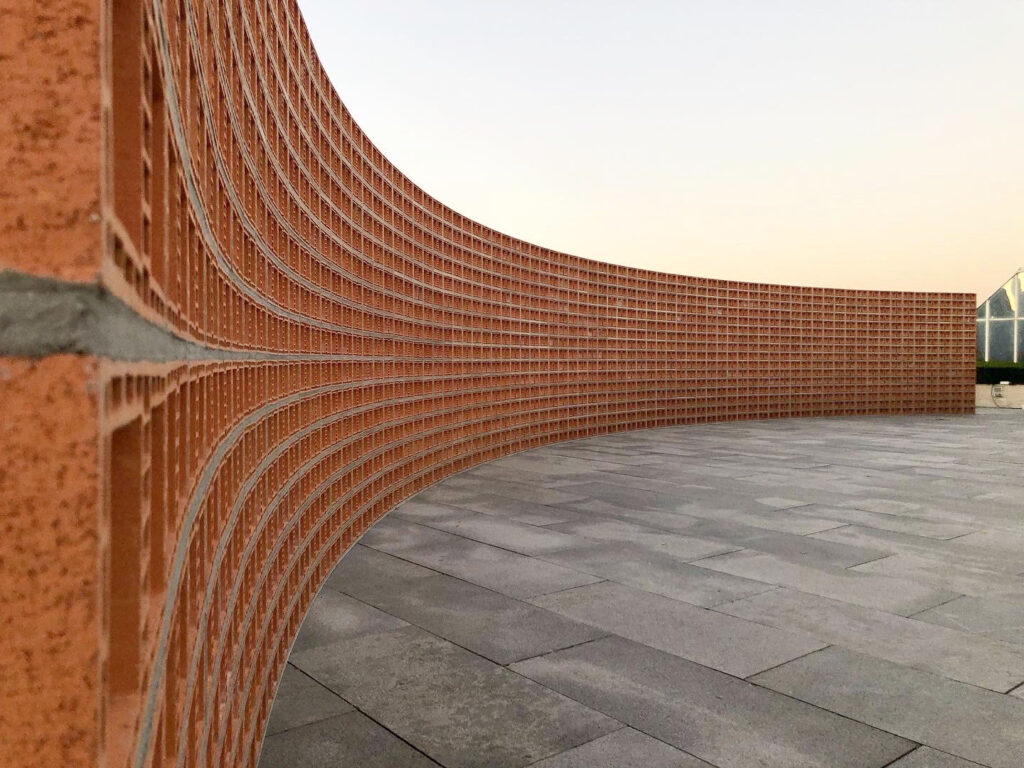
The installation’s curved wall of terra cotta bricks measured at 100 feet long and 11 feet high. The bricks were not solid, as they first appeared, but hollow so viewers could see through to the other side. Throughout the day light would pass through the wall creating different patterns and shadows.
Zamora discusses the work in the video below from The Met’s website–
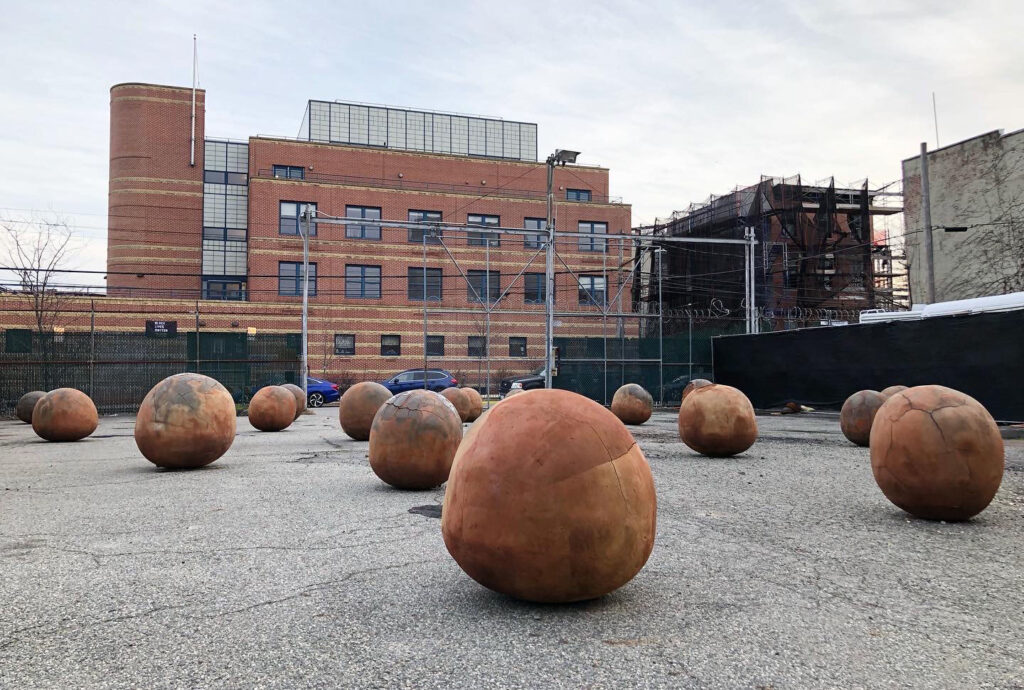
Bosco Sodi’s outdoor sculpture installation, Perfect Bodies, presented by Pioneer Works, was on view in Redhook, Brooklyn from October 2020 until December 2020.
From Pioneer Works’ press release-
Sited on a once teeming commercial concrete parking lot two blocks south of Pioneer Works, Perfect Bodies speaks to, in artist Bosco Sodi’s words, “silence, contemplation and the passing of time—the small things in life and our relationship with the earth.” The installation consists of large-scale clay spheres and cubes made from local clay fired in the artist’s studio in Oaxaca, Mexico, which made the long journey by road across the Mexico-US border to Red Hook. A longtime resident of the neighborhood—itself named after the tone of its own clay soil—Sodi is known for his use of raw and organic materials to create textured paintings and objects.
Sodi’s ongoing dialogue with nature and landscape, shaped by his interests in Japanese aesthetics and Abstract Expression, puts himself in the lineage of both Arte Povera and Land Art—two post-war movements which emphasized, respectively, radically simple materials and an integral relationship between art and earth. As Spanish author Juan Manuel Bonet remarked in the artist’s 2020 eponymous monograph, his three dimensional works reconcile an interest in minimalism with the practices of Mexican heritage. On this topic, curator Dakin Hart further writes: “At his place in Oaxaca, Sodi hand forms large geometric sculptures from clay and fires them in a makeshift kiln on the beach. Cuboids in different formats recall the scale and how-did-they-do-that-craft of cyclopean architecture across the ancient world. While spheroids, each formed by eye in a landscape of unbelievable things, might be the petrified remnants—or organic vanguard—of a Jurassic invasion. The past seeding itself into the present, a starting point for nature’s revenge.”
Currently, as part of Art Biennale 2022, Fondazione dell’Albero d’Oro is showing What Goes Around Comes Around at Palazzo Vendramin Grimani, in Venice, Italy, until November 27th, 2022. The art installation will include his paintings as well as recent sculptures.
Artist Sophie Calle’sHere Lie The Secrets of the Visitors of the Green-Wood Cemetery, a 25 year long public artwork. The project debuted on April 29th and 30th, 2017.
To inaugurate the project, the public was invited to Green-Wood Cemetery, a National Historic Landmark, in Sunset Park, Brooklyn, to privately unburden and inter their most intimate confessions.
During the two-day opening, in a setting nestled among the mausoleums and monuments of Green-Wood’s verdant rolling hills, visitors transcribed their secrets onto paper, and deposited them into the earth below, through a slot on a marble obelisk of Calle’s design. The artist was on hand during the two-day event to receive some visitors’ secrets.
The two-day performance was free and open to the public. Guests were invited to spend the day exploring the sculptures and monuments throughout Green-Wood, a tradition that dates back to the early 1800s. Free maps of the cemetery, specially designed to accompany Calle’s installation, were be available. Guided walking tours emphasizing the cemetery’s symbols and iconography were offered at no cost.
Visitors to the Cemetery can now see Calle’s installation during regular cemetery hours and independently deposit secrets into the marble obelisk. Calle has also pledged to return periodically over the next 25 years, each time the grave is filled, to exhume and cremate them in a ceremonial bonfire service and moment of remembrance.
Everyone has a secret to tell, now there’s a place to put one of yours.
For Marlene McCarty’s current exhibition Into The Weeds: Sex & Death at Sikkema Jenkins, she has combined her large scale drawings with an indoor and outdoor garden.
From the press release-
Using everyday materials such as graphite and ballpoint pen, McCarty’s work often focuses on representations of the female body, femininity, and its position within familial and biological systems. Her subjects are depicted engaging in unorthodox or transgressive social formations, breaking down the traditional, accepted interactions among humans and other species, as well as between humans and nature. For Into the Weeds, McCarty turns to plants, and their complex ecocultural role within society to explore issues of reproductive health, physical autonomy, public space, and the symbiosis of growth and decay.
Throughout history, certain plants and weeds have been foraged and cultivated for a wide range of purposes, both curative and toxic. The alkaloids of the deadly nightshade, for example, have also been used to treat fevers and inflammation, while mugwort has been used to regulate menstruation and induce abortion. Seedlings have been cultivated and installed alongside McCarty’s densely drawn compositions of plants, weeds, body parts, clothing, and abstract geometric forms. Meticulously shaded limbs and flowers interlace one another, mirroring each other’s shape with the curl of a finger or the droop of a petal. This interplay of human body and plant is disrupted by various symbols alluding to a hegemony of white western culture: a Civil War ball gown, cowboy hat, and fragments of Modernist architecture, including the honeycomb-esque Vessel at Hudson Yards. Within these chimerical gardens lies a contentious ecosystem, constantly negotiating the power dynamics across gender, race, health, and history.
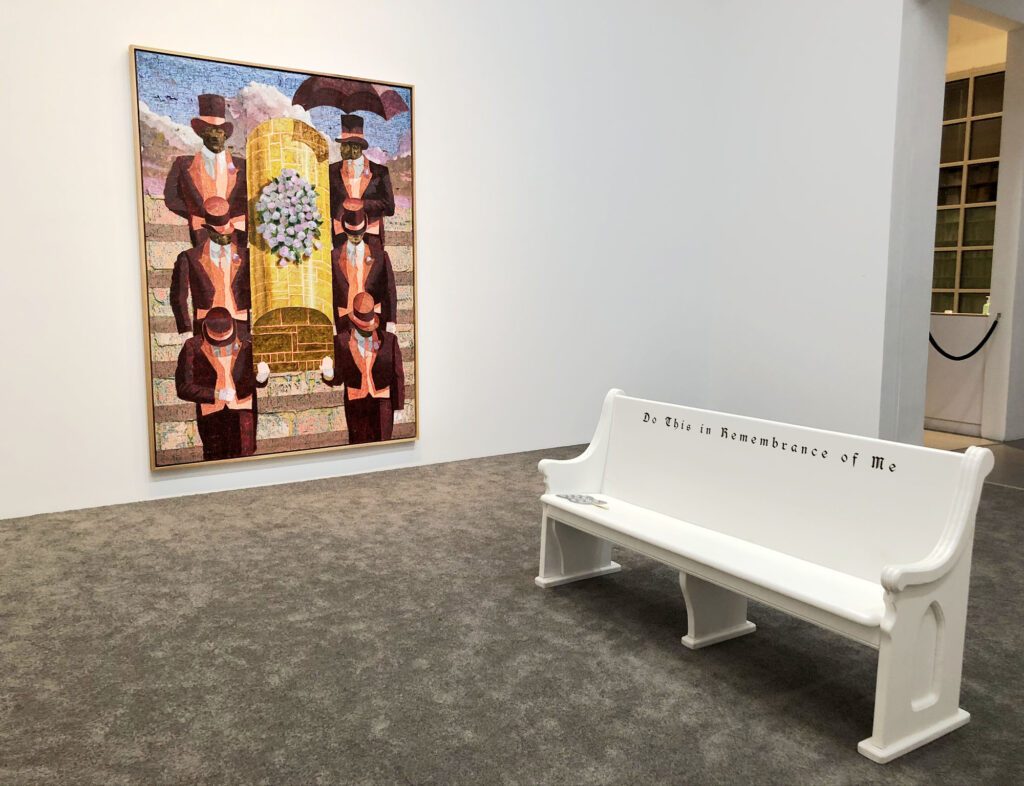
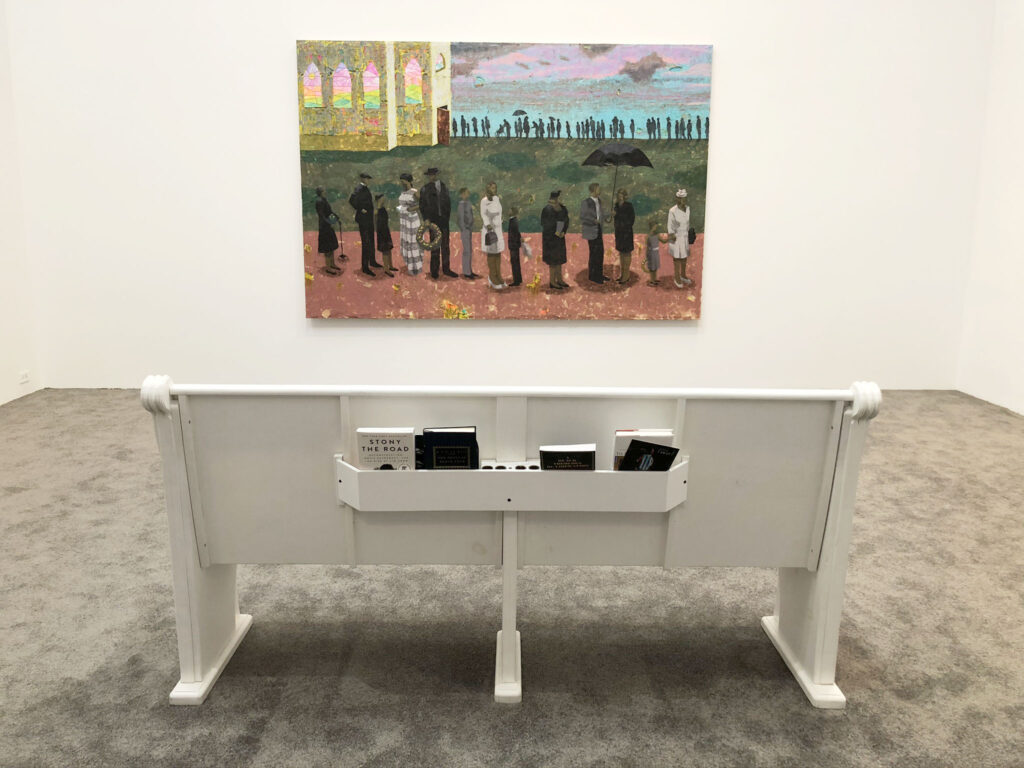
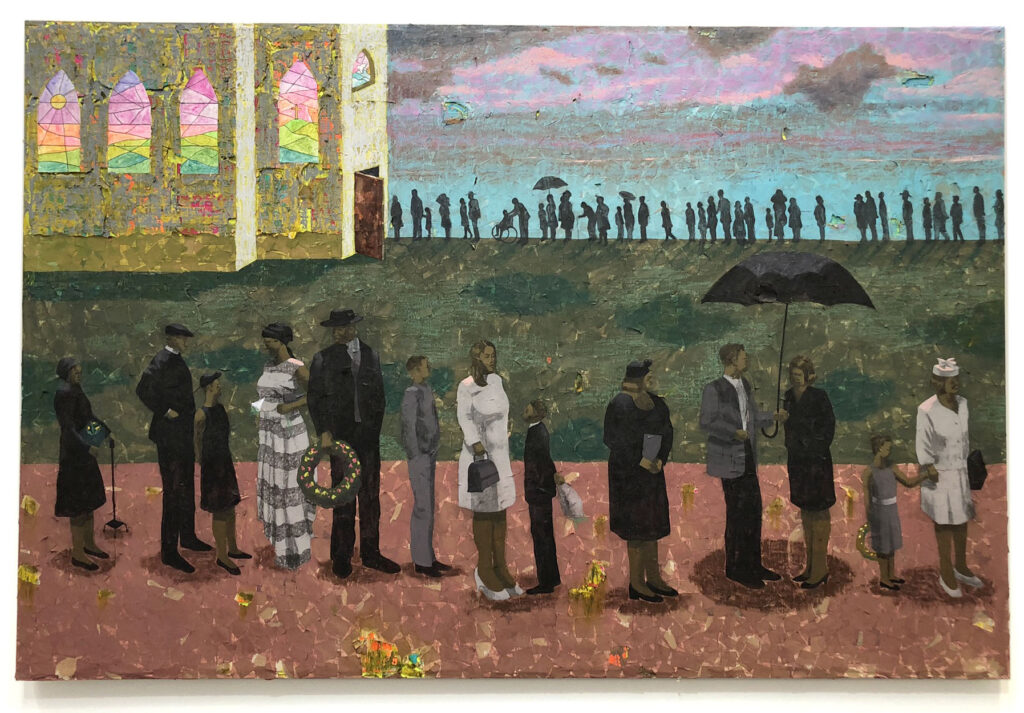
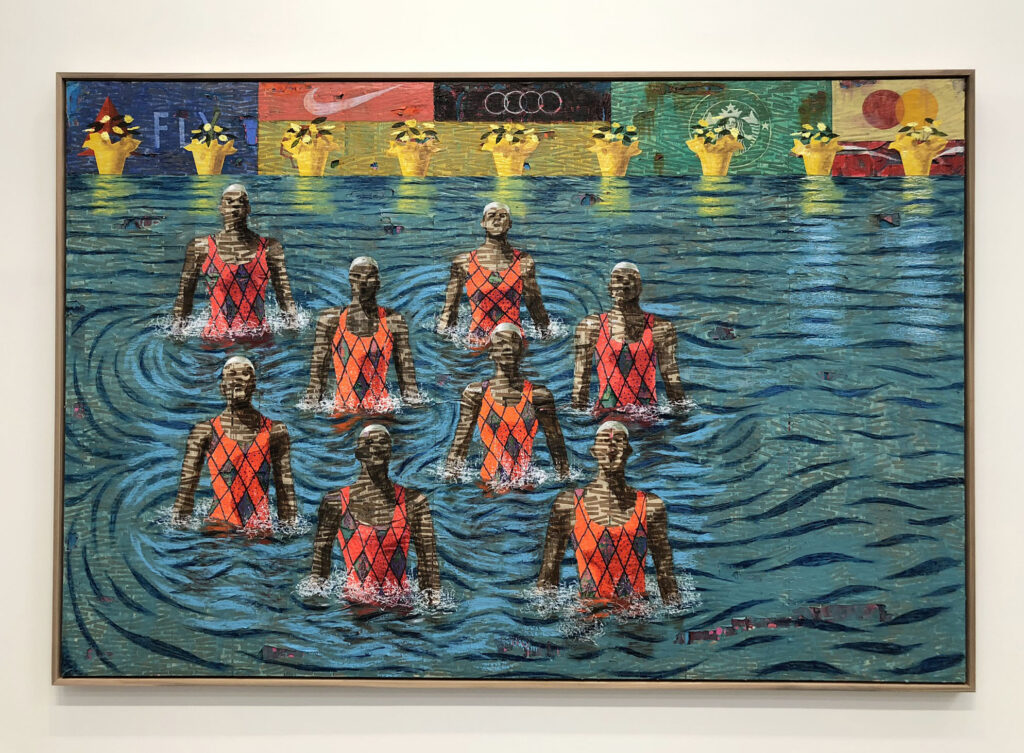
Currently at Petzel in NYC is Derek Fordjour’s solo exhibition, SELF MUST DIE, which incorporates painting, sculpture and Fly Away, a performance collaboration between Fordjour and award-winning puppeteer Nick Lehane.
From the press release-
The show, Fordjour’s first with the gallery, is an offering of creative labor in response to our current moment, a deeply personal and collective state of anxiety around death and hyper-visible racial violence. It examines the nature of martyrdom, vulnerabilities inherent to living in a Black body, performance of competency, and the liminal space existing between autonomy and control.
In SELF MUST DIE, Fordjour interrogates the inevitability of actual death, made more urgent by the realities of a global pandemic, and points to the aspirational death of the artist’s ego brought into focus by a burgeoning career. It is both cultural manifesto and personal declaration. The show is comprised of three parts: VESTIBULE, a site-specific sculptural installation; Fly Away, a live puppetry art performance; and a suite of new paintings.
VESTIBULE offers a collection of sculptural objects imbued with biblical allegory and the spirit of James Cone’s Black Theology of Liberation. It refashions the gallery as a secular yet sacred space of memorial. Among its features, the small entry compels visitors to undergo a destabilizing bodily shift that elicits an intimate and reorienting experience. A directional light from above slowly combs the entire room, invoking both searchlight and spotlight, ideas central to the recent death of Breonna Taylor. Constructed of bituminous coal and wrought iron, Taylor Memorial hangs from above.
Fly Away, a collaboration between Fordjour and award-winning puppeteer Nick Lehane, is performed by a stellar cast, with an original score composed by John Aylward and performed live by oboist Hassan Anderson. The puppet is a Fordjour-designed, hand-sculpted figure crafted by Robert Maldonado. The protagonist’s narrative arc rises and falls along a journey of personal discovery. Larger themes that course through Fordjour’s body of work become resonant.
Spanning two galleries are several new paintings, executed in Fordjour’s signature collage technique, representing the latest developments in his studio practice. The first is a suite of paintings based on Black funerary tradition. The second gallery presents a broad range of subjects including several at monumental scale.
Closing 11/2 at Tanya Bonakdar’s Los Angeles location is Ernesto Neto’s interactive exhibition Children of the Earth.
From the press release-
In Children of the Earth, Neto creates an alluring environment of color, materials, fragrances and sound, transforming the gallery into a living organism, where visitors are encouraged to wander, touch, feel, interact and connect.
Upon entering the gallery, a curtain in green and brown patterns invites the viewer to walk through a tunnel-like path which leads to the main gallery space. Entitled Children of the Earth, a large-scale installation of crochet, spices and leaves hangs from the ceiling to the floor. The large biomorphic shape—hand knitted in vibrant colors of yellows, greens, purples and reds—is flanged by drop-shaped crochet vines that serve as counterbalance and establish the delicate equilibrium of the piece. Here, references to nature interconnect with formal questions of tension, gravity and weight. On the floor, tracing the outline of the structure above, a soft surface of handmade textile is installed. Ceramic vases sprout from the ground, representing the diversity of peoples inhabiting the planet, and that ultimately, we are all the children of the earth. Musical instruments, spices, and crystals comprise an integral part of this malleable, highly tactile sculpture, which engages the five senses, and invites viewers to connect with one another in new and meaningful ways. In expanding the boundaries of physical space and calling for a new type of interaction, Neto creates an experience that is physical, sensorial, intellectual and social all at once.
Surrounding the piece, as another layer of skin, hand-sewn fabric hangs. The organic pattern and color pallet further recall the natural world, as they invoke the forest, wood grain, or the circulatory system of a plant. The path the visitor follows throughout the space, and from within the piece—like an organic line in nature—is analogues to Neto’s conception of life where there is “no separation between humans and nature, nor between art making and art experience”, highlighting that in the exhibition, as in life, everything is connected.
In the back gallery a hanging platform with a crochet canopy and crochet tendrils is installed. Designed for direct interaction, this is a healing bed that offers a moment of rest and respite, where people can connect to themselves, as to one another. The tendrils function as ‘connectors’, as they amplify the pulse of life while connecting us to the environment and to our own physicality. Embracing the participant in its serenity, the healing bed investigates the meeting point of art, sensation, personal connection and the human body.
The exhibition as a whole connects mind, body and nature through a sensory experience that is unmediated. It is an invitation to connect to ourselves and to our planet at a time when connectivity is most needed. For Neto, sculpture is an extension of the body, and the body is ultimately an extension of earth.
Located in LACMA’s B. Gerald Cantor Sculpture Garden among the sculptures by Rodin is Zak Ové’s sculptural installation, The Invisible Man and the Masque of Blackness.
From the LACMA’s website-
The title’s references—Ben Jonson’s 1605 play, The Masque of Blackness, and Ralph Ellison’s 1952 novel, Invisible Man—mark two milestones in black history: the first stage production to utilize blackface makeup, and the first novel by an African American to win the National Book Award. In addition to literary references, the artist draws inspiration from Caribbean Carnival, a festival that originated from the Mardi Gras celebrations of the region’s French colonists, and Canboulay, a parallel celebration in which enslaved people expressed themselves through music and costume and paid homage to their African traditions. The installation’s 40 graphite figures stand tall and dignified to represent the strength and resilience of the African diaspora.
In the the video below, Ové provides some interesting insight and information on the work.
This exhibition closes 11/3/19. LACMA is free for residents with ID from 3pm and is open late on Fridays until 8pm.
The exhibition revisits the Surrealist encounter with the anti-colonial movement in the Caribbean to consider present forms of coloniality and its relation to climate justice. The artists have taken inspiration from the radical and transformative collection of poems by Martinican poet and politician Aimé Césaire under the same name. The term “cadastre” refers to the means by which the territorial limits of private property are publicly registered. Taking cue from the powerful mechanics of Césaire’s writing, Allora & Calzadilla’s exhibition Cadastre brings together three works all informed by a poetics of mark making, traces, and survival.
In April 1941, the anti-colonial Martinican poets and theoreticians Susanne and Aimé Césaire, founders of the literary journal Tropiques, met with a group of artists and intellectuals fleeing Nazi-occupied France, whose boat had temporarily docked at the West Indian port of Fort-de-France. The refugees included Helena Benitez, André Breton, Wifredo Lam, Jacqueline Lamba, Claude Lévi-Strauss, André Masson, and Victor Serge, among others. Penumbra takes as its point of departure the now mythic hikes the group took in the gouffre d’Absalom valley in Martinique, which served in part as inspiration for Lam’s masterpiece, The Jungle. Penumbra is a soundscape of “shadow tones,” a psycho-acoustic phenomenon perceived when two real tones create the semblance of a third. The original musical composition by David Lang uses nonlinear distortion of violin sounds to evoke the sensation of walking through that tropical forest.
In Graft, thousands of cast blossoms of the Tabebuia chrysantha tree, a common native species in the Caribbean, appear as though a wind had swept them across the gallery floor. Graft alludes to environmental changes set in motion through the interlocking effects of colonial exploitation and global climatic transformation. Systemic deforestation and depletion of the Caribbean’s original flora and fauna is one of the primary legacies of colonialism. Nevertheless, the Caribbean remains a biodiversity hotspot and, along with thirty-five other hotspots worldwide (which amount to just 2.4% of the earth’s land surface), supports nearly 60% of the world’s plant, bird, mammal, reptile, and amphibian species. As rising global temperatures result in more frequent and violently destructive weather, adding even more pressure to the Caribbean, the uncanny presence of tropical tree blossoms in Graft stands as a potent harbinger for the immeasurable losses that continue unabated after centuries of colonial plunder.
Measuring 6 feet in height and 70 feet in length, and covering the east and south walls, the exhibition’s eponymous work, Cadastre takes electromagnetism as its subject and medium. To make the work, Allora & Calzadilla dropped iron filings on top of a canvas and placed it above an array of copper cables connected to an electrical breaker in the artists’ studio in San Juan, which gets its power from the Puerto Rico Electric Power Authority. When the breaker is turned on, the electrical current causes the iron particles to self-organize into a composition of lines and shapes governed by the electromagnetic field. As the Latin title and full subtitle (Meter Number 18257262, Consumption Charge 36.9kWh x $0.02564, Rider FCA-Fuel Charge Adjusted 36.9 kWh x $0.053323, Rider PPCA-Purchase Power Charge Adjusted 36.9kWh x $0.016752, Rider CILTA-Municipalities Adjusted 36.9kWh x $0.002376, Rider SUBA Subsidies $1.084) suggest, the work probes the propriety politics of electricity and the power grid. Cadastre is part of a continuum of multiple sites and actors that the artists are probing through their artistic process working with electricity, from the oil futures market, to the transnational holders of PREPA bond debt, to the local consumers who are forced to pay for the recently privatized power company’s fiscal mismanagement.
This exhibition closes 11/2/19.
Recently, their film, The Great Silence, was shown at Marciano Art Foundation in Los Angeles. It is subtitled with thoughts from the perspective of an endangered Puerto Rican parrot who lives in the same area as the Arecibo Observatory, which was created to capture and transmit radio waves from and into outer space. The parrot questions why humans look to communicate and make a connection with extraterrestrial life, when there are parrots who can potentially use human language nearby.
It’s a thought provoking and moving piece, well worth a watch.
When trying to talk about the David Hammon’s exhibition at Hauser and Wirth Los Angeles, his first in Los Angeles in 45 years, it’s hard to know where to start. There are no titles or descriptions of any of the works in the show, although there is writing on the walls in certain places. The press release, shown below, is a mass of lines and a dedication to jazz musician Ornette Coleman.
Before you enter either of the two massive galleries housing the exhibition you encounter a courtyard filled with tents, some with “this could be u and u” stenciled on them. Tents also line the corridor under Martin Creed’s neon piece, EVERYTHING IS GOING TO BE ALRIGHT, with a rack of fancy vintage coats nearby. Once predominantly in Skid Row, Los Angeles’ tent cities have been growing rapidly on street corners and under bridges and highways all over the city, but they often just blend into the background for people walking and driving past. What does a fake tent city in the courtyard of a high end gallery in a newly gentrified neighborhood mean? Is its fake version more affecting than the real one to gallery and restaurant patrons wandering by?
The work in the show feels at times random, clever, humorous, and confounding, but also impressive, thought provoking, and most importantly never dull. There are stacks of art history books sitting on scales. A water filled bowl that contains what once was a snowball Hammons had sold on the street at one point in his career, sits on a wooden shelf. A room with empty glass cubes on wood columns requires you to bend down to see the feet underneath. A book titled A History of Harlem is filled with empty black pages.
In the room pictured below is a three legged chair next to a wall of photos of women sitting in it. Nearby, one of Ornette Coleman’s suits is surrounded by glass.
Another room is filled with paint splattered and damaged fur coats, one facing an antique mirror that is covered. The symbolism feels a bit heavy handed, like the tents, but it works in that there are still several ways to interpret what Hammons might be saying.
Throughout the exhibition paintings are covered in various ways. One in paper, ripped with a bit of the painting visible. Others are partially hidden with tarps, plastic, different fabrics, even an antique rug (shown below). Once again, you can interpret the meaning of this in several ways. With the rug, for example, it’s turned so that only a bit of its design is visible in front of a painting that is not completely visible. These rugs are often associated with old money and sometimes are hung on walls themselves as artwork. Or is it just another assemblage, a visual combination to be taken at face value.
Ultimately the interpretation of all of the work is up to the viewer. There is something freeing in that, not being given answers. Sure, it’s nice to have an explanation of an artist’s intentions sometimes, but you often add your own ideas anyway. Art should make you think, question things, look at the world from a new perspective- this exhibition does all of that and more.
David Hammons at Hauser & Wirth Los Angeles closed 8/11/19.
In addition to the murals created for POW! WOW! Antelope Valley 2018, artist Dan Witz also created a few small pieces like the one shown above. For more of his work, check out his website and Instagram.