Feb 152024
 

“The Flameless Green Dragon”, 2018, Elm and acrylic

“In Rhythm”, 2018, Elm and acrylic; and “Water Music”, 2002, Inkjet photocollage on paper

“Introvert”, 2019, Elm; “Engendering Life”, 2020, Green soapstone

Two left sculptures made of Italian translucent alabaster and “Harboring Emptiness”, 2021, Maple and acrylic

Above are several works from Barbara Stanczak Spirit and Matter, the artist’s recent exhibition at Akron Art Museum.  Stanczak’s sculptures are energetic shapes created in partnership with the natural materials used.

From the museum’s web page-

Barbara Stanczak’s sculptures are born from an essential combination: the artist’s creative vision and the natural qualities of her materials. This two-sided collaboration remains in effect throughout Stanczak’s entire process of conceiving and creating an artwork. A piece of wood or stone presents initial possibilities that help to set a direction, but invariably the course will change—the substance may be so hard as to resist carving, or it may contain internal structures that must be accommodated. But the artist does not surrender her own interests, as she has found that a successful work must become the physical embodiment of a rich and valuable idea. In her own words, “I can only hold onto my idea of the whole by letting go of ‘mine’ and focusing on ‘our.’ The material becomes a partner who needs my patience, respect, thoughtfulness, cooperation, skill, and persistence.”

Stanczak committed to working with wood and stone only after a long process of discovery. Born in Germany in 1941, she moved to the United States in 1960 to assist her grandfather in painting church frescoes, and later worked in handmade paper, metal, and a variety of other media. She also worked alongside her husband, Julian Stanczak, whose paintings and prints were celebrated at the Akron Art Museum with a one-artist show in 2013. As her own career evolved throughout her thirty-seven-year tenure as a professor at the Cleveland Institute of Art, Barbara carved her first wooden sculpture in 1992. “I was tired of searching,” she recalls. “It was time to arrive!”

Stanczak continues to find wood and stone compelling because, as she puts it, they are constantly “teasing, tempting, and provoking me to see more, to see beyond, to see the micro and the macro of the universe.” She finds these universal qualities not in immediately recognizable forms like leaves and flowers, but rather in dense rings and layers, subtle features formed over decades or even thousands of years. As Stanczak exercises her own intuition, she aligns it with these natural processes. As the artist and the materials harmonize, it is as if two forms of intelligence are working together—as if spirit and matter are not so separate as one might expect.

Feb 142024
 

Esterio Segura’s Goodbye My Love, 2013, three sculptures created with fiberglass and automobile paint, are currently on view at Tampa Museum of Art.

From the museum about the work-

A new acquisition to the Museum’s permanent collection, Goodbye My Love represents Esterio Segura’s (Cuban, b. 1970) ongoing exploration of the meaning of airplanes and flight. Produced in multiple editions at different scales, this version is nearly the largest. In describing the series, Segura explained,  “In this work, the reference to the airplane hybridizes with a reference to another well-known universal symbol: a simplified image of the heart. This is fused with an easily understood title with several meanings, from the most corny and sentimental to the most controversial, from a political and social standpoint. With this work, I reference the experience of uprooting, nostalgia, memory, loss—how we experience the breakdown of everything we love.”

He discusses the work in the video below in a bit more detail.

Feb 092024
 

This sculpture, The Only Other, 2021, by the artist Midabi, was located in Union Square Park in NYC from June 2021- June 2022.

It is currently located adjacent to Palm Springs Art Museum in California.

Feb 012024
 

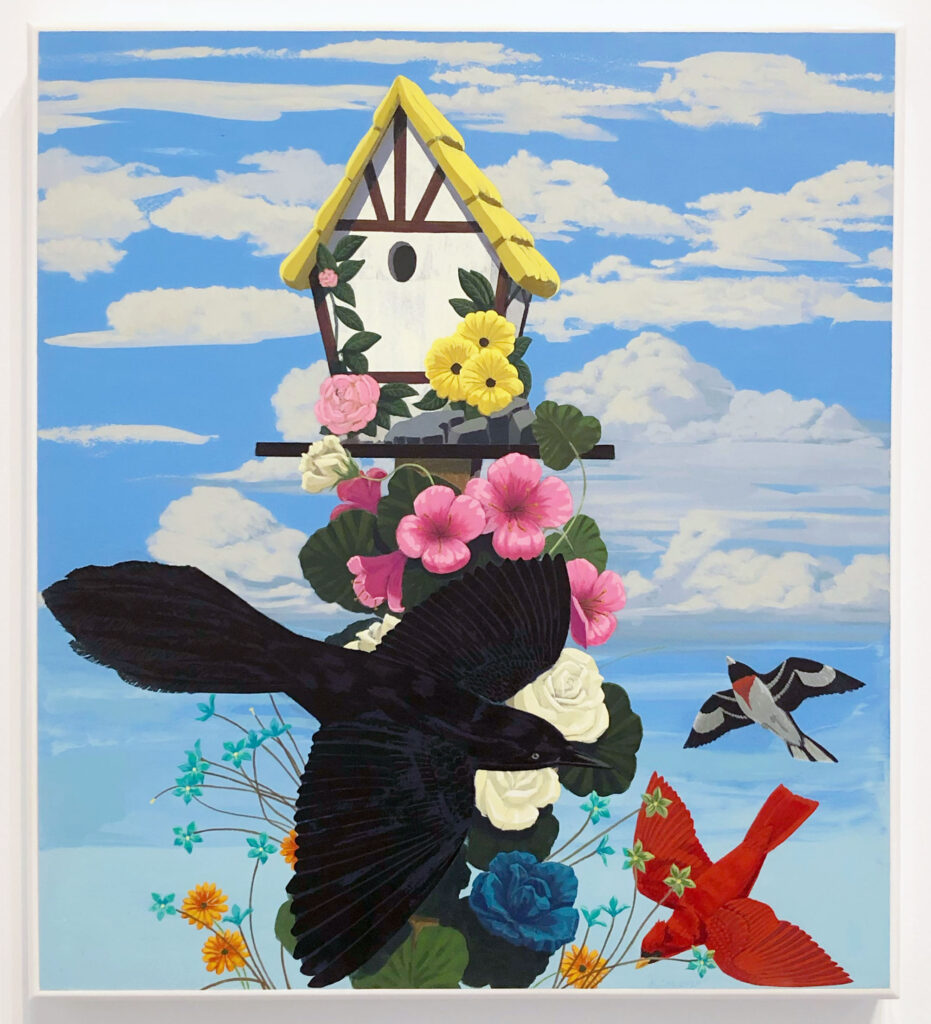
Black and part Black Birds in America: (Grackle, Cardinal & Rose-breasted Grosbeak), 2020, by Kerry James Marshall, was part of the group exhibition 20/20 at David Zwirner gallery in NYC in December of 2020. The painting is part of a series that explores black identity, his love of birding, and by the history and work of John James Audubon.

Below is an excerpt from a New York Times article about the work and its Audubon connection-

“There’s a disconnect between the house that’s built and the birds,” Mr. Marshall said of the crow and grackle. “It’s not designed for them, you know?” The scene considers, he said, “the pecking order.”

The series itself has been brewing in Mr. Marshall’s mind for eight or nine years, he said, and he began painting the works just before transmissions of the coronavirus accelerated in the United States in March.

A casual bird enthusiast who has been fascinated by Audubon’s draughtsmanship since he was a child, Mr. Marshall has long put Black protagonists at the center of his complex, richly layered compositions. “Many Mansions” (1994), one of his large-scale depictions of housing projects, features three Black men gardening — and, not incidentally, there are two bluebirds holding up a banner, too. The pointed inclusion of Black figures is part of what he has called a “counter-archive” to the familiar, white-centered story of Western art.

For the new series, the images hinge on Audubon’s own racial heritage: Many people believe he was, as Mr. Marshall’s title suggests, “part Black” — born in what is now Haiti, as Jean Rabin, to a white, plantation-owning father and a Creole chambermaid who may have been of racially-mixed descent. But, the theory goes, he was able to pass as white.

Jan 292024
 

Whimzeyland, the “Bowling Ball House”, is a local landmark located in Safety Harbor, Florida, created by artists Todd Ramquist and Kiaralinda.

About the house from their website–

In 1985, they purchased the beige house on Third Street in Safety Harbor, Florida. They traveled everywhere, actively seeking out inspirational and unusual places. Inspired by these travels, they began transforming their house. One of the earliest additions were the wooden triangles to the eaves of their house. The beige house became bold in color, too.

One day, they went to a flea market and saw a sign that said that anybody could take 10 free bowling balls. They took the bowling balls and began painting and placing them around the property. This is how they became known as the bowling ball house of Safety Harbor.

Todd and Kiaralinda even branched out of decorating their home, creating two different art cars, designed a restaurant, and making public sculptures, among other things. They began calling themselves the Whimzey Twinz because they work together on all of their projects.

Their travels soon included visits to folk artists and artists that they met at their shows. These friends visited them, too. Todd and Kiaralinda’s bowling balls inspired many of them. They would create bowling balls for Todd and Kiaralinda, who got so many of these works from artist friends that they started a gallery in their home. They created a “Call for Balls” which made a lot more of these art works roll into their home. Today, they have over 80 bowling balls from various artists around the world and people still bring them bowling balls as gifts.

If you are in the area, make sure to also stop by Safety Harbor Art and Music Center (SHAMc), a nonprofit they opened in 2017. It has an art gallery and shop, and hosts music events and art classes as well.


Jan 262024
 

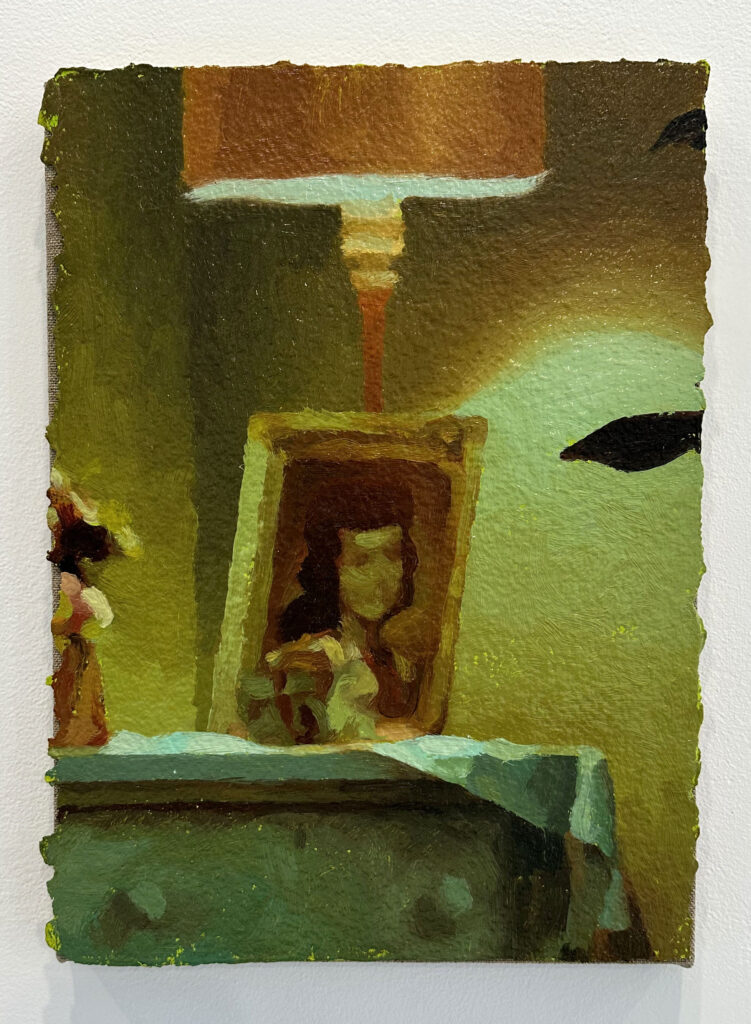
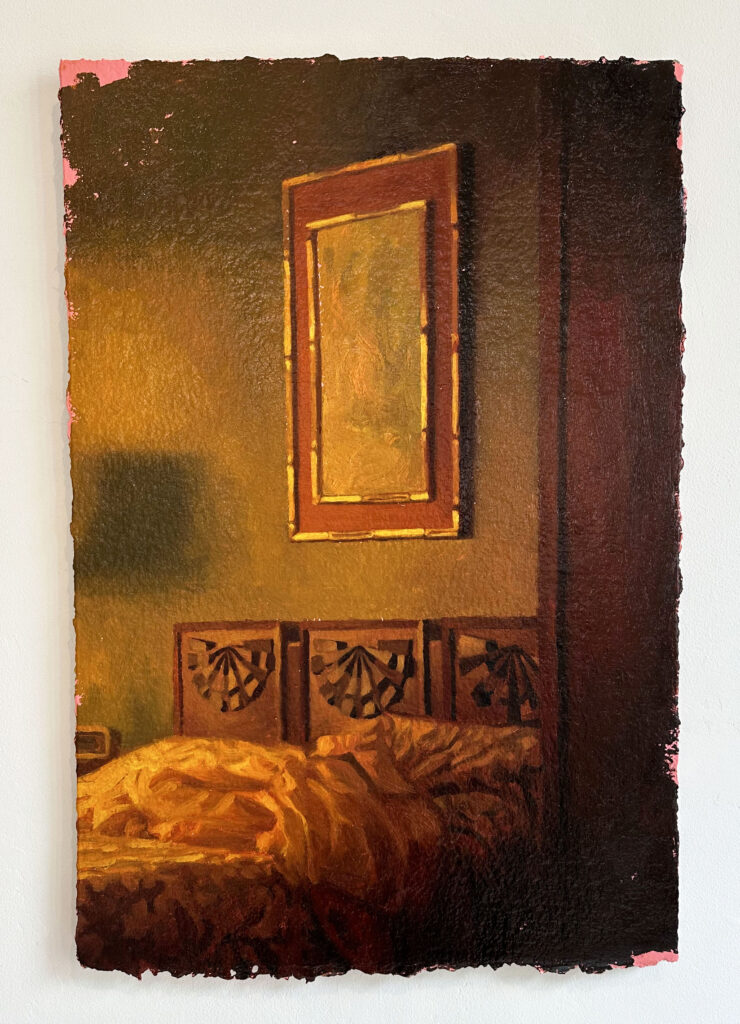
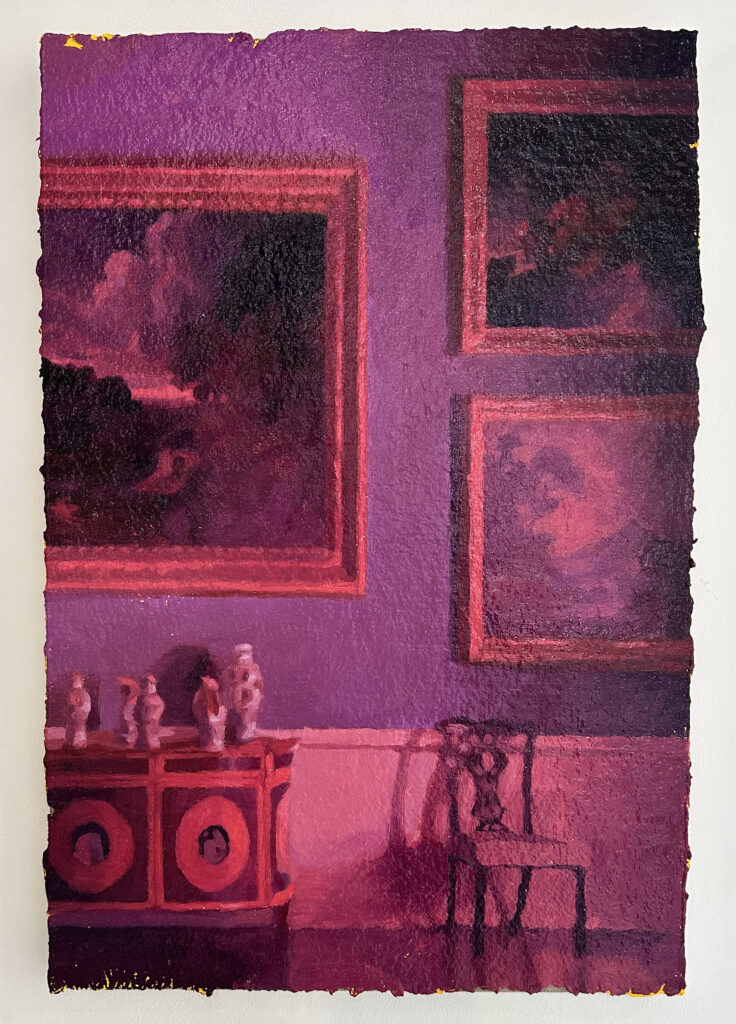
Paintings by Tim Wilson from his 2023 solo exhibition, Pictures Aside, at Nathalie Karg gallery in NYC.

From the press release-

“Everything is deceptive, only the mask never lies.”
—Pierre de Marivaux

On the surface, Wilson presents a group of paintings depicting an assortment of mirrored reflections, paintings, prints, photographs, and reproductions. These pictures within the paintings adorn a variety of provisional spaces; foyers, waiting areas, bedside tables, drawing rooms, and motels. Like his previous work, Wilson recasts images of interior spaces and set dressing found in the seemingly endless availability of streaming television and film. These repurposed screen grabs are then filtered through the historical lens of premodern tendencies in representation. This practice, an attempt at slowing the viewer down for reflection remains, yet here, Wilson doubles down by zooming in on the re-depiction of those quoted histories within his own pictures. This reframing literally and metaphorically rearranges the conditions with which one engages in that contemplation.

“To me, the recursive nature of these paintings is analogous to the infinite regress of thought and meaning—in the way that the definition of words require the use of other, yet to be defined, words to describe them, and so on. Painting is a way of re-contextualizing these strange loops and harnessing meaning indirectly. For example, to quote me speaking now in this context is altogether different than the previous paragraph, despite the fact that I wrote them both.”
—Tim Wilson

He is currently showing work at JDJ gallery in Tribeca, for the group exhibition, Feels Like Home, running until 3/2/24.

Jan 252024
 

The Mangrove Refuge (The Vorasane Family and Friends; Gandy Beach circa 1980) by Michael Vasquez was created for the 2023 edition of SHINE Mural Festival in St. Pete, Florida.

The artist’s statement about the mural-

A displaced Lao family (and friends) find refuge and a moment of reflection amidst the mangroves of Tampa Bay’s Gandy Beach.

A 1978 Datsun 280Z serves as a centerpiece and point of pride, fusing together car culture and masculinity. Similar aspects of clothing and style signal togetherness, emulation, and a shared sense of identity—yet their solitary gazes set them apart from one another and allude to a deeper and more personal past, present, and future…

Vasquez is currently part of the group show TRADITIONS: Honoring Heritage, Ritual and Family at Muzeo in Anaheim, California. The show is curated by Thinkspace and Tlaloc Studios and is on view until 2/25/24.

Also check out his Instagram for current work.

Jan 252024
 

The image above is of Squeak Carnwath’s painting, Best Borrowed, 2005, Oil and alkyd on canvas, taken at Palm Springs Art Museum in 2018.

A solo exhibition of her work is currently at Pt.2 Gallery in Oakland, California, on view until 2/16/24.


Jan 202024
 

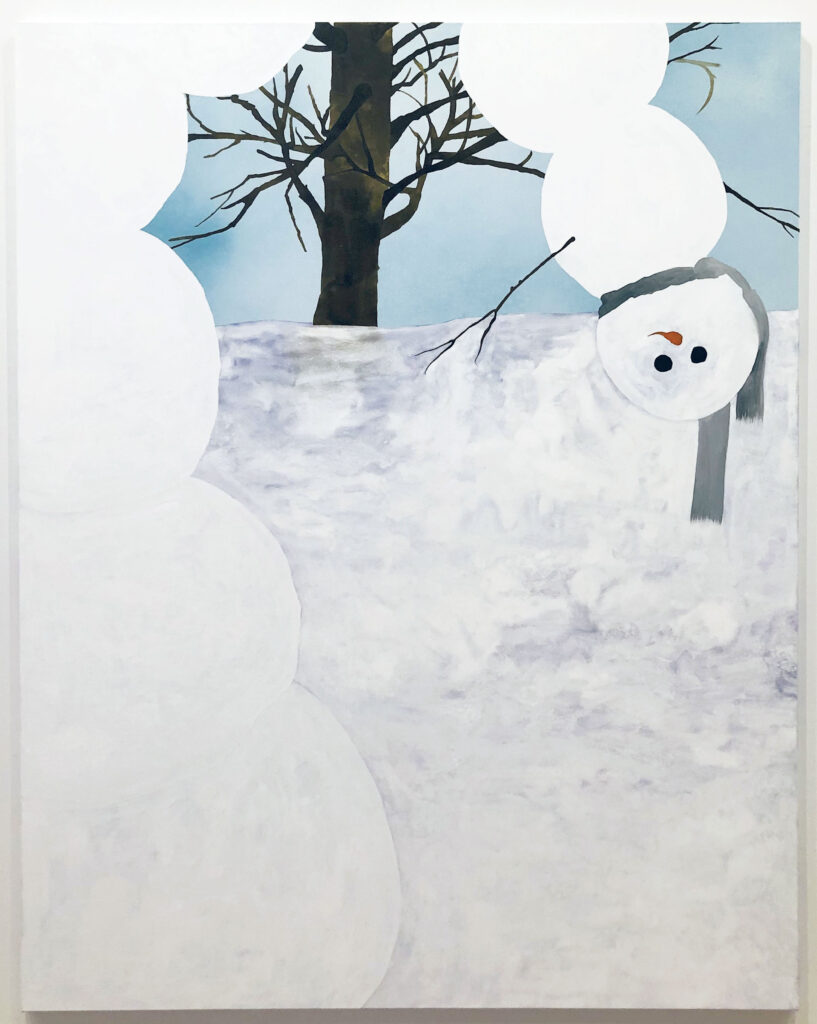
Calvin Marcus’ Tall Snowman, 2019, (Watercolor and vinyl paint on linen), was one of several of his large paintings included in Whitney Museum’s 2019 Biennial.

He and fellow Los Angeles artist Laura Owens will be in an exhibition together at Gaga gallery’s Guadalajara, Mexico location, opening 2/2/24.

Jan 192024
 

Pictured above is Drossos P. Skyllas‘ painting, Wisconsin Ice Cave, 1950, part of LACMA’s 2018 exhibition, Outliers and American Vanguard Art.

About the artist from the National Gallery of Art in Washington D.C. where the exhibition was also on view-

Drossos Skyllas achieved the exquisitely detailed, jewel-like surfaces of his paintings with tiny brushes he fashioned himself. He applied miniscule dabs of luminous oil paint in a pointillist manner, which gave his subjects a petrified yet shimmering quality. His refined technique and adherence to the academic genres of still life, landscape, portraiture, and mythological scenes demonstrate his knowledge of art history. And inspired by the old masters, he perfected the difficult depiction of reflective surfaces, including gems, mirrors, water, and ice. At the same time, his uniform clarity of detail, imposed symmetry, and sense of frozen time create a dreamlike mysteriousness reminiscent of magic realism. In addition to high art sources, Skyllas likely drew upon commercial illustration and photography. Untitled (Roses) resembles both traditional floral still lifes and midcentury advertisements for jewelry and flowers. Wisconsin Ice Cave relates as much to northern Renaissance landscape painting as to mass-produced picture postcards.

Born in Greece, Skyllas worked in his father’s tobacco business before emigrating to the US shortly after World War II. He settled in Chicago and devoted himself to becoming a professional artist, though he had no formal artistic training. Supported financially by his wife, Skyllas produced thirty-eight paintings from the late 1940s until his death in 1973. Some of these he submitted to the annual juried exhibition at the Art Institute of Chicago, Chicago and Vicinity, which featured his work in 1955, 1967, 1969, and 1973. He also sought commissions to paint portraits, but with asking prices as high as $30,000, he never found any patrons.

Skyllas’s work was discovered after his death by Chicago gallerist Phyllis Kind, who added him to her roster of self-taught artists in 1974. He was likely known to artists Jim Nutt and Gladys Nilsson before this, as they had exhibited alongside him in the 1967 Chicago and Vicinity exhibition and are enthusiastic collectors of self-taught artists (Wisconsin Ice Cave is in their collection). The meticulous finish of Skyllas’s paintings, which simultaneously evokes advertising art and Renaissance illusionism, appealed to Nutt, Nilsson, and fellow Chicago imagist Roger Brown, whose art collection also included the self-taught Greek master.