Dec 182025
 

Portraits by Carrie Ann Baade

Reclaim | Reframe: Datasets and Cultural Visibility, is one of three exhibitions that make up The Delaware Contemporary’s 2025 Biennial- Art + AI. The timely show features work by Carrie Ann Baade, Tyanna Buie, Blažo Kovačević, and Tara Youngborg.

From the museum

Through AI and computational technologies, artists Carrie Ann Baade, Tyanna Buie, Blažo Kovačević, and Tara Youngborg construct layered narratives that reclaim overlooked and marginalized histories. In doing so, these artists unsettle dominant cultural and media frameworks that have long erased, distorted, or commodified lived experience. Exploring themes of identity, ancestry, and displacement, they use generative tools as critical instruments to question, expose, and reconfigure the archival and institutional biases embedded in history, culture, and the environment. From ancestral reclamation and speculative futures to immersive storytelling and data-driven environmental translations, their work advances a reimagining of social justice through the lens of artificial intelligence.

Together, these artists offer a complex portrait of making in the age of AI, revealing how tools shaped by those in power can both perpetuate bias and enable resistance. Their work asks: Who shapes the cultural record? When an AI model “remembers,” whose truth is it repeating? How can we reclaim agency within these systems (built on our collective labor)?

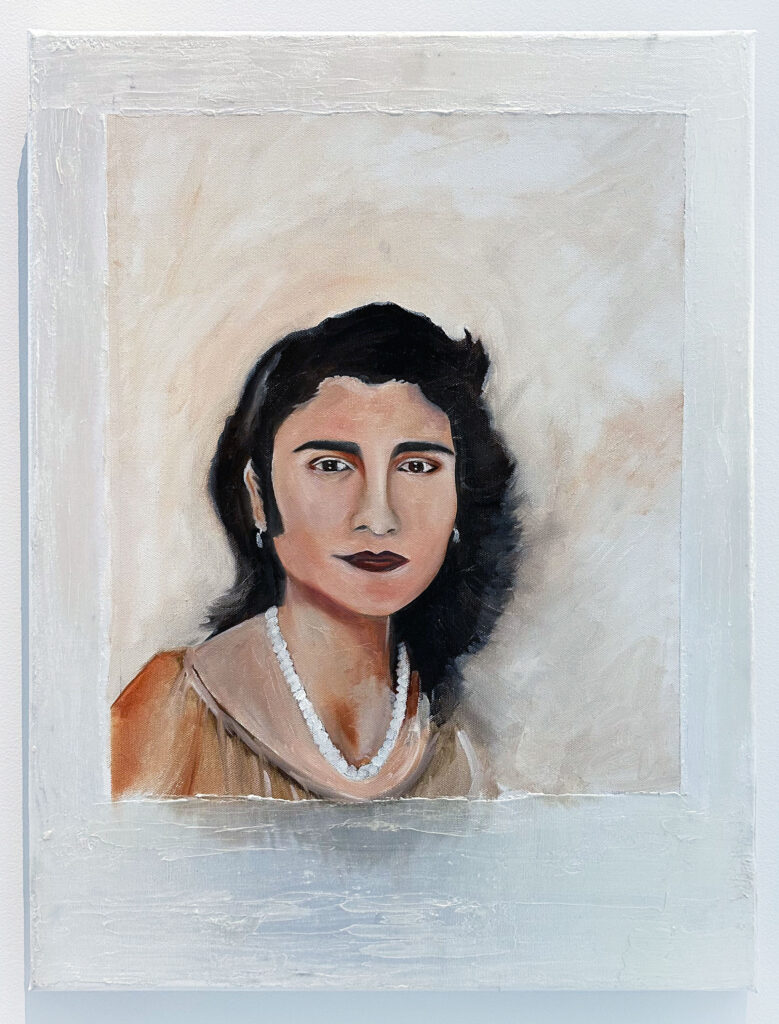
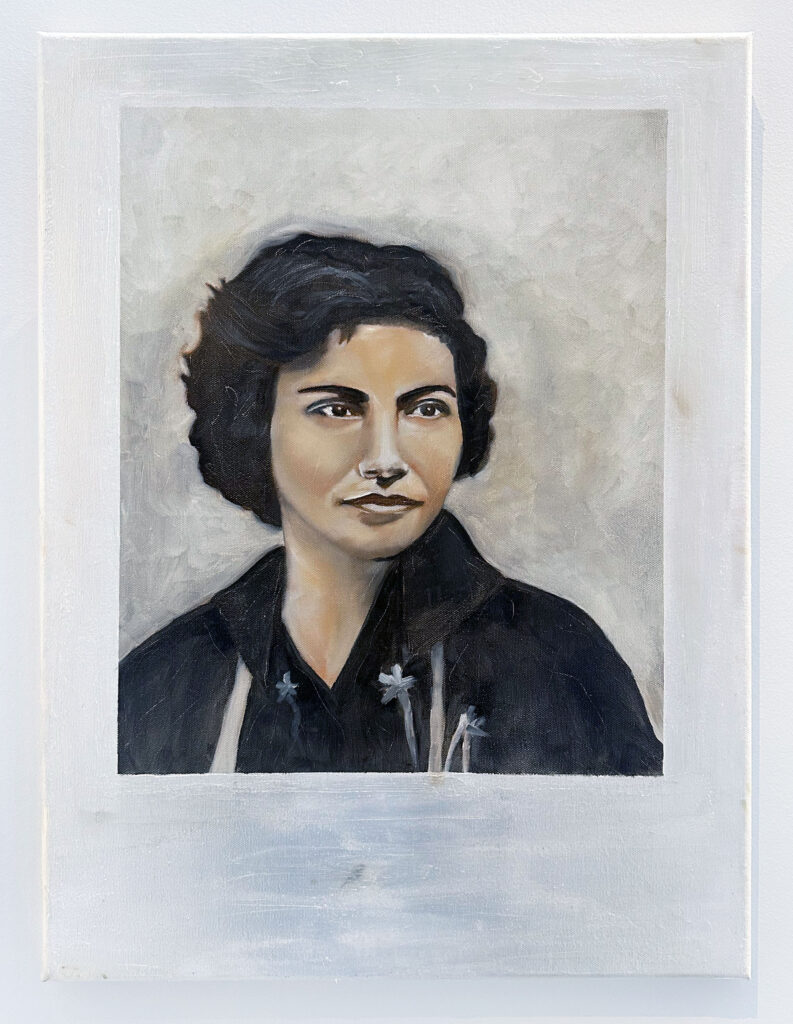
The images at the beginning of this post are from Carrie Anne Baade’s series, Birthplace. Her mixed media portraits of her ancestors, created with the help of AI, present a fascinating look at the stories of several women from early in American history.

From Baade’s statement about the work-

Birthplace is a visual exploration of personal ancestry, delving into the lives of women from colonial Louisiana between 1690 and 1750. Through oil painting, collage, and Al-generated imagery, I reconstruct the presence of these women-figures shaped by French colonial rule, Indigenous displacement, and Romani migration-whose stories have been largely absent from recorded history. Employing a methodology that blends archival research with imaginative storytelling, I create portraits that serve as visual hypotheses-acts of artistic and ancestral repair. The compositions incorporate antique lace, colonial maps, domestic fabrics, and found objects, mirroring the intertwined textures of lineage, migration, and identity. Al-generated image blending aids in synthesizing historically plausible references, speculating on the appearance and presence of women who were never visually recorded.

This project is not about one family, but a shared American inheritance. It reveals the complexity of identity in a land shaped by colonization, migration, and erasure. In rematriating these women to history, Birthplace offers viewers a visual counter-history-one rooted in survival, interconnection, and the enduring power of maternal lineage.

Pictured below are works from the other artists in the exhibition along with information provided by the museum.

Tara Youngborg examines how institutional data and machine learning shape our understanding of land and environment. Using field research, environmental archives, and US Geological Survey datasets, her datastream translates waterflow data and topographic maps into immersive video installations that highlight the limitations of digital representation. By transforming statistics into layered, shifting media, Youngborg portrays landscapes as dynamic terrains of knowledge. Glitches and ruptures in the work expose gaps between digital abstraction and lived experience, prompting questions about algorithmic authority and what is lost when place is reduced to data.

Tara Youngborg’s installation

Tara Youngborg’s installation (detail)

In AR (Argumentative Reality) and Truck for Three Illegal Passengers, Blažo Kovačević uses augmented reality, 3D modeling, and game engine software to confront invasive state surveillance and the dehumanization of migrants. Using digitally enhanced X-ray images from European Border Patrol inspections, he reconstructs a 2015 tragedy in Serbia where 54 undocumented passengers died in a van crash. His works shift between detached aerial views and intimate interior scans, altering typical media frames into ethical engagement. Kovačević warns how AI-driven technologies can perpetuate oppression through automated surveillance, data collection, and erasure, urging reflection on the politics of visibility and mediated violence.

A still from Blažo Kovačević’s video

Tyanna Buie reconstructs erased family histories and reimagines Black identity through speculative Afro-Futurist frameworks. Using ChatGPT and DeepFake technology, she remixes images, sound, and text to create narratives where absence becomes presence. In The Guardians of Nyala, Buie overlays her own likeness onto eighteenth-century Dutch dignitary portraits, then collaborates with AI to imagine a family history untouched by colonization. Rooted in personal narrative and Black popular culture, her counter-archive elevates erased lives and transforms AI from a tool of replication into one of radical self-authorship.

Two of the portraits from Tyanna Buie’s “The Guardians of Nyala”

This exhibition closes 12/28/25.
Dec 162025
 

“Allegory of Winter”, 1948, Goache and paper

“The Juggler (The Magician)”, 1956, Oil and inlaid mother of pearl on board

Surrealist artist Remedios Varo was born on December 16th, 1908, in Spain. Throughout her life, she was a part of avant-garde circles— first in her homeland, and later in Paris and Mexico. She and several other intellectuals and artists fled to Mexico during World War II, where they were given asylum and citizenship. It was there that she would create the majority of her best-known works.

Varo’s paintings are filled with symbolism and mystical imagery. They also often reference her own experiences creating art. While Allegory of Winter (first image) is currently in a private collection, The Juggler (The Magician) can be seen at the Museum of Modern Art.

From MoMa about the work-

This painting’s titular juggler (or magician) stands on the platform of a carnivalesque cart filled with fantastical objects and animals. He performs before seemingly identical figures robed in a single gray cloak. To produce this composition, Varo worked in the manner of early Renaissance masters: she transposed preparatory drawings onto a gesso-primed panel, which had been scratched to give the surface variation. She also deployed decalcomania, a technique favored by the Surrealists in which materials such as paper or aluminum foil are pressed onto wet paint to transfer a pattern that may then be embellished. This textured effect can be seen in the magician’s garments and in the background trees.


Dec 112025
 

Alex Da Corte‘s Soft Power was on view from the High Line until June of last year.

His latest exhibition, Parade, is currently on view at Matthew Marks in NYC, on view until 12/20/25. The Pink Panther appears in this show as well- Da Corte depicts himself as the character painting the gallery pink.
From the High Line website about the billboard-

Known for his immersive installations, sculptures, and films, Alex Da Corte’s work explores themes of identity, consumerism, and taste, challenging societal norms and reimagining the familiar in unexpected ways. The artist draws from myriad sources, including popular and consumer culture, art history, classical literature, and modern design, seamlessly weaving together disparate elements into cohesive narratives. His adept use of vibrant color and surreal imagery lends a dreamlike quality to his work that captivates viewers and blurs the lines between fantasy and reality.

Da Corte presents a new artwork for the High Line’s 18th Street Billboard, inspired by the Pink Panther, a Friz Freleng creation designed for the animated opening sequence of a 1963 Hollywood comedy that came to embody the film and has evolved, through 60 years of spin-offs and reinventions, into cultural ubiquity. Pink’s durability across many generations has allowed it to sell countless products, from fiberglass insulation foam to artificial sweetener, yet the creature’s essence remains out of reach. With neither master nor peer—and seemingly eternally unbound by the rules of others—Pink represents a certain queer freedom. Da Corte revives Pink as an icon of resistance, supine but poised, wielding a sign of universal protest, brandishing a clear pink purpose. “There is a difference between falling down and laying down,” Da Corte explains. “I call that soft power.” This billboard is an advertisement for the value of such power.

Dec 102025
 

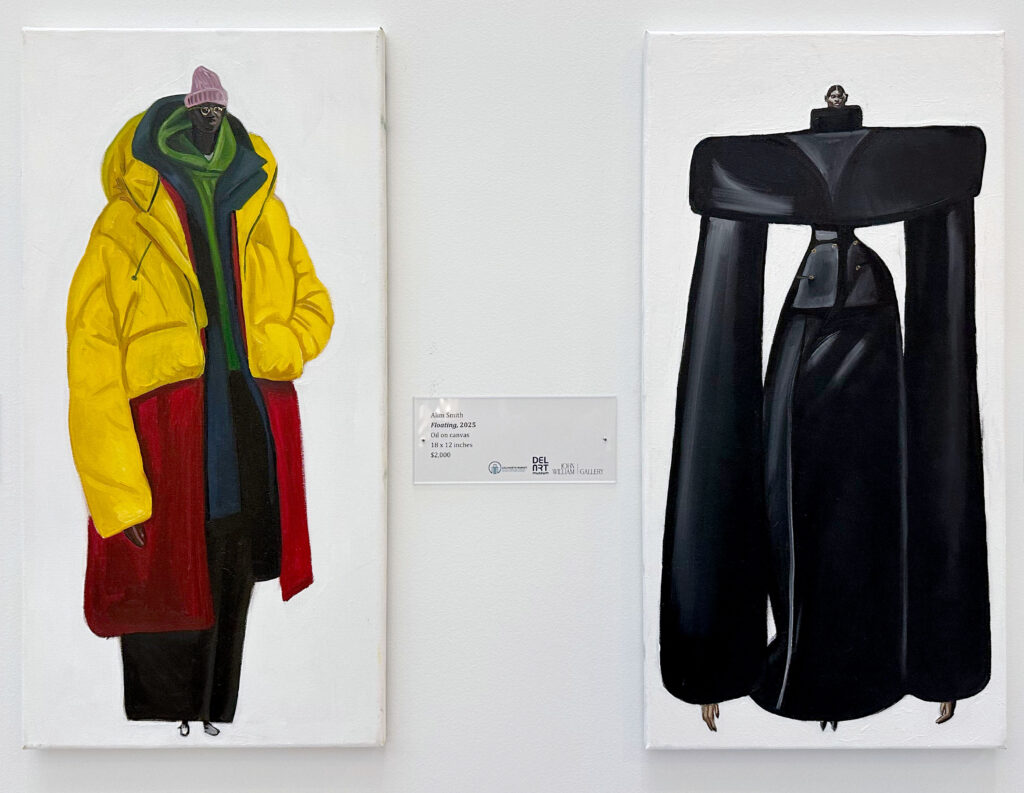
Alim Smith, “Floating” and “Thought A New Dress Would Make it Better”, 2025, Oil on canvas

Paintings by Alim Smith

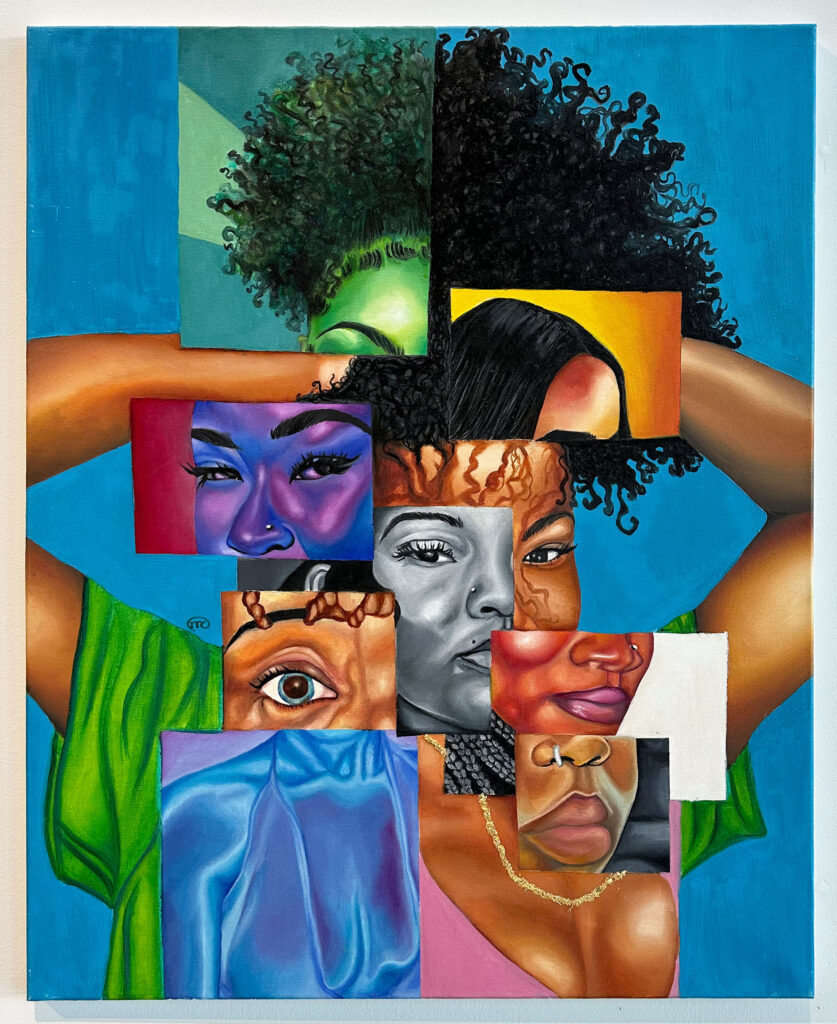
Taylor Gordon, “To Be A Black Woman”, 2023, Oil on canvas

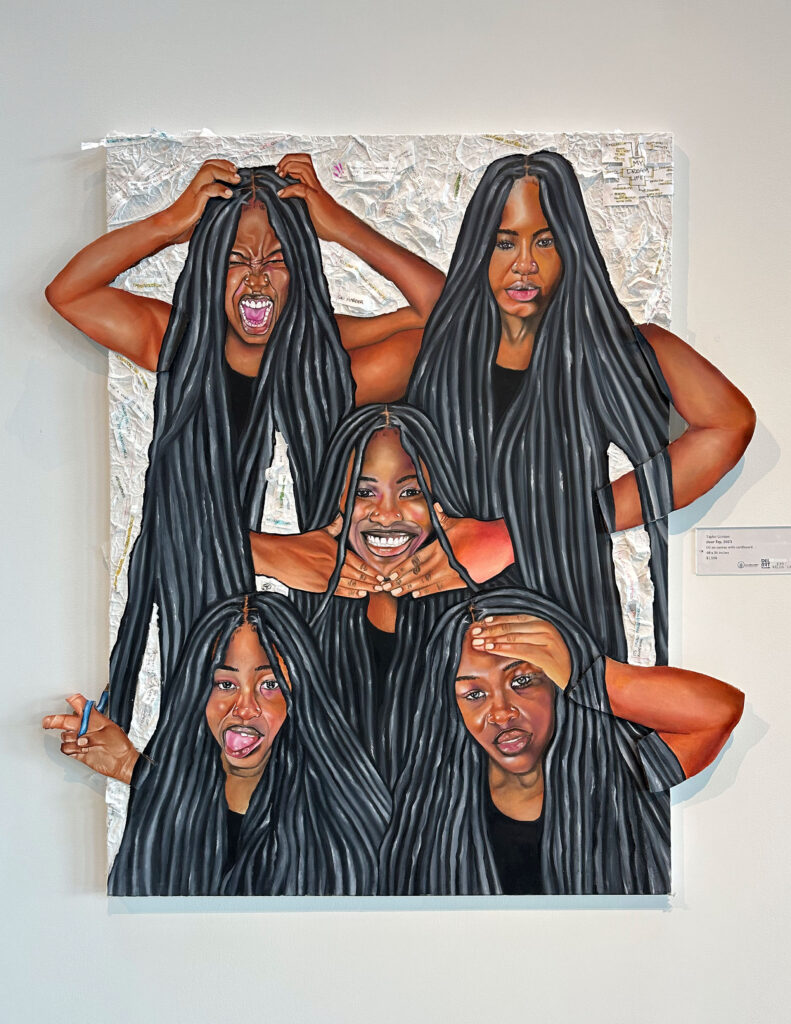
Taylor Gordon, “Dear Tay”, 2023, Oil on canvas with cardboard

Manuel Ramos, “Abuela Gorin”, 2025, Oil on canvas

Manuel Ramos, “Abuela Olga”, 2025, Oil on canvas

Currently on view at John William Gallery in Wilmington is Colorful Voices: Taylor Gordon, Alim Smith, Manuel Ramos, featuring unique paintings by the three Delaware artists.

From the gallery about the exhibition-

Colorful Voices: Taylor Gordon, Alim Smith, Manuel Ramos brings together three distinctive practices that articulate the richness of contemporary community life through color, portraiture, and cultural reference. The exhibition seeks to foreground the vitality of local voices while offering a space in which viewers might consider how identity, humor, and heritage are translated into visual form.

Taylor Gordon’s paintings situate themselves within the lineage of Black contemporary art, yet remain deeply personal. Her chromatic sensibility infuses each figure with layered emotional resonance, encouraging conversations around beauty, resilience, and the multiplicity of Black experience beyond reductive narratives. Manuel Ramos, or “RAmos ART,” approaches portraiture with a keen attentiveness to light and surface, imbuing his sitters with an understated dignity that resonates quietly yet powerfully. Emerging from a self-taught practice shaped during the pandemic, his canvases record moments of presence that hover between the intimate and universal. Alim Smith, or “Yesterday Nite,” works in a spontaneous visual language, fusing surrealism, popular culture, and sly humor. His rhythmic compositions and vivid palette translate music, memory, and cultural archetypes into forms at once playful and incisive.

Together these artists propose color as more than visual pleasure: it becomes a conduit for empathy, critique, and joy. Colorful Voices invites us to engage with works that are celebratory yet searching, attuned to both the textures of daily life and the broader currents shaping our communities. In gathering their practices, the exhibition hopes to affirm art’s capacity to nurture dialogue and to render visible the stories that animate shared experience.

This exhibition is on view until 12/18/25.
Alim Smith’s work may look familiar- he created work for the television series Atlanta and the cover art for Mac Miller‘s second posthumous album, Balloonerism, released earlier this year. Miller reached out to him in 2018, after finding his work on Instagram. Smith was recently nominated for a Grammy award for “Best Recording Package” for this album.
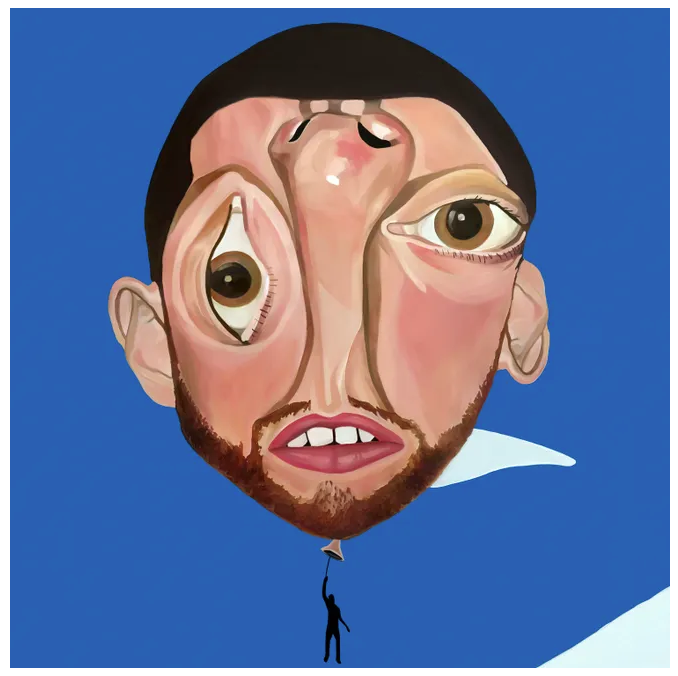
Mac Miller’s “Balloonerism” cover art by Alim Smith

Dec 052025
 

In addition to his numerous street art pieces, Alexandre Farto, aka Vhils, has shown his unique creations in various galleries around the world. The works above are from his 2018 exhibition Annihilation at Over the Influence gallery’s temporary location in Los Angeles.

From the gallery about the show-

Presenting a reflection on the current model of globalized development and the forces shaping and affecting local identities around the world today, Annihilation emphasizes the global impact of Los Angeles culture and the subsequent breakdown of unique global identities across continents. For his first solo exhibition in the United States since 2011, Vhils has taken the opportunity to set up a dialogue between the United States, Europe, and China to address the growing struggle for hegemonic supremacy between global powers and the ensuing social and economic impact on the world at large. Annihilation shares the stories of the citizens who breathe vitality into densely populated urban epicenters. Based on a variety of source material, from advertisements collected in cities worldwide to salvaged wooden doors, the new patchwork-like series intentionally dilutes the readability of each individual portrayed, a reflection on how identity is both formed and affected by the city’s visual discourse. This intentional juxtaposition of contrasts mirrors the interplay between elements from various cultures which we observe at work today in large urban contexts.

Vhils-Strata, which presents a selection of his work from the past twenty years, is currently on view at the Museum of Urban and Contemporary Art (MUCA) in Munich, Germany until 3/1/26.

He also recently created the site-specific installation, Doors of Cairo, located near the Pyramids in Giza in Egypt. It is part of  Forever is Now 05 and is on view until 12/7/25.

Nov 282025
 

Los Angeles based artist Llyn Foulkes sadly passed away last week. An innovative artist and musician, it was always fun to see his work around California.

The painting above, Post Card from Chatsworth, 1984, was on view at Palm Springs Art Museum in 2018.

About the work from the museum-

Foulkes is known for his acerbic perspective, dry humor, and distinctive style that draws from American popular culture. In the 1980s the artist returned to making Post Card paintings, which he originally created in the 1960s. This image of a seemingly desolate landscape features a large rock, an inscription, a post-office cancellation, and small self portrait. In celebrating the grand nature of the American landscape, the oversize format of the postcard also documents the absurdity of our own touristic impulses. Chatsworth is a neighborhood in northwest Los Angeles, but the area had previously been home to Native Americans, and its caves bear markings of rock art formations.

Nov 252025
 

Artist, writer and professional wrestler Rosalyn Drexler, born on November 25, 1926, sadly passed away in September of this year. In addition to her famous artworks, she also wrote several novels and won Obie awards for her plays.

The painting above, Marilyn Pursued by Death, 1963, is currently on view at the Whitney Museum of American Art in New York.

From the museum about the work-

Rosalyn Drexler’s work often explores the dark backstories of postwar media culture and gender roles. She frequently clipped subjects from printed materials-here, a news photograph of Marilyn Monroe fleeing the paparazzi with her bodyguard in tow-enlarged and collaged them onto canvas, and then painted over the image. In the artist’s words, her source images were “hidden but present, like a disturbing memory.” On the day this source photograph was taken in 1956, Marilyn Monroe and Arthur Miller were to announce their upcoming marriage; in the frenzy to cover the event, a car carrying reporters crashed, killing at least one member of the press.

Nov 212025
 

In The Recap this month- music, art, art shows, murals, spooky season posts and more. Check it out here and subscribe!

Oct 312025
 

Today’s flashback is to a few of the intricate works from Sofia Love‘s 2023 exhibition Vaquera at Shelter in NYC.

From the gallery about the exhibition-

Vaquera – not determined by an article, the word becomes both a noun and an adjective, an iconic figure and a way of being in the world. For Brooklyn-based painter Sofia Love’s debut solo exhibition in New York, vaquera is both a manifesto of queer self-fashioning and a patron saint.

Born and raised in Boston, but with deep family ties to the Mexican community of Laredo, TX, Love’s acrylic paintings serve as a negotiation between ancestral memory and contemporary identity. The titular cowgirl recurs throughout the exhibition – gun-slinging, brown, and frequently nude – framed by expanses of desert. She’s a real, historical cowgirl. She’s the artist traversing her own imagination. She’s a badass dyke. For Love, vaquera is an object of desire and an extension of herself.

While there are traditional canvases, the majority of works on view take the form of nichos, intimate yet elaborately decorated altars that can be found in homes across Mexico. Dedicated to deceased ancestors or particular saints, nichos blend folk spirituality with Catholicism, smuggling pre-Colombian vernacular traditions into contemporary, Westernized culture. Love’s nichos draw on this history to produce art objects that exist at the border of painting and sculpture, with frames that extend the content and imagery of the paintings they enshrine.

The resulting works each have interiors and exteriors, the painting and the frame, in which ambivalent scenes are surrounded by totems and animals that seem to hint at the psychological subtext of the central image. Figures reappear across the framed nichos like characters in a narrative, each with its own personal connotation for the artist. Skulls, moths, storks tell stories that are only partially legible from an external perspective. Like the vaquera herself, Love’s layered compositions refuse any easy interpretation.


Oct 302025
 

Betsy Lester, “The Weyward Sisters”, Acrylic and collage on canvas

Florida artist Betsy Orbe Lester‘s mixed media work blends the familiar with the mysterious. The works pictured are from a 2023 visit to her studio at ArtLofts in St. Pete.