Oct 202025
 

The Solitude-Funnel, 1921, was created by Suzanne Duchamp, who was born today, October 20th in 1889.

From the Museum of Modern Art about the work-

In Solitude-Funnel (1921), one of the last works that Duchamp made in the context of Dada in Paris, she combined fields of pigment with cut-out circles of metallic foil in a composition that juxtaposes painted and collaged geometric forms with a puzzling inscription. The thin, black lines emanating from the black circle at the center resemble the funnel described in the title, or the spokes of a bicycle wheel.

Her first comprehensive solo exhibition ever is currently on view at Schirn Kunsthalle Frankfurt until 1/11/26.

Oct 102025
 

Today’s flashback is to Huma Bhabha‘s spooky figures for Before The End, which was on view until March of this year at Brooklyn Bridge Park.  It is just one of the many projects organized by Public Art Fund.

From Public Art Fund about the work-

With the ominous title Before the End, Huma Bhabha (b. 1962, Karachi, Pakistan) sets the stage to evoke mythologies as old as humankind. Conceived for Brooklyn Bridge Park, Bhabha’s four monumental painted and patinated bronzes were cast from carved cork and skull fragments. The mysterious figures recall ancient effigies cut into tombstones, their surfaces evoking centuries of eroded sediment and stone. Yet, unlike a tomb, these four-sided vertical forms stand elevated above the earth, their bones open to the sky.

Before the End” is a title borrowed from the writings of Vincent of Beauvais (ca. 1184–1264), whose medieval imagination sparked with supernatural and apocalyptic visions. Today, the related popular genres of horror and science fiction continue to inspire Bhabha, as does art history from antiquity to the present day. Her rough-hewn figures are ambiguous—are they emerging or trapped within, rising from the depths of the earth or returning to the underworld? Set amidst an expansive landscape where the natural and man-made converge, Bhabha’s sculptures captivate through contradiction, seemingly forged in geological time yet animated with a visceral sense of immediacy.


Oct 082025
 

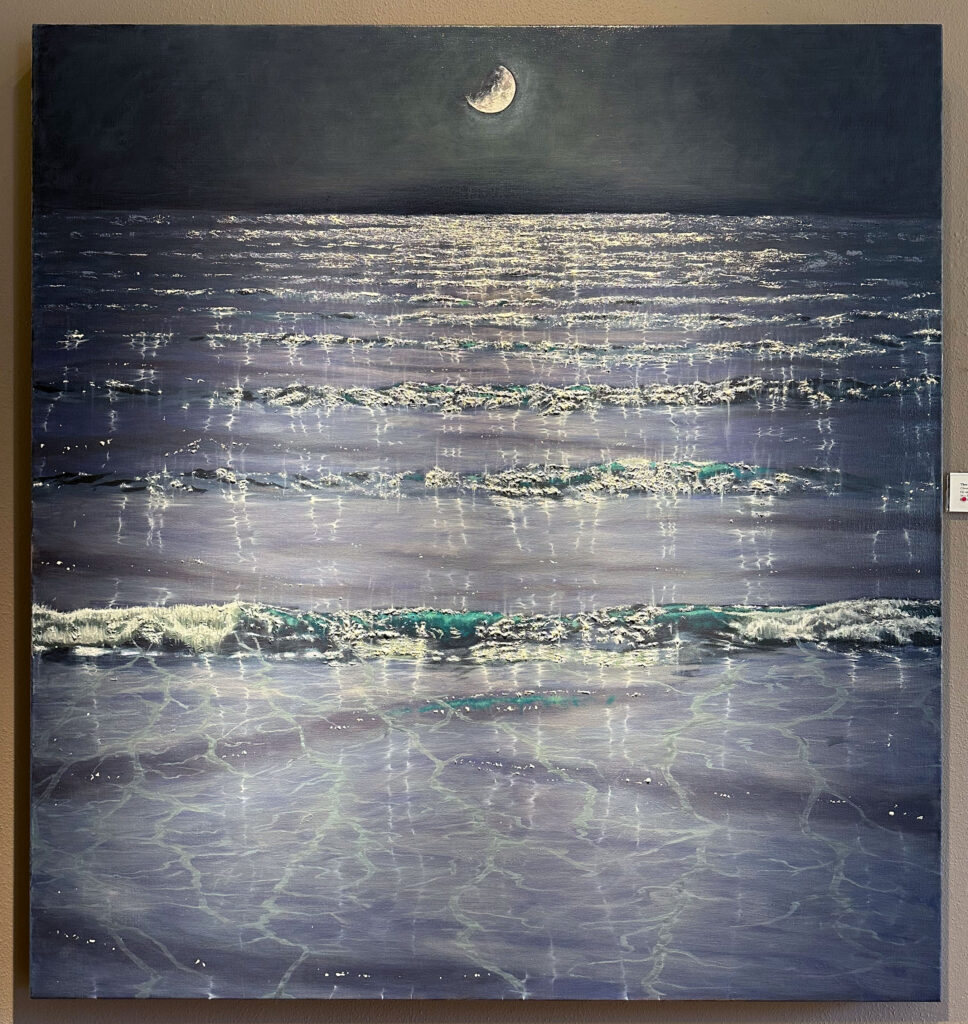
Theo Platt, “Chrome”, Oil on canvas

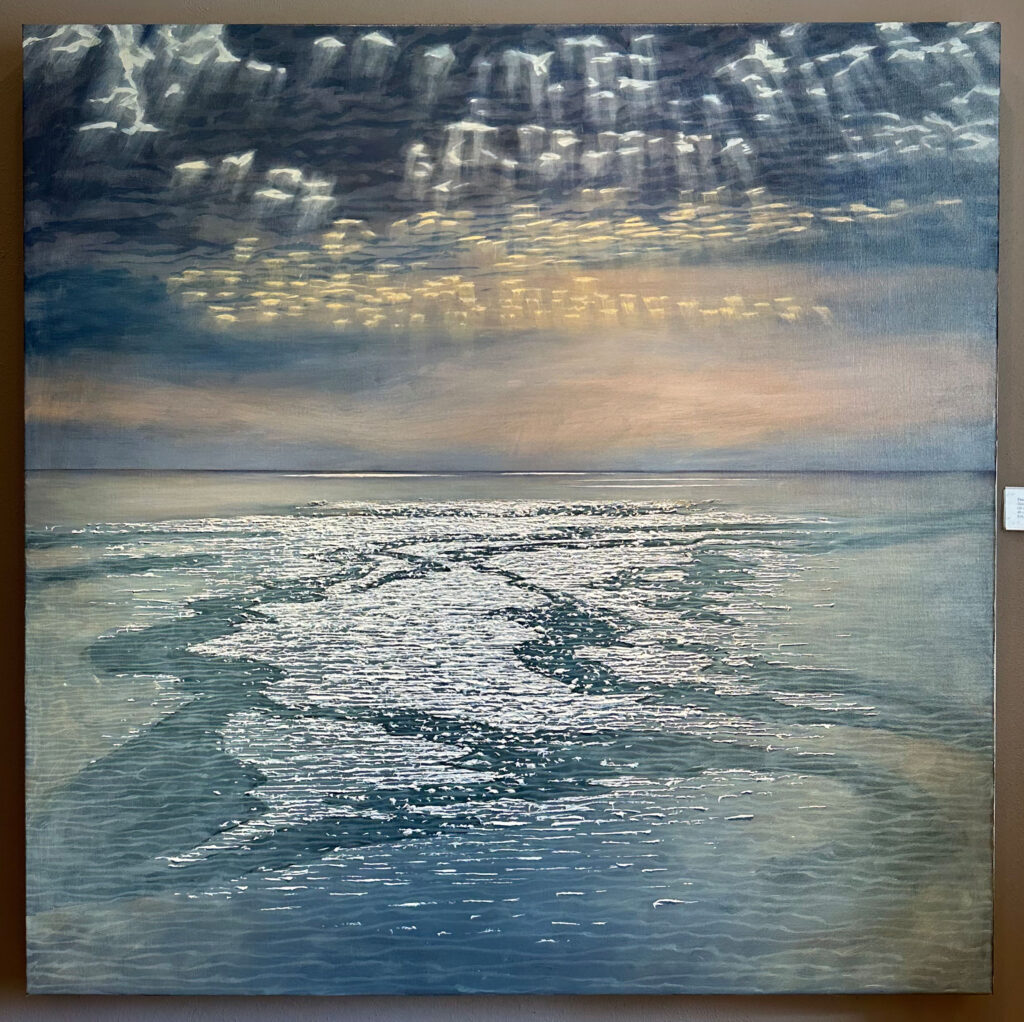
Theo Platt, “Sunstream”, Oil on canvas

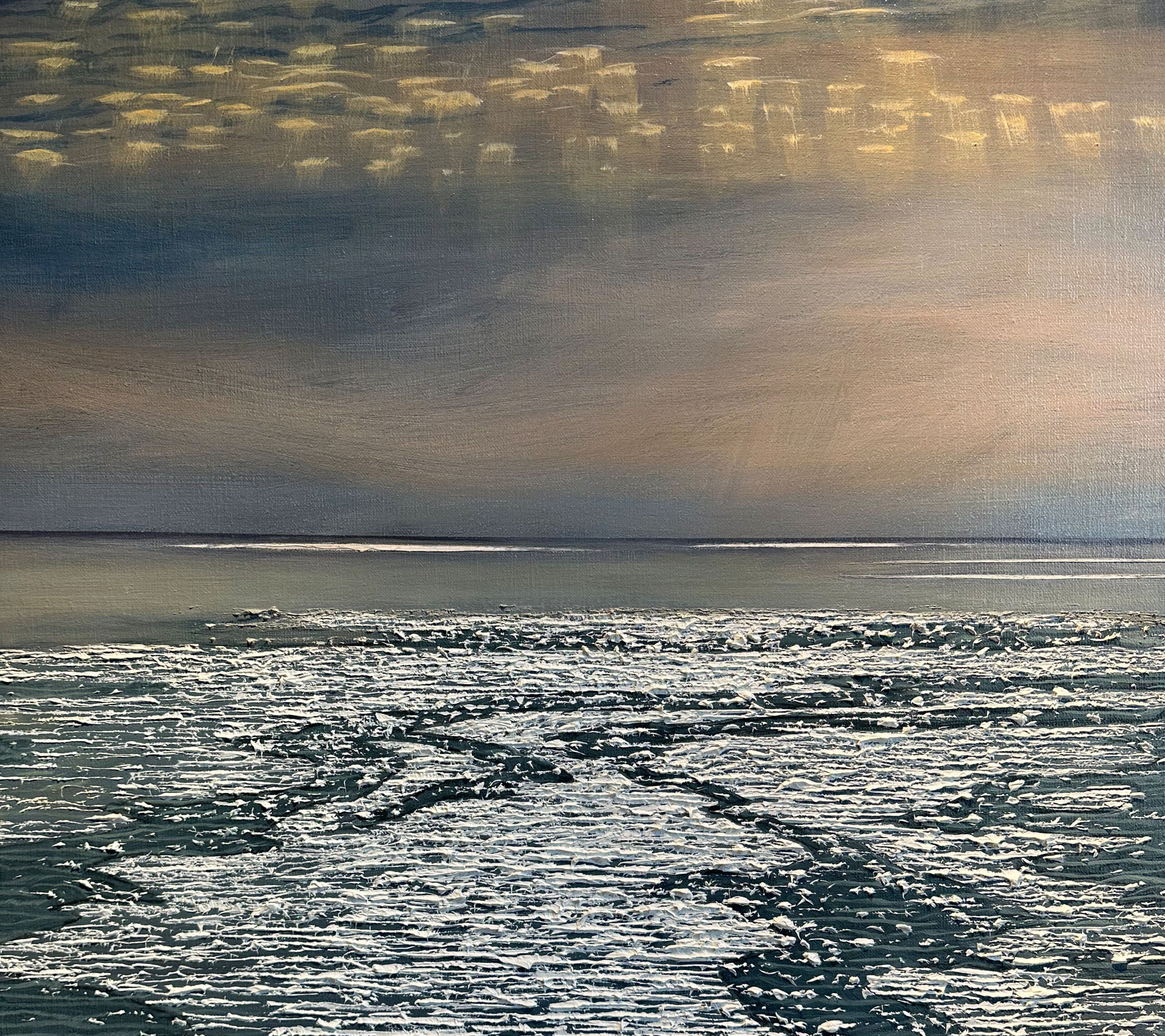
Theo Platt, “Sunstream”, Oil on canvas (detail)

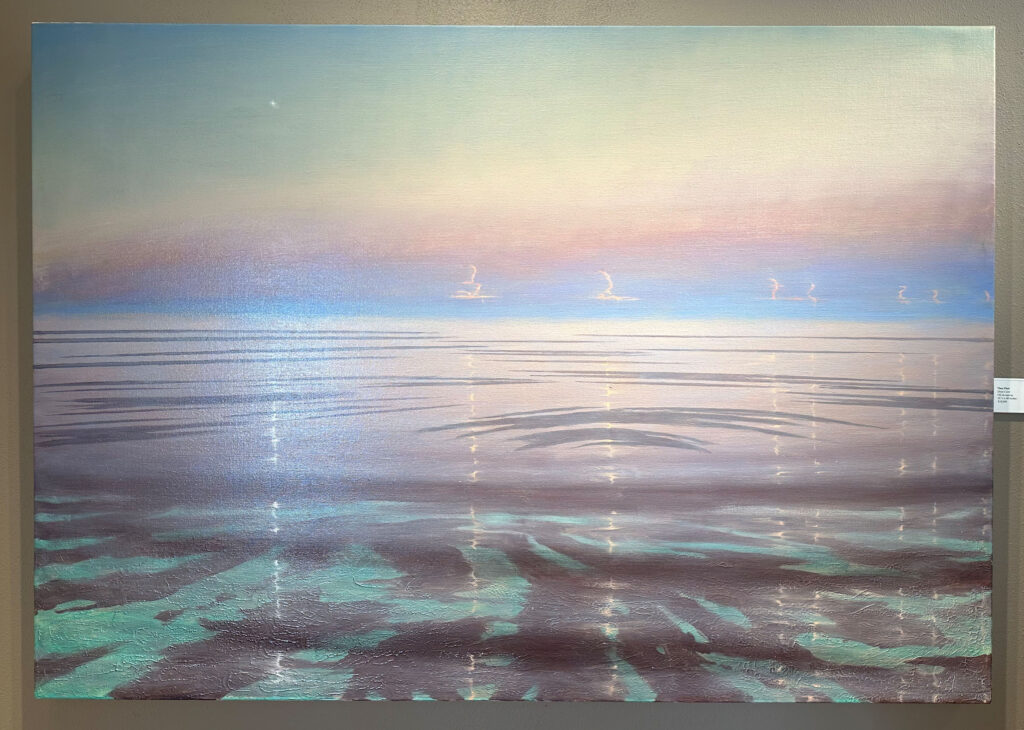
Theo Platt, “Deep Calm”, Oil on canvas

Somerville Manning Gallery is currently showing two painting exhibitions: Theo Platt‘s textured oil paintings from his Oceans series of works (pictured above) and Steven Nederveen‘s Stillness in the Shade of Green.

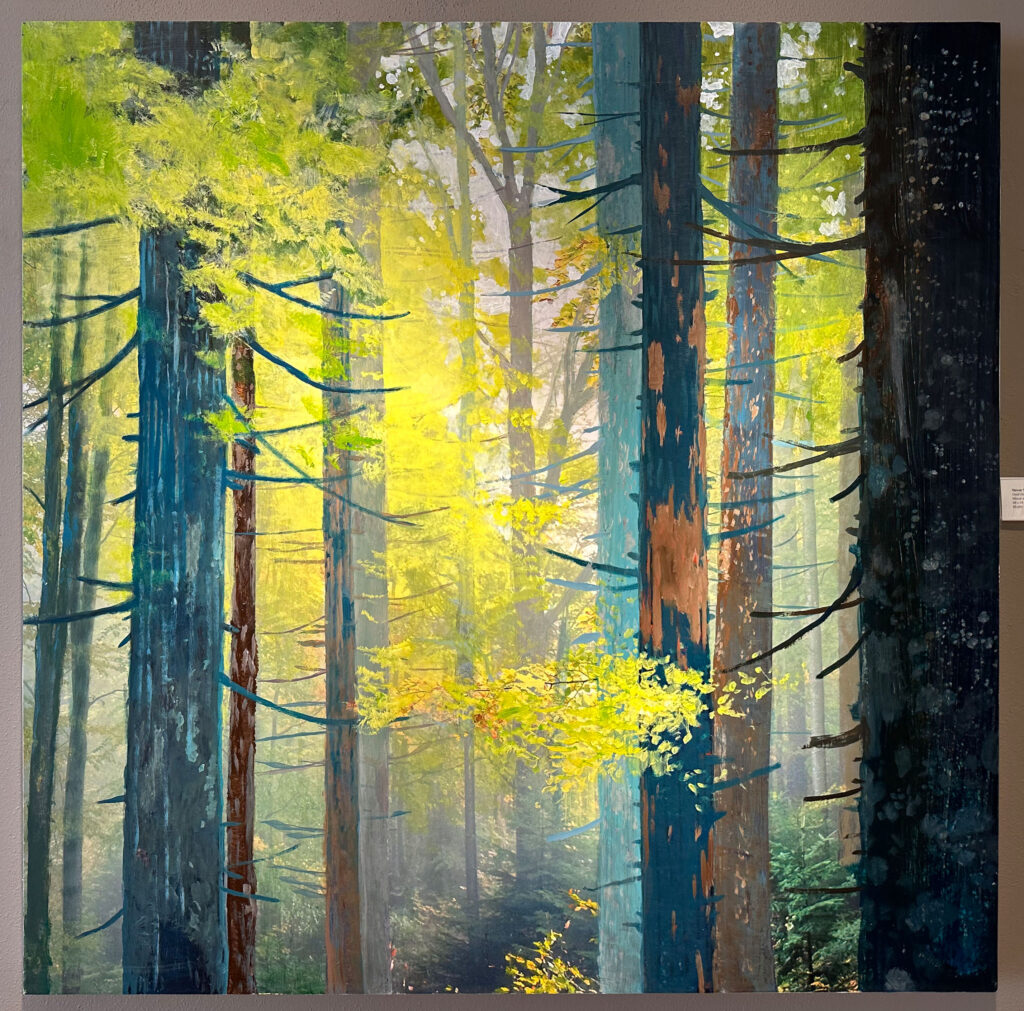
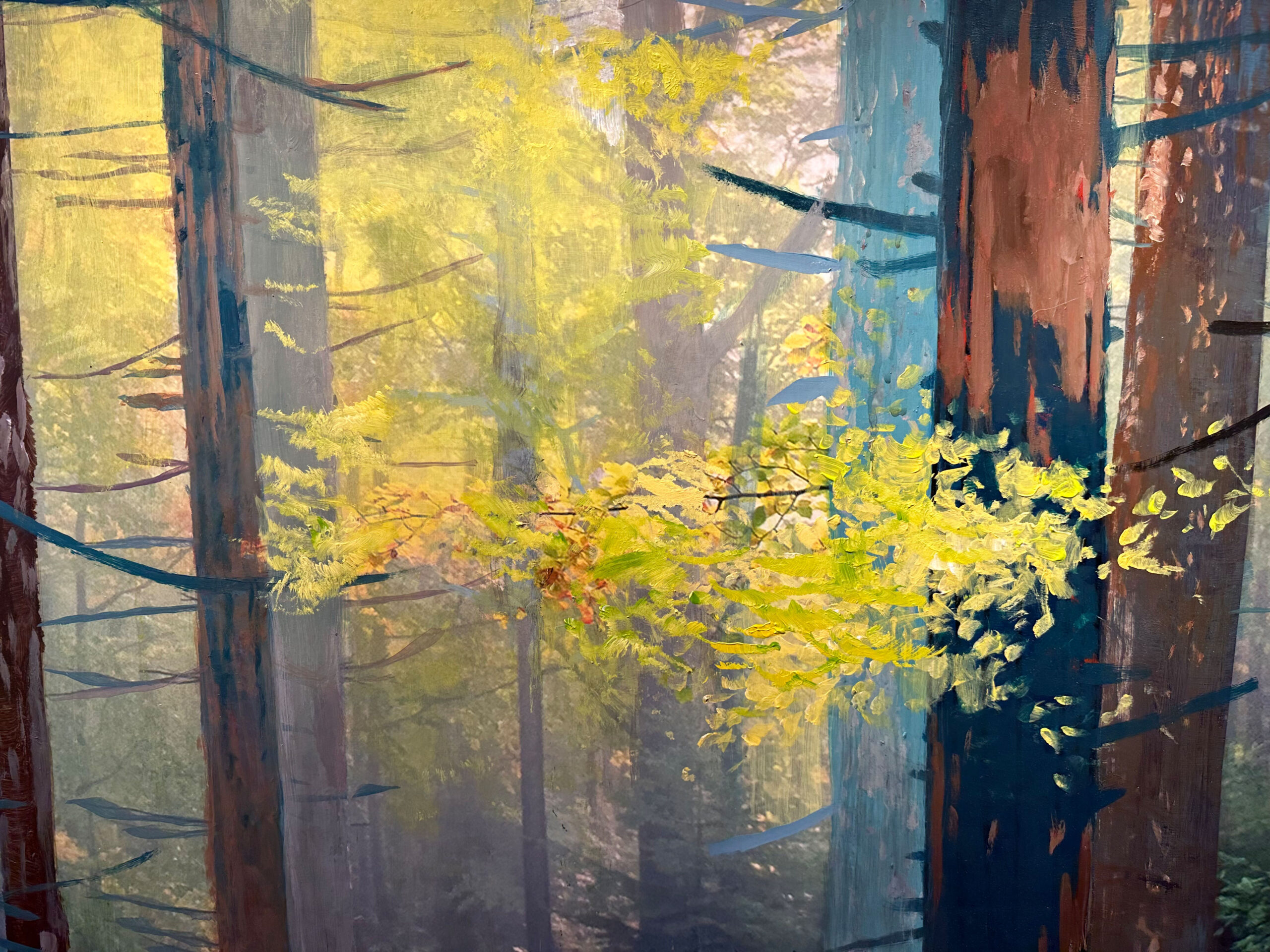
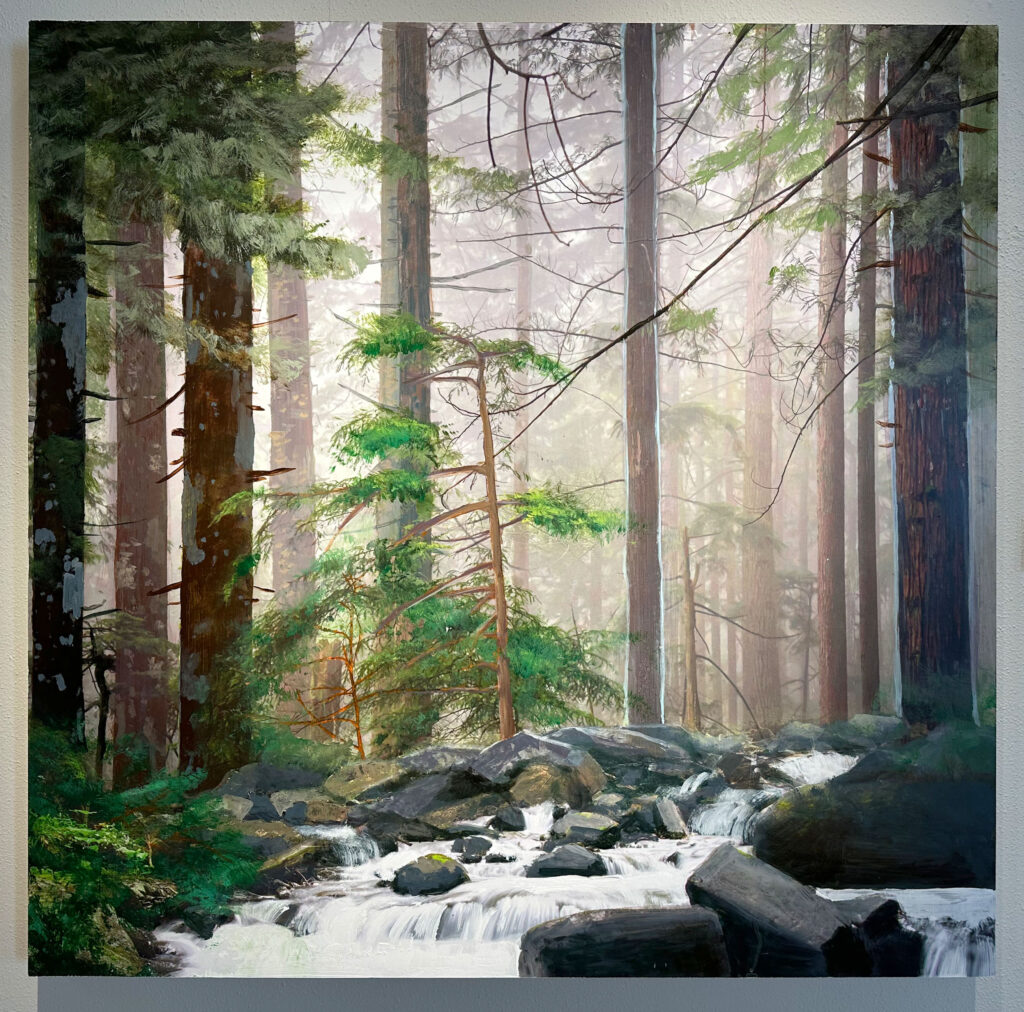
Below Nederveen describes his process for the work (pictured below)-

Using a mixed media approach to image making, I combine acrylic paint and C-print photographs. By layering these elements I can etch down into the emulsion of the photograph to reveal golden hues and also build up the surface with impasto and washes of colour. The result is an image with photo sharp detail in focal areas and painterly brush marks that obscure and create space for the imagination.

Both of these exhibitions close 10/11/25.

Steven Nederveen, “Gold Hidden Within”, Mixed Media

Steven Nederveen, “Gold Hidden Within”, Mixed Media (detail)

Steven Nederveen, “Breathe In the Forest Air”, Mixed Media


Oct 072025
 

William Wegman‘s portraits of his Weimaraner dogs were recreated in glass mosaic form by Mayer of Munich in 2018 for “Stationary Figures”, lcated in the 23rd Street subway station. The eleven murals brighten up the walls and are one of the many projects created by MTA Arts & Design.

From MTA Arts & Design about the work-

Photographed with the artist’s deadpan sense of humor, the dogs take on human attributes, from wearing street clothes like a shiny raincoat or flannel shirt, to being grouped like passengers as they gaze into space or peer down the platform as if waiting for the train.

Situated in bold blocks of color, the larger-than-life mosaic dogs are bursting into space and interacting with commuters. The mosaic fabricator, Mayer of Munich, interpreted the photographs taken for this project by meticulously transforming the facial expressions, skin textures and patterns of the dogs’ vibrant attire into glass mosaic. Wegman has lived and worked in the neighborhood for decades, and together with his dogs Flo and her brother Topper, they have created images that enliven this busy station.

Speaking about the project, Wegman said, “I wanted to create portraits of individual characters, people who you might see next to you on the platform. For these I dressed the dogs in more or less ordinary clothes, nothing too fashionable. I was very interested in the way in which photographs, even the out of focus dogs in the background of some images, could be translated into mosaic by Mayer of Munich, who skillfully turned gray stones into gray dogs.”

Below are the two series consisting of three panels each-


Sep 262025
 

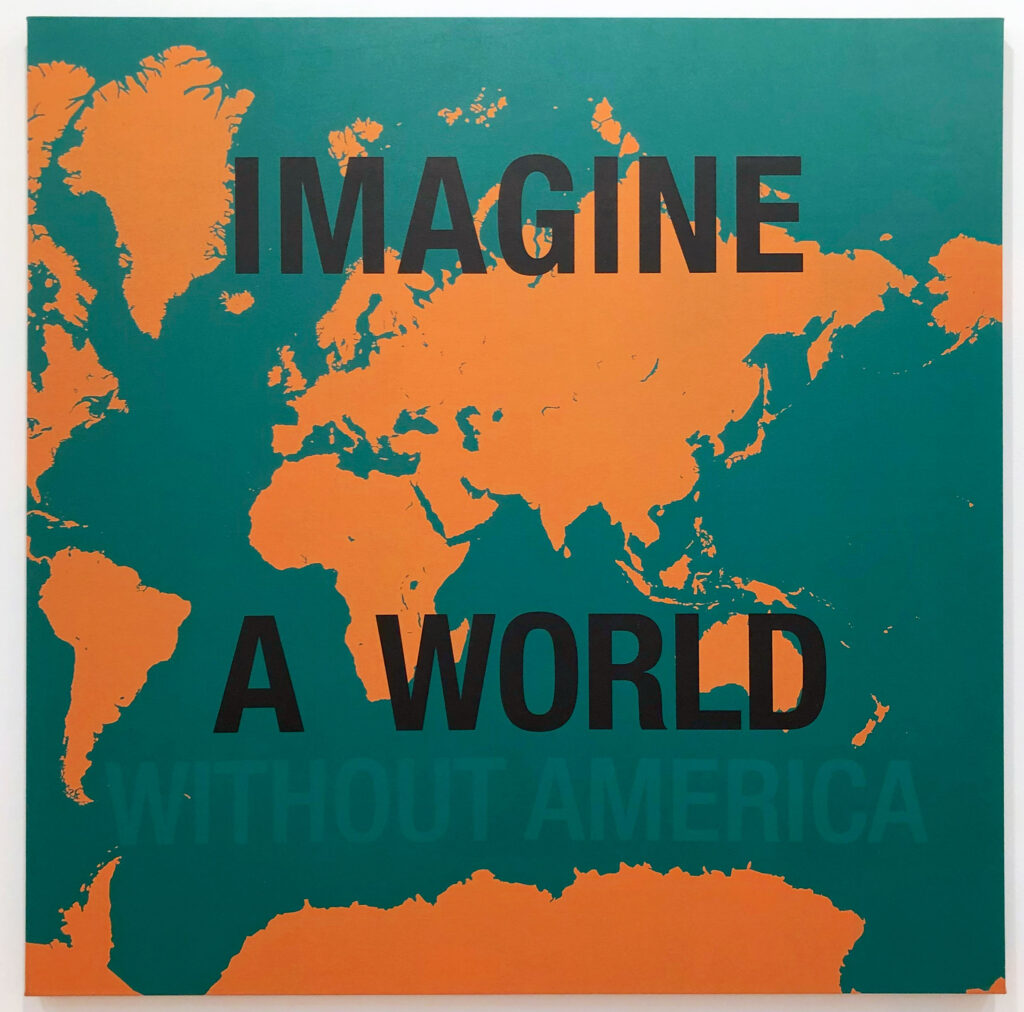
“Imagine a World Without America”, 2007, Screen print and acrylic on canvas

The painting above is by Brooklyn-based artist Dread Scott and was on view as part of the 2019 group exhibition Borders at James Cohan gallery in NYC.

From the press release about the work-

His 2007 work, Imagine a World Without America, calls upon the viewer to participate in the titular thought experiment and contemplate that absence. The painting de-centers the United States of America from the middle of the map that most Americans are familiar with. Scott utilizes the language of cartography to encourage the exploration of social questions, not geography. Land mass and sea are depicted but—like the world as it actually is—borders don’t exist.

The work is currently on view as part of 15, a group exhibition at Cristin Tierney gallery, celebrating the gallery’s anniversary and new location. 15 will be on view until 10/4/25.

Dread Scott has created political works throughout his career in a variety of mediums. In the video below he discusses how one of his art installations, What Is the Proper Way to Display a U.S. Flag (1989), drew controversy- including denouncement by then President George H.W. Bush.

Sep 122025
 

Born today, 9/12, artist Robert Irwin used light and space in his work as a way to create an experience for the observer. He started out as a painter but later became well known for his site-specific installations and architectural and outdoor projects- including the central garden at the Getty Center in Los Angeles (pictured below) and his work for the Chinati Foundation in Marfa, Texas.

The works above are from his 2020 exhibition, Unlights, at Pace Gallery in New York.

About that show from Pace-

Irwin’s new works are composed from unlit six-foot fluorescent lights mounted to fixtures and installed in vertical rows directly on the wall. The glass tubes are covered in layers of opulently colored translucent gels and thin strips of electrical tape, allowing the reflective surfaces of unlit glass and anodized aluminum to interact with ambient illumination in the surrounding space and produce shifting patterns of shadow and chromatic tonality. Reflecting his recent turn toward the perceptual possibilities of unlit bulbs, Irwin’s new body of work expands the range of possibilities for how we experience sensations of rhythm, pulsation, expansion and intensity, while continuing the artist’s long-standing interest in registering the immediacy of our own presence in space.

Expanding from his breakthrough disc paintings of the late 1960s, Irwin’s new works effectively dissolve the perceived border between object and environment, focusing the viewer’s consciousness on the act of perception. Each light fixture in Irwin’s sculptures contains one or two unlit bulbs—or no bulb at all—while alternating gaps of “empty” wall are painted in subtle shades of gray, producing a sense of uncertainty about what is tactile and what is merely optical. As the shadowed, painted and reflected intervals of space reverberate in the viewer’s visual field, the wall itself enters the composition, destabilizing any sense of figure and ground. To encounter Irwin’s sculptures is thus to allow oneself to be caught in a ceaseless oscillation between flatness and volume, transparency and opacity, solidity and atmosphere.

In Irwin’s art, the object functions as a kind of score for orchestrating “the continual development and extension of humans’ potential to perceive the world.” Although unlit, the bulbs in these new sculptures are therefore never “off.” Their optically rich surfaces serve as energetic loci for heightening the sensory possibilities of the human body. In their chromatic complexity, the works convey an almost painterly quality, recalling Irwin’s origins as a second-generation Abstract Expressionist painter in the 1950s. Suggesting a rhythmic, minimal composition of repeated linear elements, the works also evoke his innovative line paintings of the early 1960s, which involve us physically and perceptually in an open-ended, immersive and transitory experience of seeing.

Widely recognized as a pivotal figure in contemporary art, Irwin is closely associated with the Light and Space movement that emerged in Los Angeles in the 1960s, and he has continued to live and work in Southern California for his entire career. He first used fluorescent lights as substrates for producing what he has called a “conditional art” in the 1970s, often in combination with architectural scrims and other spatial interventions. In the 1990s he introduced colored gels to the fluorescent tubes to alter the chromaticism of the light, and, over the past decade, began isolating the bulbs and fixtures as sculptural objects in their own right. In returning to the use of solely ambient light, Irwin’s new sculptures embody the culmination of seven decades of rigorous experimentation.

“Everything in the world is ultimately conditional,” Irwin has observed. “There is nothing that’s transcended or infinite or whatever you want to call it. Everything acts within a set of conditions.” Like all of Irwin’s works, his new sculptures respond differently to the conditions of each specific environment in which they are installed, attuning our senses to a given context and making possible an intuitive and incidental experience of seeing that resists rational or conceptual explanation. “It’s not about answers,” the artist once remarked, but rather about the act of questioning: “It’s the constant pursuit of the possibilities of what art is.”

Getty Center, Los Angeles

Below is one of his earlier paintings Untitled, 1964-6, which was on view at Palm Springs Art Museum for the 2024 exhibition Particles and Waves: Southern California Abstraction and Science, 1945-1990.

From the museum about the work-

Although this work appears to have a monochromatic white surface from afar, a matrix of thousands of painted dots becomes visible from a closer vantage point. Irwin aimed to highlight the visual effects of color interaction by juxtaposing light green and lavender, complementary colors across from each other on a color wheel. The canvas’s outwardly bowed supports and the increasing density of dots towards the painting’s center further heighten the viewer’s perceptual experience of the work.

The documentary Robert Irwin: A Desert of Pure Feeling, does an excellent job detailing his life, art, and the philosophy behind his work. It is well worth a watch and inspiring to watch him still at work in Marfa at 87. He passed away in 2023 at the age of 95.

Sep 052025
 

“In Search of Form”, 2024, Acrylic, wood, aluminum, glass, rubber baseboard, rope, plastic tubing, drywall, solid surface, and cue balls

“Through Line (Grass) 1”, 2024, Acrylic and wood

“Line of Sight (Sunset)” and “Line of Sight (Horizon)”, 2024, Wood, acrylic and rubber

The images above are from Katie Bell‘s 2024 exhibition Edges in Search of Form at Spencer Brownstone Gallery in NYC.

From the gallery press release-

The lawn’s flat nature leads your eye to the edges in search of form, and if the edges are not sharp it will not show.

Spencer Brownstone Gallery is pleased to present Edges in Search of Form, Katie Bell’s second solo exhibition with the gallery. The show is composed of a collective of individual paintings, sculptures, and installation elements that share a common visual language with influences from architecture, the landscape, and Surrealism. The title of the exhibition references the quote above, advice from a gardener on crafting the perfect lawn.

Trained as a painter, Katie Bell’s sculptural practice stems from a rethinking of the painting process in the third dimension. Basic forms and simple found objects act as individual marks within the canvas of space, most evident in Through Line (Grass). The monochrome, matte grass green prisms are assembled together and around, activating space and generating an environment of its own. Pared down to its base attributes, shape, color, scale, and quantity foreground their objectness while their modularity alludes to a whole, greater than the sum of its individual parts. The rigidity and simplicity of the form is contrasted by its color and organic arrangement.

Operating similarly are the Line of Sight paintings, compact forms reduced to its base elements. Their shape, undulating line, softer hues, and subtle change in tones recall landscapes, shifting light, and the passage of time. The opposite wall features an amalgam of fabricated and found objects. In Search of Form is various in material and texture, with components overlapping, weaving, and puncturing the other. The eyes follow the intricacies of their interaction like a visual Rube-Goldberg machine. Or like the futile attempt of some to maintain the length and shape of grass, an exercise in controlling those things in our world that resist.

Reconciliation comes in the form of bird baths. Often found on lawns or backyards where the natural order is kept at bay to the best of one’s ability, they are beacons that welcome natural behavior. Composed of a patchwork of stone-like Corian, Water Table (Bird Bath) melds with the tones of our landscape while standing out in its formality.

Bell’s overall installation illustrates the light and often hard touches of human intervention. Her constructed worlds explore the absurdity of our extreme pursuit in controlling our environment, and ultimately its analogue in art making.

Aug 212025
 

Painting by Kelly Irvine

Installation of sculptures by Allison Hudson

Work by Anna Guarneri

Each of the five artists in Bricolage: Artists and Accumulation, currently on view at The Delaware Contemporary, use their materials to express meaning through a layering process.

From the curators, Kasia J. Bunofsky and Leah Triplett-

“I have a very simple theory. I have always pretended that objects themselves formed a self-composition. My composition consisted of allowing them to compose themselves.” – Armand Pierre Fernandez (Arman) (November 17, 1928 – October 22, 2005)

When ‘assemblage’ first circulated as an art-historical term in the early twentieth century, it referred to the primarily formalist practice of joining tangible, often discarded or found, materials. Like a three-dimensional collage, assemblages made novel juxtapositions of individual components to create a whole artwork with its own impact. As the topography of the art world shifted mid-century, assemblage was often used to critique the post-war era’s burgeoning consumerism. Similarly, “accumulation” refers to a kind of assemblage that emphasizes materiality through the mass repetition of similar objects or forms. Accumulations lent themselves particularly well to expressing discontent with consumerism. They underscored the commodity’s necessity as a medium while maintaining the artist’s agency to reclaim meaning through the processes of recontextualization and repetition. As time persisted, assemblage continued to inspire and lend credibility to avant-garde contemporary movements. Even the new wave of ‘conceptual art’–a blatant rejection of materiality–was seen as an assemblage that forwent concrete objects to assemble ideas, language, or concepts. From installation art, to performance, to ‘relational aesthetics’, assemblage and accumulation helped pave the way for today’s contemporary art world and its many innovations.

Assemblage and accumulation emphasize the importance of each material element to the message of the completed work of art. This idea evokes a sense of collectivism; a metaphorical microcosm of material cooperation that might inspire a yearning to change our individualistic society, as art reminds us the whole cannot exist without the contributions of every one of its parts.

The artists and works featured in Bricolage: Artists and Accumulation reference the tradition of assemblage, accumulation, and their many corollaries; either through the performance held within their artistic process, their compilation of abstract concepts, or their passion to speak through material. They build, assemble, accumulate, gather, and collect. Using assemblage as both a method and technique, these artists engage assemblage as an action that is always in perpetual evolution of form. Be their medium drawing or sculpting, painting or installation-their material glass or found objects, acrylic or graphite- Anna Guarneri, Allison Hudson, Brynn Hurlstone, Kelly Irvine, and Emilio Maldonado, apply an iterative, intuitive approach to making, resulting in a bricolage.

This aesthetic- in which the whole is a sum of parts-demonstrates a depth of material knowledge. The works presented here require long looks to unfold and reveal their discrete components. Layering, stacking, blending, and amalgamating are processes and aesthetic devices that enable the viewer to experience the work in an instinctual way. Throughout these artists’ individual practices, an emphasis on transformation through collecting and comingling materials, media, and forms is paramount, with bricolage being a means for metamorphosis.

Below are additional works by the artists and information from the museum-

Allison Hudson

“My work explores the nature of cycles and the emergence of growth from decay. It’s tactile and fragile- a combination of unfired clay, wool, fabric, resin, and wax. Driven to manipulate raw materials into something new and unrecognizable, I enjoy the physicality of building, tearing apart, and mending together – striving to create work that is at once ethereal and visceral.”

Kelly Irvine

“My abstract color field paintings invite the viewer to step into a lush, translucent world of color. Drawn to the beauty of layered transparent hues from an early age, I use sheer color, overlapping forms, gestural brush work, organic forms, and repeating motifs that flow and intersect, resulting in delicious new hues and increased tonal depth. Contrast is important in my work as well; hard edges are in conversation with areas of soft gradation, while vibrant, neon hues pop against muted tints and natural, raw canvas.

I’m especially inspired by the canvas staining techniques and paintings of Helen Frankenthaler and Washington Color School artists Morris Louis and Kenneth Victor Young. I pair that inspiration with constant experimentation and manipulation of materials, developing new processes as a natural outcome.”

Anna Guarneri‘s work explores the possibilities of suggestive imagery and the devotional connotations of stained glass. She uses crude marks and associations to tap into early human experience, pulling from a range of sources – ancient art, architecture, dance history, and her own body. Colors in her work conjure poignant memories, turning drawn forms and glass structures into celebrations, memorials, or premonitions.

Guarneri’s latest body of work pulls from the visual world of postpartum life, incorporating imagery of bodily landscapes and interiors, and the various devices, accessories, and toys encountered during pregnancy, birth, and early motherhood.

Brynn Hurlstone

In Time explores the process of healing from trauma, and the permanent transformation left behind once that process begins. Layers of broken safety glass are frozen within ice and slowly melt over a steel platform. The thaw allows for the release of contained breakage onto the foundation, where it rests in a slowly evaporating pool of water. Over time the water evaporates and the shattered glass may be swept away, but the foundational steel upon which the process took place will forever carry its traces.”

Emilio Maldonado

“I create art to explore personal narratives and navigate life through the material culture of capitalist America.
My work raises questions about social constructs, structural inequalities, and the dynamics of race and class. Through a multidisciplinary approach, I repurpose discarded objects as a means to reflect on memory, identity, and social conventions.”

This exhibition is on view until 8/24/25.

Aug 212025
 

Work by Tracey Tse

The Delaware Contemporary currently has several shows on view for their summer series Radius. Several of these exhibitions include emerging artists including ARC 2025. The exhibition will close 8/24/25.

More from the museum-

The Artist-in-Residence Cohort (ARC) identifies and supports local emerging artists poised for careers as dedicated artists. This year, jurors Dr. Casey Smith and former ARC resident Shefon Taylor chose four regional artists: Geraldo Gonzalez, Oscar De Paz, Tracy Tse, and Lucy H. West. These artists have spent several months in intensive professional development seminars, formal and informal critiques, and one-on-one meetings with mentors to prepare for their culminating exhibition. This year, the ARC residents “came full circle” through mini-residencies at Art-O-Mat by the Wilmington Alliance. This extended their perspective on the creative needs and opportunities of Wilmington, Delaware. You are seeing the results of ten months of their experimentation, planning, and growth.

This year’s cohort pushed the envelope to develop their skills beyond what they came to the museum doing. Lucy H. West has incorporated sophisticated video editing, performance, and sculpture into a tracing of sensory experience. Oscar De Paz has refined his political commentary in his painting practice, deeply rooted in social revolution iconography. Geraldo Gonzalez increased his scale and output, documenting the legacy and daily role DART plays in his life. And Tracy Tse, with the help of a new loom, weaves plastic nets and tapestries. These artists grew through a new partnership with Wilmington Alliance, where they each spent one month in the Art-O-Mat studio space. Their time working with a view to mid-center city grounded their work in an even deeper Wilmington context.

Below are additional selections and the artists’ bios from the museum-

Tracy Tse– “I like this little life of mine. It’s not something amazing, and it’s not a tragedy. However, every day doing art is enough in my world.

I’m a first generation Chinese American who grew up in a family tailoring business. Like many family-run businesses, I started helping out at a young age where I picked up skills in mending and tailoring. Over the years I’m grown into the career as a contemporary artist, where I used my skills interconnectively to express myself.

In my current work, I have been incorporating plarn (yarn made from plastic) to construct large-scale sculptures that protrude from the wall. Each piece is completed through labor-intensive repetition of sewing, knitting, crocheting, weaving, braiding, and knotting techniques to sculpt. The use of a variety of techniques is then adopted and shaped to form a specific look that is derived from family, tradition, heritage, history, and childhood.

Manufactured goods go through many hands and iterations before becoming the final product. Every hand played a role by putting blood, sweat, and tears into the production. Honoring and paying homage to the human touch and the sentiments that are overlooked during the production process is important. My collection of depicts efforts laborers and craftsmen. Convey the message of what human touch means.”

Geraldo Gonzalez

“I am, first and foremost, a transit artist. I began working as an artist in the early 2000s. I first started taking photos for a homework assignment in middle school, which inspired me to start taking photographs of local transit systems. Public transit has always been an interest of mine. I regularly took the bus as a teenager going to and from school, then went out and got to know other transit routes within the greater Delaware valley, like SEPTA, PATCO, AMTRAK, MTA, NJT, and DTC. My passion for public transportation has led me to make thousands of artworks to encourage people to use and find the beauty in these local transportation systems. I am a self-taught multimedia artist, working in colored pencil, acrylic paint, oil paint, watercolor, photography, video and sculpture. My process is to project images that I take and find online and translate them into my artwork through tracing, then going back and adding color.

Issues surrounding transportation like road rage and gas inflation have inspired me to spread my message about public transportation. Outside of transit-related art, I also create self portraits that express my identity and feelings. My Puerto Rican culture influences my art, in my self portraits and expressive use of color.”

Oscar Eduardo De Paz

“My drawings, paintings, and books tie together the threads of my personal experiences and sociopolitical issues. I reflect on my personal experiences of poverty, discrimination, homelessness, immigration, and disruptions in my family and education to explore how these experiences engage with their historical and sociopolitical expressions and contexts, and shape who I am. My intent is to stimulate reflection, discussion, and examination of the impacts of sociopolitical institutions and systems on individuals, specifically vulnerable populations. My artistic process begins with writing personal narratives and poetry that become sources for me to interpret or amend into visual representations. Historical, sociological, and visual research provide further inspiration in the process of creating my work. Subjects and elements in my work often function as symbolic representations of the idea and emotions evoked by my written pieces. The writing is rarely literately translated into a visual representation, but instead through a process of association translated into figurative and metaphorical representations that contain subjects and elements laden with personal, cultural, spiritual, and mythological meanings.

Sometimes, the work stands alone visually. At other times, the work stands with the written text in a unity. It is the space between the text and image where the audience, both as viewer and reader, is invited to experience the themes of my work, and to contribute their insights.”

Lucy H. West investigates intimacy, mindfulness, incorporeal inner experiences, and understanding of the worlds we inhabit and cohabit. Using painting, installation, and most recently multi-sensory media, West seeks to push the boundaries between the artist and spectator by inviting the viewers to be involved in her work, transforming them into active collaborators.

Through participatory art projects, she is interested in eliciting social consciousness, playfulness, curiosity, experimentation, and introspection from her collaborators, creating avenues for her work to evolve and be defined by the community who engages.

West is a Philadelphia-based artist from Tokyo, Japan. She has exhibited and had works acquired in Philadelphia, New York, Tokyo, Rome, and Madrid. Her artwork has also been selected and acquired by the University of Pennsylvania’s Department of Medicine.

Aug 132025
 

The Delaware Contemporary currently has several exhibitions on view for their summer series Radius. Guise/Trickery, a two person exhibition curated by Erica Loustau and Moriah Berrouet, features a photographic series by Ashley Suszczynski (Guise), pictured above, and hyper-realistic recreations of discarded fast food packaging created by Brian Richmond (Trickery), pictured below.

From the museum about the Suszczynski-

Ashley Suszczynski is an award-winning photographer focused on capturing ancient traditions in the modern day. The photographs on exhibit include work from her series, Ancient Tradition in the Modern Day, which is an ongoing discovery of ancient pagan roots of masked traditions throughout the villages of the Iberian Peninsula. Ashley documents costumed villagers, unearthing the various cultural traditions and winter rites of the region. The masked festivals are designed to ward away evil spirits and welcome a fresh and healthy new year. Elaborate handmade costumes allow participants to step outside their everyday identities and engage in imaginative storytelling.  Whether the suits are made from silky goat hair, fur, mirrors, or feathers, the wearing of masks and costumes fosters a sense of liberation and communal celebration. The concept of guise plays a vital role in masked folk traditions and festivals, serving as a powerful tool for transformation. Ultimately, the guise in these traditions invites reflection on the nature of identity itself and challenges participants to explore the boundaries between reality and fantasy.

Ashley’s work has been seen in National Geographic, Photo District News, All About Photo and more. Her most recent exhibition, “Ancient Tradition in the Modern Day: Iberian Folklore and Maskarades” headlined the 2022 Barcelona Foto Biennale along with the 7th Biennial of Fine Art and Documentary Photography. The exhibit took the grand prize in the worldwide Julia Margaret Cameron Award for Women Photographers.

About Brian Richmond and his work from the museum-

Brian Richmond creates hyper-realistic renditions of mass-produced packaging.  Adept in paper modelling and painting, Brian tricks the viewer into seeing “trash”.  His work addresses the pervasiveness of single-use packaging and the “highly manufactured refuse that permeates our daily lives and environments in such a powerful way that we hardly notice it anymore”. By blurring the lines between illusion and actuality, Brian exploits trickery to enrich the viewer’s experience, encouraging them to explore layers of meaning beyond the surface.  Each unique artwork deceives the eye and makes us question its reason for being in a museum context.  The trickery has drawn us in only to remind us that the trick is actually on us.  We are the ones creating the real debris that litters our cities and towns.

Brian William Richmond is a visual artist from Pennsylvania who makes three-dimensional paintings of trash. Brian graduated from the Pennsylvania College of Art and Design with a BFA in 2001. In 2008, he was awarded the Pennsylvania Council on the Arts Fellowship. In 2012, he was awarded the West Collects acquisition prize. He previously exhibited at Pulse Art Fair, Miami in 2012 as part of The West Collection’s “THIS END UP” installation. In 2013, Richmond was one of five artists who were selected by Jonathan Ferrara Gallery to participate in a group exhibition entitled “Philadelphia”, where Richmond’s mass-produced packaging series was exhibited. In 2016, he was awarded the Fleisher Wind Challenge from Fleisher Art Memorial. Brian has also been a songwriter/composer for many years now, and his current project with his long-term collaborator Nick Hardy is the Bell Harmers. Brian is currently working on his next collection of paintings, which he plans to release in the fall of 2024. Brian works and resides in Chester County, Pennsylvania.

This exhibition closes 8/24/25.