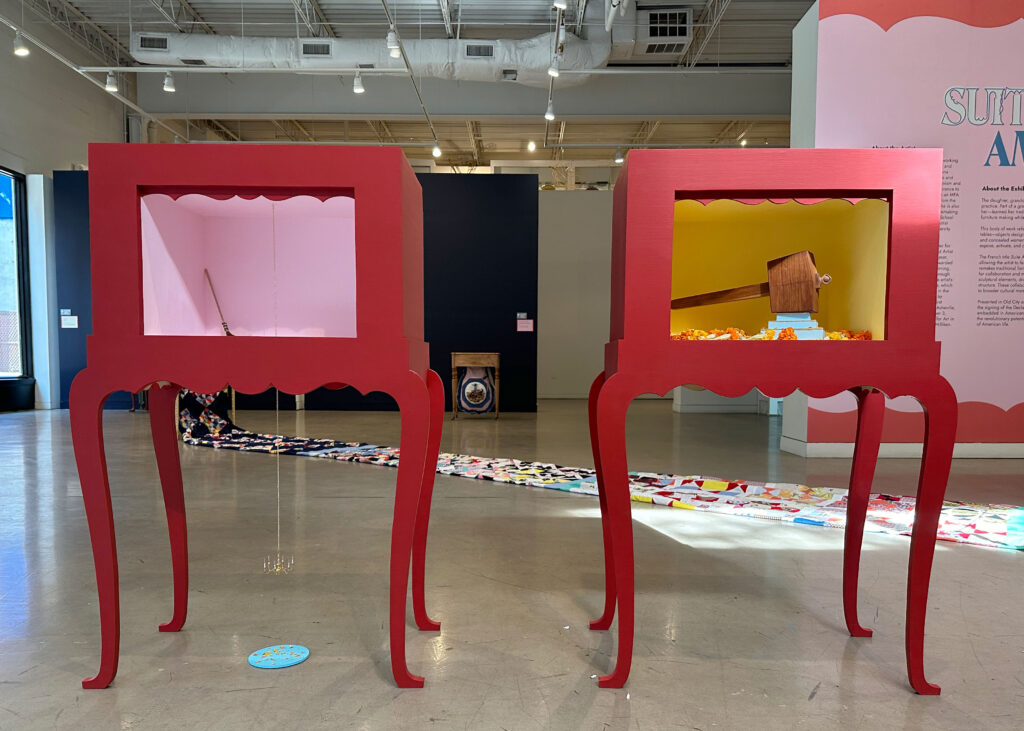
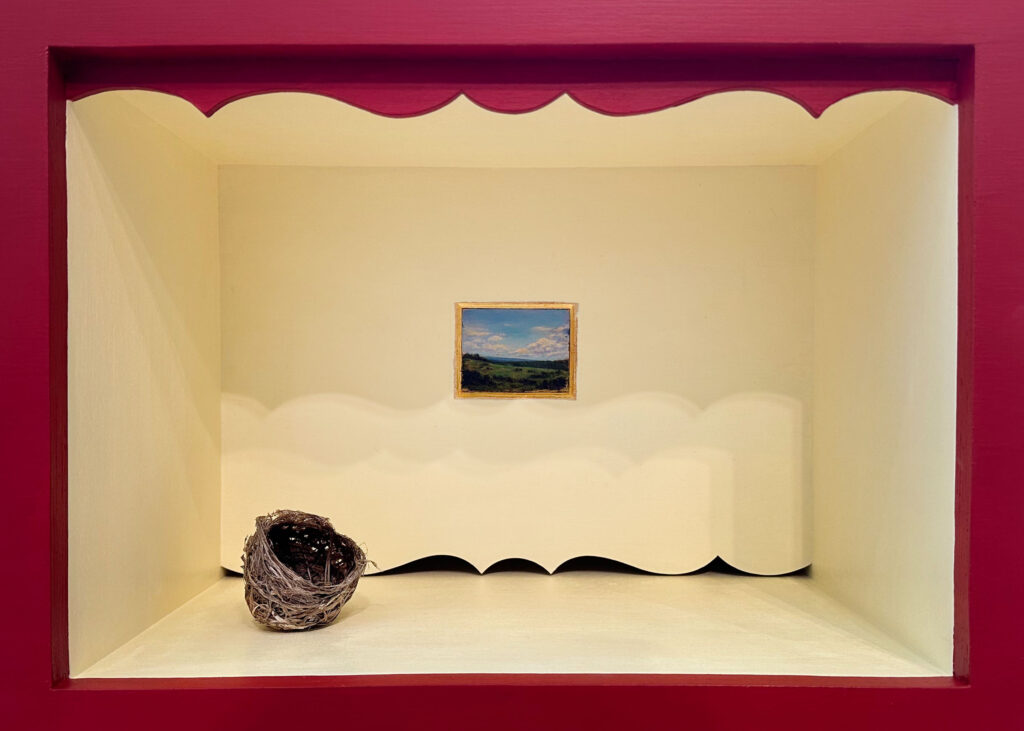
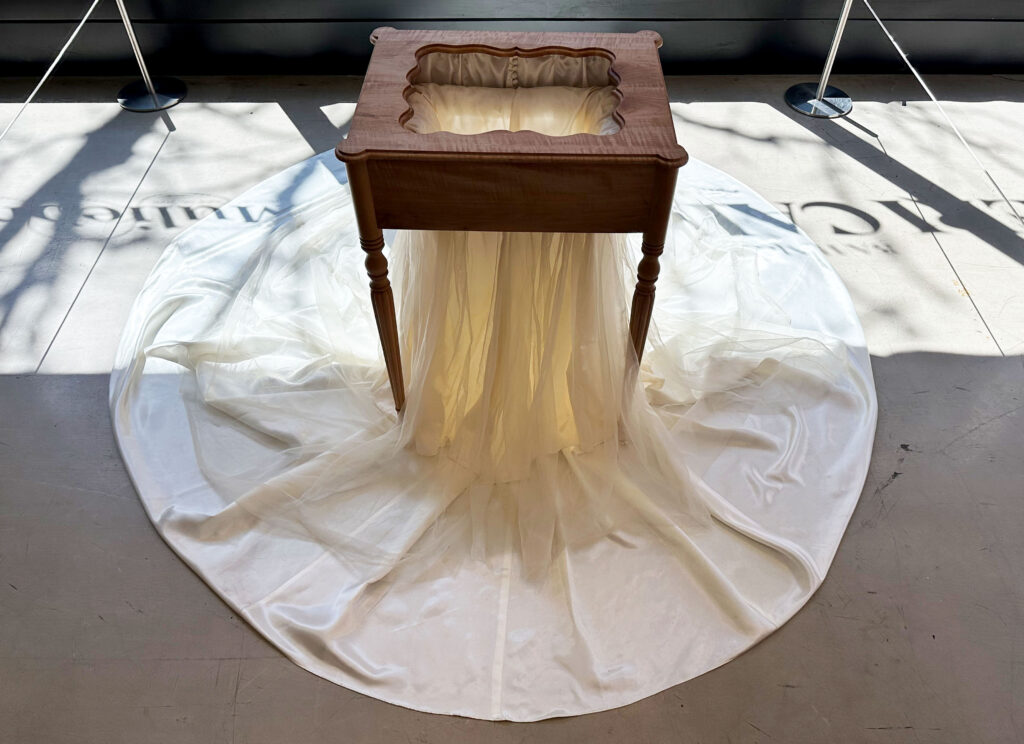
Jul 032026
 

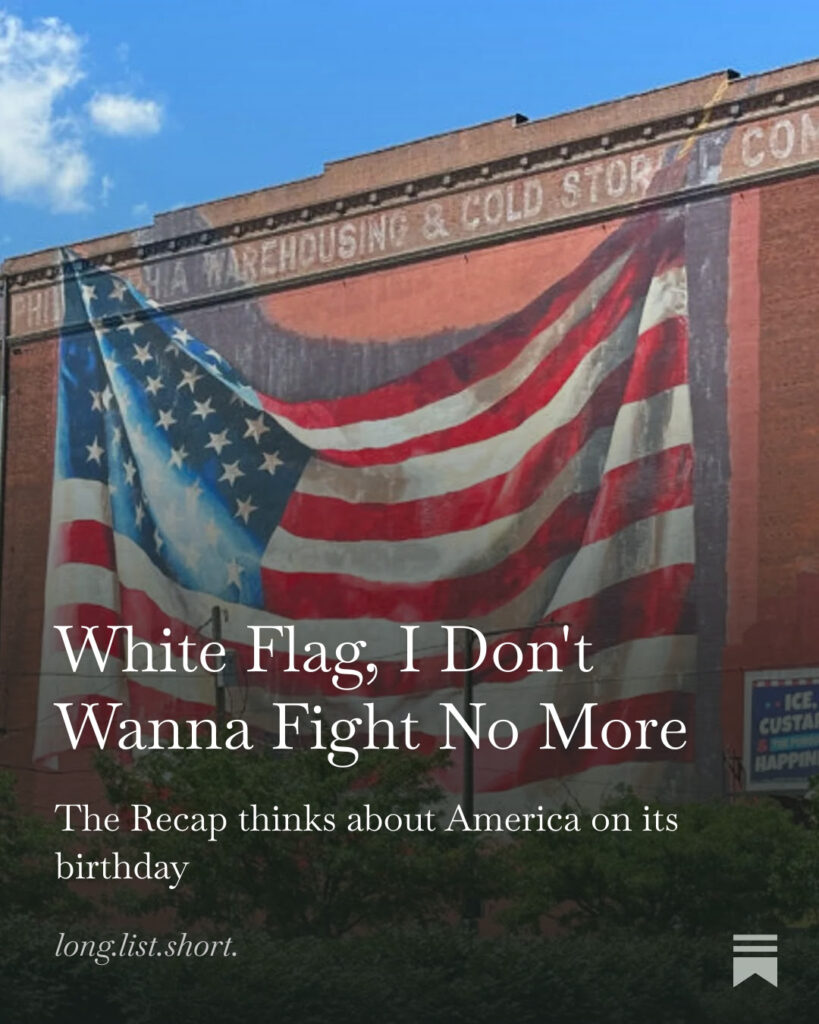
Artist Meg Saligman created this mural, Our Flag Unfurled, in 2001, for Mural Arts Philadelphia.

From the Mural Arts website:

In the wake of the 9/11 attacks, artist Meg Saligman volunteered to paint this now iconic mural, Our Flag Unfurled on the massive south facing wall of Philadelphia Warehousing and Cold Storage building. The design was intended to appear slightly sad, as if unfurling down the side of the building.

Painted just north of center city, between I-95 and the Benjamin Franklin Bridge, the size and location of the mural make it a gateway to the city for thousands of daily commuters.

Originally intended as a temporary display of resilience, the 6,000 square foot image of the flag has remained one of Mural Arts’ most visible and iconic works since the fall of 2001. Although Sherwin Williams donated their highest quality paint for the original project, 15 years is a long time for any work of public art. In 2016, the mural received a refresh in time for the Wawa Welcome America July 4th ceremonies, and the Democratic National Convention later that month.

Jul 022026
 

The Talented Mr. Trotter: You Can Be Anything, located on the wall of The Clay Studio building, was created by Philadelphia artist Roberto Lugo in 2022.  It is a portrait of Philadelphia musician Tariq Trotter, aka Black Thought, of The Roots.

From Mural Arts Philadelphia about the mural:

The Talented Mr. Trotter: You Can Be Anything by artist Roberto Lugo is located in the Olde Kensington neighborhood of Philadelphia, Pennsylvania. Lugo has taken inspiration from musical artist Tariq Trotter of The Roots, particularly his story of growing up in Philly as a renaissance man. The mural design explores Trotter’s personal and artistic influences, while materially representing his myriad elements of inspiration and support through combining textile and ceramic patterning from across the world. Trotter’s central portrait is elevated in being formally honored on a highly decorative vase, flanked by his grandmother, who raised him, on the left and Afrika Bombaataa on the right. Traditional floral patterns are spread across the background but are filled with primarily non-Western and street culture patterns. Visual references range from African and South American textile prints, to the graffiti-esque fonts of sneaker culture.

A Kensington-born potter, social activist, spoken word poet, and educator, Roberto Lugo sees his pottery as a process of transforming the ground we walk on into something we eat from. His studio practice communicates with diverse audiences that, in some cases, are not so invested in using art to understand the world. Over the past two years, Lugo has led ceramic workshops at Tyler School of Art and several virtual design challenges with youth in Mural Arts’ Education program. These workshops have tapped into everyday patterns and ceramic traditions from all over the world. Lugo has created a large mural inspired by Roots leading member and proud Philadelphian, Tariq Trotter. Trotter’s multi-talented and visionary approach to his creative practice and humble dedication to his home city are core aspects of Lugo’s mural homage.

A longtime advocate for The Clay Studio and its community programs, Lugo’s mural is installed on The Clay Studio’s building in Olde Kensington at 1425 N American Street that opened in spring 2022.

Jul 022026
 

“Alberto Ayala”, acrylic on wood; Portrait of Roberto Lugo’s grandfather; and “Potpourri Boat”, Ceramic sculpture

Art history, American history, and personal history mix in Roberto Lugo‘s exhibition, American Crib: What’s Happening?, currently on view at The Clay Studio. Wandering around the installation you’ll find portraits of Nikki Giovanni and Lugo’s grandfather, Billie Holiday and The Roots on ceramic sculptures, and plenty of places to sit and take it all in – including a graffitied train car.

From The Clay Studio’s website:

Roberto Lugo welcomes visitors into an imagined living space celebrating his Philadelphia roots and cultural heritage. This deeply personal reflection on America’s socio-political landscape celebrates the power of art to communicate. Lugo mixes historical pottery traditions with pop culture, humor, and critical clarity to address complex issues, including cultural identity, mental health, social justice, and the resilience of underrepresented communities.

This exhibition is a part of Radical Americana. A larger multi-location project that brings together art and culture institutions around Philadelphia. Learn more about Radical Americana here.

More than just a retrospective of Lugo’s career so far, “American Crib: What’s Happening?” will be a deeply personal and poignant reflection on America’s socio-economic and political landscape.

And the Lugo’s statement about his work:

My work is intended to be a biographical narrative that tells the many stories of my life. The objects I create speak of personal subjects – my experiences with obesity, racism, and class division. I use the associations with ceramic material and forms of pottery, such as elite fine china and porcelain, to discuss these issues with humor and irony. My strongest concepts are influenced from the juxtaposition of cultural elements in the form of mass media and current events. Using historical ideology within pottery as a vehicle to introduce a modern theme is of great importance because it allows me to add more dimensions to my artwork.

In the video below, also from The Clay Studio’s website, Lugo discusses the work, some of his inspirations, and the installation.

This exhibition closes 7/9/26.
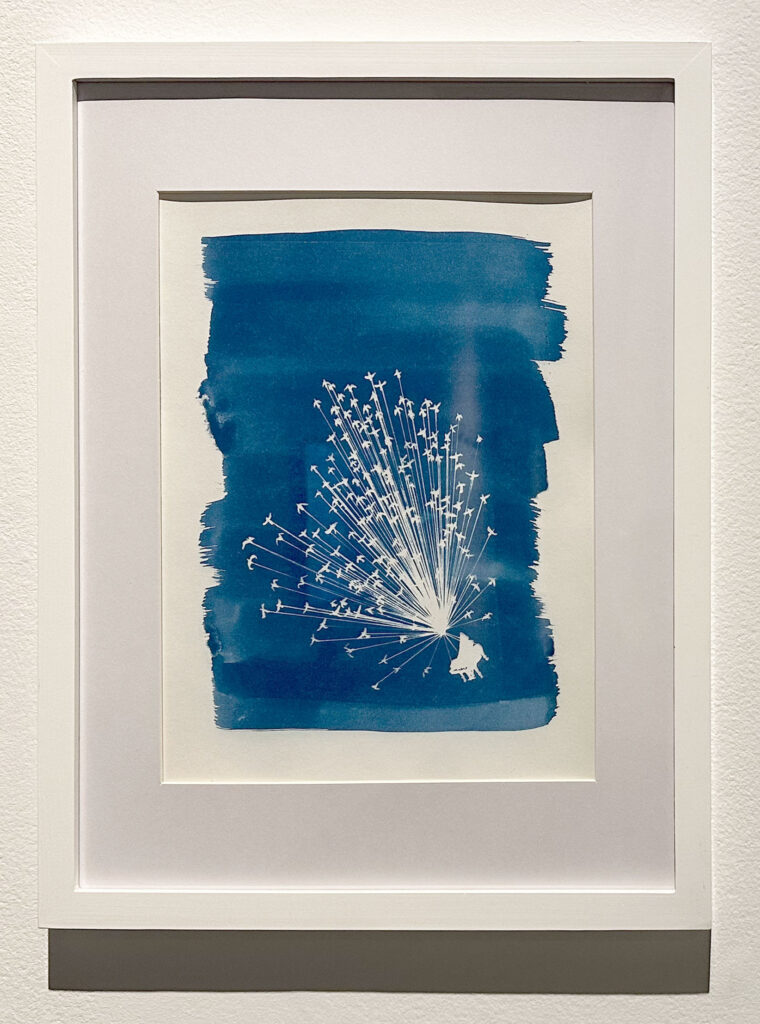
Jun 262026
 

Tomorrow (6/27/26) is the last day to see Alexandria Nazar‘s paintings for Ducks on the Pond at AUTOMAT Collective.

From the gallery and curator Whitson Ramsey about the exhibition:

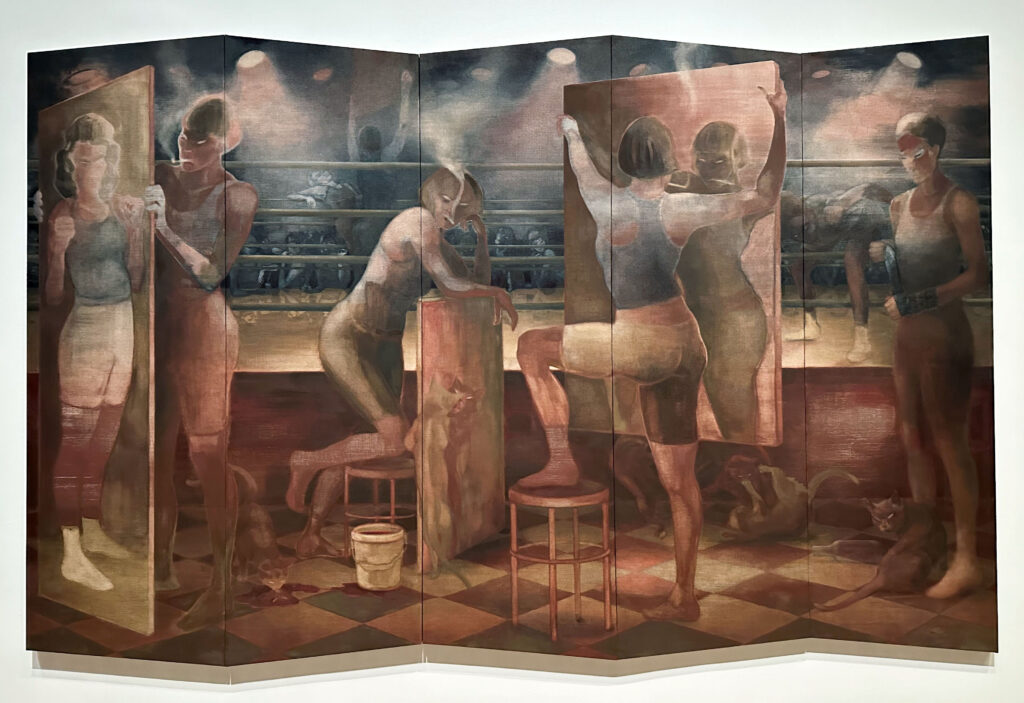
There’s a world where it seems an obvious choice to curate a baseball show in 2026, this country’s semiquincentennial, a cute milestone for this kitchen sink of a nation. After all, baseball is America’s Pastime. However, the sport predates America, and America itself is tremendously predated by the land it occupies. Even as a baseball fan myself, the idea of curating a show about baseball did not interest me. But this show isn’t about baseball. This is a show about painting, about bodies, about intimacy. Alexandria Nazar pays close attention to the subtle moments among players, coaches, their environments, and their mannerisms. Her paintings are about the material quality of paint on the surface as much as they are about the subjects they form.

This show highlights Nazar’s sophisticated yet playful handling of paint on a spectrum of canvas sizes. From the smallest work, a nearly monochromatic 7 x 5-inch painting, to the largest: a monumental, five-panel installation covering 17 feet on the gallery’s main wall, these paintings pack a punch and require a long, slow gaze.

On the other hand, a summer show whose content is explicitly relatable allows for a wider audience to enjoy these paintings. I firmly believe art should be accessible to the masses and not gatekept by private collectors and overpriced institutions. A surface-level “baseball show” allows new eyes to explore the subtle beauty of art-making and material exploration. Nazar has a knack for grabbing the viewer’s attention from a mile away. At the same time, she slowly draws you in, noticing the lustful impasto and clever brushwork, intense layers of underpaintings finding their way back to the surface, and a maze of abstracted clusters of intertwined bodies.

Ducks on the Pond is a celebration of paint through a gendered expression of male physique, American sports culture, brotherly love, and camaraderie.

Jun 262026
 

Protesting injustice is a powerful way for individuals to come together to create change. In the exhibition How We Stay Free at Tilt Institute for the Contemporary Image, photos by Mike Arrison, Harvey Finkle, Joe Piette, and Sunny Singh vividly capture past protests that have taken place in Philadelphia over the years, reminding visitors of the power of community.

From the gallery about the exhibition:

Following the widely publicized murders of George Floyd and other Black citizens by police, an unprecedented wave of public outcry swept the nation. Despite the pervasive uncertainty and restrictions imposed by the global COVID-19 pandemic, Philadelphians organized and sustained mass protests, taking to the streets to emphatically demand racial justice, police accountability, and structural reform. Later that same year, the tragic shooting death of Walter Wallace Jr. by police officers in the West Philadelphia neighborhood of Cobbs Creek further underscored these systemic issues. His family had called 911 seeking assistance for a mental health crisis, only for the encounter to escalate fatally, tragically illustrating the severe gaps in the community’s support and emergency response systems.

Inspired by the energy generated from these events, West Philadelphia residents Fajr Muhammad and Christopher Rogers published How We Stay Free: Notes On A Black Uprising. This project is not merely a book but a dynamic, living archive of community resistance, featuring powerful, multi-modal contributions from a diverse coalition of artists, writers, poets, and scholars who were active participants in the struggle. This exhibition, which shares the same title, serves as an essential visual and experiential archive. It documents the work initiated by the authors, alongside the tireless efforts of local organizations, grassroots collectives, and community-based activists. Philadelphia’s legacy of civil disobedience is both deep and enduring, stretching from the national Black Lives Matter protests to localized calls for Palestinian liberation and the No Arena fight against a proposed sports complex in the historic Chinatown neighborhood.

The visceral imagery and compelling narratives presented on the gallery walls emphasize a crucial point, a collective and sustained response is necessary to ensure meaningful and lasting progress is achieved. This philosophical approach—that change requires unity and shared purpose—serves as the foundational connective tissue binding both the publication and the exhibition. Spanning several decades of resistance and activism, the collection functions as a series of time capsules. These suspended moments deliberately position the artist not as detached photojournalists, but as participant-observers—marching alongside a broad and diverse coalition of revolutionaries united by the inalienable right of all people to be truly free.

This show closes 6/27/26.

Jun 252026
 

Shaun Kardinal “I II”, Woven paper ephemera and artist’s tape

Sculptures by Hyland Mather from the “Modus Volito” series

Framed images of work by Hyland Mather and Shaun Kardinal (sculptures by Hyland Mather on the left)

Sculptures by Hyland Mather

Discarded objects are transformed into new creations in works by Hyland Mather and Shaun Kardinal, currently on view in the two person exhibition, Form / Field, at Paradigm Gallery.

From the gallery:

This exhibition presents work from two distinct practices that converge through a shared sensitivity to line, structure, and process. Mather and Kardinal each explore how form emerges through accumulation, repetition, and material response, approaches that move between precision and drift, construction and discovery.

For his third major presentation with Paradigm Gallery, Mather presents works from several ongoing series, including Linea Pictura paintings, suspended “gravity works” (Onus Suspenda), and sculptural and assemblage-based works such as Modus Volito and Novus Inventa. Spanning painting, sculpture, and installation, the work explores line, structure, and found materials through processes of gathering, repetition, and thoughtful intervention. Across these works, line operates as both drawing and structure, with string extending into space, holding weight, or tracing paths across painted surfaces, allowing form to emerge through tension, balance, and material response.

In his debut Paradigm collection, Kardinal presents his woven paper quilts created from cut and punctured ephemera, along with a series of embroidered book pages and painted postcards, creating new forms from the smallest gestures. Kardinal’s work builds from repeating parts, embroidered marks, and modular systems that gather into larger compositions. These works often embrace landscape at a distance, horizons, city grids, or atmospheric depth, while remaining grounded in pattern and accumulation. Form, in this context, is built incrementally from repeated elements. In both practices, thread-like fiber elements and linear systems act as connective tissue, binding parts into larger wholes, or tracing form across space and surface. The “field” operates here as both a physical and conceptual space: a landscape, a surface of construction, and an invisible network of forces. Across both practices, it is within this field that form takes shape, held in a state of partnership between control and chance, repetition and variation, presence and possibility.

This exhibition closes 6/28/26.

Jun 252026
 

Curry J. Hackett, “The Gilded Block (Porch)”
mk. “you are so much to me pt. 1.” 2022

A golden inflatable porch by artist Curry J. Hackett welcomes visitors from outside the entrance to Spaces of Encounter, the current exhibition at Temple Contemporary, Temple University’s art gallery. Inside the gallery, Rokh Research & Design Studio founder and PhD student Danicia Monét Malone’s public arts research combines with NYU MA candidate Alyse Tucker‘s art curation to present an interesting selection of artwork, installations, and infographics that explore public art and shared spaces.

From the press release:

… Spaces of Encounter explores public space across North and Latin America and the Caribbean through the lens of public art. The exhibition brings together research and artistic material from Albuquerque; Cartagena; and Indianapolis, examining how people interact with public artworks across different urban contexts. Visitors are invited to reflect on who is welcomed into shared spaces—and who is made to feel excluded.

At the center of the exhibition is a guiding question: What does public space ask the body to believe about safety, care and belonging?

“For Black residents navigating environments marked by surveillance, neglect or misrecognition, aesthetic conditions operate as cumulative exposures that influence how safety, care and civic participation are felt in the body,” says Malone.

Through documentation, archival material and sculptural elements, Spaces of Encounter considers how public art mediates lived experience and contributes to collective memory. One featured work includes preserved fragments of a dismantled Black Lives Matter street mural in Indianapolis, foregrounding the fragility and afterlife of public artworks. Even when removed or destroyed, such works persist through memory, documentation and community impact.

“We’re interested in the afterlife of public art—what remains when the physical object is gone,” says Tucker.

The exhibition is particularly resonant in Philadelphia, a city shaped by one of the nation’s most expansive public art and mural programs. As development continues to transform neighborhoods, Spaces of Encounter offers an opportunity to reflect on how public artworks are preserved, displaced or erased—and what those changes mean for communities.

“Our gallery commissioned Spaces of Encounter to demonstrate Tyler’s commitment to being a beacon for art, architecture and community imagination in North Philadelphia and beyond,” says Temple Contemporary’s Director of Exhibitions and Public Programming Matthew Jordan-Miller Kenyatta, PhD. “By blurring inside and outside, the interior versus exterior, it smartly knits together the intimate, culturally specific meanings with public moments of spectacle that anyone can enjoy.”

This exhibition closes 6/27/26.

Jun 242026
 

Magic Hour, by artist and educator Brad Carney and poet Ursula Rucker, was created in 2021 for Mural Arts Philadelphia.

From Mural Arts about the work:

Magic Hour by artist Brad Carney and poet Ursula Rucker was created to reflect personal moments and shared feelings from community experiences during magic hour. Magic hour is a transitional moment each day at sunrise and sunset where the light embraces us and gives us pause to view the awe of the light. The design represents a scene of transition. The sun is just about to set, people are coming and going, embracing the moment of illuminating light.

The mural, placed across the street from the Berks SEPTA station, is also reflective of a location of transition for many commuters going to work, school, and home. The mural aims to provide a moment of pause to those in their daily commute and passers-by, just as magic hour does — reflect in a moment, shed light on our lives, and embrace the day.

Each figurative element represents an expression of joy or wonder as the viewer connects within themselves or with others. The landscape draws from nature, historical buildings, and local contemporary settings reflecting the past, but also looking ahead at the collective bright future. The words and images in the mural are meant to stand alone. They can be formed into one’s own narrative, or be something that the viewer thinks about and interprets as they walk away from the mural.

Jun 182026
 

Sonya Clark, “Whitewashed”, 2017, Sherwin-Williams house paint

Walking around the rooms of the Delaware Art Museum‘s contemporary collection you could almost miss Sonya Clark‘s Whitewashed. Painted onto one of the walls, her version of the U.S. flag uses only shades of white.

From the museum about the artist and the work:

Sonya Clark possesses the ability to deftly assemble works of art both beautiful in creation and weighted with content. Whitewashed is painted directly onto the gallery wall. Visually subtle, the work engages the viewer’s recollections of the United States flag. Whitewashed is made using three Sherwin-Williams house paint colors-Incredible White, Storyteller, and Natural Choice. The shades of white replace the red, white, and blue of the American symbol.

Clark has worked with the American flag, the Confederate flag, and the Confederate Flag of Truce throughout her career. In doing so, she addresses the physical makeup of these objects and the histories, experiences, and access these symbols uncover or veil.

Jun 172026
 

Isaac Tin Wei Lin created Start From Here in 2015 for Mural Arts Philadelphia.

From the Mural Arts website about the work:

Start From Here is a deconstruction and distillation of Isaac Tin Wei Lin’s previous abstract work which used calligraphic brush marks in single colors. In this piece similar marks were layered in different colors creating a chaotic tapestry. The layered marks are then presented individually like Lego pieces laid out before assembly, allowing them to be seen as parts of a whole.

Start From Here is a reference to operational and instructional manuals for building something. The colors of the marks were chosen based on color theory, what looked good to the artist and national flags. The title plays into the idea of newness and beginnings, while the use of colors of national flags speaks to the idea that (unless you are Native American) we all come from somewhere else as immigrants or refugees, and as the artist’s parents did, are here to start a new life.

You can also find his work on Instagram.