Death Valley Girls- Sunday
This song is from the Death Valley Girls’ 2023 album Islands in the Sky.
They are playing with Deap Vally at the Teragram Ballroom in Los Angeles on Saturday, 3/9/24.


Death Valley Girls- Sunday
This song is from the Death Valley Girls’ 2023 album Islands in the Sky.
They are playing with Deap Vally at the Teragram Ballroom in Los Angeles on Saturday, 3/9/24.

This mural is by NYC artist Chris Stain and was spotted in Bushwick, Brooklyn in 2020. It is part of Bushwick Collective’s ongoing street art project.
For Chris Stain’s most recent work, check out his Instagram.
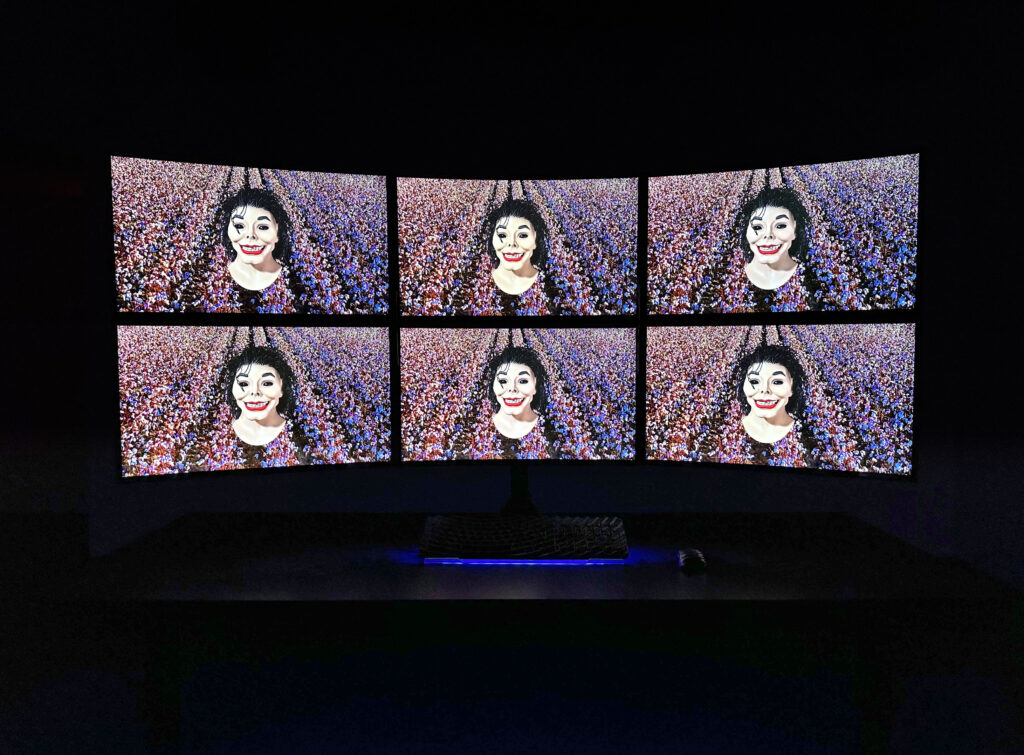
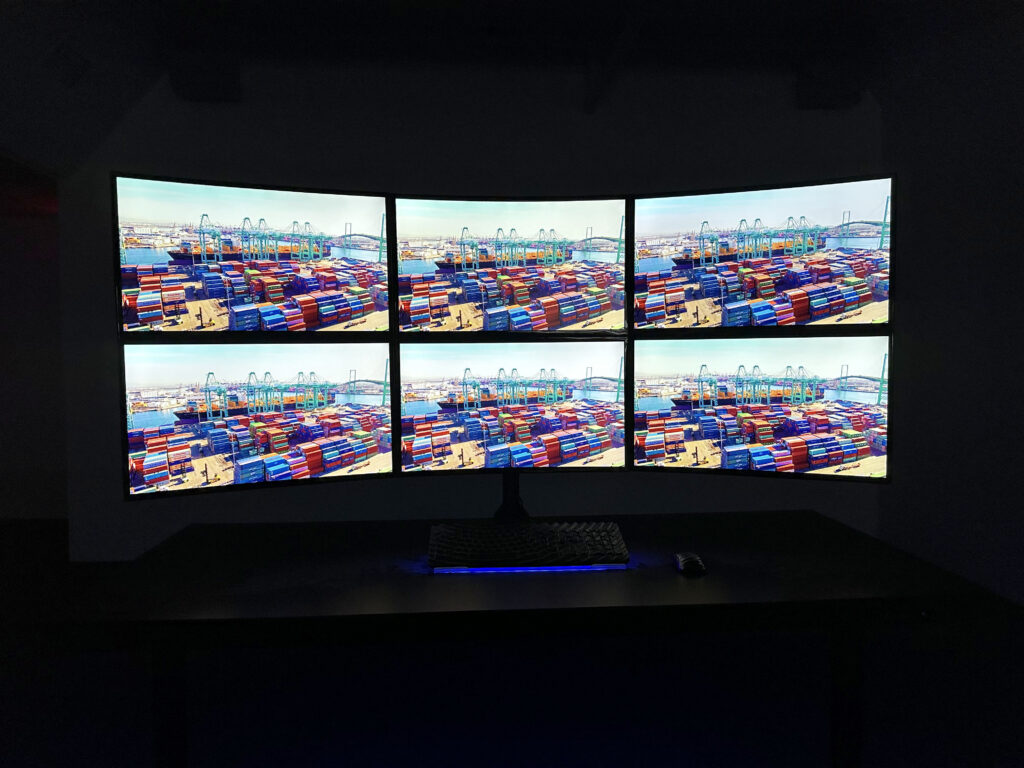
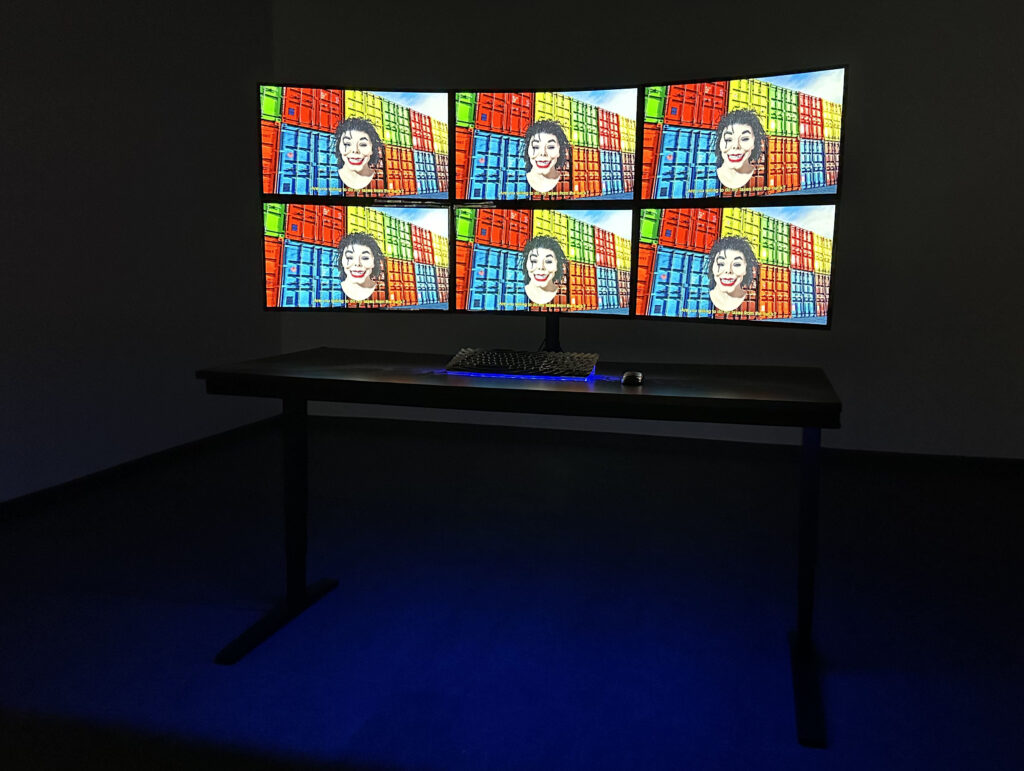
Today’s throwback is to Jenson Leonard’s solo exhibition Workflow, at Wood Street Galleries in Pittsburgh, from the beginning of February.
From the gallery about the work-
Workflow, the first institutional solo exhibition of artist Jenson Leonard, centers on a titular film that explores the velocity and momentum of Blackness as it relates to the philosophical concept of acceleration—the notion that the only way out of capitalism is through its intensification.
In Workflow, a spectral Michael Jackson Halloween mask recites a surrealistic quarterly earnings reports. Building on a 2017 essay by artist Aria Dean titled “Notes on Blacceleration,” the short film centers on the ways in which the Black subject grapples with its commodified status within the labor market despite—or, resultant of—its own history as a commodity, stemming back to the Trans-Atlantic slave trade. Completed during Leonard’s residency at Pioneer Works in 2021, the video utilizes uncanny humor as a mechanism to expose the shared grammars inherent in Afro-pessimism and speculative finance.
Within the exhibition, the film repeats simultaneously across two grids of computer monitors situated on ergonomic desks that flank the gallery, mimicking the workstations that can be found ubiquitously across stock trading floors and financial institutions. Sculptures modeled after computer keyboards and mouses are displayed on the desks, each rendered inoperable by concentric riffs that symbolize the erratic transformations caused by the flows of capital. The appearance of Jackson represents a transmogrification of its own; whereas many have aligned the controversial pop icon’s bleached skin and surgical procedures with Black self-hatred, Leonard positions his bodily modifications as a radical rupture from racial paradigms of being.
In Leonard’s own words, “Workflow is defined as the sequence of industrial, administrative, or other processes through which a piece of work passes from initiation to completion. My film seeks to disabuse notions of completion, whether it be completion of the human, the nation state, or civil society. As Dean notes, Blackness is ‘always already accelerationist’ via its incongruence with Western humanism, a wrench thrown into the locomotive gears of ‘capital and subjecthood.’ Her essay prompts us to look toward the way that the Black has been historically constructed outside of the human, as coterminous with the slave. Slavery therefore represents a kind of proto-automation, a mass forced coercion of labor, and the Blacks’ transition from object to subject calls for a reappraisal of accelerationist ideas about the (non)human entity and its revolutionary potential.”
The artist continues, “There is something about going to work—the repetition of it—that gets inscribed at an epigenetic level, as an everyday, embodied violence. From there, I thought about the panoptic workplace (open air plan, transparent yet closely surveilled, management that does not have to be in the room to be monitoring you), the fetish of efficiency (ergonomic mouse and keyboards so you can work longer), biometric data of a labor force (fingerprint and facial scans to help reduce repeat processing tasks). All of these methods to maximize profits and production can be traced back to methods worked out and perfected in the cotton and sugar cane fields hundreds of years prior.”
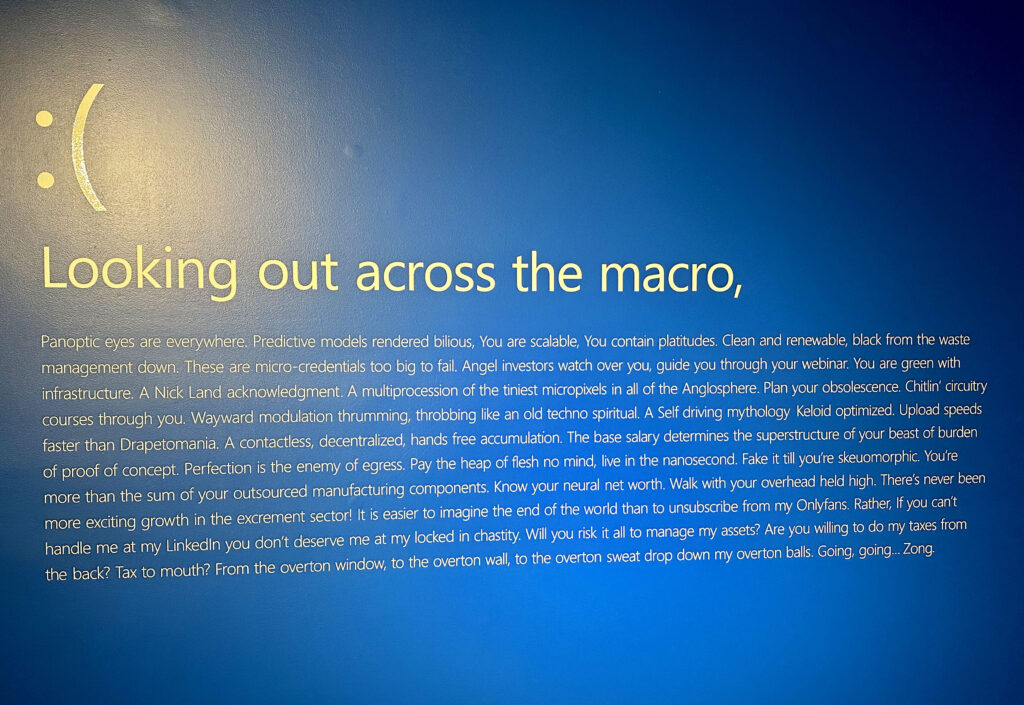
The text from the video was included on one of the gallery walls (image above) but I’ve included it below as well as it is definitely worth reading.
“Looking out across the macro- Panoptic eyes are everywhere. Predictive models rendered bilious, You are scalable, You contain platitudes. Clean and renewable, black from the waste management down. These are micro-credentials too big to fail. Angel investors watch over you, guide you through your webinar. You are green with infrastructure. A Nick Land acknowledgment. A multiprocession of the tiniest micropixels in all of the Anglosphere. Plan your obsolescence. Chitin’ circuitry courses through you. Wayward modulation thrumming, throbbing like an old techno spiritual. A Self driving mythology Keloid optimized. Upload speeds faster than Drapetomania. A contactless, decentralized, hands free accumulation. The base salary determines the superstructure of your beast of burden of proof of concept. Perfection is the enemy of egress. Pay the heap of flesh no mind, live in the nanosecond. Fake it till you’re skeuomorphic. You’re more than the sum of your outsourced manufacturing components. Know your neural net worth. Walk with your overhead held high. There’s never been more exciting growth in the excrement sector! It is easier to imagine the end of the world than to unsubscribe from my Onlyfans. Rather, If you can’t handle me at my Linkedin you don’t deserve me at my locked in chastity. Will you risk it all to manage my assets? Are you willing to do my taxes from the back? Tax to mouth? From the overton window, to the overton wall, to the overton sweat drop down my overton balls. Going, going… Zong.”
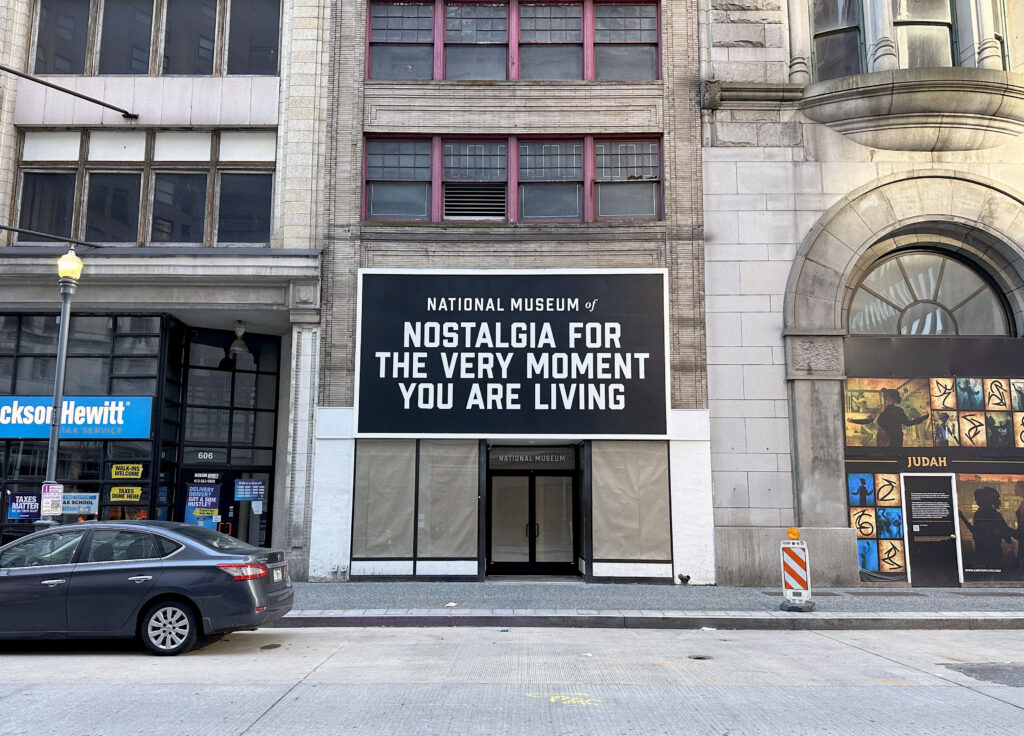
The National Museum is a public art project founded and curated by Jon Rubin and presented by Pittsburgh Cultural Trust. Different artists are invited to change the name of the museum and an essay is written using the title as a jumping off point. The first iteration is by artist and writer Pablo Helguera.
About the project from Jon Rubin’s website–
The National Museum repeatedly asks which stories, histories and futures are deemed worth saving and which are ignored or forgotten. Each month, a different artist is invited to change the name of the museum and a national writer is invited to use that museum title as the jumping off point for an essay. In its first year, the project currently consists of storefront signage, street posters, printed broadsheets, a website and monthly accompanying essays.
When a name starts with “The National Museum” it triggers contentious and political associations with borders, nationhood, even citizenship and belonging. Who gets to determine the belonging of an entire group of people bound only by the fact of their geographical location. There’s something absurd about that, if you think about it. Instead of claiming ownership over a diverse populous or even a disparate set of objects, can the notion of the “national” be rethought as something that is less tangible, less object-oriented?
There is a fundamental hubris and absurdity in calling something, anything, a museum, let alone The National Museum. But, in many ways, it’s really no different than any other museum that someone, usually with far more money, privilege, and power than any of my artist peers or myself, has simply made up. So, in a way, the project functions as a kind of loophole or work-around, a participatory fiction that allows a variety of artists to put forth an ongoing series of grand propositions, a theoretical institution that repeatedly brings into question the certainty and reality of our pre-existing institutions.
The National Museum elucidates how museums, especially national ones, are perhaps no different than the nation-states in which they reside. Each is an imagined political construct, a collective fiction used to collect, categorize, narrativize, and control. Throughout modern history museums have used the collections they steward and the stories they tell to validate extractive legacies of colonialism. And, although our current museums, both national and private, are staffed by people with experience in the arts and humanities, the ultimate decision-makers in many of these institutions are wealthy donors and trustees who derive financial benefits from, and exert ideological control over, the fundamental mission of museums. So, while the general public think museums are nominally for “everyone,” the truth is that they are delimited by economic, geographic, racial, and cultural boundaries that restrict their function, design, and access to select publics.
Pablo Helguera’s essay on building façades as art and metaphor, Creditable Unrealities, is included on the broadsheet for the project (as well as his Substack Beautiful Eccentrics) and is a highly enjoyable read.
It includes this passage on how he came up with his name for the museum-
“Ultimately, I reasoned that façades are the most direct indicator of the time when they were built: they are the things that we try to use as visual reference to identify a city we know in a historic photograph; they are time markers. And when it comes to museums, they traditionally seek to project timelessness, especially those august institutions whose neoclassic façades promise a container of art for the ages. So I thought that this façade should be the threshold not of art history but of our own awareness of that history and our minuscule place in it, knowing that the present that we are living so vividly will soon wash away, largely unimportant within the broader scope of human life. In 2001, doing research on people who consumed ecstasy, I was struck by the effect that their drug had in some people’s temporal awareness, and how it resonated with my own (drug-free) experiences. Thus the phrase “I have nostalgia for the moment I am living”, which gave the inaugural title to the National Museum.”
The next iteration of the museum will feature Edgar Heap of Birds (Hock E Aye Vi). The broadside will be written by poet, writer, lecturer, curator and policy advocate Suzan Shown Harjo.


The images above are from Brianna Lynn Hernandez’s exhibition Anticipatory|Después, one of three currently on view at Spaces gallery in Cleveland. Her moving video and sculptural installations focus on themes of end-of-life-care, grief, and mourning.
From the gallery about the work-
Anticipatory|Después visualizes the anticipatory grief of caregiving and the process of dying through performative videos and photography. Each piece shares the physical and emotional state of the dying, the caregiver, and at times the two concurrently. Ranging from fast and aggressive dance-like movement to slow and meditative contemplation, the enacted scenes capture a range of emotions and thought processes of understanding and untangling the intertwined traumas of caregiving and acute grief.
As her mother’s caregiver in the final year of her life, Hernández translated her personal experience of grief into her studio practice in order to combat the isolation and shame many grievers face in our death-avoidant culture. Through several series including Anticipatory | Después, the works aim to normalize honest conversations of grief and act as an entry point into education on end-of-life planning. Hernandez states that while we will all eventually experience the pains of loss, preparing for the logistics of death and nurturing supportive communities for grievers can provide comfort and lessen the unnecessary stressors attached to loss.


A Botanical Conversation, Mehdi-Georges Lahlou’s exhibition, explores environmental, identity, and cultural issues using the natural world as a backdrop. The two large murals are of an enlarged palm tree cell as seen through a microscope.
The exhibition statement by curator Conor Moynihan-
The palm tree is a central component of Mehdi-Georges Lahlou’s practice, a motif he has explored to highlight themes of exoticism, migration, and cultural heritage. Recently, Mehdi- Georges Lahlou has used the palm tree to explore themes of colonization, climate change, and history. While members of the Arecaceae family- palm trees- can be found in many parts of the world, they are not found here in Ohio. Unless, of course, you go to the Cleveland Botanical Garden as Mehdi-Georges Lahlou did for his residency at Spaces.
For A Botanical Conversation, Mehdi-Georges Lahlou has created four new video works using the Cleveland Botanical Garden as the setting and backdrop. While many of the plants visible in these works come from elsewhere across the world, his collaborators Diwe Augustin-Glave, CHIMI x Nature, and Dr Lady J are based in Cleveland. In many ways, this body of work imagines the conversations that might happen if the flora in the Cleveland Botanical Garden could speak, sing, chant, and educate, and then transports this dialogue in the gallery space.
Microscopy, the mural that extends over two walls in the gallery, serves a double function. Based on the cell of a dead palm tree, it enlarges from an unusual perspective a motif central to the exhibition. And it also serves as a container and a frame for the four videos. This conversation emerges within the boundaries of the palm tree cell, transporting this exhibition into the botanical garden.
Characteristic of his practice, Mehdi-Georges Lahlou draws our attention to how plants and botanical gardens become ways to highlight histories of colonization, compulsory heterosexuality, and climate disaster all contained under canopies of glass. Yet, especially through the performances of Diwe Augustin-Glave, CHIMI x Nature, and Dr Lady J, they also celebrate new queer ecologies and configurations, melding African and African American musical traditions, queer theory and scholarship, ecological history, and environmental justice towards new ends.
A Botanical Conversation is a cacophony. It asks us to listen carefully to hear all the voices that make up this chorus.


Aaron D. Williams has created a video installation, ESCAPING AAWFUL LAND, that continues the work created for his previous Aawful Friends exhibition. This new creation addresses the issue of anxiety and the power of collaboration as a way to combat it.
From the gallery-
ESCAPING AAWFUL LAND is an immersive exhibition that builds upon the success of Aaron D. William’s previous Aawful Friends showcase at Zygote Press. This new showcase explores the creative journey between Williams and collaborating artists. By delving into anxiety through art, we seek to acknowledge its profound impact on our collective well-being. We must address anxiety as a shared concern and foster a future community that supports and uplifts one another. Through individual and collective artistic expression, we can overcome the gravity of the situation and find healing and unity. In our fast-paced society, anxiety affects people from all walks of life, taking various forms and manifesting in relentless thoughts, paralyzing fear, and an overwhelming sense of unease. Despite its grip, we encourage you to embrace your inner courage and take the leap. The installation will be held at The Vault in SPACES gallery, where you will be transported to AAWFUL LAND – a hidden realm within our city accessible only to those who know it exists. Guided by the mysterious GUARDIAN, you will journey through its enigmatic mysteries. As you step into AAWFUL LAND, you will be captivated by a mesmerizing video presentation. Witness AAWFUL AARON engaged in a gripping game against a formidable opponent, reminding us that we have the inner strength to persevere and pursue our dreams even amidst anxiety. In Aawful Land, anxiety takes on tangible forms and bursts forth in vibrant colors. CREATURE is at the heart of our narrative, an overbearing shadowy figure personifying anxiety and serving as the central antagonist. Aawful Aaron is locked in a fierce battle against CREATURE, desperately seeking escape from this hidden world. However, a subtle hint suggests that Aaron may need assistance to overcome his challenges. Within Aawful Land, a group of trapped artists may hold the key to their collective liberation. Together, they offer a glimmer of hope, representing collaboration’s power in overcoming Aawful Land’s perils. This work serves as a proof-of-concept or work-in-progress, paving the way for Aawful Friends II. In the forthcoming installation, we will feature this newfound group of artists, showcasing their collective efforts and unveiling the transformative power of collaboration. Their shared experience demonstrates that collective creativity and expression can lead to freedom and transcendence. ANXIETY IS HARD – TAKE YOUR SHOT ANYWAY.
All three of these exhibitions close 3/1/24.

This mural was created by Mwanel Pierre-Louis for the 2021 edition of the SHINE Mural Festival in St. Pete, Florida.
For his most recent work, also check out his Instagram.
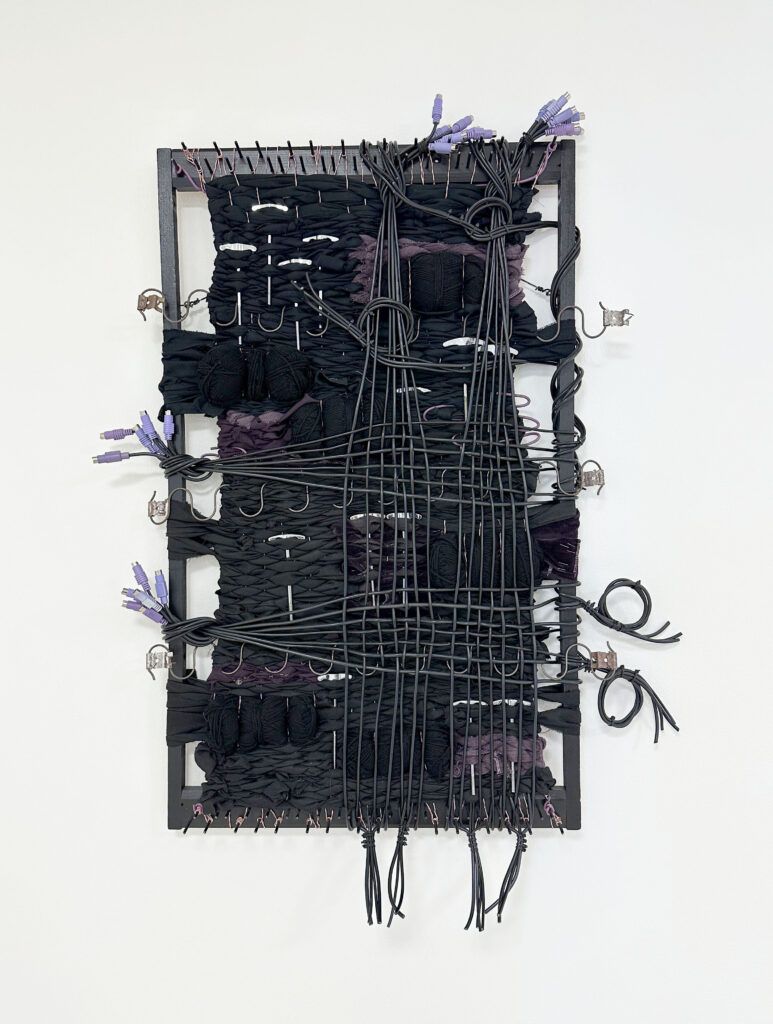
Jo Westfall, “The Queens Astronomer”, 2023, Mixed media
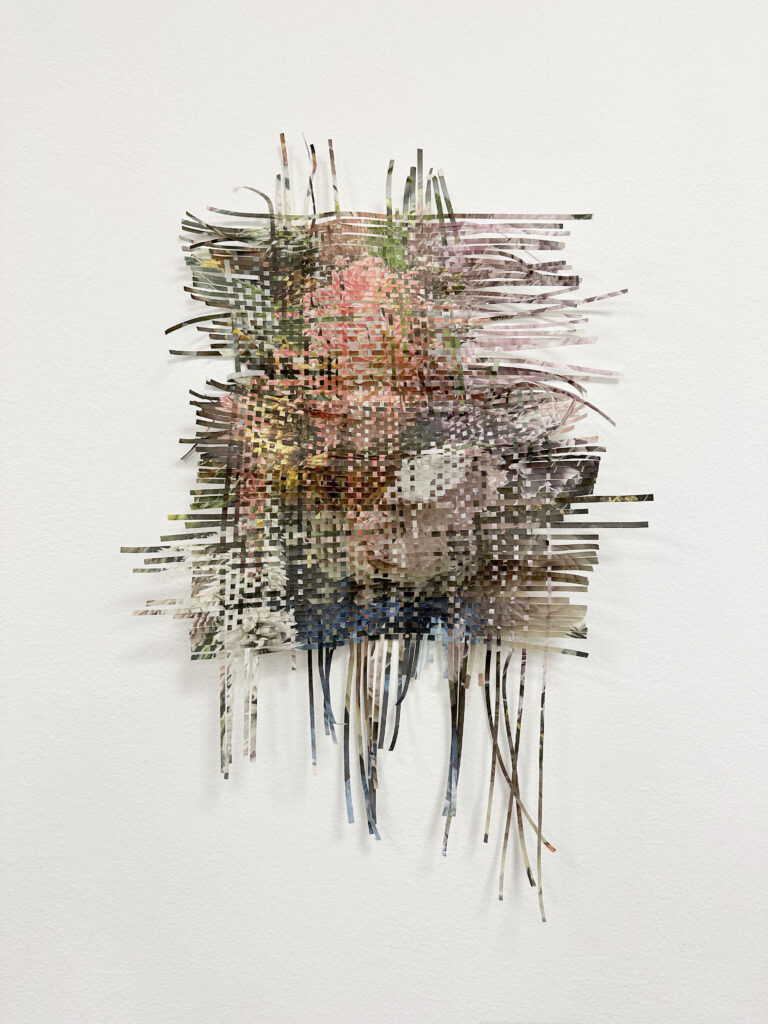
Christine Mauersberger, “Kates Bouquet”, 2022, Digital print on Japanese Kozo paper, of loom weaving
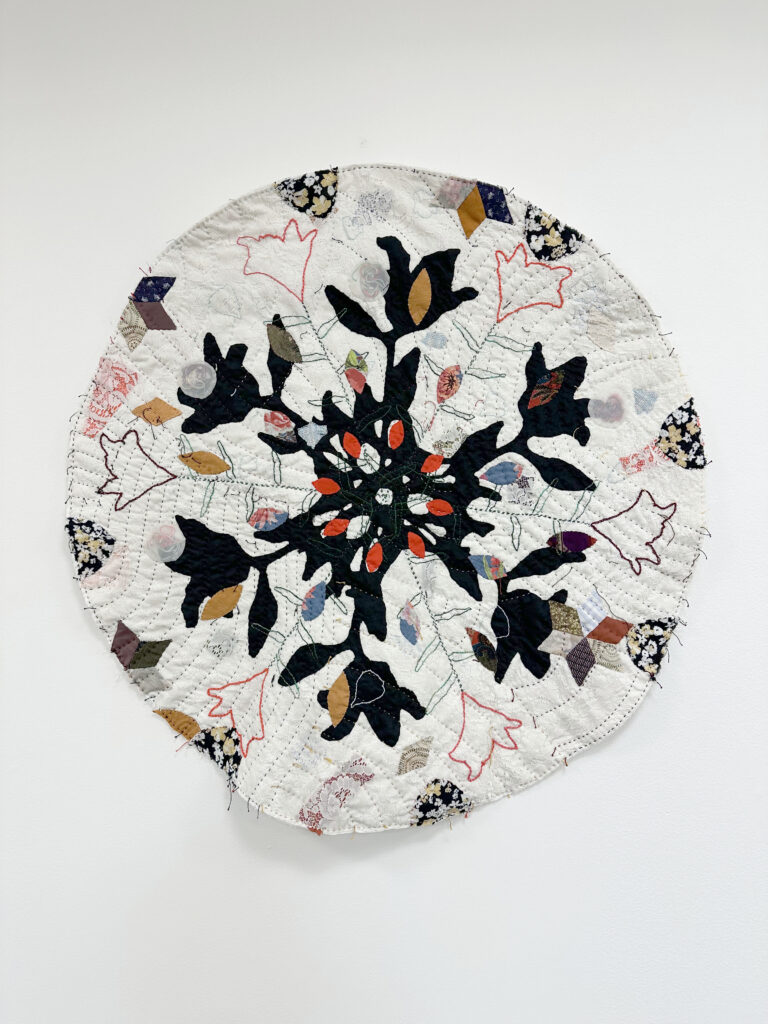
Cat Mailloux, “Rose Window”, 2023, Quilted appliqué on found fabric
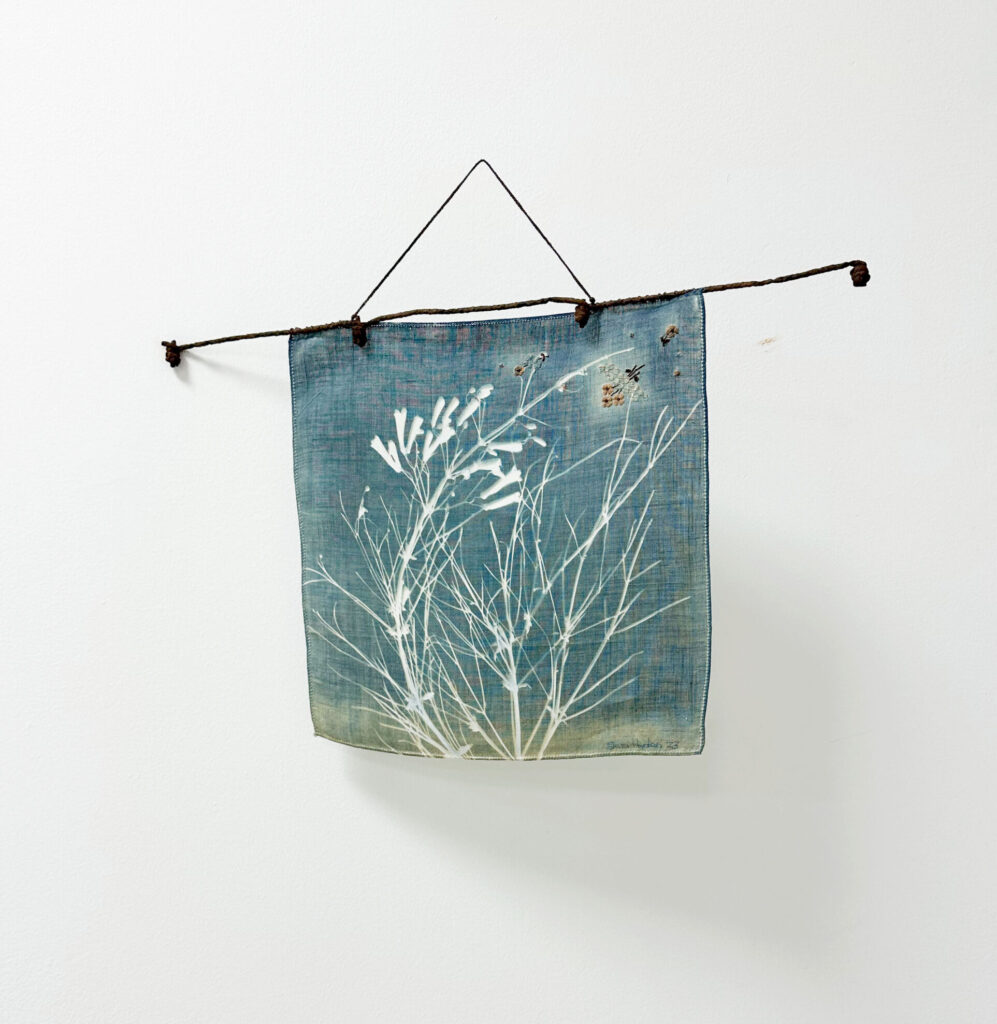
Suzi Hyden, “If the Sun Could Kiss Me”, 2023, Toned cyanotype on vintage linen hand-stitched onto metal fencing
Above are a few of the works from Common Thread, the current exhibition at Malone University’s art gallery. It is on view until 2/29/24.
From the gallery about the show-
Although quite different, all artists in this exhibition are united by the idea of textiles. Suzi Hyden’s work celebrates the environment by combining elements from nature and repurposed materials to create cyanotypes on vintage fabrics.
Cat Mailloux’s textile practice is focused in quilt making, pursuing connections between the visual language of churches, cathedrals, and domestic spaces that slowly bleed their way into imagined and limitless landscapes, exploring questions of the infinite through material.
Christine Mauersberger’s body of work is aesthetically eclectic. Hard and soft. Digital and analog. Some pieces fill a room, others can be held in your hand. The common thread is that each piece attempts to make the invisible visible.
Jo Westfall creates visual work considered resource art. It is portraiture, fiber art, and assemblage made with local materials that were discarded, overlooked, or unused. It reclaims the aesthetic capacity and utility of these items by integrating them into fresh renderings.
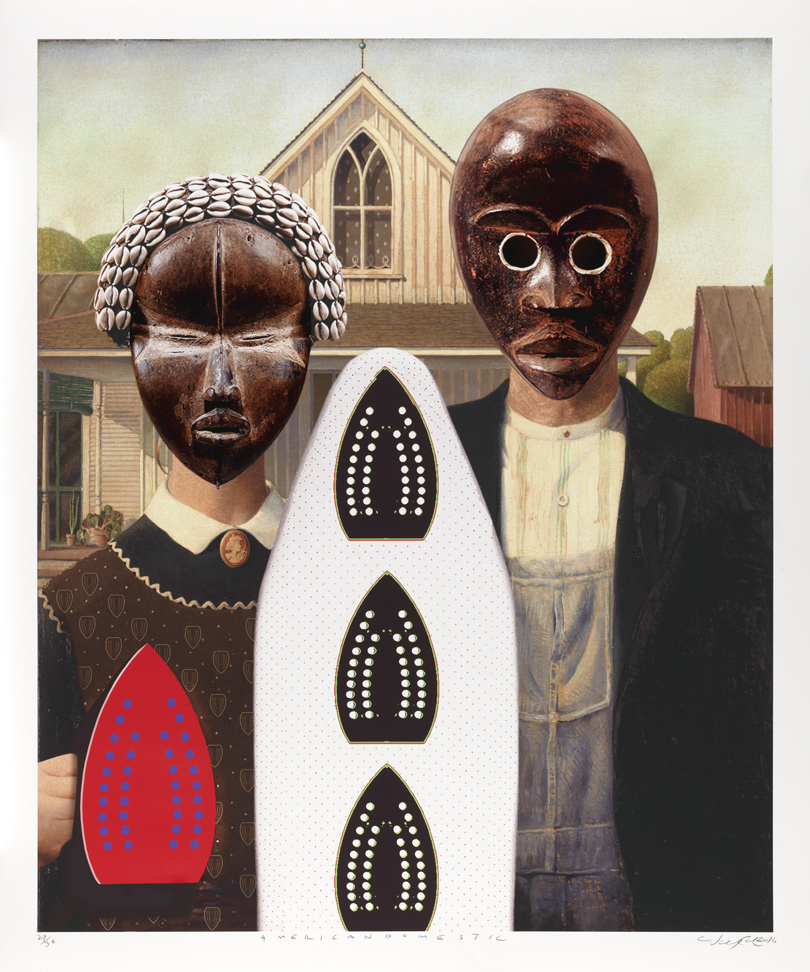
Willie Cole, “American Domestic”, 2016, Digital Print
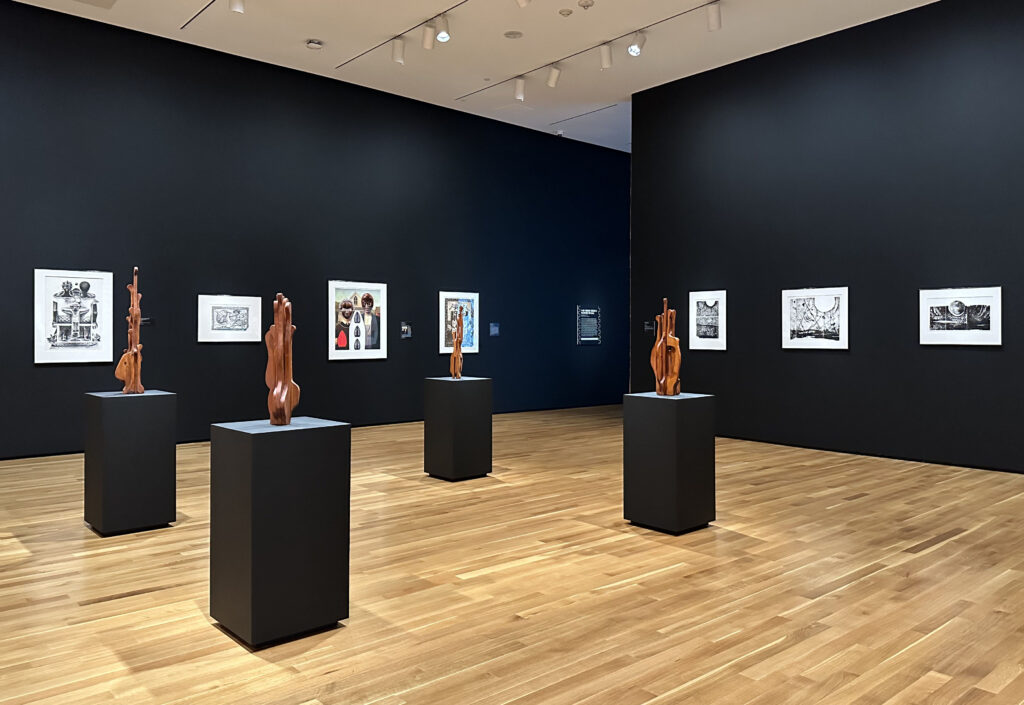
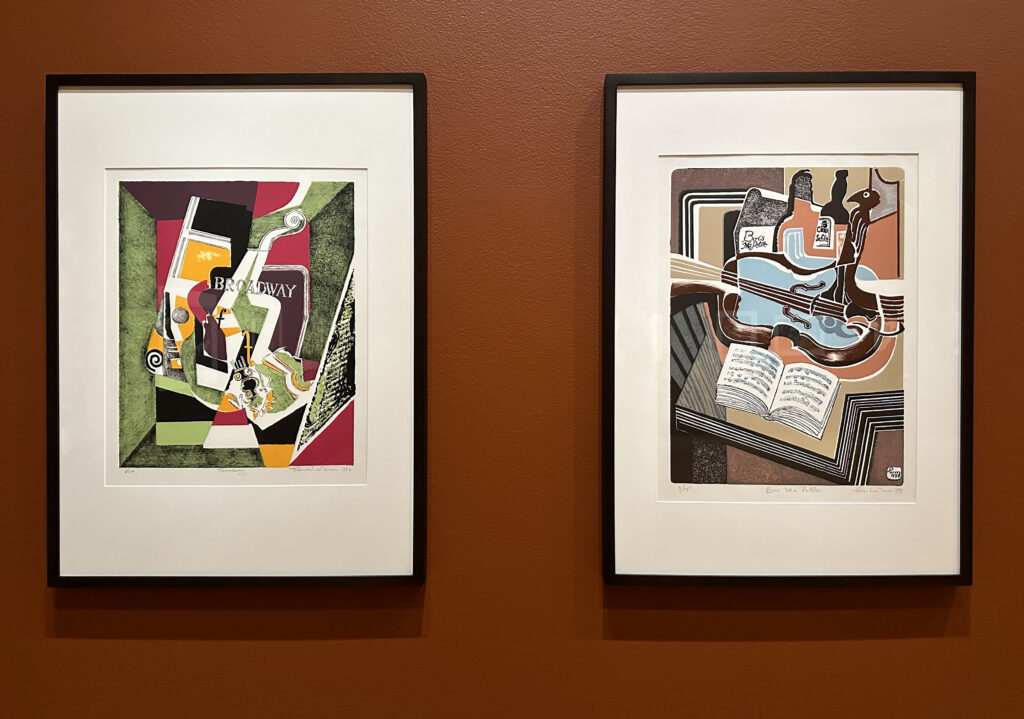
Tom Laidman, “Broadway”, 1993 and “Bois Ma Petite”, 1999, Lithograph on paper
Currently on view at Akron Museum of Art is RETOLD: African American Art and Folklore, a collection of art from the Wesley and Missy Cochran collection, organized into themes exploring aspects of African American history and culture. The show features many well known and lesser known artists including Amiri Baraka, Beverly Buchanan, Willie Cole, Trenton Doyle Hancock, William Pope.L., Tom Laidman, Jacob Lawrence, Alison Saar and more.
From the museum about the exhibition-
African folklore has been around as long as humankind, and the African diaspora in America has added new dimensions to its rich history. African American folk stories teach about culture, the mysteries of life, and the survival of a race of people bought and sold who continue to thrive in an unjust society.
“RETOLD: African American Art and Folklore” focuses on four themes: Remembering, Religion, Racialization, and Resistance. These themes provide a comprehensive retelling of the works featured in the exhibition. In many of the pieces, the artist’s muse connects closely with stories that have been told generation after generation. Folklore texts are featured throughout the space as a means to retell a richer, deeper story of African American culture.
There are more than forty artists represented in this exhibition, all holding one similar truth: their story of joy and struggle in the African American experience.
In addition to the artwork, there is also an educational video produced by Josh Toussaint-Strauss of The Guardian that explores the misconceptions about Haitian Voudou that is worth a watch.
How ‘voodoo’ became a metaphor for evil
Squid- The Blades
This song is from UK band Squid’s 2023 album, O Monolith.
The band is currently on tour and will be playing in Los Angeles on Friday, 3/1/24, at The Belasco.
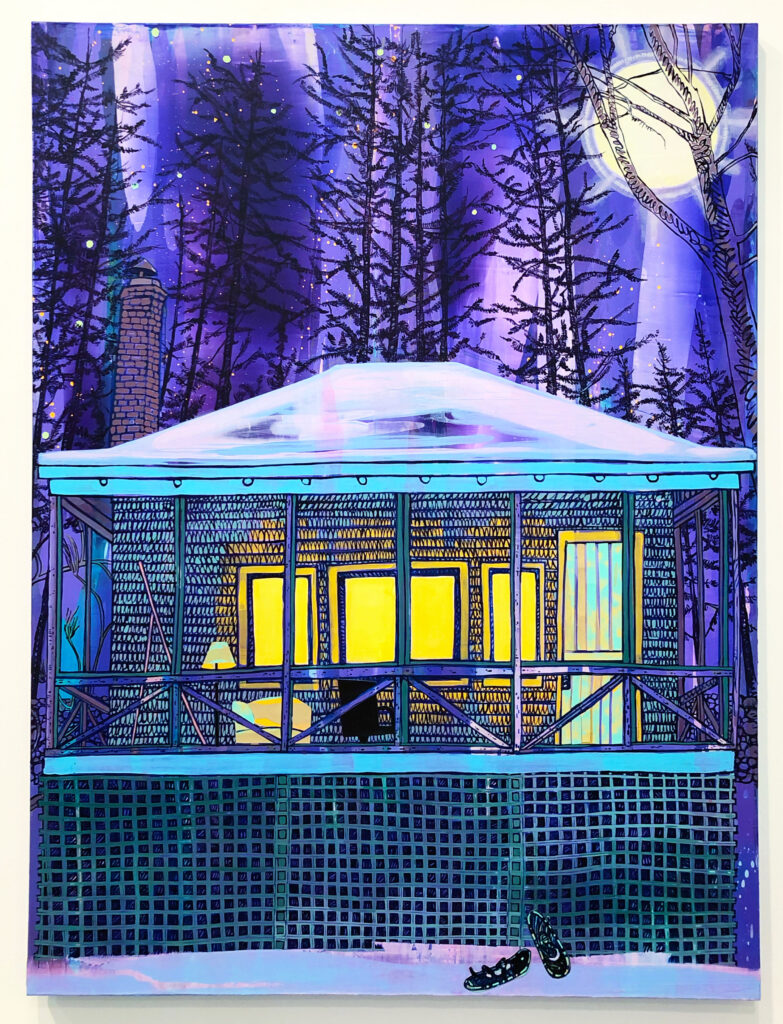
Hope Gangloff’s painting MacDowell Cheney Cabin in the Winter Super Moon, 2019, was shown at her 2019 solo exhibition at Susan Inglett Gallery in NYC. It is one of several created during her residency at MacDowell Colony in Peterborough, New Hampshire.