In Stone Formations, Kira Krell‘s exhibition at the Mezzanine Gallery in Wilmington, her large multilayered paintings and smaller delicate sculptures find a cohesive balance, much like the natural formations that inspired them.
From Mezzanine Gallery and Delaware Division of the Arts-
Stone Formations is a solo exhibition by Kira Krell that guides viewers from volcanic deserts to beautiful coastlines. Through diverse geological imagery, and weathered forms, the work traces place and time, evoking memory, endurance, and the lasting presence of landscapes once called home.
Krell’s process begins by layering sand, plaster and earth pigments to create relief-like texture paintings. Adding, subtracting, and distressing these elements is necessary to achieve surfaces that appear weathered and time-worn, in pursuit of capturing geological structures: Stone Formations. Intricate details are revealed through dry brushing and mark making techniques, using acrylic and pencils. Fascinated by natural forms and their portrayal of permanence and strength, the artist offers an impression of steadiness and belonging. This acts as a counterpoint to our fast-paced, ever-changing world. Krell invites viewers to take a moment to pause, breathe and reflect on our beautiful world.
Pictured is one of Nick Cave‘s Soundsuits, created using found fabrics and metal and wood toys. It was on view at Columbus Museum of Art in 2024.
From the museum about the work-
Nick Cave’s Soundsuits are sculptural costumes, some of which were made to be worn, others to remain stationary. Although these suits often appear whimsical and joyful, they also respond to suffering and injustice. Cave created his first suit in response to the beating of Rodney King by Los Angeles police officers in 1991, an event that focused attention on discriminatory policing and racial profiling. Reflecting the artist’s lived experience as an African American man, the Soundsuits camouflage the wearer’s body, concealing markers of race, gender, and class.
In the Art21 video below you can see some of his Soundsuits in motion. He studied with the Alvin Ailey American Dance Theater and that influence can be seen here as well.
In Mammoth, Cave remakes the museum’s galleries into an immersive environment marked by the crafted hides and bones of mammoths, a video projection of the long-dead animals come to life, and hundreds of transformed found objects—from vintage tools to his grandmother’s thimble collection—presented like paleontological specimens on a massive light table. By showcasing the ordinary and often forgotten bits and pieces of the world we live in, Cave’s work shines light on what we value and how we make meaning together. It evokes the lives and cultures we have lost, as well as the magical possibilities of a universe created through imagination and the humblest of materials.
Focused on the fundamental connections between people and their environment, Cave asks how we can begin to make sense of our relationship with a landscape that continues to evolve. How might we adapt, persevere, even thrive? As the contemporary world increasingly challenges what it means to be human, Cave envisions a space of both grief and possibility.
Currently on view at Philadelphia International Airport,It’s A Wrap 2, brightens a section of the airport with art work and installations by several local artists.
This exhibition features work by Philadelphia area artists who were invited to create unique architectural interventions within the Airport terminal. Using yarn, fabric, felt, found objects, tape, paint, wheat paste, and wood, the artists applied their work to the ceiling tiles, columns, rockers, walls, walkway, and windows. They have visually transformed this location into an immersive and experiential art-filled passageway.
The artists responded to the existing architectural elements to create an unexpected visual experience and an engaging space for people to pass through. It is a form of urban interventionism where art activates the built environment with the intention to see a public space in a new and creative way.
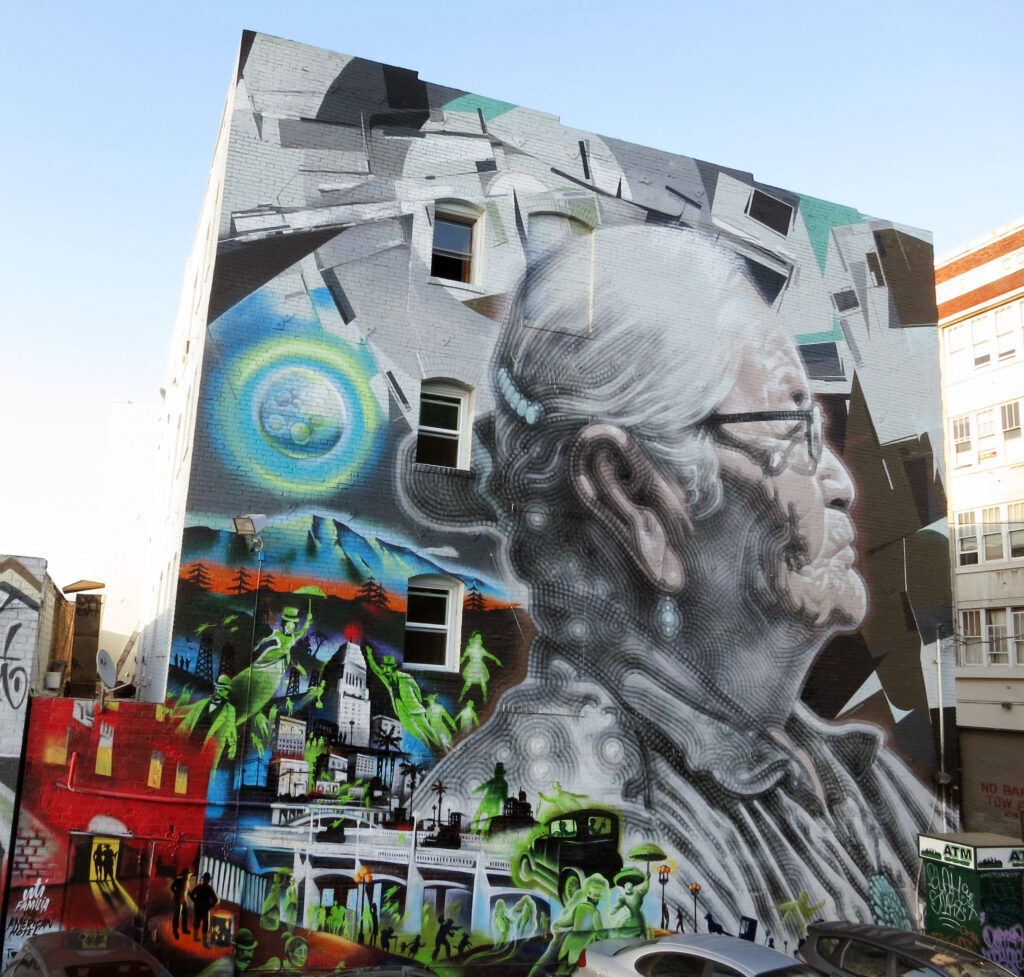
From El MAC (Miles MacGregor)’s website about the mural-
“The portrait is painted entirely with aerosol and fatcaps, and is based on photos I shot a few years ago of an artist named Martha Gorman Schultz. She is a Navajo blanket weaver from northern Arizona, and part of a respected family of weavers including her granddaughter, Melissa Cody.
I felt this painting of Martha could be an empowering representation of beauty not often depicted in public art or media. Beauty that is feminine, elderly, indigenous, loving and powerful.
The building this mural was painted on was constructed in 1901, and you can imagine how much Los Angeles history it’s seen over the last hundred years or so.
This was an especially collaborative effort- Along with the work of Kofie and Nuke surrounding the figure, SKILL UTI painted the wall to the left, integrating an already existing piece by DASH 2000(Rest In Peace). SWAN provided ground support, along with CHEE, AISE, BLK, OFIER, SELEK, CALVYRUS and some other younger members of UTI crew, which has been painting these walls for the last few decades.”
Sadly, Martha Gorman Schultz passed away in February of last year at the age of 93. For more information on her life and work, check out Hyperallergic’s tribute.
From the curators, Kasia J. Bunofsky and Leah Triplett-
“I have a very simple theory. I have always pretended that objects themselves formed a self-composition. My composition consisted of allowing them to compose themselves.” – Armand Pierre Fernandez (Arman) (November 17, 1928 – October 22, 2005)
When ‘assemblage’ first circulated as an art-historical term in the early twentieth century, it referred to the primarily formalist practice of joining tangible, often discarded or found, materials. Like a three-dimensional collage, assemblages made novel juxtapositions of individual components to create a whole artwork with its own impact. As the topography of the art world shifted mid-century, assemblage was often used to critique the post-war era’s burgeoning consumerism. Similarly, “accumulation” refers to a kind of assemblage that emphasizes materiality through the mass repetition of similar objects or forms. Accumulations lent themselves particularly well to expressing discontent with consumerism. They underscored the commodity’s necessity as a medium while maintaining the artist’s agency to reclaim meaning through the processes of recontextualization and repetition. As time persisted, assemblage continued to inspire and lend credibility to avant-garde contemporary movements. Even the new wave of ‘conceptual art’–a blatant rejection of materiality–was seen as an assemblage that forwent concrete objects to assemble ideas, language, or concepts. From installation art, to performance, to ‘relational aesthetics’, assemblage and accumulation helped pave the way for today’s contemporary art world and its many innovations.
Assemblage and accumulation emphasize the importance of each material element to the message of the completed work of art. This idea evokes a sense of collectivism; a metaphorical microcosm of material cooperation that might inspire a yearning to change our individualistic society, as art reminds us the whole cannot exist without the contributions of every one of its parts.
The artists and works featured in Bricolage: Artists and Accumulation reference the tradition of assemblage, accumulation, and their many corollaries; either through the performance held within their artistic process, their compilation of abstract concepts, or their passion to speak through material. They build, assemble, accumulate, gather, and collect. Using assemblage as both a method and technique, these artists engage assemblage as an action that is always in perpetual evolution of form. Be their medium drawing or sculpting, painting or installation-their material glass or found objects, acrylic or graphite- Anna Guarneri, Allison Hudson, Brynn Hurlstone, Kelly Irvine, and Emilio Maldonado, apply an iterative, intuitive approach to making, resulting in a bricolage.
This aesthetic- in which the whole is a sum of parts-demonstrates a depth of material knowledge. The works presented here require long looks to unfold and reveal their discrete components. Layering, stacking, blending, and amalgamating are processes and aesthetic devices that enable the viewer to experience the work in an instinctual way. Throughout these artists’ individual practices, an emphasis on transformation through collecting and comingling materials, media, and forms is paramount, with bricolage being a means for metamorphosis.
Below are additional works by the artists and information from the museum-
“My work explores the nature of cycles and the emergence of growth from decay. It’s tactile and fragile- a combination of unfired clay, wool, fabric, resin, and wax. Driven to manipulate raw materials into something new and unrecognizable, I enjoy the physicality of building, tearing apart, and mending together – striving to create work that is at once ethereal and visceral.”
“My abstract color field paintings invite the viewer to step into a lush, translucent world of color. Drawn to the beauty of layered transparent hues from an early age, I use sheer color, overlapping forms, gestural brush work, organic forms, and repeating motifs that flow and intersect, resulting in delicious new hues and increased tonal depth. Contrast is important in my work as well; hard edges are in conversation with areas of soft gradation, while vibrant, neon hues pop against muted tints and natural, raw canvas.
I’m especially inspired by the canvas staining techniques and paintings of Helen Frankenthaler and Washington Color School artists Morris Louis and Kenneth Victor Young. I pair that inspiration with constant experimentation and manipulation of materials, developing new processes as a natural outcome.”
Anna Guarneri‘s work explores the possibilities of suggestive imagery and the devotional connotations of stained glass. She uses crude marks and associations to tap into early human experience, pulling from a range of sources – ancient art, architecture, dance history, and her own body. Colors in her work conjure poignant memories, turning drawn forms and glass structures into celebrations, memorials, or premonitions.
Guarneri’s latest body of work pulls from the visual world of postpartum life, incorporating imagery of bodily landscapes and interiors, and the various devices, accessories, and toys encountered during pregnancy, birth, and early motherhood.
“In Time explores the process of healing from trauma, and the permanent transformation left behind once that process begins. Layers of broken safety glass are frozen within ice and slowly melt over a steel platform. The thaw allows for the release of contained breakage onto the foundation, where it rests in a slowly evaporating pool of water. Over time the water evaporates and the shattered glass may be swept away, but the foundational steel upon which the process took place will forever carry its traces.”
“I create art to explore personal narratives and navigate life through the material culture of capitalist America.
My work raises questions about social constructs, structural inequalities, and the dynamics of race and class. Through a multidisciplinary approach, I repurpose discarded objects as a means to reflect on memory, identity, and social conventions.”
The Delaware Contemporary currently has several shows on view for their summer series Radius. Several of these exhibitions include emerging artists including ARC 2025. The exhibition will close 8/24/25.
More from the museum-
The Artist-in-Residence Cohort (ARC) identifies and supports local emerging artists poised for careers as dedicated artists. This year, jurors Dr. Casey Smith and former ARC resident Shefon Taylor chose four regional artists: Geraldo Gonzalez, Oscar De Paz, Tracy Tse, and Lucy H. West. These artists have spent several months in intensive professional development seminars, formal and informal critiques, and one-on-one meetings with mentors to prepare for their culminating exhibition. This year, the ARC residents “came full circle” through mini-residencies at Art-O-Mat by the Wilmington Alliance. This extended their perspective on the creative needs and opportunities of Wilmington, Delaware. You are seeing the results of ten months of their experimentation, planning, and growth.
This year’s cohort pushed the envelope to develop their skills beyond what they came to the museum doing. Lucy H. West has incorporated sophisticated video editing, performance, and sculpture into a tracing of sensory experience. Oscar De Paz has refined his political commentary in his painting practice, deeply rooted in social revolution iconography. Geraldo Gonzalez increased his scale and output, documenting the legacy and daily role DART plays in his life. And Tracy Tse, with the help of a new loom, weaves plastic nets and tapestries. These artists grew through a new partnership with Wilmington Alliance, where they each spent one month in the Art-O-Mat studio space. Their time working with a view to mid-center city grounded their work in an even deeper Wilmington context.
Below are additional selections and the artists’ bios from the museum-
Tracy Tse– “I like this little life of mine. It’s not something amazing, and it’s not a tragedy. However, every day doing art is enough in my world.
I’m a first generation Chinese American who grew up in a family tailoring business. Like many family-run businesses, I started helping out at a young age where I picked up skills in mending and tailoring. Over the years I’m grown into the career as a contemporary artist, where I used my skills interconnectively to express myself.
In my current work, I have been incorporating plarn (yarn made from plastic) to construct large-scale sculptures that protrude from the wall. Each piece is completed through labor-intensive repetition of sewing, knitting, crocheting, weaving, braiding, and knotting techniques to sculpt. The use of a variety of techniques is then adopted and shaped to form a specific look that is derived from family, tradition, heritage, history, and childhood.
Manufactured goods go through many hands and iterations before becoming the final product. Every hand played a role by putting blood, sweat, and tears into the production. Honoring and paying homage to the human touch and the sentiments that are overlooked during the production process is important. My collection of depicts efforts laborers and craftsmen. Convey the message of what human touch means.”
Geraldo Gonzalez
“I am, first and foremost, a transit artist. I began working as an artist in the early 2000s. I first started taking photos for a homework assignment in middle school, which inspired me to start taking photographs of local transit systems. Public transit has always been an interest of mine. I regularly took the bus as a teenager going to and from school, then went out and got to know other transit routes within the greater Delaware valley, like SEPTA, PATCO, AMTRAK, MTA, NJT, and DTC. My passion for public transportation has led me to make thousands of artworks to encourage people to use and find the beauty in these local transportation systems. I am a self-taught multimedia artist, working in colored pencil, acrylic paint, oil paint, watercolor, photography, video and sculpture. My process is to project images that I take and find online and translate them into my artwork through tracing, then going back and adding color.
Issues surrounding transportation like road rage and gas inflation have inspired me to spread my message about public transportation. Outside of transit-related art, I also create self portraits that express my identity and feelings. My Puerto Rican culture influences my art, in my self portraits and expressive use of color.”
Oscar Eduardo De Paz
“My drawings, paintings, and books tie together the threads of my personal experiences and sociopolitical issues. I reflect on my personal experiences of poverty, discrimination, homelessness, immigration, and disruptions in my family and education to explore how these experiences engage with their historical and sociopolitical expressions and contexts, and shape who I am. My intent is to stimulate reflection, discussion, and examination of the impacts of sociopolitical institutions and systems on individuals, specifically vulnerable populations. My artistic process begins with writing personal narratives and poetry that become sources for me to interpret or amend into visual representations. Historical, sociological, and visual research provide further inspiration in the process of creating my work. Subjects and elements in my work often function as symbolic representations of the idea and emotions evoked by my written pieces. The writing is rarely literately translated into a visual representation, but instead through a process of association translated into figurative and metaphorical representations that contain subjects and elements laden with personal, cultural, spiritual, and mythological meanings.
Sometimes, the work stands alone visually. At other times, the work stands with the written text in a unity. It is the space between the text and image where the audience, both as viewer and reader, is invited to experience the themes of my work, and to contribute their insights.”
Lucy H. West investigates intimacy, mindfulness, incorporeal inner experiences, and understanding of the worlds we inhabit and cohabit. Using painting, installation, and most recently multi-sensory media, West seeks to push the boundaries between the artist and spectator by inviting the viewers to be involved in her work, transforming them into active collaborators.
Through participatory art projects, she is interested in eliciting social consciousness, playfulness, curiosity, experimentation, and introspection from her collaborators, creating avenues for her work to evolve and be defined by the community who engages.
West is a Philadelphia-based artist from Tokyo, Japan. She has exhibited and had works acquired in Philadelphia, New York, Tokyo, Rome, and Madrid. Her artwork has also been selected and acquired by the University of Pennsylvania’s Department of Medicine.
Jesse Krimes graduated from art school shortly before he was arrested and incarcerated. He spent his first year in prison in an isolation cell in North Carolina. After being transferred to Federal Correctional Institution, Fairton, in New Jersey, Krimes formed a multiracial art collective with Jared Owens and Gilberto Rivera, whose works also appear in this exhibition. During his time at Fairton, Krimes used penal matter to address questions of political theory, philosophy, aesthetics, and value.
Made over three years, Apokaluptein: 16389067 comprises thirty-nine prison bed sheets that depict a sweeping landscape representing heaven, earth, and hell. Using hair gel and a spoon, Krimes transferred images from print media to the bed sheets, drawing and painting around them to create an exploration of social value, state power, idealized beauty, and extractive capitalism. The work’s title combines the Greek word “apokaluptein,” meaning “to reveal” or “to uncover,” with Krimes’s prison number. The mass destruction Krimes depicts resonates with what he has described as his “loss of identity and stripping away of all societal markers and this destruction that happened on a very personal level….You lose your name; you become this number.” Imprisoned people are rendered state property and exploited to produce state goods: the bedsheets that compose Apokaluptein: 16389067 were made by imprisoned workers through a federal government-initiated program called UNICOR.
Krimes made each panel of this work individually, using the edge of his desk to measure the horizon on each sheet so that the panels would line up once joined. Assisted by incarcerated mailroom workers and sympathetic guards, the artist clandestinely transported finished panels out of prison before they could be confiscated. Upon his release in 2014, he assembled Apokaluptein: 16389067 and was finally able to see the work in its totality for the first time.
From The Met’s website about Corrections–
Photography has played a key role in structuring systems of power in society, including those related to crime and punishment. This exhibition presents immersive contemporary installations by the artist Jesse Krimes (American, b. 1982) alongside nineteenth-century photographs from The Met collection by the French criminologist Alphonse Bertillon, who developed the first modern system of criminal identification before the adoption of fingerprinting.
Krimes’s image-based installations, made over the course of his six-year incarceration, reflect the ingenuity of an artist working without access to traditional materials. Employing prison-issued soap, hair gel, playing cards, and newspaper he created works of art that seek to disrupt and recontextualize the circulation of photographs in the media. Displayed at The Met in dialogue with Bertillon, whose pioneering method paired anthropomorphic measurements with photographs to produce the present-day mug shot, Krimes’s work raises questions about the perceived neutrality of our systems of identification and the hierarchies of social imbalance they create and reinscribe. An artist for whom collaboration and activism are vital, Krimes founded the Center for Art and Advocacy to highlight the talent and creative potential among individuals who have experienced incarceration and to support and improve outcomes for formerly incarcerated artists.
One of his recent works on view in Corrections, Naxos, was created to pair with Apokaluptein.
The breadth of this interest in collaboration and advocacy can be seen in Naxos(2024), which features nearly ten thousand pebbles gathered from prison yards by incarcerated individuals around the country and shared with Krimes. Each hand-wrapped stone is suspended from a needle by a thread hand-printed with ink to match imagery from Apokaluptein. Installed across from each other, their pairing mirrors and deconstructs that earlier work, serving as a reflection of individuals caught up in the system of mass incarceration. The artist was inspired by the writings of psychologist Carl Jung, who warned of the danger of reducing individuals to statistics: Jung noted the impossibility of finding a river stone whose size matches the ideal average. With each distinctive yet anonymous pebble standing in for the mugshot, Krimes interweaves the complexity of individual experience with the broader social and political context in which mass incarceration exists.
Krimes’ Center for Art and Advocacy recently opened ts flagship location in the Bedford-Stuyvesant neighborhood of Brooklyn, New York. Its inaugural exhibition, Collective Gestures: Building Community through Practice, highlights “the transformative work of over 35 artists who have participated in The Center’s Right of Return Fellowship Program” and will be on view until 9/20/25.
Founded in Brooklyn in 2011, Photoville is a free annual photography festival that includes over eighty exhibitions of local and international photography. The main exhibitions take place in shipping containers and on banners and cubes in Brooklyn Bridge Park- although there are other locations around the city. The festival also includes free events, demonstrations and talks.
The work above is from artist Cinthya Santos-Briones‘ series Herbolario Migrante (Migrant Herbalism). For these pieces she embroidered over cyanotypes and lumens of various medicinal herbs on fabric and also embroidered illustrations from the Cruz-Badiano Codex.
Migrant Herbalism is a project that examines the belief system of traditional and popular medicine—Afro-indigenous—of Latin America and how their knowledge, healing practices, and rituals have migrated with forced displacement to the United States.
Through alternative techniques of cameraless photography, visual documentation, ancient codices, oral history, community workshops, and embroidery, I document and share ritual knowledge to heal physically and spiritually, with herbs and therapies offered by traditional healers, among communities of immigrants, in response to racial and economic disparities in health care access in New York City – where most of the “undocumented” immigrants do not have health insurance.
Inspired by Anna Atkins’ photographs of algae, I create photograms: cyanotypes and lumens on fabrics embroidered with illustrations from the Cruz-Badiano Codex – the oldest book on medicinal plants in the Americas, written in Nahuatl by the Aztecs in the 16th century – and medicinal herbs, barks, and seeds that have migrated with us and are found in botanicas in New York City. Through community workshops, migrant women collaborate in this project by writing ancestral knowledge about herbalism, with which I create hand-made artisanal books challenging Western beliefs about health.
Below are a selection of works from the artists and their statements about their work.
Moones Zeydabadi
Moones Zeydabadi
I make drawings and paintings depicting human and nonhuman figures in scenes of intimate encounter with each other and their environments. These narratives draw from deeply personal experiences which embody a more universal experience of being. I weave together fragments of recollection, imagined environments, and symbolic gestures to visually represent the complexity of identity and the way it shifts and fractures into new territories as one journeys through life.
My practice explores the liminal territory in which identity, memory and legacy seep through our collective subconsciousness. Through my interest in casting light on overlooked or forgotten stories, I infuse them with living qualities and complex non-linear narrative paths, I model a new, broader, and alternative space of belonging.
Foreground sculptures by Priya Dave
Detail from the interior of one sculpture by Priya Dave
Priya Dave
As an Indian, my art spectrum seeks to disrupt the cycle of disempowerment by integrating self-studied neuroscience research to explore the microbiology of the mind affected by culturally restrictive and arbitrary rules. The societal norms often resulted in mental health challenges, including depression and self-doubt, which left many struggling to trust their judgment or make decisions. Through my work, I strive to create immersive environments that map the brain’s physiological structure, fostering public engagement and raising awareness about mental health through a scientific and artistic lens.
My artistic practice encompasses various mediums, including painting, drawing, printmaking, immersive and video installations, and multi-sensorial experiences. Drawing from my Indian heritage, l often incorporate culturally and historically significant materials like kumkum, fabrics, and spices. These elements are deeply rooted in tradition and carry themes of memory, and identity. By transforming these materials into multisensory artworks, I reimagine their traditional meanings and bring them into contemporary conversations.
Through this fusion of culture and neuroscience, I create spaces that stimulate multiple senses, including sight, touch, sound, smell, and proprioception, encouraging deeper introspection. My work seeks to bridge the gap between personal experience and universal understanding, addressing the amalgamation of mental health, identity, and sensory perception. It is a reflection of my commitment to exploring how art can transcend cultural boundaries and inspire meaningful connections while fostering mental well- being and self-awareness.
Paintings by Abigail Dudley
Abigail Dudley
My paintings celebrate the singularity of perception and the way it entangles how one perceives the world. I am captivated by the slow build-up of forms and the subtle shifts in color that allow me to infuse a soft atmosphere of memory and temporal transitions into my paintings. My work is connected by my search for meaningful encounters with my surroundings through the act of painting, and a search to find surprising moments in life and painting.
My work focuses on the visual slippage between personal narrative and creating a space between harmony and contradictions of visual elements. Through this process, I tie together a space through intimate moments of perception. I aim to cultivate the idea of what it means to linger within a place and how that response can translate into a painting to act as a form of resistance to fast-looking in a culture that values a fast pace of life.
Work by Mikhail Shulga
Mikhail Shulga
My introspective nature is rooted in my identity as a Russian. Long winters and limited sunlight compel us to seek solace indoors, fostering a culture of deep spiritualism and reflection. Over generations, resilience has emerged from the hardships, shifting political regimes, and wars that define our history, further shaping this introspective tradition.
In my installations, I repurpose discarded electronics – objects imbued with nostalgia and unrealized promise. Once luxurious and cutting-edge, these items now lie abandoned on sidewalks. Many come from the ’90s and ’00s, my childhood years, when such technology symbolized hope for a better future. But that promise feels unfulfilled. While our lives have become more convenient, we are left grappling with existential questions: How does technology impact our sense of self and the meaning of human existence? Does the rapid advancement of technology amplify or diminish alienation, freedom, and authenticity? How do virtual spaces, social media, and digital communication shape our perceptions of reality, relationships, and identity? Perhaps the answers lie not in outside but in our own reflections. – “We don’t know what to do with other worlds. We don’t need other worlds. We need a mirror.” Tarkovsky, A. (Director). (1972), Solaris [Film].
Work by Emmanuel Aboagye
Emmanuel Aboagye
My work uses the language of painting to explore ideas of visibility and invisibility as it relates to issues of identity, memory and belonging in a post-colonial context. I explore the complexities of identity, be it class, race and nationality. I give agency to memory not as a tool to investigate the past but a medium for evaluation in the present. I investigate the nuances and specificity of the idea of belonging.
Having been trained as a painter, I employ modern sensibilities in engaging the materials I work with, utilizing them as a lens to examine notions of liberation. I work with materials like, acrylic paint, oil paint, brush, linen, canvas, sequence, wrappers, frost sheet, junk mail flyers, patterned plastic bags and electric iron. I consider the histories and attitude of the materials I work with. They are not merely tools but collaborators in an emancipatory process.
I lean on improvisation as a radical approach for self-liberation in my practice. This allows for spontaneity, fluidity, and the unexpected, reflecting my commitment to embracing uncertainty and possibility.
Paintings by Arend Neyhouse
Arend Neyhouse
My work weaves historical notions of art into the tapestry of our contemporary world. Specifically, while dealing with elements of myth and fable, I tell stories in the space of suburban America. As a consumer of fiction, and spending the majority of my life in suburbia, I explore the synthesis of these elements. My work exists at the crossroads of fable and familiar.
With my figurative paintings, I continue to explore realist arts position in the contemporary art world. I think that through the exploration of the mundane parts of our daily lives lies a time capsule for posterity – a captivating exploration of quietude transformed into an everlasting narrative.
My images exist in the in between. Moments before or after a great change. I am not trying to tell the whole story, but merely a single page, or even a single line; leaving whole worlds both before and after each image. A testament to the sense of sonder as the world churns around us.
Creating epic scenes through my technical approach and unwavering craftsmanship; humanity is laid bare. Through my art, I aspire to create not just paintings, but windows into the soul of our shared existence.
Head to the next page to see more of the artists from the show.
The Delaware Contemporary is currently showing several exhibitions that reflect on the theme of the dinner table. In one room Nicole Nikolich has created the installation Can I Please Eat In The Computer Room Tonight? which includes an old Macintosh desktop computer surrounded by her colorful textile pieces. The work evokes the nostalgia of a childhood spent eager to be on the computer, even in its then limited capabilities.
From the museum about the installation-
The dinner table is a place of routine and tradition, the daily ritual of which can consist of eating, sharing, and storytelling. However, the dining room is not always the location for eating a meal. Food can be served on the sofa in front of the TV or outside under the stars, and in Nicole Nikolich’s experience, these special occasions were spent in her computer room. Seeking solace as a young teen, there was an excitement in experiencing space and time alone. Nikolich reclaims this memory, reflecting on nostalgic moments through her textile practice.
Nikolich’s artistic interests varied until she taught herself how to crochet; a medium that combined her intrinsic interest in color and texture. Based in Philadelphia, she was jointly inspired by street art and the ever-increasing yarn bombing movement and so took her developing techniques to her surroundings. These early experimentations eventually led to larger projects and commissions; enabling opportunities to further explore the medium on an increased scale. Her bright colors, varied textures, and whimsical designs explode on different surfaces and in all types of environments.
Can I Please Eat In The Computer Room Tonight? is a site-specific installation in response to Nikolich’s sensorial memories, her retelling of these early moments of youth. Combining both two and three-dimensional textiles, Nikolich inserts her audience into a youthful memory that is both individually personal and collectively reflective. The space is transformed by Nikolich’s signature experimental style and bold color, constructing a portal into a textile explosion. In doing so, the installation offers audiences an opportunity to reimagine their adolescent abandon; those remembrances in which routine breaks and adventure begins.
And from Nikolich-
Can I Please Eat In The Computer Room Tonight? explores the positive and transformative view of tech from a preteens perspective growing up in the early aughts. This installation is a memorial to this fever dream of a time period where you could only access the internet in a specifically designated computer room, often decorated in brown hues and overstuffed with knickknacks and office supplies. This space, an escape to another part of your life, often felt like an oasis to explore who you were becoming for the first time without the microscope and confinements of adults and societal expectations. Swapping sandboxes for CD-ROM games and mixed tapes. Inside jokes with friends in chat rooms and staying up until way too late messaging your crush in your own secret language. Taking selfies on the front facing camera and looking at yourself in a slightly different way for the first time. Learning about yourself and the world all from the glow of a little square box in the middle of a little square room.