Feb 052026
 

Symbiosis (2011) by artist Roxy Paine has been on display in Iroquois Park on the Benjamin Franklin Parkway in Philadelphia since June 2014.

About this work from the Association for Public Art (aPA), which organized the installation and acquisition-

Hand-fabricated from thousands of pieces of stainless steel pipe, plate, and rods, Symbiosis suggests both ecological and anatomical branching systems.

Rising 34 feet high, the more than 3.5 ton sculpture was created from standard industrial piping that was welded, formed, and polished in the artist’s studio to create two shimmering, interrelated organic forms that both buttress and weigh on one another, referencing the darker aspects of nature and the fierceness of its laws. Symbiosis represents the collision of two dendroids that result in stasis, a questionable relationship that teeters between support and detriment.

Roxy Paine’s work consistently blurs the lines between the natural and artificial. He is known for work that explores the collision of industry and nature, and his series of stainless steel “Dendroid” sculptures are exemplary manifestations of this practice. The “Dendroids,” a term combining “dendron” (Greek for “tree”) and -oid (a suffix meaning “form”), are monumental structures that convey a fusion of industrial and organic forms. They evoke arboreal structures, vascular systems, synaptic networks, and industrial pipelines, interpreting the natural world through a man-made lens. The structures represent search, growth, and the branching of systems that suggest dormant energy and potential, a theme Paine has explored in his work for the last 15 years.

Nearby you can also find Mark di Suvero‘s painted steel sculpture Iroquois (seen in the second image posted).

Jan 312026
 

Secret Mall Apartment Trailer

The story in the 2024 documentary Secret Mall Apartment, feels relatively straightforward at first. In 2003, a group of eight artists built an apartment in a small, unused space in the Providence Place shopping mall in Providence, Rhode Island. They continued to use it until they were discovered a few years later. But the film takes you on a journey beyond the creation of the apartment. It’s also about gentrification, urban development, and artist housing; mall culture and consumerism; the artists’ work outside the apartment; and, by the end, even the question of what makes something art.

Artist Michael Townsend was no stranger to art installations. He had previously created one inside a drainage tunnel, allowing only a select few with keys to see it. When local artist venue and living space Fort Thunder was torn down, the idea of living in the nearby new mall began. He remembered noticing an odd extra space while the mall was still being constructed. After searching and finding it with his then-wife Adriana Valdez Young, friends and fellow artists Colin Bliss, Andrew Oesch, Greta Scheing, James Mercer, Emily Ustach, and Jay Zehngebot joined them to build the apartment. Luckily for viewers, the process was also documented with a Pentax Optio (even if the footage is low-res). Furniture was added, along with a video game system, and eventually a wall.

While their new home provided a break from the outside world, it also became a place for the artists to plan their tape-art installations. These included a five-year portrait series in NYC for 9/11; a mural on the site of the Oklahoma City bombing; and creating work with kids on the walls of Hasbro Children’s Hospital in Rhode Island. Townsend continues to make tape-art projects today.

The documentary is fun to watch and at times, even inspirational. It’s currently available to watch on Netflix and other online platforms.

Jan 302026
 

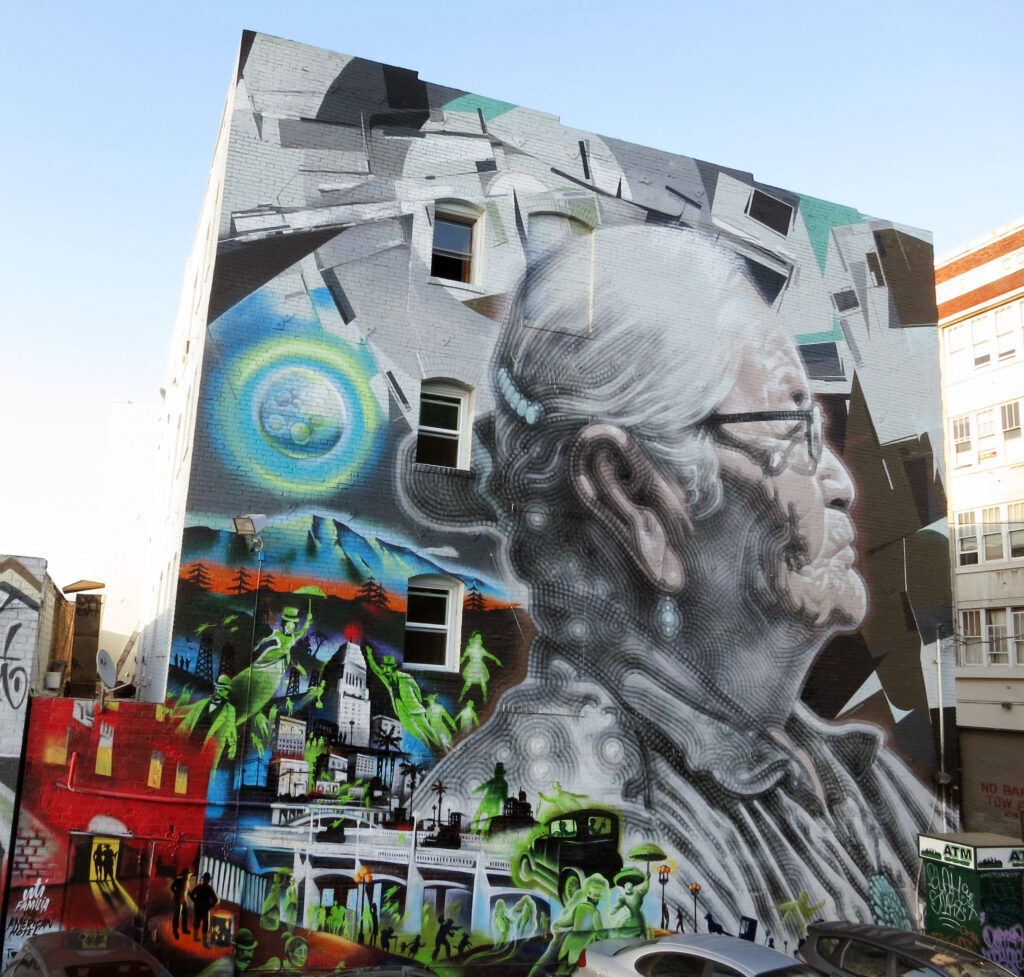
Going all the way back to 2015 today for this mural by El MAC, Augustine Kofie, and Joseph ‘Nuke’ Montalvo. La Abuelita/Má’sání, a portrait of Diné (Navajo) weaver Martha Gorman Schultz, is located on the outside of The American Hotel in Los Angeles.

From El MAC (Miles MacGregor)’s website about the mural-

“The portrait is painted entirely with aerosol and fatcaps, and is based on photos I shot a few years ago of an artist named Martha Gorman Schultz. She is a Navajo blanket weaver from northern Arizona, and part of a respected family of weavers including her granddaughter, Melissa Cody.

I felt this painting of Martha could be an empowering representation of beauty not often depicted in public art or media. Beauty that is feminine, elderly, indigenous, loving and powerful.

The building this mural was painted on was constructed in 1901, and you can imagine how much Los Angeles history it’s seen over the last hundred years or so.

This was an especially collaborative effort- Along with the work of Kofie and Nuke surrounding the figure, SKILL UTI painted the wall to the left, integrating an already existing piece by DASH 2000(Rest In Peace). SWAN provided ground support, along with CHEE, AISE, BLK, OFIER, SELEK, CALVYRUS and some other younger members of UTI crew, which has been painting these walls for the last few decades.”

Sadly, Martha Gorman Schultz passed away in February of last year at the age of 93. For more information on her life and work, check out Hyperallergic’s tribute.

Dec 182025
 

Work by Mel Rosen (sculpture) and Stass Shpanin (mural, video, and paintings)

Detail from Stass Shpanin’s “Dance of Birth” animated video

Ceramic sculptures by Mel Rosen

Paintings by Stass Shpanin

The Delaware Contemporary is currently showing three exhibitions as part of its 2025 Biennial  Art + AI programming. This post covers two of them, the third is here.

Construct | Disrupt: Artificial Intelligence as Tool and Material features work by artists Mel Rosen, Stass Shpanin, Sol Kim, and Mark Burchick.

From the museum about the exhibition-

In an age when reality itself feels unstable—filtered through algorithms, fragmented by digital archives, and refracted through competing narratives—artists are increasingly turning to the tools of fiction and speculation not to obscure the truth, but to question how we construct it. Construct | Disrupt brings together the work of Mel Rosen, Sol Kim, Stass Shpanin, and Mark Burchick, four artists who use artificial intelligence, language, and archival material to explore the porous boundaries between perception, memory, and belief.

Across diverse practices—from ceramics, drawing, and painting to video, installation, and text—these artists engage with AI not as a replacement for the hand, but as a provocateur, a co-conspirator, and a mirror to the human imagination. Rather than seeking resolution or certainty, their works open up space for doubt, complexity, and contradiction.

Together, the artists in Construct | Disrupt invite us to consider how we construct meaning in a world where the archive is no longer fixed and where the image can be endlessly generated. The work of these artists does not offer answers, but rather asks: What do we trust? What do we remember? And how do we decide what is worth believing?

About the two artists pictured above, from the museum-

Stass Shpanin engages history as a space of imaginative reconstruction. Working with visual fragments from American folk traditions and immigrant archives, he uses AI to distort and reconfigure the past, generating speculative images that blend glitch, myth, and memory. His paintings and drawings present broken, layered timelines where visual language is both preserved and interrupted. Rather than restoring a singular truth, Shpanin’s work embraces the possibility of many coexisting histories—ones shaped as much by fantasy as by fact, as much by the digital as the ancestral.

Mel Rosen’s practice draws from archaeology, natural history, and personal memory to create objects and images that feel both ancient and otherworldly. Her use of AI image generation allows her to iterate quickly, mutating prompts based on her own drawings and a mental library of organic and cultural references—from Pompeian frescoes and fossils to barnacles and talismans. The resulting images feed back into her ceramics and drawings, where mythic forms and geometric distortions coexist in a suspended cosmology. Rosen’s work suggests that artifacts—whether material or digital—are always evolving, reshaped by time, environment, and interpretation.

Still from the video “Person Enough” by Sol Kim

Sol Kim (video still above) approaches language as a material form, using words to subtly disrupt social and technological systems. Her works often begin with a textual prompt—an instruction, label, or survey—that gives rise to absurd, humorous, or quietly unsettling performances. In The Cookiest Cookie, cookies are judged and destroyed by AI based on their perceived “cookie-ness,” while in Person Enough?, performers attempt to become more legibly “human” to computer vision systems. Through these gestures, Kim reveals the tensions between human nuance and machine classification, exposing the strange logic that governs our interactions with technology—and with one another.

Mark Burchick Installation

Images from Mark Burchick’s “Felt Presence”

Mark Burchick’s Felt Presence explores the intersection of faith, media, and artificial intelligence through the lens of Catholic mysticism. Drawing on archival photographs from the 1917 “Miracle of the Sun” in Fatima, Portugal, Burchick trains AI models to generate photorealistic images of miracles that were never captured on film. Presented alongside historical documentation and witness testimony, these fabricated scenes invite viewers to question the boundaries between belief, evidence, and visual truth—highlighting the unseen technological, institutional, and spiritual forces that shape our perception of reality.

In NOO Icons, Burchick expands this inquiry through an immersive video installation framed like a reliquary. A five-minute rear-projected loop, trained on over 100 images of stained glass Rose Windows, morphs into abstract color fields via AI animation. At its center is a 3D-printed altar piece generated using DreamFusion, a text-to-3D tool prompted to create a “solar monstrance.” The resulting object—gold-finished, internally lit, and housing Lithium batteries—evokes both the Communion host and a technological relic. As Kate Crawford notes in Atlas of AI, Lithium is a sacred yet finite resource driving modern AI. By encasing it in plastic and low-res form, Burchick critiques the planned obsolescence and ecological cost of our AI-powered age, reframing divine presence through the lens of material decay.

In another of the museum’s galleries is- Reimagine | Reveal: Challenging the Algorithmic Gaze featuring work by Danielle Glovin, Stephanie Dinkins, and Leah Modigliani.

About the show from the museum-

The works covering this exhibition theme approach AI not as a neutral instrument, but as a complex cultural system—one that reflects, amplifies, and at times distorts the values of its makers. Through the intersecting strategies of critique, reimagination, and bias exposure, Danielle Glovin, Stephanie Dinkins, and Leah Modigliani probe the systems—algorithmic, archival, social—that dictate what is preserved, who is recognized, and how knowledge circulates.

Together, these artists ask urgent questions: Who trains the algorithm? Whose histories are encoded, and whose are left out? What does it mean to build an intelligence—and who is it built for? In doing so, they model a critical engagement with AI, one that challenges default narratives, centers marginalized perspectives, and opens up space for new possibilities. Their practices call us to reconsider what it means to know, to remember, and to be recognized in a world increasingly shaped by invisible systems of intelligence.

Stephanie Dinkins’ interactive sculpture Not The Only One (N’TOO)

Stephanie Dinkins’ “Conversations with Bina48” (back wall) and Leah Modigliani’s AI generated letters for “Cultural Capital”

From Danielle Glovin’s series “Future Generations”

About the artists’ work pictured above-

Stephanie DinkinsNot The Only One (N’TOO) and Conversations with Bina48 extend this inquiry into the realm of relational AI, specifically that of minority groups in the tech sector. In N’TOO, an interactive sculpture gives voice to the oral histories of three generations of Black women, creating an AI entity intentionally designed, trained, and aligned with their values and lived experiences. It is a poignant reversal: instead of AI extracting meaning from biased data sets, Dinkins encodes her AI, reorienting the goals of intelligence design toward inclusivity and equal representation.

In Conversations with Bina48, Dinkins engages in an evolving dialogue with one of the world’s most advanced humanoid robots- probing the limits of kinship, consciousness, and identity. The recorded exchanges navigate tensions between human and machine, emotion and algorithm, intimacy and abstraction—underscoring the urgency of developing AI systems coded to reflect the full richness and diversity of human stories, cultures, and embodied experiences.

Leah Modigliani’s Cultural Capital offers a satirical yet incisive intervention into the circuits of artistic legitimacy. Through a fictional archive of AI-generated letters of recommendation and rejection—authored in the mimicked voices of historical critics and curators—Modigliani reveals how the rhetoric of value and genius in the art world is both constructed and recursively reinforced. The project uses generative tools to lay bare the biases embedded in cultural gatekeeping, drawing attention to the ways AI might amplify inherited hierarchies under the guise of neutrality.

Danielle Glovin’s Future Generations presents AI-generated reinterpretations of inherited family photographs, exposing the mechanics of machine vision and the flattening effects of automated classification. By transposing Midjourney text outputs onto her photographs, Glovin literalizes the collision between personal history and digital taxonomy. The result is a visual language at once familiar and estranged—where nostalgia meets simulation, and memory is rewritten through the aesthetics of machine learning.

These exhibitions will close on 12/28/25.

Dec 182025
 

Portraits by Carrie Ann Baade

Reclaim | Reframe: Datasets and Cultural Visibility, is one of three exhibitions that make up The Delaware Contemporary’s 2025 Biennial- Art + AI. The timely show features work by Carrie Ann Baade, Tyanna Buie, Blažo Kovačević, and Tara Youngborg.

From the museum

Through AI and computational technologies, artists Carrie Ann Baade, Tyanna Buie, Blažo Kovačević, and Tara Youngborg construct layered narratives that reclaim overlooked and marginalized histories. In doing so, these artists unsettle dominant cultural and media frameworks that have long erased, distorted, or commodified lived experience. Exploring themes of identity, ancestry, and displacement, they use generative tools as critical instruments to question, expose, and reconfigure the archival and institutional biases embedded in history, culture, and the environment. From ancestral reclamation and speculative futures to immersive storytelling and data-driven environmental translations, their work advances a reimagining of social justice through the lens of artificial intelligence.

Together, these artists offer a complex portrait of making in the age of AI, revealing how tools shaped by those in power can both perpetuate bias and enable resistance. Their work asks: Who shapes the cultural record? When an AI model “remembers,” whose truth is it repeating? How can we reclaim agency within these systems (built on our collective labor)?

The images at the beginning of this post are from Carrie Anne Baade’s series, Birthplace. Her mixed media portraits of her ancestors, created with the help of AI, present a fascinating look at the stories of several women from early in American history.

From Baade’s statement about the work-

Birthplace is a visual exploration of personal ancestry, delving into the lives of women from colonial Louisiana between 1690 and 1750. Through oil painting, collage, and Al-generated imagery, I reconstruct the presence of these women-figures shaped by French colonial rule, Indigenous displacement, and Romani migration-whose stories have been largely absent from recorded history. Employing a methodology that blends archival research with imaginative storytelling, I create portraits that serve as visual hypotheses-acts of artistic and ancestral repair. The compositions incorporate antique lace, colonial maps, domestic fabrics, and found objects, mirroring the intertwined textures of lineage, migration, and identity. Al-generated image blending aids in synthesizing historically plausible references, speculating on the appearance and presence of women who were never visually recorded.

This project is not about one family, but a shared American inheritance. It reveals the complexity of identity in a land shaped by colonization, migration, and erasure. In rematriating these women to history, Birthplace offers viewers a visual counter-history-one rooted in survival, interconnection, and the enduring power of maternal lineage.

Pictured below are works from the other artists in the exhibition along with information provided by the museum.

Tara Youngborg examines how institutional data and machine learning shape our understanding of land and environment. Using field research, environmental archives, and US Geological Survey datasets, her datastream translates waterflow data and topographic maps into immersive video installations that highlight the limitations of digital representation. By transforming statistics into layered, shifting media, Youngborg portrays landscapes as dynamic terrains of knowledge. Glitches and ruptures in the work expose gaps between digital abstraction and lived experience, prompting questions about algorithmic authority and what is lost when place is reduced to data.

Tara Youngborg’s installation

Tara Youngborg’s installation (detail)

In AR (Argumentative Reality) and Truck for Three Illegal Passengers, Blažo Kovačević uses augmented reality, 3D modeling, and game engine software to confront invasive state surveillance and the dehumanization of migrants. Using digitally enhanced X-ray images from European Border Patrol inspections, he reconstructs a 2015 tragedy in Serbia where 54 undocumented passengers died in a van crash. His works shift between detached aerial views and intimate interior scans, altering typical media frames into ethical engagement. Kovačević warns how AI-driven technologies can perpetuate oppression through automated surveillance, data collection, and erasure, urging reflection on the politics of visibility and mediated violence.

A still from Blažo Kovačević’s video

Tyanna Buie reconstructs erased family histories and reimagines Black identity through speculative Afro-Futurist frameworks. Using ChatGPT and DeepFake technology, she remixes images, sound, and text to create narratives where absence becomes presence. In The Guardians of Nyala, Buie overlays her own likeness onto eighteenth-century Dutch dignitary portraits, then collaborates with AI to imagine a family history untouched by colonization. Rooted in personal narrative and Black popular culture, her counter-archive elevates erased lives and transforms AI from a tool of replication into one of radical self-authorship.

Two of the portraits from Tyanna Buie’s “The Guardians of Nyala”

This exhibition closes 12/28/25.

Dec 112025
 

Alex Da Corte‘s Soft Power was on view from the High Line until June of last year.

His latest exhibition, Parade, is currently on view at Matthew Marks in NYC, on view until 12/20/25. The Pink Panther appears in this show as well- Da Corte depicts himself as the character painting the gallery pink.

From the High Line website about the billboard-

Known for his immersive installations, sculptures, and films, Alex Da Corte’s work explores themes of identity, consumerism, and taste, challenging societal norms and reimagining the familiar in unexpected ways. The artist draws from myriad sources, including popular and consumer culture, art history, classical literature, and modern design, seamlessly weaving together disparate elements into cohesive narratives. His adept use of vibrant color and surreal imagery lends a dreamlike quality to his work that captivates viewers and blurs the lines between fantasy and reality.

Da Corte presents a new artwork for the High Line’s 18th Street Billboard, inspired by the Pink Panther, a Friz Freleng creation designed for the animated opening sequence of a 1963 Hollywood comedy that came to embody the film and has evolved, through 60 years of spin-offs and reinventions, into cultural ubiquity. Pink’s durability across many generations has allowed it to sell countless products, from fiberglass insulation foam to artificial sweetener, yet the creature’s essence remains out of reach. With neither master nor peer—and seemingly eternally unbound by the rules of others—Pink represents a certain queer freedom. Da Corte revives Pink as an icon of resistance, supine but poised, wielding a sign of universal protest, brandishing a clear pink purpose. “There is a difference between falling down and laying down,” Da Corte explains. “I call that soft power.” This billboard is an advertisement for the value of such power.

Dec 052025
 

In addition to his numerous street art pieces, Alexandre Farto, aka Vhils, has shown his unique creations in various galleries around the world. The works above are from his 2018 exhibition Annihilation at Over the Influence gallery’s temporary location in Los Angeles.

From the gallery about the show-

Presenting a reflection on the current model of globalized development and the forces shaping and affecting local identities around the world today, Annihilation emphasizes the global impact of Los Angeles culture and the subsequent breakdown of unique global identities across continents. For his first solo exhibition in the United States since 2011, Vhils has taken the opportunity to set up a dialogue between the United States, Europe, and China to address the growing struggle for hegemonic supremacy between global powers and the ensuing social and economic impact on the world at large. Annihilation shares the stories of the citizens who breathe vitality into densely populated urban epicenters. Based on a variety of source material, from advertisements collected in cities worldwide to salvaged wooden doors, the new patchwork-like series intentionally dilutes the readability of each individual portrayed, a reflection on how identity is both formed and affected by the city’s visual discourse. This intentional juxtaposition of contrasts mirrors the interplay between elements from various cultures which we observe at work today in large urban contexts.

Vhils-Strata, which presents a selection of his work from the past twenty years, is currently on view at the Museum of Urban and Contemporary Art (MUCA) in Munich, Germany until 3/1/26.

He also recently created the site-specific installation, Doors of Cairo, located near the Pyramids in Giza in Egypt. It is part of  Forever is Now 05 and is on view until 12/7/25.

Dec 052025
 

Portuguese artist Alexandre Farto, aka Vhils, created this mural of TJ Mizell (Jam Master Jay‘s son) in 2018.

It is one of many street art projects organized by LISA Project NYC.

Dec 032025
 

Robert Therrien‘s larger than life sculpture of a table and chairs for Under The Table (1994) has been delighting visitors to The Broad in Los Angeles for years. Robert Therrien: This is a Story, recently opened at the museum is the largest exhibition of the late artist’s work to date.

From The Broad about the exhibition-

Therrien’s meditations on scale and material are a deeply influential and well-known approach within the field of contemporary sculpture, significant to The Broad’s own identity as a museum, and long admired by visitors of all ages. The installation showcases Therrien’s personal vocabulary of images and symbols—from enormous tables, chairs, and dishes, to intimate drawings of snowmen, birds, and chapels—as they become a language of continuous creation and transformation for the artist over time. Featuring more than 120 works spanning five decades, the exhibition offers unprecedented access to the artist’s exploration of scale, memory, and perception, just miles from the downtown Los Angeles home and studio space he operated out of for close to thirty years beginning in 1990. Many of the works on view, including those created just before Therrien’s untimely death in 2019, have never been featured in museum exhibitions and will offer new avenues of understanding his practice.

The exhibition is on view until 5/5/2026.

Nov 262025
 

Robert Gober‘s Untitled, 1993-1994 was on view at Columbus Museum of Art last year, on loan from Art Bridges.

About the sculpture from Art Bridges

Robert Gober’s Untitled assumes an entirely familiar form that triggers a multi-sensory response. By representing a stick of Breakstone butter, the artist conjures up memories of the food’s texture, aroma, and taste. Gober manipulates these senses with Untitled, leaving the viewer mildly disoriented. Although the object is immediately recognizable, it has no odor, and its glistening beeswax sheen varies slightly from the creamy tactility of actual butter. Significantly, the artist has expanded his representation of butter to roughly the size of a human torso.

The artist’s work often functions with a corporeality that relates to the body, and as Untitled lies unwrapped with its impressionable surface exposed, a commensurate feeling of naked vulnerability is evoked. Because butter can be transformed and clarified, it has associations with spiritual awakening and purity. These notions are echoed in the near-monastic rigor of Gober’s craftsmanship, elevating the familiar object to a profound level.