Feb 212025
 

As part of PST ART: Art & Science Collide, The Getty is highlighting the incredible work created by the engineers and artists that made up the group Experiments in Art and Technology (E.A.T). The exhibition focuses on the history of the group and two of its most ambitious projects- 9 Evenings: Theatre & Engineering (1966) and the Pepsi Pavilion from Expo ’70 in Japan.

From the museum-

In 1966, engineers Billy Klüver and Fred Waldhauer and artists Robert Rauschenberg and Robert Whitman founded Experiments in Art and Technology (E.A.T.), a not-for-profit organization dedicated to promoting and supporting collaborations between artists, engineers, and scientists. These partnerships brought disparate fields together, bridging the gap between culture and emerging technology. E.A.T.’s debut event, 9 Evenings: Theatre & Engineering (1966), integrated art, theatre, and engineering at the 69th Regiment Armory in New York City, resulting in a technology-aided performance experience that proved to be a launchpad for artistic exploration. Their second major project, the Pepsi-Cola Pavilion at Expo ’70 in Osaka, Japan (1970), presented a multisensory environment featuring experiments with sound, light, lasers, a mirrored dome, and fog. Through their collaborations, E.A.T. artists and engineers came to believe that such team efforts could benefit society; subsequent multidisciplinary endeavors, such as Projects Outside Art (1970), addressed issues of housing, education, environmental sustainability, and communication.

About 9 Evenings–

In 1965, Swedish electrical engineer Billy Klüver and American artist Robert Rauschenberg gathered 10 avant-garde artists and 30 Bell Labs engineers to participate in a collaborative, multidisciplinary project combining new technologies with theatre, dance, and music. The event,9 Evenings: Theatre & Engineering, took place at the 69th Regiment Armory in New York, from October 13-22, 1966. More than 10,000 people attended performances by John Cage, Lucinda Childs, Oyvind Fahlström, Alex Hay, Deborah Hay, Steve Paxton, Yvonne Rainer, Rauschenberg, David Tudor and Robert Whitman. These performances incorporated technological equipment such as photocells, doppler sonar, remote controls, infrared cameras, and transistors. In addition, 9 Evenings engineers created the Theatre Electronic Environmental Modular, a flexible, wireless, networked control system, and the Proportional Control System (PCS), which used photocells to adjust light and sound levels. The event led to the founding of Experiments in Art and Technology the following month.

Below are images and objects from two of the nine evenings, Open Score and Physical Things–

Performance description of “Open Score” by Robert Rauschenberg

About Open Score–

Open Score began with a tennis match between professional player Mimi Kanarek and painter Frank Stella. Engineer William Kaminski wired their rackets with transmitters that caused every strike of the ball to emit a loud sound and extinguish an overhead light. The game continued until the Armory was completely dark. At that point, a cast of 300 volunteers walked onto the court and performed a series of loosely choreographed movements while infrared cameras projected their images onto large screens. Rauschenberg described the action as “the conflict of not being able to see an event that is taking place right in front of one except through a reproduction,” an idea that resonates in today’s world of social media, streaming, and smartphones. For the second performance, Rauschenberg added a third section in which he carried dancer Simone Forti around the Armory in a burlap bag while she sang an Italian ballad.

About Steve Paxton and Dick Wolff’s Physical Things–

For 9 Evenings, Paxton created an enormous, inflated sculpture using Polyethylene and box fans and invited visitors to walk through the structure at their own pace, confronting different environments and performances along the way. After climbing through a 100-foot inflated tower, participants emerged into an enclosed area with wire loops suspended above their heads. Using modified transistor radios, they could listen to an array of sounds, including animal noises and sports commentary. One’s location underneath the sound loops determined which part of the score was audible, allowing people to choose where to linger and what to listen to.

One of the group’s most ambitious projects was for the Pepsi Pavilion (pictured above).

From the museum-

In 1970, the Pepsi-Cola Corporation commissioned E.A.T. to design a pavilion for Expo ’70 in Osaka, Japan. Artists Robert Whitman, Robert Breer, David Tudor, and Forrest Myers made early contributions to the design of the pavilion; eventually the design team included 20 artists and 50 engineers and scientists.

Outside the pavilion, a water-vapor cloud sculpture by the artist Fujiko Nakaya covered the white, faceted dome. On the plaza, seven of Breer’s Floats, six-foot-high dome-shaped sculptures, glided in slow motion while emitting sounds.

Visitors entered the pavilion through a tunnel and descended a staircase into a clamshell-shaped room lit by moving patterns of laser light. On the far end, another staircase led up into the Mirror Dome, a 90-foot diameter, 210-degree spherical mirror made of aluminized Mylar. Within the Mirror Dome, visitors’ reflected images appeared to float upside down above their heads.

You can find more images and further documentation here.

This exhibition closes 2/23/25.

Feb 202025
 

Charles and Ray Eames‘ Powers of 10, is currently on view as part of Palm Springs Art Museum‘s Particles and Waves: Southern California Abstraction and Science, 1945-1990, among a collection of experimental abstract films.

In the nine minute film you travel in powers of 10 in two directions, starting with a couple having a picnic in a park in Chicago. You then zoom out into space until you are 100 million light years distance from them and then return to travel into the man’s hand in negative powers of 10 until you reach a proton of a carbon atom at 10−16 meters.

Below is the film in its entirety but it is definitely worth seeing on a big screen if you can.

Feb 202025
 

Large painting on the right- Bettina Brendel, “Particles or Waves?”, 1969, acrylic on canvas

Center sculpture by Claire Falkenstein- “Point as a Set #10, c.1962, copper

Palm Springs Art Museum is currently showing Particles and Waves: Southern California Abstraction and Science, 1945-1990 a selection of abstract work created by Southern California artists influenced by that era’s scientific ideas and breakthroughs. These explorations are divided into sections focused on optical science, mathematics, color in motion, and space age abstraction. The exhibition also includes several experimental films created during this period.

From the museum-

Beginning in the 1920s and 1930s, scientists at institutions near Los Angeles including Mount Wilson Observatory, the California Institute for Technology, and the Jet Propulsion Laboratory in Pasadena, generated groundbreaking experimental research in astronomy and particle physics. During and after World War II, the region remained at the forefront of scientific inquiry in theoretical physics and its applications within aerospace engineering, industrial manufacturing, and communications technologies. Between 1945 and 1990, many artists in Los Angeles produced visually abstract artworks while closely engaging with scientific ideas, mathematical theories, and materials or processes derived from physics and engineering.

The exhibition unites several generations of artists working in diverse materials and styles to examine how subfields of scientific investigation inspired a range of non-figurative artworks by practitioners concerned with light, energy, motion, and time. By drawing interdisciplinary connections between the work of early abstractionists and contemporary practitioners, the exhibition considers abstract artwork from Southern California in a new way.

Below are a few selections along with information from the museum.

Claire Falkenstein, “Orbit the Earth”, 1963, Oil and metallic paint on nine canvas panels

Claire Falkenstein, “Orbit the Earth”, 1963, Oil and metallic paint on nine canvas panels

Through both abstract paintings and sculptures, Falkenstein explored subjects inspired by astrophysics. In Orbit the Earth, she conveys a sense of motion through patterns of curved points in metallic paint and sweeping lines that reveal traces of the painting’s black background. The artist referred to her small gestural marks as “moving points” and explored how arrangements of these painted forms could express types of motion and energy in the universe. In her hanging sculpture Sun represents a dynamic celestial form that shifts in appearance as viewers move around the work. The sculpture’s open, webbed structure creates a continuum between the work and its surrounding space, parallelling interconnections between the Sun and other cosmic phenomena in the solar system.

Helen Lundeberg, “Untitled (Sectioned Planet)”, 1969, Acrylic on canvas

Eva Slater, “Galaxy”, 1954, Oil on panel

Oskar W. Fischinger, “Space Abstraction No.3”, 1966, Oil on canvas

Oskar W. Fischinger, “Multi wave”, 1948, Oil on canvas

Hilaire Hiler, “Parabolic Orange to Leaf Green”, 1942, Oil on board

Dr. Frank J. Malina, “Mitosis”, 1974, Painted wood, painted plexiglas, metal, fluorescent tubes, motor

Inspired by the idea of enlivening artwork with electricity, Malina developed a range of kinetic paintings like Mitosis beginning in 1956. This work exemplifies the artist’s Lumidyne system of works where illuminated colors shift through cycles generated by an encased motor, rotating components, and electric light sources. A founder of Caltech’s Jet Propulsion Laboratory in 1936 and a preeminent American specialist in rocketry, Malina turned to creating artwork in the early 1950s after relocating to France.

DeWain Valentine, “Vertical Section”, 1979, Laminated glass

DeWain Valentine, “Vertical Section”, 1979, Laminated glass (detail)

Bettina Brendel, “Prisms”, 1982, Acrylic on canvas

Miriam Schapiro, “Computer Series #3”, 1969, Acrylic on canvas

Bettina Brendel “A Numbered Universe”, 1966, Oil on canvas

In A Numbered Universe, Brendel painted the symbols of binary code within a grid drawn onto the canvas in pencil. The work’s composition is both structured and slightly irregular. The hand painted notations and off-kilter composition humanize the abstract technological language of computer code.

Lee Mullican, “Computer Joy”, 1987, TGA file 512 x 428 pixels

In Computer Joy, repeated and overlaid sections of lines and geometric forms produce an all-over field of pixelated patterns.
While teaching at the University of California, Los Angeles in 1986, Mullican explored the artistic posibilities of new computer imaging technologies. The ability to readily duplicate digital shapes using the computer complemented his long-standing practice of applying repeated striations of pigment into patterned arrangements in paintings like Source from 1981.

Lee Mullican, “Source”, 1981, Oil on canvas

Lee Mullican, “Source”, 1981, Oil on canvas (detail)

James Turrell, “Afrum (White)”, 1966, projected light

In Afrum (White), a modified projector casts a rectangle of white light onto the corner of the otherwise darkened gallery, creating the illusion of a floating three-dimensional cube. The crisply defined area of light changes in appearance depending on how viewers move in the space. Through his precise manipulation of light within specific spatial environments, James Turrell creates opportunities for viewers to engage with nuanced processes of perceptual experience.

Man Ray, “Shakespearean Equation: King Lear”, 1948, Oil on canvas

While living in Hollywood in the late 1940s, Man Ray produced his Shakespearean Equations, a series of paintings depicting mathematical models that reference plays by William Shakespeare. King Lear highlights the aesthetic qualities of a particular form known in algebraic geometry as a Kummer surface with eight real double points. For the artist, the drips of paint on the mathematical form recalled the tears shed by King Lear after learning that his favorite daughter was killed, layering human emotion onto the geometric shape.

This exhibition, part of The Getty’s PST ART programming, closes Sunday, 2/24/25.

Feb 142025
 

Barbara Kruger’s Untitled (You Are A Very Special Person), 1995, is currently on view at The Broad in Los Angeles, as part of their permanent collection.

Feb 132025
 

The contemporary artists and designers in Seeing the Unseeable: Data, Design, Art at Art Center College of Design, each use different types of data as the basis for work that is both imaginative and informative. This exhibition is part of The Getty’s PST ART: Art and Science Collide programming.

From the gallery-

Seeing the Unseeable: Data, Design, Art explores selected works by contemporary artist and designers responding to data’s impact on daily life. The exhibition premise rises from the dawn of Big Data in the early 1990s, which brought with it advancements in the field of data visualization: the practice of representing vast quantities of information to make it understandable and engaging to the public.
In its early forms, data visualization was most often used in map-making and creating statistical graphics, viewed largely as a tool to convey information in the sciences and support analytic reasoning. In recent years the field has become an influential force in contemporary culture, transforming visual literacy in the global cultural landscape.

Seeing the Unseeable considers data in the recent past and present, addressing issues related to data mining and invisible data, data humanism, and data’s relationship to our varied environments. Exploring a critical cultural moment in our relationship with the magnitudes of information that routinely bombard us, works in the exhibition draw attention to issues ranging from the vastness and capabilities of data technologies to the personal, social and humanitarian consequences of data collection and data systems.

Hyojung Seo, “Singapore Weather Data Drawing Series (Wind Direction, Tem-perature, Windspeed) 2022

About the video work by Hyojung Seo–

Singapore Weather Data Drawing Series reconsiders data visualization as it develops beyond mere representation to aestheticization. As the title of the work suggests, this series of data are drawings aimed to build a visual narrative beyond the original scope of the data itself. The weather data drawings generally represent information about Singapore’s weather patterns, while also standing as abstract digital artworks. This visual loosening of data into a series of patterns and movements presents weather statistics thorough a visual sensation rather than a more conventional data visualization design. The essential link is the descriptive title. While the work may abstract Singapore’s weather patterns, the movement and shapes designed by Seo also expand the meaning of the information as a kind of living, organic form.


About the above work by Linnéa Gabriella Spransy–

Described by Spransy as “procedural abstractions,” the paintings shown present an alternative to what may be considered data-driven art. While terms such as “data” and “generative art” are often used to describe digital-based imagery, the artist’s painting method lies at the heart of data and data visualization: number patterns. The Prime Mover paintings demonstrate the intimate working relationship between the artist and pure data. Spransy begins by constructing linear patterns using prime number sequences onto the prepared canvas. From this accumulated form, she then selects areas to pour paint over. After the paint dries, she initiates another pattern that grows around the existing intrusions. This push and pull of structure and chaos creates a field of balance and counterbalance, an ebb and flow between the artist, the numbers, and the seemingly shifting, multiple layers and dimensions of her paintings.

Iñigo Manglano-Ovalle, “Lu, Jack and Carrie (from The Garden of Delights)”, 1998, Archival pigment prints

About the above work by Iñigo Manglano-Ovalle and Storm Prototype: Cloud Prototype No. 2 and 4, 2006 (the hanging titanium sculptures in the first photo)-

Iñigo Manglano-Ovalle is recognized for a wide-ranging, multifaceted practice resulting in sculpture, large-scale instal-lations, photography, and video. Ranging in scale from modest to monumental, his works are the result of years of research and achieved working in collaboration with creatives, inventors, and technicians in a vast range of fields, from the physical and life sciences to earth sciences. Lu, Jack and Carrie (from The Garden of Delights) (1998) is comprised of three colorful digital prints: a series of abstractions based on images of DNA samples taken from imaging technologies utilized in genomic mapping and depicting “families” of friends selected in sequence. Storm Prototype: Cloud Prototype Nos. 2 and 4 2006) are hovering spectral forms manifested in three dimensions from the analysis and compilation of real weather data. Additionally, the works are inspired by the artist’s consideration of global migration patterns. These works represent the compulsory flow of nature, whether revealed in the sky, ocean, or over land, impervious to international boundaries.

Giorgia Lupi and Ehren Shorday, “Incroci (Crossings)”, 2022, Black paint on raw canvas

About the above work by Giorgia Lupi and Ehren Shorday–

Described by the artists as data portraits, this collaborative project emerged from Lupi’s observation that “each person’s life may be unique and different, but when seen together, these distinct paths begin to form patterns.” For Incroci, a dataset was created by asking strangers, and their social media circles, to share five dates (day/month/year) representing significant life moments, from the day of their birth up to the year 2022. The project was conducted during the Covid-19 pandemic, which gave weight to the question of what could be considered a significant life moment. Incroci exemplifies the ways in which data visualization design is evolving to a level beyond merely providing an aesthetic framework for data to realizing subtext within the datasets. As Lupi states: “The more ubiquitous data becomes, the more we need to experiment with how to make it unique, contextual, intimate. The way we visualize is crucial because it is the key to translating numbers into concepts we can relate to.”

About the work above by Semiconductor–

Ruth Jarman and Joe Gerhardt, aka Semiconductor, have been collaborating for over 25 years working in sound, video, installation and sculpture. Referring to their work as technological sublime, they explore ways of experiencing nature mediated through the languages of science and technology. Spectral Constellations is a series of generative animations, driven by scientific data of young stars. This data, collected by scientists using a method called Spectroscopy, creates an understanding of structures around distant young stars, where gas and dust come together to form planets. Semiconductor have employed this spectral data as a physical material, translating it into rings of light which resemble gradiated discs of planetary and stellar formations. As the data ebbs and flows it introduces a sense of form and motion. Waveforms merge and interfere revealing patterns and rhythms, engaging our human tendency towards pattern recognition. The fragmented LED mosaics provide partial windows from which the spectral data shifts and shimmers.

Fernanda Bertini Viégas and Martin Wattenberg, “Wind Map”, 2012, Interactive software, dimensions variable

About Fernanda Bertini Viégas and Martin Wattenberg‘s Wind Map-

Fernanda Viégas, a computational designer, and Martin Wattenberg, a mathematician and journalist, are known as pioneers in the field of data visualization. Their research has helped define visualization as a discipline and practice, creating interactive and open-source tools for examining a wide range of scientific, social, and artistic questions. Conceived as a personal art project, their iconic work Wind Map culls information from the National Digital Forecast Database, which is maintained by the National Weather Service and available to the public. Continually gathering these forecasts, which are time-stamped and revised each hour, the artists have created a “living portrait” of the wind landscape over the United States. To emphasize the beauty and distinction of this influential work, exhibition curators commissioned a special iteration of Wind Map without the city locations and names. The standard version of this piece remains in the public domain on their website: http://hint.fm/wind/

Laurie Frick, “Moodjam Intense”, 2024 and “Moodjam Mild”, 2024, Abet Laminati samples on ACM panel

About Laurie Frick’s Moodjam Intense and Moodjam Mild-

In her exploration to humanize data, Frick creatively mines information from her own functional and behavioral patterns as part of her art practice. Inspired initially by the daily activity tracking of computer programmer Ben Lipkowitz, Frick began tracking her own sleep with an electroencephalogram headband, expanding it to her husband’s sleep patterns and then others. Initially mapping her moods with color swatches through Mood-jam.com, Frick expanded to track her temperament every few seconds using a combination of heart rate (HRV), facial recognition and galvanic skin response (GSR), assessing her stress, nervousness, and general mood every few seconds. The work shown is an interpretation of this compiled data, using boxes of countertop laminate samples that she sourced during an artist residency at the Headlands Art Center near San Francisco. Moodjam Intense and Moodjam Mild are the resulting gridded works.

Peggy Weil, “77 Cores”, 2024, White Mylar Digital print

About Peggy Weil’s 77 Cores–

Peggy Weil has long been engaged in exploring ways of seeing. Today she continues to inquire the realms of perception, investigating how we see, what we see, and how we can see beyond. When she heard about the Greenland Ice Sheets project which stores 2-mile-long poles of ice samples in meter long cylinders, she was compelled to document them. The ice cores-paleo thermometers holding ash from volcanic eruptions, pollen and environmental gasses-are, to Weil, “deep space holding very deep time.” As such they speak to the notion of the extended landscape: stretched out beyond what we perceive and see, hidden in the atmosphere or the earth underneath our feet. In 77 Cores, images of seventy-seven glacier ice-sheet cores are printed and laid out over twenty-four feet. allowing the viewer to mark time by walking its length.

Sarah Morris “Property Must Be Seen [Sound Graph]”, 2020; “Deviancy is the Essence of Culture [Sound Graph]”, 2020; “You Cannot Keep Love [Sound Graph]”, 2020, Household gloss paint on canvas

About Sarah Morris and the Sound Graph paintings above-

Sarah Morris creates films, paintings, and sculptures based on a wide range of sources, including graphic logos, architectural space, transportation systems and maps, GPS technology, and the movement of people in urban locations. She has said, “I want to map what is going on, these situations we find ourselves in-both physically and philosophically.” The Sound Graph paintings are derived from fragments of conversations and sounds recorded by the artist and translated into hard-edged geometric shapes in vibrant patterns that seem to visually fluctuate. Her interest in incorporating sound into her paintings began when she conceived the film Finite and Infinite Games (2017), titled after the cult philosophy and numbers theory novel by James P. Carse. Morris sees her paintings as being part of a larger self-generating system, always remaining open and allowing for interpretation, motion and change.

Mimi Ọnụọha, “The Library of Missing Data Sets”, 2016; “The Library of Missing Data Sets v2.0”, 2018; “The Library of Missing Data Sets v3.0”, 2022, Mixed Media Installation

Mimi Ọnụọha, “In Absentia”, 2019, 6 risograph prints on paper

About the works above by Mimi Ọnụọha–

The Library of Missing Datasets comprises three filing cabinets filled with folders the reveal unseen biases within the system of data collecting. According to the artist, this work is “a physical repository of those things that have been excluded in a society where so much is collected.” While data-collecting algorithms claim to provide comprehensive information, their vastness hides data-driven forms of inequity: what Ọnụọha considers “algorithmic violence.” Revealing the conditions surrounding invisible data, she “aims] to trouble assumptions baked into the beliefs and technologies that mediate our existences.” In Absentia (2019) presents six risograph prints in the style of twentieth-century African American sociologist W. E. B. Du Bois’ infographics presented at Exposition Universelle, the Paris World’s Fair, in 1900. Ọnụọha visually quotes from Du Bois to acknowledge his work’s significance and the injustice it has since suffered: the US Department of Labor and Statistics halted publishing of his sociological research on Black rural life in Alabama, claiming it to be too controversial.

Finally, the image above is of work from Refik Anadol’s AI data painting series– California Landscapes.

Refik Anadol is an artist, designer, and leader in the aesthetics of data and machine intelligence. Utilizing advanced technologies including Al, machine algorithms, and quantum computing, he has become known for large scale, immersive installations that render massive amounts of data into highly dynamic abstractions. The artist’s California Landscape series employs images of California’s national parks. Spawned from a dataset of over 153 million images, the largest dataset of this kind ever to be used for an artwork, the Generative Study works feature images that are recognizable. Yet as these majestic landscapes constantly morph, so does the matter that we conventionally identify as earth and sky. A series of interconnected lines imbue the images with additional references, in this case the algorithm driving this perpetual visual flux. In its varying juxtapositions of nature and technology, this work reminds us of how distinctive our perceptions of each may be.

This exhibition closes 2/15/25.

Jan 172025
 

Flat Top Desk, 1929 and 1962, Walnut and padauk, Flat Top Desk Chair, 1929, Walnut, padauk and laced leather seat, Flat Top Desk Figure, 1929, Bronze cast of cocobolo original

“Head of Dreiser”, ca.1927, Pine- This is a portrait of writer Theodore Dreiser who Esherick met in 1924 through the Hedgerow Theatre. This was a rough, geometric sketch for a finished mahogany piece.

“Self Portrait”, 1919, Oil on canvas

The Crafted World of Wharton Esherick, on view at Brandywine Museum of Art, presents a wonderful look at the artist’s varied work from throughout his career.

From the museum-

This exhibition explores the interdisciplinary creativity of Wharton Esherick (1887-1970), the famed American artist best known as the father of the Studio Furniture Movement.

Esherick considered his hillside home and studio, now the Wharton Esherick Museum (WEM), the best representation of his iconoclastic vision, calling it “an autobiography in three dimensions.” Built between 1926 and 1966, his unconventional escape on the verdant slopes of Valley Forge Mountain houses almost 3000 iconic works of art from across Esherick’s seven decades of artistic practice.

The Crafted World brings selections from this rich and rarely loaned collection to a broader public, including many objects never before seen except in Esherick’s home and studio. Detailing the artist’s career from his early woodcut illustrations for books by members of the avant-garde literati to his revolutionary reimagining of furniture forms as organic sculpture, works will be presented in thematic vignettes that invite visitors into Esherick’s story and bring the essence of his creative world into the gallery.

Below are a few more selections.

“Drop Leaf Desk”, 1927

“Hedgerow Theatre Lobby Stair Model”, 1934, Walnut; “Spiral Staircase Model”, 1963,Pine; “Bok House Chimney Stair Model”, 1937

From the museum about the staircase models above-

Esherick made numerous objects centering on the twist or spiral to represent natural growth. He returned to this form in models for staircase commissions for the Bok House- in which the spiral is created through gradual shifts in the shape and width of each step- and for the Hedgerow Theatre– which features a staircase like the Studio’s that revolves around a center post.

“Moonlight on Alabama Pines”,1919-20, Oil on canvas, carved wood frame with metallic paint

Alabama Pine woodblock, 1929

“Oblivion” 1934, Walnut

About the sculpture above, Oblivion, from the museum-

Moved by the emotion and physicality of actors, Esherick spent many hours in the balcony of the Hedgerow Theatre, in nearby Rose Valley, sketching performers, and many more hours designing stage sets, props, posters, and other visual elements for their productions. Oblivion was inspired by the passionate embrace of two actors in The Son of Perdition, a play by Lynn Riggs. This organic, fluid sculpture offers an exaggerated rendering of emotion as two intertwined bodies, carved from a single log, seem to softly dissolve into one another. Oblivion was prominently featured in the sculpture portion of the second Whitney Biennial in 1936.

This exhibition closes Sunday, 1/19/25.

May 282018
 

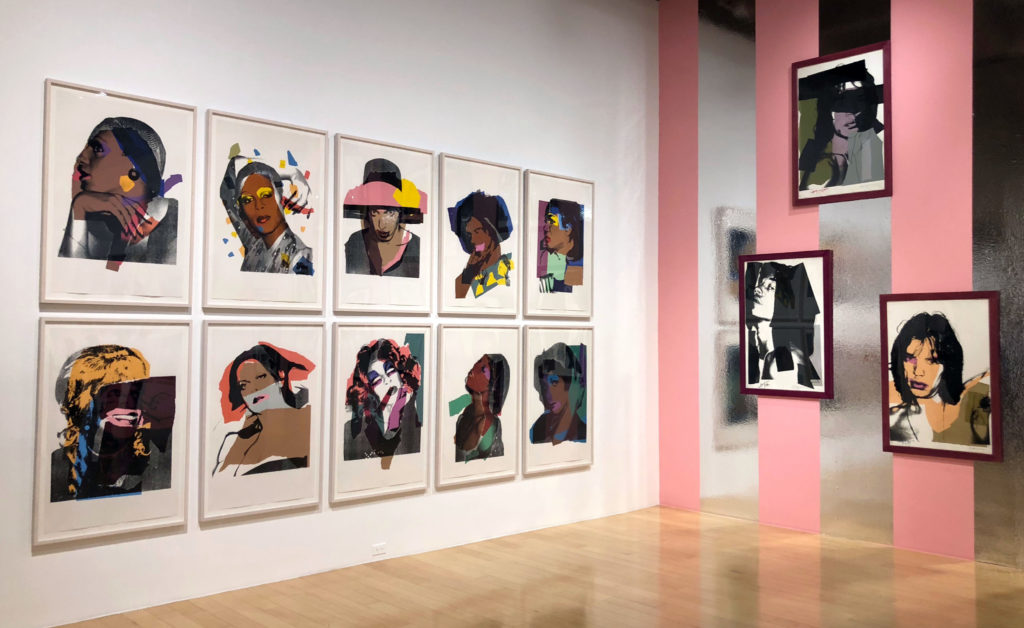
Currently at Palm Springs Museum of Art is Andy Warhol: Prints from the Collections of Jordan D. Schnitzer and His Family Foundation. Taking up the majority of the first floor of the museum, the exhibition includes many of his well known prints as well as several of his illustrations from his early graphic design career, a few of his Screen Tests (including Edie Sedgwick’s), his album covers, and a short documentary created for the museum with local residents who knew the artist.

This exhibition closes 5/28/18.

Nov 082013
 

frutique

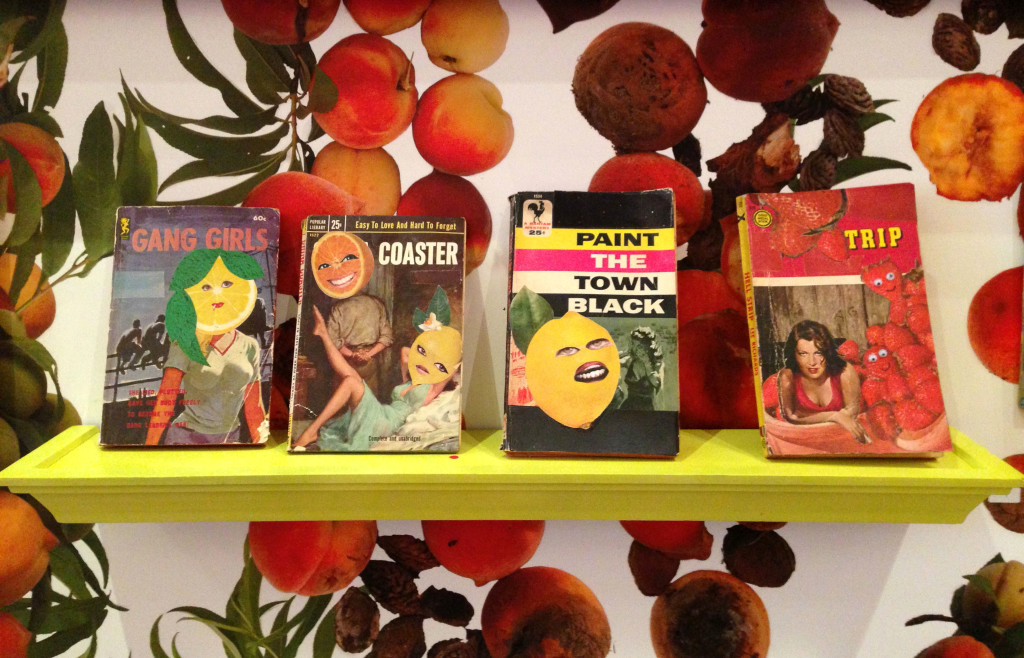
Fallen Fruit: Fruitique!

This art installation/ thrift store is part of Arts ReSTORE LA: Westwood. Everything is fruit themed within the space including the wallpaper, numerous thrift store finds and even the music playing (Cherry Bomb was on when I was there- although that may have been coincidence).  They are also planning fruit related activities throughout the event.

Fallen Fruit is an art collaboration originally conceived by David Burns, Matias Viegener, and Austin Young.

They are also part of the Ojai Art Festival this weekend.