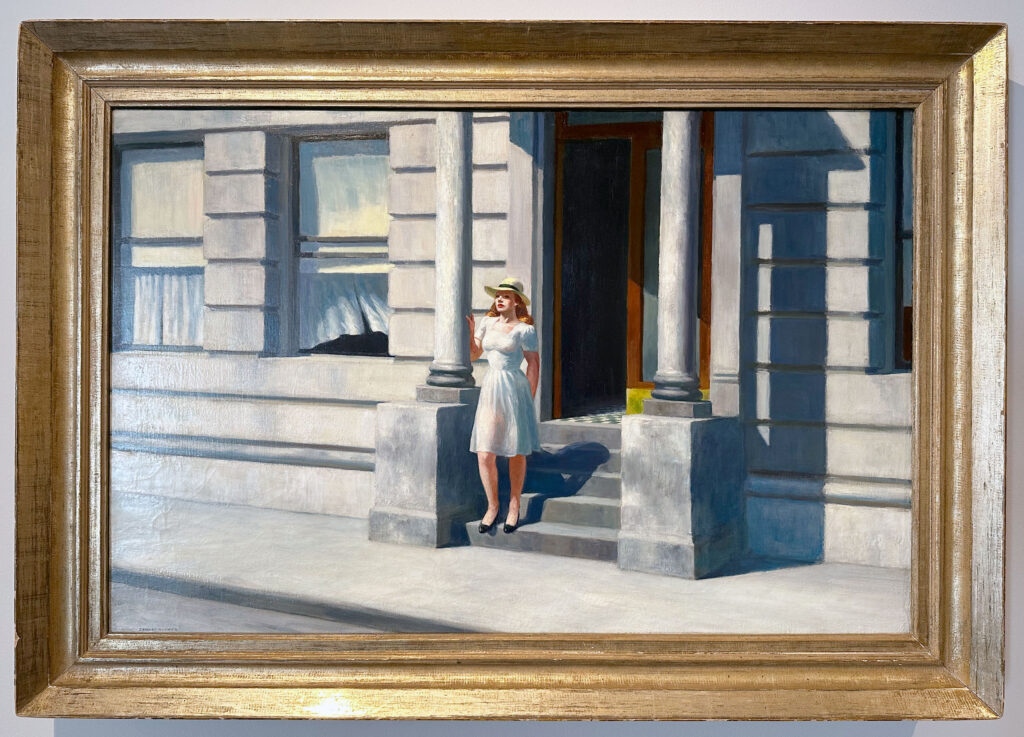
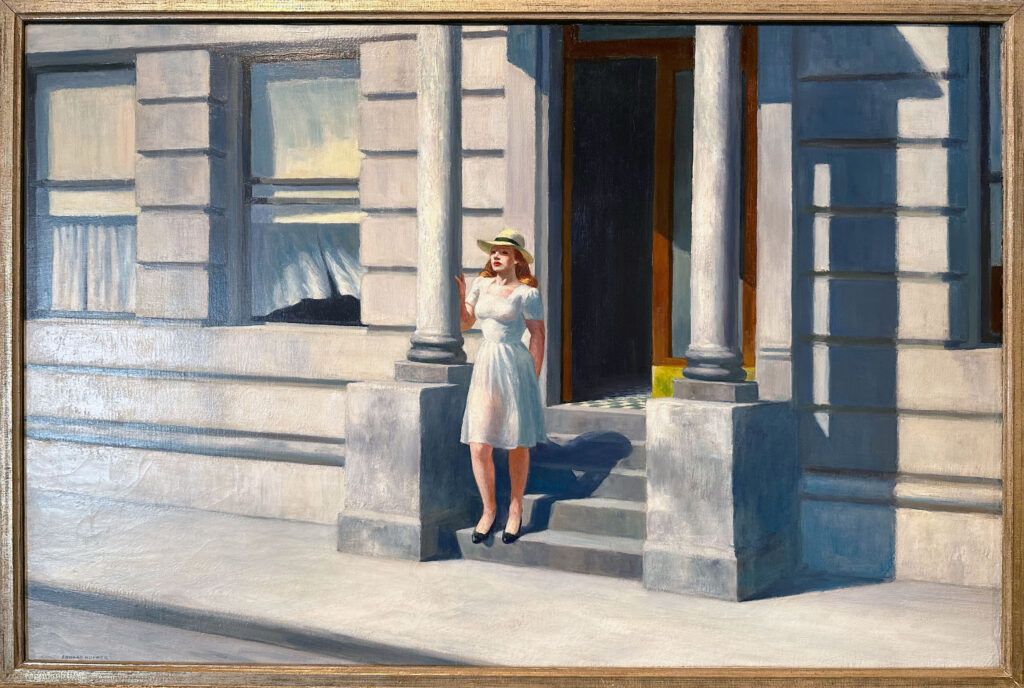
American artist Edward Hopper was born today, July 22nd, in 1882. He created numerous portraits of people in New York City, including the one pictured above, Summertime, painted in 1943. It is currently on view at the Delaware Art Museum.

American artist Edward Hopper was born today, July 22nd, in 1882. He created numerous portraits of people in New York City, including the one pictured above, Summertime, painted in 1943. It is currently on view at the Delaware Art Museum.
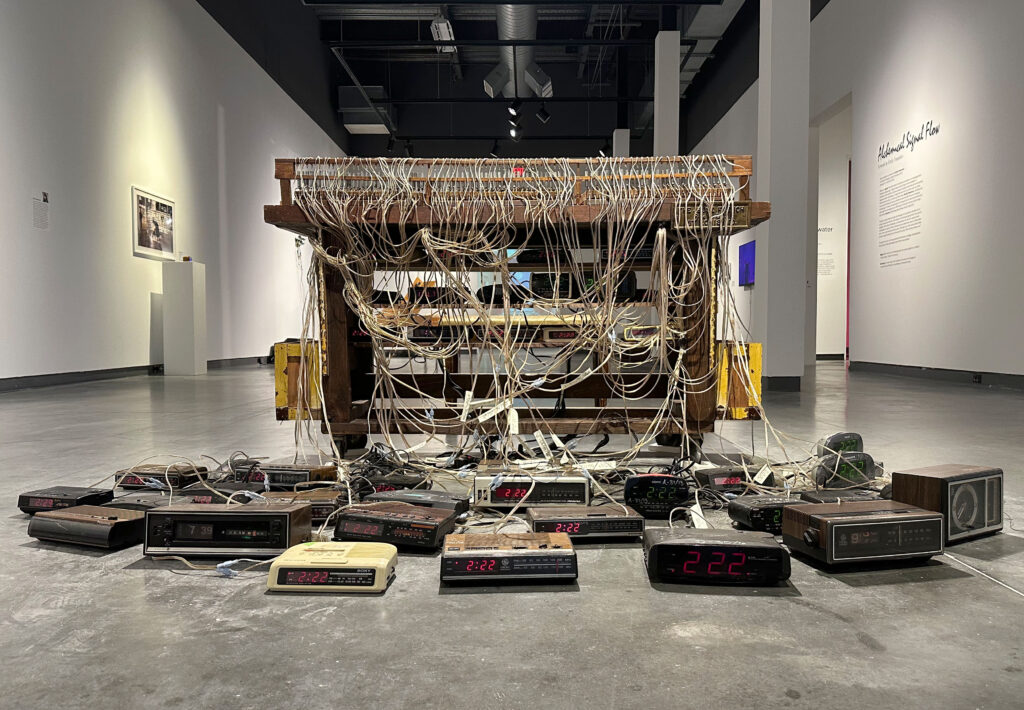
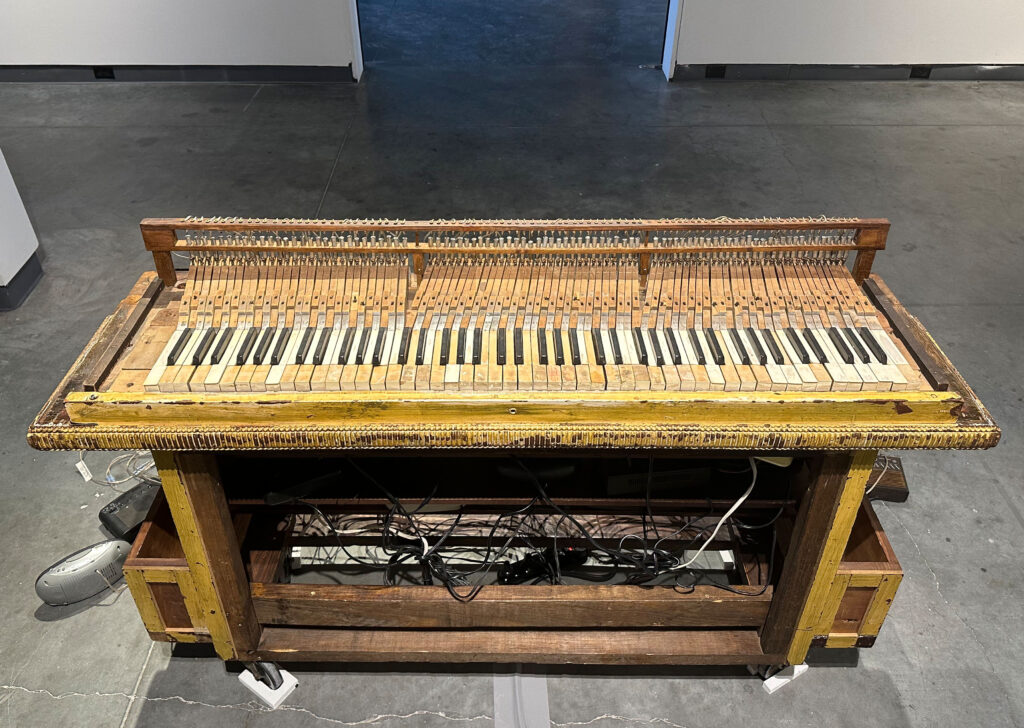
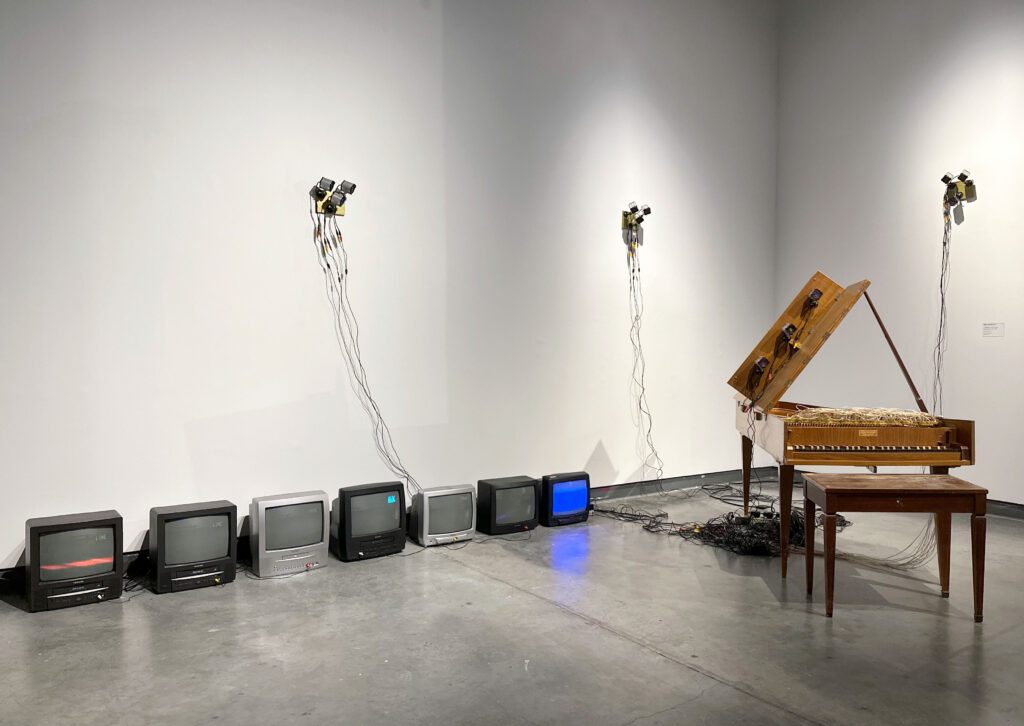
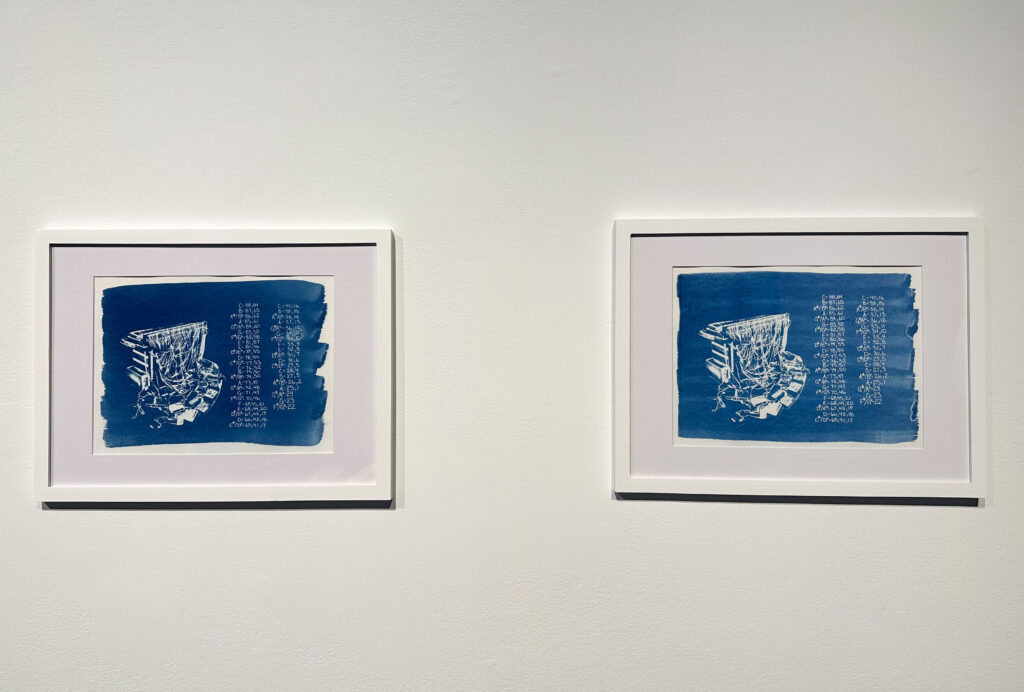
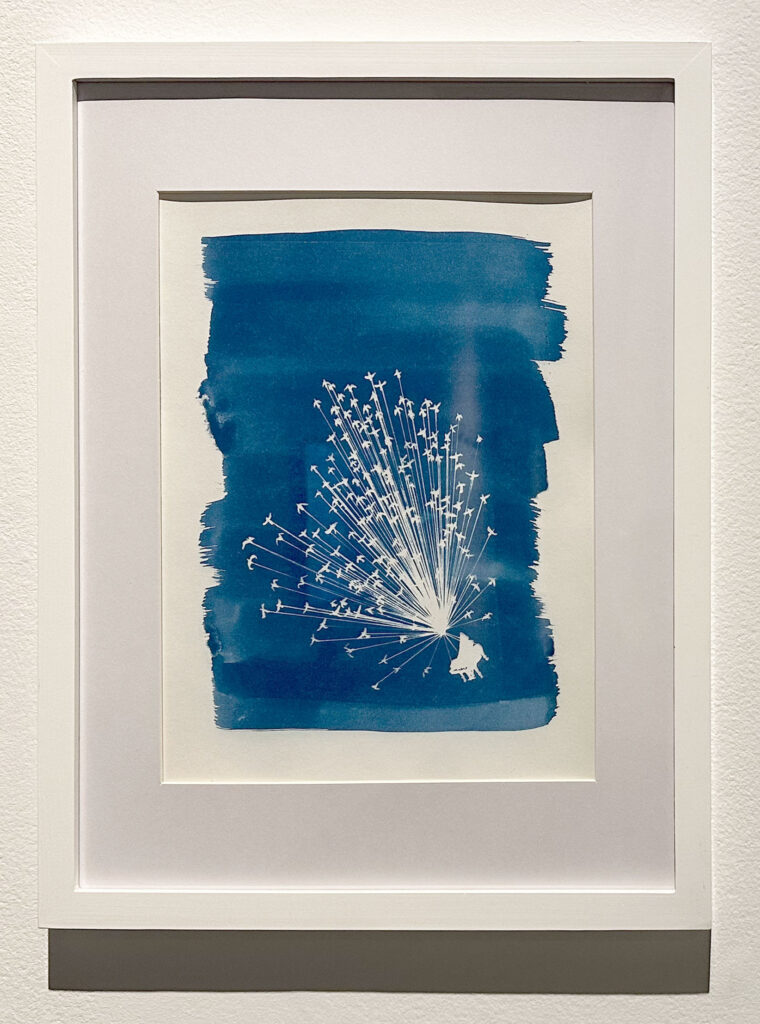
Old televisions and clock radios are given a second life in the interactive sculptures in Emily Francisco‘s exhibition, Alchemical Signal Flow at The Delaware Contemporary. The exhibition also includes videos and documentation of some of Francisco’s other projects, and a few cyanotype prints.
From the museum:
What is a signal? We often think of cell phone reception, or a message sent through a digital app. A signal means many things in this exhibition, it references the transfer of physical data and digital data (ones and zeroes) that happens within technology. A signal can also be social, like how you dress, what brands you buy, or what you throw away. Emily Francisco combines old and new technology to help us rethink how we live with new and changing technology. To many, the mechanics of a harpsichord (a keyboard instrument) and organ are as magical as an MP3 player. Francisco embraces that magic and makes alchemy of blending old and new, low and high tech.
Francisco uses cheap everyday technology and discarded, obsolete (or no longer produced) devices. By doing so, she disrupts signal flows from user to speaker. This action challenges our expectation of call-and-respond and challenges our sense of time. Someone once owed every piece of discarded tech. One could have even been yours. She asks us to think about what these personal objects mean to us at the end of the day. What do they mean to us?
Through her work, she brings together the memory, nostalgia, and aspiration these objects hold, attempting to give them new purpose.
This exhibition closes 8/2/26.
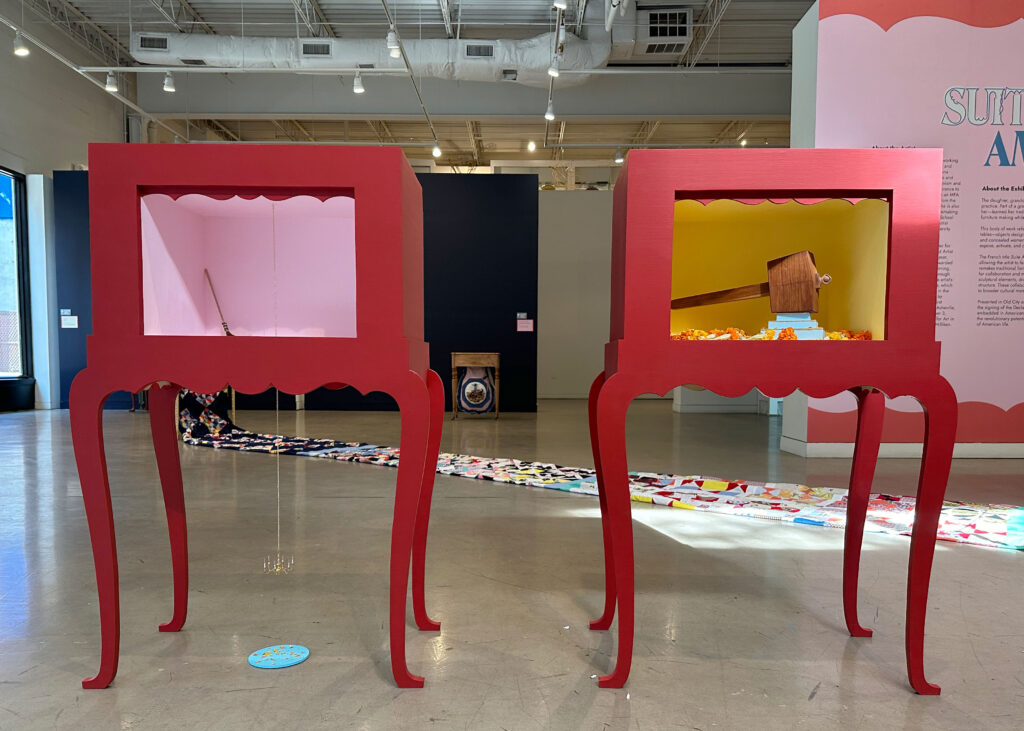


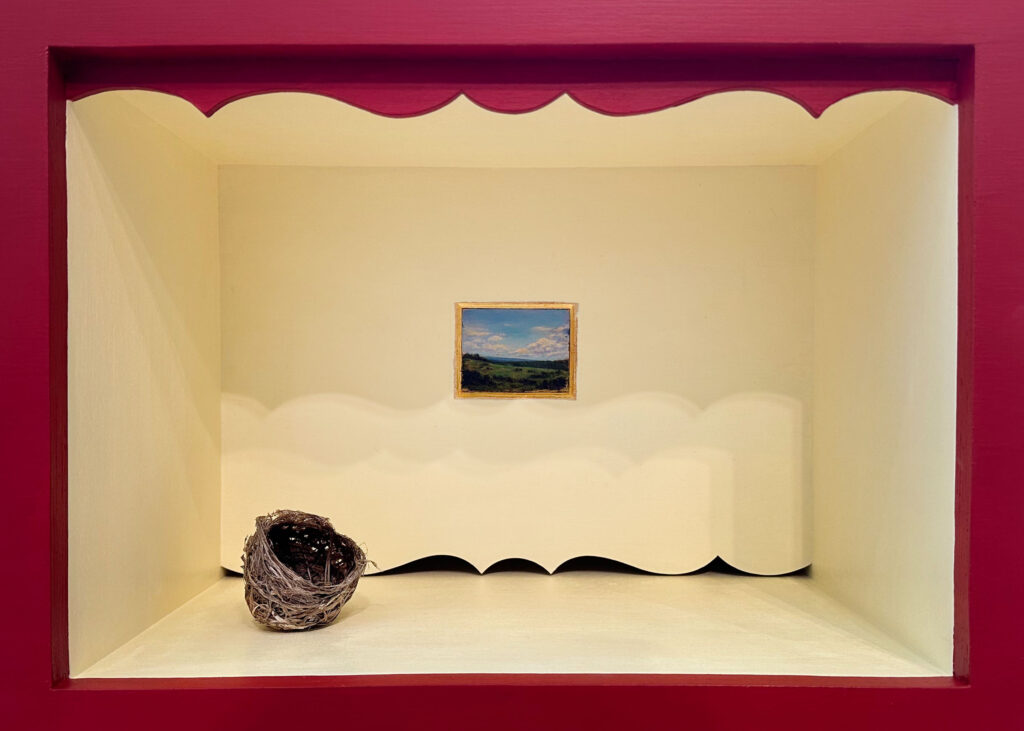
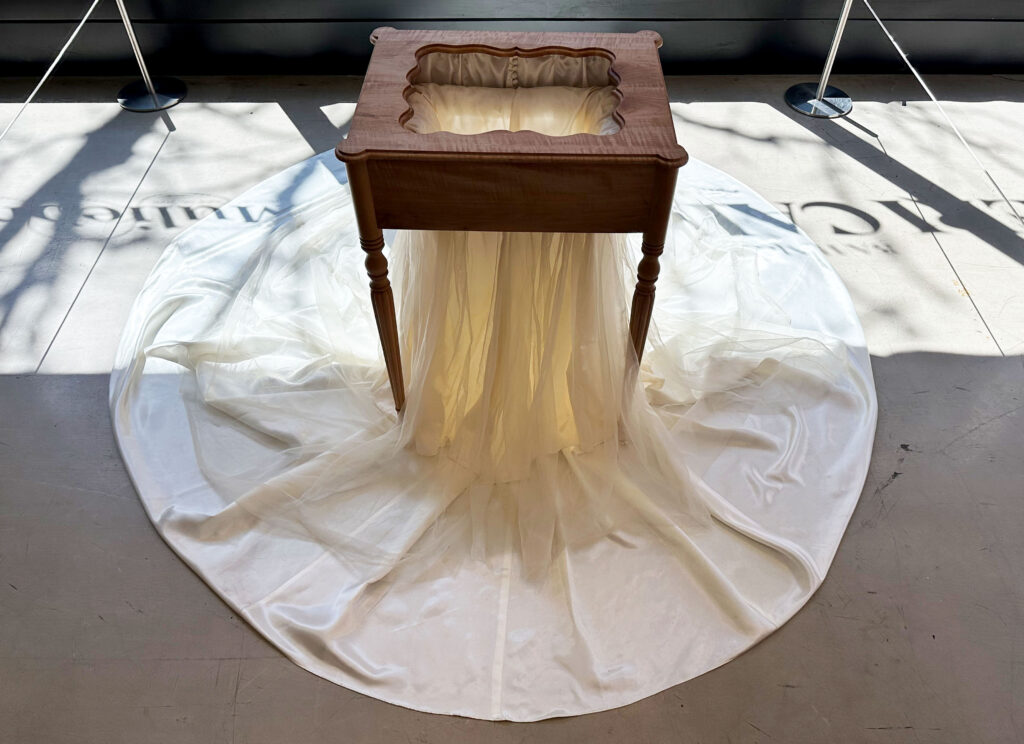
At the Museum for Art in Wood in Philadelphia, BA Harrington‘s Suite Américaine and Viola Bordon‘s Muliebrity, both present works influenced by history and created from a feminist perspective. Harrington adds inventive additions to her expertly crafted furniture pieces, while Bordon’s intricate textile triptych (pictured below) examines the feminine associations in icons of freedom and liberty.
From the museum about Suite Américaine:
The daughter, granddaughter, and sister of carpenters, artist BA Harrington carries craft lineage into contemporary practice. Part of a growing, intersectional cohort of women-identifying woodworkers, Harrington learned her trade, like many before her, by reproducing furniture forms of the past. Suite Américaine holds a reverence for the history of American furniture making, but is inflected with a contemporary feminist imagination.
This body of work references late-seventeenth through early-nineteenth century dower chests, writing desks, and sewing tables, which were designed specifically for women but historically made by men. However, where these objects once stored and concealed the labor and craft skill of women, Harrington opens them. The objects expose, activate, and celebrate their rich interiors, with linens and quilts spilling out of their wooden casings. The use of French in the exhibition’s title, Suite Américaine, is both a nod to the eighteenth-century term for a furniture set and a phrasing that allows the artist to feminize the word “American.” Similarly, the work on display acts as a feminist intervention on historic furniture, using video activations and collaborations with fellow artists to deepen the discussions around these works.
In this exhibition, Harrington not only remakes the original forms with her own hands, asserting her technical skill, but also highlights the revolutionary potential of furniture to self-actualize the creative endeavors of women.
Suite Américaine is a part of Radical Americana, a series of exhibitions organized by a consortium of Philadelphia’s extensive collection of arts and cultural institutions that celebrate how today’s artists are continuing the city’s unique and rich legacy as a center for creativity and civic engagement. To learn more about the other participating artists and organizations, please click HERE.
To watch the Gallery Talk with BA Harrington and Viola Bordon, click HERE.

Viola Bordon, “Muliebrity”
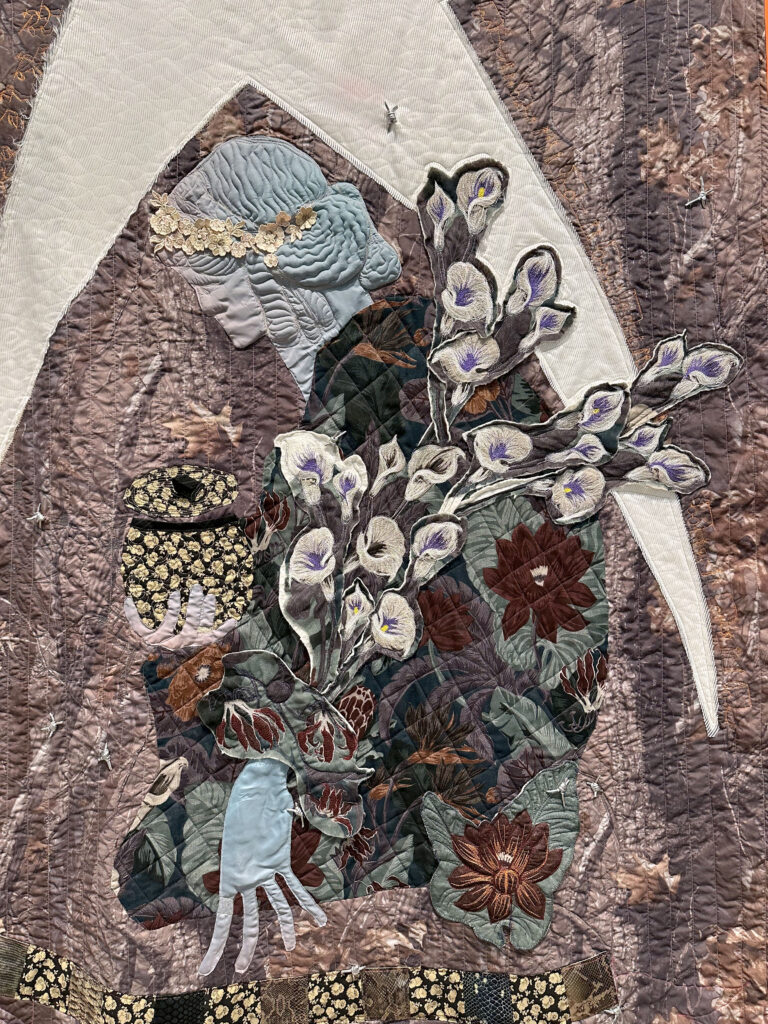
About Viola Bordon’s Muliebrity:
Since the American Revolution, the Roman goddess Libertas has served as a personification of the nation’s ideals, including ever shifting definitions of freedom and enfranchisement. Exemplifying the contested meanings of Libertas, the 1886 dedication of the Statue of Liberty coincided with national discord over the boundaries of freedom, sparked by the end of Reconstruction in the South, legislative debates over immigration, and the growing movement for women’s suffrage.
Drawing from archival research at the American Historical Society, textile artist Viola Bordon examined the invention and evolving meanings of “Lady Liberty” as a fragmented icon of American identity. The resulting triptych, Muliebrity, takes its title from a term Bordon uses to articulate a distinctly feminine form of power-one aligned with endurance, fertility, and embodied knowledge, and inspired in part by poet Sujata Bhatt’s Muliebrity, which describes a woman whose daily labor is suffused with quiet, almost mystical authority.
Sewing found fabric swatches into her quilt through the process of appliqué, Bordon presents a kneeling Lady Liberty surrounded by wilderness. With its visual affinity to late Medieval and early Renaissance depictions of Mary Magdalene, the artist’s patchworked portrayal invites us to consider how this figure of womanhood is repeatedly mobilized to serve the symbolic needs of patriarchal institutions.
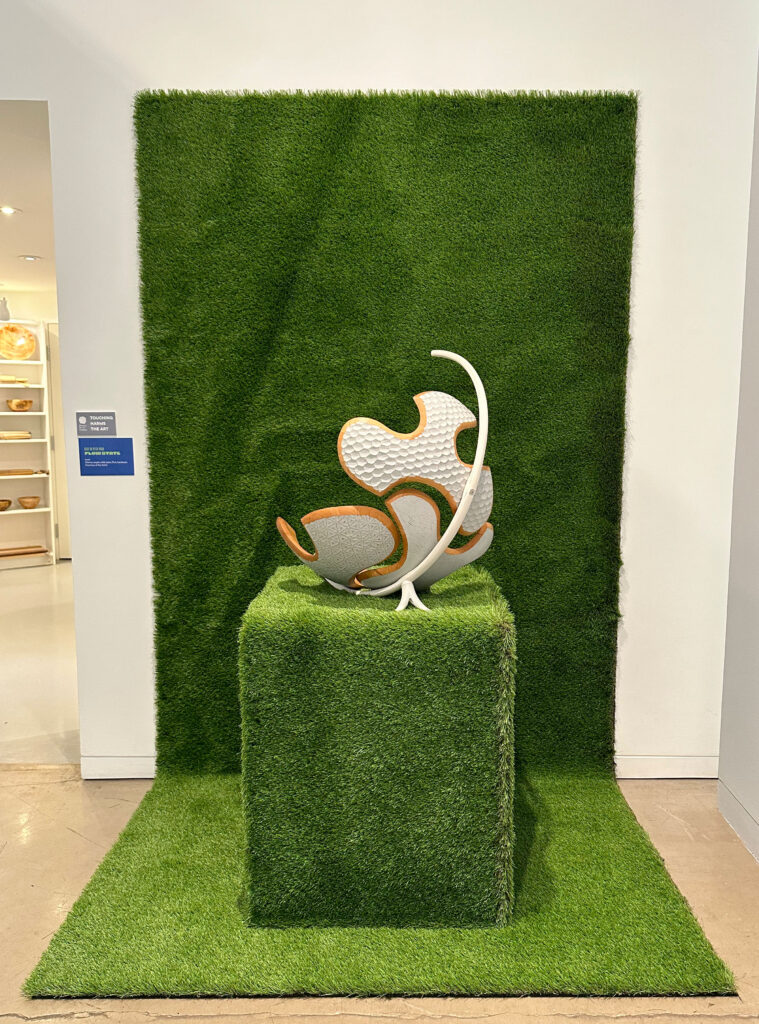


To celebrate the World Cup, the museum is also showing Keun Ho Peter Park‘s soccer ball sculpture for Flow State. It was made using two woods, cherry and maple, which are native to the Philadelphia region where several of the games are being played.
From the museum:
Soccer — known globally as futbol — has long inspired artistic expression. Its accessibility has made it one of the world’s most beloved sports, played by hundreds of millions across cultures, generations, and levels of competition. The FIFA World Cup, held every four years, is a global spectacle that draws billions of fans who rally behind their favorite players and nations. Yet at the center of this phenomenon is a single object: the ball itself.
In World Cup 2026: Flow State, Philadelphia-based artist Keun Ho Peter Park presents a sculptural portrait of the soccer ball. Inspired by the evolving forms of official World Cup match balls, Park explores how each design reflects the identity and aspirations of its host nation while conforming to FIFA’s exacting standards. A woodworker, furniture maker, and sculptor, Park celebrates this iconic object through a sculptural work that brings together his artistic languages of alternative coopering and pattern carving.
Flow State also traces the cultural histories embedded within World Cup tradition. As a youth in Seoul, Park witnessed the 2002 FIFA World Cup, co-hosted by South Korea and Japan, when the tournament — and its official Fevernova ball — served as a powerful symbol of diplomacy and cooperation. The 2026 World Cup similarly commemorates a moment of international partnership. Referencing the official match ball, Trionda, whose tripartite design represents the three host nations of Canada, Mexico, and the United States, Park reflects on soccer’s capacity to create connections across borders while sustaining local identities. The two woods selected for the work — cherry and maple — are native to the region surrounding Philadelphia, itself a host city for the 2026 World Cup.
All three of these exhibitions close on 7/26/26.


New Deal Posters

Willie Cole, “Rolanda”, November 5, 1978, Pastel on brown paper bag. This work was created while Cole was a CETA employee in Delaware

Photographs from the 1975 CETA-funded project “CITYSIGHTS/CITYSOUNDS” in Wilmington

Dorothea Lange, “Migrant Mother, Nipomo, CA”, 1936

Clockwise from top left: William Davidson White, “Children in the Tree”,1934; Michael J. Gallagher, “A Man’s Job”, c.1933-1934; Philip N. Yates, “Broken Nets”, 1934; Walter Willoughby, “Winter Landscape”, c. 1933-1934

Helen Farr Sloan, “W.P.A. Theater”c.1935, Oil on board. It depicts a Federal Theater production during the Depression in NYC’s Washington Square Park. These productions were often free or heavily discounted.
At a time when government arts funding and jobs programs are needed more than ever, Citizen Artist at Delaware Art Museum reminds visitors of the positive and long lasting impact of two past initiatives- The New Deal in the 1930s and 1940s, and the Comprehensive Employment and Training Act of 1973 (CETA). Featuring artwork created during these both of these time periods, the exhibition also highlights the important contributions made by artists in their communities.
From the museum about the exhibition:
Citizen Artist highlights diverse artists working for America during 1930s and 1940s Depression-era programs and federally funded initiatives of the 1970s. The New Deal and the Comprehensive Employment and Training Act were catalysts in Delaware and across the nation as economic relief programs amplified the arts, creating new possibilities for creative employment. This exhibition centers artists as historians, storytellers, and visionaries during the Semiquincentennial.
Through the Comprehensive Employment and Training Act of 1973 (CETA), the Department of Labor supported a nation’s worth of art programs on a scale not seen since the conclusion of the New Deal in 1943. Those New Deal artists that outlived the Federal Art Project never forgot the significance of their work for the public, and they took that knowledge to the classrooms and administrative offices where they carried out the rest of their careers. CETA was designed as a jobs program, not an arts program, but Title VI of the legislation funded opportunities for the cyclically unemployed —artists—in public service roles. When CETA arrived in the 1970s, artists and their allies across the nation quickly understood its potential in the context of the legacy of the New Deal.
Citizen Artist is a story about reciprocal support between artists and communities. The exhibition celebrates artists who found lasting success through their participation in fine art programs like the Public Works of Art Project and CETA-funded contemporary art spaces. We also honor the public service work undertaken by tens of thousands of New Deal and CETA-funded artists, especially the painters, puppeteers, and photographers who produced educational resources and performances for children across the nation. Citizen Artist looks back at the intertwined histories of CETA and the New Deal to elevate how artists can and do support the public. By working in graphics offices, writers’ programs, and darkrooms, New Deal and CETA artists created and transformed the physical and cultural infrastructure of the United States.


Included within Citizen Artist is Citizen Photographer, an exhibition of images created by Delaware photographers for the U.S.’s 250th anniversary.
From the museum about Citizen Photographer:
What does it mean to be a Delawarean at the nation’s 250th anniversary? The Delaware Art Museum, collaborating with Wilmington’s Teen Warehouse, the Smyrna Opera House, and the Lewes Public Library, invited residents across the state to engage in civic reflection and contribute to shaping public perceptions of identity through photography. Citizen Photographer is inspired by the federally funded initiatives of the past, such as the Farm Security Administration and the Comprehensive Employment and Training Act. These were times when documenting the nation and the many people who called it home was an earnest endeavor, the means to understand and appreciate our individuality, humanity, and common needs.
At the United States 250th anniversary in 2026, this project offers multiple ways for Delawareans to engage as learners, artists, and citizens contributing to the state’s shared story. Photographers Morris Brown II, B. Proud, and Andre’ Wright, Jr. led workshops across the state and selected the 24 photographs on view. For Wright, Jr., Citizen Photographer is “about perspective, voices, and the stories people choose to tell about where they come from.” Proud reflects how local photographers “captured the many facets of Delaware, from its cities to its farmlands, from its people to its landscapes, revealing why the state truly lives up to one of its nicknames, ‘Small Wonder.'” Morris invites us to “take the time to treasure each photograph and to experience each Delaware love story on exhibit.”
This exhibition closes 7/19/26.

Mexican artist Frida Kahlo was born today, July 6th, in 1907. She painted many self-portraits, including the one pictured above, Me and My Parrots (Yo y mis pericos), from 1941. The painting was on view as part of the 2020 exhibition Vida Americana: Mexican Muralists Remake American Art, 1925–1945 at the Whitney Museum in New York.
Her work can currently be seen in the exhibitions Frida: The Making of an Icon at the Tate Modern in London and Frida and Diego: The Last Dream at the Museum of Modern Art in NYC.

The Talented Mr. Trotter: You Can Be Anything, located on the wall of The Clay Studio building, was created by Philadelphia artist Roberto Lugo in 2022. It is a portrait of Philadelphia musician Tariq Trotter, aka Black Thought, of The Roots.
From Mural Arts Philadelphia about the mural:
The Talented Mr. Trotter: You Can Be Anything by artist Roberto Lugo is located in the Olde Kensington neighborhood of Philadelphia, Pennsylvania. Lugo has taken inspiration from musical artist Tariq Trotter of The Roots, particularly his story of growing up in Philly as a renaissance man. The mural design explores Trotter’s personal and artistic influences, while materially representing his myriad elements of inspiration and support through combining textile and ceramic patterning from across the world. Trotter’s central portrait is elevated in being formally honored on a highly decorative vase, flanked by his grandmother, who raised him, on the left and Afrika Bombaataa on the right. Traditional floral patterns are spread across the background but are filled with primarily non-Western and street culture patterns. Visual references range from African and South American textile prints, to the graffiti-esque fonts of sneaker culture.
A Kensington-born potter, social activist, spoken word poet, and educator, Roberto Lugo sees his pottery as a process of transforming the ground we walk on into something we eat from. His studio practice communicates with diverse audiences that, in some cases, are not so invested in using art to understand the world. Over the past two years, Lugo has led ceramic workshops at Tyler School of Art and several virtual design challenges with youth in Mural Arts’ Education program. These workshops have tapped into everyday patterns and ceramic traditions from all over the world. Lugo has created a large mural inspired by Roots leading member and proud Philadelphian, Tariq Trotter. Trotter’s multi-talented and visionary approach to his creative practice and humble dedication to his home city are core aspects of Lugo’s mural homage.
A longtime advocate for The Clay Studio and its community programs, Lugo’s mural is installed on The Clay Studio’s building in Olde Kensington at 1425 N American Street that opened in spring 2022.


“Alberto Ayala”, acrylic on wood; Portrait of Roberto Lugo’s grandfather; and “Potpourri Boat”, Ceramic sculpture
Art history, American history, and personal history mix in Roberto Lugo‘s exhibition, American Crib: What’s Happening?, currently on view at The Clay Studio. Wandering around the installation you’ll find portraits of Nikki Giovanni and Lugo’s grandfather, Billie Holiday and The Roots on ceramic sculptures, and plenty of places to sit and take it all in – including a graffitied train car.
From The Clay Studio’s website:
Roberto Lugo welcomes visitors into an imagined living space celebrating his Philadelphia roots and cultural heritage. This deeply personal reflection on America’s socio-political landscape celebrates the power of art to communicate. Lugo mixes historical pottery traditions with pop culture, humor, and critical clarity to address complex issues, including cultural identity, mental health, social justice, and the resilience of underrepresented communities.
This exhibition is a part of Radical Americana. A larger multi-location project that brings together art and culture institutions around Philadelphia. Learn more about Radical Americana here.
More than just a retrospective of Lugo’s career so far, “American Crib: What’s Happening?” will be a deeply personal and poignant reflection on America’s socio-economic and political landscape.
And the Lugo’s statement about his work:
My work is intended to be a biographical narrative that tells the many stories of my life. The objects I create speak of personal subjects – my experiences with obesity, racism, and class division. I use the associations with ceramic material and forms of pottery, such as elite fine china and porcelain, to discuss these issues with humor and irony. My strongest concepts are influenced from the juxtaposition of cultural elements in the form of mass media and current events. Using historical ideology within pottery as a vehicle to introduce a modern theme is of great importance because it allows me to add more dimensions to my artwork.
In the video below, also from The Clay Studio’s website, Lugo discusses the work, some of his inspirations, and the installation.
This exhibition closes 7/9/26.


Tomorrow (6/27/26) is the last day to see Alexandria Nazar‘s paintings for Ducks on the Pond at AUTOMAT Collective.
From the gallery and curator Whitson Ramsey about the exhibition:
There’s a world where it seems an obvious choice to curate a baseball show in 2026, this country’s semiquincentennial, a cute milestone for this kitchen sink of a nation. After all, baseball is America’s Pastime. However, the sport predates America, and America itself is tremendously predated by the land it occupies. Even as a baseball fan myself, the idea of curating a show about baseball did not interest me. But this show isn’t about baseball. This is a show about painting, about bodies, about intimacy. Alexandria Nazar pays close attention to the subtle moments among players, coaches, their environments, and their mannerisms. Her paintings are about the material quality of paint on the surface as much as they are about the subjects they form.
This show highlights Nazar’s sophisticated yet playful handling of paint on a spectrum of canvas sizes. From the smallest work, a nearly monochromatic 7 x 5-inch painting, to the largest: a monumental, five-panel installation covering 17 feet on the gallery’s main wall, these paintings pack a punch and require a long, slow gaze.
On the other hand, a summer show whose content is explicitly relatable allows for a wider audience to enjoy these paintings. I firmly believe art should be accessible to the masses and not gatekept by private collectors and overpriced institutions. A surface-level “baseball show” allows new eyes to explore the subtle beauty of art-making and material exploration. Nazar has a knack for grabbing the viewer’s attention from a mile away. At the same time, she slowly draws you in, noticing the lustful impasto and clever brushwork, intense layers of underpaintings finding their way back to the surface, and a maze of abstracted clusters of intertwined bodies.
Ducks on the Pond is a celebration of paint through a gendered expression of male physique, American sports culture, brotherly love, and camaraderie.


Protesting injustice is a powerful way for individuals to come together to create change. In the exhibition How We Stay Free at Tilt Institute for the Contemporary Image, photos by Mike Arrison, Harvey Finkle, Joe Piette, and Sunny Singh vividly capture past protests that have taken place in Philadelphia over the years, reminding visitors of the power of community.
From the gallery about the exhibition:
Following the widely publicized murders of George Floyd and other Black citizens by police, an unprecedented wave of public outcry swept the nation. Despite the pervasive uncertainty and restrictions imposed by the global COVID-19 pandemic, Philadelphians organized and sustained mass protests, taking to the streets to emphatically demand racial justice, police accountability, and structural reform. Later that same year, the tragic shooting death of Walter Wallace Jr. by police officers in the West Philadelphia neighborhood of Cobbs Creek further underscored these systemic issues. His family had called 911 seeking assistance for a mental health crisis, only for the encounter to escalate fatally, tragically illustrating the severe gaps in the community’s support and emergency response systems.
Inspired by the energy generated from these events, West Philadelphia residents Fajr Muhammad and Christopher Rogers published How We Stay Free: Notes On A Black Uprising. This project is not merely a book but a dynamic, living archive of community resistance, featuring powerful, multi-modal contributions from a diverse coalition of artists, writers, poets, and scholars who were active participants in the struggle. This exhibition, which shares the same title, serves as an essential visual and experiential archive. It documents the work initiated by the authors, alongside the tireless efforts of local organizations, grassroots collectives, and community-based activists. Philadelphia’s legacy of civil disobedience is both deep and enduring, stretching from the national Black Lives Matter protests to localized calls for Palestinian liberation and the No Arena fight against a proposed sports complex in the historic Chinatown neighborhood.
The visceral imagery and compelling narratives presented on the gallery walls emphasize a crucial point, a collective and sustained response is necessary to ensure meaningful and lasting progress is achieved. This philosophical approach—that change requires unity and shared purpose—serves as the foundational connective tissue binding both the publication and the exhibition. Spanning several decades of resistance and activism, the collection functions as a series of time capsules. These suspended moments deliberately position the artist not as detached photojournalists, but as participant-observers—marching alongside a broad and diverse coalition of revolutionaries united by the inalienable right of all people to be truly free.
This show closes 6/27/26.

Shaun Kardinal “I II”, Woven paper ephemera and artist’s tape


Sculptures by Hyland Mather from the “Modus Volito” series

Framed images of work by Hyland Mather and Shaun Kardinal (sculptures by Hyland Mather on the left)

Sculptures by Hyland Mather
Discarded objects are transformed into new creations in works by Hyland Mather and Shaun Kardinal, currently on view in the two person exhibition, Form / Field, at Paradigm Gallery.
From the gallery:
This exhibition presents work from two distinct practices that converge through a shared sensitivity to line, structure, and process. Mather and Kardinal each explore how form emerges through accumulation, repetition, and material response, approaches that move between precision and drift, construction and discovery.
For his third major presentation with Paradigm Gallery, Mather presents works from several ongoing series, including Linea Pictura paintings, suspended “gravity works” (Onus Suspenda), and sculptural and assemblage-based works such as Modus Volito and Novus Inventa. Spanning painting, sculpture, and installation, the work explores line, structure, and found materials through processes of gathering, repetition, and thoughtful intervention. Across these works, line operates as both drawing and structure, with string extending into space, holding weight, or tracing paths across painted surfaces, allowing form to emerge through tension, balance, and material response.
In his debut Paradigm collection, Kardinal presents his woven paper quilts created from cut and punctured ephemera, along with a series of embroidered book pages and painted postcards, creating new forms from the smallest gestures. Kardinal’s work builds from repeating parts, embroidered marks, and modular systems that gather into larger compositions. These works often embrace landscape at a distance, horizons, city grids, or atmospheric depth, while remaining grounded in pattern and accumulation. Form, in this context, is built incrementally from repeated elements. In both practices, thread-like fiber elements and linear systems act as connective tissue, binding parts into larger wholes, or tracing form across space and surface. The “field” operates here as both a physical and conceptual space: a landscape, a surface of construction, and an invisible network of forces. Across both practices, it is within this field that form takes shape, held in a state of partnership between control and chance, repetition and variation, presence and possibility.
This exhibition closes 6/28/26.