Oct 182025
 

https://substackcdn.com/image/fetch/$s_!5vrz!,f_auto,q_auto:best,fl_progressive:steep/https%3A%2F%2Flonglistshort.substack.com%2Fapi%2Fv1%2Fpress_kit%2F175577049.jpg%3FtextColor%3D%2523ffffff%26aspectRatio%3Dinstagram%26bgImage%3Dtrue%26hidePreviewText%3Dtrue%26isDraft%3Dfalse%26hash%3D86331169%26version%3D13

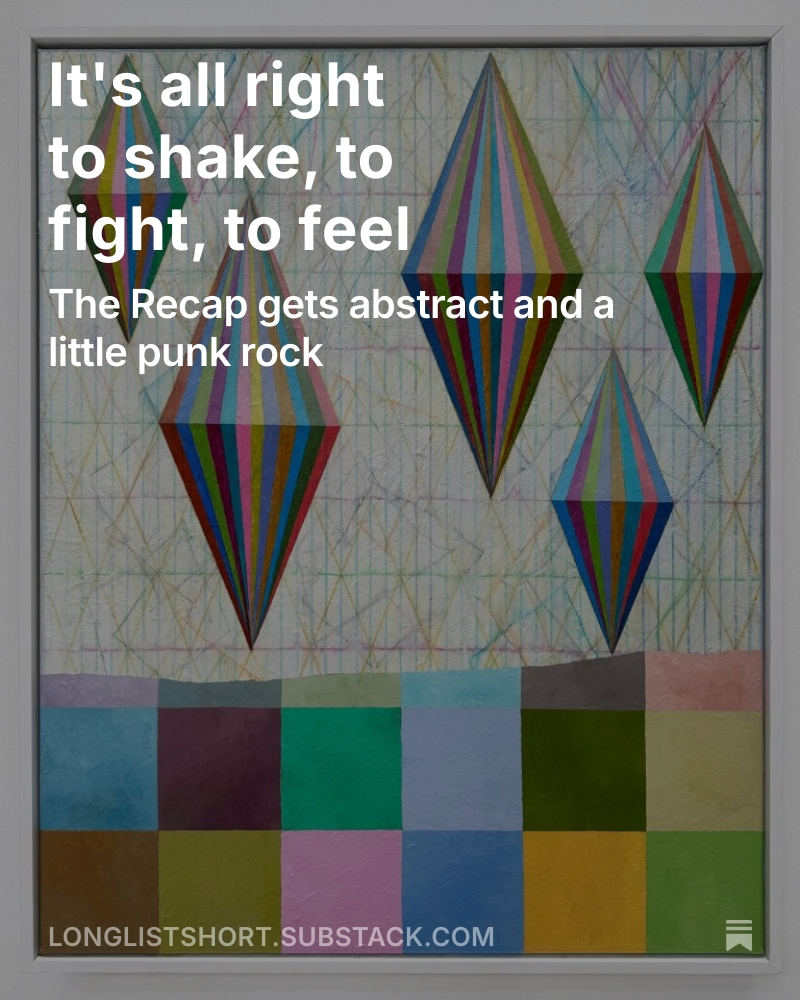
The Recap, my Substack newsletter, returns today with a focus on abstract art, punk rock, the American flag, the 90s, and more. It adds a little more dimension to what I post on the website and ties things together thematically.

Check it out and subscribe!

Sep 222025
 

Alice Bag performing with the Bags for “The Decline of Civilization I”

Ozzy Osbourne from “The Decline of Civilization II: The Metal Years”

Street kids from “The Decline of Civilization III”

From 1979-1998 director Penelope Spheeris made three films documenting the music scene in Los Angeles for the trilogy, The Decline of Western Civilization. All three combine interviews with musicians and their fans with live footage from the shows. Spheeris is able to capture the unique energy of the different scenes and present the participants she interviews without judgment.

The first, released in 1981, and probably the strongest, features concert footage of X, Black Flag, Circle Jerks, Bags, and the Germs, among others. Many of these artists continue to perform to this day, like Pat Smear of the Germs who would go on to play with several bands- including Nirvana and Foo Fighters.

It’s also fun to see a young Phranc (pictured below) playing in Catholic Discipline. She would later switch to folk music and creating fun cardboard sculptures. At the same time it’s sad seeing Darby Crash behind the scenes knowing he would die by suicide in 1980 before the film was released.

X (Exene Cervenka and John Doe)

Phranc

Darby Crash

Pat Smear

The second installment, The Decline of Western Civilization Part II: The Metal Years, changes tone quite a bit as Spheeris covers the heavy metal scene in the late 1980s.  Big hair, big hopes, and lots of makeup mark a big change from the previous punk era, both in attitudes and musical style. Several big names show up along with the lesser known bands including Ozzy Osbourne, Lemmy from Motörhead, Poison, Aerosmith, and Alice Cooper. Gene Simmons and Paul Stanley from KISS also make appearances, the latter filmed on a bed surrounded by women.

Two members of Poison

The third installment, released in 1998, returns to punk music twenty years later. It also returns to the style of the first installment, but this time focuses more on the “gutter punks”- homeless kids living on the streets of Hollywood.  There are several scenes of them panhandling, partying, and talking about their rough upbringing. These scenes are mixed with band footage and interviews with some of the musicians from the previous punk scene, like Flea and Rick Wilder (of The Mau Maus), who provide their perspective on the changes. Spheeris was so moved by the stories these kids told, she went on to be a foster parent after making the film.

Rick Wilder of the Mau Maus

All of these films were released in a box set with the help of Spheeris’s daughter Anna. They are also available on several streaming sites.


Sep 122025
 

Born today, 9/12, artist Robert Irwin used light and space in his work as a way to create an experience for the observer. He started out as a painter but later became well known for his site-specific installations and architectural and outdoor projects- including the central garden at the Getty Center in Los Angeles (pictured below) and his work for the Chinati Foundation in Marfa, Texas.

The works above are from his 2020 exhibition, Unlights, at Pace Gallery in New York.

About that show from Pace-

Irwin’s new works are composed from unlit six-foot fluorescent lights mounted to fixtures and installed in vertical rows directly on the wall. The glass tubes are covered in layers of opulently colored translucent gels and thin strips of electrical tape, allowing the reflective surfaces of unlit glass and anodized aluminum to interact with ambient illumination in the surrounding space and produce shifting patterns of shadow and chromatic tonality. Reflecting his recent turn toward the perceptual possibilities of unlit bulbs, Irwin’s new body of work expands the range of possibilities for how we experience sensations of rhythm, pulsation, expansion and intensity, while continuing the artist’s long-standing interest in registering the immediacy of our own presence in space.

Expanding from his breakthrough disc paintings of the late 1960s, Irwin’s new works effectively dissolve the perceived border between object and environment, focusing the viewer’s consciousness on the act of perception. Each light fixture in Irwin’s sculptures contains one or two unlit bulbs—or no bulb at all—while alternating gaps of “empty” wall are painted in subtle shades of gray, producing a sense of uncertainty about what is tactile and what is merely optical. As the shadowed, painted and reflected intervals of space reverberate in the viewer’s visual field, the wall itself enters the composition, destabilizing any sense of figure and ground. To encounter Irwin’s sculptures is thus to allow oneself to be caught in a ceaseless oscillation between flatness and volume, transparency and opacity, solidity and atmosphere.

In Irwin’s art, the object functions as a kind of score for orchestrating “the continual development and extension of humans’ potential to perceive the world.” Although unlit, the bulbs in these new sculptures are therefore never “off.” Their optically rich surfaces serve as energetic loci for heightening the sensory possibilities of the human body. In their chromatic complexity, the works convey an almost painterly quality, recalling Irwin’s origins as a second-generation Abstract Expressionist painter in the 1950s. Suggesting a rhythmic, minimal composition of repeated linear elements, the works also evoke his innovative line paintings of the early 1960s, which involve us physically and perceptually in an open-ended, immersive and transitory experience of seeing.

Widely recognized as a pivotal figure in contemporary art, Irwin is closely associated with the Light and Space movement that emerged in Los Angeles in the 1960s, and he has continued to live and work in Southern California for his entire career. He first used fluorescent lights as substrates for producing what he has called a “conditional art” in the 1970s, often in combination with architectural scrims and other spatial interventions. In the 1990s he introduced colored gels to the fluorescent tubes to alter the chromaticism of the light, and, over the past decade, began isolating the bulbs and fixtures as sculptural objects in their own right. In returning to the use of solely ambient light, Irwin’s new sculptures embody the culmination of seven decades of rigorous experimentation.

“Everything in the world is ultimately conditional,” Irwin has observed. “There is nothing that’s transcended or infinite or whatever you want to call it. Everything acts within a set of conditions.” Like all of Irwin’s works, his new sculptures respond differently to the conditions of each specific environment in which they are installed, attuning our senses to a given context and making possible an intuitive and incidental experience of seeing that resists rational or conceptual explanation. “It’s not about answers,” the artist once remarked, but rather about the act of questioning: “It’s the constant pursuit of the possibilities of what art is.”

Getty Center, Los Angeles

Below is one of his earlier paintings Untitled, 1964-6, which was on view at Palm Springs Art Museum for the 2024 exhibition Particles and Waves: Southern California Abstraction and Science, 1945-1990.

From the museum about the work-

Although this work appears to have a monochromatic white surface from afar, a matrix of thousands of painted dots becomes visible from a closer vantage point. Irwin aimed to highlight the visual effects of color interaction by juxtaposing light green and lavender, complementary colors across from each other on a color wheel. The canvas’s outwardly bowed supports and the increasing density of dots towards the painting’s center further heighten the viewer’s perceptual experience of the work.

The documentary Robert Irwin: A Desert of Pure Feeling, does an excellent job detailing his life, art, and the philosophy behind his work. It is well worth a watch and inspiring to watch him still at work in Marfa at 87. He passed away in 2023 at the age of 95.

Jul 092025
 

In Alfred Hitchcock’s Vertigo, his thriller starring Jimmy Stewart and Kim Novak, issues of power, control, obsession, and identity loom large over the mysterious plot.  Stewart plays Scottie, a former San Francisco detective who retired when a traumatic incident left him with a debilitating fear of heights and vertigo. He is hired as a private investigator to follow an acquaintance’s wife, Madeline, played by Kim Novak, who has recently been acting strangely.

Shot in Technicolor, Hitchcock uses the vivid colors to represent the characters. Below, a hotel sign fills the room with an eerie green light, and Scottie’s head floats in red within a dream sequence that includes colorful animation.

There are also several recurring motifs throughout the film. One of the strongest is the various spirals present throughout the film- the tree rings, Madeline’s hair and the hair of the woman in the painting, and the staircase in the mission.  Of course, spirals can be dizzying, and when someone is feeling overwhelmed by their thoughts it is often referred to as “spiraling”- which Scottie is doing as the film progresses. They can also represent the cyclical nature of time.

Madeline and Scottie among the Redwood trees in Muir Woods

Madeline points to two lines marking her life.

Northern California is the backdrop and the scenes in and around San Francisco in the 1950s are stunning.

Vertigo received mixed reviews at the time of its release, but is now considered one of the best films ever made. Through his unique personal vision, Hitchcock created a world to get lost in, with new things to notice on each revisit. The film can also serve as a reminder to struggling artists to stay true to their own ideas- sometimes it takes time for a work to gain appreciation.

Jun 112025
 

In 2016, Taylor Mac performed his immersive 24-Decade History of Popular Music in a theater in Brooklyn for a full twenty four hours. Normally performed in sections, this was the first and only time this had been done. Decade by decade, from 1776-2016, the history of popular music and the history of America merge, with a decidedly queer slant.

The documentary, directed by Rob Epstein and Jeffrey Friedman, includes footage from the show combined with interviews with Mac, his incredible costume designer Machine Dazzle, his musical director Matt Ray, and his co-director Niegel Smith. Although Mac is the main performer, the show includes a stage full of musicians, additional singers, and his “Dandy Minions” who can often be found offstage interacting with the audience. Mac’s desire to draw people together and build community is highlighted during several moments focused on the audience’s participation.

Throughout the many hours, performers leave the stage for good leaving only Mac by the end of the show. This is meant to mirror the losses from the AIDS epidemic. Even with only a small selection of these moments, you can feel the effect this creates.

Inventive, beautiful, funny, and often moving, this documentary provides a small taste of the performance and will leave you wanting more.

Mac’s costume for the 1980s

Taylor Mac and Machine Dazzle

Mac’s costume photo shoot for the 1950s

Mac with an audience member

May 292025
 

Brazilian documentary photographer and photojournalist Sebastião Salgado passed away on May 23rd at the age of 81. His distinctive black and white images brought attention to previously unseen cultures, devastating humanitarian crises, and the struggles of workers, all around the world.  Later, he turned his sharp focus to the remote natural world and its inhabitants.

The images in this post are from the 2014 documentary The Salt of the Earth, co-directed by Wim Wenders and his son Juliano Ribeiro Salgado. The film celebrates the artist’s life and career and focuses on several of his large projects.

Salgado also created Instituto Terra with his wife Lélia in 1998. The organization focuses on planting trees and restoring Brazil’s Atlantic Forest. The project began in on his family’s farmland, pictured below, before and after the restoration.

Below are additional images from Salgado’s environmental work seen in the film.


Mar 172025
 

The Work of Art: How Something Comes from Nothing by former New York magazine editor Adam Moss is a fascinating look at the creative processes of several famous artists. Each artist discusses specific works and gives the reader an inside look at how they came about.

The 43 artists included are visual artists, writers, musicians, editors, designers, and many other creative categories. Moss is also an artist and you can see that in his desire to both inform the reader, and to learn for himself, what makes these individuals tick.

Many of the names will be familiar, but these behind the scenes looks are incredibly enlightening. These discussions often also inspired, for me, a deeper dive. I found myself watching videos of Twyla Tharp‘s choreography, reading Guy Talese’s essay and Sheila Heti’s book, listening to Moses Sumney, watching Tony Kushner’s Angels in America, and so on, as I progressed through the book.

While some artists will appeal more than others depending on your interests, all of them had something interesting and valuable to say. This book was one of my favorites of 2024.


Feb 212025
 

As part of PST ART: Art & Science Collide, The Getty is highlighting the incredible work created by the engineers and artists that made up the group Experiments in Art and Technology (E.A.T). The exhibition focuses on the history of the group and two of its most ambitious projects- 9 Evenings: Theatre & Engineering (1966) and the Pepsi Pavilion from Expo ’70 in Japan.

From the museum-

In 1966, engineers Billy Klüver and Fred Waldhauer and artists Robert Rauschenberg and Robert Whitman founded Experiments in Art and Technology (E.A.T.), a not-for-profit organization dedicated to promoting and supporting collaborations between artists, engineers, and scientists. These partnerships brought disparate fields together, bridging the gap between culture and emerging technology. E.A.T.’s debut event, 9 Evenings: Theatre & Engineering (1966), integrated art, theatre, and engineering at the 69th Regiment Armory in New York City, resulting in a technology-aided performance experience that proved to be a launchpad for artistic exploration. Their second major project, the Pepsi-Cola Pavilion at Expo ’70 in Osaka, Japan (1970), presented a multisensory environment featuring experiments with sound, light, lasers, a mirrored dome, and fog. Through their collaborations, E.A.T. artists and engineers came to believe that such team efforts could benefit society; subsequent multidisciplinary endeavors, such as Projects Outside Art (1970), addressed issues of housing, education, environmental sustainability, and communication.

About 9 Evenings

In 1965, Swedish electrical engineer Billy Klüver and American artist Robert Rauschenberg gathered 10 avant-garde artists and 30 Bell Labs engineers to participate in a collaborative, multidisciplinary project combining new technologies with theatre, dance, and music. The event,9 Evenings: Theatre & Engineering, took place at the 69th Regiment Armory in New York, from October 13-22, 1966. More than 10,000 people attended performances by John Cage, Lucinda Childs, Oyvind Fahlström, Alex Hay, Deborah Hay, Steve Paxton, Yvonne Rainer, Rauschenberg, David Tudor and Robert Whitman. These performances incorporated technological equipment such as photocells, doppler sonar, remote controls, infrared cameras, and transistors. In addition, 9 Evenings engineers created the Theatre Electronic Environmental Modular, a flexible, wireless, networked control system, and the Proportional Control System (PCS), which used photocells to adjust light and sound levels. The event led to the founding of Experiments in Art and Technology the following month.

Below are images and objects from two of the nine evenings, Open Score and Physical Things

Performance description of “Open Score” by Robert Rauschenberg

About Open Score

Open Score began with a tennis match between professional player Mimi Kanarek and painter Frank Stella. Engineer William Kaminski wired their rackets with transmitters that caused every strike of the ball to emit a loud sound and extinguish an overhead light. The game continued until the Armory was completely dark. At that point, a cast of 300 volunteers walked onto the court and performed a series of loosely choreographed movements while infrared cameras projected their images onto large screens. Rauschenberg described the action as “the conflict of not being able to see an event that is taking place right in front of one except through a reproduction,” an idea that resonates in today’s world of social media, streaming, and smartphones. For the second performance, Rauschenberg added a third section in which he carried dancer Simone Forti around the Armory in a burlap bag while she sang an Italian ballad.

About Steve Paxton and Dick Wolff’s Physical Things

For 9 Evenings, Paxton created an enormous, inflated sculpture using Polyethylene and box fans and invited visitors to walk through the structure at their own pace, confronting different environments and performances along the way. After climbing through a 100-foot inflated tower, participants emerged into an enclosed area with wire loops suspended above their heads. Using modified transistor radios, they could listen to an array of sounds, including animal noises and sports commentary. One’s location underneath the sound loops determined which part of the score was audible, allowing people to choose where to linger and what to listen to.

One of the group’s most ambitious projects was for the Pepsi Pavilion (pictured above).

From the museum-

In 1970, the Pepsi-Cola Corporation commissioned E.A.T. to design a pavilion for Expo ’70 in Osaka, Japan. Artists Robert Whitman, Robert Breer, David Tudor, and Forrest Myers made early contributions to the design of the pavilion; eventually the design team included 20 artists and 50 engineers and scientists.

Outside the pavilion, a water-vapor cloud sculpture by the artist Fujiko Nakaya covered the white, faceted dome. On the plaza, seven of Breer’s Floats, six-foot-high dome-shaped sculptures, glided in slow motion while emitting sounds.

Visitors entered the pavilion through a tunnel and descended a staircase into a clamshell-shaped room lit by moving patterns of laser light. On the far end, another staircase led up into the Mirror Dome, a 90-foot diameter, 210-degree spherical mirror made of aluminized Mylar. Within the Mirror Dome, visitors’ reflected images appeared to float upside down above their heads.

You can find more images and further documentation here.

This exhibition closes 2/23/25.

Feb 202025
 

Charles and Ray EamesPowers of 10, is currently on view as part of Palm Springs Art Museum‘s Particles and Waves: Southern California Abstraction and Science, 1945-1990, among a collection of experimental abstract films.

In the nine minute film you travel in powers of 10 in two directions, starting with a couple having a picnic in a park in Chicago. You then zoom out into space until you are 100 million light years distance from them and then return to travel into the man’s hand in negative powers of 10 until you reach a proton of a carbon atom at 10−16 meters.

Below is the film in its entirety but it is definitely worth seeing on a big screen if you can.

Feb 172025
 

Wim Wenders‘ 2023 film Perfect Days, stars Kōji Yakusho as Hirayama, a toilet cleaner in Tokyo who leads a solitary but seemingly contented life. He spends his time outside of work reading, listening to music on cassette tapes, taking care of his plants, and taking analog photos of trees. This simple life begins to change as smaller and larger moments with others expand his world and alter his routines.

The quiet film focuses on a few of these people- including his coworker and later the surprise arrival of his niece. Watching them together as they spend his previously solitary days mirroring each other unconsciously, is especially lovely. After her departure there is another interaction that leaves the viewer to wonder if Hirayama will continue to live this simple life or embrace potential changes to his “perfect days”.

The pictures of the trees throughout the film capture the Japanese word “komorebi”. The word is defined at the end of the film, after the credits, as “the shimmering of light and shadows that is created by leaves swaying in the wind”. These images continue in Hirayama’s black and white dreams, created by Wenders’ wife Donata.

Wim Wenders is currently showing two bodies of work at Howard Greenberg Gallery in NYC- Written in the West, from his roadtrip to the American West in 1983 and Once, a series of works from his travels and encounters with Hollywood. This exhibition will be on view until 3/15/25.