Feb 062026
 

Giorgio de Chirico, “Portrait of Guillaume Apollinaire”,1914, Oil and charcoal on canvas

René Magritte, “The Secret Double”, 1927, Oil on Canvas

Dreamworld: Surrealism at 100 at the Philadelphia Museum of Art presents a large collection of works, in a variety of mediums, from the artistic movement. The show takes you through Surrealism’s history and is filled with many inventive and imaginative pieces- including several from lesser-known artists.

From the museum about the exhibition-

Surrealism burst onto the scene in Paris in 1924. French writer André Breton announced the aims of this revolutionary literary and artistic movement in his Manifesto of Surrealism. It started with a question: How, ideally, should we live? Breton observed that, at about twenty years of age, we make the error of trading our childlike imaginations for adult good sense and logic. Yet it’s the imagination that allows access to the innate state of freedom that we all possess. And maintaining freedom, Breton proposed, should always be the highest human aspiration.

Surrealism’s ambitions were broad and bold: its adherents wanted nothing less than a revolution in consciousness. To that end, they explored a method of experimental poetry called automatic writing, comparable to spoken free association, done spontaneously and, as far as possible, without conscious intent. Sigmund Freud’s theories about the role of the unconscious and the interpretation of dreams were an important inspiration. The Surrealists looked to access the unconscious mind to break free from the constraining rationality of the modern world.

Visual artists were part of the Surrealist movement from the start. They took up surprising and often challenging subject matter, imagery, and techniques across many mediums: painting, sculpture, drawing, printmaking, photography, book illustration and design, and film. In Dreamworld: Surrealism at 100, we explore how, from the movement’s 1920s beginnings through the 1950s, these trailblazing artists made good on Surrealism’s revolution in consciousness.

The exhibition is split into six categories- Waking Dream which features Surrealism’s beginnings in the 1920s, Natural History, focused on the influence of nature, Desire, Premonition of War, Exiles, and Magic Art, which focuses on the new type of esotericism that emerged within Surrealism in the aftermath of World War II.

Lee Miller’s photographs of natural rock formations

Salvador Dalí, “Aphrodisiac Telephone” 1938, Plastic, metal

From the museum about Aphrodisiac Telephone, one of the artworks in the Desire section

Salvador Dalí likened the Surrealist object, which uses found items, as a symbolic creation with improbable juxtapositions, comparable to poetry and sexual perversion. He applied this idea in Aphrodisiac Telephone. Its basis is the substitution of a lobster— a real lobster in the sculpture’s first iteration for display in 1938, a factitious lobster in white plastic for the editioned version —for a similarly shaped telephone handset. The title alludes to the lobster’s reputation as an aphrodisiac when eaten.

Max Ernst, “The Fireside Angel (The Triumph of Surrealism)”, 1937, Oil on canvas

From the museum about the Max Ernst painting above, from the Premonition of War section-

Ernst painted The Fireside Angel (The Triumph of Surrealism) to protest the atrocities of the Spanish Civil War as well as the defeat of the Republican side. But this depiction of a rampaging bird-headed beast also served as an allegorical reflection on the nature of evil. Ernst exhibited this painting as The Triumph of Surrealism — a despairingly ironic title given the situation in Europe — at the 1938 International Surrealist Exhibition in Paris.

During World War II many European artists escaped to New York City and Mexico. The Exiles section features works by these artists, as well as Mexican (like Roberto Montenegro pictured below) and American artists whose work could also be seen as part of the Surrealist movement.

Roberto Montenegro, “The Double”, 1938, Oil on panel

The last section of the exhibition Magic Art, focuses on the increase in post-war interest in supernatural themes. There was also a room devoted to the work of artist friends Leonora Carrington and Remedios Varo, who had moved to Mexico during the war.

Leonora Carrington, “And Then We Saw the Daughter of the Minotaur”, 1953, Oil on canvas

Remedios Varo, “Creation of the Birds”, 1957, Oil on Masonite

This exhibition is on view until 2/16/25.

Jan 312026
 

Secret Mall Apartment Trailer

The story in the 2024 documentary Secret Mall Apartment, feels relatively straightforward at first. In 2003, a group of eight artists built an apartment in a small, unused space in the Providence Place shopping mall in Providence, Rhode Island. They continued to use it until they were discovered a few years later. But the film takes you on a journey beyond the creation of the apartment. It’s also about gentrification, urban development, and artist housing; mall culture and consumerism; the artists’ work outside the apartment; and, by the end, even the question of what makes something art.

Artist Michael Townsend was no stranger to art installations. He had previously created one inside a drainage tunnel, allowing only a select few with keys to see it. When local artist venue and living space Fort Thunder was torn down, the idea of living in the nearby new mall began. He remembered noticing an odd extra space while the mall was still being constructed. After searching and finding it with his then-wife Adriana Valdez Young, friends and fellow artists Colin Bliss, Andrew Oesch, Greta Scheing, James Mercer, Emily Ustach, and Jay Zehngebot joined them to build the apartment. Luckily for viewers, the process was also documented with a Pentax Optio (even if the footage is low-res). Furniture was added, along with a video game system, and eventually a wall.

While their new home provided a break from the outside world, it also became a place for the artists to plan their tape-art installations. These included a five-year portrait series in NYC for 9/11; a mural on the site of the Oklahoma City bombing; and creating work with kids on the walls of Hasbro Children’s Hospital in Rhode Island. Townsend continues to make tape-art projects today.

The documentary is fun to watch and at times, even inspirational. It’s currently available to watch on Netflix and other online platforms.

Dec 182025
 

Work by Mel Rosen (sculpture) and Stass Shpanin (mural, video, and paintings)

Detail from Stass Shpanin’s “Dance of Birth” animated video

Ceramic sculptures by Mel Rosen

Paintings by Stass Shpanin

The Delaware Contemporary is currently showing three exhibitions as part of its 2025 Biennial  Art + AI programming. This post covers two of them, the third is here.

Construct | Disrupt: Artificial Intelligence as Tool and Material features work by artists Mel Rosen, Stass Shpanin, Sol Kim, and Mark Burchick.

From the museum about the exhibition-

In an age when reality itself feels unstable—filtered through algorithms, fragmented by digital archives, and refracted through competing narratives—artists are increasingly turning to the tools of fiction and speculation not to obscure the truth, but to question how we construct it. Construct | Disrupt brings together the work of Mel Rosen, Sol Kim, Stass Shpanin, and Mark Burchick, four artists who use artificial intelligence, language, and archival material to explore the porous boundaries between perception, memory, and belief.

Across diverse practices—from ceramics, drawing, and painting to video, installation, and text—these artists engage with AI not as a replacement for the hand, but as a provocateur, a co-conspirator, and a mirror to the human imagination. Rather than seeking resolution or certainty, their works open up space for doubt, complexity, and contradiction.

Together, the artists in Construct | Disrupt invite us to consider how we construct meaning in a world where the archive is no longer fixed and where the image can be endlessly generated. The work of these artists does not offer answers, but rather asks: What do we trust? What do we remember? And how do we decide what is worth believing?

About the two artists pictured above, from the museum-

Stass Shpanin engages history as a space of imaginative reconstruction. Working with visual fragments from American folk traditions and immigrant archives, he uses AI to distort and reconfigure the past, generating speculative images that blend glitch, myth, and memory. His paintings and drawings present broken, layered timelines where visual language is both preserved and interrupted. Rather than restoring a singular truth, Shpanin’s work embraces the possibility of many coexisting histories—ones shaped as much by fantasy as by fact, as much by the digital as the ancestral.

Mel Rosen’s practice draws from archaeology, natural history, and personal memory to create objects and images that feel both ancient and otherworldly. Her use of AI image generation allows her to iterate quickly, mutating prompts based on her own drawings and a mental library of organic and cultural references—from Pompeian frescoes and fossils to barnacles and talismans. The resulting images feed back into her ceramics and drawings, where mythic forms and geometric distortions coexist in a suspended cosmology. Rosen’s work suggests that artifacts—whether material or digital—are always evolving, reshaped by time, environment, and interpretation.

Still from the video “Person Enough” by Sol Kim

Sol Kim (video still above) approaches language as a material form, using words to subtly disrupt social and technological systems. Her works often begin with a textual prompt—an instruction, label, or survey—that gives rise to absurd, humorous, or quietly unsettling performances. In The Cookiest Cookie, cookies are judged and destroyed by AI based on their perceived “cookie-ness,” while in Person Enough?, performers attempt to become more legibly “human” to computer vision systems. Through these gestures, Kim reveals the tensions between human nuance and machine classification, exposing the strange logic that governs our interactions with technology—and with one another.

Mark Burchick Installation

Images from Mark Burchick’s “Felt Presence”

Mark Burchick’s Felt Presence explores the intersection of faith, media, and artificial intelligence through the lens of Catholic mysticism. Drawing on archival photographs from the 1917 “Miracle of the Sun” in Fatima, Portugal, Burchick trains AI models to generate photorealistic images of miracles that were never captured on film. Presented alongside historical documentation and witness testimony, these fabricated scenes invite viewers to question the boundaries between belief, evidence, and visual truth—highlighting the unseen technological, institutional, and spiritual forces that shape our perception of reality.

In NOO Icons, Burchick expands this inquiry through an immersive video installation framed like a reliquary. A five-minute rear-projected loop, trained on over 100 images of stained glass Rose Windows, morphs into abstract color fields via AI animation. At its center is a 3D-printed altar piece generated using DreamFusion, a text-to-3D tool prompted to create a “solar monstrance.” The resulting object—gold-finished, internally lit, and housing Lithium batteries—evokes both the Communion host and a technological relic. As Kate Crawford notes in Atlas of AI, Lithium is a sacred yet finite resource driving modern AI. By encasing it in plastic and low-res form, Burchick critiques the planned obsolescence and ecological cost of our AI-powered age, reframing divine presence through the lens of material decay.

In another of the museum’s galleries is- Reimagine | Reveal: Challenging the Algorithmic Gaze featuring work by Danielle Glovin, Stephanie Dinkins, and Leah Modigliani.

About the show from the museum-

The works covering this exhibition theme approach AI not as a neutral instrument, but as a complex cultural system—one that reflects, amplifies, and at times distorts the values of its makers. Through the intersecting strategies of critique, reimagination, and bias exposure, Danielle Glovin, Stephanie Dinkins, and Leah Modigliani probe the systems—algorithmic, archival, social—that dictate what is preserved, who is recognized, and how knowledge circulates.

Together, these artists ask urgent questions: Who trains the algorithm? Whose histories are encoded, and whose are left out? What does it mean to build an intelligence—and who is it built for? In doing so, they model a critical engagement with AI, one that challenges default narratives, centers marginalized perspectives, and opens up space for new possibilities. Their practices call us to reconsider what it means to know, to remember, and to be recognized in a world increasingly shaped by invisible systems of intelligence.

Stephanie Dinkins’ interactive sculpture Not The Only One (N’TOO)

Stephanie Dinkins’ “Conversations with Bina48” (back wall) and Leah Modigliani’s AI generated letters for “Cultural Capital”

From Danielle Glovin’s series “Future Generations”

About the artists’ work pictured above-

Stephanie DinkinsNot The Only One (N’TOO) and Conversations with Bina48 extend this inquiry into the realm of relational AI, specifically that of minority groups in the tech sector. In N’TOO, an interactive sculpture gives voice to the oral histories of three generations of Black women, creating an AI entity intentionally designed, trained, and aligned with their values and lived experiences. It is a poignant reversal: instead of AI extracting meaning from biased data sets, Dinkins encodes her AI, reorienting the goals of intelligence design toward inclusivity and equal representation.

In Conversations with Bina48, Dinkins engages in an evolving dialogue with one of the world’s most advanced humanoid robots- probing the limits of kinship, consciousness, and identity. The recorded exchanges navigate tensions between human and machine, emotion and algorithm, intimacy and abstraction—underscoring the urgency of developing AI systems coded to reflect the full richness and diversity of human stories, cultures, and embodied experiences.

Leah Modigliani’s Cultural Capital offers a satirical yet incisive intervention into the circuits of artistic legitimacy. Through a fictional archive of AI-generated letters of recommendation and rejection—authored in the mimicked voices of historical critics and curators—Modigliani reveals how the rhetoric of value and genius in the art world is both constructed and recursively reinforced. The project uses generative tools to lay bare the biases embedded in cultural gatekeeping, drawing attention to the ways AI might amplify inherited hierarchies under the guise of neutrality.

Danielle Glovin’s Future Generations presents AI-generated reinterpretations of inherited family photographs, exposing the mechanics of machine vision and the flattening effects of automated classification. By transposing Midjourney text outputs onto her photographs, Glovin literalizes the collision between personal history and digital taxonomy. The result is a visual language at once familiar and estranged—where nostalgia meets simulation, and memory is rewritten through the aesthetics of machine learning.

These exhibitions will close on 12/28/25.

Dec 182025
 

Portraits by Carrie Ann Baade

Reclaim | Reframe: Datasets and Cultural Visibility, is one of three exhibitions that make up The Delaware Contemporary’s 2025 Biennial- Art + AI. The timely show features work by Carrie Ann Baade, Tyanna Buie, Blažo Kovačević, and Tara Youngborg.

From the museum

Through AI and computational technologies, artists Carrie Ann Baade, Tyanna Buie, Blažo Kovačević, and Tara Youngborg construct layered narratives that reclaim overlooked and marginalized histories. In doing so, these artists unsettle dominant cultural and media frameworks that have long erased, distorted, or commodified lived experience. Exploring themes of identity, ancestry, and displacement, they use generative tools as critical instruments to question, expose, and reconfigure the archival and institutional biases embedded in history, culture, and the environment. From ancestral reclamation and speculative futures to immersive storytelling and data-driven environmental translations, their work advances a reimagining of social justice through the lens of artificial intelligence.

Together, these artists offer a complex portrait of making in the age of AI, revealing how tools shaped by those in power can both perpetuate bias and enable resistance. Their work asks: Who shapes the cultural record? When an AI model “remembers,” whose truth is it repeating? How can we reclaim agency within these systems (built on our collective labor)?

The images at the beginning of this post are from Carrie Anne Baade’s series, Birthplace. Her mixed media portraits of her ancestors, created with the help of AI, present a fascinating look at the stories of several women from early in American history.

From Baade’s statement about the work-

Birthplace is a visual exploration of personal ancestry, delving into the lives of women from colonial Louisiana between 1690 and 1750. Through oil painting, collage, and Al-generated imagery, I reconstruct the presence of these women-figures shaped by French colonial rule, Indigenous displacement, and Romani migration-whose stories have been largely absent from recorded history. Employing a methodology that blends archival research with imaginative storytelling, I create portraits that serve as visual hypotheses-acts of artistic and ancestral repair. The compositions incorporate antique lace, colonial maps, domestic fabrics, and found objects, mirroring the intertwined textures of lineage, migration, and identity. Al-generated image blending aids in synthesizing historically plausible references, speculating on the appearance and presence of women who were never visually recorded.

This project is not about one family, but a shared American inheritance. It reveals the complexity of identity in a land shaped by colonization, migration, and erasure. In rematriating these women to history, Birthplace offers viewers a visual counter-history-one rooted in survival, interconnection, and the enduring power of maternal lineage.

Pictured below are works from the other artists in the exhibition along with information provided by the museum.

Tara Youngborg examines how institutional data and machine learning shape our understanding of land and environment. Using field research, environmental archives, and US Geological Survey datasets, her datastream translates waterflow data and topographic maps into immersive video installations that highlight the limitations of digital representation. By transforming statistics into layered, shifting media, Youngborg portrays landscapes as dynamic terrains of knowledge. Glitches and ruptures in the work expose gaps between digital abstraction and lived experience, prompting questions about algorithmic authority and what is lost when place is reduced to data.

Tara Youngborg’s installation

Tara Youngborg’s installation (detail)

In AR (Argumentative Reality) and Truck for Three Illegal Passengers, Blažo Kovačević uses augmented reality, 3D modeling, and game engine software to confront invasive state surveillance and the dehumanization of migrants. Using digitally enhanced X-ray images from European Border Patrol inspections, he reconstructs a 2015 tragedy in Serbia where 54 undocumented passengers died in a van crash. His works shift between detached aerial views and intimate interior scans, altering typical media frames into ethical engagement. Kovačević warns how AI-driven technologies can perpetuate oppression through automated surveillance, data collection, and erasure, urging reflection on the politics of visibility and mediated violence.

A still from Blažo Kovačević’s video

Tyanna Buie reconstructs erased family histories and reimagines Black identity through speculative Afro-Futurist frameworks. Using ChatGPT and DeepFake technology, she remixes images, sound, and text to create narratives where absence becomes presence. In The Guardians of Nyala, Buie overlays her own likeness onto eighteenth-century Dutch dignitary portraits, then collaborates with AI to imagine a family history untouched by colonization. Rooted in personal narrative and Black popular culture, her counter-archive elevates erased lives and transforms AI from a tool of replication into one of radical self-authorship.

Two of the portraits from Tyanna Buie’s “The Guardians of Nyala”

This exhibition closes 12/28/25.

Nov 202025
 

In Welcome to Li’l Wolf, 2022-3 Fellow Amy Ritter‘s solo exhibition at A.I.R. Gallery, she explores the mobile home park where she grew up and her parents continue to live. Throughout her career she has documented several mobile home parks around the U.S. and considers how they reflect on the American Dream. For this exhibition the work is more personal and includes depictions of her father, his life, and his feelings of nostalgia.

From the press release-

In 2015, Ritter created the MH Archive to document the forgotten and marginalized mobile home communities across the United States. Through meticulous documentation consisting of interviews, photography, recordings, and video, Ritter has gained a deeper understanding of the diverse world of manufactured housing. This ongoing process of visiting mobile home parks now brings her back to where her interests originated, Li’l Wolf, her parents’ mobile home community in eastern Pennsylvania. Using her father’s camcorder from the ’90s, she turns her focus inside her childhood home for the first time. She offers the audience a glimpse into her father’s life by investigating the spaces he inhabits.

When the visitor first steps into the gallery, they are confronted by Li’l Wolf 6, part of the artist’s ongoing MH Window Series. In this life-sized photograph, taken of a window at her parents’ home, Ritter captures the exterior of a world often guarded and hidden from society. Installed opposite the photograph is the video “Happy Birthday Dean.” Here, Ritter gives the viewer an intimate tour of the inside of her father’s home, culminating with footage from a recent birthday party. The celebration evokes feelings of nostalgia in her father and a yearning for his childhood—a time when things were easier for him. As his age has increased, so too have his fears and resistance to change, encapsulated by the fifteen-minute video Fear | Comfort, projected on the central wall.

The insecurities that haunt Ritter’s father flicker across the projector and TV screen. But, unlike the details of his home’s exterior, they remain partly hidden from view. The viewer is asked to project onto Ritter’s father their own baggage about the American Dream. Seen through his daughter’s lens, he becomes a window into the psyche of an entire generation, leaving us with the question: “How do we restore the dignity of those who get left behind?”

Ritter more recently created work in a similar vein for the 2025 installation What Does it Feel Like To Be You at Ortega y Gasset Projects.

Nov 192025
 

In Andrei Tarkovsky‘s 1983 film, Nostalghia, a Russian author finds himself lost in memories of home while traveling in Italy researching the life of an 18th century Russian composer who committed suicide after returning to Russia from Italy. The film initially follows the author, Andrei Gorchakov, and his relationship with his attractive interpreter. Drifting between dreams of his family in Russia shot in black-and-white and the present day in color, he later becomes fascinated by a local man, Domenico, who struggles with complicated issues of his own.

Nostalghia features motifs Tarkovsky used in many of his films including reflections, mirrors, water, and birds. There are also several scenes reminiscent of Ingmar Bergman‘s work, including the dream scenes of his wife and the interpreter (seen below). Tarkovsky’s feelings while living in Italy, away from his homeland, are also mirrored by those of Gorchakov.

It is in the character of Domenico (played by actor Erland Josephson who was also in several Bergman films), his past, and his connection to the author, that the film takes a more interesting and tragic turn.

Through Domenico’s moving speech, given from on top of a statue of Marcus Aurelius in Rome, Tarkovsky comments on a culture he sees headed in the wrong direction.

“What ancestor speaks in me? I can’t live simultaneously in my head and in my body. That’s why I can’t be just one person. I can feel within myself countless things at once.

There are no great masters left. That’s the real evil of our time. The heart’s path is covered in shadow. We must listen to the voices that seem useless in brains full of long sewage pipes of school wall, tarmac and welfare papers. The buzzing of insects must enter. We must fill the eyes and ears of all of us with things that are the beginning of a great dream. Someone must shout that we’ll build the pyramids. It doesn’t matter if we don’t. We must fuel that wish and stretch the corners of the soul like an endless sheet.

If you want the world to go forward, we must hold hands. We must mix the so-called healthy with the so-called sick. You healthy ones! What does your health mean? The eyes of all mankind are looking at the pit into which we are plunging. Freedom is useless if you don’t have the courage to look us in the eye, to eat, drink and sleep with us! It’s the so-called healthy who have brought the world to the verge of ruin. Man, listen! In you water, fire and then ashes, and the bones in the ashes. The bones and the ashes!

Where am I when I’m not in reality or in my imagination? Here’s my new pact: it must be sunny at night and snowy in August. Great things end. Small things endure. Society must become united again instead of so disjointed. Just look at nature and you’ll see that life is simple. We must go back to where we were, to the point where we took the wrong turn. We must go back to the main foundations of life without dirtying the water. What kind of world is this if a madman tells you you must be ashamed of yourselves!

O Mother! The air is that light thing that moves around your head and becomes clearer when you laugh.”

Although written in the 1980s the speech feels relevant today, perhaps more than ever. Below is the re-release trailer.

Oct 262025
 

In Andrei Tarkovsky‘s Mirror (1975) we follow the history of a dying poet, told through his dreamlike memories. It’s one of Tarkovsky’s most personal films and is semi-autobiographical. His older mother appears in the film, and he includes poetry by his father, Arseny Tarkovsky. Alternating between black-and-white and color film, as well as Russian archival footage, the film is nonlinear. Different characters are at times played by the same actor, like the younger version of his mother and his wife.

The visual poetry of the film captures something universal that is hard to describe in words, but is very affecting. Mirrors, reflections, flooding, fire, a gust of wind- even just watching the condensation from a cup disappear from a table- there’s so much to take in and contemplate.

Filled with his famous long takes, time moves more slowly in Mirror, and provides a much-needed break from our often too fast-paced world.

Oct 182025
 

https://substackcdn.com/image/fetch/$s_!5vrz!,f_auto,q_auto:best,fl_progressive:steep/https%3A%2F%2Flonglistshort.substack.com%2Fapi%2Fv1%2Fpress_kit%2F175577049.jpg%3FtextColor%3D%2523ffffff%26aspectRatio%3Dinstagram%26bgImage%3Dtrue%26hidePreviewText%3Dtrue%26isDraft%3Dfalse%26hash%3D86331169%26version%3D13

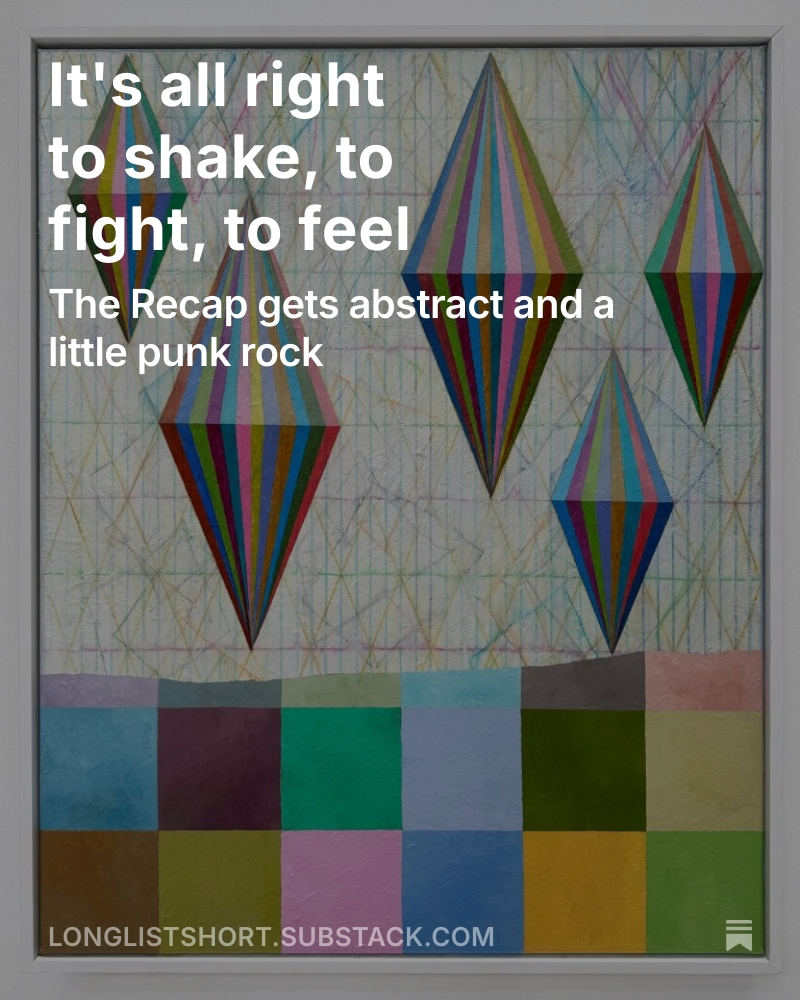
The Recap, my Substack newsletter, returns today with a focus on abstract art, punk rock, the American flag, the 90s, and more. It adds a little more dimension to what I post on the website and ties things together thematically.

Check it out and subscribe!

Sep 222025
 

Alice Bag performing with the Bags for “The Decline of Civilization I”

Ozzy Osbourne from “The Decline of Civilization II: The Metal Years”

Street kids from “The Decline of Civilization III”

From 1979-1998 director Penelope Spheeris made three films documenting the music scene in Los Angeles for the trilogy, The Decline of Western Civilization. All three combine interviews with musicians and their fans with live footage from the shows. Spheeris is able to capture the unique energy of the different scenes and present the participants she interviews without judgment.

The first, released in 1981, and probably the strongest, features concert footage of X, Black Flag, Circle Jerks, Bags, and the Germs, among others. Many of these artists continue to perform to this day, like Pat Smear of the Germs who would go on to play with several bands- including Nirvana and Foo Fighters.

It’s also fun to see a young Phranc (pictured below) playing in Catholic Discipline. She would later switch to folk music and creating fun cardboard sculptures. At the same time it’s sad seeing Darby Crash behind the scenes knowing he would die by suicide in 1980 before the film was released.

X (Exene Cervenka and John Doe)

Phranc

Darby Crash

Pat Smear

The second installment, The Decline of Western Civilization Part II: The Metal Years, changes tone quite a bit as Spheeris covers the heavy metal scene in the late 1980s.  Big hair, big hopes, and lots of makeup mark a big change from the previous punk era, both in attitudes and musical style. Several big names show up along with the lesser known bands including Ozzy Osbourne, Lemmy from Motörhead, Poison, Aerosmith, and Alice Cooper. Gene Simmons and Paul Stanley from KISS also make appearances, the latter filmed on a bed surrounded by women.

Two members of Poison

The third installment, released in 1998, returns to punk music twenty years later. It also returns to the style of the first installment, but this time focuses more on the “gutter punks”- homeless kids living on the streets of Hollywood.  There are several scenes of them panhandling, partying, and talking about their rough upbringing. These scenes are mixed with band footage and interviews with some of the musicians from the previous punk scene, like Flea and Rick Wilder (of The Mau Maus), who provide their perspective on the changes. Spheeris was so moved by the stories these kids told, she went on to be a foster parent after making the film.

Rick Wilder of the Mau Maus

All of these films were released in a box set with the help of Spheeris’s daughter Anna. They are also available on several streaming sites.


Aug 252025
 

Max Cooper and Aho Ssan- When I Sit Alone. In My Thoughts. I Am Crushed.

This song is from Max Cooper‘s latest album, On Being, released in February of this year. He has released several videos for the songs on the album, each directed by a different artist and based on a quote from a prompt on his website.

This video above was created by Simon Kounovsky aka axonbody.

More information on the album and song from Cooper in the Youtube video description

The quote arrived on my album website after I asked “What do you want to express, which you feel you can’t in everyday life?”. Using thousands of anonymous quotes, my On Being album attempts to capture the experience of being human, now.

This was one of the first quotes from the database that reached out and grabbed my guts and squashed them. I had to tackle it, and I immediately contacted Aho Ssan with the idea, because his approach to music contained some of the intensity and noise elements that I felt were needed to deliver the quote.

It was submitted anonymously, so over the past few years I had a story in my mind about who submitted it and why. But then ahead of the Bristol show I heard from Robbie Evans, the writer of the words, who I met at the show. If any of you submitted any of the words in the project I’d love to hear from you so I can put a face to the name of the words I’ve spent my last 3 years with.

The writing process began with a live improvisation on Void and Vista Folds, which formed the structure of the 7 minute sequence. I then jammed with my hardware synths and pedals to introduce the aggression, and sent everything to Aho Ssan, who mangled and layered on his special blend.

The final touches came from a visit to Taichung, where recordings of the night market feature in the track, and finally, over compression to pump a sub bass into obliterating everything else to reach for some new chaos, for any you who have the full frequency response available. It was pure catharsis, and maybe not something many people will enjoy listening to, but that’s where the quote sent me, and hopefully it will be worthwhile for some of you.

3D/AV, Max Cooper’s live immersive audio-visual experience, is currently on tour and will be at The Belasco in Los Angeles on Saturday, 8/30/25.