Jul 022026
 

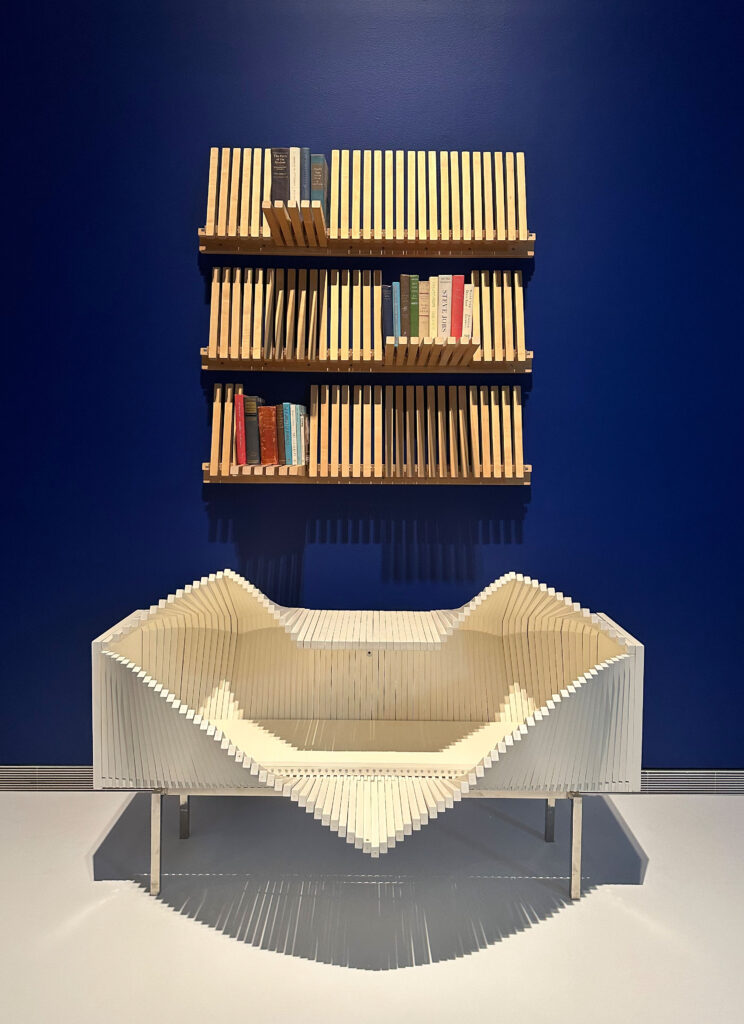
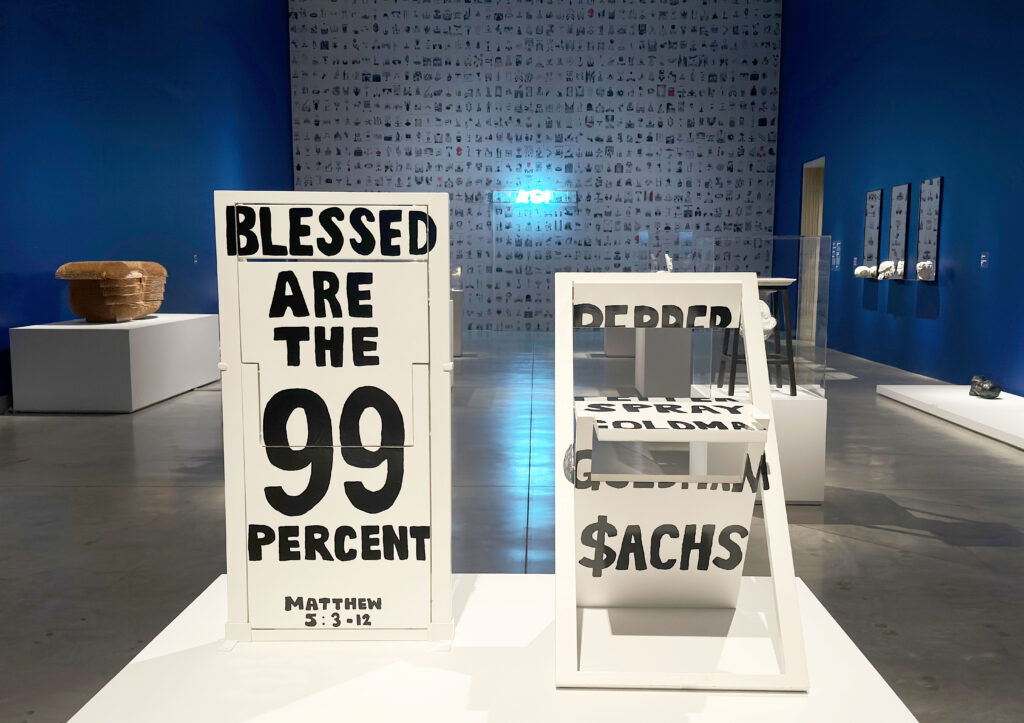
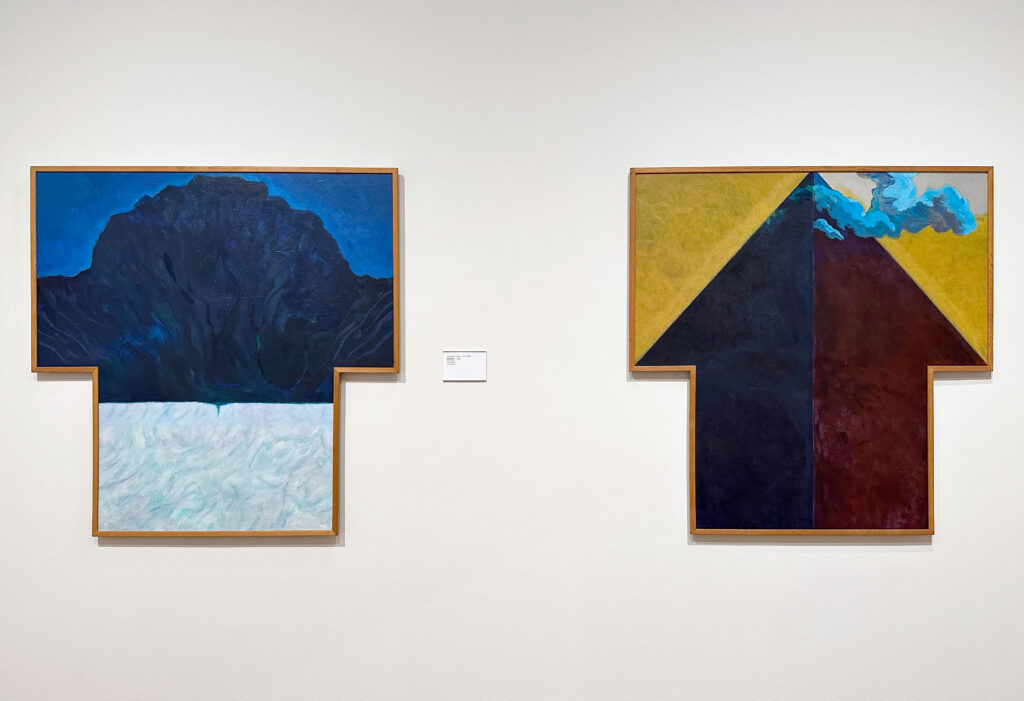
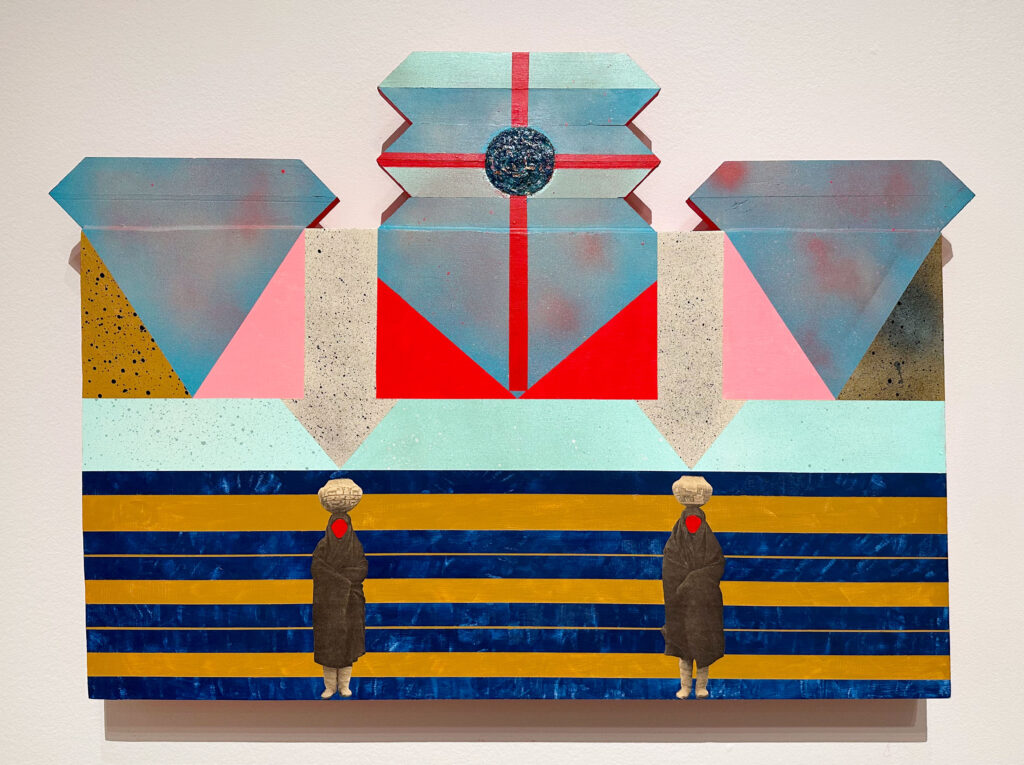
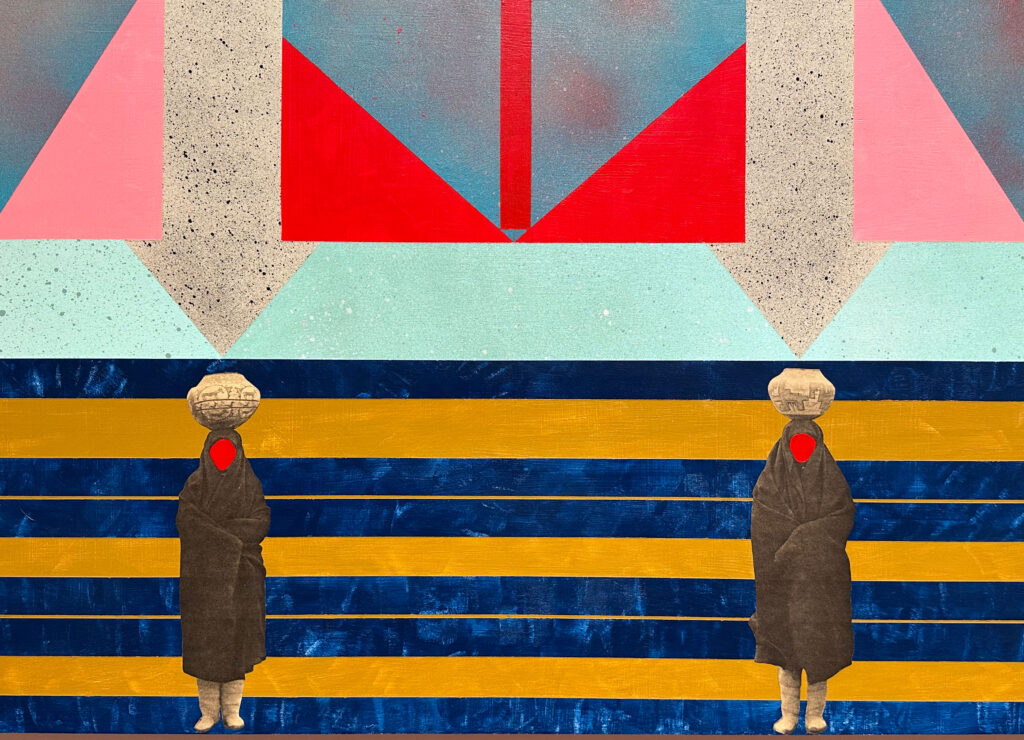
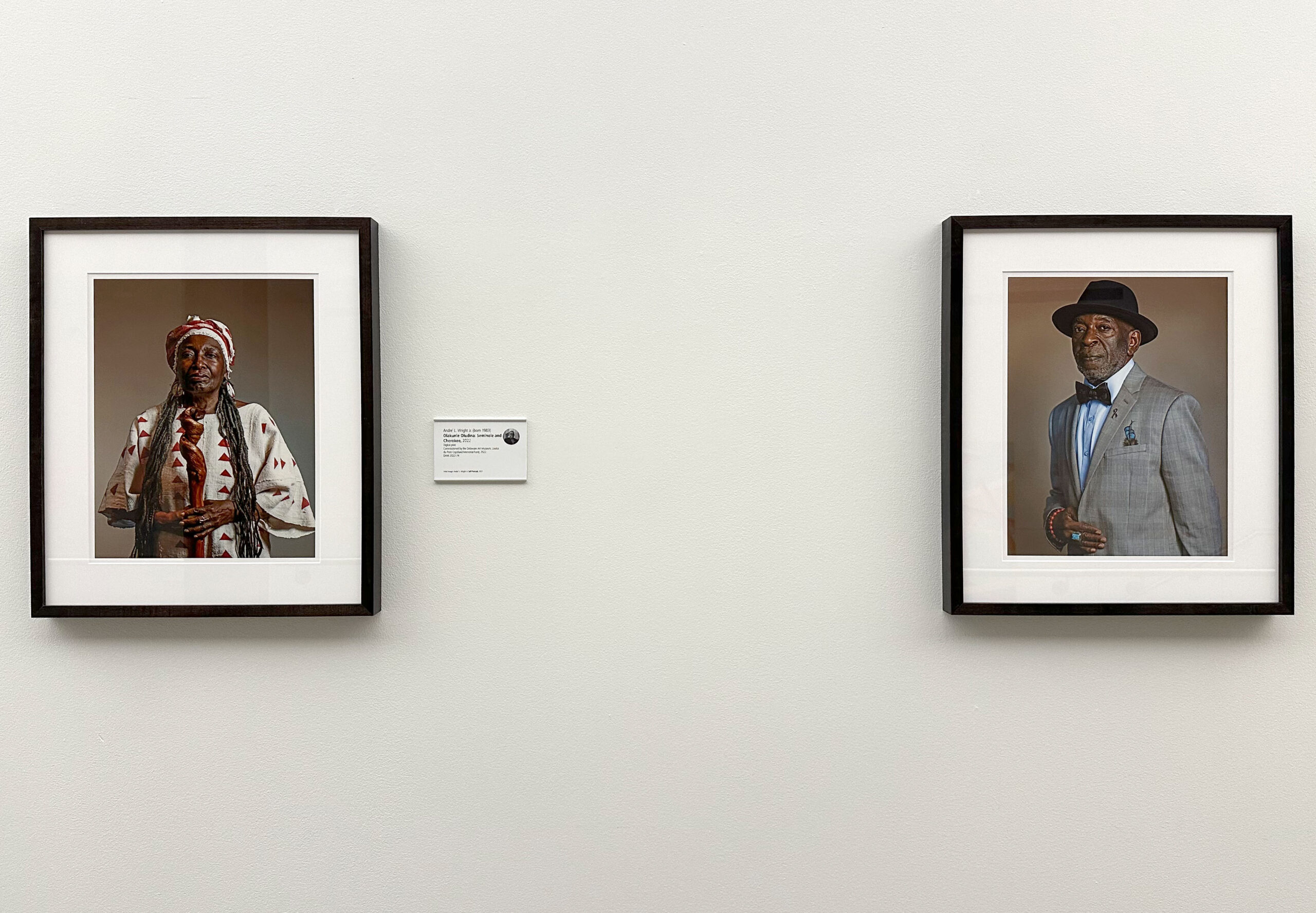
“Alberto Ayala”, acrylic on wood; Portrait of Roberto Lugo’s grandfather; and “Potpourri Boat”, Ceramic sculpture

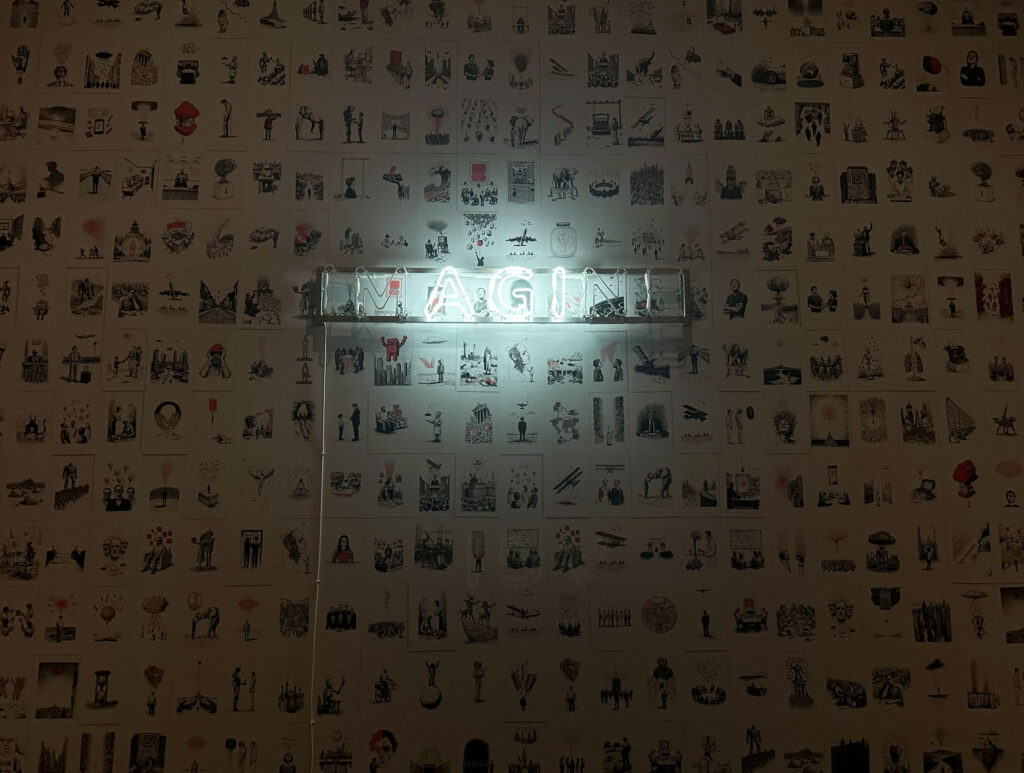
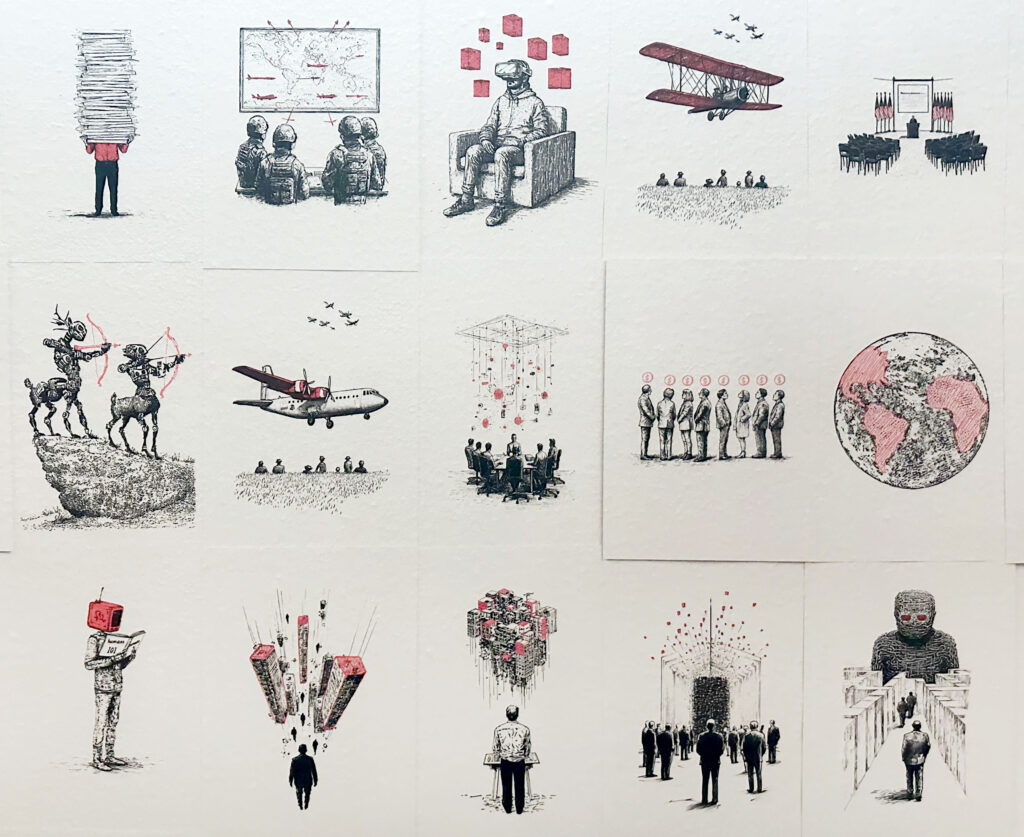
Art history, American history, and personal history mix in Roberto Lugo‘s exhibition, American Crib: What’s Happening?, currently on view at The Clay Studio. Wandering around the installation you’ll find portraits of Nikki Giovanni and Lugo’s grandfather, Billie Holiday and The Roots on ceramic sculptures, and plenty of places to sit and take it all in – including a graffitied train car.

From The Clay Studio’s website:

Roberto Lugo welcomes visitors into an imagined living space celebrating his Philadelphia roots and cultural heritage. This deeply personal reflection on America’s socio-political landscape celebrates the power of art to communicate. Lugo mixes historical pottery traditions with pop culture, humor, and critical clarity to address complex issues, including cultural identity, mental health, social justice, and the resilience of underrepresented communities.

This exhibition is a part of Radical Americana. A larger multi-location project that brings together art and culture institutions around Philadelphia. Learn more about Radical Americana here.

More than just a retrospective of Lugo’s career so far, “American Crib: What’s Happening?” will be a deeply personal and poignant reflection on America’s socio-economic and political landscape.

And the Lugo’s statement about his work:

My work is intended to be a biographical narrative that tells the many stories of my life. The objects I create speak of personal subjects – my experiences with obesity, racism, and class division. I use the associations with ceramic material and forms of pottery, such as elite fine china and porcelain, to discuss these issues with humor and irony. My strongest concepts are influenced from the juxtaposition of cultural elements in the form of mass media and current events. Using historical ideology within pottery as a vehicle to introduce a modern theme is of great importance because it allows me to add more dimensions to my artwork.

In the video below, also from The Clay Studio’s website, Lugo discusses the work, some of his inspirations, and the installation.

This exhibition closes 7/9/26.
Jun 262026
 

Tomorrow (6/27/26) is the last day to see Alexandria Nazar‘s paintings for Ducks on the Pond at AUTOMAT Collective.

From the gallery and curator Whitson Ramsey about the exhibition:

There’s a world where it seems an obvious choice to curate a baseball show in 2026, this country’s semiquincentennial, a cute milestone for this kitchen sink of a nation. After all, baseball is America’s Pastime. However, the sport predates America, and America itself is tremendously predated by the land it occupies. Even as a baseball fan myself, the idea of curating a show about baseball did not interest me. But this show isn’t about baseball. This is a show about painting, about bodies, about intimacy. Alexandria Nazar pays close attention to the subtle moments among players, coaches, their environments, and their mannerisms. Her paintings are about the material quality of paint on the surface as much as they are about the subjects they form.

This show highlights Nazar’s sophisticated yet playful handling of paint on a spectrum of canvas sizes. From the smallest work, a nearly monochromatic 7 x 5-inch painting, to the largest: a monumental, five-panel installation covering 17 feet on the gallery’s main wall, these paintings pack a punch and require a long, slow gaze.

On the other hand, a summer show whose content is explicitly relatable allows for a wider audience to enjoy these paintings. I firmly believe art should be accessible to the masses and not gatekept by private collectors and overpriced institutions. A surface-level “baseball show” allows new eyes to explore the subtle beauty of art-making and material exploration. Nazar has a knack for grabbing the viewer’s attention from a mile away. At the same time, she slowly draws you in, noticing the lustful impasto and clever brushwork, intense layers of underpaintings finding their way back to the surface, and a maze of abstracted clusters of intertwined bodies.

Ducks on the Pond is a celebration of paint through a gendered expression of male physique, American sports culture, brotherly love, and camaraderie.

Jun 262026
 

Protesting injustice is a powerful way for individuals to come together to create change. In the exhibition How We Stay Free at Tilt Institute for the Contemporary Image, photos by Mike Arrison, Harvey Finkle, Joe Piette, and Sunny Singh vividly capture past protests that have taken place in Philadelphia over the years, reminding visitors of the power of community.

From the gallery about the exhibition:

Following the widely publicized murders of George Floyd and other Black citizens by police, an unprecedented wave of public outcry swept the nation. Despite the pervasive uncertainty and restrictions imposed by the global COVID-19 pandemic, Philadelphians organized and sustained mass protests, taking to the streets to emphatically demand racial justice, police accountability, and structural reform. Later that same year, the tragic shooting death of Walter Wallace Jr. by police officers in the West Philadelphia neighborhood of Cobbs Creek further underscored these systemic issues. His family had called 911 seeking assistance for a mental health crisis, only for the encounter to escalate fatally, tragically illustrating the severe gaps in the community’s support and emergency response systems.

Inspired by the energy generated from these events, West Philadelphia residents Fajr Muhammad and Christopher Rogers published How We Stay Free: Notes On A Black Uprising. This project is not merely a book but a dynamic, living archive of community resistance, featuring powerful, multi-modal contributions from a diverse coalition of artists, writers, poets, and scholars who were active participants in the struggle. This exhibition, which shares the same title, serves as an essential visual and experiential archive. It documents the work initiated by the authors, alongside the tireless efforts of local organizations, grassroots collectives, and community-based activists. Philadelphia’s legacy of civil disobedience is both deep and enduring, stretching from the national Black Lives Matter protests to localized calls for Palestinian liberation and the No Arena fight against a proposed sports complex in the historic Chinatown neighborhood.

The visceral imagery and compelling narratives presented on the gallery walls emphasize a crucial point, a collective and sustained response is necessary to ensure meaningful and lasting progress is achieved. This philosophical approach—that change requires unity and shared purpose—serves as the foundational connective tissue binding both the publication and the exhibition. Spanning several decades of resistance and activism, the collection functions as a series of time capsules. These suspended moments deliberately position the artist not as detached photojournalists, but as participant-observers—marching alongside a broad and diverse coalition of revolutionaries united by the inalienable right of all people to be truly free.

This show closes 6/27/26.
Jun 252026
 

Shaun Kardinal “I II”, Woven paper ephemera and artist’s tape

Sculptures by Hyland Mather from the “Modus Volito” series

Framed images of work by Hyland Mather and Shaun Kardinal (sculptures by Hyland Mather on the left)

Sculptures by Hyland Mather

Discarded objects are transformed into new creations in works by Hyland Mather and Shaun Kardinal, currently on view in the two person exhibition, Form / Field, at Paradigm Gallery.

From the gallery:

This exhibition presents work from two distinct practices that converge through a shared sensitivity to line, structure, and process. Mather and Kardinal each explore how form emerges through accumulation, repetition, and material response, approaches that move between precision and drift, construction and discovery.

For his third major presentation with Paradigm Gallery, Mather presents works from several ongoing series, including Linea Pictura paintings, suspended “gravity works” (Onus Suspenda), and sculptural and assemblage-based works such as Modus Volito and Novus Inventa. Spanning painting, sculpture, and installation, the work explores line, structure, and found materials through processes of gathering, repetition, and thoughtful intervention. Across these works, line operates as both drawing and structure, with string extending into space, holding weight, or tracing paths across painted surfaces, allowing form to emerge through tension, balance, and material response.

In his debut Paradigm collection, Kardinal presents his woven paper quilts created from cut and punctured ephemera, along with a series of embroidered book pages and painted postcards, creating new forms from the smallest gestures. Kardinal’s work builds from repeating parts, embroidered marks, and modular systems that gather into larger compositions. These works often embrace landscape at a distance, horizons, city grids, or atmospheric depth, while remaining grounded in pattern and accumulation. Form, in this context, is built incrementally from repeated elements. In both practices, thread-like fiber elements and linear systems act as connective tissue, binding parts into larger wholes, or tracing form across space and surface. The “field” operates here as both a physical and conceptual space: a landscape, a surface of construction, and an invisible network of forces. Across both practices, it is within this field that form takes shape, held in a state of partnership between control and chance, repetition and variation, presence and possibility.

This exhibition closes 6/28/26.
Jun 252026
 

Curry J. Hackett, “The Gilded Block (Porch)”
mk. “you are so much to me pt. 1.” 2022

A golden inflatable porch by artist Curry J. Hackett welcomes visitors from outside the entrance to Spaces of Encounter, the current exhibition at Temple Contemporary, Temple University’s art gallery. Inside the gallery, Rokh Research & Design Studio founder and PhD student Danicia Monét Malone’s public arts research combines with NYU MA candidate Alyse Tucker‘s art curation to present an interesting selection of artwork, installations, and infographics that explore public art and shared spaces.

From the press release:

… Spaces of Encounter explores public space across North and Latin America and the Caribbean through the lens of public art. The exhibition brings together research and artistic material from Albuquerque; Cartagena; and Indianapolis, examining how people interact with public artworks across different urban contexts. Visitors are invited to reflect on who is welcomed into shared spaces—and who is made to feel excluded.

At the center of the exhibition is a guiding question: What does public space ask the body to believe about safety, care and belonging?

“For Black residents navigating environments marked by surveillance, neglect or misrecognition, aesthetic conditions operate as cumulative exposures that influence how safety, care and civic participation are felt in the body,” says Malone.

Through documentation, archival material and sculptural elements, Spaces of Encounter considers how public art mediates lived experience and contributes to collective memory. One featured work includes preserved fragments of a dismantled Black Lives Matter street mural in Indianapolis, foregrounding the fragility and afterlife of public artworks. Even when removed or destroyed, such works persist through memory, documentation and community impact.

“We’re interested in the afterlife of public art—what remains when the physical object is gone,” says Tucker.

The exhibition is particularly resonant in Philadelphia, a city shaped by one of the nation’s most expansive public art and mural programs. As development continues to transform neighborhoods, Spaces of Encounter offers an opportunity to reflect on how public artworks are preserved, displaced or erased—and what those changes mean for communities.

“Our gallery commissioned Spaces of Encounter to demonstrate Tyler’s commitment to being a beacon for art, architecture and community imagination in North Philadelphia and beyond,” says Temple Contemporary’s Director of Exhibitions and Public Programming Matthew Jordan-Miller Kenyatta, PhD. “By blurring inside and outside, the interior versus exterior, it smartly knits together the intimate, culturally specific meanings with public moments of spectacle that anyone can enjoy.”

This exhibition closes 6/27/26.

Jun 182026
 

Sonya Clark, “Whitewashed”, 2017, Sherwin-Williams house paint

Walking around the rooms of the Delaware Art Museum‘s contemporary collection you could almost miss Sonya Clark‘s Whitewashed. Painted onto one of the walls, her version of the U.S. flag uses only shades of white.

From the museum about the artist and the work:

Sonya Clark possesses the ability to deftly assemble works of art both beautiful in creation and weighted with content. Whitewashed is painted directly onto the gallery wall. Visually subtle, the work engages the viewer’s recollections of the United States flag. Whitewashed is made using three Sherwin-Williams house paint colors-Incredible White, Storyteller, and Natural Choice. The shades of white replace the red, white, and blue of the American symbol.

Clark has worked with the American flag, the Confederate flag, and the Confederate Flag of Truce throughout her career. In doing so, she addresses the physical makeup of these objects and the histories, experiences, and access these symbols uncover or veil.

Jun 172026
 

John Baldessari, “One and Three Persons (with Two Contexts-One Chaotic)”, 1994-2012, 14-color screenprint

California artist John Baldessari was born today, June 17, in 1931.  The print above was part of The Cleveland Museum of Art‘s 2024 exhibition, New Narratives: Contemporary Works on Paper.

From the museum about this work:

John Baldessari often incorporated appropriated (or “found”) imagery into his artwork, such as the photographs of architecture and rubble appearing in this print. He juxtaposed these elements with outlined figures in a typically obtuse manner to suggest a narrative or simply a feeling with strange or even ominous undertones. The artist’s interest in the formal qualities of art, such as dimensionality, highlighted by his use of the irregularly shaped sheet of paper, white cut-outs, and silhouettes, adds to the sense of suggestion and uncertainty in the print.

Jun 122026
 

Duane Michals, “The Spirit Leaves The Body”, 1968, courtesy of DC Moore Gallery


“Magritte with Easel”, 1965, courtesy of DC Moore Gallery

“A Letter From My Father”, 1975, courtesy of DC Moore Gallery

Innovative photographer Duane Michals passed away on Tuesday, 6/9/26, at the age of 94. He was famous for both his portraits of famous artists and celebrities, and for more personal work that often included his writing on the prints, something not done at the time.

He continuously worked up until his death, even shooting the campaign, What are Dreams, for Bottega Veneta last year. Featuring actor Jacob Elordi, it includes a short film along with a photo series, both based on a poem by Michals.

Jacob Elordi and Duane Michals in Bottega Veneta’s “What Are Dreams” campaign, photographed by Duane Michals in 2025. Photo courtesy of Bottega Veneta (image via Artnet)

His 2019 exhibition, Illusions of the Photographer at The Morgan Library and Museum included The Spirit Leaves the Body, and A Letter From My Father (pictured above), along with a few handwritten notes in his distinctive style, like the one below on death. Many of his photographs reflected an interest in mortality, but there was also a lighthearted aspect to many others.

For more on the artist, also check out this 2022 interview in Aperture magazine. In it he talks about his work, his partner of over 50 years (architect Fred Gorrée), his dreams, the importance of curiosity, and more. He also had a fun Instagram worth taking a look through.


Jun 112026
 

Mona Gazala, “Place and Power”, Broken concrete slab, paint, 2024

Closing this weekend, MOUTHFUL, a group exhibition at Vox Populi in Philadelphia, features a unique mix of works exploring aspects of language.

From the gallery about the exhibition:

MOUTHFUL brings together artists working with, around, through, against, beneath, within, alongside language. Featuring over 15 artists engaging a diverse set of techniques and media, the exhibition situates key archival pieces beside new and contemporary works: flags, impossible shots, concrete slabs, worksheets, disco on repeat, and many holes.

MOUTHFUL unearths echoes, rhymes, and dissonances across the past 50 years of cultural production. How and why do artists continue to turn to language as material? How and why do writers continue to turn towards visual practices to investigate language?  What sound does meaning make? What shapes do our mouths take? Curated by Vox Populi’s director, Blanche Brown, MOUTHFUL picks up these familiar questions and shakes them out: see what falls though May 1- June 14th 2026

Featuring: Robert Carey, Theresa Hak Kyung Cha, China Rain Chung, Logan Cryer, Catia Colagioia, Jordan Deal, Lucia Garzón, Mona Gazala, Rachel Hsu, Tan Lin, M Slater, Lea Devon Sorrentino, Cecilia Vicuña, Eva Wu, Connie Yu, Janet Zweig

Janet Zweig, “Mind Over Matter”, 1993, Computer, printer, paper, rock, rope, pulleys, basket

From the label for Janet Zweig‘s Mind Over Matter, pictured above:

The computer was fed three sentences:

I think therefore I am – Descartes

I what I am – Popeye

I think I can – The Little Engine That Could

It randomly generates sentences from the parts. Text slowly lifts rock.

Rachel Hsu, “Fetch the Moon from the Seabed(海底撈月)”, Inkjet prints on kozo, two from series

Pictured are two prints from Rachel Hsu‘s Fetch the Moon from the Seabed(海底撈月), a series that was on two walls of the gallery. Click on the image to enlarge.

Written on the information card beside the work:

Fetch the Moon from the Seabed(海底撈月), a long-form poem, investigates yearning and migration through language and translation. Taking the form of a Chinese language-learning workbook, the poem reveals the emotional and physical exertion that speaking a second language and cultural assimilation requires.

Logan Cryer, “How I Understand It All”, 2021-2026, Retired family basketball backboard

The words on the tape read: “If I turn around and speak by showing the back of my head, I am honestly telling you how I understand it all”.


Jun 102026
 

Donald Lipski, “Who’s Afraid of Red, White and Blue #37”, 1990, White wool gabardine, made in collaboration with The Fabric Workshop and Museum

Rose B. Simpson, “Tonantzin”, 2022, Linen, cotton, clay, and thread, made in collaboration with The Fabric Workshop and Museum

(L to R) Rev. Howard Finster, “George Washington Meets Martha Custis, 1984, Pigment on cotton t-shirt; James Luna, “High Tech War Shirt”, 1997-98, Smoked hide, nylon setting, silk suiting, horse hair, metal, shell buttons, bead work with watches and necklace (shell, thermometer, and plastic toys); Hock E Aye VI Edgar Heap Of Birds, “Who Owns History”, 1992, Pigment on cotton t-shirt (all works made in collaboration with The Fabric Workshop and Museum)

S.A. Bachman, “Are You Telling Yourself A Little White Lie?”, 1988, Edition of 5, Halftone photographic silkscreen pigment on nylon, made in collaboration with The Fabric Workshop and Museum

Pictured are just a few of the many excellent artworks currently on view in Some American Dreams at The Fabric Workshop and Museum in Philadelphia. Exploring the concept of America and the American dream, all the works were created by an impressive list of artists who were Artists in Residence at the museum over the past four decades.

From the museum and curator Hilde Nelson:

In her 1986 essay “Waking Up in the Middle of Some American Dreams,” poet June Jordan calls for a multiplicity of American dreams rather than a singular paradigm. For Jordan, those in pursuit of these dreams include:

the white people the black people the female people the lonely people the terrorized people the elderly people the young people the visionary people the unemployed people the regular ordinary omnipresent people who crave grace and variety and surprise and safety and one new day after another.

On the occasion of the 250th anniversary of the U.S. Declaration of Independence, this presentation of works from The Fabric Workshop and Museum’s collection explores the complexity of American-ness through lenses of history, memory, and mythology. Made by past Artists in Residence in collaboration with the FWM Studio, the projects reimagine symbols of nationhood and belonging, critique ongoing legacies of inequity, and offer expanded visions of kinship and community.

The works on view represent four decades of making at FWM. They meditate on themes including indigeneity and race, alternative origin stories, landscape and the environment, the construction of historical narrative, memory and resistance, and images of cultural affiliation. Sections of the exhibition invite additional voices, drawing their titles from a chorus of American poets, songwriters, essayists, abolitionists, and historians.

The artists featured in Some American Dreams break down borders and categorical distinctions to propose a polyphony of American dreams shaped by hybridity, friction, and affinity. They ask: what if America is not one project, but many? And how might these Americas be affirmed, resisted or remade, in Jordan’s words, to envision “one new day after another?”

This exhibition closes 6/14/26.