Dec 222025
 

Jean-Michel Basquiat was born today, December 22nd, in 1960. The painting above, Untitled (1981) is currently on view at The Broad in Los Angeles.

From the museum about this work-

Many of Jean-Michel Basquiat’s paintings are in some way autobiographical, and Untitled may be considered a form of self-portraiture. The skull here exists somewhere between life and death. The eyes are listless, the face is sunken in, and the head looks lobotomized and subdued. Yet there are wild colors and spirited marks that suggest a surfeit of internal activity. Developing his own personal iconography, in this early work Basquiat both alludes to modernist appropriation of African masks and employs the mask as a means of exploring identity. Basquiat labored over this painting for months — evident in the worked surface and imagery — while most of his pieces were completed with bursts of energy over just a few days. The intensity of the painting, which was presented at his debut solo gallery exhibition in New York City, may also represent Basquiat’s anxieties surrounding the pressures of becoming a commercially successful artist.

In the video below (also from The Broad) LeVar Burton discusses the work and its possible connection to Basquiat’s childhood and family.

Dec 122025
 

Cleveland artist Jake Kelly‘s 2010 mural was inspired by the artwork and concepts of ArtsCollinwood‘s portfolio project students. Along with his numerous murals band posters, and fliers, he has also made several comics detailing darker moments from Cleveland’s history.

He also created the fictional series, The Lake Erie Monster, with fellow artist John G. A few issues are currently available online for free.

More about the series from their website-

The flagship story is an “adaptation” of a fake movie that J. Kelly developed for a series of Ten Imaginary Movie Posters. Set in the 1970s, we follow a cast of eclectic characters as they have to navigate the choppy waters stirred up by a Monster born out of the pollution from a city gone to seed. Along with the main title, each issue will feature at least one short back up story.

The Aither‘s 2023 interview with Kelly is also worth a read for more information on the artist.


Oct 182025
 

https://substackcdn.com/image/fetch/$s_!5vrz!,f_auto,q_auto:best,fl_progressive:steep/https%3A%2F%2Flonglistshort.substack.com%2Fapi%2Fv1%2Fpress_kit%2F175577049.jpg%3FtextColor%3D%2523ffffff%26aspectRatio%3Dinstagram%26bgImage%3Dtrue%26hidePreviewText%3Dtrue%26isDraft%3Dfalse%26hash%3D86331169%26version%3D13

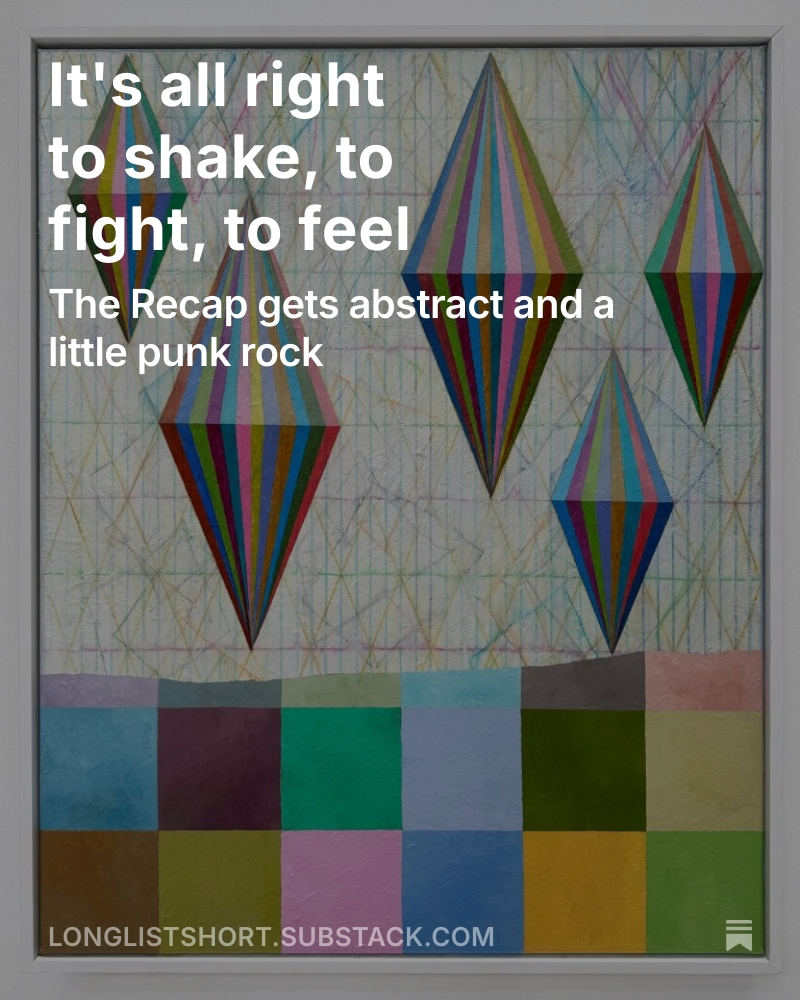
The Recap, my Substack newsletter, returns today with a focus on abstract art, punk rock, the American flag, the 90s, and more. It adds a little more dimension to what I post on the website and ties things together thematically.

Check it out and subscribe!

Oct 022025
 

Corita Kent (Sister Mary Corita)’s print I Should Like to Be Able to Love My Country and Still Love Justice, 1968, was on view at the Museum of Modern Art in NYC in June of 2024.

From the museum about the artist-

Corita Kent, also known in the Catholic Church as Sister Mary Corita, incorporated a range of references into her silkscreen prints, spanning pop culture imagery and song lyrics, biblical allusions, and literary conceits. After seeing Andy Warhol’s Campbell’s Soup Cans in 1962, she was inspired to embrace the language of Pop art, using bold, graphic designs to convey anti-war messages. In the 1980s Kent’s posters and ephemera were collected by PAD/D (Political Art Documentation/Distribution), a New York-based art activism group with a mission to create an archive of politically concerned art and ephemera from around the world. The materials are now part of the MoMA Archives, Library, and Research Collections.

You can currently see some of her photographic archive at Marciano Art Foundation in Los Angeles for the exhibition Corita Kent: The Sorcery of Images, on view until 1/24/26. The show “focuses on a little seen part of Corita’s artistic practice: her archive of over fifteen thousand 35 mm slides that she and her cohorts took between 1955 and 1968 while she was a beloved teacher in the art department at Immaculate Heart College”.

As part of their press release they include this lovely quote from the artist-

“In a sense, the whole world around the artist is his source, his sorting and relating powers are his sorcery, and the one isn’t much good without the other. … Anything can be a source, even a mistake. The sorcery or the thievery is the art of relating sources into a new solution.”

Her work can also be seen in Los Angeles at the Corita Art Center. The center is free to visit on Saturdays (with appointment).


Sep 092025
 

In honor of artist Sol LeWitt‘s birthday today (9/9), here is his work Wall Drawing #1240, Planes with broken bands of color (Akron), located at Akron Art Museum. It was created in 2005 and installed at the museum in 2007.

The piece was drawn by Megan Dyer, Tomas Ramberg, Joe Ayala, Jennifer Bair-Shipman, Ashlie Dyer, Kathy Ilg, Sarah Sutton and Kelly Urquhart.

From the museum about the work-

Presiding over the McDowell Grand Lobby is a wall drawing by Sol LeWitt, one of the leading artists of his time. LeWitt’s approach to art stressed rigorous design and geometric abstraction, rejecting narrative, emotion and representation for the reality of art’s elemental components—line, shape, space, color and the most important, concept.

LeWitt began creating wall drawings in 1968 in response to his concern-and that of other artists at the time-that art was becoming too much of a commodity. These drawings are not so much physical objects as ideas. The artist conceived and planned them; his “drafters” (artists themselves) draw them directly on the walls of museums and public spaces around the world. Drawings may share forms and motifs, but each is unique and many, like Akron’s, are site specific.

Wall Drawing #1240 was created by the artist for the 18 by 34 foot wall where the museum’s historic 1899 building and its 2007 expansion interconnect. The triangular shapes refer to the angled supports and folded forms of the newer glass and steel lobby, while the blocks of color echo the brick wall removed from the south façade of the older building. Two drafters, assisted by area artists, worked for five weeks to fabricate the wall drawing.


Aug 272025
 

William T. Williams, “Walter’s Advice”, 1970, Oil on canvas

10-color screen prints by William T. Williams in collaboration with HKL Ltd.

A selection of books surrounded by posters created for The Pennsylvania Opera Company

Six works by painter and printmaker Gabor Peterdi

Prints by Ilya Bolotowsky

Delaware Art Museum is currently showing an impressive collection of prints from a variety of artists for Marisol to Warhol: Printmaking and Creative Collaboration.

From the museum about the exhibition-

Marisol to Warhol: Printmaking and Creative Collaboration, brings together more than a dozen portfolios and suites in DelArt’s collection. The featured prints showcase the creative collaboration of artists who experiment across media. The exhibition presents a who’s who of American artists working in the second half of the 20th century, including Marisol, William Majors, Jacob Lawrence, Andy Warhol, Audrey Flack, Robert Blackburn, Ben Sakoguchi, Lorna Simpson, Lowell Nesbitt, and Luis Jiménez. Produced by individuals and print shops, these groups of prints functioned as tools for commemoration, fundraising, and political awareness in a range of techniques, styles and intentions.

Joining the exhibition is a special loan from Art Bridges, William T. Williams’ painting Walter’s Advice from 1970. Produced the same year as a newly acquired print portfolio by Williams, Walter’s Advice employs similar forms and colors. The two are displayed together to showcase an artist’s creative exploration across media and the collaborative aspect of printmaking.

Below are a few more selections-

Pages from Dead Birds, a book which combined poetry by Christopher Erb with prints by 24 artists.

From the museum-

Dead Birds pairs poetry by Christopher Erb with prints by 24 artists, demonstrating the vibrant artistic community around the poet and his wife Elena Laza, a printer, designer, and typographer. Erb penned the poems and sent them to artists who used them as inspiration for their prints. Once the prints were produced, Laza typeset and printed the text using a turn-of-the-century press and created boxes to house the prints.

Several of the collaborating artists were affiliated with Robert Blackburn’s Printmaking Workshop and the Center for Book Arts in New York, where Erb and Laza exhibited. Others worked and studied at the Art Students League of New York and were introduced to the project through Will Barnet, a master printer and longtime instructor at the League. Dead Birds was among Erb’s most ambitious and collaborative projects.

Above are four prints from Lowell Nesbitt‘s Moon Shot print series.

From the museum-

Lowell Nesbitt produced this suite of prints, published by the Palley Gallery, following his participation in NASA’s Artist Cooperation Program. Artists working for NASA had behind-the-scenes access to witness events like launches and splashdowns up close and in person. For this series, though, Nesbitt reproduces photographs of the one place NASA can’t let him go: the Moon.

Nesbitt is often associated with Photorealism, but these prints take evocative liberties with their approach to depicting the Moon. Bolstered by quotes from astronauts, Nesbitt meditates on the visual experience of seeing the Moon up close and undistorted by the Earth’s atmosphere. The cratered surface appears in shimmering gestural whorls against the black paper-an appropriate stand-in for the unpigmented vacuum of outer space. Nesbitt’s portfolio considers space exploration alongside his printmaking process. One lithograph showing the footprint of an astronaut’s boot pressed into the lunar soil seems to reference the lithographic process itself.

Upstairs in a separate section are prints from Salvador Dalí’s playing card series, seen below.

From the museum-

In 1967 and 1969, Salvador Dali designed a set of playing cards for the renowned French printing house Draeger Freés. Several years later, the artist revisited the project and created a series of 17 designs featuring an ace, jack, queen, king, and joker in each suit. The art dealer Reese Palley later published the 250-print edition with the goal of selling individual prints at an elaborate, 50th birthday party in Paris. The sales scheme, and the chartered Pan American flights from Atlantic City to the event, were widely covered in national press in January 1972. Both the original cards and the prints that followed feature Dali’s surreal motifs and reference many of his most famous paintings.

This exhibition closes 9/7/25.

Aug 212025
 

Painting by Kelly Irvine

Installation of sculptures by Allison Hudson

Work by Anna Guarneri

Each of the five artists in Bricolage: Artists and Accumulation, currently on view at The Delaware Contemporary, use their materials to express meaning through a layering process.

From the curators, Kasia J. Bunofsky and Leah Triplett-

“I have a very simple theory. I have always pretended that objects themselves formed a self-composition. My composition consisted of allowing them to compose themselves.” – Armand Pierre Fernandez (Arman) (November 17, 1928 – October 22, 2005)

When ‘assemblage’ first circulated as an art-historical term in the early twentieth century, it referred to the primarily formalist practice of joining tangible, often discarded or found, materials. Like a three-dimensional collage, assemblages made novel juxtapositions of individual components to create a whole artwork with its own impact. As the topography of the art world shifted mid-century, assemblage was often used to critique the post-war era’s burgeoning consumerism. Similarly, “accumulation” refers to a kind of assemblage that emphasizes materiality through the mass repetition of similar objects or forms. Accumulations lent themselves particularly well to expressing discontent with consumerism. They underscored the commodity’s necessity as a medium while maintaining the artist’s agency to reclaim meaning through the processes of recontextualization and repetition. As time persisted, assemblage continued to inspire and lend credibility to avant-garde contemporary movements. Even the new wave of ‘conceptual art’–a blatant rejection of materiality–was seen as an assemblage that forwent concrete objects to assemble ideas, language, or concepts. From installation art, to performance, to ‘relational aesthetics’, assemblage and accumulation helped pave the way for today’s contemporary art world and its many innovations.

Assemblage and accumulation emphasize the importance of each material element to the message of the completed work of art. This idea evokes a sense of collectivism; a metaphorical microcosm of material cooperation that might inspire a yearning to change our individualistic society, as art reminds us the whole cannot exist without the contributions of every one of its parts.

The artists and works featured in Bricolage: Artists and Accumulation reference the tradition of assemblage, accumulation, and their many corollaries; either through the performance held within their artistic process, their compilation of abstract concepts, or their passion to speak through material. They build, assemble, accumulate, gather, and collect. Using assemblage as both a method and technique, these artists engage assemblage as an action that is always in perpetual evolution of form. Be their medium drawing or sculpting, painting or installation-their material glass or found objects, acrylic or graphite- Anna Guarneri, Allison Hudson, Brynn Hurlstone, Kelly Irvine, and Emilio Maldonado, apply an iterative, intuitive approach to making, resulting in a bricolage.

This aesthetic- in which the whole is a sum of parts-demonstrates a depth of material knowledge. The works presented here require long looks to unfold and reveal their discrete components. Layering, stacking, blending, and amalgamating are processes and aesthetic devices that enable the viewer to experience the work in an instinctual way. Throughout these artists’ individual practices, an emphasis on transformation through collecting and comingling materials, media, and forms is paramount, with bricolage being a means for metamorphosis.

Below are additional works by the artists and information from the museum-

Allison Hudson

“My work explores the nature of cycles and the emergence of growth from decay. It’s tactile and fragile- a combination of unfired clay, wool, fabric, resin, and wax. Driven to manipulate raw materials into something new and unrecognizable, I enjoy the physicality of building, tearing apart, and mending together – striving to create work that is at once ethereal and visceral.”

Kelly Irvine

“My abstract color field paintings invite the viewer to step into a lush, translucent world of color. Drawn to the beauty of layered transparent hues from an early age, I use sheer color, overlapping forms, gestural brush work, organic forms, and repeating motifs that flow and intersect, resulting in delicious new hues and increased tonal depth. Contrast is important in my work as well; hard edges are in conversation with areas of soft gradation, while vibrant, neon hues pop against muted tints and natural, raw canvas.

I’m especially inspired by the canvas staining techniques and paintings of Helen Frankenthaler and Washington Color School artists Morris Louis and Kenneth Victor Young. I pair that inspiration with constant experimentation and manipulation of materials, developing new processes as a natural outcome.”

Anna Guarneri‘s work explores the possibilities of suggestive imagery and the devotional connotations of stained glass. She uses crude marks and associations to tap into early human experience, pulling from a range of sources – ancient art, architecture, dance history, and her own body. Colors in her work conjure poignant memories, turning drawn forms and glass structures into celebrations, memorials, or premonitions.

Guarneri’s latest body of work pulls from the visual world of postpartum life, incorporating imagery of bodily landscapes and interiors, and the various devices, accessories, and toys encountered during pregnancy, birth, and early motherhood.

Brynn Hurlstone

In Time explores the process of healing from trauma, and the permanent transformation left behind once that process begins. Layers of broken safety glass are frozen within ice and slowly melt over a steel platform. The thaw allows for the release of contained breakage onto the foundation, where it rests in a slowly evaporating pool of water. Over time the water evaporates and the shattered glass may be swept away, but the foundational steel upon which the process took place will forever carry its traces.”

Emilio Maldonado

“I create art to explore personal narratives and navigate life through the material culture of capitalist America.
My work raises questions about social constructs, structural inequalities, and the dynamics of race and class. Through a multidisciplinary approach, I repurpose discarded objects as a means to reflect on memory, identity, and social conventions.”

This exhibition is on view until 8/24/25.

Aug 212025
 

Work by Tracey Tse

The Delaware Contemporary currently has several shows on view for their summer series Radius. Several of these exhibitions include emerging artists including ARC 2025. The exhibition will close 8/24/25.

More from the museum-

The Artist-in-Residence Cohort (ARC) identifies and supports local emerging artists poised for careers as dedicated artists. This year, jurors Dr. Casey Smith and former ARC resident Shefon Taylor chose four regional artists: Geraldo Gonzalez, Oscar De Paz, Tracy Tse, and Lucy H. West. These artists have spent several months in intensive professional development seminars, formal and informal critiques, and one-on-one meetings with mentors to prepare for their culminating exhibition. This year, the ARC residents “came full circle” through mini-residencies at Art-O-Mat by the Wilmington Alliance. This extended their perspective on the creative needs and opportunities of Wilmington, Delaware. You are seeing the results of ten months of their experimentation, planning, and growth.

This year’s cohort pushed the envelope to develop their skills beyond what they came to the museum doing. Lucy H. West has incorporated sophisticated video editing, performance, and sculpture into a tracing of sensory experience. Oscar De Paz has refined his political commentary in his painting practice, deeply rooted in social revolution iconography. Geraldo Gonzalez increased his scale and output, documenting the legacy and daily role DART plays in his life. And Tracy Tse, with the help of a new loom, weaves plastic nets and tapestries. These artists grew through a new partnership with Wilmington Alliance, where they each spent one month in the Art-O-Mat studio space. Their time working with a view to mid-center city grounded their work in an even deeper Wilmington context.

Below are additional selections and the artists’ bios from the museum-

Tracy Tse– “I like this little life of mine. It’s not something amazing, and it’s not a tragedy. However, every day doing art is enough in my world.

I’m a first generation Chinese American who grew up in a family tailoring business. Like many family-run businesses, I started helping out at a young age where I picked up skills in mending and tailoring. Over the years I’m grown into the career as a contemporary artist, where I used my skills interconnectively to express myself.

In my current work, I have been incorporating plarn (yarn made from plastic) to construct large-scale sculptures that protrude from the wall. Each piece is completed through labor-intensive repetition of sewing, knitting, crocheting, weaving, braiding, and knotting techniques to sculpt. The use of a variety of techniques is then adopted and shaped to form a specific look that is derived from family, tradition, heritage, history, and childhood.

Manufactured goods go through many hands and iterations before becoming the final product. Every hand played a role by putting blood, sweat, and tears into the production. Honoring and paying homage to the human touch and the sentiments that are overlooked during the production process is important. My collection of depicts efforts laborers and craftsmen. Convey the message of what human touch means.”

Geraldo Gonzalez

“I am, first and foremost, a transit artist. I began working as an artist in the early 2000s. I first started taking photos for a homework assignment in middle school, which inspired me to start taking photographs of local transit systems. Public transit has always been an interest of mine. I regularly took the bus as a teenager going to and from school, then went out and got to know other transit routes within the greater Delaware valley, like SEPTA, PATCO, AMTRAK, MTA, NJT, and DTC. My passion for public transportation has led me to make thousands of artworks to encourage people to use and find the beauty in these local transportation systems. I am a self-taught multimedia artist, working in colored pencil, acrylic paint, oil paint, watercolor, photography, video and sculpture. My process is to project images that I take and find online and translate them into my artwork through tracing, then going back and adding color.

Issues surrounding transportation like road rage and gas inflation have inspired me to spread my message about public transportation. Outside of transit-related art, I also create self portraits that express my identity and feelings. My Puerto Rican culture influences my art, in my self portraits and expressive use of color.”

Oscar Eduardo De Paz

“My drawings, paintings, and books tie together the threads of my personal experiences and sociopolitical issues. I reflect on my personal experiences of poverty, discrimination, homelessness, immigration, and disruptions in my family and education to explore how these experiences engage with their historical and sociopolitical expressions and contexts, and shape who I am. My intent is to stimulate reflection, discussion, and examination of the impacts of sociopolitical institutions and systems on individuals, specifically vulnerable populations. My artistic process begins with writing personal narratives and poetry that become sources for me to interpret or amend into visual representations. Historical, sociological, and visual research provide further inspiration in the process of creating my work. Subjects and elements in my work often function as symbolic representations of the idea and emotions evoked by my written pieces. The writing is rarely literately translated into a visual representation, but instead through a process of association translated into figurative and metaphorical representations that contain subjects and elements laden with personal, cultural, spiritual, and mythological meanings.

Sometimes, the work stands alone visually. At other times, the work stands with the written text in a unity. It is the space between the text and image where the audience, both as viewer and reader, is invited to experience the themes of my work, and to contribute their insights.”

Lucy H. West investigates intimacy, mindfulness, incorporeal inner experiences, and understanding of the worlds we inhabit and cohabit. Using painting, installation, and most recently multi-sensory media, West seeks to push the boundaries between the artist and spectator by inviting the viewers to be involved in her work, transforming them into active collaborators.

Through participatory art projects, she is interested in eliciting social consciousness, playfulness, curiosity, experimentation, and introspection from her collaborators, creating avenues for her work to evolve and be defined by the community who engages.

West is a Philadelphia-based artist from Tokyo, Japan. She has exhibited and had works acquired in Philadelphia, New York, Tokyo, Rome, and Madrid. Her artwork has also been selected and acquired by the University of Pennsylvania’s Department of Medicine.

Jul 232025
 

Portia Mortensen, “Floating Landscape”, 2025, Colored crayon, acrylic, and oil on canvas

Work by Portia Mortensen

Wes Memeger, “Squares, Circles, Arcs and Lines Together”, 2019, Acrylic on canvas

Wes Memeger, “Homage to Venetians IV”, 2013 (top) and “Homage to Venetians II”, 2012

Haeley Kyong, “Harmonic Progression”, Oil on Canvas

Haeley Kyong, “In Pursuit of Invariable”, Oil on canvas

Currently at John William Gallery in Wilmington is Beauty in Unwavering Truths, an exhibition of geometric art by Portia Mortensen, Wes Memeger, and Haeley Kyong.

From curator Phoebe Caswell-

In a universe of great complexity, sometimes the quiet and simple things can resonate most deeply. The simplest shapes compose the form of many of our most rudimentary understandings of the world, and the laws of geometry are immutable facts that bind the very fabric of our existence. In Beauty in Unwavering Truths, artists Haeley Kyong, Wes Memeger, and Portia Mortensen investigate these fundamentals and highlight the beauty in the simple forms of squares, circles, and diamonds, each finding their unique aesthetic voices through experimentation in color, light, and composition.

Haeley Kyong works particularly in soft pastel colors and keeps her compositions abstract and minimalist. For example, Harmonic Progression, oil on canvas, 30 x 30 x 2 inches, is a mathematical expression of emotion. The painting’s gentle hues of pink and purple accompany the generous use of circles and squares to mimic the mathematical formula of the Fibonacci sequence. The spiraled pattern often appears in nature and is called the “golden ratio” for its aesthetic appeal. Despite its simple components, Kyong takes advantage of the golden ratio to create an aesthetically elevated piece.

The late Wes Memeger took a similar approach to his work, developing abstracted pieces from shapes he became enchanted by through his work as a polymer chemist. Like Kyong and Mortenson, Memeger found beauty in the simplicity of shapes and the evolution of each piece as he created each composition using the eternal geometric models. In his, Squares, Circles, Arcs, and Lines Together, 2019, acrylic on canvas, 72 x 72 inches, Memeger explores luminous warm tones to create a similar depth to his piece as the composition recedes into the background. Austere shapes and a lush monochromatic color palette form the complex pictorial structure.

Portia Mortensen, too, composes her work out of the foundational elements of shape and color. Her use of light and shadow plays with one another to simulate 3D forms in the diamond shapes, producing “spinners.” In Rainbow and Blue Spinners on Checkers, acrylic on canvas, 30 x 40 inches, the simple shapes seem to move on the canvas, the contrasting saturations adding to its depth. Of the three artists, Mortensen adds a stark asymmetry to her work with the roughly sketched diamond shapes to reinforce the beauty of the composed spinners.

Together, the works of Kyong, Memeger, and Mortensen serve as a compelling reminder that complexity is not a prerequisite for profundity. Through their shared focus on elementary shapes and disciplined exploration of light, color, and form, these artists reveal geometry’s quiet elegance and expressive power. Though rooted in the familiar, their pieces transcend the ordinary to evoke wonder, movement, and emotional resonance—showcasing that there is infinite space for artistic discovery within unwavering truths.

This exhibition will be on view until 9/25/25.

Jul 162025
 

Kentucky Route Zero  is a point-and-click adventure game created by Jake Elliott, Tamas Kemenczy, and musician Ben Babbitt working together as Cardboard Computer. Started in 2011 with Kickstarter funding, it contains five parts and four interludes that were released over several years, with the final section completed in 2020.

The game begins with a truck driver named Conway arriving at a highway gas station with his dog. He is having trouble finding the address he was given for his delivery. From there you travel with him over various roads, an underground highway, and eventually even by boat. Along the way you stop at museums, an abandoned mine, local bars, an odd office building, a cave filled with bats, and more while meeting several of the area’s residents. You can choose to learn more about the characters and often join them to explore locations. The story unfolds with no sense of urgency and you are often given the choice to move on or to stay and explore further.

Filled with magical realist elements, it is often a world that can still feel depressingly familiar. Most of the characters are struggling in some way with the effects a failing economy, something that feels even more relevant since 2020. But there are also glimmers of hope in the ways the characters show up for each other- adapting, creating, and forming communities.

Below are a few selections from the game’s interludes that provide engaging breaks from the main story.

In Limits and Demonstrations three characters visit an art museum. You can check out several artworks including- Overdubbed Nam June Paik installation in the style of Edward Packard, which pays homage to Nam June Paik’s 1963 work, Random Access.

Scenes from The Entertainment– a play directed by one of the characters-

One of the phones from Here and There Along The Echo– you dial the number and the character Will (played by musician Will Oldham) reads information from the Echo River’s Bureau of Secret Tourism.

Scenes from Un Pueblo De Nada take place at the public access station- you can also find a live action version here.

Kentucky Route Zero is a game that stays with you long after it finishes. There are lots of things to discover and it’s worth playing more than once to find them. The website Highway Zero is good for things you may have missed.

The game is available for purchase on their website and can also currently be found on Netflix.